




 ACR GP38-2 200-205
 200, as delivered, May 6, 1981 TED ELLIS
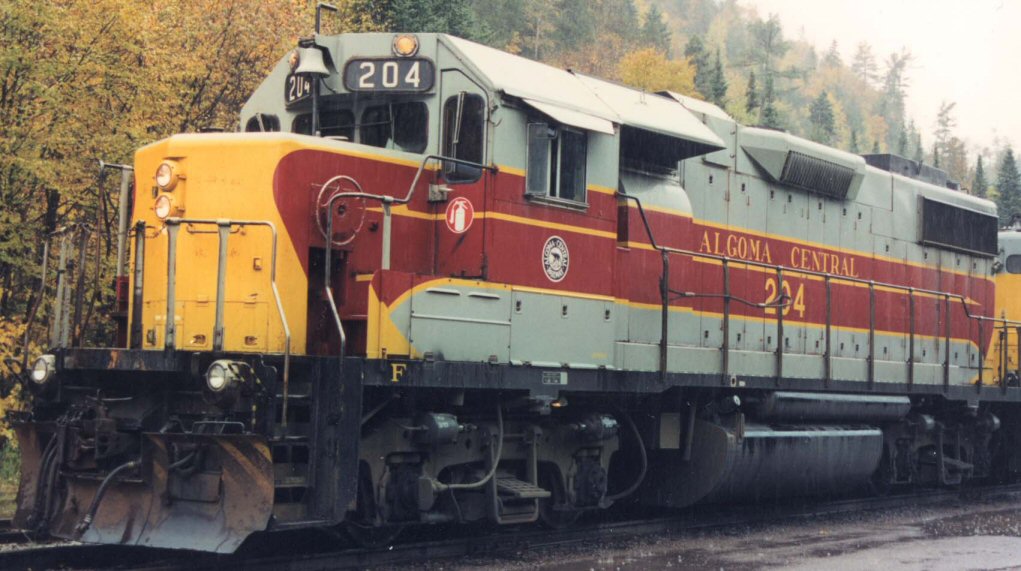 204 at Canyon, Oct. 1993 BLAIR SMITH
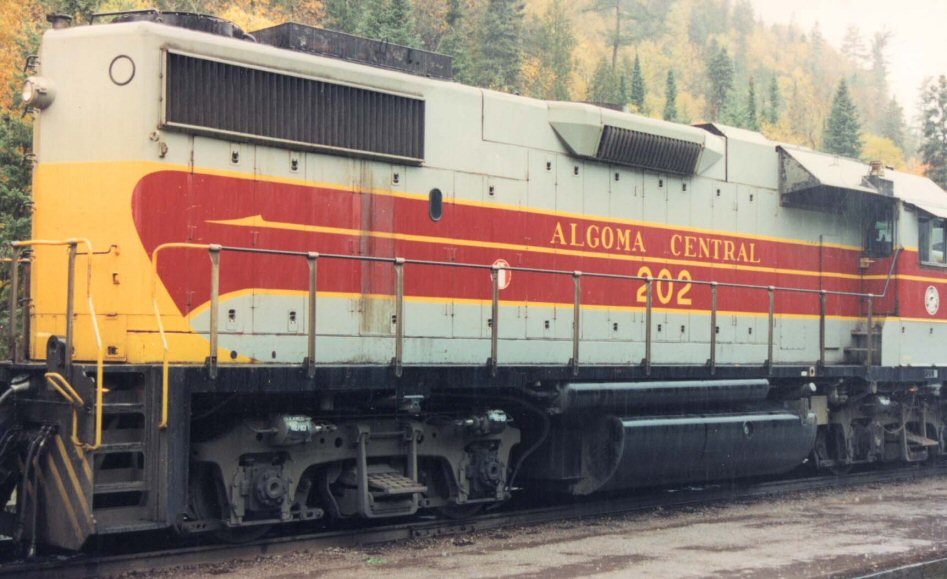 Rear end of 202, note blank appearance of hood end. At Canyon, Oct. 1993. BLAIR SMITH
After rebuilding 9 GP7's in 1978-79, the ACR decided that further rebuilding of GP7 units was uneconomical. So an order was placed with GMDD in London for 6 2000-HP GP38-2 locomotives. The ACR's 6 GP38-2 units were delivered from GMDD in London in April of 1981. These units were mainly meant for use on the ACR's passenger trains, however it was still possible to see GP7's and GP7L-m's on passenger trains (often in combination with GP38-2's), and GP38-2's could sometimes be in freight service as well. These units were equipped with special control stands for controlling steam generator cars.
The GP38-2 units were delivered without ditchlights, which were added by the ACR's shops by 1982. Snowshields and a winterization hatch were added a few years later; photographic evidence suggests 1984-85.
While GP38s and GP38-2s look a lot alike, they share almost no sheet metal so you really can't make an accurate GP38-2 from the Atlas GP38 without scratchbuilding a new body. The AC's GP38-2s came with 2600 gallon fuel tanks so the Athearn tank is the right size, but you will need Athearn's Blomberg-B (F7, GP35) sideframes instead of the Blomberg-Ms that come on their GP38-2.
Algoma Central's GP38-2s were built rather late as GP38-2s go, in April 1981 by the London, Ontario plant. Athearn's GP38-2 is an early version (pre-1977) with the 81" nose, etc. The AC's GP38-2s have the 88" nose, "shotgun" exhaust silencers, Q-fans (I think), and so on. They received showshields and a winterization hatch over the front radiator fan a few years after delivery.
Almost everything built at London before 1989 had distinctly Canadian features, such as vertical stepwells and the bell between the numberboards on the cab. Miniatures By Eric and Juneco make some of these parts in cast brass, but only a few big shops south of the border carry them (Des Plaines for sure, Caboose Hobbies probably). Custom Finishing also makes cast brass steps that I think match the 4-level vertical stepwells of the AC's GP38-2. You can get CF parts through Walthers, but they're not cheap.
If you can find one, I'd start with Athearn's "late" GP38-2 shell which already has the corrugated radiator grills but stil has the 81" nose (which makes it a late 1976 GP38-2). If you can't find that shell just start with Athearn's early GP38-2 (easy to find undec shells of this one) and shave off the "waffle" grills and glue Cannon's corrugated GP38-2 grills on it. Then replace the big square paper air filter box with Cannon's "AAF" angled filter box.
The exhaust silencers on non-turbo EMDs built after January 1980 have a round port instead of the oval port used before 1980. MbyE makes this part, but it isn't hard to make from scratch. You just need a 12" tube in a 22" square base plate, with the tube sticking one whole inch out of the base.[These new exhaust stacks are also located differently from the older oval stacks, away from the dynamic brake fan. The front stack is moved closer to the filter box and the rear stack is located just back of where the oval stack would have been. Since installation of these new silencers involves removing the old stacks and drilling holes anyway, it's not any more work to located these silencers properly]
If you really want to be anal, the dynamic blister needs to be extended about six inches on both sides. The intake grill is the same, they just added some blank sheet metal behind it. Probably has something to do with the silencers.
I think the AC's GP38-2s have Q-fans. [They do.] If so, several folks make a good 48" Q-fan. The winterization hatch is a big squared-off thing, similar to a part Details West makes. Detail Associates' "60-Series" hatch will be close too. Note however that the hatch wasn't added until the mid-1980s.
The rear of the hood needs to have the numberboards filled in and the rear headlight is a single bulb type, another one of those Canucks-just-have-to-be-different things. I think Detail Associates' "back up light" will work. Shave off the two ridges on the blower bulge. Canadian Dash-2s didn't have those either. [Also remove the class lights from the end. Another way to modify the end is to replace the whole end with a Cannon "blank" end, with no numberboards or class lights, just a set of circles (class light blanks) at the top of the hood. These the ACR units DID have.]
Up front you need Cannon's 88" nose with a notch filed in it for the headlight (an "early Pyle" type). They have a brakewheel on the side of the nose, but it's not mounted the same as American units, so you'll have to do a little cutting. The bell goes between the front numberboards, and class lights go over the numberboards. Since you're cutting off the nose, you might as well cut off the "sub-base" (the battery boxes and the doors under the cab) and replace it with a Cannon Dash-2 sub-base with the correct doors for a late GP38-2.
The front pilot needs Cannon's #AC-2105 "50-Series anticlimber" (really just a pointed walkway extension) [Actually, use Miniatures by Eric A9 anticlimber which is accurate for the ACR's unique anitclimber and lift ring combo on their GP38-2's] and a proper snowplow. Details West makes several plows that should work. These units didn't have ditch lights installed by the factory, but I thought ditch lights were already required in Canada by 1981, so they probably got them soon after delivery. That cover photo shows the ditch lights mounted on the anticlimber/extension.
Model locomotive performance can be a very subjective thing. A well tuned Athearn GP38-2 will run almost as nicely as the several P2k Geeps, but the Kato GP35 is hard to beat. Install a good can motor in the Athearn frame (or use Proto Power West's assembled drive) and you'll have a very good runner.
The front MU electrical plug is a square socket mounted under the anticlimber on the right side (looking at the front of the engine). This is why many photos of the engine don't seem to show any MU electrical connections, as it is hidden under the anticlimber.
These units have a speed recorder on the front axle, on the brakeman's side on the front truck.
On hangers under the frame are a pair of rerailers, one above the rear truck on the brakeman's side and above the front truck on the engineer's side. This is similar to rerailers used on steam engines, and lots of companies produce a part like this. Miniatures by Eric has a nice brass set, 2 rerailers and it includes the frame hangers.
The rear pilot has a pair of lift rings that can easily be made with small pieces of styrene, drilled and rounded at the top. Remove the beam at the bottom and smooth out the pilot (Leave the lip at the top!). Then add the MU air hoses and brake hose. Add a drop step at the top of the pilot and an MU stand.
This page © 2001 Chris VanderHeide
Home - Diesels - Equipment Guide Main