



 Passenger Equipment
Skip to:
Steam and Electrical Generator Cars
Baggage Cars
Coaches
Dining Cars
Dome Cars
Private Cars
Paint Schemes
![[Click for photo]](Images/Passenger/ac72.jpg) Steam Generator 72 at Steelton in 1992. MORGAN TURNEY
Steam Generator 72 at Steelton in 1992. MORGAN TURNEY
![[Click for photo]](http://algomacentral.railfan.net/images/AlgoCenRy/74.jpg) Steam Generator 74 at Steelton, June 1979 TED ELLIS
Steam Generator 74 at Steelton, June 1979 TED ELLIS
![[Click for photo]](Images/Passenger/ac74.jpg) Other side of 74 at Frater, 1983. Notice the trucks have been replaced. SEAN TROFIN
Other side of 74 at Frater, 1983. Notice the trucks have been replaced. SEAN TROFIN
![[Click for photo]](Images/Passenger/ac74_3.jpg) In later silver paint scheme, around 1996. BLAIR SMITH
In later silver paint scheme, around 1996. BLAIR SMITH
These cars were built in 1951 by the ACR's own shops using the steel underframe of old 40' wooden boxcars. Passenger cars were heated using steam, and no ACR diesels came with steam generators, so heat had to be provided by these cars. Notice in the first photo, 74 rides on Andrews leaf-spring trucks, but in the second photo, it rides on common Bettendorf trucks. Originally these cars would have been painted in the dark green and black scheme. Cars 71 and 73 were scrapped in the early 1970s.
Due to the custom built nature of these cars, the body would need to be scratchbuilt. Note that in the earlier maroon colour scheme, the Algoma Central name lettering is located lower down beside the entry door, and the spacing is compressed to fit. On the silver version, the lettering is moved up above the doors to allow it to use the same width and spacing as on most other cars. Black Cat Decals offers a set of Algoma Central passenger car decals; this set includes both the standard (wide spaced) name lettering and the compressed spacing version found on these four generator cars.
![[Click for photo]](http://algomacentral.railfan.net/images/AlgoCenRy/AC_76_Steelton_12-30-1979.jpg) Steam Generator 76 at Steelton, Dec. 30, 1979 TED ELLIS
Steam Generator 76 at Steelton, Dec. 30, 1979 TED ELLIS
![[Click for photo]](Images/Passenger/ac76_2.jpg) 76 at Steelton, showing the silver colours, 1996. BLAIR SMITH
76 at Steelton, showing the silver colours, 1996. BLAIR SMITH
This car 76 was rebuilt from ACR baggage car 204 in 1951 to provide steam for heating the ACR's coaches. The original Allied express trucks were replaced with smoother riding leaf-sprung Andrews trucks. Note that in the 1995 photo in the silver scheme, this car has Bettendorf trucks.
This car can be built in HO using Walther's Troop Sleeper as a starting point, or Micro-Trains' Troop Sleeper in N scale. The two windows on either side of the entrance door on the model with have to be filled in and a new opening for the baggage door cut around the original entrance door in the side of the car. Roof vents, stacks and piping will need to be added to detail it as a steam generator. Some of the side windows are also plated over. Algoma Central passenger car decals are available from Black Cat Decals.
![[Click for photo]](Images/Passenger/ac77a.jpg) Steam Generator 77 still in VIA colours. Steelton yard, early 1990s. MORGAN TURNEY
Steam Generator 77 still in VIA colours. Steelton yard, early 1990s. MORGAN TURNEY
![[Click for photo]](Images/Passenger/ac75_2.jpg) Steam Generator 75 at Steelton yard, 1996 BLAIR SMITH
Steam Generator 75 at Steelton yard, 1996 BLAIR SMITH
![[Click for photo]](Images/Passenger/ac77_3.jpg) Steam Generator 77 at Steelton yard, 2001 BLAIR SMITH
Steam Generator 77 at Steelton yard, 2001 BLAIR SMITH
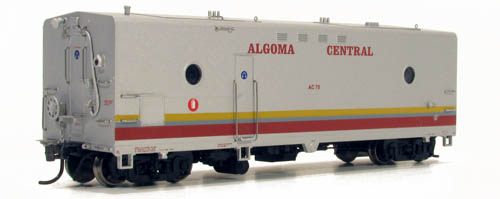
These two cars, acquired from VIA Rail in 1992, are General Motors Diesel-built steam generator cars.
A ready-to-run model of this type of GMDD steam generator car is produced by Rapido Trains  . Rapido offers it in road numbers
72, 74, 75 and 77, but only 75 and 77 are accurate numbers for this model. Model Photo.
. Rapido offers it in road numbers
72, 74, 75 and 77, but only 75 and 77 are accurate numbers for this model. Model Photo.
![[Click for photo]](Images/Passenger/ac80_3.jpg) Steam Generator 80 at Steelton, early 1996 BLAIR SMITH
Steam Generator 80 at Steelton, early 1996 BLAIR SMITH
![[Click for photo]](Images/Passenger/ac80_4.jpg) Opposite side and end BLAIR SMITH
Opposite side and end BLAIR SMITH
![[Click for photo]](Images/Passenger/ac80c.jpg) Side detail MORGAN TURNEY
Side detail MORGAN TURNEY
These interesting cars were rebuilt from Northern Pacific auxiliary tenders that were pulled behind large locomotives to provide more fuel and water. With the demise of steam, NP had them rebuilt as steam generator cars, and in 1972 the Algoma Central took possesion of two of these cars. They were painted in 1973 to match the Algoma Central's locomotives. Retired and scrapped around 1996-97.
![[Click for photo]](Images/Passenger/ac78b.jpg) 78 at Sault Ste. Marie, 2007. BLAIR SMITH
78 at Sault Ste. Marie, 2007. BLAIR SMITH
Acquired in 2007 to provide electrical head-end-power for several new cars (HEP equipped baggage 312 and coaches 5654-5656) acquired for the regular Hearst train. This car was originally DRGW PB-1 locomotive #600B. It was renumbered 6002 and later rebuilt into a steam generator car and numbered DRGW 253. Later it was rebuilt into an electrical power car, keeping it's old number and eventually sold to Ski Train, from where it was acquired by CN for service on the Algoma Central.
![[Click for photo]](Images/Passenger/ac79.jpg) 79 at Sault Ste. Marie, 2008. NEIL THOMPSON
79 at Sault Ste. Marie, 2008. NEIL THOMPSON
![[Click for photo]](Images/Passenger/ac79_2.jpg) Opposite side NEIL THOMPSON
Opposite side NEIL THOMPSON
Acquired in late 2007 or 2008, the exact history of this car is unknown, but it appears to have been rebuilt from an former Amtrak 1400 series mail/express boxcar.
![[Click for photo]](Images/Passenger/ac201ps.jpg) Baggage Car 205 at Oba in 1976 PAUL O'SHELL
Baggage Car 205 at Oba in 1976 PAUL O'SHELL
![[Click for photo]](Images/Passenger/ac203bg.jpg) Baggage Car 203 at Sault Ste. Marie station August 3, 1979 BILL GRANDIN
Baggage Car 203 at Sault Ste. Marie station August 3, 1979 BILL GRANDIN
![[Click for photo]](http://algomacentral.railfan.net/images/AlgoCenRy/AC_205_Hawk_2-15-1977.jpg) Baggage Car 205 at Hawk Junction, Feb. 15, 1977 TED ELLIS
Baggage Car 205 at Hawk Junction, Feb. 15, 1977 TED ELLIS
![[Click for photo]](http://algomacentral.railfan.net/images/AlgoCenRy/AC_205_Hawk_12-26-1979.jpg) Baggage Car 205 repainted silver, but with no lettering in the name band. Hawk Junction, December 1979 TED ELLIS
Baggage Car 205 repainted silver, but with no lettering in the name band. Hawk Junction, December 1979 TED ELLIS
These interesting cars were converted from troop sleeper cars built by Pullman for the US Army in the second World War for transporting troops across the country to ports and naval bases for embarcation to Europe or East Asia. In 1949 the Algoma Central bought five of the surplus cars and had them converted into baggage/express cars. They were rather rough riding on account of their original Allied trucks, and were used for transporting boats, propane tanks, hunter's trophies, etc. In 1951, one car, no. 204, was rebuilt as steam heating car 76, since the ACR's diesels did not provide their own steam for passenger car heating.
In 1981, the remaining four cars were renumbered 303-306, to clear the 200 number series for the new GP38-2 locomotives that were arriving.
These cars can be modelled in HO using Walthers' Troop Sleeper. Micro-Trains has a Troop Sleeper in N scale. The two windows on either side of the entrance door on the model with have to be filled in and a new opening for the baggage door cut around the original entrance door in the side of the car. Algoma Central passenger car decals are available from Black Cat Decals.
![[Click for photo]](http://algomacentral.railfan.net/images/AlgoCenRy/AC_206_Steelton_9-16-1973.jpg) Baggage 206 at Steelton, Sept. 16, 1973 TED ELLIS
Baggage 206 at Steelton, Sept. 16, 1973 TED ELLIS
![[Click for photo]](Images/Work/exbaggage.jpg) Former 206 in work service, around 2001. KRIS ROENINGK
Former 206 in work service, around 2001. KRIS ROENINGK
These cars were standard heavyweight baggage cars, acquired secondhand in 1949. They lasted in service into the mid-1970s when they were retired into work service.
![[Click for photo]](http://algomacentral.railfan.net/images/AlgoCenRy/209.jpg) Baggage/Express 208 at Steelton, June 13, 1974 TED ELLIS
Baggage/Express 208 at Steelton, June 13, 1974 TED ELLIS
![[Click for photo]](Images/Work/ac10401bg.jpg) Former 208 in work service as tool car 10401 in 1979 BILL GRANDIN
Former 208 in work service as tool car 10401 in 1979 BILL GRANDIN
Express baggage car 208 was a 60-foot heavyweight baggage car from the Denver and Salt Lake Railroad. This car was acquired around 1949 and lasted in service to the mid-1970's when it was retired to work service as tool car 10059.
![[Click for photo]](http://algomacentral.railfan.net/images/AlgoCenRy/AC_1201_Steelton_10-6-1973.jpg) AC 1201 (AC 209) ex-DRGW 1201 before repainting at Steelton in 1973 TED ELLIS
AC 1201 (AC 209) ex-DRGW 1201 before repainting at Steelton in 1973 TED ELLIS
![[Click for photo]](http://algomacentral.railfan.net/images/AlgoCenRy/drgwbag2.jpg) Baggage Car 209 at Steelton, 1974 TED ELLIS
Baggage Car 209 at Steelton, 1974 TED ELLIS
These two cars were purchased in 1973 from the Denver & Rio Grande Western RR, which had acquired the cars from the Chesapeake & Ohio railroad. In 1981, the two cars were renumbered 300-301.
Nickel Plate Car Co. (etched plated brass) and
Union Station Products (laser cut styrene) both offer car
sides for these DRG&W cars that can be mated with Train Station Products
Pullman-Standard car core kits to build a model of this type of baggage car.
Algoma Central passenger car decals are available from Black Cat Decals,
and this set includes the variant narrow lettering found on this pair of cars.
![[Click for photo]](http://algomacentral.railfan.net/images/AlgoCenRy/AC_1100_Steelton_9-30-1973.jpg) AC 1100 (AC 211) ex-DRGW 1100, before repainting at Steelton in 1973 TED ELLIS
AC 1100 (AC 211) ex-DRGW 1100, before repainting at Steelton in 1973 TED ELLIS
![[Click for photo]](Images/Passenger/ac211bg.jpg) AC 211 at Sault Ste. Marie circa 1979 BILL GRANDIN
AC 211 at Sault Ste. Marie circa 1979 BILL GRANDIN
This stainless steel car was purchased in 1974. It was Denver & Rio Grande Western #1100 (Silver Antelope), from the California Zephyr pool. 211 was re-numbered to 302 in 1981. (See below)
![[Click for photo]](Images/Passenger/ac300_2.jpg) Baggage Car 300, Sault Ste. Marie, 2002 BLAIR SMITH
Baggage Car 300, Sault Ste. Marie, 2002 BLAIR SMITH
![[Click for photo]](Images/Passenger/ac301.jpg) Baggage Car 301, 2004 CHRIS VANDERHEIDE
Baggage Car 301, 2004 CHRIS VANDERHEIDE
Renumbered in 1981 from AC 209-210. (See above)
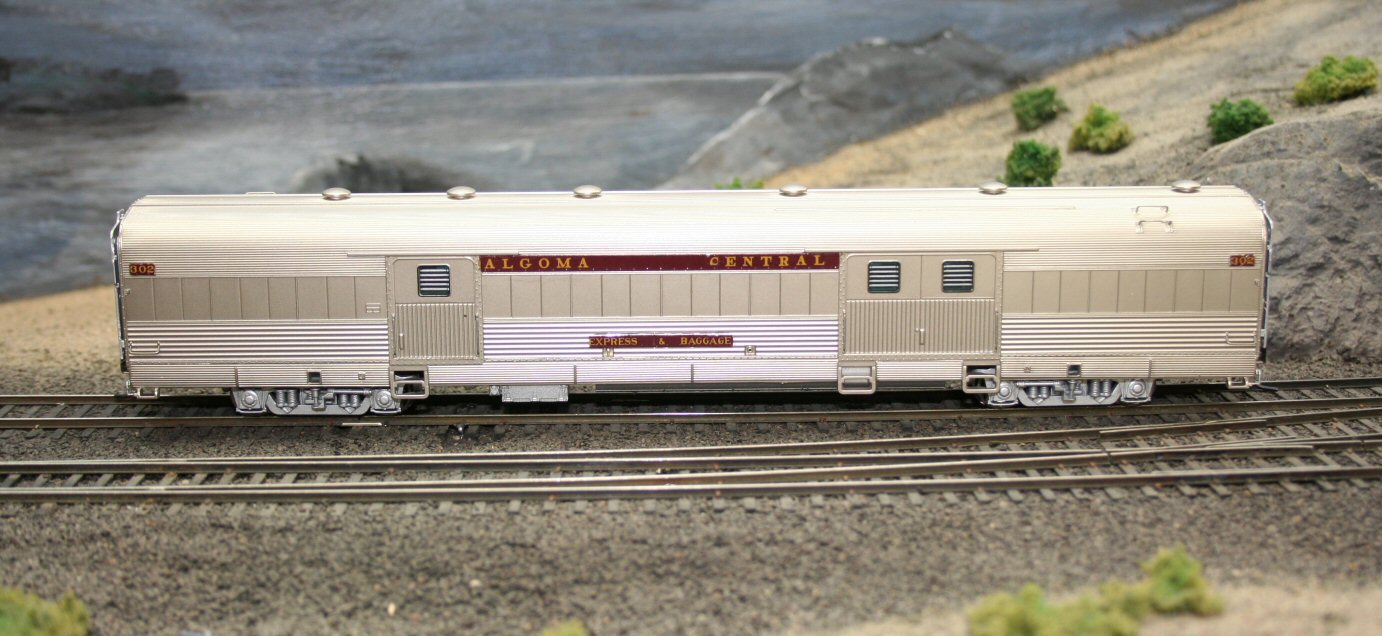
![[Click for photo]](Images/Passenger/ac302.jpg) AC 302 at Steelton, July 1988 TED ELLIS
AC 302 at Steelton, July 1988 TED ELLIS
Renumbered in 1981 from AC 211. (See above)
An accurate model for this car can be obtained in HO scale from Broadway
Limited Imports' series of California Zephyr cars. Algoma Central passenger car decals are available from Black Cat Decals,
and this set includes the variant narrow lettering found on this car and several other AC baggage cars.
Model Photo by Chris vanderHeide of BLI baggage car custom lettered with Black Cat Decals.
![[Click for photo]](Images/Passenger/ac305.jpg) AC 305 (ex-AC 203) in peeling maroon and grey paint at Frater?, 1983 SEAN TROFIN
AC 305 (ex-AC 203) in peeling maroon and grey paint at Frater?, 1983 SEAN TROFIN
![[Click for photo]](Images/Passenger/ac306.jpg) AC 306 (ex-AC 205) in silver paint at Frater, 1983. Notice the red name band (with no lettering in it!) is just touching the top of the door, unlike the photo of Steam Generator 76 above. Also, the door on this car has not been repainted. SEAN TROFIN
AC 306 (ex-AC 205) in silver paint at Frater, 1983. Notice the red name band (with no lettering in it!) is just touching the top of the door, unlike the photo of Steam Generator 76 above. Also, the door on this car has not been repainted. SEAN TROFIN
Renumbered in 1981 from AC 201-203 and 205. (See above) All cars now off roster.
![[Click for photo]](Images/Passenger/ac307.jpg) 307 at Steelton, 1997 BLAIR SMITH
307 at Steelton, 1997 BLAIR SMITH
![[Click for photo]](Images/Passenger/ac308_2.jpg) 308 at Steelton, 1997 BLAIR SMITH
308 at Steelton, 1997 BLAIR SMITH
![[Click for photo]](Images/Passenger/ac308.jpg) 308 in the current colours at Sault Ste. Marie, August 2008. Note the snowmobile/ATV ramp mounted in the baggage door. NEIL THOMPSON
308 in the current colours at Sault Ste. Marie, August 2008. Note the snowmobile/ATV ramp mounted in the baggage door. NEIL THOMPSON
![[Click for photo]](Images/Passenger/ac309.jpg) 309 at Sault Ste. Marie, 2002 BLAIR SMITH
309 at Sault Ste. Marie, 2002 BLAIR SMITH
These three cars were acquired from VIA Rail in 1983 and were formerly VIA 9674, 9600 and 9603 respectively. They were originally built for CN as 9674, 9600 and 9603.
![[Click for photo]](Images/Passenger/ac310.jpg) 310 at Agawa Canyon Park, 2000 PAUL BOWN
310 at Agawa Canyon Park, 2000 PAUL BOWN
310 was acquired in late 1999. Exact history is unknown, but this car is likely ex-Fox River Valley and Western.
Another CN lineage baggage car, this car was acquired in 2001 from CN, where it was in work service. Formerly CN 71303, ex-VIA 9628, ex-CN 9628, originally CN 9247.
![[Click for photo]](Images/Passenger/ac312.jpg) 312 at Sault Ste. Marie, August 2008 NEIL THOMPSON
312 at Sault Ste. Marie, August 2008 NEIL THOMPSON
Acquired in 2007 from Amtrak (ex-AMTK 1173, ex-ATSF 3460) along with coaches 5654-5656 for use on the Hearst passenger train. This car and the three coaches are equipped for head-end electrical power from generator cars 78 or 79.
![[Click for photo]](http://algomacentral.railfan.net/images/AlgoCenRy/AC_407_Steelton_6-10-1976.jpg) Coach 407 at Steelton, June 10, 1976 TED ELLIS
Coach 407 at Steelton, June 10, 1976 TED ELLIS
Purchased in 1949 from the Denver & Rio Grande Western Ry., these were the ACR's first steel coaches and lasted in service until the mid-1970s when the new Canadian Pacific coaches were obtained and put in service. Interestingly enough, built in 1912, these cars were actually two years older than the wooden coaches they replaced.
These cars were acquired from 1969-1974 from Canadian Pacific. Click here for photos and detailed information about these coaches.
![[Click for photo]](http://algomacentral.railfan.net/images/AlgoCenRy/AC_CofG_672_Steelton_12-23-1973.jpg) CG 672 (AC 443) at Steelton, December 1973 TED ELLIS
CG 672 (AC 443) at Steelton, December 1973 TED ELLIS
![[Click for photo]](http://algomacentral.railfan.net/images/AlgoCenRy/AC_440_Steelton_8-7-1978.jpg) AC 440, still in orange and brown in 1978 and just relettered for Algoma Central. TED ELLIS
AC 440, still in orange and brown in 1978 and just relettered for Algoma Central. TED ELLIS
![[Click for photo]](http://algomacentral.railfan.net/images/AlgoCenRy/AC_441_Steelton_6-1-1983.jpg) AC 441 in Algoma's silver scheme in 1983 TED ELLIS
AC 441 in Algoma's silver scheme in 1983 TED ELLIS
![[Click for photo]](Images/Passenger/Coaches/pair_of_ex-CoG_coaches.jpg) ACR 442 and 443 in an excursion train in Michigan MIKE SLATER
ACR 442 and 443 in an excursion train in Michigan MIKE SLATER
These coaches were purchased in 1974 from the Central of Georgia railroad. They arrived in Illinois Central colours, and the condition of the paint was so good that the cars were not fully repainted for almost 5 years. Only the Algoma Central name and numbers were repainted.
AC 440 ended up at the Southern Appalachian Railway Museum, while ex-AC 442 and 443 are currently in service with the trainset for steam engine MILW 621 as NSR 201 and 202. 441 was renumbered to 2067 in the late 1980s or early 1990s and may have been scrapped.
![[Click for photo]](http://algomacentral.railfan.net/images/AlgoCenRy/AC_GMO_3056_Steelton_3-7-1974.jpg) GM&O 3056 at Steelton, 1974. TED ELLIS
GM&O 3056 at Steelton, 1974. TED ELLIS
Two cars, GM&O 3056 and 3057, were acquired by the ACR in 1974. Some rosters actually gives these cars the AC numbers 444 and 445, but I have no evidence so far that these cars were actually refurbished and put into passenger service. They seem to have been parted out and then put into work service. They did later get rebuilt into crew sleepers 10633 and 10674.
![[Click for photo]](http://algomacentral.railfan.net/images/AlgoCenRy/AC_2454_Steelton_4-26-1974.jpg) AC 2454 at Steelton with another ex-SP set, April 1974 before repainting and relettering. This car and its partner, 2453 became AC 454-455. TED ELLIS
AC 2454 at Steelton with another ex-SP set, April 1974 before repainting and relettering. This car and its partner, 2453 became AC 454-455. TED ELLIS
![[Click for photo]](http://algomacentral.railfan.net/images/AlgoCenRy/AC_450_Frater_10-2-1979.jpg)
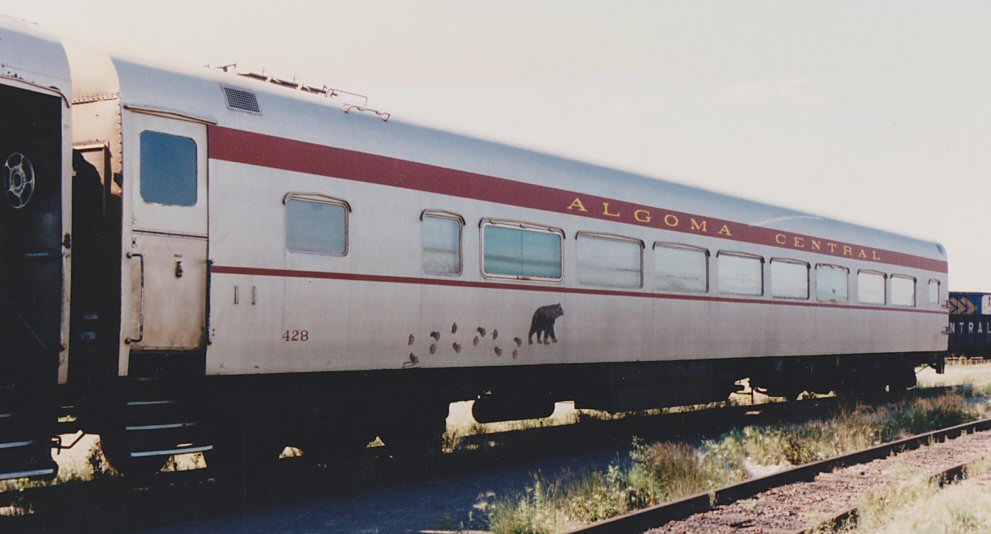
![[Click for photo]](http://algomacentral.railfan.net/images/AlgoCenRy/AC_451_Frater_10-2-1979.jpg) 450 and 451 at Frater, 1979. Note how the left car feature the bear & paw prints graphic, but there is no stripe or name lettering yet. TED ELLIS
450 and 451 at Frater, 1979. Note how the left car feature the bear & paw prints graphic, but there is no stripe or name lettering yet. TED ELLIS
![[Click for photo]](http://algomacentral.railfan.net/images/AlgoCenRy/AC_450_Frater_9-21-1982.jpg) 450-451 three years later and now featuring the maroon stripes and full lettering. Frater, September 1982. TED ELLIS
450-451 three years later and now featuring the maroon stripes and full lettering. Frater, September 1982. TED ELLIS
![[Click for photo]](Images/Passenger/Coaches/ac452pl.jpg)
![[Click for photo]](Images/Passenger/Coaches/ac454bg.jpg) 452-453 on loan to Ontario Northland at Moosonee, ON 1985 PAUL LANTZ
454-455 at Sault Ste. Marie in 1979 BILL GRANDIN
452-453 on loan to Ontario Northland at Moosonee, ON 1985 PAUL LANTZ
454-455 at Sault Ste. Marie in 1979 BILL GRANDIN
![[Click for photo]](http://algomacentral.railfan.net/images/AlgoCenRy/AC_45x_SP_Artic_Steelton_6-10-1976.jpg) 458-459 at Steelton, June 1976 TED ELLIS
458-459 at Steelton, June 1976 TED ELLIS
![[Click for photo]](http://algomacentral.railfan.net/images/AlgoCenRy/spcoach1.jpg) 460 (and 461) at Steelton, Sept. 22, 1974 TED ELLIS
460 (and 461) at Steelton, Sept. 22, 1974 TED ELLIS
Information is slightly sketchy on these, with some sources listing 5 sets of ex-SP articulated being acquired by the AC, and variously indicating that only either 2 or 3 sets were ever reconditioned and put into passenger service; however there are references to positively identify at least six sets as being sold to the AC with at least 3 proven to be fully repainted and used in regular service. The total identified number range seems to allow for at least 7 pairs, for a total of 14 individual car bodies. (Compared to 18 ex-CP lightweight coaches) However since only some of these cars seem to have actually been put into passenger service, with the remainder possibly being directly placed into work service as sleepers, diners, etc., it's rare to actually see more than one pair in service on a train.
Some may have run for a time with their SP numbers and paint, and several sets ended up in work service, still with SP lettering evident. It's not certain if all of pairs identified below actually received their indicated AC numbers or any sort of AC paint job. Certainly 450-451, 458-459 and 460-461 can be conclusively identfied as being painted in their revenue numbers.
Some variations in the paint and lettering occurred on these cars; some had silver roofs, while others had black roofs (some had the roofs repainted black over time), and initially the cars were repainted without the belt rail stripe. Some cars as evidenced by Ted's photos of 450-451 received a "quicky" repaint early on, just adding the bear image and car numbers with the name band added on much later. It's also not clear if some of these cars ran for a while in their original SP colours.
AC Numbers  Former SP Numbers   Disposition
450-451*    ex-SP 2496-2497     ?
452-453*    ex-SP 2498-2499     ?
454-455*    ex-SP 2454-2453     retired to work service as 10634-10635
456-457     ?                   ?
458-459*    ex-SP 2473-2474     sold to Bytown Ry. Society (Ottawa) 1988, to Golden Gate Railway Museum 1996
460-461*    ex-SP 2471-2472     retired to work service 10672-10673
462-463     ex-SP 2477-2478     retired to work service 10014-10015, scrap 1996?
Cars marked with an asterisk are definitively confirmed to have been fully repainted and used in passenger service.
![[Click for photo]](Images/Passenger/Coaches/ac3236.jpg) Coach 3236 at Steelton yard in August 1996 BLAIR SMITH
Coach 3236 at Steelton yard in August 1996 BLAIR SMITH
![[Click for photo]](Images/Passenger/Coaches/3210.jpg) Coach 3210 at Hearst, Dec. 2000 RICHARD SHIVELEY
Coach 3210 at Hearst, Dec. 2000 RICHARD SHIVELEY
These coaches were purchased from VIA in 1992 and differ from the coaches below in that they have a small on-board snack bar. Externally they are identical, as they were rebuilt from VIA 5400-5600 cars. There are seven coaches in this series, numbered 3210, 3226, 3227, 3230, 3236, 3239, 3243. They retain their previous VIA numbers. 3226 was wrecked in a grade crossing incident with a logging truck near Hawk Junction.
These cars were converted by CN from former 5400-5600 series cars and Rapido Trains' new lightweight coach is based on the CN 5400-5600 series and as such is an exact match for the AC cars.
![[Click for photo]](Images/Passenger/Coaches/ac5495.jpg) Coach 5495 at Steelton shops, 1996 BLAIR SMITH
Coach 5495 at Steelton shops, 1996 BLAIR SMITH
![[Click for photo]](Images/Passenger/Coaches/ac5514.jpg) Coach 5495 at Sault Ste. Marie, 2004 CHRIS VANDERHEIDE
Coach 5495 at Sault Ste. Marie, 2004 CHRIS VANDERHEIDE
![[Click for photo]](Images/Passenger/Coaches/ac5610.jpg) Coach 5610 at Steelton shops, 1996 BLAIR SMITH
Coach 5610 at Steelton shops, 1996 BLAIR SMITH
There are 19 of these coaches. They were built in 1954 for CN, and transferred to VIA Rail in 1978. In 1992 they were aquired by the Algoma Central. Some of these coaches are leased from the Ontario Northland Railroad. These coaches still have their former VIA numbers and thus do not form a contiguous series.
Rapido Trains' new lightweight coach is based on the CN 5400-5600 series and as such is an exact match for the AC modern fleet. Several runs in AC colours have been offered.
![[Click for photo]](Images/Passenger/Coaches/ac5654.jpg) 5654 at Sault Ste. Marie, August 2008 NEIL THOMPSON
5654 at Sault Ste. Marie, August 2008 NEIL THOMPSON
![[Click for photo]](Images/Passenger/Coaches/ac5655.jpg) 5655 at Sault Ste. Marie, July 2013. This car has had the new Agawa Canyon Tour logo applied to it. CHRIS VANDERHEIDE
5655 at Sault Ste. Marie, July 2013. This car has had the new Agawa Canyon Tour logo applied to it. CHRIS VANDERHEIDE
These three cars were acquired in 2007 for trains 1 and 2 to Hearst. They are ex-Amtrak 7621, 7622 and 7624. Originally they were built by Budd for Santa Fe in the ATSF 28xx series. These cars are rebuilt for head end supplied electrical power, and are currently used on the regular train to Hearst with new generator car 78 or 79 and baggage 312. (Older baggage cars may also be tacked onto the consist, opposite from the generator car.)
![[Click for photo]](Images/Passenger/Coaches/ac5704.jpg) 5704 ("Island Lake") at Sault Ste. Marie, 2013 CHRIS VANDERHEIDE
5704 ("Island Lake") at Sault Ste. Marie, 2013 CHRIS VANDERHEIDE
![[Click for photo]](Images/Passenger/Coaches/ac5709.jpg) 5709 ("Mongoose Lake") at Sault Ste. Marie, 2013 CHRIS VANDERHEIDE
5709 ("Mongoose Lake") at Sault Ste. Marie, 2013 CHRIS VANDERHEIDE
![[Click for photo]](Images/Passenger/Coaches/canyontourlogo.jpg) Detail of the new Agawa Canyon Tour logo CHRIS VANDERHEIDE
Detail of the new Agawa Canyon Tour logo CHRIS VANDERHEIDE
Acquired in 2009 from Ski Train in Colorado, to replaced the 5400-5600 series ex-VIA cars. These cars are ex-VIA/CN "Tempo" lightweight cars built by Hawker-Siddely, which had been sold to Ski-Train. CN acquired the entire set of Ski-Train equipment including 3 F40PH locomotives. This equipment is now in use on the Agawa Canyon Tour Train. Each car is named after local rivers and lakes.
Rapido Trains' produced the "Tempo" cars in HO scale and offered several car names/numbers in the Agawa Canyon Tour train colours.
![[Click for photo]](Images/Passenger/Coaches/ac9301.jpg)
![[Click for photo]](Images/Passenger/Coaches/ac9301_2.jpg) AC 9301 Sault Ste. Marie, 2004 CHRIS VANDERHEIDE
Opposite side CHRIS VANDERHEIDE
AC 9301 Sault Ste. Marie, 2004 CHRIS VANDERHEIDE
Opposite side CHRIS VANDERHEIDE
These two coaches were rebuilt from ex-VIA combination coach/baggage cars 9301 and 9302 acquired in 1992, which were themselves originally rebuilt from CN 5400-5600 series coaches.
As these cars were converted from original CN 5400-5500 series coaches, these cars could be modelled by kitbashed some windows in the sides of the Rapido Trains lightweight coach.
![[Click for photo]](http://algomacentral.railfan.net/images/AlgoCenRy/AC_502_Steelton_3-7-1974.jpg) Café Car 502 stored for the winter, March 7, 1974 TED ELLIS
Café Car 502 stored for the winter, March 7, 1974 TED ELLIS
![[Click for photo]](Images/Work/ac10055.jpg) Work service cook car 10055, ex-cafe car 503, early 1990s MORGAN TURNEY
Work service cook car 10055, ex-cafe car 503, early 1990s MORGAN TURNEY
For many years these old converted ex-Rio Grande (original Denver & Salt Lake) coaches served as dining cars on the railway. They were obtained in 1949 and lasted in service inot the early 1970's when the ACR purchased two regular diners for the Agawa Canyon Tour Train. These three cars were then retired to work service. The former 502 was later moved to Canyon and converted to a souvenir shop.
![[Click for photo]](Images/Passenger/ac504.jpg) Diner 504 at Frater, 1983 SEAN TROFIN
Diner 504 at Frater, 1983 SEAN TROFIN
![[Click for photo]](Images/Passenger/ac504a.jpg) Opposite side, early 1990s. MORGAN TURNEY
Opposite side, early 1990s. MORGAN TURNEY
Dining car 504 was built in 1948 for the Atchison, Topeka and Santa Fe as "lunch counter diner" no. 1554. In 1969 it was sold to the tourist railroad Cadillac and Lake City, where it was named Emerald Lake. The ACR purchased the car in 1972 for use on the Agawa Canyon Tour train. In 1998 this car suffered a kitchen fire and was put out of service to be replaced by 506. 504 remained stored on the property for a few years before being sold to Mid-America Railcar Leasing (MRLX).
![[Click for photo]](http://algomacentral.railfan.net/images/AlgoCenRy/updin2.jpg) Diner 505 at Steelton, Nov 16, 1974 TED ELLIS
Diner 505 at Steelton, Nov 16, 1974 TED ELLIS
![[Click for photo]](Images/Passenger/ac505.jpg) 505 in the current colour scheme at Sault Ste. Marie, August 2008 NEIL THOMPSON
505 in the current colour scheme at Sault Ste. Marie, August 2008 NEIL THOMPSON
Originally Union Pacific no. 4805, it was purchased in 1973 by the Algoma Central for use on the Agawa Canyon Tour Train, which was gaining in popularity.
Walthers offers a model of the UP 4800 series 48-seat dining car which can be used to model this car. Additionally, the old Rivarossi diner was also based on this car. Decals for the circa 1974 Algoma Central silver scheme are available from Black Cat Decals.
![[Click for photo]](Images/Passenger/ac506_3.jpg) Diner 506 at Sault Ste. Marie station, 2004 CHRIS VANDERHEIDE
Diner 506 at Sault Ste. Marie station, 2004 CHRIS VANDERHEIDE
![[Click for photo]](Images/Passenger/ac506_4.jpg) Opposite side of 506 at Sault Ste. Marie, 2004 CHRIS VANDERHEIDE
Opposite side of 506 at Sault Ste. Marie, 2004 CHRIS VANDERHEIDE
ACR 506 was aquired in 1998 after Diner 504 was damaged by a kitchen fire. It is the ex-CB&Q 190, Silver Pheasant.
![[Click for photo]](http://algomacentral.railfan.net/images/AlgoCenRy/AC_511_Steelton_9-16-1979.jpg) AC 511 still in Illinois Central colours with Algoma Central lettering. September 1979, Steelton. TED ELLIS
AC 511 still in Illinois Central colours with Algoma Central lettering. September 1979, Steelton. TED ELLIS
![[Click for photo]](Images/Passenger/ac511_1.jpg) Snack Coach 511 in the silver colour scheme, summer 1983 SEAN TROFIN
Snack Coach 511 in the silver colour scheme, summer 1983 SEAN TROFIN
![[Click for photo]](Images/Passenger/ac511_2.jpg) Other side of car. 1983 SEAN TROFIN
Other side of car. 1983 SEAN TROFIN
This car was built as Missouri Pacific 870, renumbered 564, then sold to Illinois Central where it became IC 3341. The Algoma Central purchased this car from Illinois Central in 1971. It remained in IC colours until 1982, a full decade after it was acquired. This car was normally used on the regular passenger train.
![[Click for photo]](Images/Passenger/acdome.jpg) Algoma Country at Canyon, 2000 CHRIS VANDERHEIDE
Algoma Country at Canyon, 2000 CHRIS VANDERHEIDE
![[Click for photo]](Images/Passenger/algomacountry_3.jpg) Algoma Country at Sault Ste. Marie, 2004 CHRIS VANDERHEIDE
Algoma Country at Sault Ste. Marie, 2004 CHRIS VANDERHEIDE
Originally Union Pacific 9001, it was subsequently owned by Auto Train and then Wisconsin Central, with the name Trempeauleau River. In 1997 WC had the car repainted and transfered to the Algoma Central for the Agawa Canyon Tour Train. The car carries the number GBW 901. Note that in the 2000 photo above, the car actually carries the Wisconsin Central name, but by 2004 it has been changed to Algoma Central and the WC shield logos have been painted over.
Walthers offers a model of the UP dome coach, and decals for the modern bear scheme were once available from ORO Decals. ORO is long out of business, but the artwork has recently
been purchased by Highball Graphics , and so these may become available again.
Here's an good article about modeling Algoma Country from the Walthers car by Andrew Castle.
![[Click for photo]](Images/Passenger/spirit.jpg) Spirit of Superior at Sault Ste. Marie, 2004 CHRIS VANDERHEIDE
Spirit of Superior at Sault Ste. Marie, 2004 CHRIS VANDERHEIDE
![[Click for photo]](Images/Passenger/spirit_2.jpg) Opposite side. Sault Ste. Marie, 2004 CHRIS VANDERHEIDE
Opposite side. Sault Ste. Marie, 2004 CHRIS VANDERHEIDE
Acquired by the AC in 1999, this car is ex-WP 813 Silver Palace (from the California Zephyr pool) built by the Budd Car Co. In fact, the letter boards still read California Zephyr. The window band is painted dark red with yellow trim, and the name board below the windows is bright yellow.
Broadway Limited has produced a set of California Zephyr equipment in HO scale, so this dome car is available from them. (The cars are avaialable individually).
There is a passing reference to Car 9 on a page of the 1936 employee's timetable, in a table of weights of various equipment. This page is reproduced on page 143 of the book "Algoma Central Railway" by Dale Wilson. I have not yet come across any other references to this car.
Car 10 was a wooden business car that for many years was the main business car in use on the railway. There is a large picture window at the rear of the car in the lounge section facing out on the rear platform, with the door on the left side (looking out from the lounge). #10 appears to have probably been formerly named "Michipicoten" and acquired from the Illinois Central around 1900. Renumbering to #10 and elimination of the car's name may have happened around 1910 when the Lake Superior was acquired. #10 featured open platforms typical of late 1800s built coach stock. #10 was scrapped in the early 1960s.
Lake Superior was also a wooden private car and it had a picture window at the rear, very similar to Car 10, but the door onto the platform is on the other side of the car. Lake Superior featured closed vestibules at the opposite end of the car and is obviously of more modern construction than #10, which had open platforms. The origins of this car are unknown but it was acquired in 1910, possibly secondhand. Lake Superior was scrapped in the early 1960s.
![[Click for photo]](Images/ico_cam.gif) At Steelton in 1972 TED ELLIS
At Steelton in 1972 TED ELLIS
![[Click for photo]](Images/Passenger/ac550.jpg) The Agawa at Steelton, 1996. BLAIR SMITH
The Agawa at Steelton, 1996. BLAIR SMITH
![[Click for photo]](Images/Passenger/agawa_4.jpg) Repainted into Wisconsin Central colours, 2003 MARK BECKER
Repainted into Wisconsin Central colours, 2003 MARK BECKER
![[Click for photo]](Images/Passenger/agawa_2.jpg) Repainted back into a version of the Algoma Central colours, 2004 CHRIS VANDERHEIDE
Repainted back into a version of the Algoma Central colours, 2004 CHRIS VANDERHEIDE
The Agawa was built in 1911 by the Barney & Smith Car Company for the Longview, Portland and Northern Railroad as # 101. It was later purchased by the Wabash where it was named the Chicago. In 1953 it was acquired by the Algoma Central and named Agawa In the late 1960's, it was rebuilt and completely restored by the ACR. The car features a large observation platform at the rear with polished brass railings and a round panel with the ACR logo hung on the rear.
![[Click for photo]](http://algomacentral.railfan.net/images/AlgoCenRy/AC_Canyon_View_Pvt_Car_Steelton_4-16-1972.jpg) Canyon View at Steelton, 1972 TED ELLIS
Canyon View at Steelton, 1972 TED ELLIS
Canyon View was one of 5 "double bedroom lounge observation cars" built for the New York Central in 1949. The Canadian Pacific bought three of these cars from the NYC, mainly for overnight Ottawa to Toronto runs. NYC Shining Brook became CP Mountain View. In 1969 the ACR bought the car and renamed it Canyon View (although it was sometimes referred to by some shop employees as the Silver Bullet) The lounge at the rear was raised over a water tank, thus the extra tall windows in the observation end of the car. The rear door was at some point replaced by a sheet of plexiglass for better visibility. A curtain was then added when it was felt that privacy had become an issue. The car was eventually sold around 1984-5.
![[Click for photo]](Images/Passenger/ac552.jpg) The Michipicoten at Steelton in the early 1990s. MORGAN TURNEY
Michipicoten at Steelton, 1996 BLAIR SMITH
The Michipicoten at Steelton in the early 1990s. MORGAN TURNEY
Michipicoten at Steelton, 1996 BLAIR SMITH
The Michipicoten was built in 1910 by Pullman for the Southern Railway as the Advance. In 1937 it was renamed Asheville, and in 1944 it was acquired by the Algoma Central.
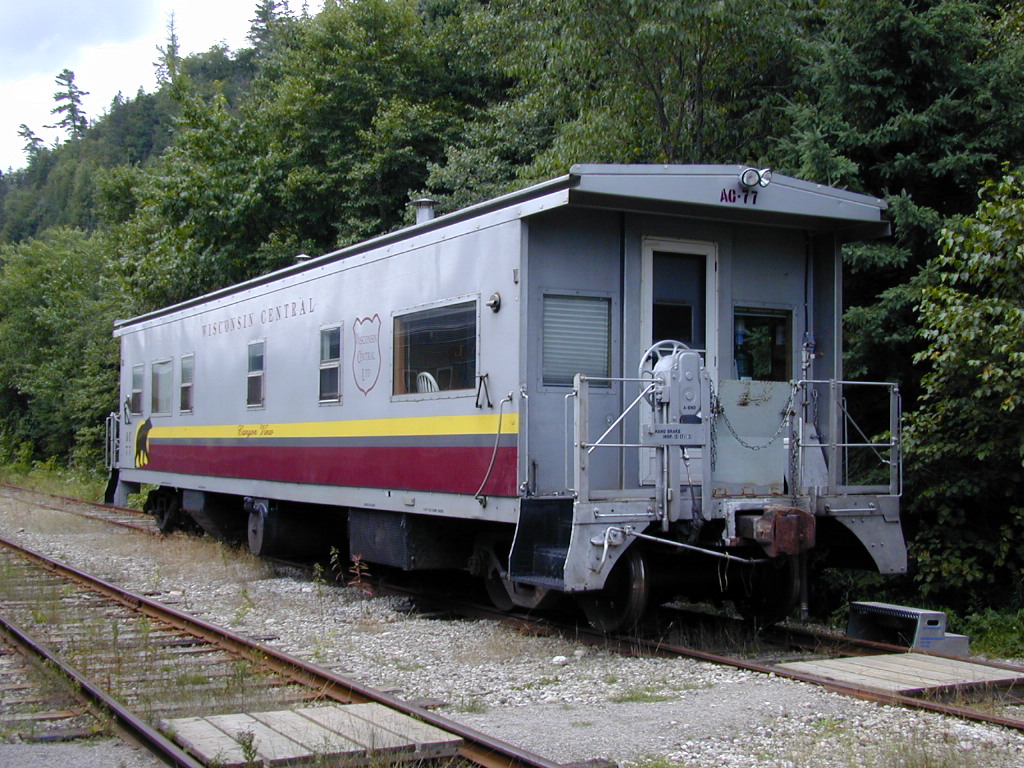 Canyon View parked on the siding at Agawa Canyon Park. Note that it is lettered for Wisconsin Central JOHN SPEAKMAN
 Canyon View at Steelton, 2004. Note the Wisconsin Central lettering has been removed and it is now lettered Algoma Central CHRIS VANDERHEIDE
In the late 1990's the name Canyon View was revived for the ACR's new "camp car." This car is ex-Green Bay Western business car 1776, which was built from an old GBW caboose. The car features a complete dining room, kitchen, bathroom with shower, and diesel generator. It is available for charter, and is dropped on the siding at Canyon for a weekend and you can camp in the park in the comfort of this fully equipped caboose.
This was the second car to carry the name Canyon View, and also reproduces a number from one of the GMDD-built steam generator cars.
Home - Top of page - Equipment Guide Main