



Shortly after returning from the 2000 North American Rail Pass 33-day expedition, I checked my Alaska Airline miles which I earn riding Amtrak West and with plenty, I made the decision to go to Hawaii, which was be the 50th state in which I would ride a train. I called the Partner Desk at Alaska Airlines who set me up on a round trip flight going via San Francisco and returning on a direct flight to LAX, then called the Hawaiian Railway in Ewa Beach, Oahu to inform them of my upcoming visit and my desire to ride their train. I suggested that a press release might be in order due to the nature of my visit and was I doing something that no one else had done?
A few nights later, Larry Howard of the Hawaiian Railway Society called me and we discussed matters, with him offering to find me an inexpensive hotel room through some of the people he knew on the island. We kept in contact over the next few weeks and he found me a room at the Radisson Prince Kuhio in Waikiki for four nights at a very low price. One Friday afternoon, I received a call from Will Hoover of the Honolulu Advertiser who wanted to write an article about me and my upcoming visit, which was published about a week before my visit and Will telephoned me to apologize for its earliness and told me I could go to their website to read it. I made copies for my friends then two days before I left, two copies arrived in the mail. With that, I packed my bags to begin my 50th State Adventure.
11/9/2000 At 4:00 AM, I drove to my friend Brad Tarr's house in Santa Fe Springs and he drove me to LAX, dropping me off at Terminal 3 and I flew north to San Francisco on American Airlines Flight 191 on a beautiful clear morning with a magnificent view of the California Coast. We arrived early since we were the first in line to take off in Los Angeles and I strolled to my connecting gate for Flight 39 to Honolulu. Leaving San Francisco was wonderful with downtown and Golden Gate Bridge very visible. From that point on just the clouds and ocean were with me as I spent the time doing word searches and listening to music but squeezed in a nap as well. As we descended into Honolulu on Oahu, a beautiful rainbow greeted me to my 50th State.
Walking off the plane, I felt as though I already had accomplished something since probably not too many people visit all fifty states. I followed the signs to the rental car counters and Avis had me checked in within two minutes and I received a very good deal because I had travelled on American Airlines. A shuttle bus took me to the lot where a Chevrolet Prism had its keys in the ignition and it was my easiest rental car yet. As I drove away from the airport, I wondered in how many states I driven and worked out seven versus forty-nine in which I had ridden a train. Driving east on Interstate H1, I made my way to Waikiki to check into the Radisson Prince Kuhio and received a 28th floor room with an ocean view and upon walking out onto my balcony, realized I was a block from the beach and had a partial view of Diamond Head, my first destination.
The unique profile of Diamond Head (Lē‘ahi) sits prominently near the eastern edge of Waikiki's coastline. Hawaii's most recognized landmark is known for its historic hiking trail, stunning coastal views and military history. Diamond Head State Monument encompasses over 475 acres, including the interior and outer slopes of the crater. This broad, saucer-shaped crater was formed about 300,000 years ago during a single, explosive eruption that sent ash and fine particles in the air. As these materials settled, they cemented together into a rock called tuff, creating the crater, and which is visible from the trail in the park. Most of the vegetation and birds were introduced in the late 1800s to early 1900s.
The trail to the summit of Lē‘ahi was built in 1908 as part of Oahu's coastal defense system. The 0.8 mile hike from trailhead to the summit is steep and strenuous, gaining 560 feet as it ascends from the crater floor. The walk is a glimpse into the geological and military history of Diamond Head. A concrete walkway built to reduce erosion shifts to a natural tuff surface about 0.2 mile up the trail with many switchbacks traversing the steep slope of the crater interior. The ascent continues up steep stairs and through a lighted 225-foot tunnel to enter the Fire Control Station completed in 1911. Built on the summit, the station directed artillery fire from batteries in Waikiki and Fort Ruger outside Diamond Head crater. At the summit, you'll see bunkers and a huge navigational lighthouse built in 1917.
I drove there on the coastal side and on the north side, found the entrance to the park, driving the access road that leads into a crater via a tunnel. I parked and paid a dollar to be able to hike to the top of Diamond Head and what a hike it was! It started with a paved trail for the first part before turning into rock and switchbacks were used to gain elevation to a staircase with 33 steps. A long dark tunnel is next (bring a flashlight with you) and you then climb 99 steps to a dark cave with two spiral staircases which exits into a room. To exit, you must crawl on your hands and knees to get outside. Take the path to the last staircase and climb it and you will be standing on the summit of Diamond Head, just like I was.
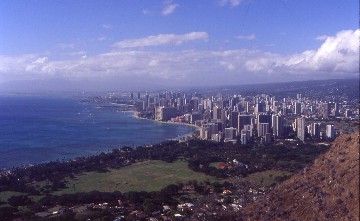
What a view! It was recommended to allow an hour-and-a-half for a round trip hike but I did the climb in twenty-five minutes up and nineteen minutes down. I paid for a certificate to certify that I climbed Diamond Head and at the bottom, bought a Diamond Head Summit Club Member T-shirt then returned to Waikiki, explored my new environment on foot before the activities of the day caught up with me and called it an early evening to rest for my next day's planned activities.
The Arizona Memorial and Around Oahu 11/10/2000 BackgroundBuilders first began working on the USS Arizona in 1914. Many believed the ship would be named the North Carolina after the home state of Josephus Daniels – Secretary of the Navy at that time – but upon its completion, it was called the Arizona instead. On June 19, 1915, the USS Arizona officially launched, but its first few years saw a number of mechanical problems. In 1917, the ship finally joined the Atlantic fleet, though she was mainly used as a training ship during World War I. Though a proud ship, she relied on oil, which was more scarce than coal at the time. The other ships fighting in the British Grand Fleet used coal, and the USS Arizona stayed out of heavy combat. After the war ended, the USS Arizona served as one of the escort ships bringing President Woodrow Wilson to Paris for the Paris Peace Conference.
Over the next few decades, the ship mainly carried cargo and passengers, and it was completely modernized. President Hoover used it to travel down to the Caribbean for a vacation. When an earthquake struck San Pedro while the USS Arizona was docked there, the ship provided shelter, first aid, and communications for the people impacted by the earthquake. The ship even starred in a movie "Here Comes the Navy". In October 1941, the USS Oklahoma struck the USS Arizona with a torpedo while out doing a routine exercise. No one was seriously injured, but the ship had to be dry-docked in Pearl Harbor while it was repaired.
When the Japanese began their attack on Pearl Harbor just after 8:00 AM on December 7, 1941, the USS Arizona was hit almost immediately. At 8:10 AM, an 800 kilogram bomb dropped right on the starboard side and moments later, the forward magazine powder lit up, exploding and destroying that part of the ship. Two turrets fell 20 feet, and the forward superstructure and foremast came falling into the void left by the previous explosion. Fires broke out across the ship. Many brave men and women fought to defend the ship and rescue those who were trapped as the ship went down, but in the end, most of the crew members – 1,177 total – died on the ship.
In the months that followed Pearl Harbor and for the duration of the war, the USS Arizona became a symbol to the soldiers and citizens. It symbolized what was being fought for – freedom and the lives of the crew members who tragically lost their lives at Pearl Harbor. Efforts were made to recover the bodies of those trapped on board, but over 900 of them were never found. Parts of the ship were also scrapped, but until the 1950s, the USS Arizona stayed at the bottom of the harbor. It was not until 1958 that legislation came through the Hawaiian government to create a memorial in honor of the great ship. The Navy would not only be allowed to build the memorial, but they would also be able to accept donations. Perhaps the most famous donation came from Elvis Presley; his 1961 concert helped raise a great deal of funds to go to the project.
The memorial was designed by Honolulu architect Alfred Preis, whose design was chosen in a contest. This brilliant designer of the USS Arizona Memorial fled Austria to avoid persecution from the Nazis. The memorial was designed to look similar to a milk carton with open walls on both sides. Preis intended the structure to sag in the middle and stand strong and vigorous on both ends, expressing initial defeat and ultimate victory. The memorial does not touch the sunken ship, but visitors can easily see the ship below them. In 1960, construction on the memorial finally began, and on Memorial Day 1962, the USS Arizona memorial officially opened. Nearly two decades later, a visitor's center was built on the shore next to the wreck, and the National Park Service took over the management of the memorial from the Navy. The USS Arizona Memorial was declared a National Historic Landmark in 1989.
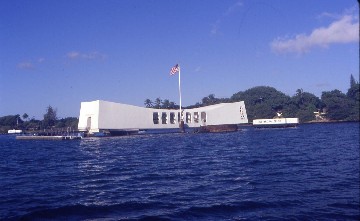
Waking up early after a great night's rest, I drove to the Arizona Memorial where I arrived at 6:45 am to be first in line for the tour. They opened at 7:30 AM and twenty minutes into my wait, a tour group arrived led by an former Army officer who gave a free commentary to anyone within earshot. I learned a few things that led up to the attack as well as getting tips on which side of the theater to sit (left down front) so you can be first out for the boat on the right side for the best view of the memorial. I was able to go in at 7:30 and half an hour later, a film was played showing scenes from the battle then I rode the boat out to the Arizona, which was quite a moving experience. For the return trip, I was first into the boat and chose the rear row of seats to have the best view of the memorial, thus ending my USS Arizona Experience.
Back at my car, I started my driving tour travelling west through Pearl City to reach Interstate H1 to Kapolei, then north on Highway 93 along the West Shore to the end of the road at Ka'ena Point State Beach, where I laid out on an empty beach. On the way, I stopped at Ka'ena Point where I found railroad tracks and wondered if this was where my ride on Sunday would take me? The tracks went north about two more miles but there were two bridges missing and I later learned that the tracks had once extended all the way along the coast to the north side of the island.
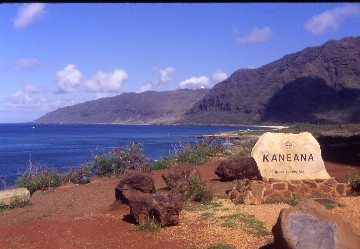
On my southern return, I made a side trip up the Waianae Valley just to see what was up there then retraced my route back to Interstate H1 and exited at Highway 750 crossing the saddle of the island with the pineapple fields owned by Dole. I passed through the Scofield Barracks before taking Highway 830 down to the North Shore to Highway 930, which I took west to the end of the road to the north part of Kaneana State Beach, where I laid out on an empty north shore beach. Returning east, I made my way to Highway 83 which would take me around to the east side of Oahu.
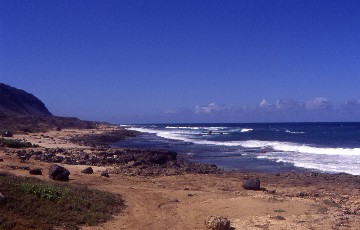
On the North Shore I passed through Waialua, Haleiwa, Waimea Bay, Sunset Beach and Kawela Bay before the road turned south at Kuilima Point then drove by the Kahuku Sugar Mill and the Polynesian Cultural Center before stopping for lunch at Hauula. I laid out on an empty beach at Kalaipaloa Point on the east side of Oahu before continuing my drive by Ka'a'Awa Point, the Crouching Lion and Kapapa Island prior to reaching Kaneohe then made my way on Highway 72 through Waimanalo Beach, out to Makapu'u Point.
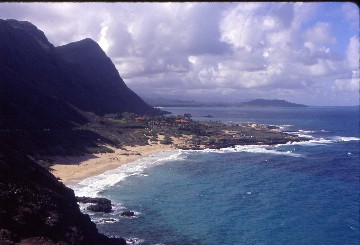
After a picture, I went around to the south side of Oahu and stopped at Koko Head Regional Park.
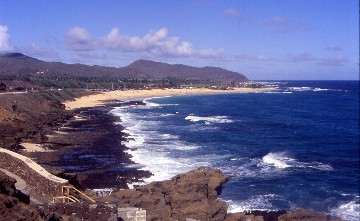
I stopped at Hanauma Bay before returning to Waikiki via the south side of Diamond Head then walked down and laid out on a crowded Waikiki beach, thus I had laid out on a beach on all sides of Oahu. I spent the evening in my room having a well-deserved rest.
Hawaiian Railway Society First Visit, the Wind and the Zoo 11/11/2000I woke up early and drove to a swap meet at Aloha Stadium to purchase a hat of the University of Hawaii Rainbow Warriors for Amtrak Conductor Christy Pacheco as none of the shops in Waikiki had one. I paid fifty cents to get in and after walking around, found a tent where the woman went through fourteen boxes in search of that hat and was successful and I tipped her well. On my way back to the car, I found a booth selling ten T-shirts for twenty dollars which took care of me and gifts for several other people. Back on Interstate H1, I drove to Interstate H2 to Wahiawa and back to add that route to my driving miles. Back on Interstate H1, I took Highway 76 down to Ewa and Renton Road to its end, where the Hawaiian Railway is located and met Larry Howard in person and several other members who were about to go out on a track gang. I was invited to ride along, but for the first time, declined a train ride because tomorrow was set to be the big day.
I returned to Interstate H1 which I took to Interstate H3, which reaches the east side of Oahu through a tunnel under the Ko'olau Mountains to the end of the road at Kaneohe Marine Corps Air Station. With that, I had driven every Interstate highway mile in Hawaii, a first for me in any state, and it had been a very beautiful drive. I returned over the Likelike Highway (63) through Wilson Tunnel to Interstate H1 before returning across on the Pali Highway then stopped at Nu'uanu Pali Lookout which is one of the windiest places on earth. It was so windy that when a tour bus of Japanese ladies came out to the lookout in some very skimpy outfits that the wind ripped off about half of the women's blouses causing a very comical reaction. I went down to the bottom through the Pali Tunnel then made a U-turn, retracing my path to Interstate H1 and returned to Waikiki and walked to the Honolulu Zoo before spending the rest of the day relaxing in anticipation of tomorrow.
50th State Ride Day 11/12/2000Sunday morning, or Day 2,126 of my sobriety found me in high spirits and with loads of energy as I was going to be riding a train in my 50th State. With time to spare, I decided to visit the National Memorial Cemetery of the Pacific located in the Punchbowl Crater, an extinct volcano near the center of Honolulu. On either side of the grand stairs leading to the memorial are eight courts of the missing on which are inscribed the names of the 18,095 American World War II missing from the Pacific, excluding those from the southwest Pacific, and 8,210 American missing from the Korean War. These names were listed on the Korean War Courts of the Missing at the time of the dedication in 1966.
Two half courts have been added at the foot of the staircase that contain the names of 2,504 Americans missing from the Vietnam War. At the top of the stairs is a chapel flanked by galleries containing mosaic maps and descriptions of the achievements of the American armed forces in the central and south Pacific regions and in Korea. The memorial was established by American Battle Monuments Commission to honour the sacrifices and achievements of American armed forces in the Pacific during World War II and the Korean War. The memorial grew in 1980 to include the missing of the Vietnam War.
The monument was outstanding and completed my Pearl Harbor Experience. It was also an absolute beautiful day with a glorious view of Honolulu, Pearl Harbor, Waikiki, Diamond Head and the Koolau Mountains.
Hawaiian Railway Society HistoryThe Hawaiian Railway Society works to save Hawaii's rich railroad history. This educational, non-profit organization was able to get the remaining stretch of track on Oahu (from Ewa to Nanakuli) placed on the State and National Registers of Historic Sites. Today, the Society has restored about 6.5 miles of track and works to restore more. Three vintage diesel locomotives have been restored to operation and several steam locomotives have been cosmetically restored. The famous Dillingham parlor car has been restored and is available for rides on the second Sunday of each month and also for charter. Hawaiian Railway, the operating arm of the Hawaiian Railway Society, has the only active, historical railway on Oahu. We offer two regularly scheduled rides each Sunday. From Monday through Friday, we offer rides to charter groups.
In 1970 two important events took place. First, Waialua Agricultural Company announced that they planned to scrap their 0-6-2T locomotive No. 6 because rust and deterioration had reduced the engine to an unsightly liability and posed a danger to the local kids who played on her. John Knaus then contacted Bill Paty who was the manager of Waialua Agricultural Co. about saving and restoring the locomotive. John then contacted his boss, Captain Henry Davies, of the Naval Ammunition Depot, Lualualei about having the locomotive moved there since it had the only locomotive facility left on Oahu. This was followed by a letter to Ed Berntsen of the National Railway Historical Society seeking information on organizing a local chapter. John received approval to have No. 6 restored at Lualualei. He then talked to Nick Carter, another rail fan who had expressed interest in saving the Navy mainline on the leeward coast for an operating railroad.
On August 22, 1970, John Knaus, Nick Carter, Luman Wilcox and Ken Peale met at Coco's Restaurant to discuss forming a local chapter of the NRHS. Wilcox was appointed to draw up the temporary by-laws. On August 27th an organizational meeting was held at Coco's with 15 people in attendance. Wilcox entertained a motion to organize forming a local chapter of the NRHS. Dr. Bob Kemble seconded and the motion was carried. Thirteen of the fifteen people present signed up. Nominated and elected were: Luman Wilcox for pres., Ken Peale for VP, Nick Carter for Secretary-Treasurer, and John Knaus for National Director. On Oct 9, 1970 the membership met to approve the By-Laws and Charter Night was set for Nov. 13th at Bishop Museum.
On Feb. 17th 1971, a Waialua Agricultural Company trailer was used to transport WA Co. 6 to Lualualei. Waialua Elementary School students gave the old locomotive a send off before it left Waialua. No. 6 was a magnet that brought a group of talent to Lualualei shortly after. A boiler maker named Dave Griner, a welder named Dick Marshall and a machinist named Bob Haney were all joined by others who wanted to lend a hand. On October 13th the Hawaii Chapter of the National Railway Historical Society was granted a charter. On Oct. 13, 1971 The State of Hawaii, Department of Regulatory Agencies granted the Hawaii Chapter of the National Railway Historical Society, INC. a charter of incorporation.
Now the use of Hawaii Chapter, NRHS posed a problem the name was too long and it really did not say anything about local railroading. So at a membership meeting on December 19, 1973, the members voted to use the name, Hawaiian Railway Society without severing itself from the NRHS. One more significant date: on November 25, 1972, a Saturday, a dedication ceremony marked the restoration of No. 6. On hand were local dignitaries to celebrate the event. After 84 Sundays of restoration work, a dream came true.
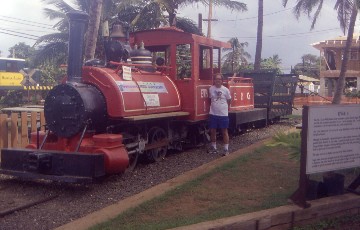
My VisitI then drove out to Ewa which did not seem to take long and when I drove through the gate to park, I noticed there was a sign on Ewa 0-4-2T 1's boiler cover and as I walked toward it, Larry Howard approached and asked for a picture of me by them.
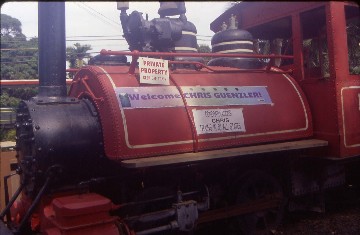
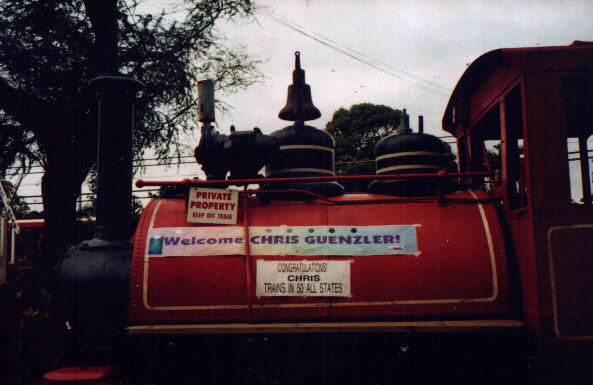
The top one read "Welcome Chris Guenzler" in the form of a banner and the one under stated "Congratulations 50 States 50 Train Rides." I was extremely proud and deeply touched by all this and was photographed by the steam engine by various people. Larry then introduced me to the other members of the society who came out for this event and they congratulated me on what I was about to accomplish. I visited their gift shop and bought several souvenirs then Will Hoover of the Honolulu Advertiser newspaper arrived and we repeated the pictures then toured the grounds with me as the guide.
The train was already sitting on their mainline ready to be boarded led by 45 ton narrow gauge 423 built by Whitcomb for the United States Navy and was restored in 1997. It would push the train out and then pull it from the end of the line at Kahe Point. The consist was four covered open air coaches and the car I rode was parlour-observation 64 "Ambassador" built by Oahu Railway and Land Company in 1900 for the company's founder, B.F. Dillingham. It was constructed of birdseye maple, koa and other woods and its lavish interior included a marble sink top, commode and galley. It was an absolutely beautiful car and more pictures were taken as I boarded and even more as I sat out on the observation platform prior to our high noon departure.
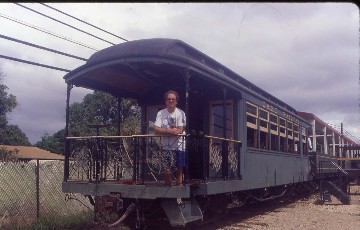
With a toot of the horn by Larry, the train started moving and with one turn of the wheel, I had completed my goal of riding a train in every state of the United States of America. Will and I laughed about that as we proceeded west down the narrow gauge tracks. To the right was Barbers Point Naval Air Station which we would parallel for three-and-a-half miles. Also on the right was where the former Ewa Plantation sugar cane fields were, the first part was now a construction site used by local motorcyclists who make very good use of its undulating terrain. As we travelled at twenty miles an hour, I listened to our brakeman and Will talk about what used to be along the line and I received a very good education. We passed the spot where the spur used to go into the air base and a few minutes later, our brakeman hopped off to flag us across the road at the main entrance to the Naval Air Station.
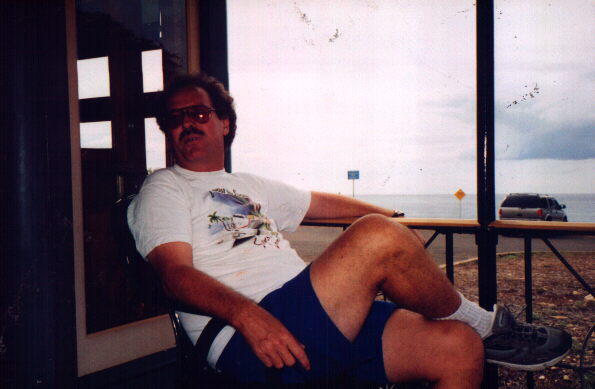
I really enjoyed riding out in the fresh Oahu air and the ability to have a 180 degree clear view. To the north there was an old quarry where coral was mined to use for the runway at the air station. Looking inside the base, I saw housing that was still in use followed by buildings, some of which were closed and in the process of being demolished. We passed the highest point on the line at 68 feet in elevation just before Jensen Siding which had some flat cars of steel from those two missing bridges past the end of the operating line. Off to the north was the ever-present Waianae Range of mountains with very dark clouds hanging over them. As always, I was on storm watch.
The train stopped to flag Kalaeloa Boulevard which led out to Barbers Point and the industrial area there. When I arrived in Oahu a few days ago, the plane flew right above it so I had a good aerial view. Just before that road, we passed an unused desalinization plant with the rumour that a new and larger plant would be built in the future. The tracks went straight through the Ko Olina Resort on the best track of the route since when the resort was built, the whole area was re-graded and the contractor had to remove the railway and rebuild it. It was a win-win situation for all parties concerned, with the railway getting the best part of the deal.
The Hawaiian Railway now passed through golf courses and landscaped grounds with a marina to the southwest. Further along, there was a resort hotel to the west and a wedding chapel complete with steps from the train platform if anyone included the train in their wedding plans. We had now reached the shore of the Pacific Ocean and travelled north another half mile with Maili Point standing out against a darkened sky. The train reached the end of active tracks at Kahe Point and the end of the first leg of my train ride in my 50th State.

On the return journey to Ewa, I sat back, relaxed and watched the sky turn darker and it had been great day but the threat of rain may have kept people away from riding. Will was enjoying the experience as much as I and all too soon, we were back at the museum grounds. Will bought me a souvenir spike and as we said goodbye to each other and I thanked him for everything he did for me. I bought a Coca-Cola to celebrate the accomplishment along with a route map of the old Hawaiian Railway and postcards to help remember this momentous occasion.
However, my train riding was not over as Larry had planned for me to ride the 2:00 PM with me riding in the locomotive with him, which was an enjoyable experience. On the return trip, I passed 577,000 rail miles, which made me very happy having done it in Hawaii. I totally enjoyed my round trip in the locomotive but all good things must come to an end, so as we entered Ewa station, I thanked Larry for everything and making this day one of the most special.
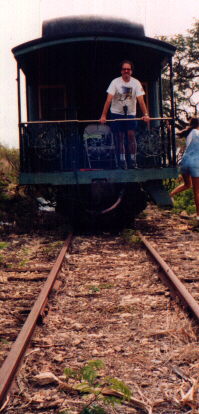
I detrained and bid everyone goodbye before returning to the car and driving back to Waikiki through a heavy downpour with a very natural high after completing my goal of riding a train in all 50 states. Back at the hotel, I ordered room service for dinner, a steak/teriyaki platter which was excellent and watched Sunday Night Football, then called home with the good news that I had completed my goal and watched "American Tragedy" The O.J. Simpson miniseries, before calling it a night, my last night in the State of Hawaii.
On My Way Home 11/13/2000Sleeping in late, I visited the hotel's sun deck for the first and only time and found a sheltered spot out of the high wind. The warm Hawaiian sun felt so good and I called Maureen Angle's classroom at McFadden Intermediate as we had pre-arranged because some of my students were in her sixth period class. I then checked out, filled the car with petrol and returned it to the airport and waited in line to obtain my boarding pass. All passengers going to Los Angeles had to switch gates.
My seat was in the over-sea flight attendant rest area so I had a lot of leg room and a small television monitor in front of me. From my window seat, I saw Molokai, Lanai, Maui and Kaho'olawe Islands with the Big Island hidden away under a blanket of clouds. The movie was Disney's "The Kid" which used up good portion of the flight. Rush's "All the World is a Stage" was listened to for most of the rest of the flight, then we became a night flight and soon the coastal lights of the Los Angeles Basin came into view. We banked with Malibu below, flew over downtown Los Angeles and I spotted both BNSF and Union Pacific's yards before we made a 180 degree turn for our final approach into Los Angeles International Airport and had a very gentle landing. Brad met me at the gate and drove me back to Santa Fe Springs where I returned to my car and drove home, bringing an ending to my 50th State train riding adventure.
Sad Note: My father Donald Guenzler died at 11:38 PM on December 15, 2000 in the presence of myself and my brother Bruce. The funeral was on December 21, 2000.| RETURN TO THE MAIN PAGE |