



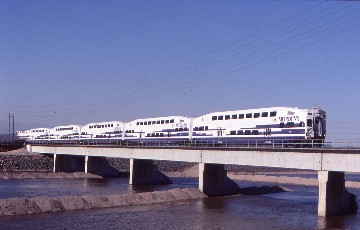
Every so often I will spend a day riding the Metrolink commuter trains of the five county operations in Southern California. One of my favourite trips can be done with off-peak tickets and is a good way to spend a day riding trains.
Metrolink 800 Inland Empire Line-Orange County LineThis train is part of the line that was the first suburb-to-suburb commuter line in the country. It runs from San Bernardino through Orange County to Oceanside in northern San Diego County. When the line opened, it became the first Metrolink line not to serve Union Station in Los Angeles, nor cross the Los Angeles River. It runs for 100.1 miles, making it the system's longest. This sixth line to be introduced opened between Riverside and Irvine on October 2, 1995. Following the completion of track improvements, the line opened to San Bernardino on March 4, 1996. With the exception of the Anaheim Canyon station, the line shares all of its stations with the Orange County Line, the Riverside Line and the San Bernardino Line.
I drove to the Santa Ana station, went to the Metrolink ticket machine and waited until after 8:30 AM so it would be off-peak and first pressed the Adult round trip button and then San Bernardino, so I would have a round trip ticket. I would reboard at Riverside on the return. About four minutes after I had my ticket in hand, I heard a whistle from the south and the train came into view. The doors opened and I went upstairs, riding in my usual seat with a vent on the side for a foot rest. The train whistled off and I was on my way to San Bernardino.
We crossed the Santa Ana Freeway then went through my neighbourhood, which Metrolink wants to double-track, something I was in favour of. The single track between CP La Veta and CP Lincoln was the biggest bottleneck not only for Metrolink, but also for Amtrak in its Pacific Surfliner corridor. We crossed Santiago Creek before ducking under California Highway 22 then regained the double track before crossing Chapman Avenue and arrived at the Orange station, where the former Santa Fe station is now a Cask and Cleaver Restaurant. At CP Maple, we went straight onto the Olive Subdivision towards Atwood and along here, one can see what remains of the former Pacific Electric line to Marlboro. We passed the point where the former Southern Pacific Tustin Branch used to cross the Olive District. A little further on, we ran along Orange-Olive Road, which took us to the Santa Ana River and after crossing it and California Highway 91, we arrived at Anaheim Canyon.
On the move again, a few minutes later, we arrived at Atwood where we turned onto BNSF's San Bernardino Subdivision main line for its namesake city and travelled along Orangethorpe Avenue, a few miles later crossing Imperial Highway then out into Santa Ana Canyon. The conductor came though the train checking tickets but only looks to see if they are valid. Through the housing projects, we went out to Esperanza where the double track became triple track then rounded Horseshoe Bend as we went east through the canyon and once we escaped the housing developments, our route passed through the last natural part of the canyon then by the Green River Golf Course. We crossed high above the Santa Ana River before passing below California Highway 91, where the triple track ended.
We curved above the buildings with Prado Dam above before a large turn prior to running under the freeway again, which took the train to the West Corona stop. A few minutes later, we ran through downtown Corona , beneath both California Highway 91 and Interstate 15 and passed through Porphyry before arriving at Riverside-La Sierra where a few school children detrained. On the move again, we passed through Arlington and Casa Blanca before curving between the hills that took us to West Riverside, where the Union Pacific joined the BNSF mainline for out to Daggett, east of Barstow. We stopped at the Riverside Metrolink station where most of the remaining passengers detrained then continued through Riverside under Interstate 215/California Highway 60 interchange before travelling through Highgrove, where the San Jacinto line departs the mainline. We crossed over Interstate 215 before descending down the hill to the Santa Ana River bridge then went through Colton, crossing the Union Pacific's former Southern Pacific Sunset Route} and under Interstate 10. After passing the former Union Pacific station, we took the "short way", crossing Lyle Creek Wash and arriving at San Bernardino Metrolink station.
Metrolink 817 San Bernardino LineThis line runs between Downtown Los Angeles east through the San Gabriel Valley and the Inland Empire to San Bernardino. It is one of the three initial lines on the original Metrolink system, along with the Santa Clarita Line (now the Antelope Valley Line) and the Ventura County Line. Los Angeles County Transportation Commission acquired the Southern Pacific Railroad Burbank Branch in 1992. When the line opened on October 26, 1992, service extended only as far as Pomona and was incrementally extended to Claremont that December, Montclair the following February, then finally to San Bernardino in May 1993. Saturday service was added in 1997 and Sunday service in 1998, making it the first Metrolink line to offer weekend service.
I told the conductor that I needed to get a ticket so ran to the machine and purchased a round-trip off-peak ticket to Los Angeles, which I could use to return to Riverside this afternoon. We departed on time and after passing the junction with the "short way", climbed up and over the Metrolink flyover that takes the trains over the busy BNSF mainline shared with Union Pacific. Looking down, I could see Santa Fe 4-8-4 3751 waiting for its next excursion and home since it was stored outside. We passed the BNSF grain car facility before running beneath the Palmdale Cutoff then rounded a curve before proceeding due west to the station stop at Rialto.
We passed the industries with San Gabriel Mountains to the north to our next stop at Fontana. The conductor came through inspecting tickets and walked right by me, since he knew I had bought one and admonished three people for having children's tickets, giving them citations for not having the correct ticket. We went through BNSF's Kaiser Yard before passing the California Speedway at the former site of Kaiser Steel then went by more industries before ducking under Interstate 15 and the warehouses to the Rancho Cucamonga station. From here to Pomona, the line had a streetcar feel to it with stops every few minutes.
We stopped next at Upland at the former Santa Fe depot before sprinting to the huge park-and-ride station at Montclair. Claremont came a couple of minutes later at the former Santa Fe station there then we departed the former Santa Fe Second District for the former Pacific Electric, later Southern Pacific, Baldwin Park Branch before arriving at Pomona station with the former Santa Fe station just to the northeast. We travelled along the north side of the Los Angeles County Fairgrounds along the drag race track then from here, we would be passing between the houses as we ducked under California Highway 57 to our next station stop at Covina. Residences were on both sides of the tracks until we reached the south end of the deep gravel pits, where we turned southwest to the stop at Baldwin Park.
More factories were passed and we went under Interstate 10, past an old drive-in movie theatre now used as a swap meet and down to the former Southern Pacific main line, where we turned to parallel it. The train them climbed to cross the flyover above the San Gabriel River and Union Pacific's Sunset Route before ducking back under Interstate 10 and entering El Monte, where we met an eastbound Metrolink train on its way to San Bernardino. We left the Sunset Route, climbed the bridge that took us high above the Rio Hondo and everything else to get us to the underpass that led the train to the middle of the San Bernardino Freeway. We cruised by the traffic which was stop-and-go to the junction of the Long Beach Freeway before we diverted from the freeway's median to reach the Cal State Los Angeles station. Our route continued on the north side of the freeway, ducking under Interstate 5 before passing below the junkyards to reach the east bank of the Los Angeles River, which we crossed at Mission Tower, prior to reaching the throat of Los Angeles Union Station. We arrived at Track 6 and I detrained and went to Phillipe's for lunch and had a French Dip roast beef sandwich.
Metrolink 402 The Riverside LineThe Riverside Line, the fourth line to be introduced, was added to the Metrolink system in June 1993 and its route is from Los Angeles Union Station to Riverside along the Union Pacific Railroad.
I waited on Track 7 for this train to arrive and once on board, the train departed on schedule, going back out to Mission Tower and across the Los Angeles River. We stayed along the east bank of the river across from the Amtrak coach yards and travelled below the Sears Building before curving away from the river and running to Union Pacific's East Los Angeles yard, where we paralleled its north side to the crossing of the Santa Ana Freeway. We passed Union Pacific's East Los Angeles station and picked up speed to our first station stop at Montebello.
The conductor inspected the tickets as we accelerated to cross the San Gabriel River, went through the junction of the Puente Branch at Bartolo then ducked under Interstate 605. The Rose Hills Cemetery on the Puente Hills was seen before we sped under California Highway 60 and sprinted through the City of Industry then passed through Puente Junction and continued east through the Puente Valley to our next station stop at Industry. The train continued its racing ways under California Highway 57 and into Pomona then we ran along the Sunset Route, passing the former Southern Pacific Pomona station and out to Montclair, where our Union Pacific route turned to the southeast after passing through Ontario.
After passing Ontario Airport, our next stop was at East Ontario then we continued southeast until we reached Pedley, where our route turned south, taking us to Pedley station then we turned east, running along the Santa Ana River on the bluff before crossing it on a high ten-arch concrete bridge. We travelled through Streeter and turned east, going through the neighbourhoods before the north side of the Pachappa Hill then crossed over California Highway 91 into the Riverside Metrolink station, ending this ride. The Riverside Line is a true high-speed racetrack for Metrolink.
Metrolink 609 The Inland Empire Line-Orange County LineI had to use the new pedestrian bridge to reach the south platform to wait for my train to arrive from Orange County and enjoyed the passing of two BNSF freight trains. The ride home was the same way I came out this morning and was relaxing.
| RETURN TO THE MAIN PAGE |