



I always wanted to ride the Grand Canyon Railway since Amtrak stopped at Williams Junction with a free shuttle to the depot, I decided it was time to ride their train and planned to make it a weekend trip. Marty, the night-time Amtrak agent in Santa Ana found me a good fare so we booked it.
Pacific Surfliner 581 2/9/2001Late in the afternoon, I boarded Pacific Surfliner 581 for the trip to Los Angeles and conductor Ron Houston took my ticket and the train made the quick journey to Los Angeles, where I went into the station to get my boarding pass and was in the first coach, which was empty, but it would fill up in Flagstaff an hour after I detrained.
Southwest Chief 4 2/9/2001The Southwest Chief boarded and departed after the crew added the regular mail and express cars to the consist. I enjoyed the bouncing ride in the lounge car to Fullerton then turned in for the night.
2/10/2001 I slept really well and woke up about twenty minutes outside Williams Junction, where I packed and enjoyed the rest of the pre-dawn ride.
Williams 2/10/2001I detrained just as the sun was rising on this cold February morning before boarding a van for the ride to the Fray Marcos Hotel in Williams then walked into the lobby and they offered to store my luggage while I rode the train to the canyon. I walked over to the station to pick up my tickets before going to Max and Thelma's Restaurant for breakfast then walked over to the gift shop before photographing the train. To the south of town, the Bill Williams Mountain loom over the city and on display in front of the station was Grand Canyon Railway 2-8-0 20 and Santa Fe wide vision caboose 999727.
Grand Canyon Railway HistorySince 1901 the Grand Canyon Railway has enchanted millions of people from all over the world. From its yesteryears of transporting ore to our present-day journeys to the canyon with the help of authentic characters who bring the Old West to life, the story of our railway is almost as dramatic as the spectacular surroundings.
The train-whose fate seemed sealed when it was shut down back in 1968 due to the popularity of automobiles-is now responsible for keeping approximately 50,000 cars outside of a national treasure. By traveling aboard Grand Canyon Railway you are not only part of history in the making, you are also doing your part to help preserve the pristine, incredible beauty of Grand Canyon National Park.
Back in the late 1800s, the Grand Canyon was a far-off distant land. Only the most adventurous of explorers could rough the elements to see it at its remote location in northern Arizona, which was still a territory at the time. But Americans were on the move and going west. American ingenuity was hard at work in the form of the railways, being built and tying the nation together.
Initially, the main line west was built from Chicago to Los Angeles and it passed through Williams, Arizona. The railway was originally built to transport ore in the Wild West from the Anita mines, 45 miles north of Williams, in the late 1800s. Buckey O'Neill, sheriff of Yavapi County, mayor of Prescott, prospector, promoter and later one of Teddy Roosevelt's Rough Riders, realized money could be made in the mines. He traveled east to gain the support and investment. O'Neill gained the support of Thomas Lombard from the investment firm of Lombard, Goode and Company in New York. Together they entered conversations with the Santa Fe Pacific Rrailway.
To help gain the interest of the Santa Fe, O'Neill sent ore samples of gold saying he had mined the samples from the Grand Canyon. In the same letter, however, O'Neill also recognized the potential for tourism so he spoke to the natural beauty of the region and the canyon. O’Neill continued to flirt with the Santa Fe through the years seeking their investment. He also tried to get local investors, which he did, and in 1897 the Santa Fe and Grand Canyon Railway Company was incorporated. Development of the tracks north from Williams began. O'Neill would not see its completion. He left to fight in the Spanish American War behind Colonel Theodore Roosevelt where he died in 1898.
The Railway changed management and consolidated numerous times in the early year. Finally, the Atchison, Topeka and Santa Fe Railway took over and completed the track to Grand Canyon in 1901. The company could make a return on its investment through tourism because the lure of ore and mining proved to be unsustainable. The $3.95 train ride would replace the $15.00 eight-hour stagecoach ride from Flagstaff, allowing visitors to gaze upon what Teddy Roosevelt said, "Every American should see". The 65 miles of track the iron horse traveled became the lifeline to Grand Canyon.
Grand Canyon Railway made its first journey to the Grand Canyon on September 17, 1901. And since that time, notable passengers to ride the Grand Canyon Railway include Theodore Roosevelt, John Muir, William Howard Taft, Franklin Delano Roosevelt, Dwight D. Eisenhower, Clark Gable, Jimmy Durante, Doris Day, Warren Buffet and Bill Gates.
Over the years, the Santa Fe also built many of the structures that now grace the South Rim. After all, if they were going to start bringing people in large numbers, they had to have a way to accommodate and feed them. When the train first arrived in 1901, tent camps were found along the rim. The Santa Fe approached the development with engineering skills and technology of the times that made a wonderful contribution still evident today. In 1904, the Railway hired the Fred Harvey Company to manage the hotels and restaurants at the Grand Canyon for the Santa Fe, and in 1905, Santa Fe built its flagship hotel, the El Tovar, which became the finest lodging at the rim and arguably in the Southwest at the time.
The Railway, in a most progressive move for the times, hired Mary Elizabeth Jane Colter, a woman, to design many of the buildings that have become part of the signature of Grand Canyon National Park. Her distinctive touch stamped an indelible imprint the building at the Grand Canyon with her version of a natural style of Pueblo Indian architecture. Colter is responsible for such landmarks as the Hopi House, Lookout Studio, Bright Angel Lodge, Desert View Watchtower and Hermit's Rest.
All supplies used in the construction of Grand Canyon Village came to Northern Arizona aboard the train. The train also brought all water to the Grand Canyon until 1926. Supplies were not the only things carried in trains. Ranching and lumber were the primary industries of the early 1900s. Ranchers and lumberjacks contracted with the Grand Canyon Railway to transport their stock. The Railway shared the countryside with its neighbors forming a unique bond. Cowboys, lumberjacks and shepherds alike felt a little better and closer to civilization just being able to hear the train or see its lights off in the distance.
Grand Canyon Railway stopped service to Grand Canyon in 1968 after ridership declined due to the rise in popularity of automobile travel. The Interstate highway system had been completed and people fell in love with "the road trip". The train had been a source of regional pride, a symbol of man's spirit of conquest and a sense of harmony with nature. Interstate highways were built paralleling the Rrailway, and silently replaced virgin landscapes privileged only to the train with billboards and gas stations.
The Railway was reopened for passenger service on September 17, 1989, by entrepreneurs Max and Thelma Biegert - 88 years to the day of the first passenger train to the Grand Canyon. "Bringing the Grand Canyon line back to life really came down to the eleventh hour", explained then Williams Marshal John Moore. "As Grand Canyon Railway was working on getting the final paper-work complete, a corporation which made a failed attempt to restore the Grand Canyon line, had begun tearing it up for salvage materials. If it hadn't been for Grand Canyon Railway, train service to the Grand Canyon would have been permanently lost".
In 1989, Grand Canyon Railway put a stop to the salvage work and began a detailed restoration process. The decaying tracks were rebuilt, the historic depots at both ends of the line were restored, and after 21 years, passenger service once again returned to Grand Canyon National Park.
"Max Biegert and his wife Thelma brought an important piece of Arizona history back to life. We have them to thank for the opportunity to travel just as those first passengers did in 1901 to the canyon so appropriately named Grand", said Railway Historian Al Richmond.
Today, Grand Canyon Railway provides a historic and fun journey to the canyon with the help of authentic western characters who bring the Old West to life. Moreover, the train whose fate seemed sealed when it was shut down due to the popularity of automobiles, is now responsible for keeping approximately 50,000 cars outside of the national treasure.
Explains Jeff D'Arpa, Grand Canyon Railway General Manager, "By traveling aboard Grand Canyon Railway you are not only experiencing an entertaining and historic journey, but you are also doing your part to help preserve the pristine beauty of the Grand Canyon".
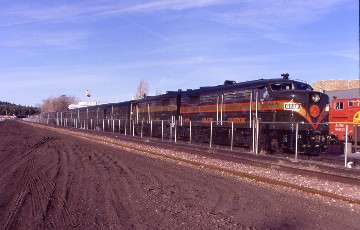
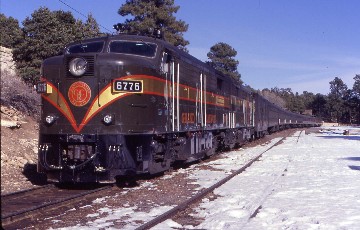
Our train was parked out on the track in front of the station and on the point were Grand Canyon FPA4 6776 and 6793, formerly VIA Rail and originally Canadian National. That was followed by a power car, five former Southern Pacific Harriman coaches, a café car, former Southern Pacific coach "Anasazi" dome car "Coconino" and observation car "Chief". I walked through the gift shop before ending up at the west end of the train.
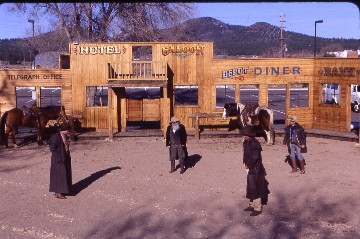
As departure time approached, a Wild West show was performed which was very entertaining. Everyone then boarded and I chose the third coach and found a left hand side window seat which I was assigned and was joined by a gentleman riding this railway for the first time; this would be my third. The first time was with my parents in the camper years ago and the second time was to the Havisupai Indian Reservation with the St. Peters Lutheran Church youth group with Pastor {PJ} Hale when I was eighteen.
We departed on time and left town passing the wye used to turn equipment and trains. To the west were the Three Sisters Mountains and a few minutes later, we passed the Grand Canyon Railway Shops with various equipment in the yard. We ducked under the double track former Santa Fe main line of the BNSF, which I rode over earlier this morning. We ran along Cataract Creek with the forest to the east before crossing the road to the airport then rounded a snaking curve giving an excellent view of our train as we descended the short grade between the bluffs to Red Valley, with a wash of the same name crossed at the bottom of the grade.
We then passed Red Lake with Highway 64 running to the right and for a few miles before turning to the northwest. There was not too much out here along the line so the passing under the power lines from Black Mesa was an event. We continued our high desert trek through Valle and slowly descended to Spring Valley Wash, following it north before we turned away from its path to run to the east of Howard Hill. Miller Wash was crossed several times in a mini canyon before passing the former station location of Willaha then we proceeded into the Kaibab National Forest and passed the former location of Anita and a corral before starting up the Apex Grade.
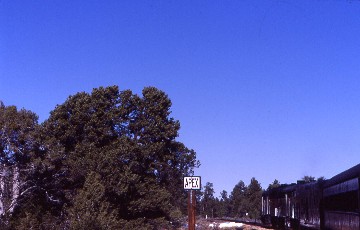
We went by Hopi siding before reaching Apex and wound the way through Coconino Canyon, the most interesting part of the journey. The train followed the Coconino Wash through the layers of Kaibab limestone and into the Toroweap formations then crossed the wash several times in the canyon before reaching an area called the switchbacks, where the tracks made two 180 degree curves. We reached the top of the canyon at Coconino before entering the Grand Canyon National Park and entered the wye to turn the train, where I received my first view of the Grand Canyon. We reversed into the yard and stopped in front of the log station at the Grand Canyon where everyone detrained and I found my tour bus.
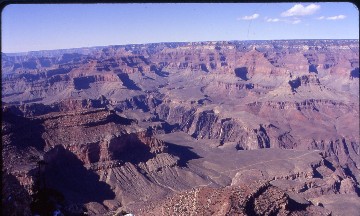
I paid for a tour so was taken to the Bright Angel Lodge for roast beef lunch then had time to look at the vista, which was spectacular on this perfectly clear February day. The bus tour then took us west to the overlooks at Hopi Point, Mohave Point and Pima Point before returning to Power Point with the mine and San Francisco Peak behind. We then drove to Yavapai Point and I walked to Grandeur Point. All in all, it was a very beautiful trip along the rim.
All too soon it was time to return to the train. It was a relaxing ride and I was sitting on the left side this time. On the desert portions, I had a great view of San Francisco Peak and there was the usual train robbery performed by the cast of the Wild West Show.
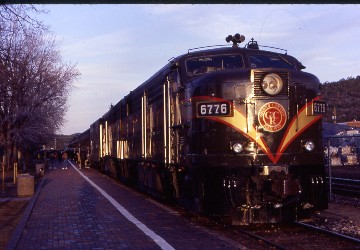
We arrived in Williams in the last light of day with the train beautifully lit in front of the depot. I walked over to Rod's Steak House and had a wonderful steak dinner then claimed my bags after I learned that the Southwest Chief was running five hours late. The staff at the Fray Marcos gave me a room to use during my wait so I watched a film, had a hot bath and went to bed.
Southwest Chief 3 2/11/2001At 1:30 AM, I was given a wakeup call to meet the van driver to take me out to Williams Junction to board the Southwest Chief. We sat out there only about eight minutes when a headlight approached and moments later, I boarded for Los Angeles and found two empty seats. Once my ticket was taken, I fell back asleep, woke up rested at Kingman then rode in the lounge car all the way into the Los Angeles Basin, where we arrived in Los Angeles at 10:45 AM.
Pacific Surfliner 574 2/11/2001I walked over to this train where Lawrence Dixon greeted me aboard for the ride to Santa Ana, took my ticket then asked me about the experience, commenting he would like to do it someday in the same manner. Taking Amtrak really made getting to the Grand Canyon easy and was a nice weekend trip.
| RETURN TO THE MAIN PAGE |