



Feeling the need for a Christmas getaway, I booked a Rail Sale ticket to Chicago and a roundtrip on the ever-endangered Kentucky Cardinal. With tickets in hand, I sent an e-mail to both the Kentucky Railroad Museum and My Old Kentucky Dinner Train then later, a telephone call booked the dinner train. I always wanted to go to Mammoth Caves so I booked the largest tour I could. I called Mike at AAA to reserve an Enterprise rental car then called Best Western in Bardstown for the night I would need.
Since I moved my website to Trainweb.com, something the co-owners, Steve Grande and Ray Burns, encouraged me to do for years, I received an early Christmas present from my mother of an Epson scanner which can accomodate slides and I started adding pictures to my website. With all that done, let this trip begin!
Pacific Surfliner 583 12/25/2002After a wonderful turkey dinner with my family, my brother Jon drove me to the Amtrak station where I sat on the platform waiting to start my journey and boarded Pacific Business Class on the lower level. The train ran perfectly on time to Los Angeles, arriving early then in the station, I ran into Conductor Woody Lamberth and wished him a very Merry Christmas for the second time today; the other time this morning on Pacific Surfliner 769.
Southwest Chief 4 12/25/2002Almost as soon as I started the coach queue for train number four, the station personnel came and told me to go to car 413 and I led the way to the Southwest Chief. I was assigned seat 45, right hand side large window and waited for departure. The book for this trip was a gift from my brother-in-law Henry called "Last Train to Paradise" by Les Standiford, the story of Henry Flagler and the spectacular rise and fall of the railroad that crossed an ocean, in this case from Key Largo and Key West. After we departed on time from Track 12 with P42DCs 194, 177, 49 and 511, we reversed onto Track 11 to pick up the US Mail in two box cars and eight Road Railers which would follow our cars to Chicago. We left the City of Angels at 7:10 PM and proceeded east.
At Norwalk, I upgraded to a sleeper and at Fullerton, walked the outside to my Sleeper 431. On the platform, I ran into Steve Grande, who wished me a good trip then once the train started, I went to the dining car and had a filet mignon as we passed through Santa Ana Canyon where BNSF had three trains parked for the holiday. Passing on "ET: The Movie", I enjoyed the darkened room listening to Yes' "The Ladder" as far as San Bernardino, where I called it a night.
12/26/2002 I awoke east of Winslow on Day 2,900 of my sobriety to an earth covered with snow and a solid light gray sky as the train sped east. I enjoyed a breakfast of French Toast and sausage with a father and daughter going to Pittsburgh then returned to my room in sleeping car "Illinois" and Victor Karl, my excellent attendant, made up my room in record time using a unique method. The fog burned off as we neared New Mexico and it turned into a beautiful blue sky as I started listening U2's "Joshua Tree". We arrived at Gallup with all of our incoming passengers bundled up against the cold temperatures outside the warmth of the train and I visited the lounge car from Gallup to Baca before returning to my room to read and relax as the snow disappeared. I had a Black Angus steak burger prior to our over-an-hour layover in Albuquerque while the train was serviced. We departed on time once two additional Road Railers were added.
The train arrived early at Lamy then at Glorieta, we passed the westbound 23-car Southwest Chief. After the "S" curve at Blanchard, I started to see the old semaphores signals that were still in service; the railroad has started to replace them but BNSF put the line up for sale so that may have put an end to their replacement plans. I spent the rest of the afternoon in my room listening to music, reading and then did some word fill-in puzzles. Sunset came before we reached Wagon Mound and the scenery returned to being snow-covered. I had a 5:00 dinner reservation with a couple from Santa Clarita going to Raton to transfer to the bus to Denver and enjoyed another filet mignon with a chocolate sundae, finishing ten minutes before Raton. With the light out in my room, I rode over Raton Pass with the snow on the ground and a star-filled sky overhead. It rarely gets better than this. Christmas displays greeted us as we arrived at Trinidad, Colorado and I rode the rest of the way to La Junta, where I made my bed to call it a night, or so I thought.
12/27/2002 I could call it "The night I bounced across Kansas!" My thoughts were I could not wait for the BNSF to sell this line so that the Chief would be re-routed onto the much-smoother southern mainline through Amarillo. I arose while we were at BNSF's Argentine Yard and went to the dining car for another wonderful French Toast breakfast. The lead kitchen staff messed up each meal on this journey so far, including this one. While I ate, the train was refuelled then continued to Kansas City, using Union Station once again. I detrained and walked up the stairs and into the newly-restored station which was very nice. Back on the train, I prepared myself for the day before our on-time departure.
The Southwest Chief took the flyover out of town and at Sibley, crossed high over the Missouri River on the single track bridge. Following a nap to just east of La Plata, I was up for six westbound freights, all stopped on each other's tails. Brown was the colour of the day to describe Missouri this afternoon then we entered Iowa for a short visit and I was seated in the dining car at Fort Madison for the final meal of this train ride. We crossed the Mississippi River and entered Illinois for the final race to Chicago and I enjoyed another steak burger and had my signature dessert, chocolate cake, which I named Zorro. The dining car steward, Charlie Brown, runs an excellent dining car with an excellent staff. We left the former Santa Fe mainline at Cameron for the former Chicago, Burlington and Quincy (later Burlington Northern) mainline for the rest of the journey and from Galesburg on, the trip was relaxing.
Leaving Mendota, a large puff of smoke from B32-8WH 511 made me look to see if Milwaukee Road 261 was powering our train! Well, I can always have a fantasy. The Southwest Chief made one last stop at Naperville before we followed a Metra train the rest of the way into Chicago. Every time he stopped, we stopped! We wyed before the station, dropping off the express cars and Road Railers then reversed into Chicago Union Station, arriving at 3:53 PM, 44 minutes early. What a great ride!
Chicago 12/27/2002I stored my bags in the Metropolitan Lounge and made my way to the Quincy "L" station, boarding a Brown Line train to Adams/Wabash, where I waited for Green Line Train 11 for Harlem/Lake, a new CTA route for me. The sun had set and I sat behind the operator's compartment so I could enjoy the forward view. We left the Loop and I was now on the new route, crossing high above the Chicago River before passing over the leads for both Union Station and the Ogilvie Transportation Center, the former Chicago Passenger Terminal when Chicago and North Western operated passenger trains. We then crossed the Expressway where I saw the Quality Inn that I usually stay at then at Ashland, there was a beautiful church to the south. We went by the United Center with no stop for it, followed by California, Kedzie, Conservatory-Central, Park Drive, Pulaski, Cicero, Laramie and Central, all of which were beside the former Chicago and North Western Metra Line to West Chicago, where an outbound Metra run passed us.
The rest of the stops were Austin, Ridgeland and Oak Park before our final stop at Harlem, still right next to the Union Pacific's triple track mainline. I stepped off after thanking the operator before walking down the platform to board my return train to Chicago. There was a great nighttime view of the skyline as we returned and watching a train curve at Tower 18 junction was very similar to watching a Fourth of July show where the sparks fly. Following our Loop-running at the southeast junction, I returned to new trackage then at Roosevelt, we stopped right next to the Hotel Roosevelt where I previously stayed, then travelling through the south side of Chicago, we stopped at 35th/Bronzeville ITT, where the line curved east for a minute. Once going south, we stopped at 43rd, 47th, 51st and Garfield, after which we branched off to the west to Halstead after crossing the former Conrail mains, the Metra Rock Island Line and the Dan Ryan Expressway, with passing Orange Line trains below. We made our way past the storage yard to our final stop at Ashland and I detrained into a very cold wind, finding out my train for Chicago was scheduled to depart at 6:13 PM as Train 622. I enjoyed the station's heating lamps before returning to downtown Chicago.
I rode back to Adams/Wabash and then transferred to the first train to take me back to Quincy. That just left the Green Line branch to Cottage Grove and the Orange Line to Midway to ride before I can say I have ridden every route of the CTA. God willing, that should be Monday when I come back from Kentucky. I made my way back through the cold south winds to Union Station for my Char Dogs and root beer at Gold Coast then returned to the Metropolitan Lounge to wait for the boarding of my next train.
Kentucky Cardinal 850 12/27/2002All passengers were boarded in the last Horizon car of an eight-car mixed train with our out-of-service Express Cars and Horizon cars on their way to the shops at Beech Grove for repairs. The Horizon cars in front of ours had no heat so it was about 32 degrees inside and the conductor decided to use that car as a smoking car on a non-smoking train. We left with seventy seats and sixty-nine passengers. To use another passenger's comment, "We are packed in like sardines packed in a can!" There were two distinct types of passengers on this train, the loud and talkative Indianapolis passengers and the quiet trying-to-sleep passengers such as me. One woman from Lafayette, Indiana was so loud that she told the whole car how she always calls Amtrak to complain, making up things that are not true so she receives travel vouchers. It was quite a menagerie to say the least.
We proceeded southeast to Dyer picking up no one, but sat for twenty minutes since we did not pick up any Express Cars in Chicago, which was built into our schedule. I slept off and on until a cell phone woke me up at Rensselaer where we gained another female passenger and were officially a full coach, then stopped for twenty-five minutes at Reynolds, where the interlocking crossing had to be cleared following several attempts to push a button in the interlocking box. At Lafayette, twelve passengers detrained, allowing my seatmate to finally sit with his girlfriend, so I could stretch out across two seats. Happiness occurred in Indianapolis when all those noisy passengers detrained and I slept soundly until about an hour north of Louisville.
12/28/2002 Waking up, I prepared for the day ahead and wrote the story of this train ride from Chicago before we arrived at Jeffersonville, after which it was all new trackage the rest of the way to Louisville. I could see downtown Louisville and the bridge over the Ohio River ahead of us to the south. We crossed over Interstate 65 before passing through the rest of Jeffersonville, crossed the Ohio River with its rapids on the left and the calm waters on the right, used by boats with a lock system in the distance. With that, welcome to Kentucky! We entered Louisville through an industrial area and at CP Mark, we turned east, crossing several roadways before turning south again with Louisville Union Station to the northeast. We went by the station leads before our conductor threw the switch and we reversed into the platform at the back of the station. At 8:40 EST, we arrived fifty minutes late and I once again completed riding every mile of the Amtrak system.
Kentucky 12/28/2002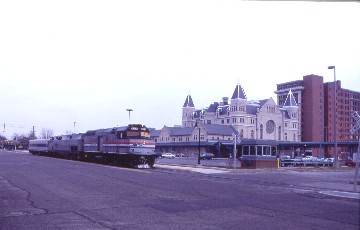
Our train in front of the station before it departed for its daily layover location. I inspected Louisville Union Station with one of the last two horsedrawn cars of the Louisville Street Railway beside it. After I talked with the guard about the hours on Sunday, I walked out the front door onto Broadway and started looking for the Enterprise car rental office where I rented a Dodge SE and was told the return procedures for Sunday as the office was closed. I drove south on the well-designed Interstate 65 to Kentucky 245, which took me to Bardstown and I found My Old Kentucky Dinner Train.
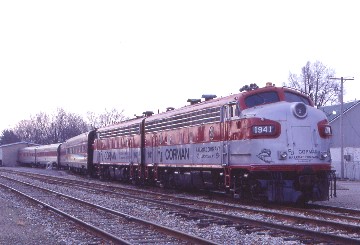
On the point of the train was R.J Corman FP7 1941, ex. Norfolk Southern 3497, nee Cincinnati, New Orleans and Texas Pacific Railway (Southern Railway) 6138, built by Electro-Motive Division in 1950. I was escorted to my hotel, the Best Western General Nelson, by an employee who turned out to be our engineer tomorrow, but I did not know it at this time. Following check in, I freshened up.
Kentucky Railway Museum 12/28/2002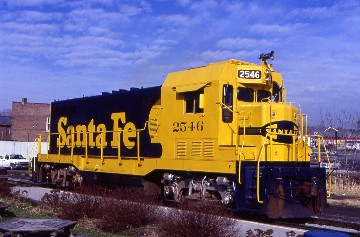
After purchasing a ticket for the 2:00 PM train ride, I photographed Santa Fe CF7 2456, nee Santa Fe F7A 229L built by Electro-Motive Division in 1950. It was in fresh paint and is the only CF7 still in its Santa Fe colours.
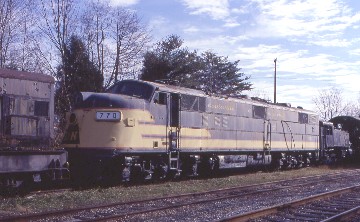
Louisville and Nashville E6A 770 was built by Electro Motive Corporation in 1939 and was one of the first diesel–electric units purchased by the Louisville & Nashville Railroad. I toured the inside museum as well as the fantastic model train center, a very pleasant surprise. After a call home to my mother, I wrote the Kentucky part of this story as I waited.
The Train Ride 12/28/2002Today's excursion train was CF7 2546, L&N business car 363 "Kentucky", Tennessee Central dining car 8038, Missouri-Kansas-Texas coach 884 and Southern Pacific coach 2359. When it was time to board, passengers did so through only one door and the last two cars. The ticket has written on it, "The Rolling Fork River Valley Line" and we were riding on a former Louisville and Nashville charter line built in 1856 which CSX sold to the museum in 1988. The museum moved to New Haven in 1990 and had already survived both a tornado and a flood. We departed, proceeding west across the Rolling Fork River and out into the beautiful countryside then a few miles later, we crossed the Rolling Fork River once again.
This car and its large windows made me curious as to its history and I found a sheet stating it was Southern Pacific, so I was riding a Southern Pacific coach behind a Santa Fe CF7 on a train in Kentucky going between New Haven and Boston. Had I not already travelled between those two cities before? Cities before, towns now! We passed through forests waiting for spring to come, with a few pines in the mix. We were travelling faster than the Kentucky Cardinal did this morning. We crossed under the Blue Grass Parkway and out across another valley then traversed the Beech Fork River twice before arriving in Boston, where we were allowed to detrain to either shop, as I did, or tour the locomotive.
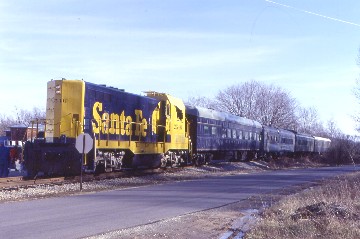
Once the passengers finished touring, I took my picture of the train, then when everyone was back aboard, we pulled forward to a siding where the locomotive ran around the train for the return journey. Back in New Haven, our conductor gave myself and two other passengers a tour of the shops where he explained everything and when the train was re-spotted, a tour of Louisville and Nashville business car 363, which was extremely impressive. I thanked him for a most wonderful visit and the excellent excursion train. I drove back to Bardstown and changed for my next train ride.
My Old Kentucky Dinner Train 12/28/2002I drove to their depot, parked and picked up my ticket and was told to go straight to my car outside the end of the building. Our train consisted of R.J. Corman FP7A's 1941 and 1940, R.J. Corman table car 011 (former Eisenhower funeral train and originally a sleeper/lounge built by Budd Company in 1946), R.J. Corman table car 777, built by Budd in 1946 as a coach, R.J. Corman kitchen car 021, nee Santa Fe blunt-end lounge/observation car built by Budd in 1946 and my car, R.J. Corman table car 007, ex. Amtrak 4586, ex. Penn Central 4056, nee Pennsylvania Railroad 60-seat coach 40xx, built by Budd in 1946.
The tracks we were going to be on from Bardstown to Limestone Springs and back were built in 1860 as the Bardstown and Louisville, which later become part of Louisville and Nashville, then CSX, who sold the line to R.J. Corman in 1987. Dinner train operations started in July 1988 with a GP7 and two cars, 007 and 011. For six months all meals were catered then in 1989, kitchen car RJC 777 arrived and all meals were then cooked on board. Car RJC 011 arrived in 1992. The trip is 32 miles at 20 miles and hour and 20,000 passengers a year are carried and they also offer murder mysteries. In addition, the line also does a good amount a freight business of distillery products, plastics and they serve brickyards.

I was seated at a table by myself which worked well for me since I was writing. Course number one was crackers, grapes, celery and a dip. We departed at 5:08 PM and would follow most of the same route that I drove over on Kentucky 245 this morning so even if grew dark, I had already seen the countryside, which made me happy. One surprise right away was a field with llamas, who do not like trains as much as horses. This was definitely Kentucky horse country and there is plenty of land for them to roam. Cows were present as well and the land was much more undulating than my train ride was this afternoon. The undercarriages of the cars were equipped with lights, which reminded me of the Lynn Lake mixed train from 1999.
Salads were next which I of course passed on and continued to drink hot tea. At Deatsville, we passed eight huge bourbon storage buildings belonging to the Heaven Hill Distillery then the line started to descend as we passed a pair of man-made fishing lakes while the wheels squealed on the curves. We crossed the 40 foot high curving Jackson Hollow Trestle and I was at the back door of the train to enjoy the view. The underlight shining brightly really allowed me to see the superb rock strata along the line. Mrs. Angle, that most wonderful science teacher I know at McFadden Intermediate, would love this trip, as well as what I was going to be doing tomorrow. The Jim Beam Distillery Plant 1 was next before we reached Limestone Springs.
My prime rib arrived with little potatoes, vegetables and rolls, which provided an excellent meal. The outbound engineer joined me and tried to answer my questions and we had an enjoyable conversation. Later on the way back, he came and walked me through the two engine compartments so I could have a cab ride and meet the engineer, who answered more questions. Having the opportunity to ride in my favourite type of locomotive was a definite bonus. I truly enjoyed my entire experience on My Old Kentucky Dinner Train. The service by Sandy was excellent, the food fantastic and of course, the cab ride topped it off. Back at Bardstown, the crew ran the locomotives around the train before reversing us into the depot.
Once I detrained, I was given permission to tour the other cars, which were incredible. My Old Kentucky Dinner Train is really a first class operation in every way. I returned to my hotel, watched the last three minutes of the Oakland Raiders shutting out the Kansas City Chiefs in a torrential rain and on a muddy swampy field then went to bed, a very satisfied human being.
South to Mammoth Caves 12/29/2002Sleeping in later than normal, I drove the Blue Grass Parkway back over to Interstate 65 and over to Cave City. On the way, I had a surprise when I saw a sign which read "Entering the Central Time Zone". As I had based getting there on a time schedule, I now had an extra hour to play with so stopped at Cave City at a McDonald's for hot cakes and sausage, which I took to a grade crossing in town and ate while I waited for any CSX trains, of which there were none. I continued my drive to Mammoth Caves, stopping at a gift shop for some postcards and at Mike's Rocks and Gems to get a gift for Mrs. Angle then drove to the visitor center, picked up my tickets, a videotape and a few more postcards for my classroom post card wall. From then until the tour started, I relaxed in the warming Kentucky sunshine as I was going to be spending some time underground.
Mammoth Caves Grand Avenue Tour 12/29/2002Mammoth Cave National Park encompasses portions of Mammoth Cave, the longest known cave system in the world. The park's 52,830 acres are located primarily in Edmonson County, with small areas extending eastward into Hart and Barren counties. The Green River runs through the park, with a tributary called the Nolin River feeding into the Green just inside the park. The cave system has formally been known as the Mammoth–Flint Ridge Cave System since 1972, when a connection was discovered between Mammoth Cave and the even longer system under Flint Ridge to the north. The park was established as a national park on July 1, 1941, after oft-contentious eminent domain proceedings whose consequences still affect the region. It was named a World Heritage Site on October 27, 1981 and an international Biosphere Reserve on September 26, 1990.
Mammoth Cave developed in thick Mississippian-aged limestone strata capped by a layer of sandstone, which has made the system remarkably stable. It is known to include more than 426 miles of passageway. New discoveries and connections add several miles to this figure each year. The upper sandstone member is known as the Big Clifty Sandstone. Thin, sparse layers of limestone interspersed within the sandstone give rise to an epikarstic zone, in which tiny conduits (cave passages too small to enter) are dissolved by the natural acidity of groundwater. The epikarstic zone concentrates local flows of runoff into high-elevation springs which emerge at the edges of ridges. The resurgent water from these springs typically flows briefly on the surface before sinking underground again at the elevation of contact between the sandstone caprock and the underlying massive limestones. It is in these underlying massive limestone layers that the human-explorable caves of the region have naturally developed.
The limestone layers of the stratigraphic column beneath the Big Clifty, in increasing order of depth below the ridgetops, are the Girkin Formation, the Ste. Genevieve Limestone and the St. Louis Limestone. The large Main Cave passage seen on the Historic Tour is located at the bottom of the Girkin and the top of the Ste. Genevieve Formation. Each of the primary layers of limestone is divided further into named geological units and sub-units. One area of cave research involves correlating the stratigraphy with the cave survey produced by explorers. This makes it possible to produce approximate three-dimensional maps of the contours of the various layer boundaries without the necessity for test wells and extracting core samples.
The upper sandstone caprock is relatively hard for water to penetrate: the exceptions are where vertical cracks occur. This protective layer means that many of the older, upper passages of the cave system are very dry, with no stalactites, stalagmites or other formations which require flowing or dripping water to develop. However, the sandstone caprock layer has been dissolved and eroded at many locations within the park, such as the Frozen Niagara room. The contact between limestone and sandstone can be found by hiking from the valley bottoms to the ridgetops: typically, as one approaches the top of a ridge, one sees the outcrops of exposed rock change in composition from limestone to sandstone at a well-defined elevation. At one valley bottom in the southern region of the park, a massive sinkhole has developed. Known as Cedar Sink, the sinkhole features a small river entering one side and disappearing back underground at the other side.
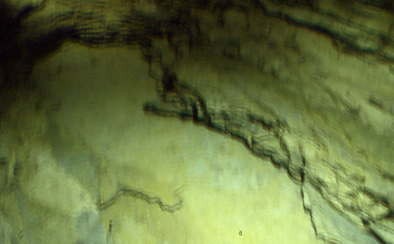
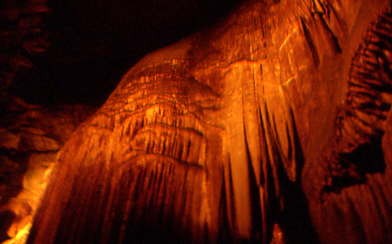
This tour lasted for four-and-a-half hours and covered four miles underground in Mammoth Cave. Visitors boarded buses after Ranger Amy explained what lay ahead and what we would have to do physically to complete this tour. We took the bus to the Carmichael Entrance that would take our group to the depths of Mammoth Cave and went 180 steps down that took us into the dry area of the cave called Cleveland Avenue. As we walked easily down Cleveland, up on the cave ceiling were gypsum flowers and another feature was the Cleveland Cabinet formation. Amy was excellent at pointing out items and I was behind her which I felt was the best place to be as you received first-hand information as well as seeing the darkened cave come to light in an unobstructed view every time we approached a new section when she turned on the lighting. It was incredible to see it this way.
We later saw the Wild Cave Tour coming out of what is called the birth canal into Cleveland Avenue, with their Ranger spanking each member of their group as they enter our world and calling out whether it is a boy or a girl. After about an hour, we arrived at the Snowball Room for lunch and the restroom, which looked as though someone had thrown snowballs to the ceiling and they stuck. The food was brought down by a long elevator and is a unique restaurant located at 267 feet below the surface. After lunch we went underground east down Boone Avenue, past Mary's vineyard to Thorpe Pit, before turning off down very narrow passageways with ceilings about 40 feet above us. At the Rock of Gibraltar, we entered Kentucky Avenue, passed Alice Grotto and had to climb 85 feet to the top of Mount McKinley where there was a restroom stop at the summit, which gave everyone in our group reason to complete the climb.
From the top, we went 95 feet down to reach the Grand Canyon, where a steel cable crossing was still high above and people used to ride across the Grand Canyon. Of course, the carrying vehicle would have dropped you twenty feet down when you started. Our group had done an excellent job of staying together and our continuing journey next took us to the Aero Bridge and the Big Break before we arrived at Grand Central Station, where we rested while Amy demonstrated just how dark this cave really was. First she turned out the lights and you were in pitch blackness. Next was just a lighter, followed by her flashlight, before the lights were restored. It was a pretty amazing demonstration. From here to our exit, the cave changed from a dry environment to a wet one as there was no cap rock above the next part of the cave to keep the water out. This is one part of Mammoth Cave which features stalactites and stalagmites, pits, domes and drip-stone formations. They are also cave grapes and cave bacon. We went on a narrow walkway with drops on both sides called Lover's Leap, along College Heights, into Moonlight Dome and Frozen Niagara, which under it is the Drapery Room, also incredible.
Climbing back up, we went by Crystal Lake before going through a short man-made entrance and returned to the surface and daylight. A bus then took everyone to the Visitor Center and that was the end of the tour. It was an incredible experience and if you take it, make sure you get plenty of exercise before making the journey so you are in great shape for a fantastic trek.
Back to Louisville 12/29/2002
Before I left the park, I stopped at Mammoth Cave National Park Association 0-4-2T 4, ex. Mammoth Cave Railroad Company 4 "Hercules", nee East End Railway Company 4 built by Burnham, Parry, Williams & Company, an early incarnation of the Baldwin Locomotive Works, in 1888. The East End Street Railway was then incorporated into the Memphis Street Railway in 1895. It operated overhead electrified cable streetcars and trolleybuses over roughly 160 route miles until 1960. Streetcars ceased running in 1947, when trolleybuses took over.
The enclosed type of design of this locomotive was often referred to as a "dummy" locomotive as it was made to resemble a streetcar and thereby, the thinking went, was less likely to frighten horses along its path. 4 was the same design as four rear-tank engine dummies built by Baldwin for the Metropolitan Railway operating between Atlanta and Decatur, Georgia. Its condensing engines operated without the noise of escaping steam, and pipes, rods, linkages and other moving parts were covered. This was also because bare engine parts were thought to be too unsightly to be seen on city streets! At some point prior to 1895, 4 was sold to the Mammoth Cave Railroad.
The Mammoth Cave Railroad was built from the Louisville & Nashville Railroad depot in Glasgow Junction, Tennessee (now Park City) to transport visitors to the Mammoth Hotel and Cave, replacing a stagecoach line. The L&N owned the right-of-way but did not build the 8.7 mile line with its 3½ percent grade and 14-17 degree curves. In 1874, a contract was signed with the Mammoth Cave Railroad Company and work began in 1880 with the section to Diamond Cave. Construction then stopped until 1886 and the railroad opened for business in that year. It cost $3 per ticket when it first started running. From 1886 to 1929, the railroad used four "dummy" locomotives, all built by Baldwin, two passenger coaches and two combination coaches. Passengers could catch one of the several twenty-five minute trips during summer, but only a single round trip in winter.
In the first few decades of the twentieth century, however, an inevitable decline in the railroad's fortunes followed the growth of automobile transport. By the late 1920's, it faced hard times and, from 1929, started using motorised railbuses in place of the engine and coaches. In 1931, the newly formed Mammoth Cave National Park Association ceased operations on the line and disposed of the equipment except for a locomotive and carriage to be placed on display in the park. The original "Hercules" 3 was, by then, too worn out to make the trip to Mammoth Cave, so 4 went instead and, for a while, bore the erroneous name "Hercules".
I drove back to Cave City and stopped at a Kentucky Fried Chicken which did not taste any better here in Kentucky than it does back home, then drove back down Interstate 65 to Louisville, where I filled the car with petrol before returning it and leaving the car under the port and put the keys into the key return device. I walked back to Louisville Union Station, passing the old L&N building with the railroad's initials lit up in red neon. I dropped my bags off at the guard station before walking three blocks west to the Broadway Cinema where I saw "Two Weeks Notice" with Sandra Bullock and Hugh Grant. It was an enjoyable movie and I was the only person in the theater. As I walked back to Union Station, I heard a horn and as I arrived, my train was reversing in. I retrieved my luggage and thanked the guard for watching it then walked out to the train, thinking how blessed I had been with the weather. 50 degrees and clear was far better than the rain, sleet or snow with cold temperatures that I could have faced. Maybe I am the bringer of good weather! I stepped onto the one-car train with a big smile on my face.
Kentucky Cardinal 851 12/29/2002In my usual spot, the conductor took my ticket and it turned out that he used to work for Metrolink on the Lancaster trains. I was tired after such a great day but decided to stay awake to Jeffersonville. We reversed out of the station on time and once our conductor threw a switch, we were on our way north and I saw a Thomas the Tank Engine in very poor shape in an industrial yard. We crossed the Ohio River with a great view of downtown Louisville before proceeding to Jeffersonville, where a family detrained and we picked up five more for a total of twenty-two passengers then sat waiting for departure time, which used to pick up the former Express Car business that came from here. We resumed our journehy on time and I slept very soundly through the night.
12/30/2002 Waking up briefly in Indianapolis after the car had been cut off with no heat and noting that it was raining, I fell back into a deep sleep that lasted until 7:30 AM and awoke to snow-covered fields before I went to get breakfast in the Cardinal dining car. We were the rear car now, on the Cardinal, that picked us up in Indianapolis so I walked through three different coaches (a Metroliner cab car, Amfleet II and Amfleet I with those horrible orange seats) then rebuilt Amfleet lounge car with smoking room 28000 "New York" before arriving at rebuilt dining car 8504, which had a small counter that was never used. There I had dry French Toast as this train was sent out with no syrup. As the Cardinal made its way to Chicago under grey skies, I finished reading "Last Train to Paradise" and we arrived at Dyer at 9:00 AM {7:16} EDT.
Our eight-car train was stopped at Dalton waiting to get onto the Union Pacific, formerly Chicago and Eastern Illinois which was blocked by a Union Pacific freight. As we started moving, a Canadian National (Grand Trunk Western) train passed us on its way to Chicago then nearing our destination, I noticed how wet it was but it was not raining. We crossed over the Illinois Central/Metra Electric lines and slowly made our way north, stopping and going, then travelled under both the Metra Rock Island Line and the CTA Blue Line I rode the other night. We passed Comiskey Park and I was already planning a trip to see a Chicago White Sox game here. The Cardinal passed above Chinatown before crossing the Chicago River and pulled straight into Chicago Union Station just as the Lake Shore Limited was reversing, arriving at 9:41 AM CST, or forty-one minutes late, ending another part of this adventure.
Chicago 12/30/2002I could not find a locker and called for help on their phone and for $7.50, my bags were stowed in the oversized storage room. I walked to the Quincy stop of the CTA and boarded an Orange Line train for Midway, which had arrived quickly on another cold windy day for a reverse trip around the Loop. Once on the Loop, we went to Roosevelt with the doors only staying open for ten seconds. The location where the tracks made the tight "S" curve off Wabash was going to be straightened out as pillars had already been constructed, which will increase CTA speed in and out of the city. Once we passed Roosevelt, we turned off the Green Line and I was again on new CTA trackage. I had seen a lot of Chicago and the outlying regions thanks to Metra and the CTA. We crossed the Metra Rock Island Line and the junction I just came in on at 23rd Street then ran above the route of the Texas Eagle and the former Santa Fe route the Southwest Chief used to run on before stopping at Halstead and just before Ashland, crossed the Chicago River.
The former Santa Fe turned off to the west with us still following the former Illinois Central (Canadian National) line to 35th/Archer where we left that line for a Belt Railway of Chicago one near their large yard to the east and the Wheatland Tube Company on the west where we turned southwest. We stopped at Kedzie before climbing high over the southern leads of BNSF's Corwith Yard to Pulaski. Within two minutes, we were passing the CTA maintenance facility prior to going below grade to the Midway Airport stop, ending my ride on the Orange Line. Once there, I walked across the platform to take the next train back to Chicago and the Roosevelt stop.
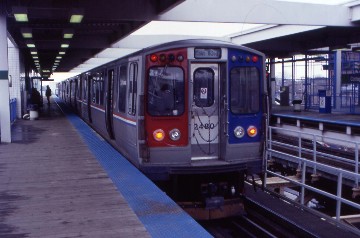
After a quick picture of the train at Roosevelt, I boarded a Blue Line train to 63rd and Cottage Grove, a repeat of Friday's trip as far as Garfield and the junction to Ashland. Once past that junction, I was on new trackage once again and my final miles of the CTA. We passed the CTA maintenance facility before turning east to our next stop at King Drive then made a straight shot to Cottage Grove and with that, I had just completed riding every mile and route of the CTA. I took the Blue Line back through the Loop to Clinton and on the way, off to the east along Lake Michigan, I saw the new Soldier Field, home of the Chicago Bears, being built. I detrained at Clinton and walked through the former Chicago and North Western station, stopping at Waldens Books to buy "The Christmas Train" by David Baldacci. Back at Union Station, I had a Gold Coast Char Skirt Steak before I retrieved my luggage and waited for my train home to California.
Southwest Chief 3 12/30/2002I was assigned to seat number one on the right side of the car at the front, which had no table but plenty of leg space right over the trucks. I was hoping to upgrade to a room again as there were five rooms still open when I checked this morning. We departed on time and pulled down even with the Metra yard to add the eight mail and Express Cars and 14 Road Railers, then sped through the western suburbs to Aurora, where the line to Minneapolis branched off, bringing back memories of my Milwaukee Road 261 trip last summer. I spent a nice trip to Galesburg in conversation with Henry going to San Bernardino and a couple heading home to Bakersfield and shared several of my interesting stories which made time really fly.
Our conductor told me I could have a room for $257.60 and to be ready to walk up at Galesburg. Since I had a 5:30 dinner reservation and would have to move during my deal, I went to the dining car to see if the steward could change the time. Ken was more than happy to do so, re-scheduling me to 7:00 PM. A few more stories and then I was downstairs ready for my move.
At Galesburg I led four other passengers from the coaches to our sleeping car 331 and I was given room 11 downstairs which I was happy with since I rode the other side on the journey a few days ago. I paid the conductor for the room and then waited for 7:00 PM as the train took the Cameron Connection back to the former Santa Fe. I went to the dining car where I found Camille, with her always-fabulous smile working from the extra board. She had served me so many excellent meals on the Coast Starlight I knew my meals on this train would be fun. On the way to dinner, I noticed the name of my sleeper car was "Illinois". The funny thing was that was the car I had going east, so while I went to Kentucky and spent the night there, this car went to Washington, DC and spent the night there. That also meant that the coach I had been sitting in from Chicago was the same coach that I was in when I left Los Angeles.
To continue the funny part, my table mates at dinner, going home to Albuquerque, had the same sleeper going to Chicago when they had went east on the 19th. It is a small world! I had another filet mignon and a "Zorro" chocolate cake. Following more good conversation, I refreshed myself after the day's activities and felt like a new man then read some more before making my bed and calling it a night in western Missouri.
12/31/2002 Waking up on my birthday (45 this year) has occurred in several different locations over the years. Last year, it was in Boston on the way to Maine and in other years, places like Sufragio, Sinaloa in Mexico waiting for my day to start going over the CHP to Copper Canyon.
This year found me near Dodge City where I prepared myself for the day the train waited for the time to leave. I went to the lounge car to wait for the diner to open before having breakfast of French Toast with the man going to Bakersfield and a couple visiting from Toronto on their way to Los Angeles before going up the Coast to Vancouver then across on the Canadian. We had really good conversation of places we had been, politics and just life in general while cruising to Lamar and arrived at La Junta forty-five minutes early.
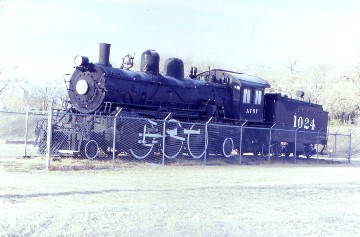
I took an eleven minute power walk to the park where Santa Fe 2-6-2 1024, built by Burnham, Williams & Company, an early incarnation of the Baldwin Locomotive Works, in 1901 was on display. It was donated to the City of La Junta by the Santa Fe in 1956. I picked up a pack of doughnuts at a Texaco Food Mart on the way back to the train and was reading the Pueblo Chieftain as we departed on time then read more of "The Christmas Train" until about halfway up Raton Pass, where I was going to take a picture of our train curving climbing up the pass. What I photographed instead was us passing a BNSF freight with two Norfolk Southern locomotives in front and more buried mid-train.
We arrived in Raton and I sat in the room waiting for lunch to be called then had another steak burger and ice cream sundae with the same couple I had dinner with last night. I returned to my room for more of the book which I later finished when we descended Glorieta Pass into Apache Canyon. At Canyoncito, we met the 23-car eastbound Southwest Chief while our 31-car train ran through the siding then we arrived at Albuquerque almost an hour early. With that, I called home to my mother, bought a turquoise and silver ring for myself for my birthday and a USA Today. I had a good power walk on the platform as we waited for our departure time then sunset happened before we departed and right after we left, I went to the dining car for my final dinner of the trip, another filet and "Zorro", with a father and son from Oklahoma going to the Rose Bowl. I relaxed in my room doing fill-ins and listening to music; it had been the quietest birthday of my life by far and I made my bed and fell fast asleep.
That was until Gallup when two young men, dressed as gang bangers, were thrown off the train. They boarded in Chicago dressed like that and today I learned that they had started problems in the lounge car and our conductor must have had enough of the pair. I was sleeping soundly and was awakened to the sounds of the police telling the two to get off the train. They were swearing at the police and calling the conductor a racist and started banging on my wall with a lady telling the police that they are not ghetto boys but from.... She finally was quiet after the police said that they would just put them on a bus to Los Angeles. We had a forty-five minute delay before I tried to get back to sleep with limited success and my bed at home calling to me. After the latest event, I could not wait!
1/1/2003 What a way to start a New Year, waking up in a sleeping car outside of Barstow, showering and enjoying a final breakfast on the Southwest Chief to Victorville. Our descent down Cajon Pass was under the stars and dawn came at San Bernardino. Now, if we could get to Fullerton in time for me to connect with Pacific Surfliner 564 to Santa Ana, my trip would end perfectly. Riverside was a pre-sunrise stop and now the sprint to Fullerton would take place; sunrise came to the peaks at Arlington as the big wheels continued to spin. The fog in Santa Ana Canyon was interesting and the BNSF had three trains parked in the canyon. The train arrived at Fullerton at 7:35 AM and would arrive in Los Angeles on time. I crossed the pedestrian bridge, called home so my mother would be waiting and rode Train 564 home to Santa Ana on time, ending another fantastic trip.
| RETURN TO THE MAIN PAGE |