




Steve Grande, co-owner of Trainweb.com, sent me an e-mail asking if I could cover this event and I called my friend Robin Bowers, who agreed to join me and we would both ride Metrolink 661. Saturday morning arrived and after a good breakfast, I drove to the Santa Ana station and bought my Saturday Metrolink weekend pass then waited for Pacific Surfliner 562 to arrive.
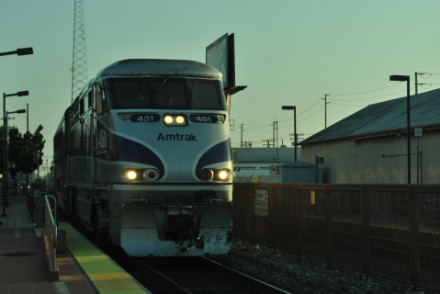
Pacific Surfliner 562 arrived and I boarded the last car then the conductor scanned my ten ride ticket and I showed him my just-produced 2018 calendar. The train stopped in Irvine before San Juan Capistrano.
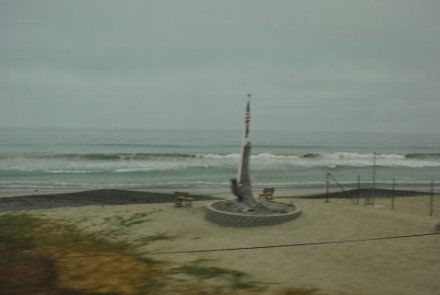
My favouite American Flag.
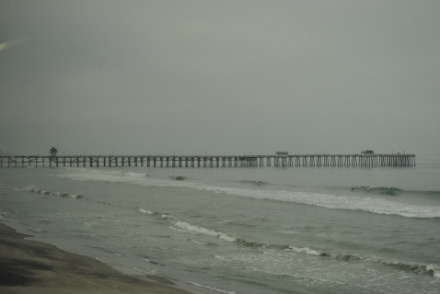
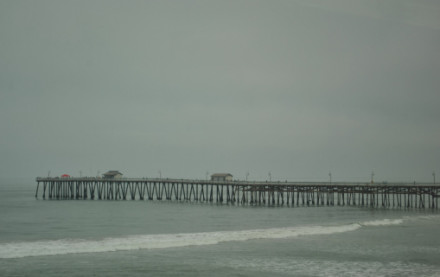
The San Clemente Pier.
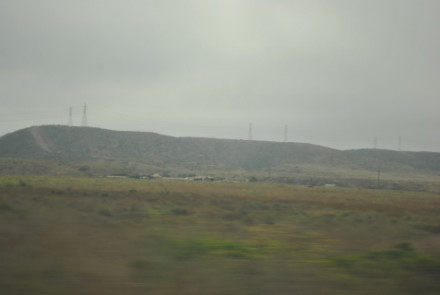
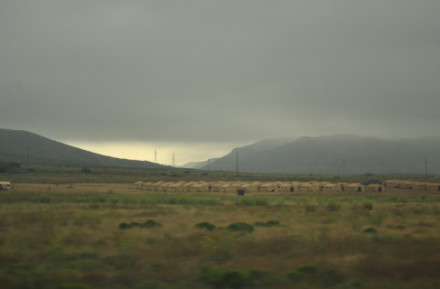
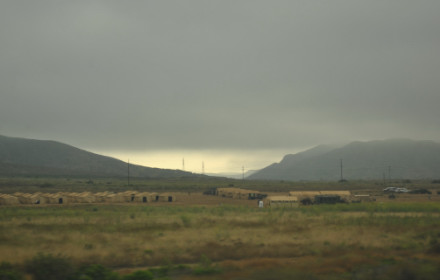
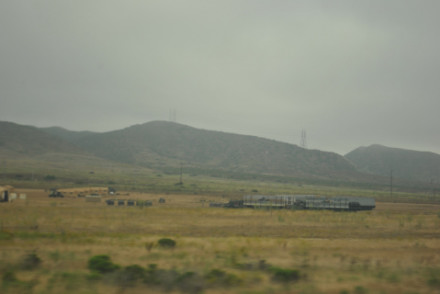
United States Marines were out on maneuvers this week. We met Pacific Surfliner 565 before arriving in Oceanside, where I detrained and walked over to Track 2 to board Metrolink 661.
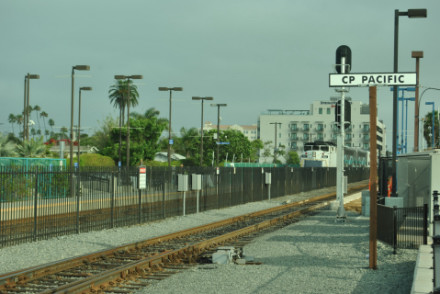
CP Pacific at the south end of Oceanside station, leading to the Track 3 platform that many trains use during the day as the platform in front of the station was closed for construction. In the background is Metrolink 661, which I boarded, found busy and chose a table on the inland side. We stopped at San Clemente Pier, San Clemente North Beach, San Juan Capistrano, Laguna Niguel, Irvine and Tustin before the conductor had to flag McFadden Street in Santa Ana then arrived there. Robin soon joined me and we stopped in Orange, Anaheim, Fullerton, Buena Park and Norwalk/Santa Fe Springs.

Along the Los Angeles River, a Union Pacific power move before we stopped to let the Coast Starlight leave LAUPT for Seattle. We then proceeded to LAUPT, where we found Christy Walker in the front car and she joined us. We detrained and the person in charge of the event informed us they were closed until noon but upon showing him my Railnews Press Pass, we walked in.
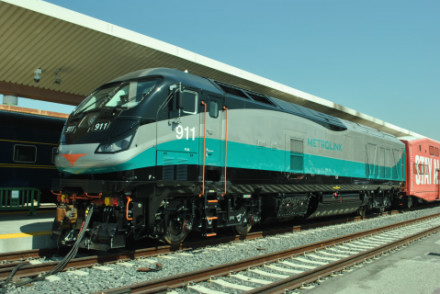
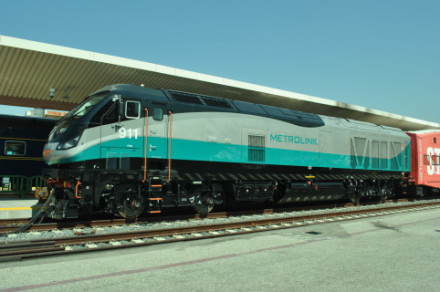
Metrolink F125 911 was on display along with Metrolink coach 208 in a Stay Alert, Stay Alive wrap.
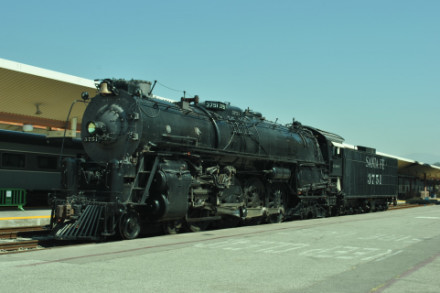
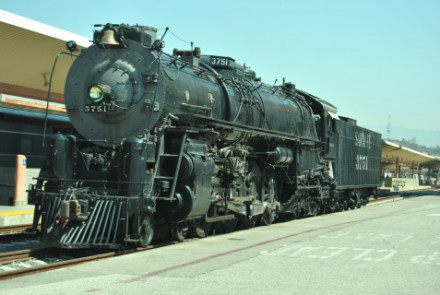
Santa Fe 4-8-4 3751, built by Baldwin in 1927 was the highlight of the event.
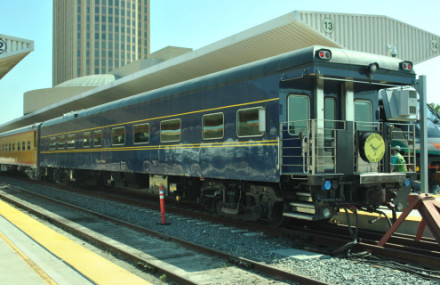
Observation Car Tioga Pass, built by Canadian National Railway in 1959. Originally numbered 23, and later numbered 93, "Tioga Pass" spent most of its life in Edmonton, Alberta where it served the Vice President of the Mountain Region. In 1992 Canadian National decided to sell the car, and a local businessman in Barstow, California named Rutherford P. "Rudy" Hayes bought it sight unseen because, as he put it, "I always just wanted one." In an epic trip, the car travelled from Edmonton to Barstow in January 1993. Through fierce cold and driving blizzards, the passengers stayed warm inside. Its new owner was like a proud father, pronouncing the car was all he ever thought it would be. Unfortunately, Rudy never got the chance to travel on his new car. He died of a heart attack only months after it was delivered. The car sat, forlorn and neglected in front of the Harvey House train station in Barstow for several years. Aronco Leasing Company and Norman Orfall purchased the car in 1997 from the Hayes estate and completely overhauled it over several years.
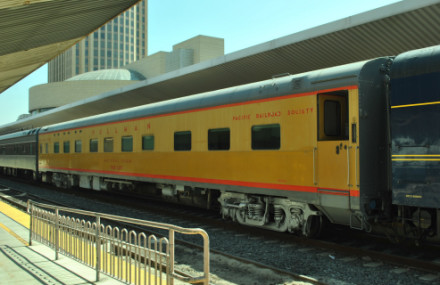
Pacific Railroad Society Sleeper 1207 "National Forum". In 1955 and 1956, the Union Pacific Railroad and the Wabash Railroad, both of whom partnered to run the City of St. Louis, received some of the last sleepers to be built before the advent of Amtrak. In addition, these cars, named in the National series, were also the last passenger cars built with open sections.
The National cars contained 6 sections, 4 double bedrooms and 6 roomettes (6-4-6). Although similar in accommodations to the pre-war American (4-6-6) series of cars built for the UP, the Nationals had numerous improvements and modifications. The most notable changes from the Americans design were the placement and design of the four double bedrooms. In the Americans, the double bedrooms were over one of the trucks and closest to the vestibule. This meant that one of the most expensive accommodations were located in the one of the noisiest areas of a passenger car. In the Nationals, the bedrooms were moved to the quieter center of the car, away from the trucks and vestibule. In addition, unlike the American bedrooms, the toilets in the National bedrooms were enclosed.
The Nationals were assigned to the City of Portland, City of Denver, and City of St. Louis trains. Numerous changes in the passenger traffic occurred on the UP during the late 1950's and early 1960's. By June 30th, 1968, due to reduction in passenger traffic on the UP and the discontinuance of the City of St. Louis with the merger of the Wabash into the Norfolk and Western, the Nationals' service was relegated to the secondary service on the Denver-to- Portland Portland Rose. By December 1969, the Portland Rose was history and the Nationals were idle. During the 1970-71 ski seasons, the UP Los Angeles passenger office operated at least two ski trains to Sun Valley utilizing the idle Nationals. In addition, the Union Pacific used the Nationals in special excursion service until the advent of Amtrak in 1971.
Between 1969 and 1971, the Pacific Railroad Society leased the National Forum and other National cars for excursion service. Impressed with the cars, PRS bought two of the Nationals. In October 1971, PRS purchased the National Forum and in December 1971, purchased the National Embassy.
The National Forum has been used extensively in excursion travel. The National Forum is the only PRS car that is Amtrak compatible. In 1993, PRS members Will Walters and Marti Ann Draper completed the Amtrak work with assistance from Bill Farmer and Dave Abbott.
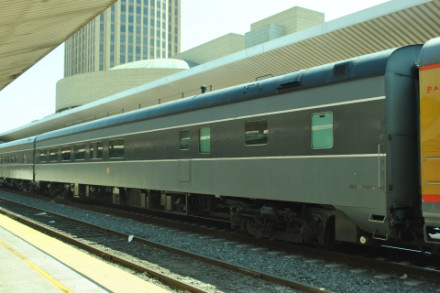
Southern Pacific lounge car "Overland Trail", nee Southern Pacific 2941, built by Pullman Standard Car Manufacturing Company in 1949.
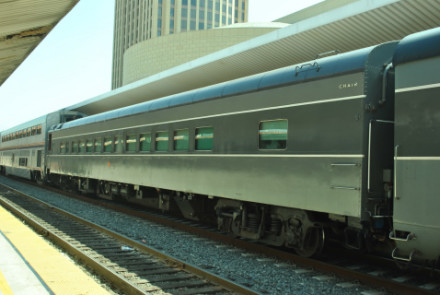
Southern Pacific coach "Amber Trail", ex. Amtrak 4403 1971, exx. Penn Central 3003, nee Union Pacific 5430 "Pacific Trail", built by Pullman-Standard in 1950. It was placed into general service, meaning it would serve where needed on trains all over the system. Built as a long-distance chair car, it featured plenty of leg room. Each pair of seats had its own window, venetian blinds, reading lights and decorative curtain on the pier panel between each window. This class of car also featured decorative artwork on the coach compartment bulkheads, large men's and women's restrooms with several washstands and rubber floor covering with inlaid designs.
After serving across the Amtrak system through the 1970s, the car was retired and sold at public auction in 1981. We purchased her in 1983 and have delighted in seeing her preserved for future generations to enjoy. The owner changed the name of the car from "Pacific Trail" to its current name "Amber Trail".
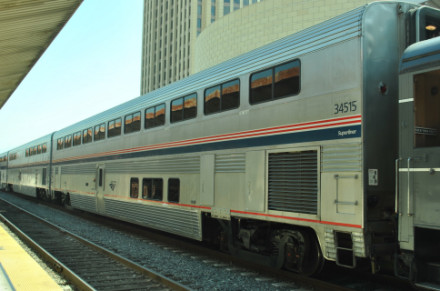
Amtrak Coast Starlight Business Class Car 34515, ex. Amtrak family coach 34512 1996, nee Amtrak 74-seat coach, built by Bombardier in 1995. Between 2008-2009, the lower level of the car was equipped with video arcade games. Amtrak has since returned these cars to regular coaches, having replaced the arcade on the lower level with the normal 12 coach seats found in normal Superliner coaches, still retaining the number 34515.
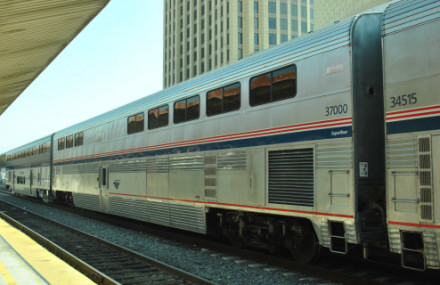
Amtrak Cross-Country Cafe 37000, nee Amtrak 38014, built by Pullman-Standard in 1979 and converted into its present form in 2006.
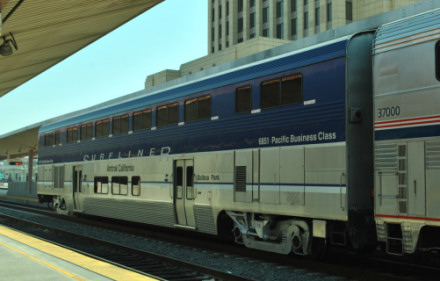
Pacific Surfliner Business Class Car 6851 "Balboa Park" built by Alstom in 2000.
With that, I walked back to the waiting Metrolink 662 for the ride home. Christy first joined me, followed by Robin and we rode back to Santa Ana, while Christy went home to Irvine. This ended the coverage of a fantastic event.
| RETURN TO THE MAIN PAGE |