




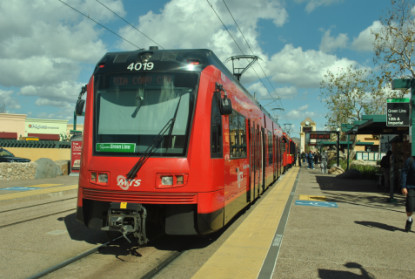
I decided to ride the entire San Diego Trolley system using the $12 Regional Pass on Presidents' Day and invited Chris Parker, his friend Bob Jacoby, Bob Gordon, David Aten and Robin Bowers to join me. That morning, I arose early and rode a round trip to San Clemente North Beach for a bit more mileage so drove to the Santa Ana station and bought my ticket then waited for Metrolink 803 on a very cold and windy morning. I rode south with Conductor Kim Chadwick and arrived at San Clemente North Beach.
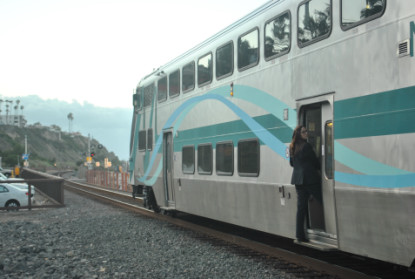
Conductor Chadwick checking for any other passengers before leaving for Oceanside.
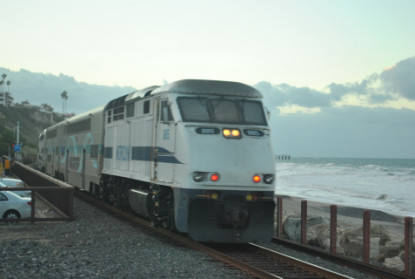
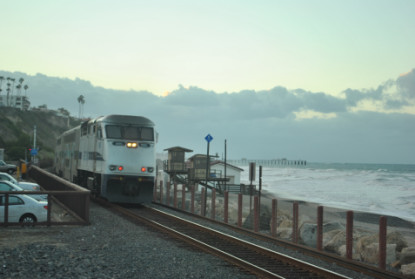
Metrolink 803 departed as the wind blew.
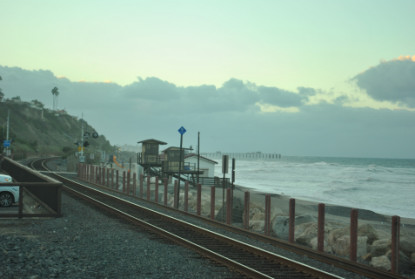
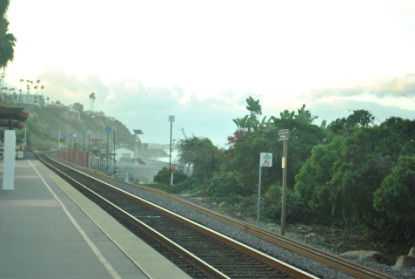
Looking southbound.
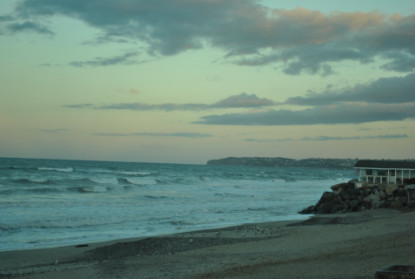
Looking north towards Dana Point with a very angry sea.
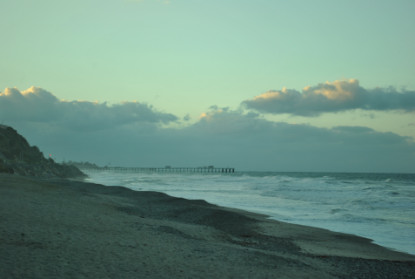
South towards the San Clemente Pier.
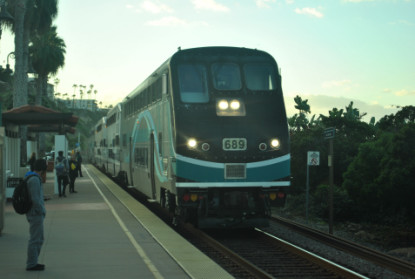
Metrolink 607 arrived, I boarded and walked into the cab car then chatted with Metrolink Conductor Henry. Chris called telling me that he and Bob Jacoby were on Pacific Surfliner 564 which was a Surfliner trainset, not a low-level set, which made me happy. Not many people were riding this holiday Monday and we arrived at Santa Ana early. I went home to re-charge the camera's battery for ten minutes then returned to the station where I found Robin Bowers inside ready to go and we braved the cold wind to wait for our train.
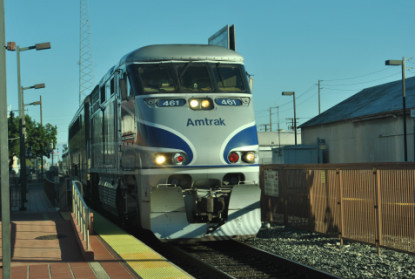
Pacific Surfliner 564 arrived and we boarded the cab car.

Our group: Bob Jacoby, David Aten, Bob Gordon, Robin Bowers and Chris Parker. We chatted throughout the journey to Oceanside.
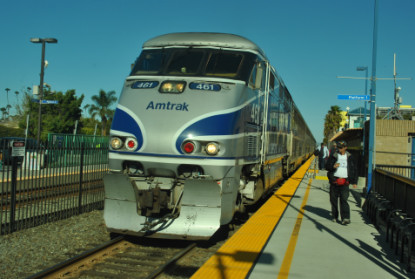
Pacific Surfliner 564 before it departed for San Diego. We all walked over to the Sprinter ticket machine then went to the Coaster ticket machine and had much better luck and I helped everyone but Robin get their paper tickets then led the way to Platform 3.
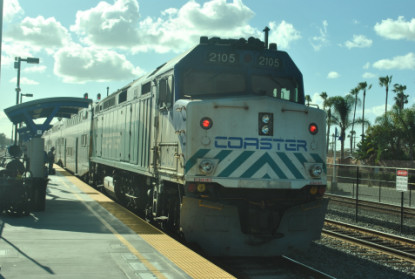
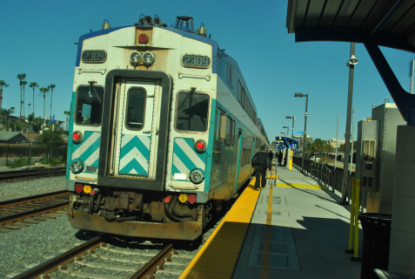
Both ends of our Coaster Train 644. We boarded the cab car for the ride to San Diego and more good conversations were had.
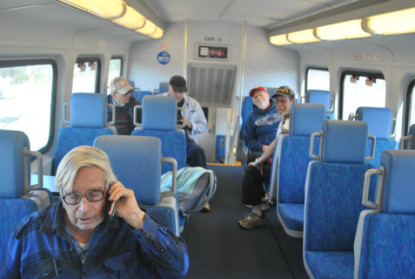
Our group on the Coaster.
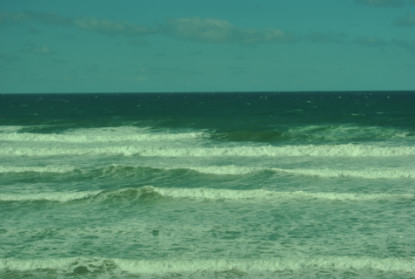
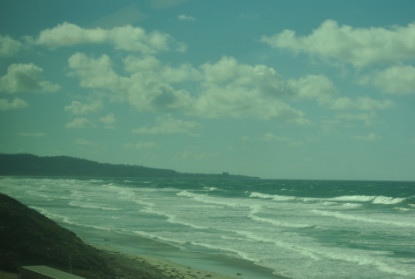
The angry Pacific Ocean on this very windy day. I pointed out the new construction zones, as well as the San Diego Trolley extension project then we all acquired a little new rail mileage when we crossed the new San Diego River bridge.
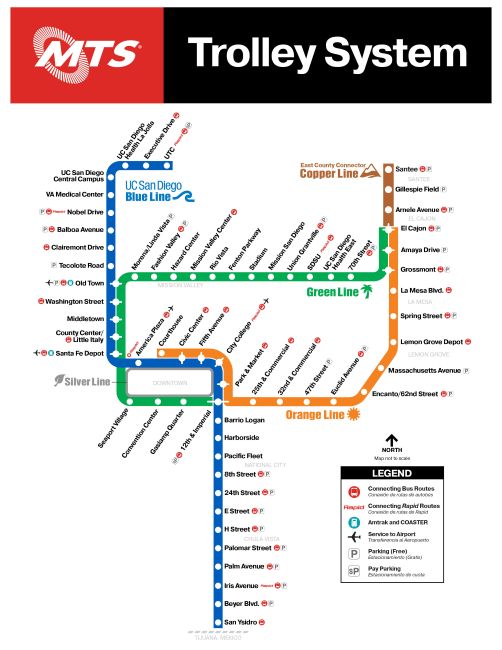
Electric rail service in San Diego traces its roots back to 1891 when John D. Spreckels incorporated the San Diego Electric Railway. San Diego's streetcar system had been replaced with buses in 1949, and by 1966 the local bus company, San Diego Transit, was facing a financial crisis and public takeover. Planning for mass transit in the San Diego region began in 1966 under the auspices of the Comprehensive Planning Organization, now known as the San Diego Association of Governments, an intergovernmental agency of 13 cities and San Diego County.
The trolley began service on July 26, 1981, making it the oldest of the second-generation light rail systems in the United States, and the success of the system helped spark a nationwide revival of light rail. The system serves 62 stations, over about 67.9 miles route, using four primary lines (Blue, Orange, Green, and Copper) that operate daily, and a "downtown loop" heritage streetcar line (Silver) that operates on holidays. There is one downtown station where all major lines connect, and thirteen other stations that provide transfers to a second line (two of these also provide connections to commuter rail systems).
San Diego Trolley operates with an all-Siemens fleet of light-rail vehicles on its main lines. It also runs two "heritage" PCC streetcars on the Silver Line, a downtown-only service with a limited schedule. When the system opened, it used high-floor Siemens–Duewag U2 vehicles originally designed for the Frankfurt U-Bahn. At the time, no purpose-built LRVs were manufactured for the North American market, so the model was adapted for San Diego and systems in Canada. A total of 71 cars were delivered in four batches as the Trolley expanded: nos. 1001–1014 in 1980, 1015–1024 in 1982, 1025–1030 in 1985, and 1031–1071 by 1989. Built in West Germany, later units were assembled with support from a Siemens' facility in Florin, California, which opened in 1984. The U2 cars were retired between 2010 and 2015 with eleven sold to the Metrotranvía Mendoza in 2010, 29 were retired after the Orange Line platforms were rebuilt for low-floor LRVs in 2013, and the remainder after the Blue Line platforms were rebuilt in January 2015.
Six cars have been preserved: no. 1001 by MTS for the Silver Line, nos. 1003 and 1008 at the Southern California Railway Museum,nos. 1017 and 1018 at the Western Railway Museum, and no. 1019 at the Rockhill Trolley Museum. Car 1035 was sold in 2020 to the Memphis Area Transit Authority, which operates a vintage-trolley system and plans to use the LRV to test modern, higher-capacity vehicles on its Madison Avenue Line.
In 1995, the Trolley acquired 52 high-floor Siemens SD-100 vehicles, an updated model designed specifically for the North American market. Starting with this order, all of San Diego's future LRVs would be built entirely in California. The SD-100s were retired from service in 2023. The transition to low-floor vehicles began in 2005 with the opening of the Green Line and the introduction of 11 Siemens S70 cars. Their design required slightly higher platforms, restricting their use to the new line and they were also 9.34 feet longer than the SD-100s, preventing three-car trains from fitting within a downtown block; as a result, they continue to operate only on the Green Line, which does not enter downtown, and the East County Copper Line on weekends.
In 2009, MTS ordered 65 Siemens S70 US ("Ultra Short") vehicles, which retained the low-floor design but matched the SD-100's length. In 2016, the agency ordered 45 Siemens S700 US cars with re-designed center sections that have longitudinal (aisle facing) seating to address complaints about the S70's cramped layout that limited passenger circulation. An additional 25 S700 US cars were ordered in 2019 and delivered by the end of 2021.
Our RideUpon arriving at San Diego, we boarded a waiting Green Line Trolley for Santee, taking it to the next stop of County Center/Little Italy, where the train stopped and we had to detrain due to the fact that the middle car would not communicate with the two end cars of this trolley set.
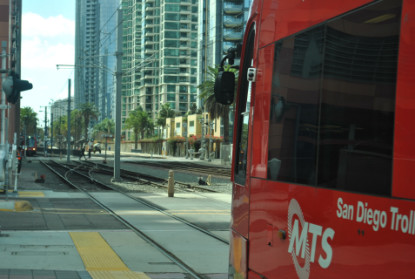

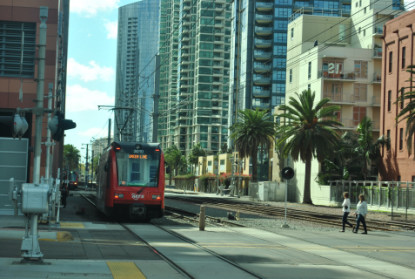
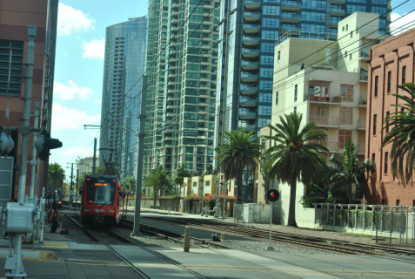
Our trolley then went to the barn and we waited for the next one to take us to Santee.

The next trolley arrived and we all boarded. However, this trolley only took us to Gillespie Field, where we were ordered off the trolley and would have to wait for the next one. I asked the operator the reason and he replied that something was blocking the route into Santee but would be cleared by the time the next trolley arrived.
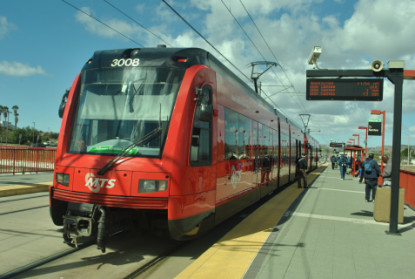
The trolley prepared to leave and return to 12th/Imperial station. It was here that the group walked away from me.
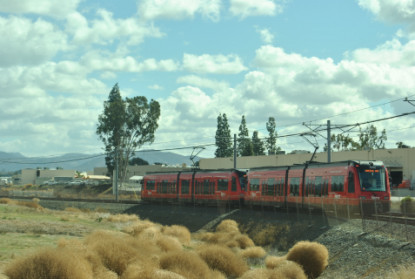
The second trolley returned.
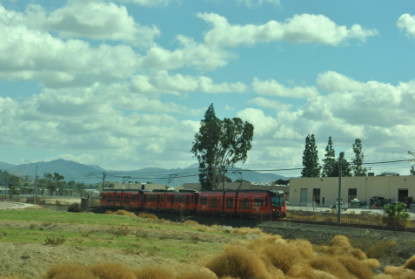
The third trolley of the trip on approach. I boarded the rear car while the rest of the group boarded the middle car and we travelled the rest of the way to Santee.
The trolley at Santee. After a washroom break, we rode the next trolley for El Cajon.
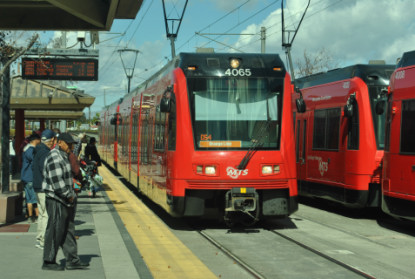
The Orange Line Trolley arrived at El Cajon and we rode it to the end of the line at America Plaza then walked across the street to the Santa Fe station and had ten minutes until our next Green Line trolley, bound for 12th/Imperial, arrived. This was also a washroom break and I returned in time to see Pacific Surfliner 579 leave San Diego for Los Angeles.
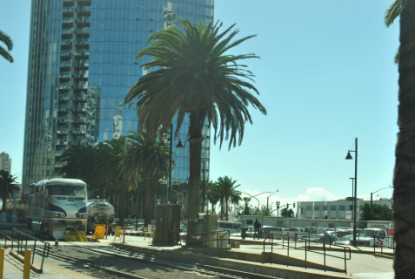
Amtrak always keeps a locomotive in San Diego in case a Pacific Surfliner train has an engine issue.
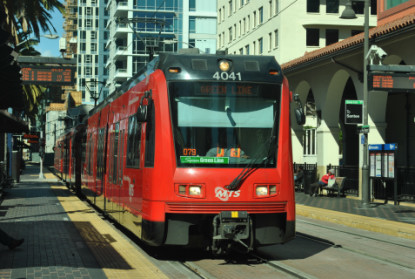
Next our trolley for 12th/Imperial came in and we boarded it to that station. Once there, we all walked over to board a Blue Line trolley to San Ysidro, then upon arrival, we stayed on and rode back to 12th/Imperial, where we boarded the next Green Line trolley back to the Santa Fe station. There, we boarded Coaster 653 for the return trip to Oceanside, passing Pacific Surfliner 774 just south of there, and we knew he would be over two hours late, so Pacific Surfliner 785 was going to be our ride home tonight.
We arrived at Oceanside where we went straight to Amtrak and I helped four members of our group get their Amtrak tickets for their respective cities from the Amtrak ticket machine. To escape the cold wind, we went to Burger King and I enjoyed a chocolate shake before returning outside.
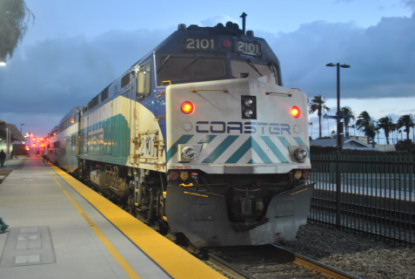
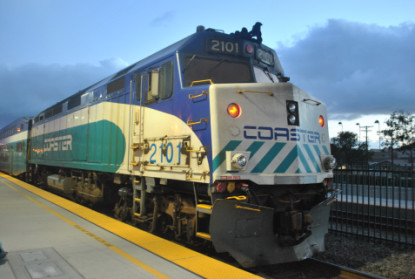
Twilight view of Coaster 657.
Pacific Surfliner 580.
Night-time station views.
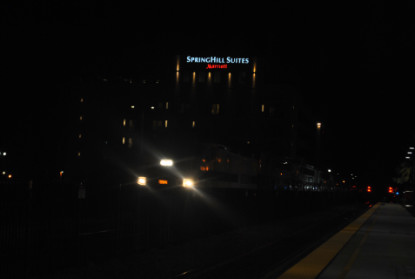

Metrolink 604 arrived.
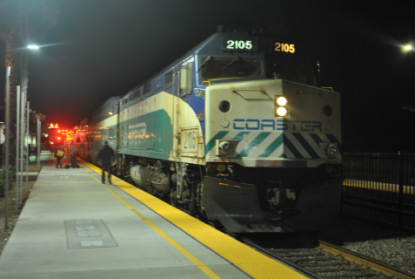
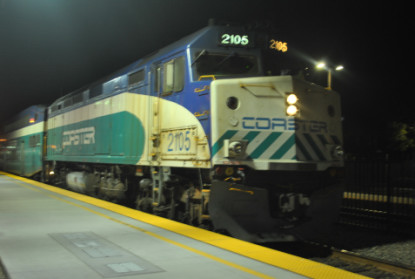
Coaster 661 before making is way north to Stuart Mesa.

Pacific Surfliner finally arrived and we boarded a standing-room only train over two hours late.
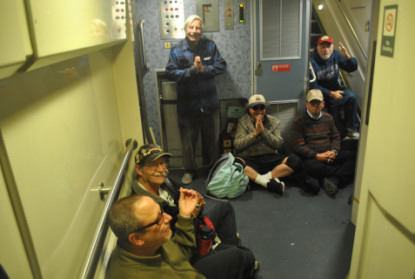
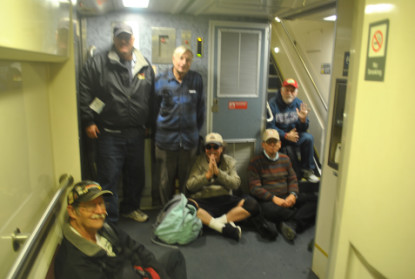
Our group on Pacific Surfliner praying for seats which never arrived. The conductor never checked our tickets, at least as far as Santa Ana, where I detrained, and received an apology from him for the lack of seats on this train. As I walked toward my car, Metrolink 689 was still sitting at Santa Ana waiting to be towed back to Los Angeles so I guessed my ride sitting on the floor was nothing compared to those poor passengers stuck on that Metrolink train for over three hours. I went home straight to bed, remembering my motto "Every Trip is an Adventure!"
| RETURN TO THE MAIN PAGE |