




The NRHS convention was now over so we slept in then walked over to Leo's Coney Island where I had French toast and my loving wife had an omelette. We checked out of The Graduate Hotel after doing our Internet duties and I drove us to Durand Union Station.
DurandThe Village of Vernon Center (now Durand) was built up around the railroads in the late 1850's. After the rapid expansion of the railroad in the 1870's, the Village incorporated itself as Durand in 1887. Durand Union Station was designed by Spier and Rohms and originally built in 1903. Eighteen months afterward, it was almost completely destroyed by fire and rebuilt in 1905.
This was a very busy station as the Grand Trunk Western and Ann Arbor Railroads crossed at grade there. During the early 1900's when the railroad industry was at its peak, 42 passenger trains, 22 mail trains and 78 freight trains passed through Durand daily. Durand Union Station handled approximately 3,000 passengers per day, making it a prospering hub of the industry.
America came into maturity riding the rails. The railroad helped build, shape and define the America we live in today. Railroads helped open the frontiers to settlement, and soon after, to industrialization. The decline of rail traffic started at the end of World War I and culminated in 1974 when Grand Trunk determined it could no longer justify the cost of maintaining the station. Abandoned, the old depot's destruction appeared imminent, but the community rallied to save it and in 1979, the City purchased it for $1.00. Since then, it has become the State Railroad History Museum.

Welcome to Historic Durand Union Station sign.
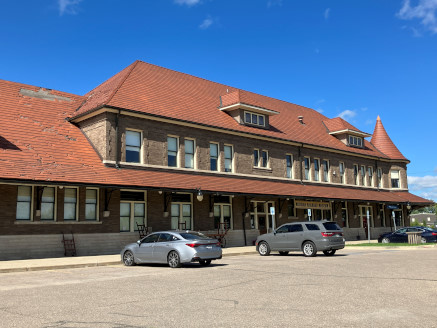
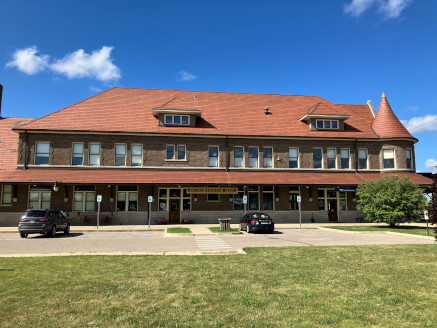
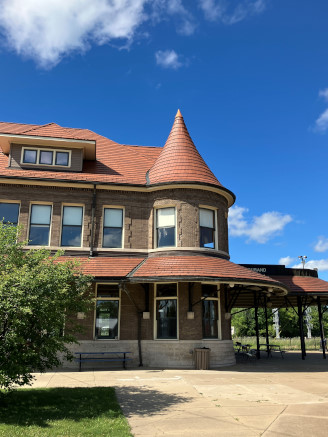
Durand Union Station built in 1903 by the Detroit firm of Spier and Rohns, contained a formal dining room as well as a snack counter complete with swivel stools and a rack of comic books selling for a nickel each, you could also buy a daily paper from a nearby newsboy. A large postal box collected the mail, which was sent by rail to its destination. The second floor of the building held railroad offices and a sleeping area for train crews. The lower level of the massive depot, once the second busiest train station in Michigan, has been renovated to its original grandeur. Terrazzo floors gleam, beautiful oak-trimmed windows provide views of the surrounding tracks, and the restored ticket cage is reminiscent of the turn of the century. Because of its unusual Chateau Romanesque architecture, the Durand Depot has gained prominence as one of the most photographed train stations in America.
Passengers still walk the corridors of the depot to board their train. The Amtrak Blue Water eastbound to Port Huron and westbound to Chicago make daily stops at the Durand Union Station. Thirty or more freight trains pass the station daily providing for excitement and photo opportunities for rail fans on a regular basis. All the activity proves that while waiting on the depot platform, people can still experience the sights and sounds of railroading and imagine what it was like decades ago.
The depot is also the State Railroad History Museum, an educational and entertaining source of Michigan's rich railroad history. The museum gallery features new exhibits several times per year to pay tribute to the colorful heritage of the railroader, and to the contribution of Michigan's railroads to lumbering, mining, agriculture and industry. The Museum Information Center and Archives contains a wealth of railroad information for rail enthusiasts, researchers and genealogists. Included in the collection are photographs, ledgers, technical railroad information, union materials and a variety of other documents pertaining to railroading in Michigan.
It had a high volume of rail traffic as the Grand Trunk Western and Ann Arbor railroads crossed at that location. It was almost destroyed by fire in 1905, but quickly rebuilt. At its peak, 42 passenger, 22 mail, and 78 freight trains passed through Durand on a daily basis. It serviced almost 3,000 passengers a day.
In July, 1950, the station lost northwest–southeast service with the Ann Arbor Railroad's terminating passenger service, which went from Toledo to Frankfort and Elberta on Lake Michigan. (Elberta was a launch point for ferries north and west across Lake Michigan.
Into the 1960s the Grand Trunk Western (operating in Canada under the Canadian National Railway) three trains a day operated as part of Chicago - Port Huron - London - Toronto trains: Inter-City Limited, International Limited (only making stops on the eastbound trip), La Salle and Maple Leaf. Until 1960 the Grand Trunk also into ran through trains from Detroit to Grand Rapids and Muskegon, where ferries could be boarded, for travelling across Lake Michigan, to Milwaukee. From Durand passengers could also board Detroit - Bay City mixed trains.
DeclineIn 1971, the Grand Trunk Western terminated its last trains through Durand. These included the International Limited, its Chicago-Detroit Mohawk and an unnamed duplicate itinerary train with that route. In 1974, the GTW decided to close the station due to declining traffic. The historic building was going to be torn down, however, the city of Durand filed for an injunction to stop the demolition and eventually purchased the station in 1979 for $1.00.
Amtrak restored service through the station in 1974 and today Amtrak continues to provide daily intercity passenger rail service on the Blue Water route between Chicago and Port Huron, a remnant of the Grand Trunk service. Baggage cannot be checked at this location; however, up to two suitcases in addition to any "personal items" such as briefcases, purses, laptop bags, and infant equipment are allowed on board as carry-ons. From 1982 to 2004, it was instead served by the modern incarnation of the International Limited, operated jointly by Via Rail and Amtrak between Chicago and Toronto.
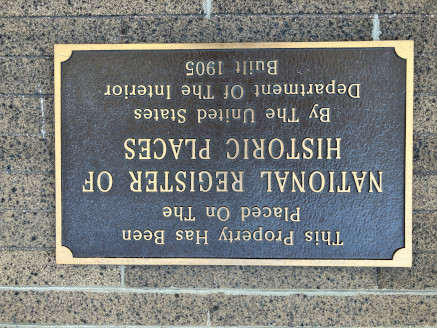
This property has been placed on the National Register of Historic Places by the United States Department of the Interior.
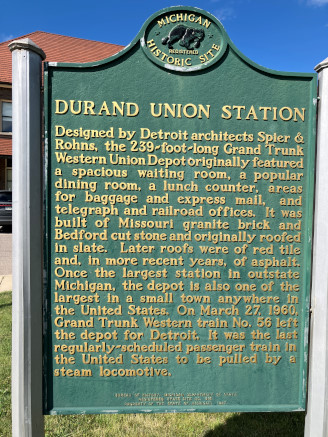

Durand Union Station Historic plaque.
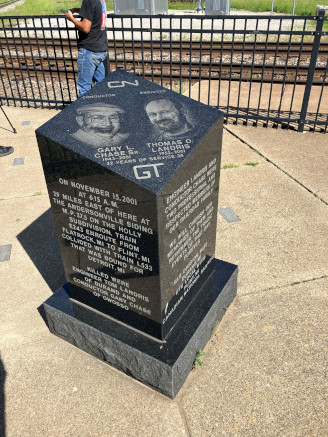
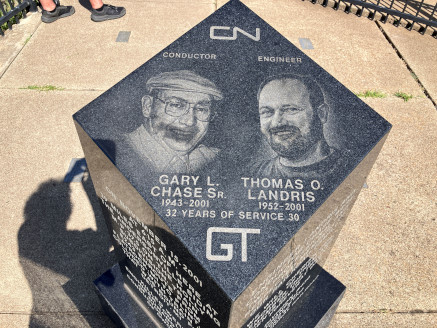
A memorial to Conductor Gary L. Chase, Sr. and Engineer Thomas O. Landris.


The memorial.
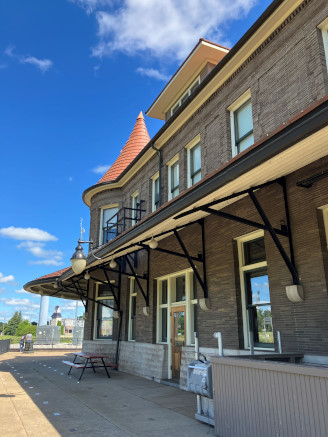
After exploring the exterior, we went inside.
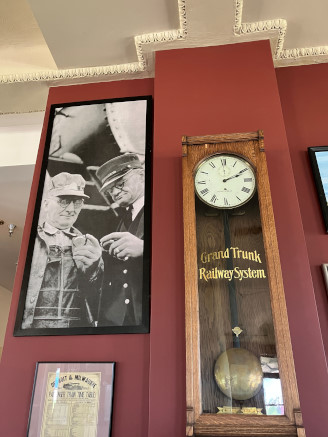
Time-keeping was a must on the railroad and Seth-Thomas clocks were found in most stations.
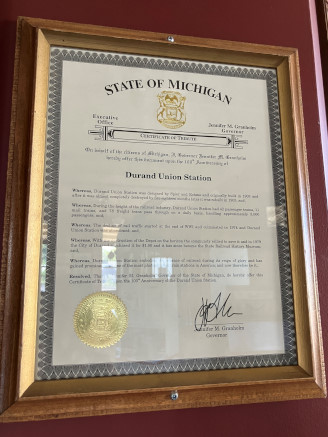
Certificate of Tribute on the 100th Anniversary of the station by Governor Jennifer M. Granholm.
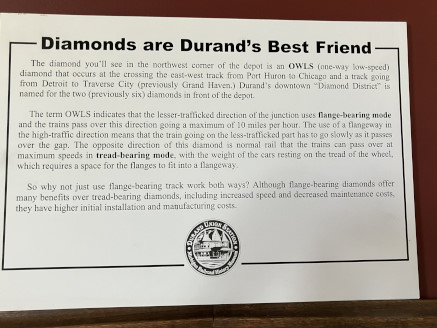
Diamonds are Durand's Best Friend, explaining the diamond crossing at the northwest corner of the depot.
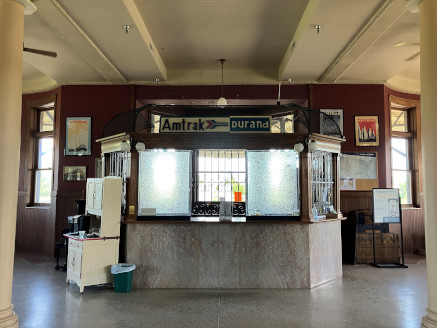
The Amtrak ticket window which serves the Blue Water from Chicago to Port Huron.
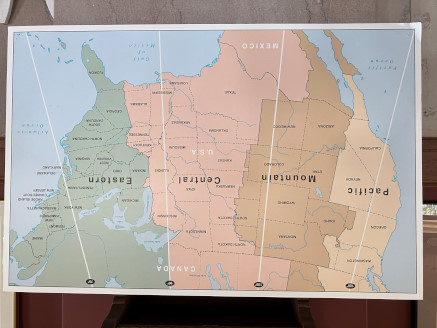
Time Zone Map, something neither of us had seen in a station before.
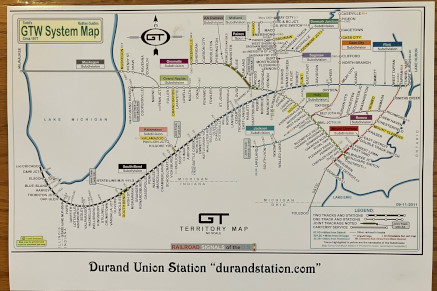
Grand Trunk Territory map circa 1977. We then went upstairs.
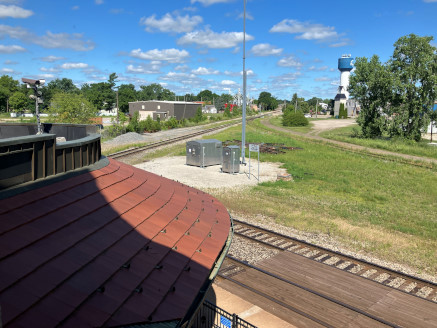

Looking northeast, where former Grand Trunk Western, now Canadian National, Holly and Flint Subdivision interchange. The latter starts at Port Huron, MP 334.2 and goes to Emmett Street at MP 178.8. Durand is at MP 253.3.
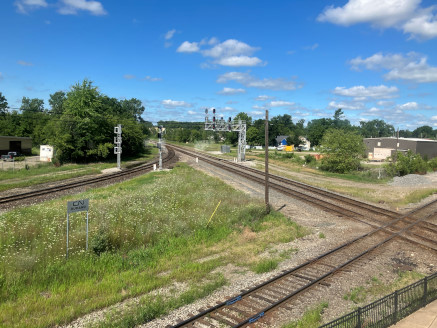
Looking north at Canadian National's Holly Subdivision, which starts at Milwaukee Junction and ends at Durand, MP. 67.0.

The interchange track from the Holly Subdivision to the Flint Subdivision.
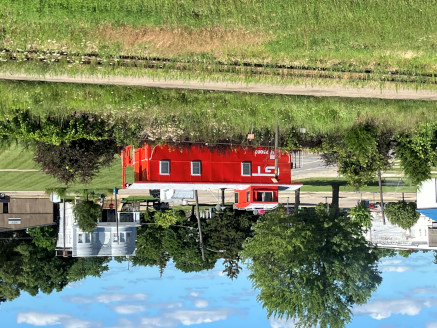
Grand Trunk Western caboose 75003 across from the station.
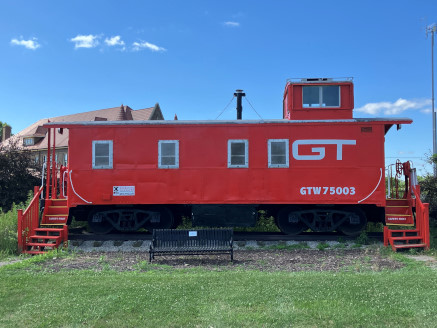
We then drove over to Grand Trunk Western caboose 75003, nee Santa Fe 1647 built by American Car and Foundry in 1928. It was rebuilt twice by the Santa Fe before the Grand Trunk Western purchased it in 1969. Upon delivery, it was re-numbered to 75003 to match the local standard. This caboose was used around the Durand area until 1988, when it was sent to Port Huron's yard and retired in August 1989. Shortly thereafter, it was purchased by Jim and Laurie Kapp and donated to Durand Union Station.
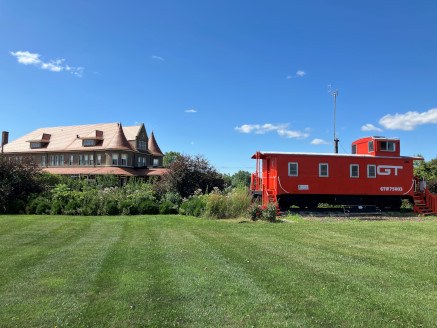
Caboose 75003 and the Durand Union Station.
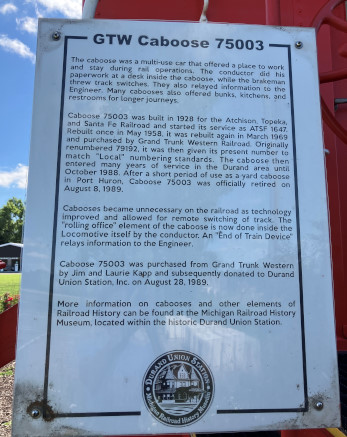
Grand Trunk Western caboose 75003 information board.

Durand Union Station seen from across the tracks. There was a third attraction close by at Kiwanis Railroad Park.
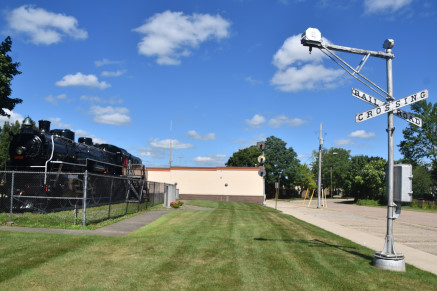
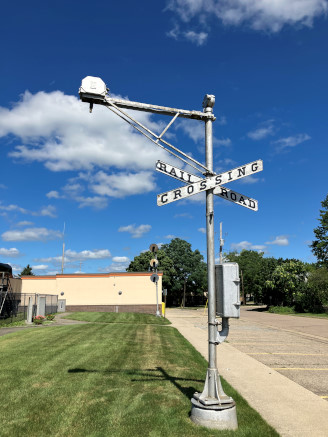
The Western Supply Railroad wig-wag crossing signal.
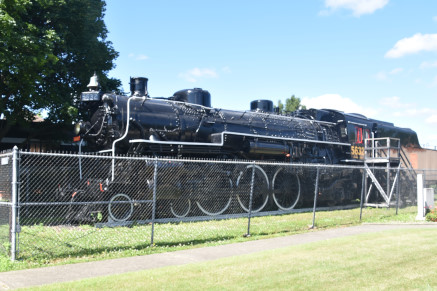

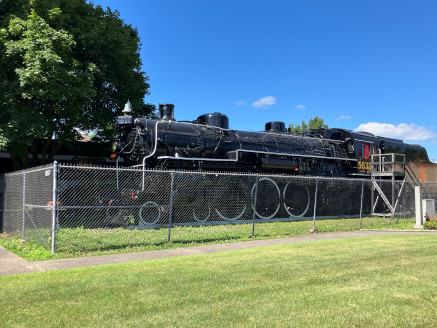
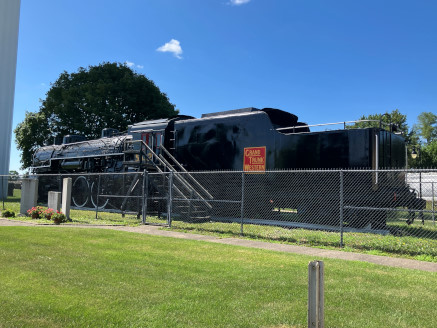
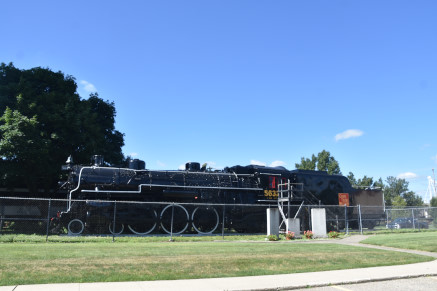
Grand Trunk Western 4-6-2 5632 built by Baldwin in 1929 and donated to the City of Durand in 1961.
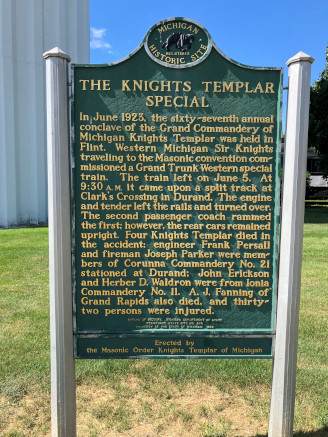
The Knights Templar Special plaque.
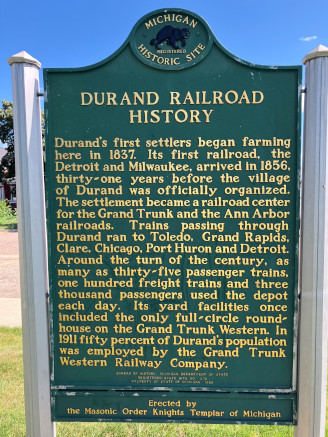
Durand Railroad History information board. As we were exploring, we heard a horn.
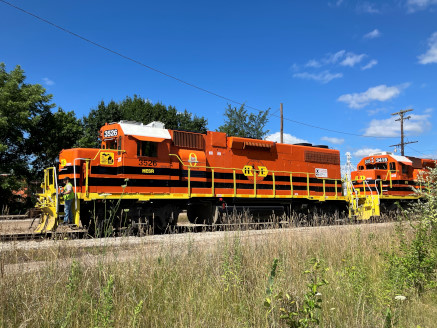
Huron and Eastern GP38-2 3526, ex. Helm Leasing 1822, exx. Union Pacific 322, nee Missouri Pacific 2059, built by Electro-Motive Division in 1972.
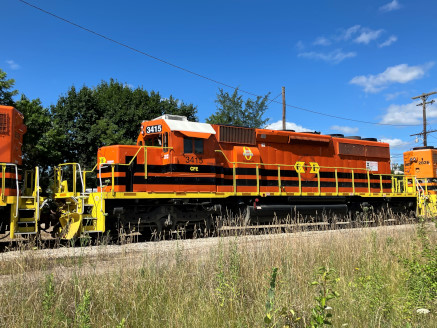
Chicago Fort Wayne and Eastern SD40-2 3415, ex. Norfolk Southern 3541, exx. Helm Leasing 7171, nee Burlington Northern 7171, built by Electro-Motive Division in 1979.
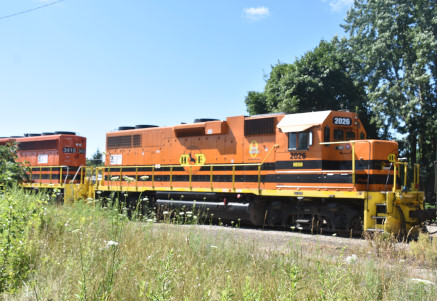
Huron and Eastern GP38AC 2026, ex. Huron and Eastern 8804, exx. Central Michigan 8804, nee Baltimore and Ohio 3720, built by Electro-Motive Division in 1969.
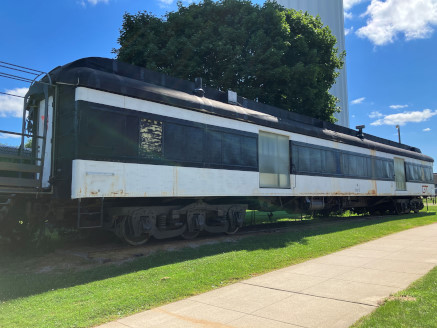
Back to the displays and Grand Trunk Western Railroad baggage car 8812, nee Canadian National colonist sleeper 2791 built by Pullman in 1919. It was rebuilt to a baggage car in December 1938 and leased to Grand Trunk Western as GTW 8812.
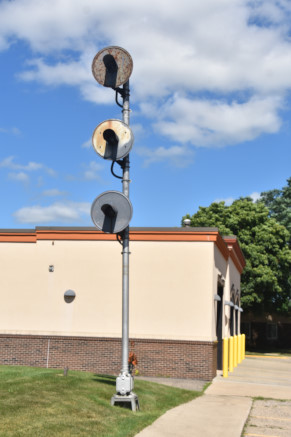
A tri-colour signal. Having seen and photographed everything we wanted in Durand, we continued the journey to Crossroads Village in Flint.
Crossroads Village HistoryIn 1967, local individuals and organizations realized that many structures of historical importance in the Flint area were being destroyed, and plans for the construction of interstate highways and urban development would necessitate the demolition of additional buildings. There was also a realization that rural skills, equipment and crafts were being lost. The idea of a Farm Museum was proposed at the December 12th, 1968 meeting of the Commission by John West and Stanley Mahaffy and considerable interest was shown by the Commission.
On May 8th 1969, the Commission was appointed as advisory committee on historical preservation and the Genesee County Historical Society became involved with the project and was represented on the advisory committee. The Wisner Carriage Barn and Buzzell House, donated by the Highway Commission, were moved to the present site. The buildings were placed within the Genesee Recreation Area near the C.S. Mott Children's Farmland that had been given to the people of Genesee County by the C.S. Mott Foundation. The Carriage Barn was moved to the area in 1969; the Eldridge-Hamner House, located on land that had been purchased by the Commission in Genesee, was also moved to the Village site.
Eventually, ideas to create a farm museum and preserve buildings of historic importance merged into the concept of a rural village. Impetus came with the realization that the nation's bicentennial was fast approaching. In the summer of 1973, the County Board of Supervisors adopted the creation of a rural Crossroads Village as Genesee County's Bicentennial project and funds were appropriated for planning purposes. The plans for this hypothetical Crossroads Village evolved from the common characteristics of rural villages in Genesee County as depicted in the 1873 Atlas of Genesee County. The master plan was approved at the August 1974 meeting of the Commission, and in September and October, the Clayton Town Hall and Davison Depot were moved to the Village. The Village, dedicated July 4th 1976, became a reality.
Effort was made to furnish all of the buildings with artifacts of the period 1860-1880 and create an impression of a "living village" with the sights, sounds, smells and activities characteristic of that period. In addition to preserving buildings and artifacts, the Village serves as a place to demonstrate the crafts of the past. Thus, the Village, the Huckleberry Railroad and the Genesee Belle serve as valuable educational resources and tourist attractions. You can experience a day in the life for yourself surrounded by authentic and replica buildings and artifacts.
Huckleberry RailroadThe Huckleberry Railroad was named because the train ran so slow, that a passenger could step off the train, pick some huckleberries and then jump back aboard the train. The Huckleberry Railroad began in 1857 as part of the Flint Pere Marquette Railroad. The line was built from Flint to Otter Lake then later to Fostoria. The Pere Marquette Railroad was absorbed by first the Chesapeake and Ohio and later the Chessie System, which became CSX Transportation.

The Crossroads station is from Davison, Michigan, eight miles from Flint, and is a Grand Trunk Western station built in 1900 and moved here in 1976 as a bi-centennial project.

Davison Depot information board.
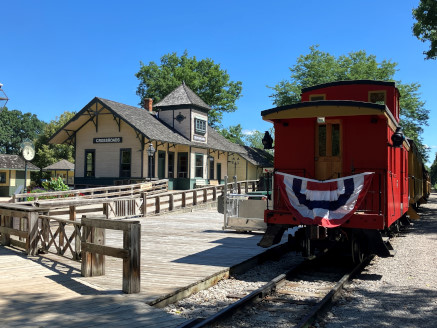
Crossroads Depot and the train.
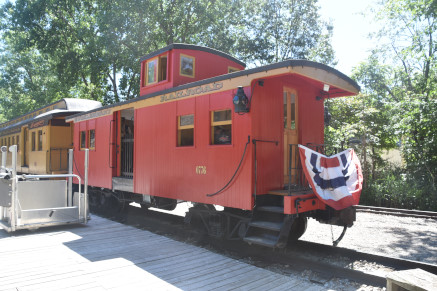
Huckleberry Railroad caboose 0776, nee Coahuila Y Zacatecas 152 built in 1880. We started exploring the village but went separately.
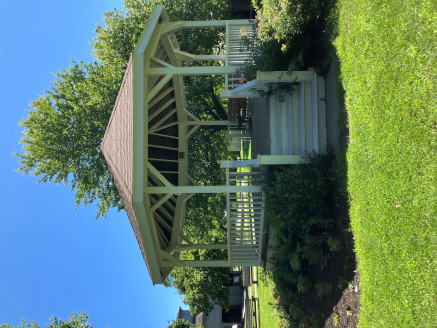
A replica of a Victorian gazebo.
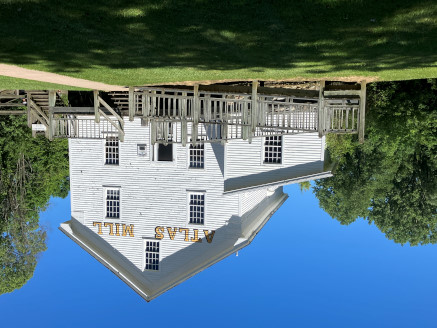

Atlas Mill, originally located in the Atlas Township, was built in 1936 and remained in operation until 1942. The mill is powered by a water-driven turbine.
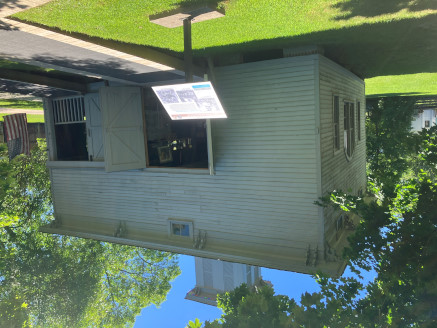
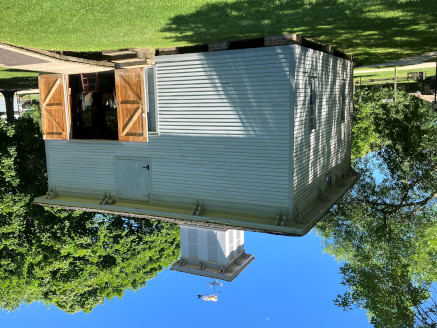
Carriage Barn, built in 1878, where the first automobile produced in Flint was assembled by Judge H. Wisner. It was originally designed to house a few carriages and horses.

Wisner Carriage Barn information board.
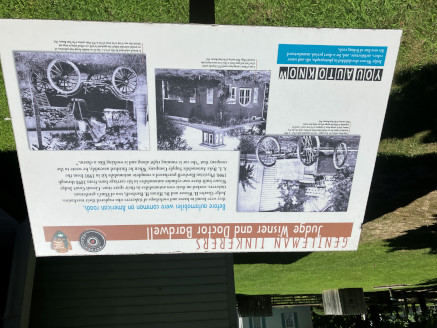
Gentleman Tinkerers Judge Wisner and Doctor Bardwell.
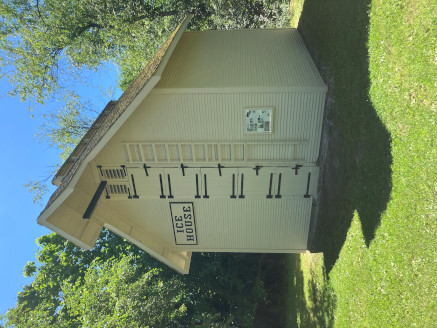
Ice House, originally located on a farm south of Holly, has a foot of sawdust packed in its walls for insulation.
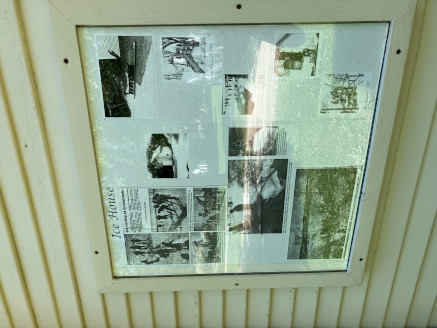
Ice House information board.
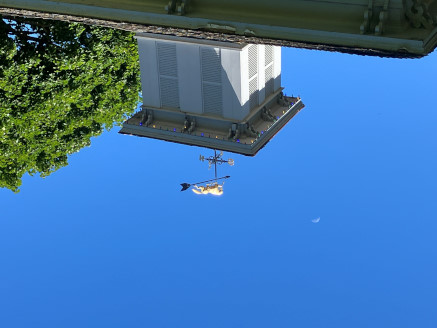
On top of the Ice House was horse weather vane with the moon in a third quarter phase.
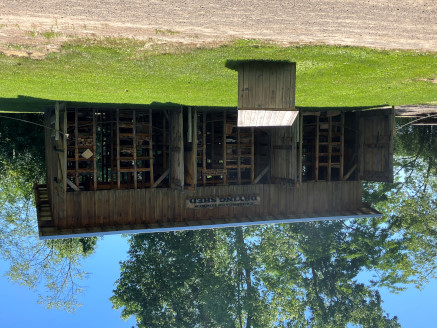
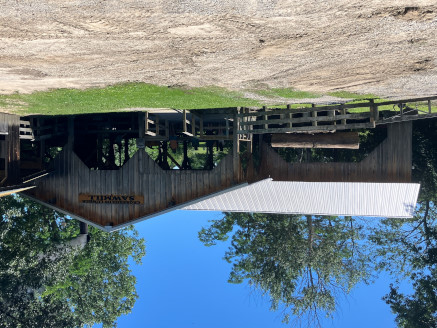
Crossroad Lumber Company was a major industry in Genesee County in the mid 1880's and the mill is a typical example of a portable sawmill moved from one lumber camp to another.
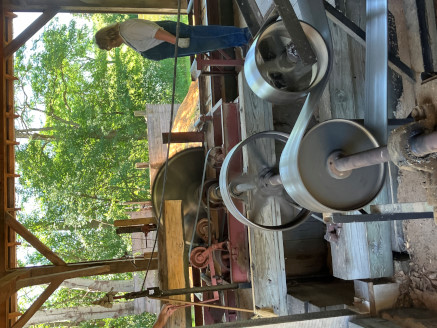
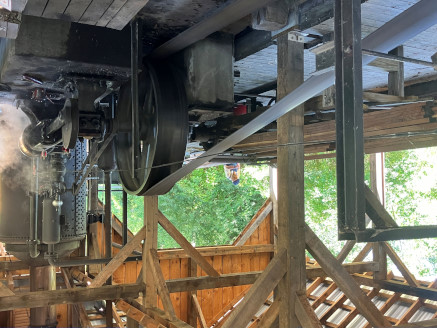
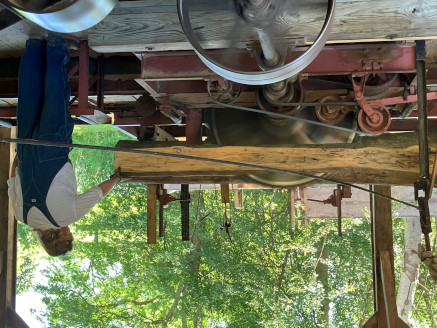
Sawmill demonstration.
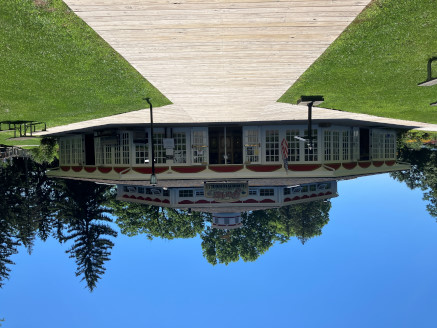
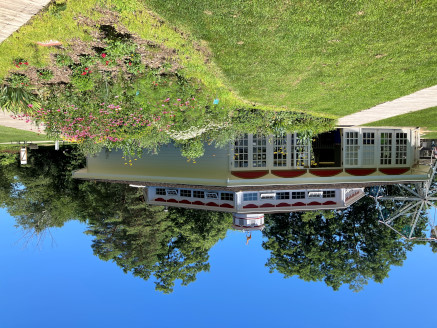
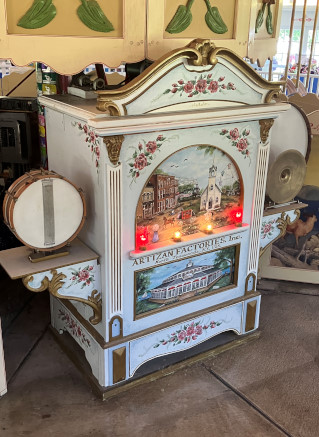
Charles W. Parker Carousel manufactured in 1912 by "America's Amusement King". It features 36 horses and an antique Artizan band organ.
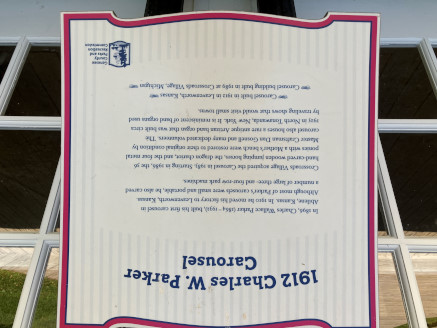
Carousel information board.

The band organ is behind this decorative exterior.
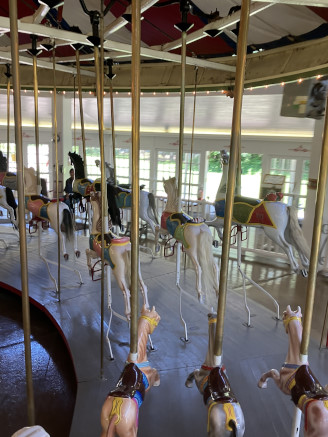
Elizabeth had her first carousel ride here and was the sole rider on their first ride of the morning.
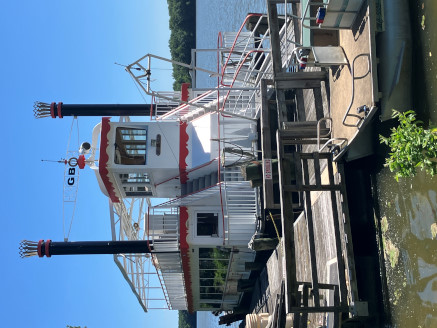
The Genesee Belle which takes people on a cruise of Mott Lake.
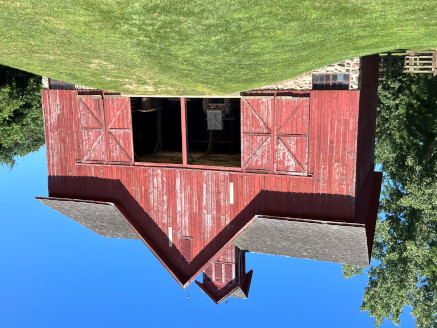
The fancy Queen Anne-style Fenton Carriage Barn houses broom-making equipment and was moved from Fenton in 1994.
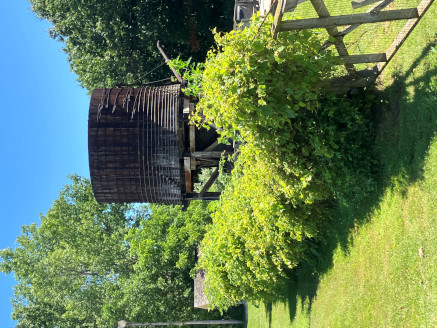
The Crossroads Village water tank. We returned to the station area and set up for photographs.
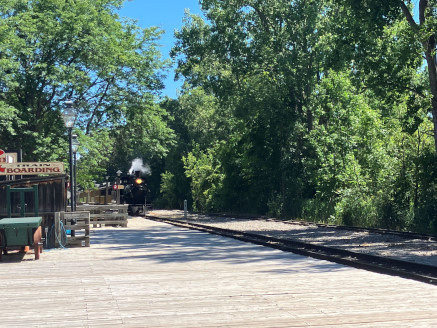
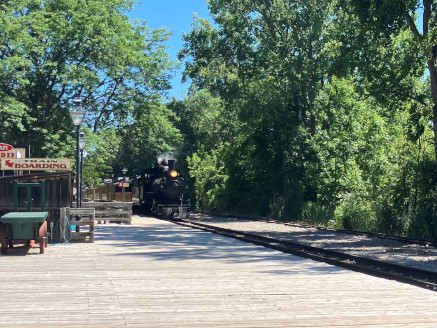

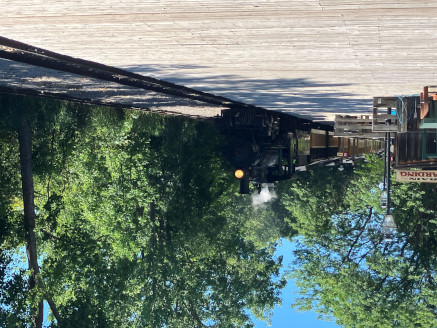
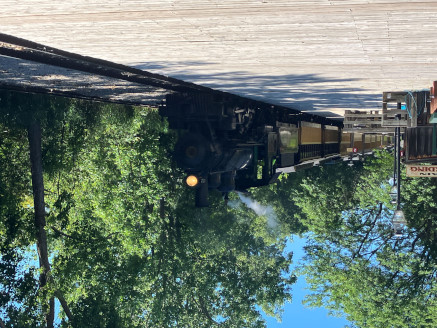
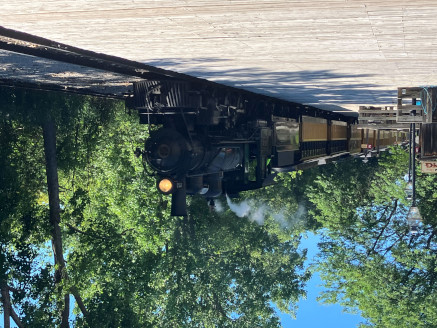
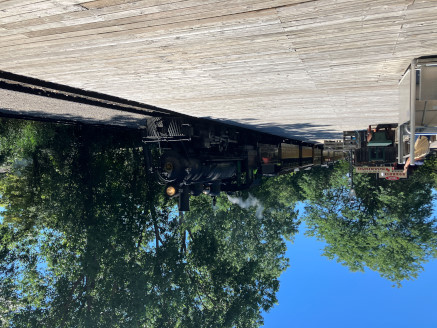
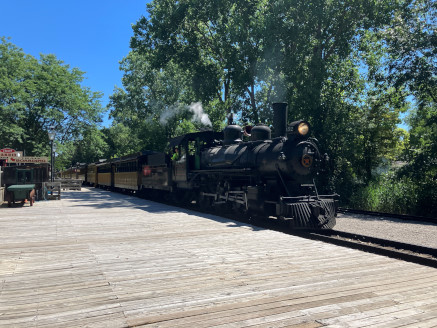
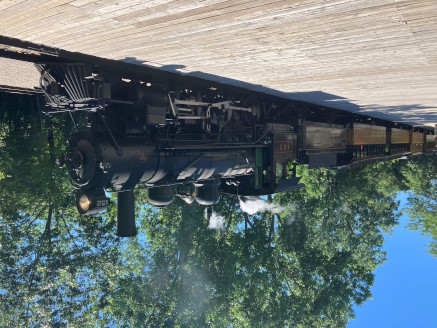
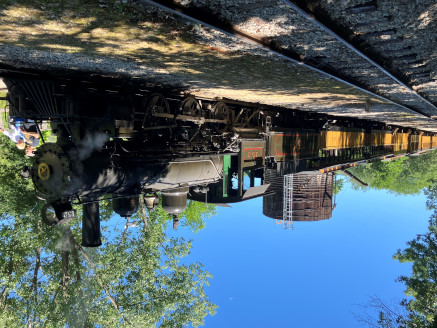
Huckleberry Railroad 4-6-0 152, ex. Huckleberry Railroad 2 1975, exx. Keystone Light Railway Company 2 1974, exxx. Camino, Cable and Northern 2 1963, exxxx. Antelope and Western 2 1951, exxxxx. M. Davidson Scrap Company at Stockton 1946, exxxxxx. transfer to United States Army 152 at Skagway, Alaska, exxxxxxx. Alaska Railroad 152, nee Alaska Engineering Commission 152, built by Baldwin Locomotive Works in 1920.
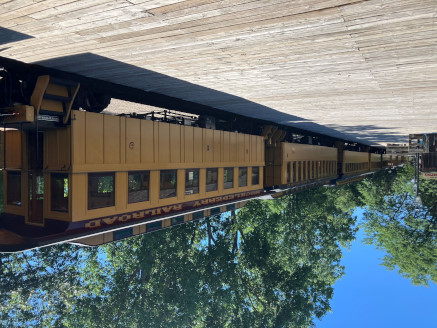
Huckberry Railroad coach 9, ex. Camino, Cable and Northern Railroad 9, nee Diamond and Caldor Railroad flatcar 243, built in the 1920's.
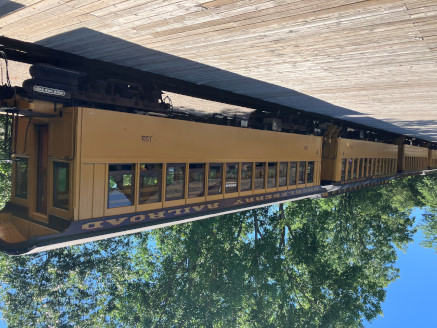
Huckberry Railroad coach 102, ex. Chino Airport, exx. Early West Railways, nee National Railways of the Yucatan 102 built in the 1890's.
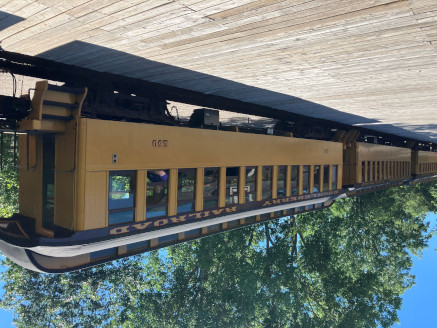
Huckleberry Railroad coach 260, ex. Rio Grande Southern maintenance car 0260 for bridge and building gang, nee Rio Grande Southern 260, built by the Denver and Rio Grande in 1896. It was the only "new" coach that the RGS rostered and worked until the 1930's when the Galloping Geese replaced steam-powered or mixed trains.
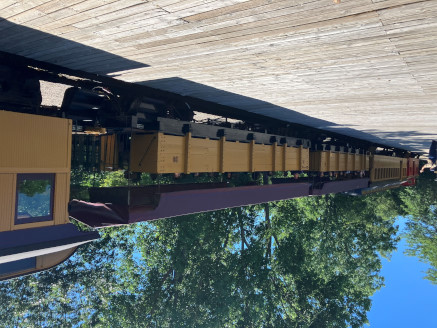
Hucklbverry Railroad open air gondola 30, ex. Coahuila y Zacatecas 30, exx. Antelope and Western 30, nee San Bernardino National Orange Show 30 built in the 1920's. Also pictured is open air gondola 20 with the same history.
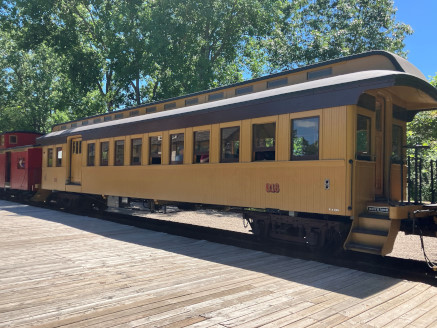
Huckleberry Railroad combine 316 built by the railroad in 1996 from blueprints of an 1800's combine. It was fitted with a special interior for wheelchair patrons and will fit up to 14 chairs.
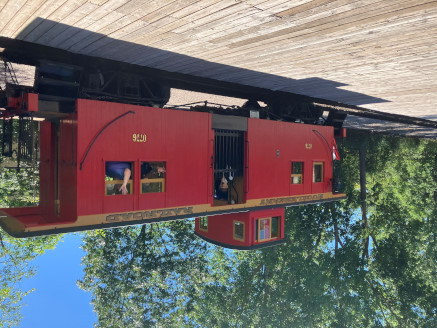
Huckberry Railroad caboose 0776, nee Coahuila Y Zacatecas 152 built in 1880.
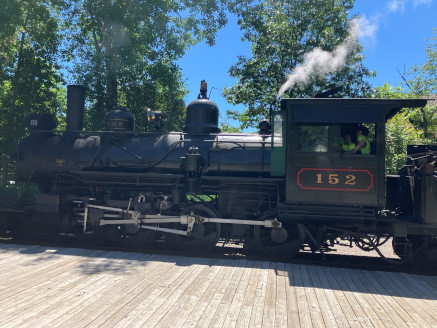
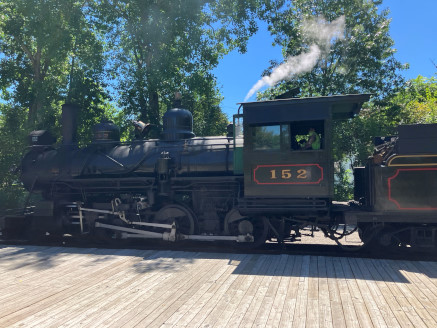
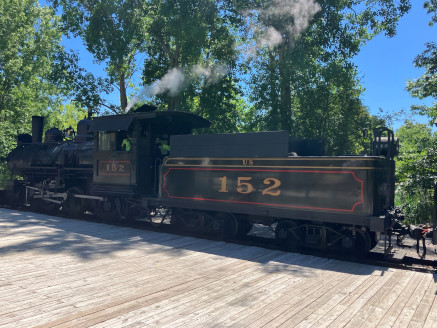
Huckleberry Railroad 4-6-0 152.
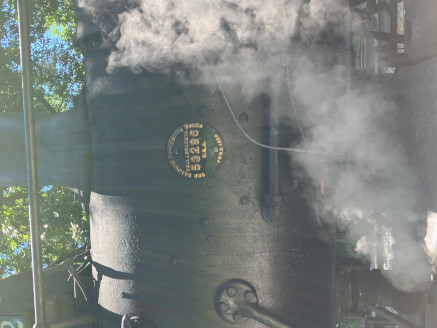
The builder's plate.
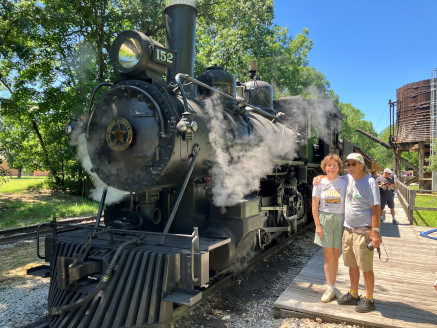
Elizabeth and I next to Huckleberry Railroad 4-6-0 152.
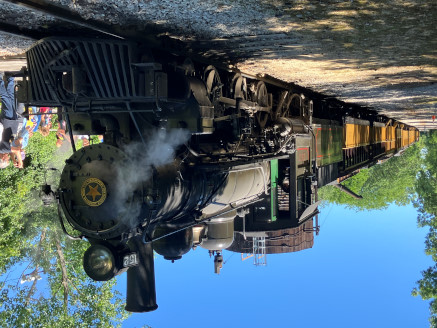
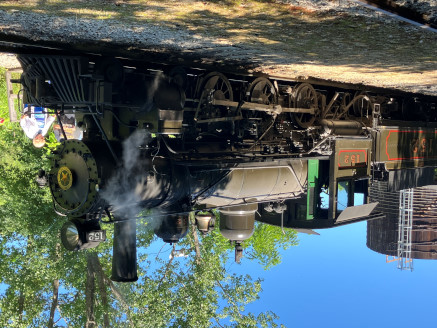
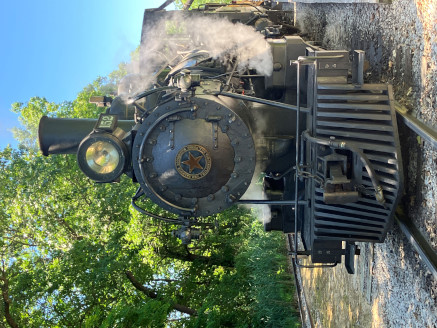
Huckleberry Railroad 4-6-0 152.
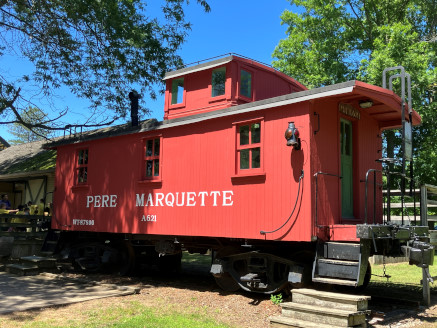
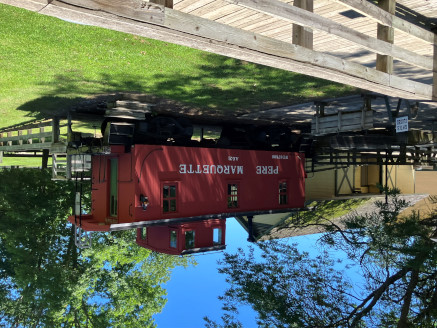
Pere Marquette caboose A621, built by the railroad in the 1920's.
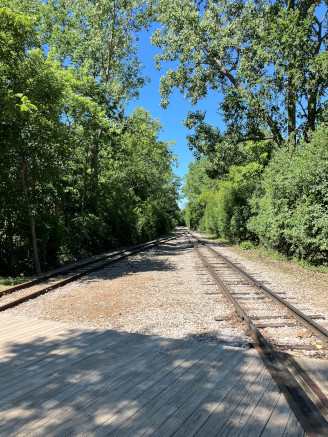
The western switch.
As we were not riding until the 2:00 PM train, Elizabeth and I went for a carousel ride.
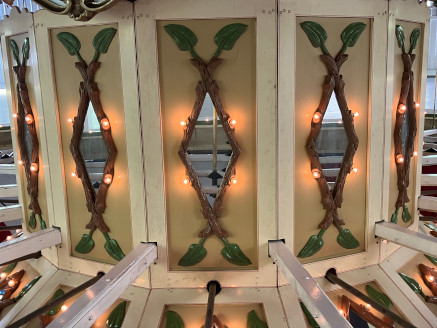
The middle support for the carousel.
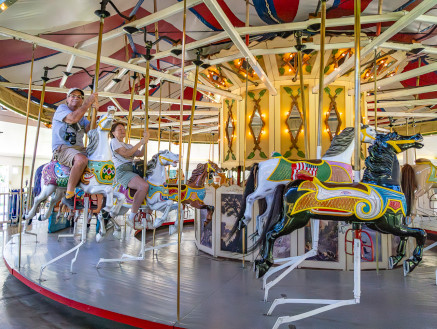
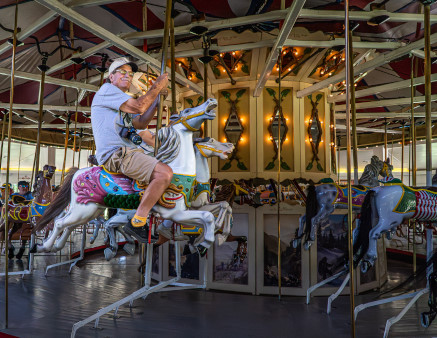
Elizabeth and myself on the carousel, courtesy Doug Scott, a friend and fellow NRHS member, who was visiting here with his wife, Ellen.
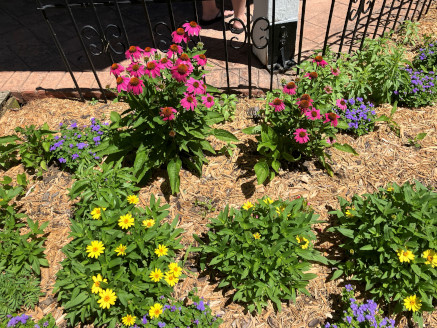
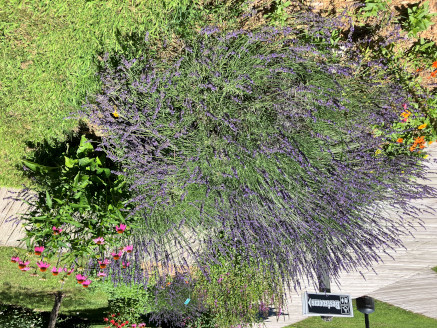
Part of the blooming butterfly garden beside the carousel building.
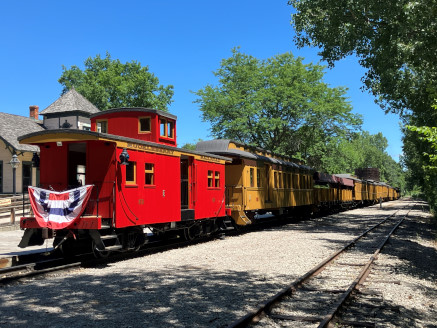
Then we returned to ride the train.
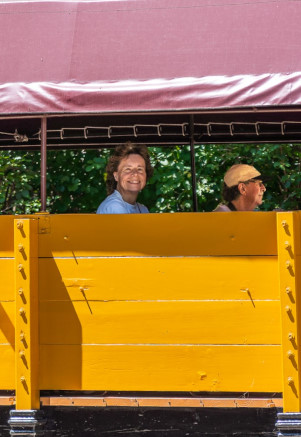
The author and Elizabeth his wife ready for their ride on the Huckleberry Railroad, courtesy Doug Scott.

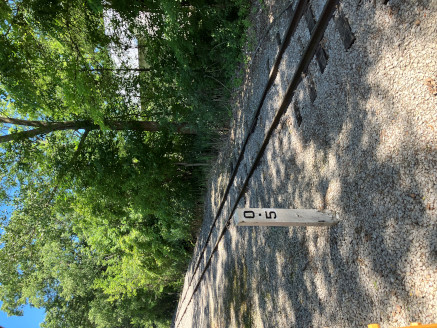
Milepost 0.5.
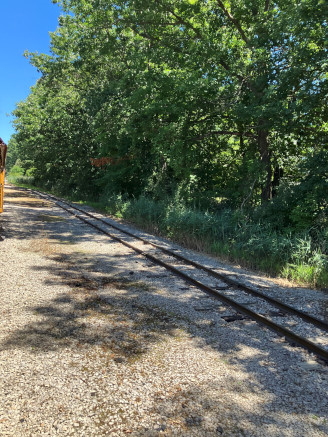
The station siding in front of the depot.
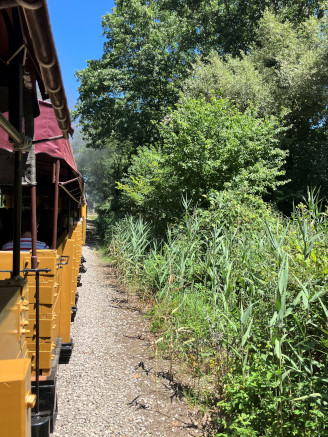
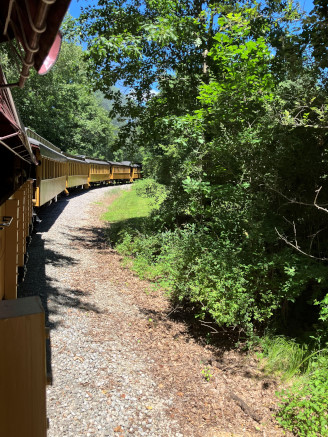
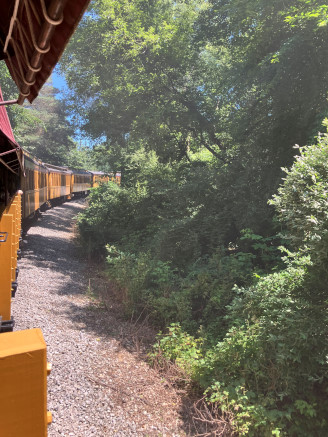
Travelling through the forest.
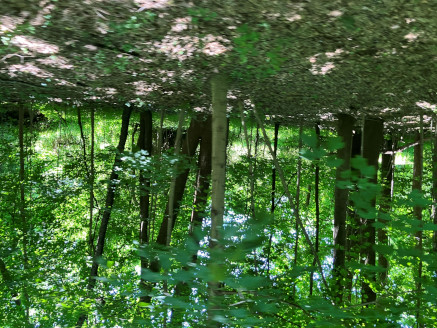
The forest.
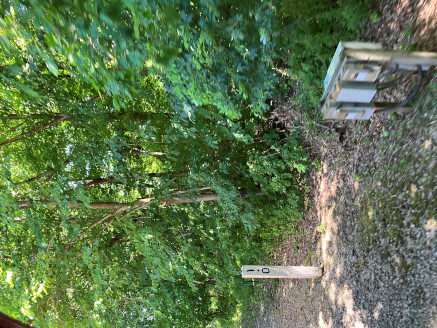
Milepost 1.0.
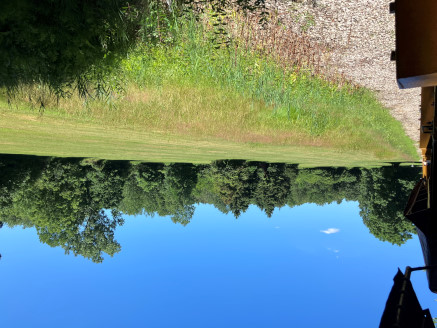
An open area on our route.
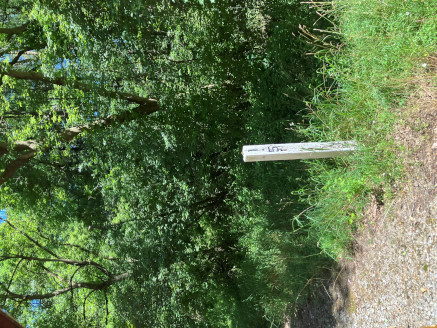
Milepost 1.5.
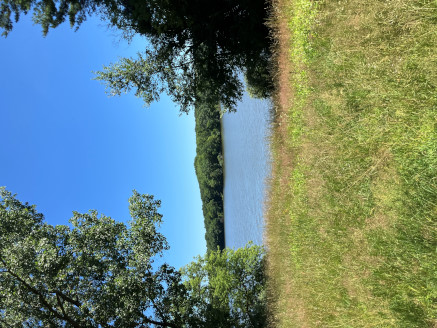
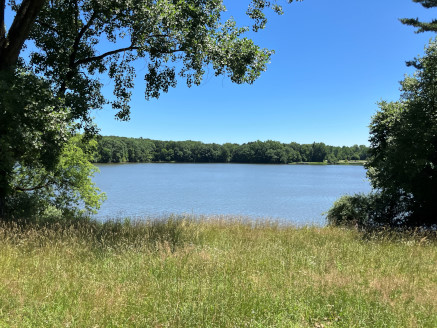
Mott Lake.
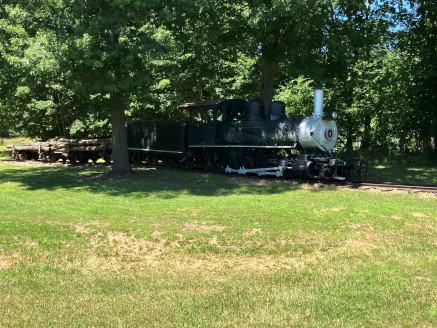
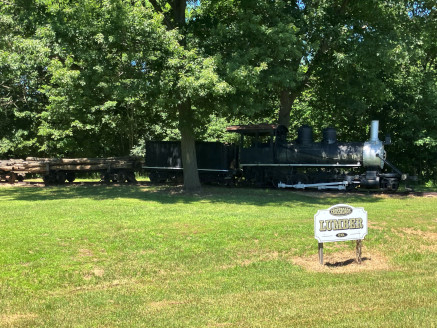

Genesee County Parks and Recreation Commission 36" gauge 2-8-0 4, ex. Colorado Railroad Museum 1972, exx. Ferrocaril Mineral de Chihuahua 4 in Chihuahua Mexico 1952, nee Ferrocarril Potosi & Rio Verde 4 built by Baldwin in 1904.
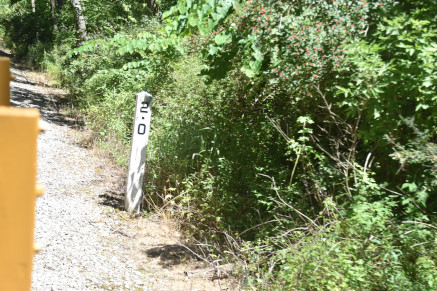
Milepost 2.0.
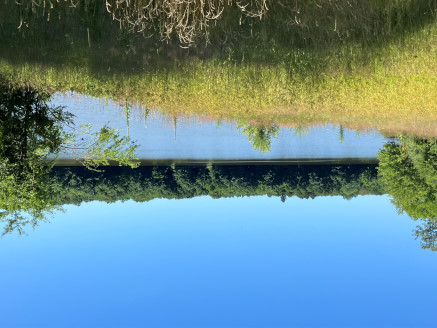 >
>

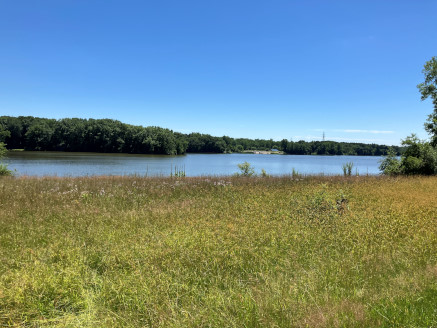
Mott Lake.
Another open area.
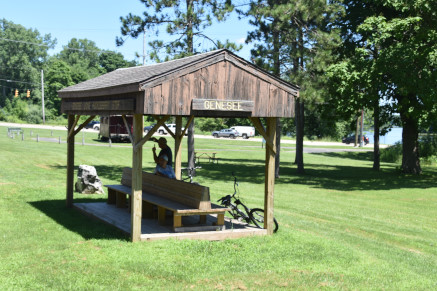
Genesee covered bench.
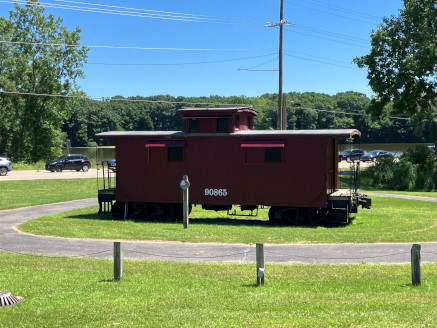
Chesapeake and Ohio caboose 90865, built by Standard Tank Car in 1926 on display.

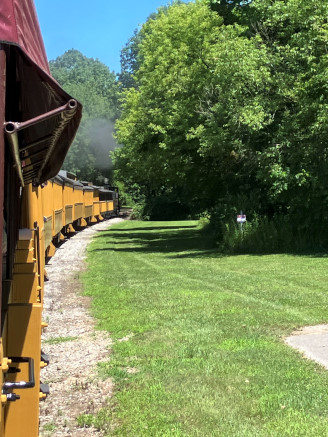
Running by a foundation remains from building.
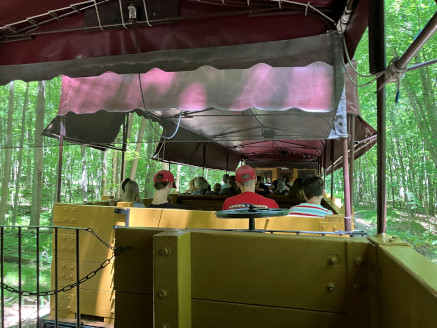
The passengers in the car ahead of us.
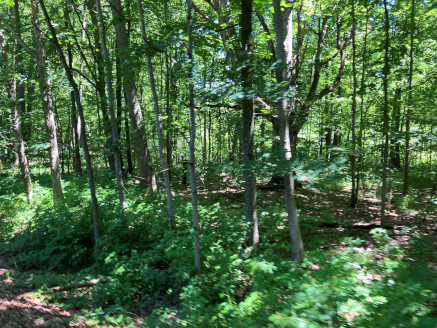
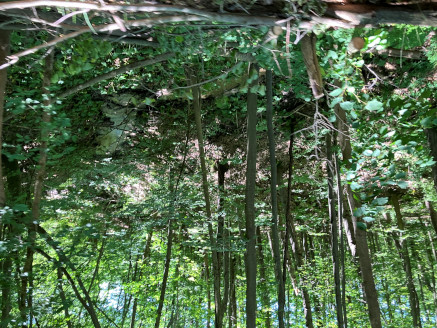
In the forest.

Milepost 3.5.
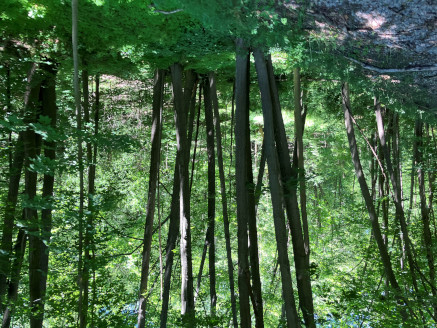
More forest.
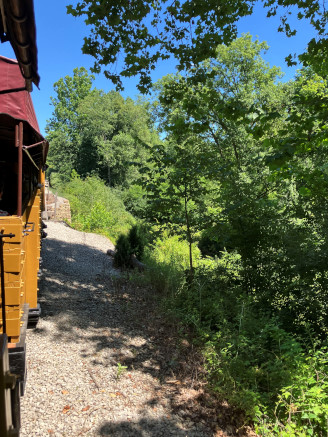
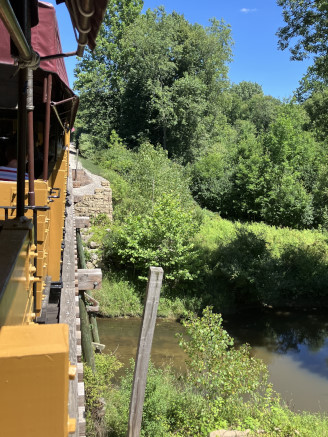
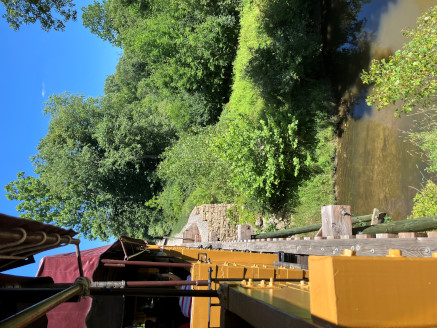
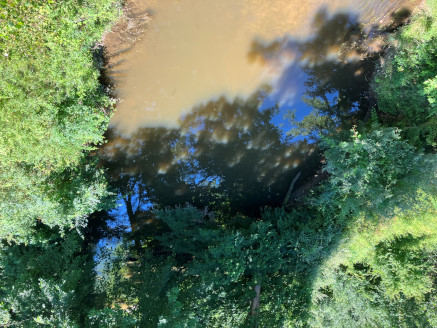
Butternut Creek.
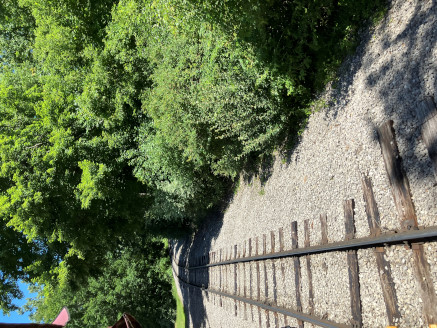
The turning loop on the eastern end.
Starting to round the loop.

The eastern turning loop.
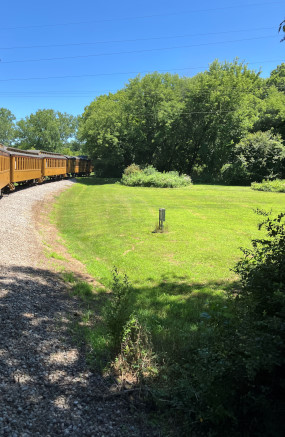
On the loop.
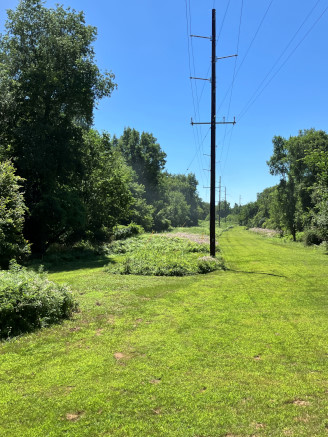
Electrical poles for Crossroads Village.
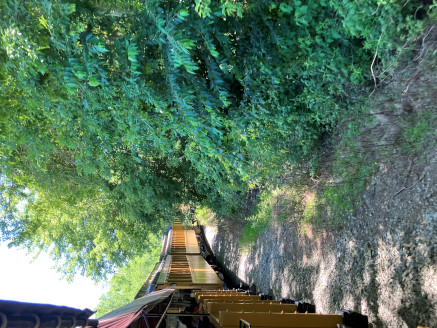
About to enter the open area of the loop.
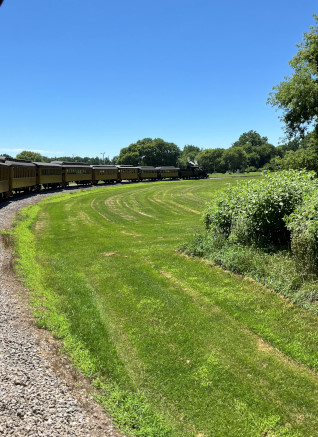
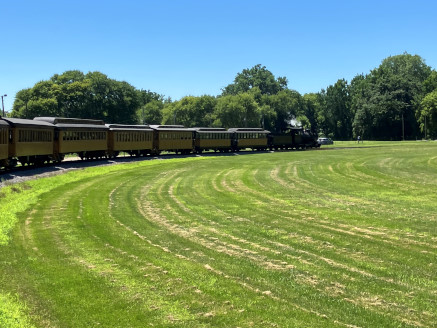
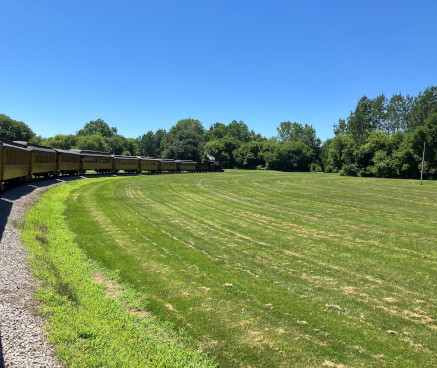
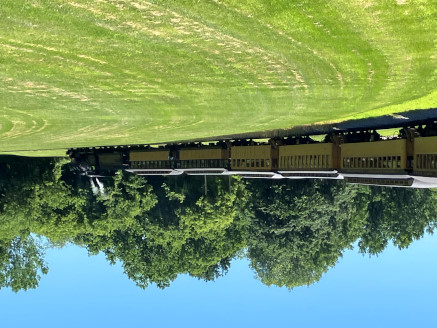
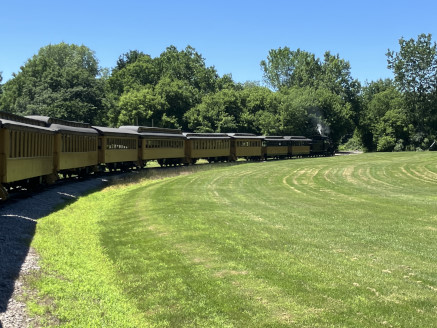
Curving around.
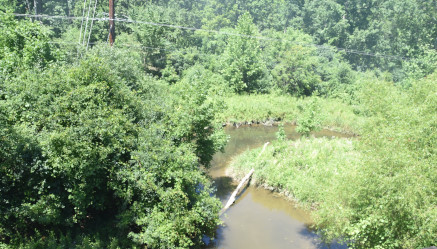 >
>
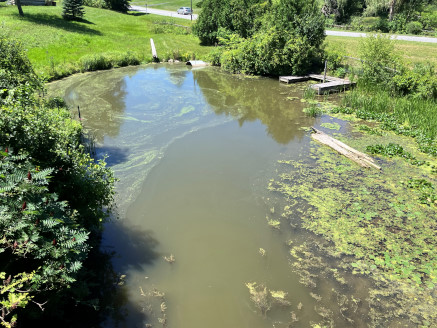
Butternut Creek.
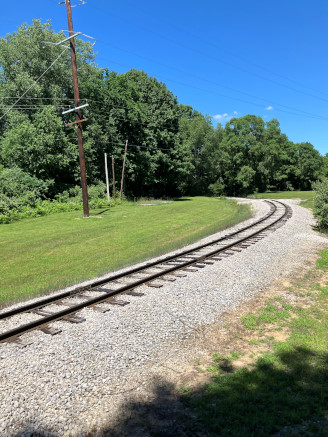
The turning loop.
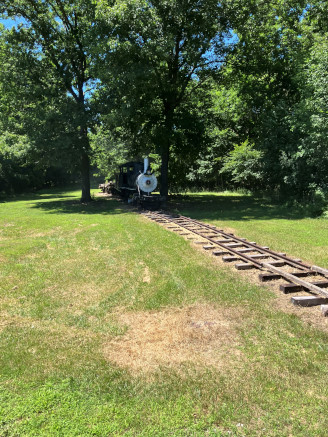
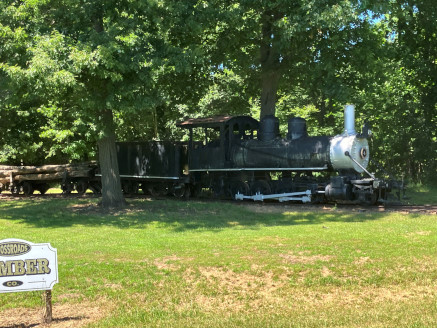
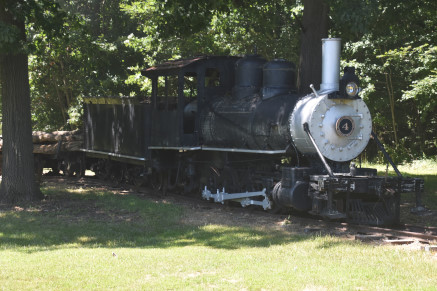
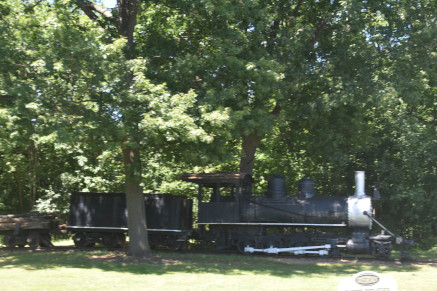
Genesee County Parks and Recreation Commission 36" gauge 2-8-0 4.
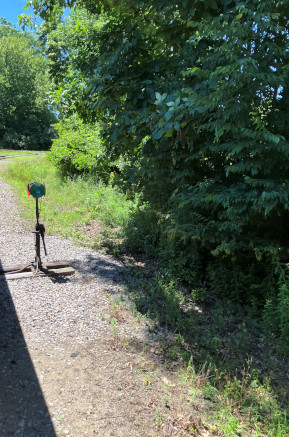
The switch to the shops.
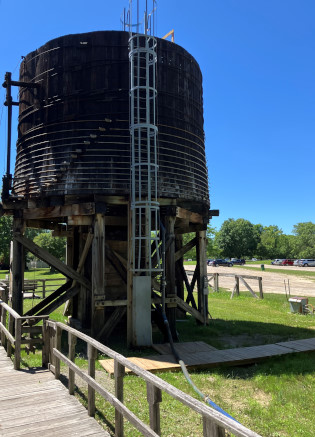
Crossroads Village water tower.
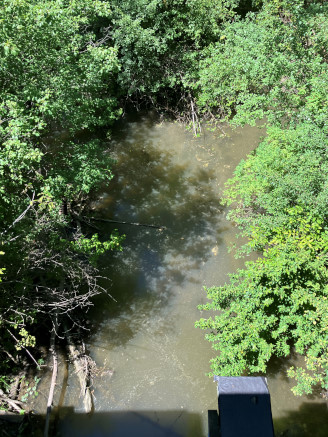
A mill pond that flows into Mott Lake.
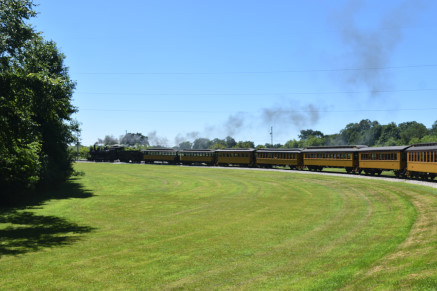
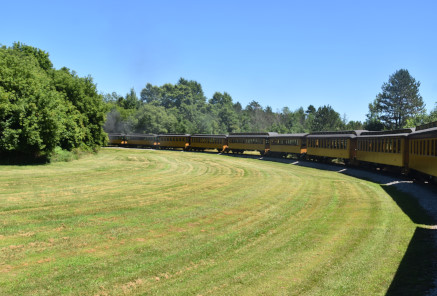
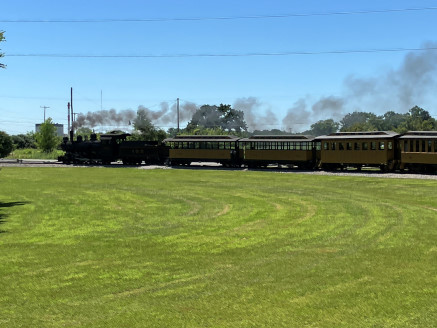
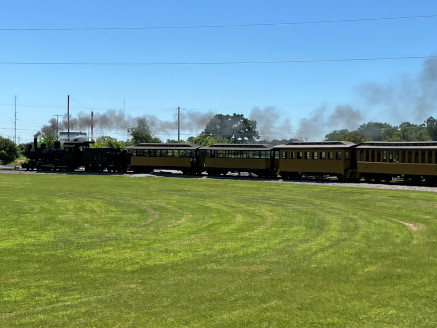
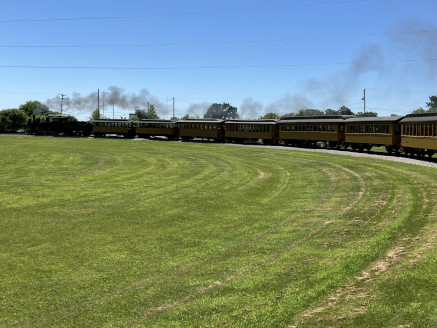
On the western loop before we returned to the station, ending our enjoyable train ride and a first for Elizabeth since when she was last here in 2009, the train was not running. We drove to Battle Creek and had dinner at Cracker Barrel before checking in to the Baymont Inn for the night.
| RETURN TO THE MAIN PAGE |