




This year, Elizabeth attended the convention in Binghamton, New York herself, whereas I would be participating in the 100th anniversary event of the K-36 locomotives at Cumbres and Toltec Scenic in August. As we are both members of the RRSHS and I have covered the 2023 and 2024 conventions, this is full coverage of the 2025 convention, with all photographs by Elizabeth Guenzler.
Elizabeth arose at 6:00 AM, had the hotel's breakfast then drove to the convention hotel, Tru by Hilton, where the bus was waiting for the conventioneers. The first stop was Hallstead.


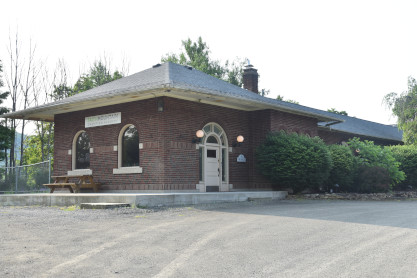
Delaware, Lackawanna and Western Hallstead combination depot built in 1915. This gabled depot structure is the home of Faith Mountain Christian Academy.
Hallstead was settled in 1787 and was incorporated as Great Bend on November 28, 1874. It was renamed to Hallstead Borough in honour of William H. Hallstead, president of the Delaware, Lackawanna and Western. The Foundry, or Hallstead Foundry, as it became known, consists of twenty-seven acres of land on Main Street. During the early 1900's, it was manufacturer of lead crystal but after almost three decades, ownership shifted, and it became a major foundry. Today, nothing more than big slabs of concrete foundation floor remains.
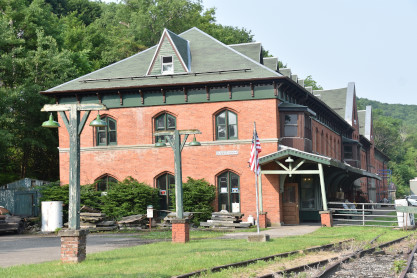
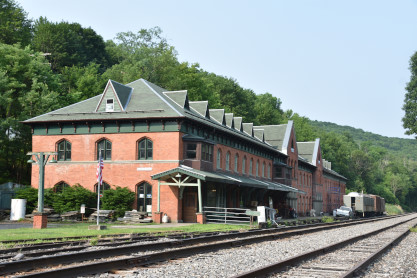
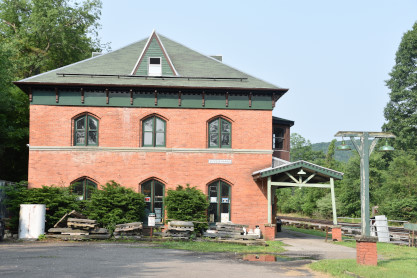
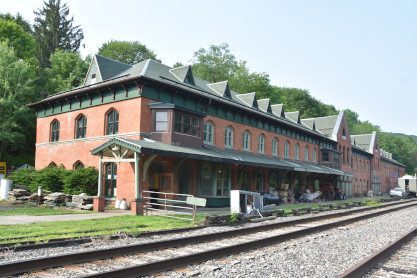
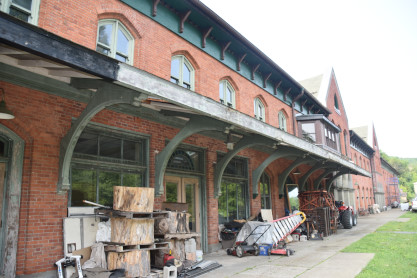

The Starrucca House is now privately owned and under a major construction effort.

Erie Railroad "Stillwell" coach 2125, built by Pressed Steel in 1924. It is now numbered 2387 and owned by the Chemung Valley Historical Society. This is one of the few remaining Erie Stillwell cars, named for Lewis Buckley Stillwell, a pioneering electrical engineer and industrial designer who consulted for the railroad. The Erie Railroad ordered their first Stillwell-designed coaches as early as 1915, looking forward to the day when they might electrify their suburban commuter operations. The Erie Stillwell cars were built without electrical gear, but left the provision for conversion in the future. With features selected specifically by Erie president F.D. Underwood, these were the most modern passenger cars of the day.
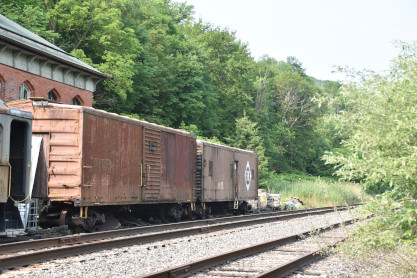
Erie Railroad 40 foot boxcar 76382 builder and year unknown, and Erie Railroad camp car 464075, nee a 40 foot boxcar, converted to maintenance-of-way use, built by Pressed Steel in 1924.
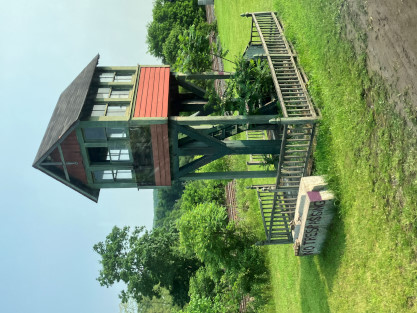
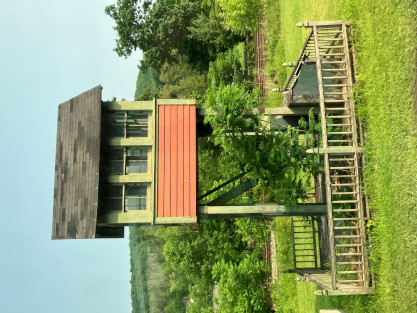
In Susquehanna, this gate tower was diagonally across from the station in the parking lot.
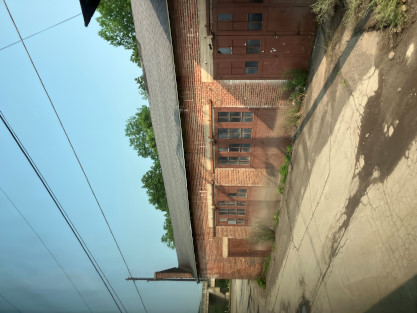
The land on which the Borough of Susquehanna is situated was originally part of the Drinker Tract, purchased by Henry Drinker in 1794. No large settlements were established in the region during the first half of the nineteenth century. The area was the site of several large farms. It was part of Harmony Township, which was originally in Luzerne County.
The New York and Lake Erie Railroad Company was incorporated in April of 1832. Initially, the project to construct a rail line from New York City to Dunkirk on Lake Erie progressed slowly. The line was finally opened in May of 1851. The line became the Erie Railway after reorganization in 1862. It followed the Susquehanna River through the northern part of Susquehanna County for approximately twenty-five miles, and had two stations, Susquehanna and Great Bend, within the county. About 1845 the farms that included what is now Susquehanna Borough were purchased by the Erie Railway Company. A town of regular lots was laid out. The topography of the area and the location of the railroad tracks along the south bank of the Susquehanna River constricted the plan of the town. The tracks were located along the flat plain following the river, with the first rail yards erected just south of the tracks between the tracks and the river between 1904 and 1922; south of the yards, the land begins to rise sharply, dictating that the town’s main street run east and west. The plan of the town was determined by these hills, the river on the north, and by Drinker Creek which runs through the middle of town.
Susquehanna, then called Susquehanna Depot, was incorporated as a borough in 1853; the name was changed to Susquehanna in 1869 The original name of the settlement had been Harmony. The earliest extant tax assessment record for the town dates to 1855 and provided a glimpse into the town during that year. Within ten years of the town’s founding, 272 residences had been constructed, including 69 “small” houses and two shanties; a few of these houses were listed as standing on “railroad land,” suggesting that the railroad may have owned the buildings but that the occupants were responsible for paying the taxes. Other types of buildings listed in the assessment for 1855 include six taverns, two saloons (including one with a bowling alley), 13 storerooms, 11 shops, two barns and a slaughter house (Susquehanna 1855).Many of the 350 taxables assessed in 1855 worked for the railroad, including engineers, brakemen, a telegraph clerk, foremen, molders, boilermakers, a railroad agent and yard watchmen. Many others were involved in commerce of service occupations, including shoemakers, grocers, merchants, innkeepers, bakers, physicians, attorneys, tailors and barbers. Only 19 of the 350 taxables were immigrants; six men were listed as English, 13 as Irish.
The chief mechanical headquarters for the Erie Railway were at Susquehanna and at times employed as many as 3,000 people. The rail year was constructed in 1848 on the banks of the Susquehanna River. Among the first structures in the yard was a boarding house to accommodate the workmen. The original, small frame buildings erected in 1848 and used as shops in the building and repairing of rail cars were replaced in 1865 by a more extensive rail yard. The new complex covered more than eight acres, cost $1.7 million to build, and employed nine hundred men. The main building constructed of stone with a slate roof was 750′ long and 137′ wide. This structure contained the erecting, machinery, tool, rod, turning, planning, wheel, tin and copper and stock departments. Adjoining the main building to the north were six brick annexes housing the boiler shop, blacksmith shop, engine room, bathhouse, paint shop, pattern storeroom and carpentry shop. Additional structures in the rail yard included the foundry, hammer shop, a 33 stall roundhouse, gas works, oil works and an office building. The yard could accommodate approximately 200 locomotives at a time.
From here, the bus took the delegates to Starrucca Viaduct.
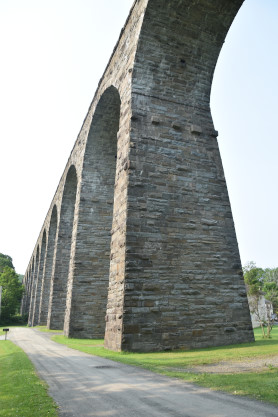
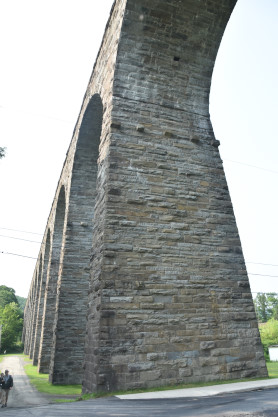
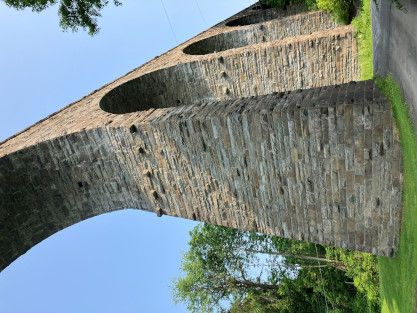
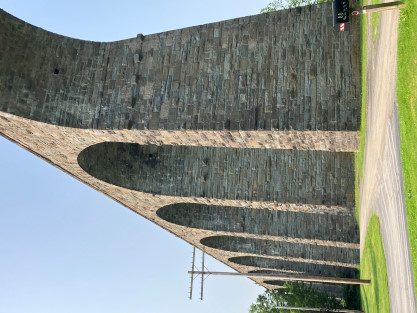
The Starrucca Viaduct is a stone arch bridge that spans Starrucca Creek in Lanesboro built at a cost of $320,000. It was at time the world's largest stone viaduct and was thought to be the most expensive railway bridge as well. It is still in use. The viaduct was designed and was built by Julius W. Adams and James P. Kirkwood and built in 1847 by the New York and Erie Railroad of locally-quarried random ashlar bluestone, except for the three brick interior longitudinal spandrel walls and the concrete bases of the piers. The viaduct was the first to use Rosendale cement from a large deposit of limestone found during the excavation of the Delaware and Hudson Canal of 1835.
It was built to solve an engineering problem posed by the wide valley of Starrucca Creek. The railroad considered building an embankment but abandoned the idea as impractical. The lead stonemason, Thomas Heavy, an Irish immigrant from County Offaly, who had worked on other projects for Kirkwood, primarily in New England. It took 800 workers, each paid $1 per day to complete the bridge in a year. The falsework (temporary structure used to support a permanent structure) required more than half a million feet of cord and hewn timbers.
The original single broad gauge track was replaced by two standard gauge tracks in 1886. The roadbed deck under the tracks was reinforced with a layer of concrete in 1958.
The viaduct was designated as a National Historic Civil Engineering landmark in 1973 and was listed on the National Register of Historic Places in 1975. In 2005, Norfolk Southern leased the portion of the line from Port Jervis to Binghamton to the Delaware Otsego Corporation, which operates it under the name Central New York Railway. It is used by Delaware Otsego's New York Susquehanna and Western Railway.
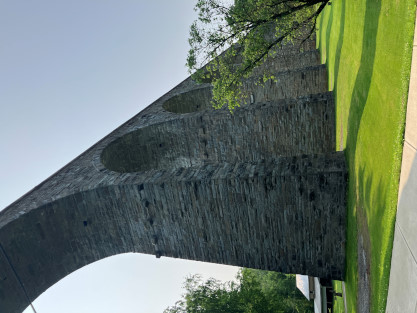
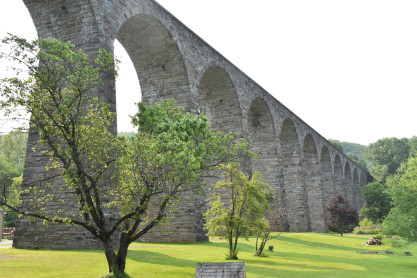
The north side.
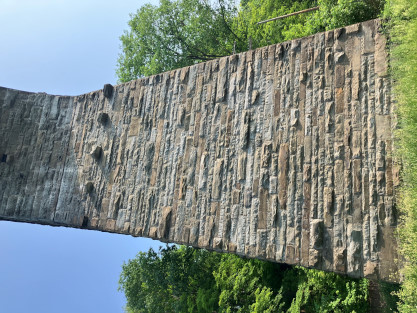
Close up of the stonework at the base of the columns.
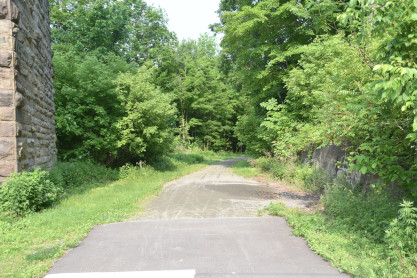
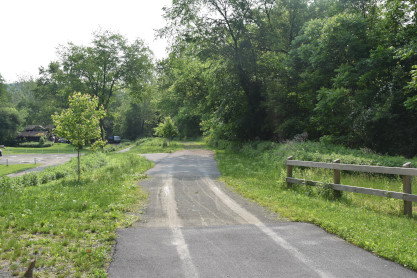
The bicycle trail under the viaduct, the former Delaware and Hudson Railroad grade.
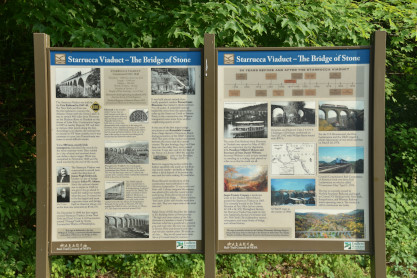
The dual history and information boards of Starrucca Viaduct - The Bridge of Stone.
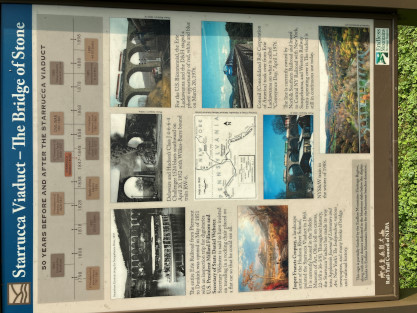

The individual boards.
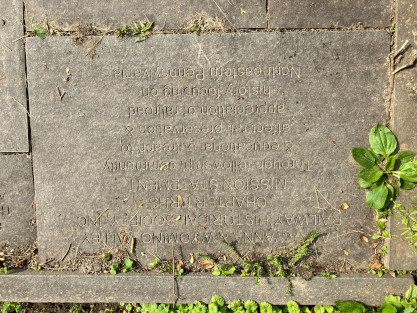
Elizabeth did not expect to see this plaque, which reads "Lackawanna and Wyoming Valley Railway Historical Society, Inc. Chapter NRHS Mission Statement: through fellowship, community and educational outreach to affect rail preservation and appreciation of railroad history focusing on Northeastern Pennsylvania". That evening, she sent this photograph to Ed Fortuna, the National Representative for the chapter, who invited her to their chapter's meeting two days later. However, due to the timing of the meeting and the distance to the meeting location, she had to regretfully decline. Ed showed the picture at the meeting and several attendees had forgotten of its existence, so were appreciative of Elizabeth sending it.
The bus transported everyone to Thompson.
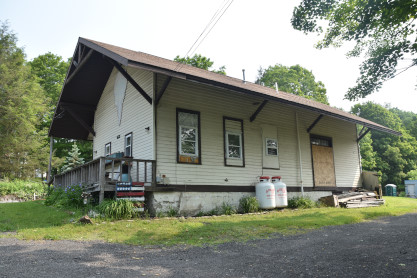
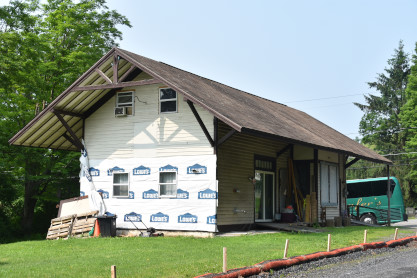
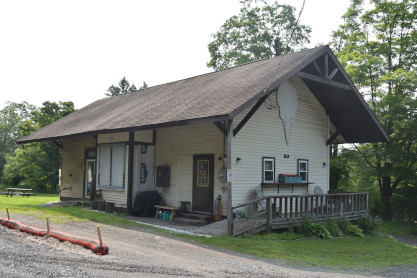
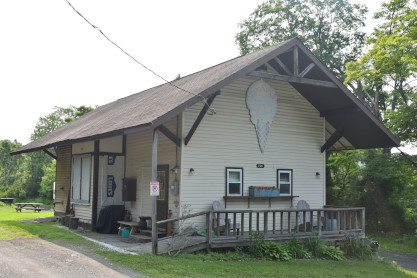
Erie Railroad passenger depot in Thompson; this wooden gabled depot housed Rooney's Ice Cream until a few years ago. Prior to January 1955, the Delaware & Hudson Pennsylvania Division (Lanesboro to Carbondale) was owned and operated by the Erie as its Jefferson Division, but Thompson Station remained an Erie and Erie-Lackawanna agency. The D&H owned the building and the D&H track tool house was in the depot, but it remained an EL agency up until Conrail in 1976. EL retained trackage rights on the Jefferson Branch and operated it to serve local customers.
The Spencer Milling Company gristmill was built on Jackson Street by G. Fenton Spencer in 1870. Thompson Borough was incorporated on August 15, 1876 from part of Thompson Township. It was named after Susquehanna County associate judge William Thompson.
On the way into Nicholson, a stop along the road was made and those who wanted to, debussed for photographs.
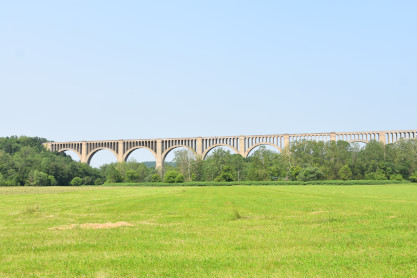
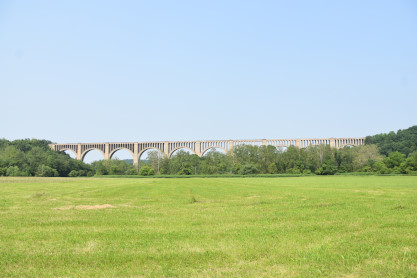
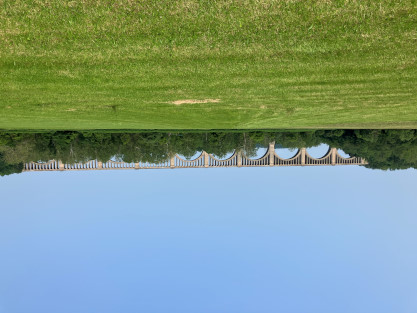
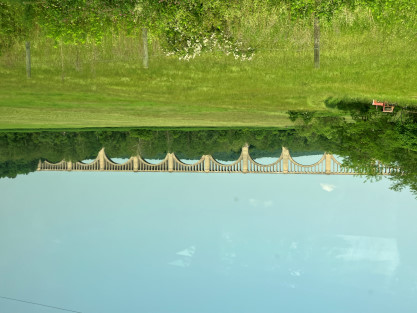
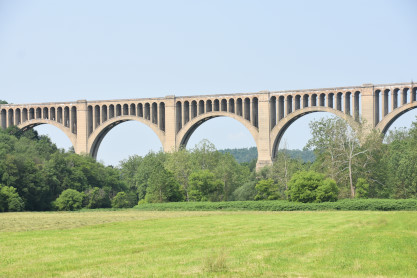
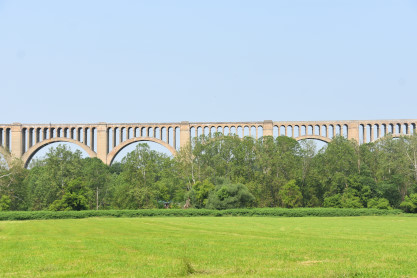
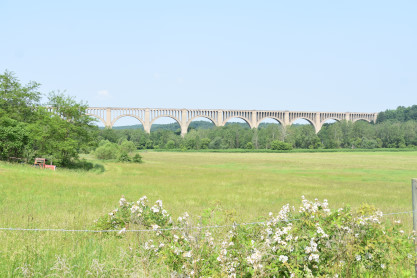
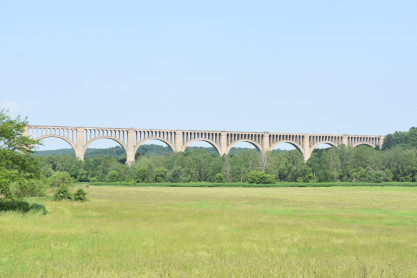
The Tunkhannock Creek Viaduct, also known as the Tunkhannock Viaduct or the Nicholson Bridge, was built by the Delaware, Lackawanna & Western Railroad in 1912 and was completed, dedicated and ready for use on November 6, 1915. This massive reinforced concrete bridge celebrated its centennial in November 2015! The Tunkhannock Viaduct received its proper name from the Tunkhannock Creek that it traverses. However, it is also known as the Nicholson Bridge because of the small Pennsylvania borough where it is located. This engineering marvel was designed by Abraham Burton Cohen with George J. Ray as the chief engineer of the project. Concrete was first poured in January 1913 with the entire project using 185,000 barrels, or 1,093 carloads, of cement producing 167,000 cubic yards of concrete. In addition, about 1,140 tons of steel were used to reinforce the concrete. Moreover, the bridge was built to endure 6,000 pounds per square foot, considering that some engines at that time would weigh 233 tons. At that time, the bridge itself cost $1.4 million to build.
Five hundred men of which only half or less were skilled laborers worked 24 hours a day with very little equipment. All they had were steam shovels, dynamite for excavation and a cement mixer that was built on-site. At piers 5 and 6, the workers encountered quicksand making it necessary to use pneumatic chambers and many extra hours of manpower. The DL&W would not allow dynamite to be transported on their railroads so the dynamite was shipped by the Lehigh Railroad into Springville and transported to Nicholson by horse and wagon.
The Nicholson Bridge is 2,375 feet long and 34 feet wide. It is 240 feet above stream level and 300 feet above bedrock. There are twelve arches with ten being 180 feet across and two being 100 foot arches, one at each end of the bridge that are totally buried in the land fill. In Theodore Dreiser’s 1916 travel biography, he called the bridge: “A thing colossal and impressive. Those arches! How really beautiful they were. How symmetrically planned! And the smaller arches above, how delicate and lightsomely graceful! It is odd to stand in the presence of so great a thing in the making and realize that you are looking at one of the true wonders of the world". Thomas Edison, Henry Ford and former President Theodore Roosevelt were among the many people that came to view this one of a kind bridge.
This remarkable construction and engineering feat of its time was listed on the National Register of Historic Places on April 11, 1977 due to its national architectural, engineering and transportation significance. The nomination application that was submitted in August 1976 affirms the national significance of the viaduct: “The literal keystone in the early-twentieth-century modernization of a major railroad, Tunkhannock was put up at a time when a reinforced -concrete structure of such a size was considered venturesome, and before perfection of a number of now commonly accepted techniques in concrete construction". The national significance narrative was taken from William S. Young's 1967.
Earlier in 1975, the American Society of Civil Engineers designated the bridge as a National Historic Civil Engineering Landmark due to its significant contribution to the development of the United States and to the profession of civil engineering. As of 2008, only 244 landmarks in the world received this designation. “The Tunkhannock Viaduct represents a great feat of construction skill and a successful departure from contemporary, conventional concepts of railroad location in that its main line traversed the regional drainage pattern, therefore reducing the distance and grade impediments to economy of operation".
Additionally, the viaduct has been documented by the Historic American Engineering Record, which was established in 1969 by an agreement by the National Park Service, the ASCE and the Library of Congress to document historic sites and structures related to engineering and industry. Subsequently, this agreement was ratified by four other engineering societies. The Library of Congress website states that: “the collections document achievements in architecture, engineering, and design in the United States and its territories through a comprehensive range of building types and engineering technologies.” The HAER affirms that: “More than 50 years after its building, the Tunkhannock Viaduct still merits the title of largest concrete bridge in America, if not the world".
The Nicholson Bridge was part of a larger project, called the Clarks Summit-Hallstead Cutoff, built to shorten the DL&W main rail line from Scranton, Pennsylvania to Binghamton, New York by 3.6 miles, lessen the steep grades that had previously required pusher engines, and straighten the rail line. The DL&W president at the time, William H. Truesdale, was looking for ways to modernize the railroad and make it more efficient. Not only did the railroad construct a smaller version of the Tunkhannock Viaduct nine miles north in Kingsley, Pennsylvania, called the Martin's Creek Viaduct, the DL&W also built a 3,630 foot tunnel about two rail miles south of Nicholson. The entire cutoff, sometimes referred to as the Nicholson Cutoff, was built with two sets of tracks to allow for trains going north and trains going south at the same time. This shortened route costing $14 million saved considerable travel time between the two major cities: as much as an hour for freight trains and at least ten minutes for passenger trains.
At the turn of the 20th Century, the Lackawanna Valley, which included Scranton, was the industrial hub of Northeastern Pennsylvania. The Lackawanna Heritage Valley Authority website details the importance of the region’s coal, iron and steel industries: “Settled in the early 1800s, the rugged frontier (Lackawanna) valley rapidly grew to be a hub of commerce and manufacturing because of the enormous anthracite coal reserves just below the surface. The Pennsylvania Anthracite Region eventually produced 80 percent of the world’s anthracite coal, a clean, hot-burning fuel that was perfect for running machines and building empires. Historians consider Scranton the industrial center of the region. The huge coal industry, iron and steel production, railroading and railroad building, food processing, large-scale fabrication, and textiles all played a significant role in the area’s growth. The region became the powerful engine that drove America’s Industrial Revolution.” The Nicholson Bridge provided the capacity for increased goods, including coal, iron, and steel, and passenger traffic in the Northeast that contributed to the Industrial Revolution in the United States.
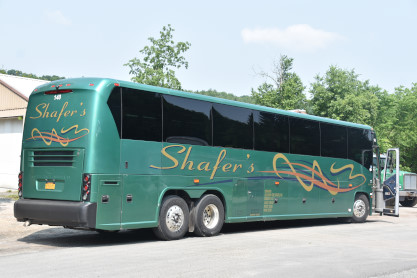
The motor coach that transported the attendees to the various stations throughout the four days.
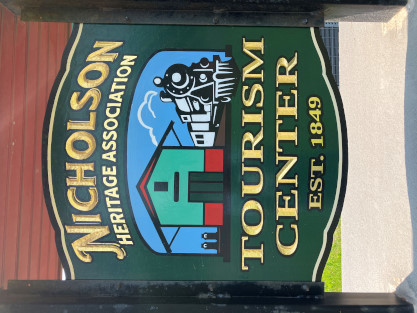
Nicholson Heritage Association Tourism Center sign.
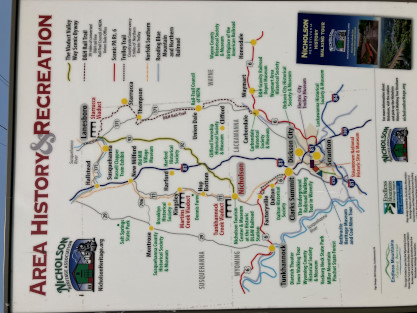
Area History and Recreation.
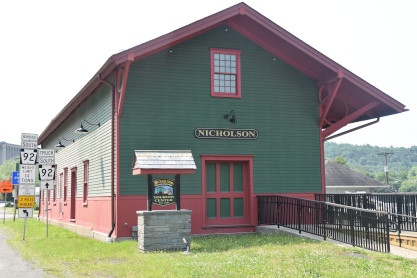
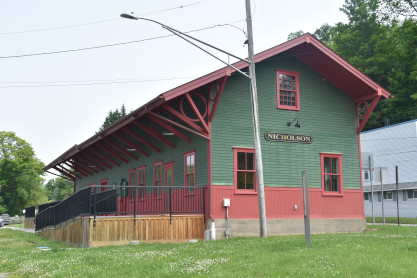
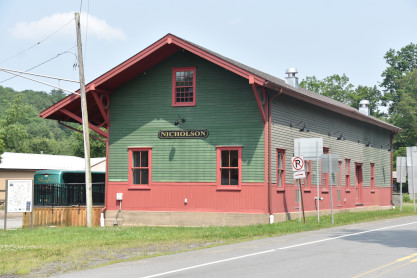
Delaware Lackawanna and Western station built in 1878, which is the original building on the old main lin, now Route 11. It is similar to Clarks Summit except that the DL&W constructed a concrete station on the new line at Nicholson at the west end of the Tunkhannock Viaduct, which has been gone for several years. At that time, 1915, the "old" station became converted to "freight only" with a separate agent and over the years, lost of its passenger appearance.
The borough of Nicholson was incorporated on August 23, 1875 and was named after John Nicholson, who had been Pennsylvania's comptroller general in the late 1700's.
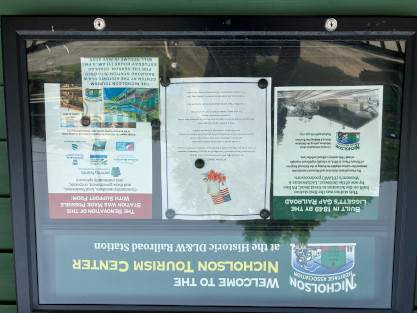
Welcome to the Nicholson Tourism Center.

The original ticket window.
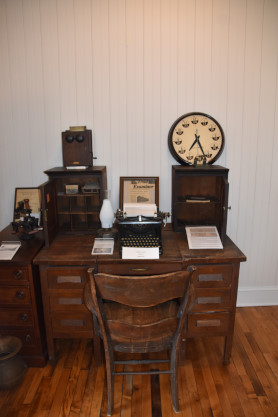
The station agent's desk.
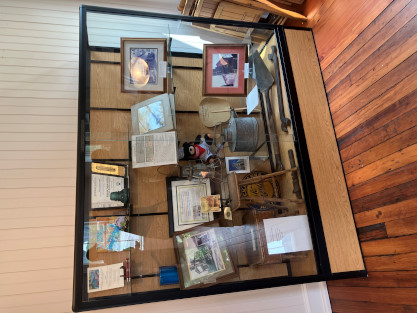
Nicholson Heritage Association display cabinet. Elizabeth then entered the freight portion of the depot.
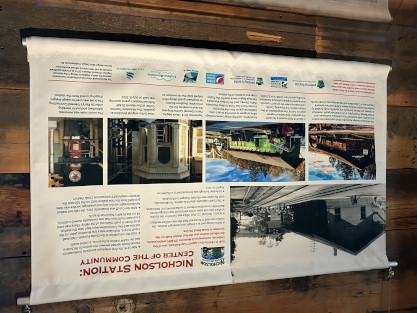
Nicholson Station: Center of the Community.
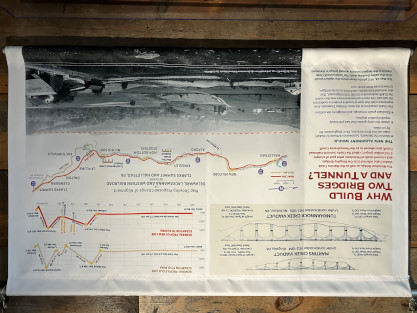
Why Build Two Bridges and a Tunnel?
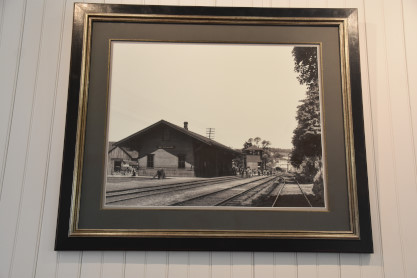
Nicholson Station and Tower.
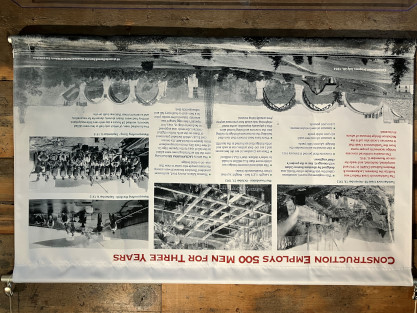
Contruction Employs 500 Men for Three Years.
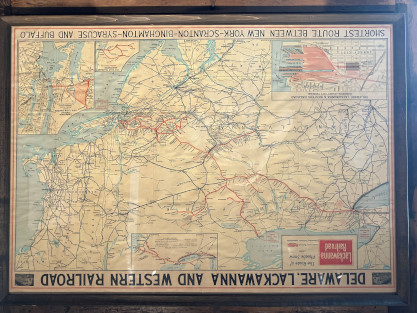
Delaware Lackawanna and Western Railroad map.
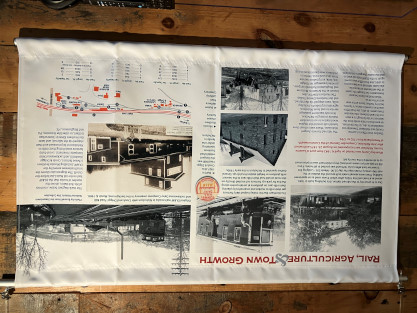
Rail, Agriculture and Town Growth.
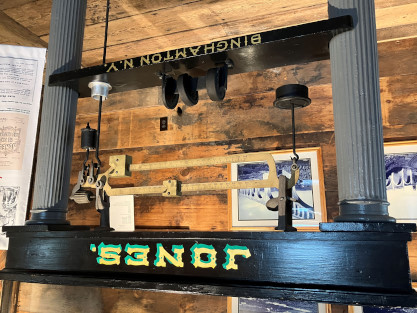
The Jones scale, used to weigh incoming and outgoing freight.
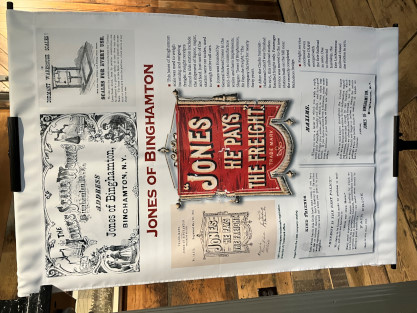
History about the scale and the company.
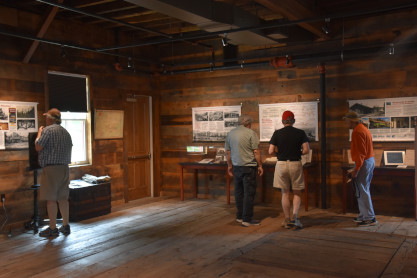
Attendees learning about the area's history and detail.
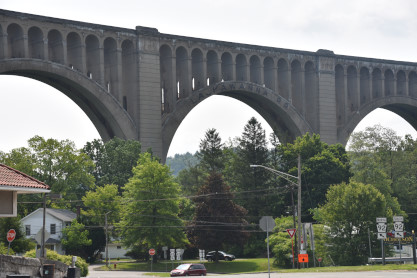
Once back outside, Elizabeth walked down a bit in an attempt to photograph the lettering "Lackawanna RR" on the middle arch. It is hardly visible from this distance. Everyone reboarded the bus and went down the road a short way to a pullover.

Welcome to Nicholson and the Tunkhannock Creek Viaduct.
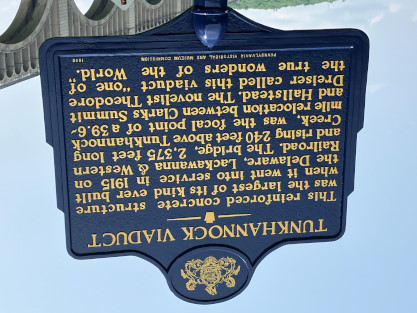
The historical sign about the viaduct.
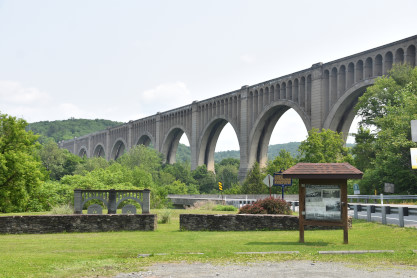
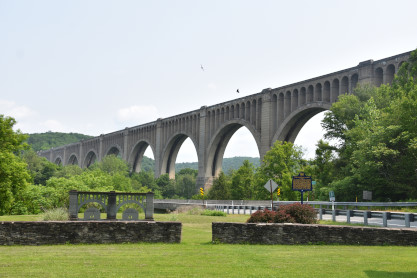
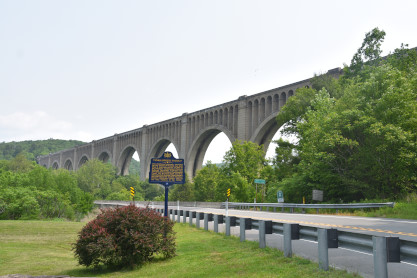
Tunkhannock Viaduct.
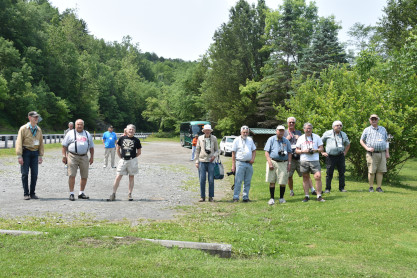
Society conventioneers awaiting a freight train.
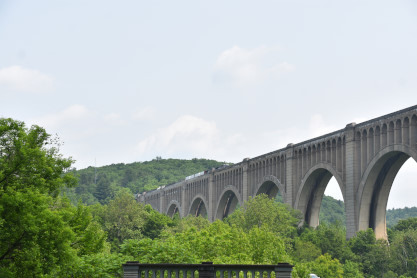
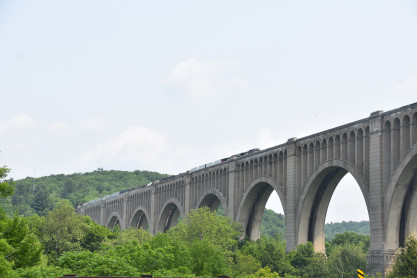

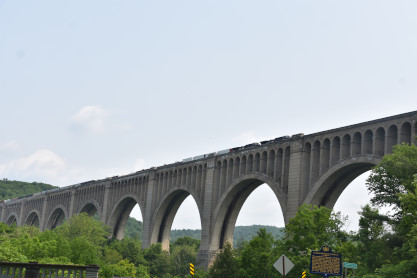
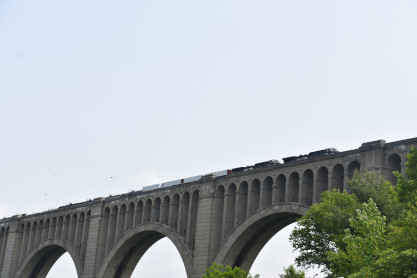
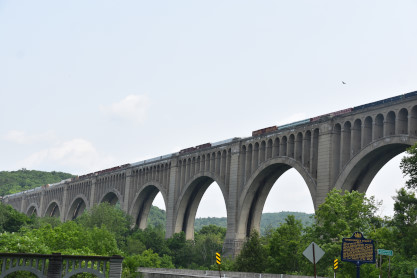
Norfolk Southern 11R, led by 4192, on the far track.
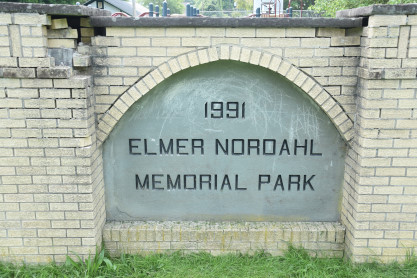
Before we left Nicholson, our planned last stop was in Elmer Nordahl Memorial Park.

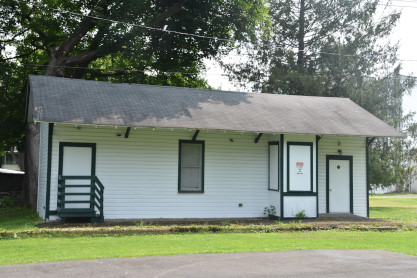
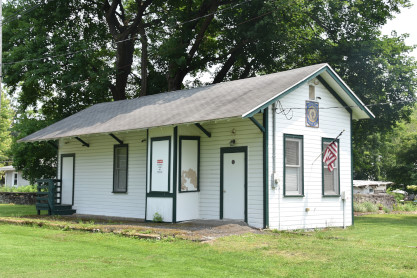
Here was the Scranton, Montrose and Binghamton interurban depot built in 1926. Commonly known as the Northern Electric Railway, it was incorporated in 1904 and started service in 1907. The line later reached Factoryville in 1908, Nicholson in 1912, and Foster (now Hop Bottom) and Brooklyn in 1915. However, proposed to go as far as Binghamton, it ended at Tiffany Junction in 1916, one mile from the heart of Montrose.
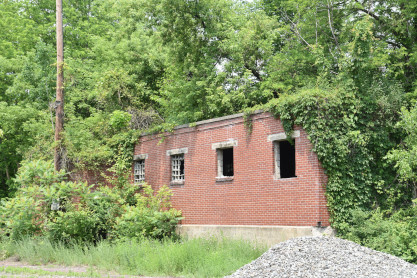
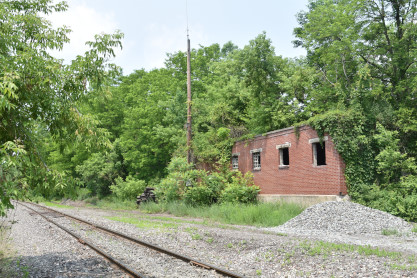
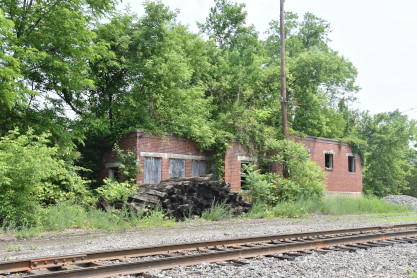
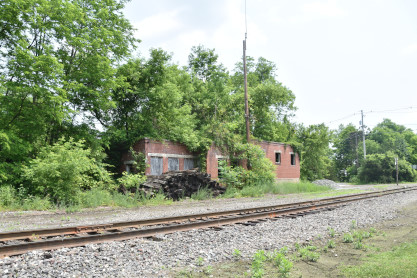
In Tunkhannock itself was the Lehigh Valley brick station built in 1954, partially dismantled and overgrown. We continued the morning's adventure by visiting Meshoppen.
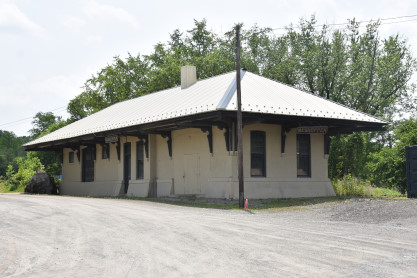
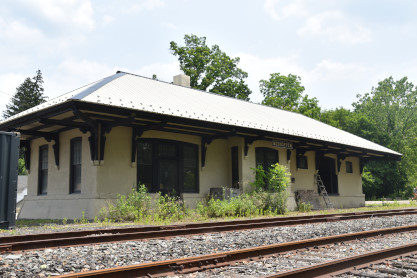
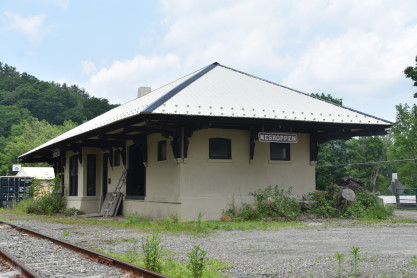
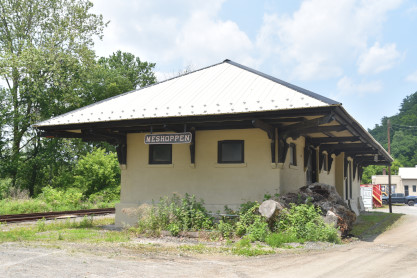
Lehigh Valley stucco gabled depot in Meshoppen, built in 1911. Meshoppen takes its name from Meshoppen Creek, a Native American name purported to mean "glass beads".
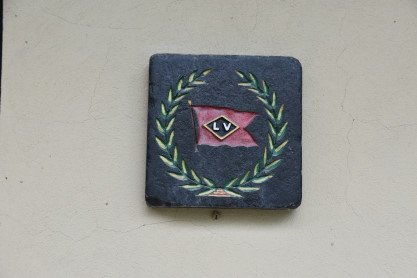
The Lehigh Valley emblem. Next we were driven to New Albany.
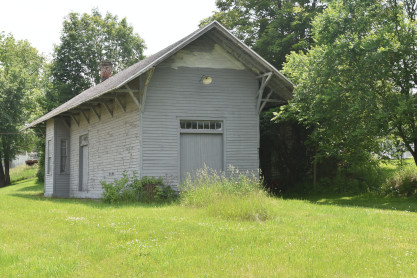
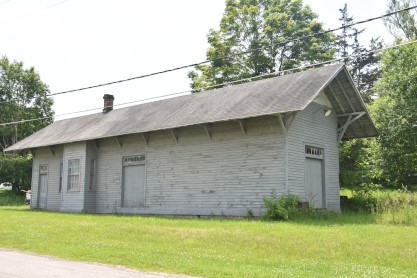
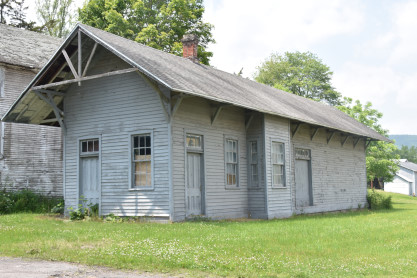
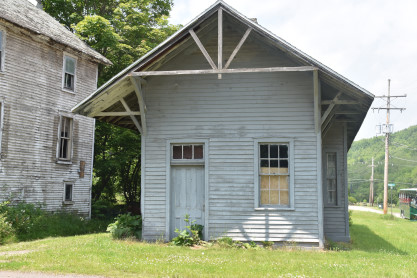
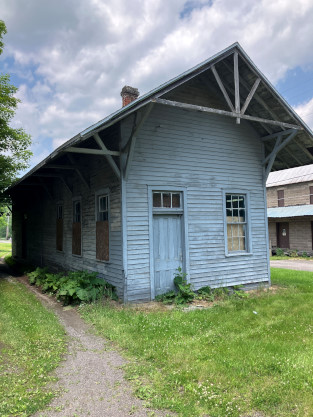
Lehigh New Albany wooden combination depot built in 1896.
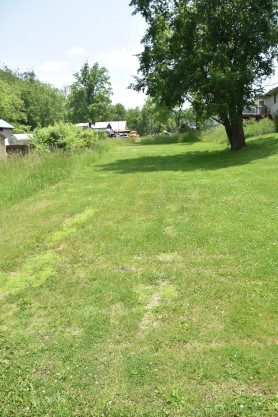
The former Lehigh Railroad right-of-way.
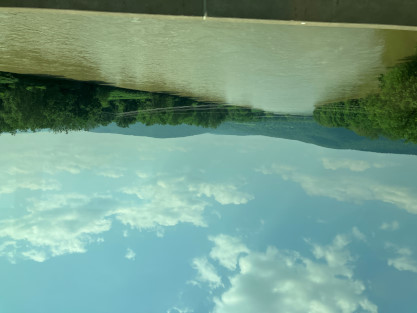
The crossing of the Susquehanna River as the motor coach entered Towanda. It was here that a lunch break occurred and of the choices in the immediate vicinity, Elizabeth chose Subway. Fortified and refreshed, we were taken to the Lehigh Valley freight house and unexpected baggage car.
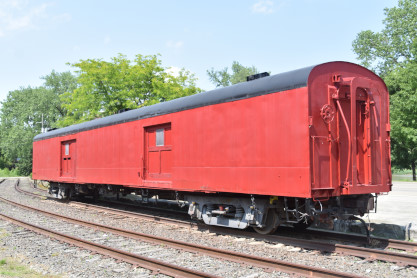
The rear of the Erie baggage car 2xx built by American Car and Foundry in 1950.
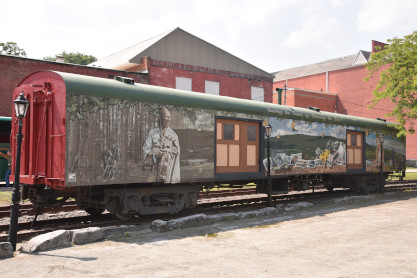
The mural, created by artist Jonathan Laidacker, was designed using a "paint by numbers" format, allowing for community engagement in creating the mural. Individual segments of the mural were transported throughout various locations within Bradford County, enabling community members to actively participate in the painting process.
This artistic endeavor serves as a tribute to the rich and diverse history of Bradford County, encapsulating everything from its strong agricultural heritage to notable personalities and landmarks. The mural represents a combining of elements for which the communities of Bradford County have been known and celebrated, seamlessly weaving together the past and present to illustrate a cohesive and vibrant tapestry of local identity and culture.
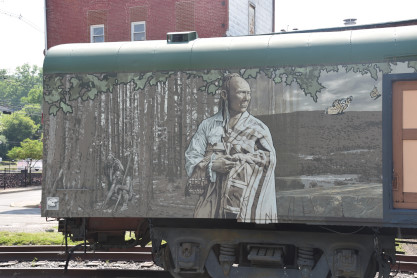
Chef Watona and Native Americans.
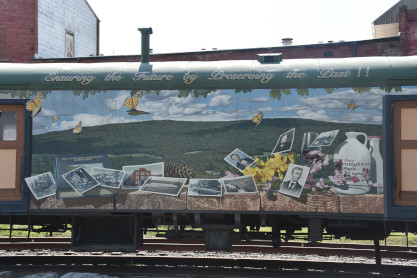
Ensuring the Future by Preserving the Past, which depicts Part of Pennsylvania's Rich Heritage Lumber Region, Coal Mining on Barclay Mountain, Honoring the History of Locomotive Production in the Region, Sayre Repair Shops, Lehigh Valley Railroad, Minnequa Springs Hotel, Canton, The "North Branch Canal" (another name for the Pennsylvania Canal opened in spring 1856), Wyalusing Rocks photo by H.J. Lloyd which captures a Spot of Spiritual Significance to Lenape, Iroquois and other native peoples, Actor Harry Davenport, U.S. Senator from PA David Wilmot and Composer Pat Ballard (Mr. Sandman).
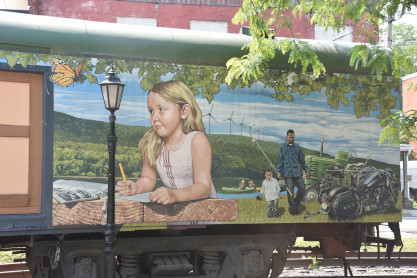
In Modern Times.
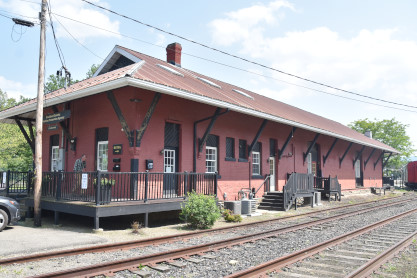
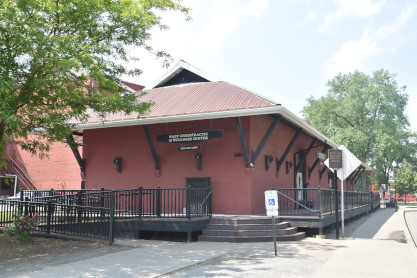
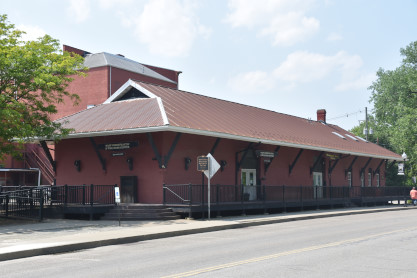
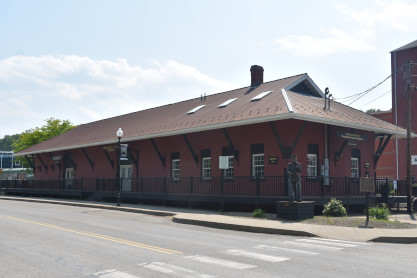
Across the road was the Lehigh Valley freight depot, a brick structure built by the Pennsylvania and New York in 1884. Later it was used as a station by several rail lines including the Barclay, Lehigh Valley, State Line & Sullivan and Susquehanna and New York. The north side of the building housed the train dispatcher and Western Union operator. The freight room was in the rear. It currently serves as headquarters for the Bradford County Tourism Promotion Agency and the chiropractic office of Dr. Ryan Napp.
Towanda means "burial ground" in the Algonquian language. It was settled in 1784 and became the county seat of Bradford County in 1812. It was variously known as Meansville, Overton, Williamson and Monmouth and was incorporated in 1828. It was once known primarily for its industrial interests which included flour, planing, silk mills, machine shops, dye works and manufacturers of talking machines, cut glass, toys and furniture.
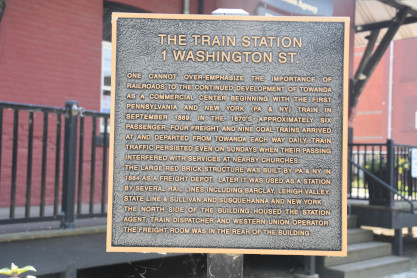
The plaque for the freight station.

"Time's Ticking ..." by Heath Bender sponsored by Henry and Sarah Dunn April 3, 2007.
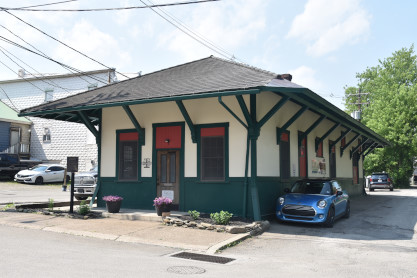
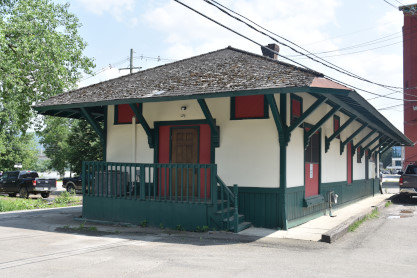
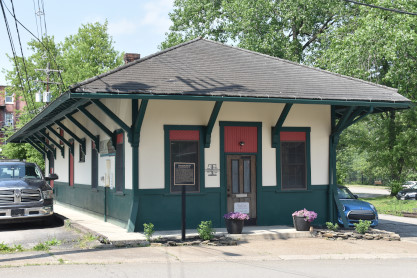
Susquehanna and New York passenger station built in 1922. The depot had three rooms - the ticket office, freight room and passenger waiting room. The building was "city steam-heated and electric" lighted. The postal telegraph cable company also had an office in the new station. The main station for the rail lines was located in the northern part of Towanda Borough just south of the present Sylvania Plant near the intersection of Hayes Street and Packer Avenue. It is the current home of Trowbridge & Company Wealth Management Group.
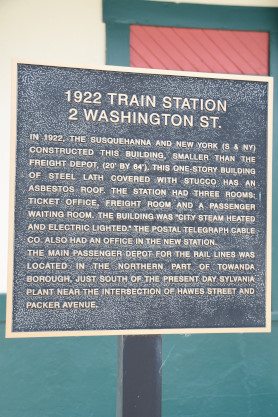
The plaque for the station.
The bus then took all to Milan.
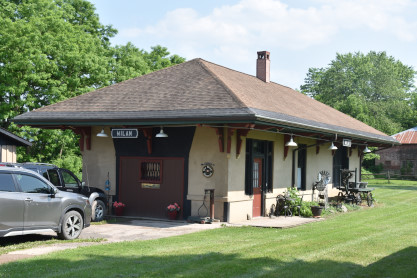
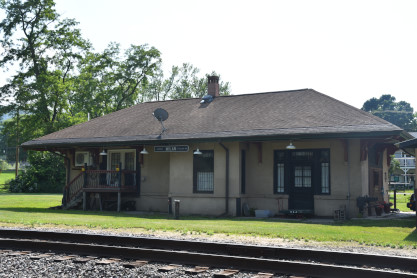
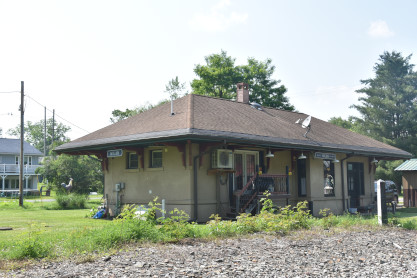
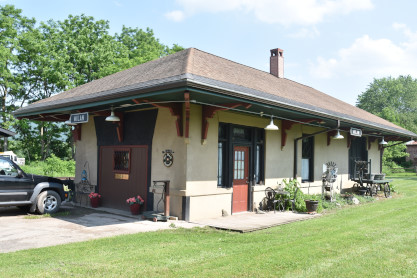
Lehigh Valley Milan combination depot, year of construction unknown, which has been converted to a residence.
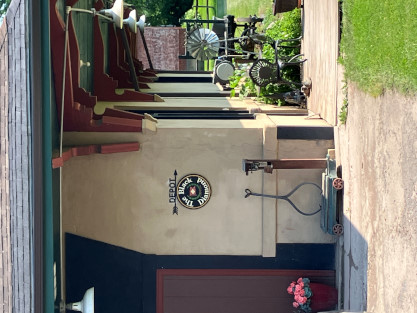
On the side of the station was this Black Diamond emblem, a commemoration of the Lehigh Valley's flagship train since 1896, on the through route between New York City and Buffalo. Alone among the "small fry", it possessed an entry to Pennsylvania Station and Manhattan proper, a relic of USRA control during World War I. Desperate to establish a streamliner brand to compete against the big boys, the LV. hired industrial designer Otto Kuhler of Baltimore and Ohio and Gulf, Mobile and Northern Rebel fame. With no budget to speak of his first effort was modest; a skirted and painted steam locomotive hauling a heavyweight Asa Packer. However, the public reception was so positive that Lehigh Valley was motivated to open its coffers wide enough to turn out two new streamliners (albeit largely of heavyweight equipment rebuilt in the railroad's own Sayre shops), the John Wilkes of June 1939 and the streamlined Black Diamond of April 1940.
The final stop of the day was in Sayre, where there was much to see and photograph.
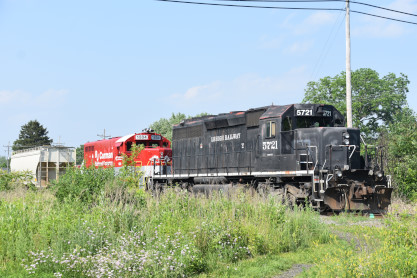
Lehigh Valley SD40-2 5721 and R.J. Corman GP16 1804.
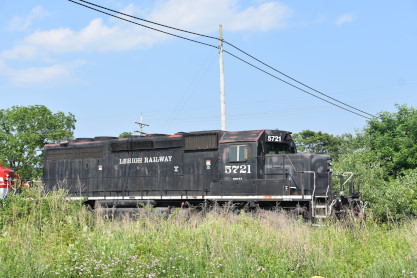
Lehigh Valley SD40-2 5721, ex. Luzerne and Susquehanna 5721, nee Canadian Pacific 5721, built by Electro-Motive Division in 1956.
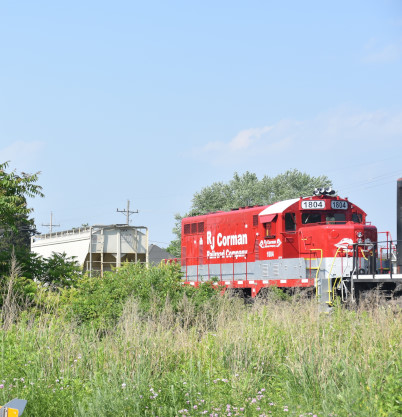
R.J. Corman GP16 1804 ex. CSX 1804, exx. Seaboard 4758, nee Seaboard Air Line GP7 1726, built by Electro-Motive Division in 1950.
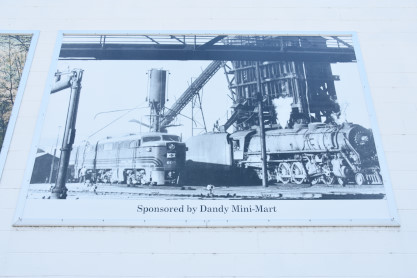

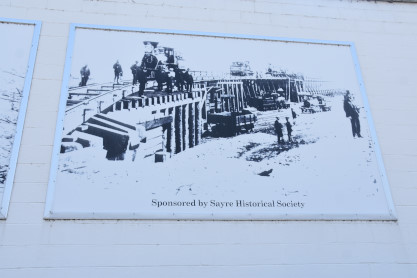
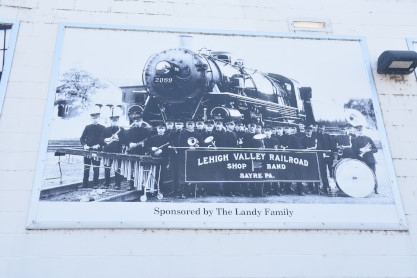
On the side of a building adjacent to the station was a series of historic photographs; these are the railroad ones.

Norfolk Southern yard office.
Once a strong, busy and vital railroad town, Sayre, Pennsylvania is today a quiet place, one where time seems to have passed it by. Home to the Northern division headquarters for the former Lehigh Valley Railroad, Sayre provided thousands of jobs to railroad employees from the 1870's through the railroad's golden age and on into the post World War II era. Sayre was a town that was never quiet. Around the clock railroad activity hummed along the Valley's mainline. The nearby massive locomotive erection shops added their own background music to a symphony song of the railroad age. The sounds of steam locomotion and the rumble of freight and coal trains were ever present.
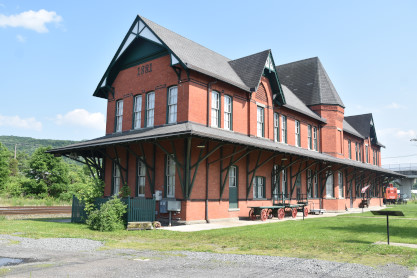
The present Sayre depot dates from 1881. It replaced a temporary structure which substituted for the original depot that burned in 1875. This was just a few years after the town had been renamed from South Central Junction. The railroad's original chief engineer, Robert Sayre had the newly bustling junction named after him by the Lehigh's Asa Packer, one of the 19th Century's most prolific rail entrepreneurs. The present structure is built in a High Victorian Gothic style, and has details in the Queen Anne motif. The railroad also constructed a three story brick office building. Both structures were meticulously landscaped with trees and flowers and were the pride of the railroad during the Valley's golden age.
Sayre was also home to a well-known medical facility which began in the former home of Robert Packer, son of the railroad's master builder. Robert Packer embraced new technology when he installed the first direct telephone line in the Sayre area, connecting his home with the railroad's offices in the Sayre yard.
Dating to 1878, the shops at Sayre replaced outmoded ones originally located in Waverly. Sayre joined Packerton and Easton as a principal heavy repair center. In 1904, a new shop complex opened in Sayre. Massive traveling cranes had been adopted by American railroads just a few years before, and the Valley's Sayre shops became one of the first ones to be so equipped. These wonders of the machine age could lift an entire locomotive and easily move it to the next repair point within the shop. By the turn of the 20th century, locomotive motive power was undergoing much standardization and the Lehigh Valley followed suit. When opened, the new shops could turn out one new or rebuilt steam locomotive a day. Sayre became the focal point as the railroad modernized and expanded its physical plant to meet the demands of a booming industrial economy. The melodious song of the steam age grew into a chorus at Sayre.
The Lehigh Valley was for many years primarily a coal hauler, one of the several Anthracite Roads transporting the flood of Black Diamonds from the Wilkes-Barre and Scranton areas of Pennsylvania. Coal, the lifeblood of the early industrial age was the foundation for the railroad's success. However, as early as the turn of the 20th century, general merchandise carloadings exceeded coal traffic. The Buffalo, NY extension had been completed in 1892, and the Valley slowly assumed the role of a fast freight expediter between the Buffalo gateway and New York City tidewater. Although it was freight and coal that paid the bills, the LVRR hosted several passenger trains proclaimed as the "Handsomest Trains in the World". The famous Black Diamond was the railroad's premier Buffalo to New York daylight accommodation.
Throughout the early part of the 20th Century, the railroad continued improving it's steam motive power, culminating in the very handsome 4-8-4 Wyoming series. The success of this locomotive with freight led to the railroad's 1934-35 order for five passenger engines of the same wheel arrangement. Oddly, the railroad did not seem to use these in regular passenger service, preferring to assign them to heavy milk trains. During World War II, the railroad took delivery of ten 4-8-4's from Alco. Designated class T-2b, these would be the newest steam locomotives to be scrapped. They were in nearly new condition when sent to the scrapper in 1951. The age of the diesel had arrived, and the pressures of the post war economy found the Valley in a struggle for survival.
But let us return to Sayre and imagine a summer afternoon in 1929. On the station platform are baggage wagons loaded with express and milk cans waiting for the afternoon milk train. Milling around are the usual assortment of small town kids, a few adults, and some old timers now retired from the railroad anxiously anticipating the arrival of the westbound Black Diamond. On an adjacent track, one of the Valley's dual-purpose Pacific locomotives is being readied for her next assignment. Hefty steam switchers are shuffling around the yards. The sounds from the backshops add additional atmosphere to the scene. Soon the Black Diamond is at the station. With crisp precision, the passenger loading business is quickly concluded and the train whistles off. Soon the last car rolls past. Today it is the solarium parlor-lounge "Black Diamond", one of a pair built in 1927 that the railroad owns. The sounds of the westbound Diamond slowly fade away on the Lehigh Valley Railroad.
The above written by John C. Dahl, from the Railroad Station Historical Society website.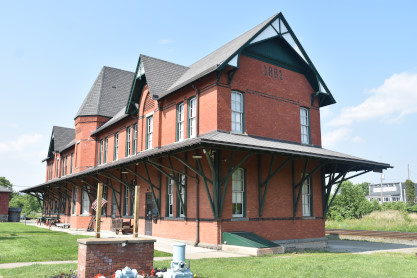
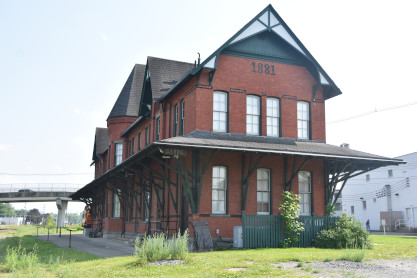
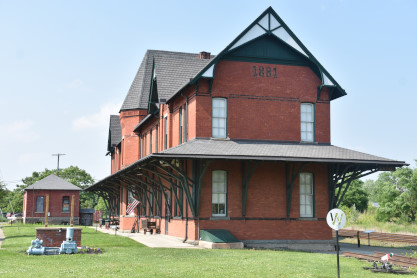
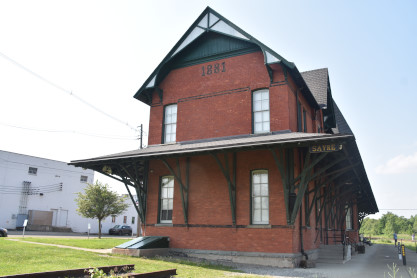
The imposing Lehigh Valley station built in 1881.
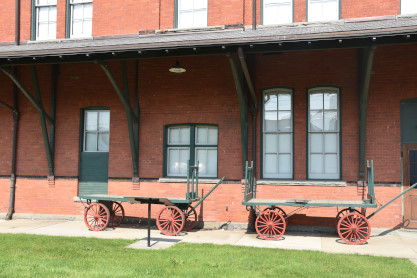
Baggage carts in front of the station.
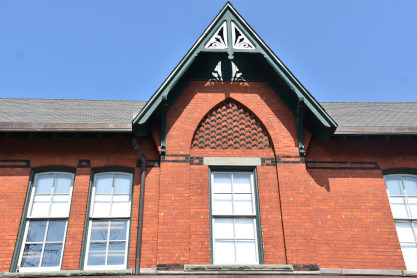
Architectural details.
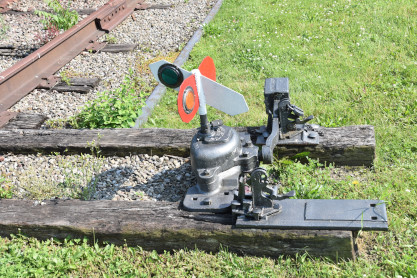
A low switch stand.
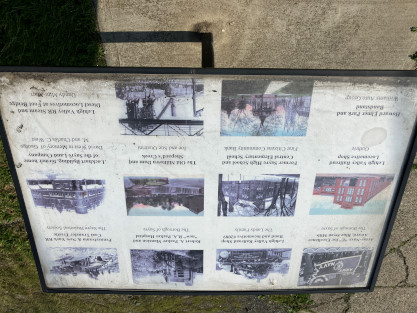
Sayre Historical Society sites.
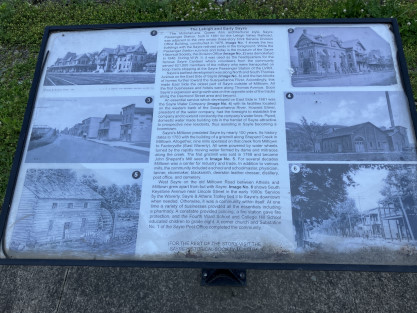
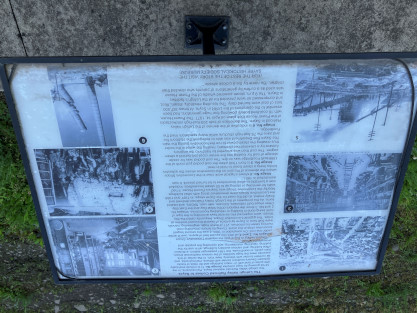
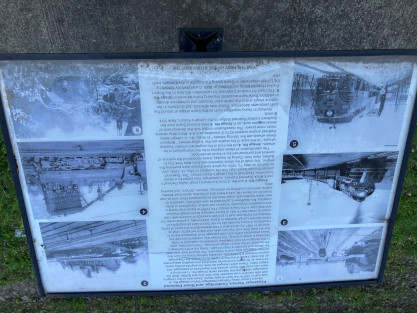
Around the exterior of the station were several history boards showing photographs and accompanying details. The angle of these boards was not conducive to photographing the text in a manner suitable for reproduction here.
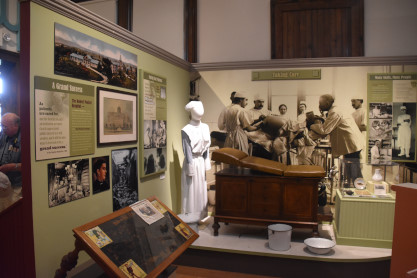
The first of many comprehensive displays, this one depicting Robert Packer Hospital, part of the People of Sayre.
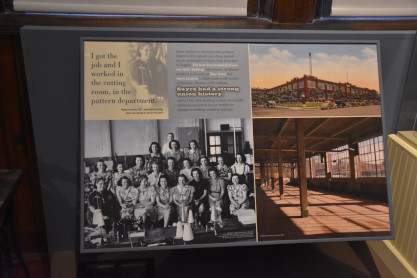
Sayre and union history.
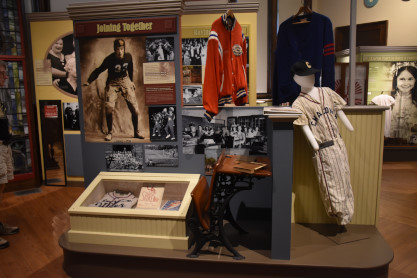
Sports in Sayre.
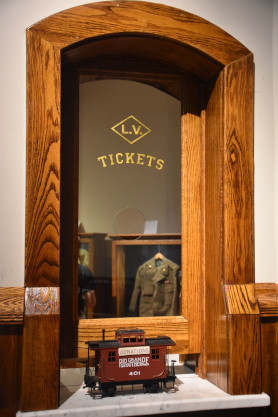
Lehigh Valley ticket window.
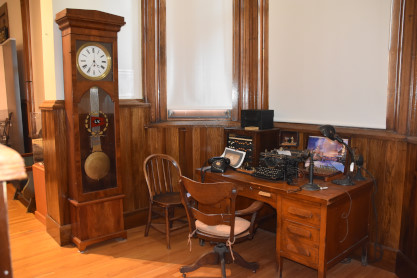
Station agent's desk and a Lehigh Valley grandfather clock.
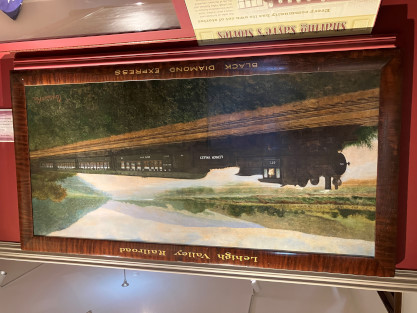
The Black Diamond Express painting by William Rau, donated by Anna Frances and Robert Payne.
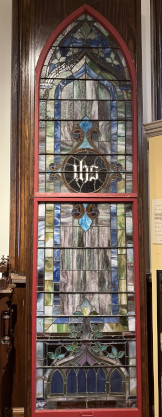
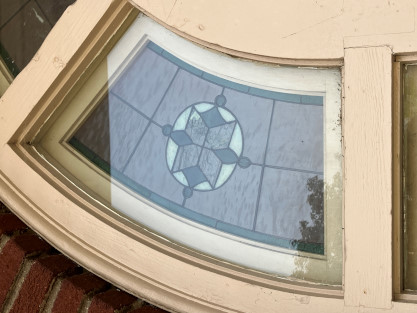
A pane of stained glass.
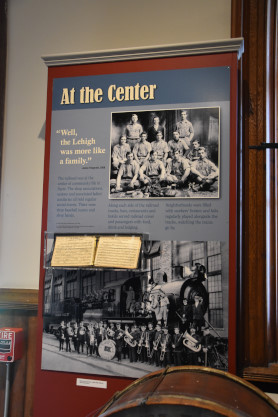
The railroad was at the center of community life in Sayre.
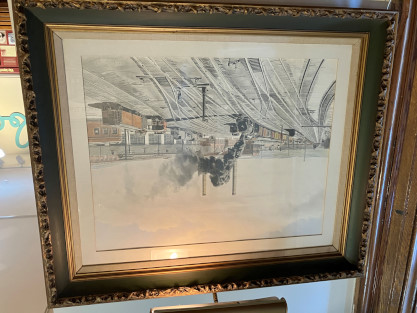
Robert Gauss' depiction of Lehigh Valley's shops during the steam era.
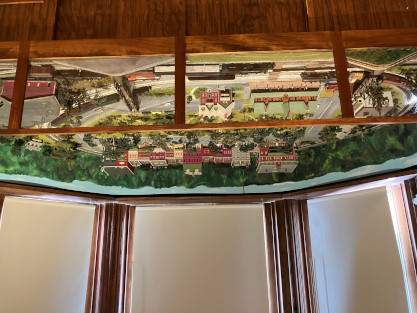
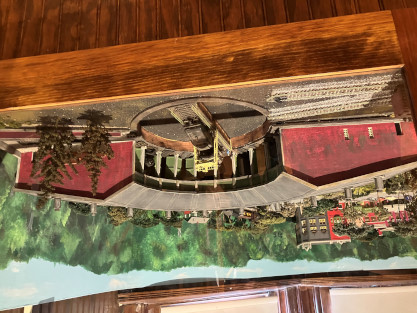
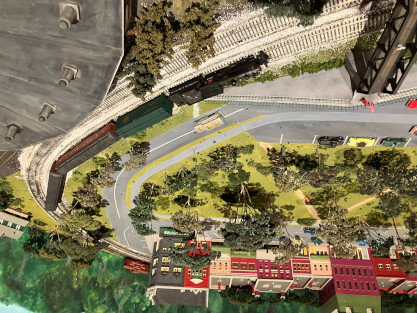
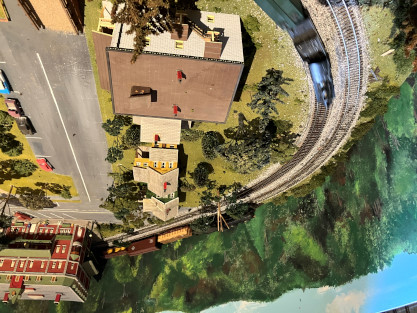
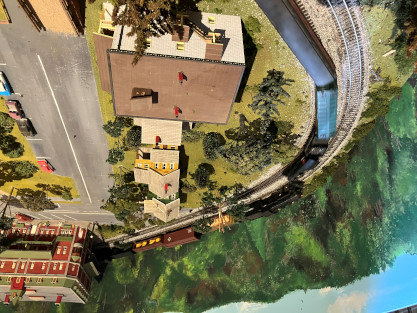
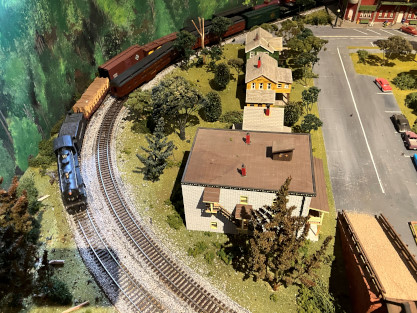

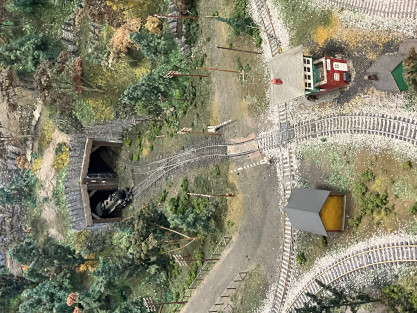
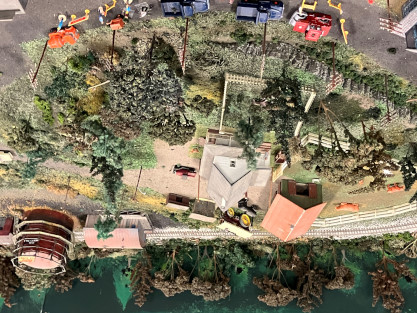
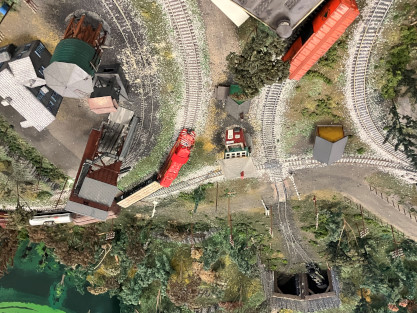
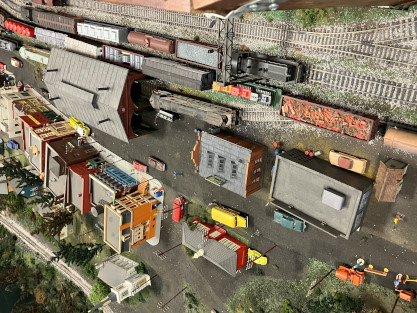
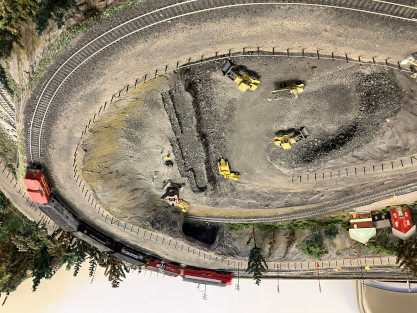
This HO scale model train layout was constructed by Charles Dixon and donated in his memory by his family.
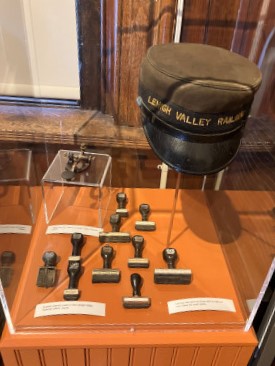
Rubber stamps used in the Lehigh Valley Railroad office in Sayre. The hat is a call boy hat worn by boys sent to call out train crews for work shifts.
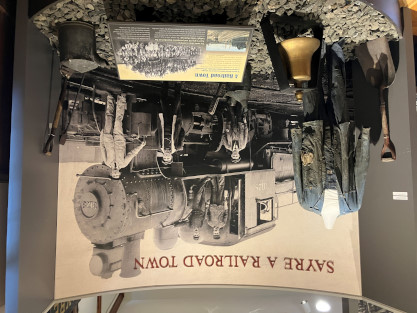
Sayre A Railroad Town. Sayre's growth and prosperity depended on the Lehigh Valley Railroad.
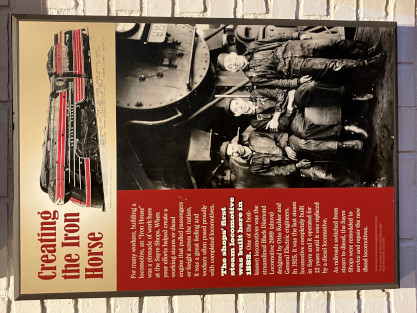
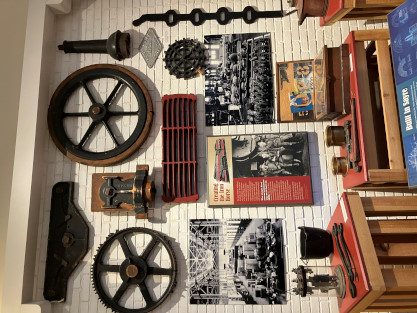
Creating the Iron Horse. The first shop was built here in 1883.
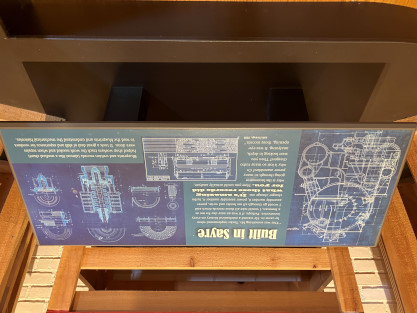
Built in Sayre.
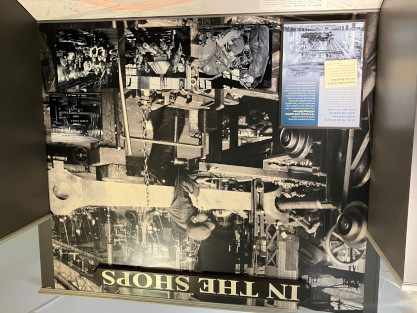
In the Shops. Skilled workmen made and repaired every part of the train.
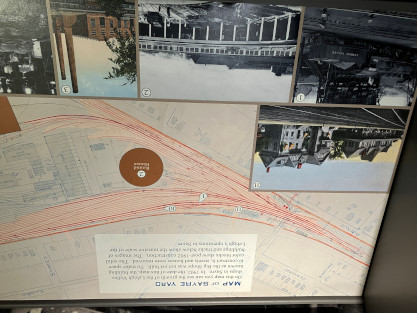
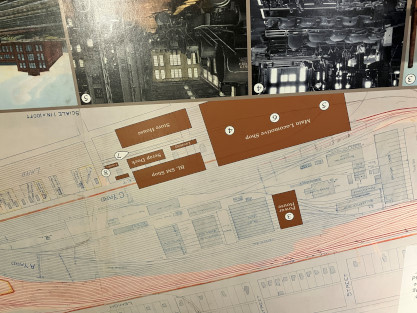

Map of Lehigh Valley's Sayre Yard which would eventually include 250 acres of land with 21 major buildings and 80 miles of tracks between Sayre's southern border with Athens, Pennsylvania, and its northern border with Waverly, New York. In the center of this expanse were the huge facilities of the various mechanical shops, train yards, a roundhouse, the 1881 passenger station, a division office building and various auxiliary buildings, all in use for the building, repairing, maintaining and operating the popular and prosperous railroad.
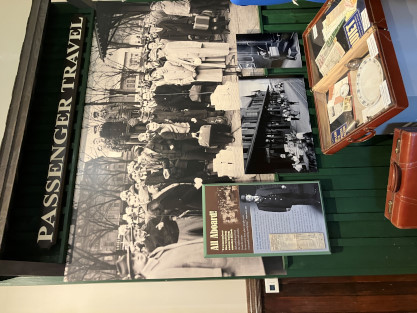
Passenger Travel.
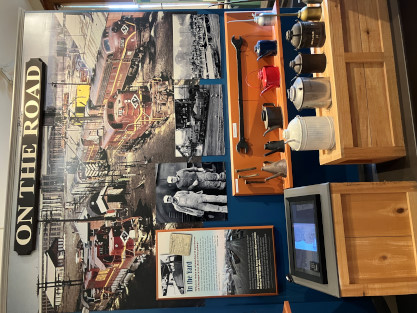
On the Road.
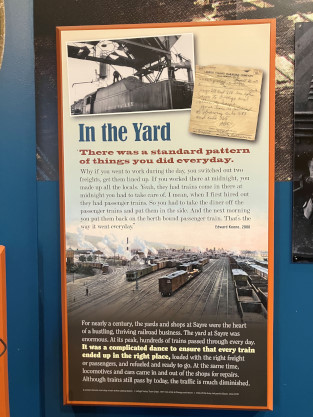
In the Yard.
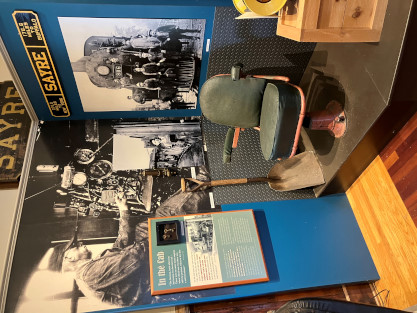
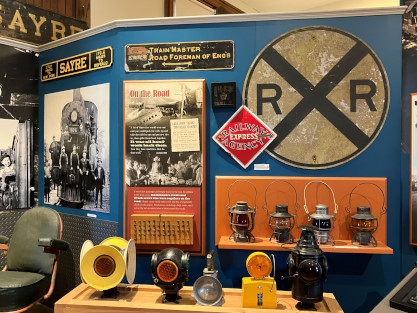
The Point-of-View of the Engineer.
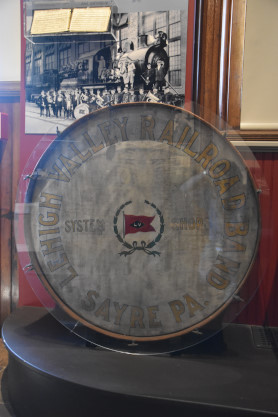
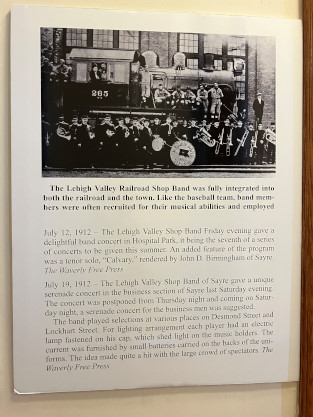
The Lehigh Valley Railroad Shop Band was fully integrated into both the railroad and the town.
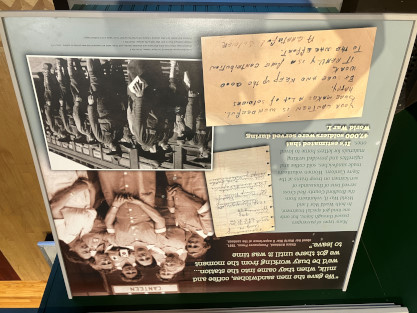
The Canteen.
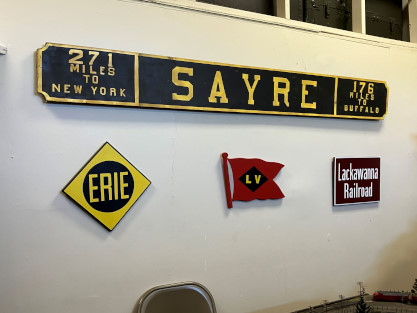
The station board proclaiming Sayre as 271 miles to New York and 176 miles to Buffalo, as well as Erie, Lehigh Valley Railroad and Lackawanna Railroad emblems.
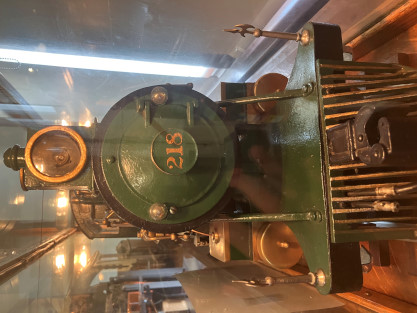
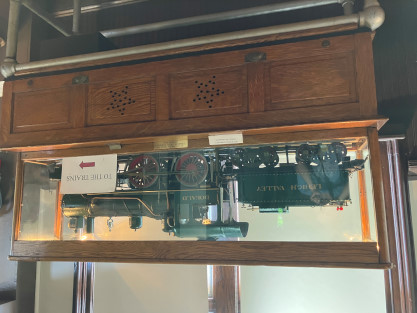
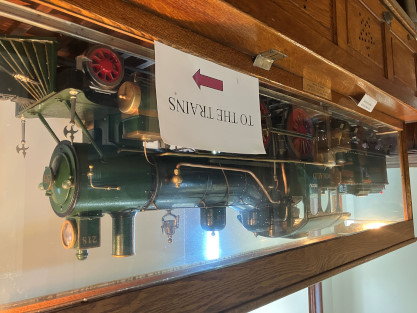
Lehigh Valley 2-4-0 18 on loan from the families of Francis David Gorman; Gorman and Koons.
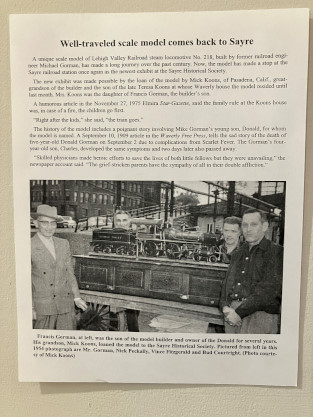
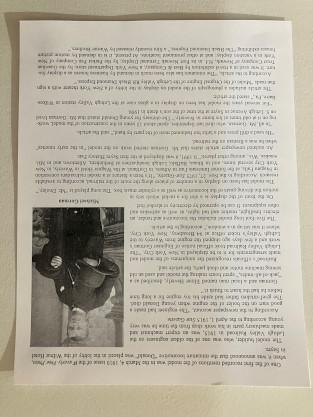
The interesting story of Lehigh Valley steam locomotive 218, highlights of which are: This scale model was built by former engineer Michael Gorman over a period of twelve years, and is the newest exhibit at the Sayre Historical Society. It was made possible by its loan by Mick Koons of Pasadena, California, great-grandson of the builder and the son of the late Teresa Koons, at whose Waverly house the model resided until it was donated. Mrs. Koons was the daughter of Francis Gorman, the builder's son. The history of the model includes a poignant story involving Mike Gormans's young son, Donald, for whom the model in named. A September 10, 1909 article in the Waverly Free Press tells the sad story of the death of five-year-old Donald Gorman September 2 due to complications from Scarlet Fever. The Gorman's four-year-old son, Charles, developed the same symptoms and two days later, also passed away.
Michael Gorman, one of the oldest engineers on the Lehigh Valley Railroad in 1915, was an expert machinist and made machinery parts in his work shop. Railroad officials recognized the uniqueness of the model and made arrangements
for it to be displayed in New York City. The five foot long model includes the locomotive and tender, an electric headlight, marker and tail lights, as well as airbrakes and other equipment. It can be operated by electricity or
alcohol fuel. On the front of the display is a slot for a nickel which sets in motion the driving gears of the locomotive as well a cylinder music box. The song played is "Mr. Dooley".
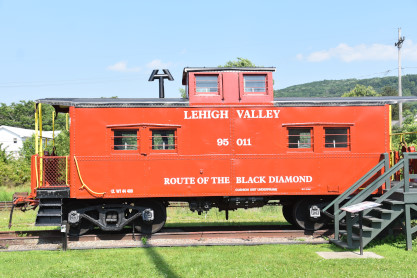
Lehigh Valley "Northeastern" caboose 95011, built by the railroad here in Sayre in 1941. After retirement, it was consigned to Conrail and ended up in the Enola Yards near Harrisburg then was located by a local historian Frank Evans and purchased by the Valley Railroad Museum in 1989. Local fundraising and donations were made, then the caboose was delivered to GE Railcar where it was grit-blasted and repainted inside and out and returned to Sayre in 2013.
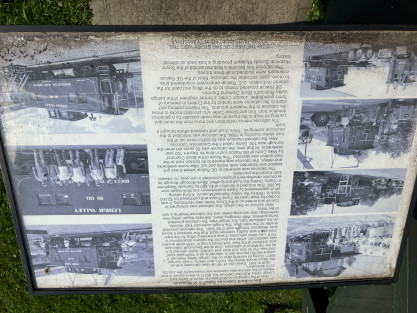
The caboose history board.
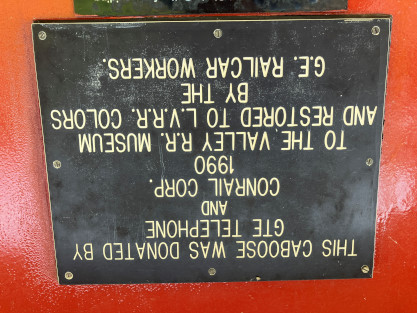
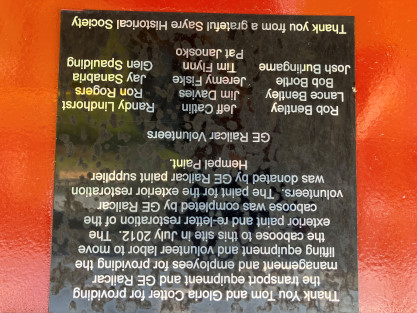
Plaques of appreciation on the caboose door.
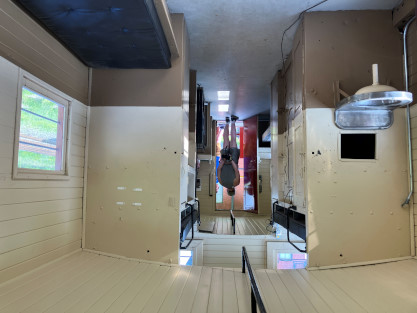
The unfinished interior of the caboose and father-and-son team of Thomas and Aaron Dickson showing a visitor around.
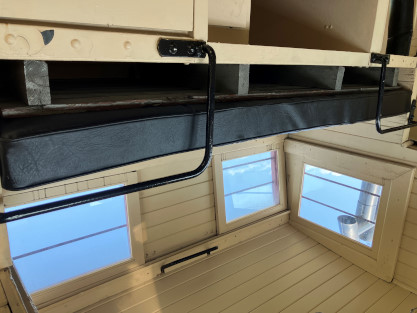
The bunk bed in the caboose.
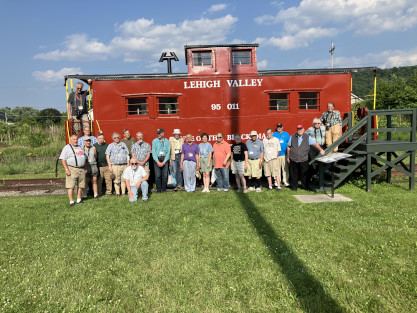
It was fitting that the convention photograph was taken here although one member could not join us until the next day. Board Member and Business Manager Jim Dent is standing in the caboose, tour guide Robert Pastorkey is kneeling and board member and convention organizer Ted Xakellis is in the purple shirt.
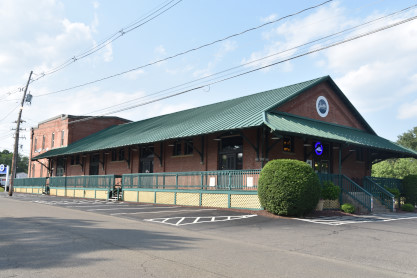
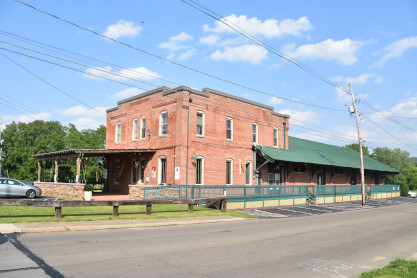
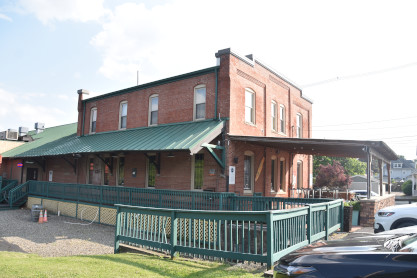
The Lehigh Valley Railroad freight house is now The Grille, a fine restaurant.
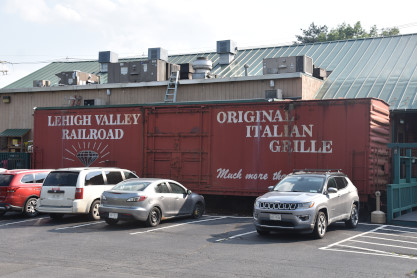
Behind the restaurant is this Lehigh Valley Railroad box car, identity unknown.
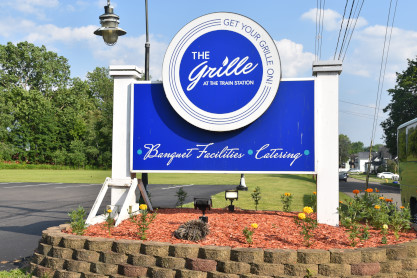
The Grille at the Train Station, banquet facilities and catering. That ended the day and the bus returned us to the hotel, Elizabeth went to Cracker Barrel for dinner then to her hotel for the evening.