



My brother Bruce's friend, Bruce Jacobs, married Shelly, whom I sang with in the St. Peter Lutheran Church's Knight Choir. He and I were also friends and railfans. He was transferred to Bothell, Washington so they had to move and I was asked if I could help. I checked with my college professors at Cal State Fullerton that my first three final exams would be right away but the last a week later. As such, I had a six-day window to assist with the move. I called my brother in Idaho and he booked me a return trip on the Coast Starlight and I was all set.
The Journey North 12/15/1980Moving someone out of an upstairs apartment was an interesting experience, especially with a long sofa and a piano. Most of one afternoon was spent packing a rental truck then we drove north in two vehicles, the truck and their car, and spent the first night at Merced, arriving in the wee hours of the morning.
12/16/1980 We drove up the Central Valley and the Sacramento River Canyon past Mount Shasta to Yreka, staying at a Motel 6.
12/17/1980 The third day proved to be the most interesting as we had agreed upon the fact that if the vehicles become separated, to go to the first rest area along the highway and wait. After Medford, Oregon, we did become separated so Bruce and I in the truck went to the Rouge River Rest Area. After about twenty minutes, Bruce decided to go and look for Shelly, leaving me at the rest area wearing only a light jacket. It was a cold, moist morning and minutes after he left, snow flurries started and the temperature dropped. I must have looked rather stupid and strange to an Oregon Highway Patrol officer who pulled up and asked me what I was doing there without a vehicle.
While I was freezing mostly, after I explained the situation to the officer, it turned out that Shelly was at the Highway Patrol Office in Grants Pass, so the officer went to look for Bruce and left me out in the cold. About twenty-five minutes later, Bruce arrived to collect his friend who was a popsicle by this time and we went to Grants Pass. The heater thawed me out and were soon reunited with Shelly. That day ended at the Motel 6 at Olympia, Washington.
12/18/1980 We arrived at the new house in Bothell and spent most of the day unpacking the truck before briefly exploring the city then had a fast food dinner and enjoyed a quiet first night in their new home.
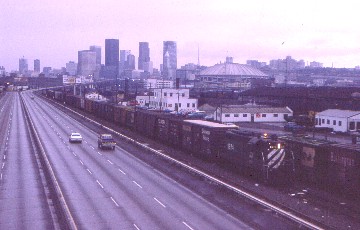
12/19/1980 Bruce and I embarked on a quick railfan tour of Seattle .
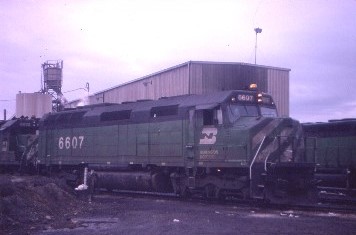
Burlington Northern F45 6607, nee Great Northern 434 (Big Sky Blue paint), built by Electro-Motive Division in 1969. Retired in 1984, it was leased to Helm for use on the Utah Railway, retaining its number and was then scrapped.
Bruce thanked me for all my help and dropped me off at Seattle's King Street Station, where I obtained my boarding pass and when the door opened, I was off to begin my first ride on Amtrak's Coast Starlight. Before the formation of Amtrak, no passenger train ran the entire length of the West Coast. The closest equivalent was Southern Pacific's West Coast, which ran via the San Joaquin Valley from Los Angeles to Portland from 1924 to 1949, with through cars to Seattle via the Great Northern Railway.
By 1971, the SP operated just two daily trains between Los Angeles and the San Francisco Bay Area: the Los Angeles–San Francisco Coast Daylight via the Coast Line, and the Los Angeles–Oakland San Joaquin Daylight via the Central Valley. The SP also operated the tri-weekly Cascade between Oakland and Portland, Oregon. The Burlington Northern and Union Pacific ran three daily round trips between Portland and Seattle, while the Santa Fe ran the San Diegan between Los Angeles and San Diego.
The Seattle–San Diego route was initially left out of plans for Railpax (later Amtrak) until protests from politicians in California, Oregon and Washington. With the start of Amtrak operations on May 1, 1971, a single train began running between Seattle and San Diego. The unnamed train (11/12) ran three days a week; on the other four days, another unnamed train (98/99) ran between Oakland and Los Angeles. On November 14, Amtrak extended the Oakland–Los Angeles train to San Diego, renumbered it to 12/13, and renamed it Coast Daylight. The Seattle–San Diego train became the Coast Daylight/Starlight (11-12) northbound and Coast Starlight/Daylight (13-14) southbound.
Both trains were cut back from San Diego to Los Angeles in April 1972, replaced by a third San Diegan. On June 10, 1973, Amtrak began running the combined Coast Daylight/Starlight daily for the summer months. Positive response led to Amtrak to retain this service, and the Coast Daylight name was dropped on May 19, 1974. An additional train, the Spirit of California, ran the section of the route between Sacramento and Los Angeles on an overnight schedule from October 25, 1981 to September 30, 1983. From November 10, 1996 to October 25, 1997, through coaches were transferred between the Coast Starlight and San Diegan at Los Angeles.
The Coast Starlight originally used the Southern Pacific West Valley Line between Tehama and Davis. That route included a stop at Orland but bypassed Sacramento. On April 26, 1982, the train was re-routed via Roseville on the Southern Pacific Valley and Martinez Subdivisions, with stops added at Sacramento, Chico and Marysville, per request from the state. In 1999, the Coast Starlight was re-routed onto the more direct ex-Western Pacific Sacramento Subdivision between Marysville and Sacramento, with the Marysville stop closed.
Coast Starlight 11 12/20/1980I boarded a dome coach and chose a window seat on the right. This was my first full-service Amtrak train, meaning full lounge and complete meal service in the dining car. The train had six coaches, three of those being the dome variety, and four sleeping cars. With the two baggage cars, it was a fourteen car steam-heated train, unlike the all-electric Amfleet trains I had been riding since 1976. Amtrak was in the throes of obtaining new Superliner cars to replace these low-level ones and replace their unreliable steam-heated cars with new all-electric trainsets. The conductor took my ticket and told me to use the dome seating whenever I wanted.
We departed Seattle on time and passed the Kingdome, where Major League Baseball's Seattle Mariners and National Football League's Seattle Seahawks played. We proceeded through the industrial areas of South Seattle and passed Union Pacific's Argo Yard, followed by the Boeing aircraft plant then crossed the Black River bound for Kent. Burlington Northern's Auburn Yard came next as we were on their rails until Portland. Mount Rainier was visible to the southeast from the dome windows and we sped through Puyallup before arriving at Tacoma, Washington's second largest city. We departed along the waterfront and along Puget Sound, passing the Nelson-Bennett and Ruston Tunnels through headlands protruding into the Sound. We then gently curved along the shoreline passing Steilacoom, crossing a few drawbridges with the offshore islands standing guard across Carr Inlet and Nisqually Reach. After about twenty miles of shore-running we cut inland, leaving a marsh for the forest to our next stop at Olympia, the state capital. The train then slipped through the hills, passing Union Pacific and Burlington Northern freights on this double tracked main line to our next stop at Centralia. We left town before passing through Chehalis then climbed the grade to Vader before starting downgrade towards the Columbia River.
This brought us to the part of the trip that involved Mount St. Helens. Seven months ago, it erupted and blasted away 2,000 feet of its summit, causing a flood of ash and trees down the Toutle River, destroying everything in its path. We entered the area where our route paralleled the river and after crossing it, it looked as though it was a major construction zone, all white with the ash and mud being dredged out of the river channel and piled into high mounds. Where once forest had stood, now there was nothing except this white groundcover. The trees looked like toothpicks just dropped from above and it was an absolute mess and just proved how much power Mother Nature possesses. We then escaped back into a reality of green Washington forest until our next station at Kelso-Longview.
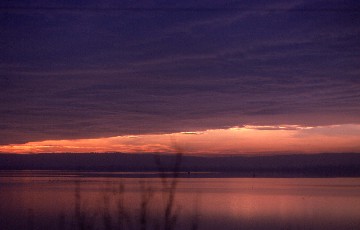
The Columbia River was in sight and Oregon on the south side of the water. The river curved to the south and the railroad stayed on the east side all the way to Vancouver, where it was crossed once more into the Columbia River Gorge. In the late afternoon, the trees were reflected on the still waters of the many sloughs; it was a very beautiful scene and I attempted a few pictures. We passed through Burlington Northern's Vancouver Yard before arriving at the station located in the middle of a huge wye with tracks going east into the Gorge. After our double station stop due to the length of our train, we crossed the Columbia River on a swinging span drawbridge and entered the State of Oregon.
Once on Oregon soil, we quickly crossed another channel with pleasure boats located upstream before saying goodbye to the Union Pacific, which had been sharing our route since Tacoma, prior to crossing the Willamette River. We travelled along the riverfront industries before going past Burlington Northern's Lake Yard and arrived at Portland Union Station as the sun set over the Coast Range and I took advantage of the servicing stop to explore the station.
Departure was on time and we crossed the Willamette River on the Steel Bridge under the cover of night then travelled through Southern Pacific's Brooklyn Yard and would stay on their rails all the way to Los Angeles. We passed the waterfall at Oregon City, lit by their hydroelectric activities. The first call for dinner was announced and since I was in the lounge car finishing a drink, I walked back one car for my first full-course rail dining car experience on Amtrak. I was seated in the middle of the car with a forward-facing window seat with three German tourists who spoke no English, and I did not speak any German. For my part, it was going to be a very quiet dinner but I did have the passing nighttime scenery to watch. The waiter brought us our menus and I ordered something new, a Prime Rib since I knew that the word 'prime' meant excellent and since it was the highest price meal, thought it must be good.
The table was set with white linens and china and a single rose in a stainless steel vase. The silverware was really outstanding and I had not been to many upscale restaurants. The waiter brought the salad, which I passed on, and then the rolls, which he brought extras since I was not having a salad. After about twenty minutes of passing lights, the waiter returned with my order of Prime Rib and a baked potato. As soon as I tasted it, I knew I had found a new meal since I am a very finicky eater. While I was enjoying my repast, the train continued south along the Willamette Valley, stopping in Salem and Albany then afterwards, I went to the lounge car for an after-dinner drink and enjoyed the surroundings. The air was thick from the smokers so at Eugene, I detrained for some fresh air and passengers detrained and entrained, including a high school wrestling team from Davis, California, but they were seated in the car ahead of mine.
Leaving Eugene, I went upstairs into the dome and chose a forward seat on this clear and star-filled moonlit night. About Oakridge, my car attendant came to check on the dome and I asked if he could turn out the lights so we could enjoy the outside world. He left and within a minute, the lights were out which dramatically increased the view and once we reached the snow line, the view was almost as good as daytime. The ride across the Cascades was incredible and the moonlight reflecting off Odell Lake was beyond words and a very special moment. I called it a night at Chemult and returned to my seat, glad to have the seat next to me empty, and fell asleep. During my slumber, we stopped at Klamath Falls, then entered California, passed Mount Shasta, stopped at Dunsmuir, travelled down the Sacramento River canyon and stopped at Redding before continuing down the west side of the Sacramento Valley to Willows.
12/21/1980 I awoke just as the train was passing through Woodland and ten minutes later, we stopped at Davis where the train was met by the Davis police and I later learnt later that some of the wrestlers had been up on the roof of the train last night and bad-mouthed the conductor, hence the authorities were called to the station. As we had arrived twelve minutes early, the incident did not delay us then upon departing, this part of the Sacramento Valley was covered in a dense Valley fog with visibility near zero. I went to the lounge car for my milk and doughnuts before returning to the front seat of the dome where I found that someone had loosened the glass panel and it was partially open, so I closed it all of the way.
The Coast Starlight cut through the dense fog as we passed through Dixon, Cannon and Fairfield-Suisan City prior to the fog lifting to the east where I saw the United States Navy's Mothball Fleet. We climbed the grade to the bridge over the Carquinez Straits before descending into Martinez, our next stop, then travelled along the shoreline, twisting, turning and ducking under the Interstate 80 bridge before going through a tunnel. We then had a excellent view of San Pablo Bay and the Marin Headlands before passing a refinery and then the picturesque setting of Pinole before cutting across another headland to our next stop at Richmond. We continued south through Berkeley with a view of San Francisco across the bay, then Emeryville and into Oakland's 16th Street station. This was a long servicing stop so I explored the station and found the elevated platforms from the Sacramento Northern electric trains that once served the city.
Departing on time, the train went through Southern Pacific's West Oakland yard, down the street of Jack London Square before later passing the Oakland Coliseum, home of Major League Baseball's Oakland Athletics and National Football League's Oakland Raiders. The air conditioner then shut down and I was told that it was a common occurrence in these older dome cars, after which it emptied and with my last final exam tomorrow in Air Photo Interpretation, I used this opportunity to study. We passed the large salt plants, the Alviso Ghost Town and Santa Clara before arriving at San Jose then continuing south, the Starlight followed the route of the Spanish highway El Camino Real. Gilroy, the Garlic Capital of the World, was next, after which we went through the Pajora Gap, a passage through the Coast Range to the coast, and crossed the San Andreas Fault Zone.
We then ran through Watsonville prior to crossing a coastal estuary before reaching Moss Landing, where we turned to the southeast to start our long trek up the Salinas Valley. The temperature in the dome was nice and toasty so I removed my shirt to enjoy the sauna. As I continued to study and felt as though I was ready for Dr Lee's final, I did miss the miles of irrigated fields, hills with ranching, the Coast Range to the west and more mountains to the east. The Salinas Valley narrowed as we passed through Camp Roberts, Paso Robles and climbed into Santa Margarita, then curved out of town to the tunnel that allowed the train to pass under Cuesta Pass. Once we exited, there were two more right away as the train started its descent. While California Highway 101 takes the steep and straight route to San Luis Obispo, the railroad, on the other hand, takes the long but steep 2.5 percent grade. The view looking down off the mountain was spectacular and we rounded several horseshoe curves to reduce elevation before another tunnel was plunged through prior to rounding the famous Goldtree Horseshoe Curve, a tight affair where you can see both ends of the train. We crossed the high Steiner Viaduct before passing Cal Poly San Luis Obispo and arriving at San Luis Obispo, our next servicing stop.
Leaving there, we passed the Southern Pacific helper locomotives waiting to push a freight over Cuesta Grade then passed through the gap in the hills to Grover Beach and the sand dunes at Pismo Beach. The Coast Starlight climbed a short hill that led it into the Santa Maria Valley, where we crossed the Santa Maria River right before Guadalupe then climbed the hills to Casmalia, where we followed a creek down towards the Pacific Ocean. From here, our train would follow the coastline all the way to Ventura. We crossed the Vandenberg Air Force Base with its missile launching complexes and miles later, crossed the Santa Ynez River at Surf, the only public access to the ocean for many miles along the coast due to the base. We climbed up onto the bluff for the rest of the trip across the base and once back on non-military land, we crossed the privately-owned lands used mainly for ranching then traversed a high trestle at Jalama Beach County Park. From here to Santa Barbara, anytime the route crossed a major stream, there was a trestle bridge.
The coastline was really rugged along here as the Coast Starlight rounded Point Conception and proceeded east along the Santa Barbara Channel. The Channel Islands were seen far offshore and the massive kelp beds were located just offshore. Offshore oil wells were seen occasionally as we went through Gaviota, Refugio and El Capitan State Beaches before reaching the next stop at Santa Barbara and with an on-time departure, the sun was setting in the western sky. We travelled under the cover of darkness to Oxnard and Glendale, before arriving at Los Angeles Union Station on time, where I detrained from a wonderful and interesting first ride on the Coast Starlight. I went into the station and sat in front of the gate for my last train of the day.
San Diegan 584 12/21/1980I was expecting this would be a quick 36 mile journey home to Santa Ana, however, in reality it became a four hour ordeal. We left Track 8 on time but only reached the end of the platform where the locomotive died. The crew tried to restart it to no avail and we sat and waited about forty-five minutes when another locomotive was added to the consist and this time we departed but only managed as far as the 8th Street Coach Yards where our new engine died. After several more attempts to revive the sick patient, it too was declared dead. We sat and waited as our engineer walked down to the roundhouse in the dark to secure a locomotive which would be capable of pulling our train and placing it on the point in front of the other two dead engines.
We departed for Fullerton and points south two hours and twenty minutes late and after Fullerton, the train lost all head-end power. I arrived home at Santa Ana three hours late and watched the train leave, wondering what awaited it out in the night. Once home, I had a short five hours of sleep before going to Cal State Fullerton for a final exam that Mr. Lee informed me I did not need to take as I had done so well in his class. While that was true, it would have been nice to know beforehand so I did not have to study on the train.
The Coast Starlight June 1982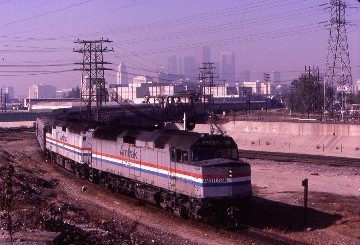
I boarded a San Diegan and the Coast Starlight after graduating from Cal State Fullerton for a trip to Bothell to visit Bruce and his family. The most interesting occurance about the northbound trip was meeting a young woman named Helen, from, of all places, Helendale, near Barstow. I nicknamed her Barstow and we just had a casual conversation between Oakland and Martinez while I was enjoying my nightcaps. She was destined for Martinez with her mother visiting Walnut Creek. We said our goodbyes and I through I would never see her again, but would always have a memory of her nice smile.
Following a nice visit with Bruce, five days later I was on my way home on the Coast Starlight. After the stop at Salinas, I was sitting in my coach seat when I saw a beautiful young woman smiling so nicely and we recognized each other and had a very enjoyable trip the rest of the way to Los Angeles.
| RETURN TO THE MAIN PAGE |