



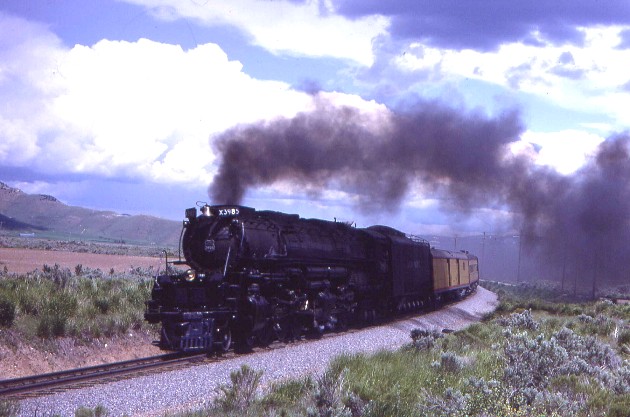
My brother Bruce called to inform me that Union Pacific 4-6-6-4 3985 was going to be visiting Pocatello, Idaho for the city's 100th Anniversary, followed the next weekend by its first public excursion from Salt Lake City to Provo, Utah.
I planned a trip which would have me arrive in Pocatello two days before the steam train's arrival and leaving Ogden the night of the excursion. My friend Bill Compton would join us on the day Union Pacific 3985 was going to Salt Lake City. Bruce bought us three tickets for the steam excursion and made my Amtrak reservation.
6/16/1982 The day before Union Pacific 3985 arrived, Bruce and I drove east on US 30 to scout locations.
6/17/1982 Bruce and I drove east to Montpelier.
Union Pacific Challenger 3985 was designed by Union Pacific and built in 1943 by the American Locomotive Company. It is one of 105 Challengers built for Union Pacific between 1936 and 1943 and was the only operating engine of its class in the world – the largest and most powerful operating steam locomotive. 3985 last operated in "regular" train service in 1957. It was retired in 1962 and stored in the roundhouse in Cheyenne, Wyoming, until 1975 when it was placed on display near the Cheyenne depot. A group of Union Pacific employees volunteered their services to restore the locomotive to running condition in 1981.
The name Challenger was given to steam locomotives with a 4-6-6-4 wheel arrangement. This means that they have four wheels in the leading "pilot" truck, which helps guide the locomotive into curves; two sets of six "driving" wheels, and finally, four "trailing" wheels, which support the rear of the engine and its massive firebox. Each set of driving wheels has its own steam cylinder. In essence, the result is two engines under one boiler. The frame of the locomotive is "articulated," or hinged, to allow it to go through curves. When watching the approaching locomotive go through a curve, you can see the boiler swing out left or right independently of the lower half of the engine, as the rear half of the locomotive remains in a straight direction until its wheels and frame are halfway through the curve.
Built between 1936 and 1943, the Challengers were nearly 122 feet long and weighed more than one million pounds. They operated over most of the Union Pacific system, primarily in freight service, but a few were assigned to passenger trains operating through mountain territory to California and Oregon. The Challengers were designed for fast freight service, but occasionally pulled passenger trains. 3985 originally burned coal and pulled a tender with a 32-ton capacity. In 1990, it was converted to use No. 5 oil. The top speed of 3985 is about 70 miles an hour. The only other remaining Challenger, No. 3977, is on display in North Platte, Nebraska.
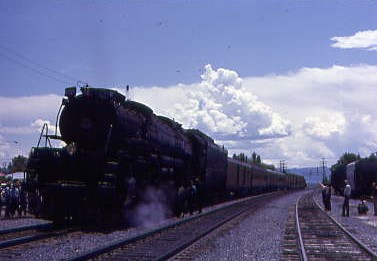
Here we found Union Pacific 3985 being serviced with a consist of a dome chair car, dome lounge car, a Pacific Fruit Express mechanical refrigerator car, a boxcar and CA-11 bay window caboose. We then made our way west to Mason.
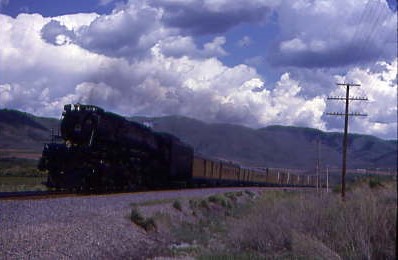
The special train at Mason, where I made the mistake of turning to watch it and receiving a faceload of hot cinders.
We drove west, racing Union Pacific 3985 easily to our next location at Alexander, where the Grace Branch took off.
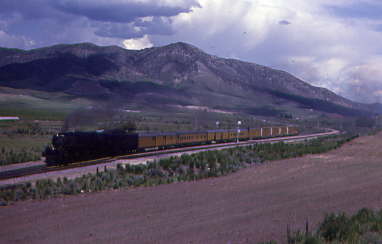
Back in the Pinto and continuing west, this is at the west end of Topaz. We gave up the chase to retrieve Bruce's truck which had become stuck the day before due to heavy rains when we were out wood-cutting. It had dried out nicely and we returned to Pocatello in time to watch the end of the wyeing process, thus ending our first day with Union Pacific 3985.
6/19/1982
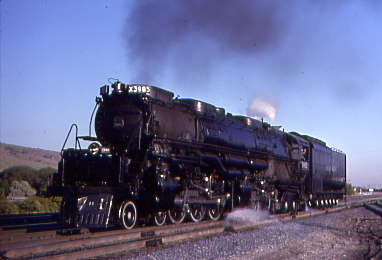
Two mornings later, we went down to the west end of the yard and caught Union Pacific 3985 on its way to the station for display at Union Pacific's Family Days and the Pocatello Centennial Celebration.
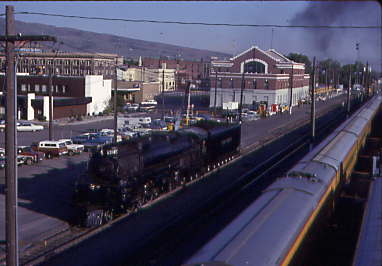
The steam engine at Pocatello Station with the Family Days special diesel-powered train awaiting its first excursion.
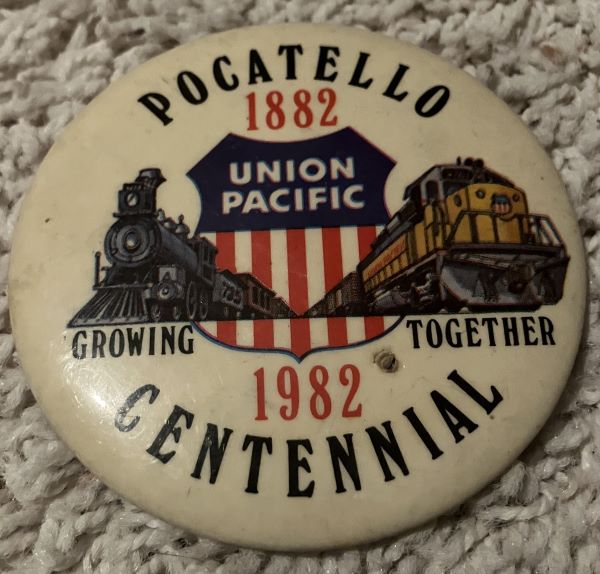
The commemorative button.
6/20/1982 Today, Union Pacific 3985 would run east to McCammon to wye then return to Inkom to pick up Idaho Governor John Evans and bring him to Pocatello to cap the centenntial. I drove out east to the beautiful Portneuf River Canyon at the East Inkom Hold to wait for the steam special.
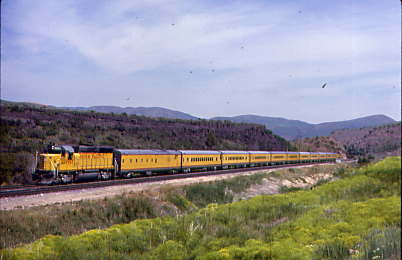
A Family Day train arrived first.
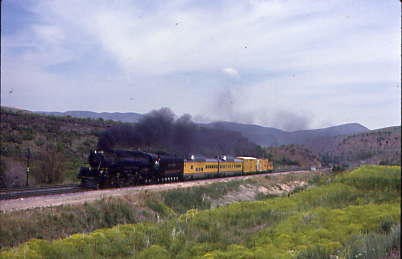
A few minutes later, Union Pacific 3985 appeared with its short special train.
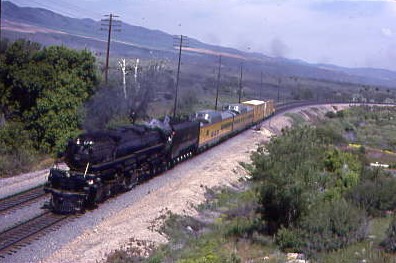
I jumped into the Pinto and raced ahead, photographing him just before he reached McCammon.
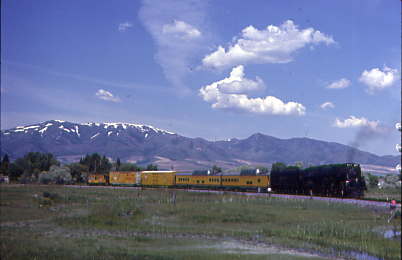
The train one the wye.
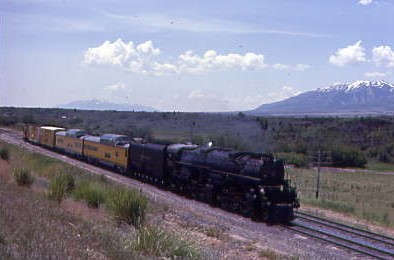
I drove back to the East Inkom Hold.
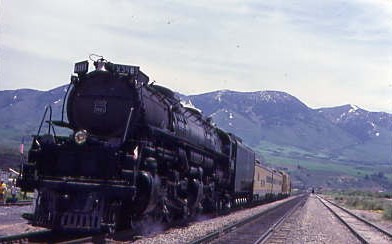
On the way to Inkom to pick up Governor Evans.
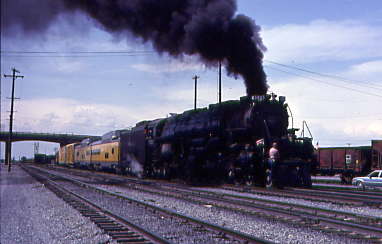
Later back in Pocatello, Union Pacific 3985 wyeing again.
Union Pacific 3985 to Salt Lake City 6/21/1982Up early, Bruce and I drove to the east end of Pocatello Yard.
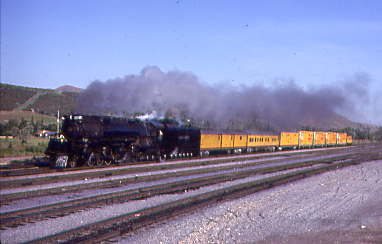
Departing for Salt Lake City.
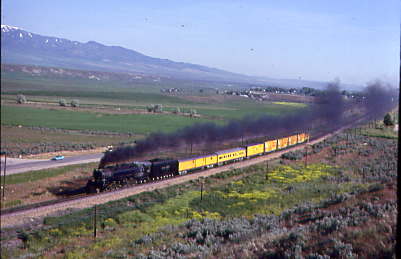
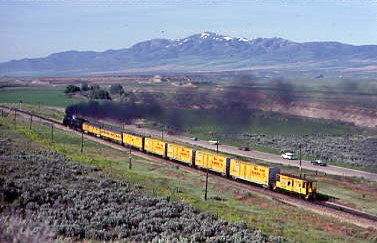
We drove south on Interstate 15 to Arimo where we found a road up onto the bluff for these approaching and departing pictures.
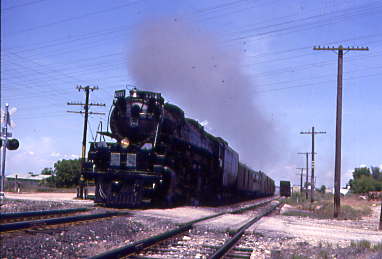
We drove down to pick up a waiting Bill Compton in Ogden before back-tracking north to Hot Springs, Utah where we found Union Pacific 3985 coming towards us.
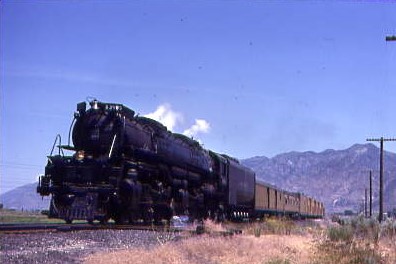
The chase was on and we beat the train to Perry.
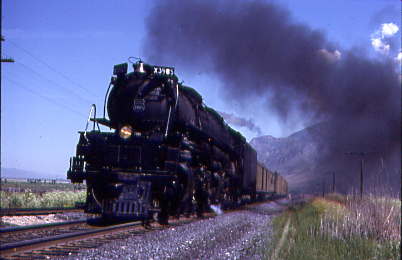
The three of us continued south and overtook the train, making it to Brigham City.
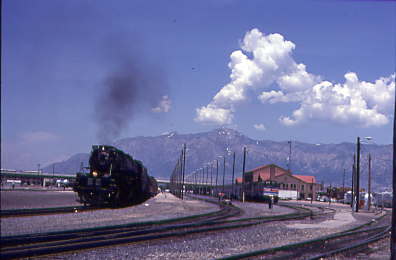
Due to slow trackage in Ogden, we arrived at Ogden Depot before the steam train and were able to photograph him passing the depot, where the Desert Wind awaited its nightly departure.
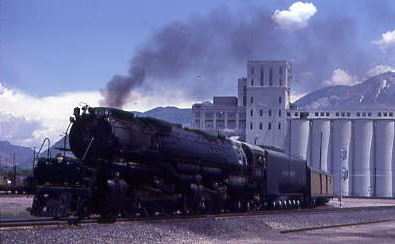
Back in the car, we caught up to and overtook Union Pacific 3985 to catch him coming around the wye at Ogden.
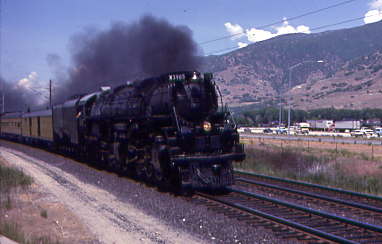
Returning to Interstate 15, we drove south to Farmington to photograph Union Pacific 3985 and its train running under the test catenary. Union Pacific was contemplating electrifying the former Overland Route and chose Farmington as a test bed. This was our last shot of the day, after which we returned to Pocatello.
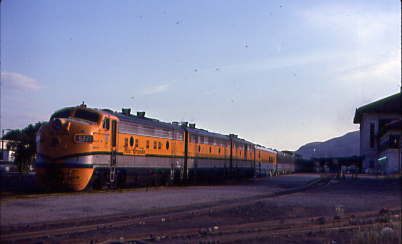
During the week, Bill and I ventured out to Salt Lake City to photograph the Rio Grande Zephyr.
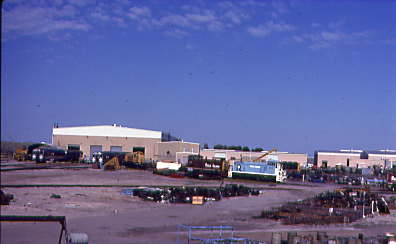
We also stopped in Boise to see the Morrison-Knudsen shops.
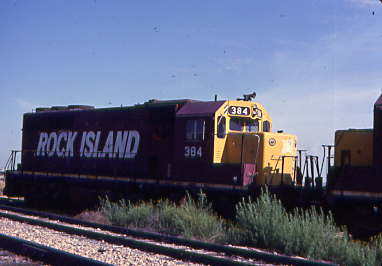
Chicago, Rock Island and Pacific GP40 384, built by Electro-Motive Division in 1969. It would later become New Jersey Transit 4138, then San Luis and Rio Grande 4138. It is currently San Luis and Rio Grande 1921 and painted in an Adams State University livery.
| RETURN TO THE MAIN PAGE |