




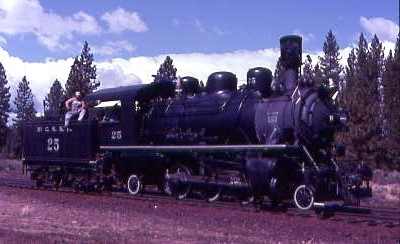
I had always wanted to ride the McCloud River Railroad after seeing a picture in Trains Magazine of one of their Snowflake Specials and in the railfan magazine Flimsies was a blurb about a trip over Labour Day weekend 1983 that both my friend Jeff Hartmann and I decided to ride.
McCloud River Railroad HistoryThe McCloud River Railroad was a class III railroad operated around Mount Shasta incorporated on January 21, 1897 and began operations on August 1, 1897 as a forest railway bringing logs to the company sawmill on the Southern Pacific Railroad at Upton, a few miles north of Mount Shasta. Originally, locomotives were borrowed from the Southern Pacific, but in 1902, the railroad received their first locomotive, number 1. By 1901, the company sawmill was moved to McCloud and the distance for hauling lumber produced there was reduced to 17.8 miles by shifting the junction south to Mount Shasta in 1906.
The locomotives were converted from wood to oil fuel as the railroad extended into the forests east of McCloud in 1907. Trains brought logs to the McCloud sawmill from the east and carried lumber from the sawmill west to the Southern Pacific. In 1922, the Pacific Gas & Electric Company built branches south from the McCloud main line at Bartle to build hydropower plants on the Pit River. Materials to build the Pit 1 powerhouse, the Pit 3 Dam and the Pit 4 Dam were carried over the McCloud River Railroad to connect with the Pit River Railroad, officially known as the Mount Shasta Corporation Construction Railroad.
During this period, the McCloud Lumber Company, who owned the railroad, decided to build a branch northeast to access the forests there. Meanwhile, the Great Northern and Western Pacific Railroads were building a north–south mainline, with plans to meet at Lookout. The McCloud decided to continue their lumber branch to serve as an interchange with the Great Northern and Western Pacific and the connection was made at Lookout Junction in 1927, although the connection of the GN and WP was actually made six miles south in Bieber. However, when the Great Depression hit, McCloud was desperate for money, so they decided to sell the line from Lookout to Hambone to the GN. The McCloud retained operating rights until the Branch was abandoned in 2003.
In 1955, McCloud extended the former PG&E line south to Burney and upon reaching there, McCloud operated a 130 mile, railroad including trackage rights over the 34 mile Great Northern Hambone branch. The railroad remained primarily a logging railroad with several different owners over the following years including: U.S. Plywood Corporation (1963), U.S. Plywood-Champion Papers (1969), Champion International (1972) and Itel Corporation (1977), until the railroad officially ceased logging operations in 1979. It was then sold to Jeff E. and Verline Forbis (4-Rails, Inc.) on July 1, 1992.
On June 28, 2005, the railroad petitioned the Surface Transportation Board to abandon most of its line and service on all lines east of the now-abandoned McCloud Sawmill were terminated. A small section of the line between McCloud and Mount Shasta remained open briefly for excursion and the Shasta Sunset Dinner Train. As timber demand declined, the railroad slowly cut back, although new ownership also led to its downfall. In 2009, the railroad was sold to the MidWest Pacific Rail Net & Logistics, owner of A&K Railroad Materials, among other companies. Railroad operations slowed in 2005, with the abandonment of the Burney Branch, but continued on, with the dinner train being the only scheduled train on the entire line, with the occasional yard and hill job.
Later that year, it was announced that the dinner train would cease operations by the end of the year, the final one being on Saturday, January 16, 2010, thus ending all operations on McCloud. McCloud River Railroad 2-6-2 25 was sold to the Oregon Coast Scenic Railroad and all but two of their diesel locomotives were sold. The railroad stayed shut down, but not abandoned through the rest of the 2010s.
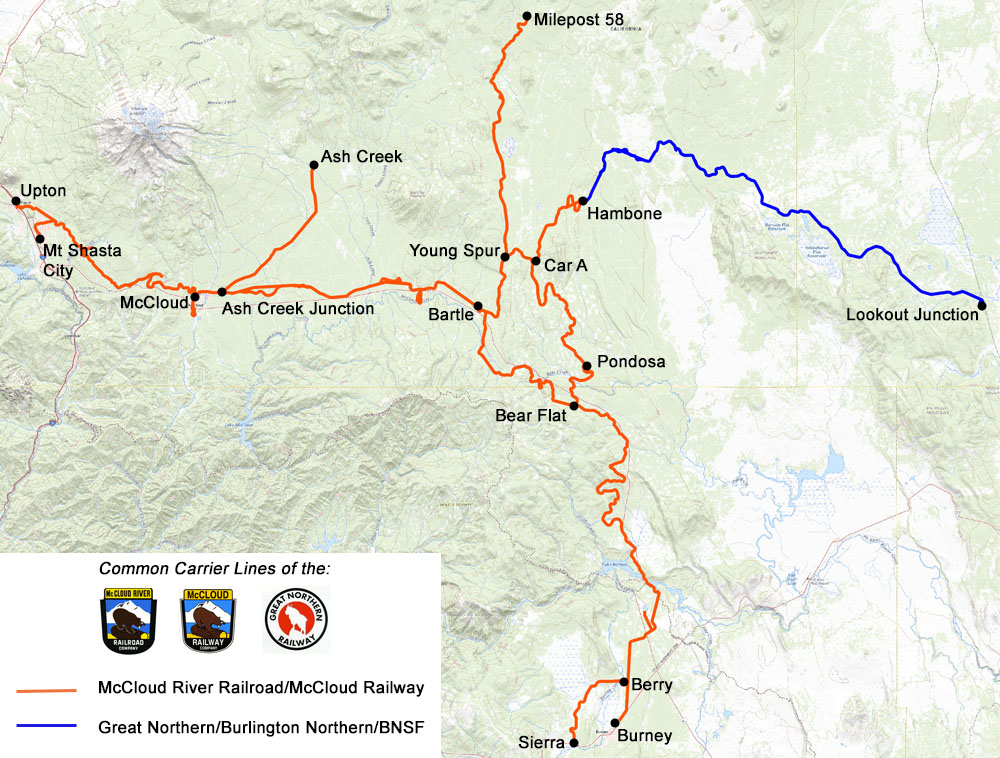
The map of the railroad.
9/8/1983 Jeff and I drove up to Mount Shasta City, railfanning along the way and stayed at a nice motel just outside of town.
The First McCloud Steam Trip - Clear and Warm 9/9/1983We drove up and over the divide to McCloud and easily found the station which was built with logs.
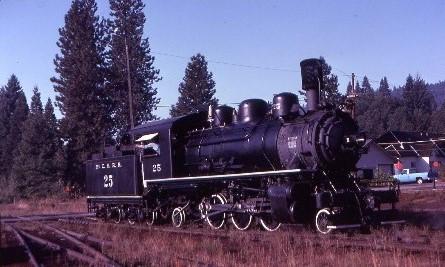
Jeff and I walked down to the engine house and found McCloud River Railroad 2-6-2 25, built by American Locomotive Company in 1925, slowly reversing out into the clear morning sun with only a few clouds hanging over the mountain in the distance. After leading the 1955 Gold Spike Excursion marking completing the Burney extension, it was retired and stored until the early 1960's when it was restored for passenger excursions that lasted from 1962-1975, 1982-1986, 1997-2001 and a few trips in 2008. Between 1988 and 1997, it was leased to Great Western Railway Museum then re-acquired by McCloud River Railroad before being sold to the Oregon Coast Scenic Railroad.
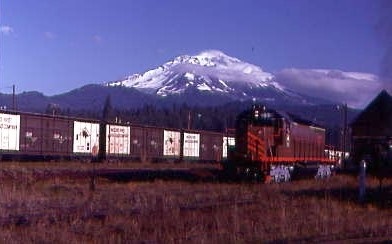
Switching a few cars and joining in today's excursion was McCloud River Railroad SD38 37, built by Electro-Motive Division in 1969. In 1992, it became Itel Rail 37, then McCloud Railway Company 37 in 1993. Ownership was conveyed to Williams Equipment Leasing by 2014, then sold in 2017 to Buck's Creek Rental LLC, another Williams Group company. It became Dakota Southern 37 in October 2016, where it operated until suffering electrical problems in early 2019. Stored out of service in Chamberlain until June 2021, it was re-marked to St. Maries River Railroad 37 and transferred to St. Maries, Idaho in July 2021.

After a few pictures, the steam engine with its white flags slowly reversed to its train letting out steam from the cylinders as it moved. Our consist was McCloud 2-6-2 25 on the point, Southern Pacific coach 500 "San Joaquin", Southern Pacific coach 510 "Tuolomne", Southern Pacific coach 511 "Stanislaus" (leased from Sierra Western Tours), two leased Southern Pacific gondolas complete with steps on the sides, SD38 37 and a caboose. After everyone boarded, the whistle blew and we were off.

Jeff and I were in the open cars as we passed the shops and rounded the wye to take the eastern branch toward Bartle. Mount Shasta was almost continuously in view as we slowly travelled by the sawmill and McCloud River Railroad's yard before we left its limits and proceeded into the forest. We were told to be on the look out for the motor car known as the Vinegar Valley Express, which transported loggers to the camps and we spotted it resting in the forest to the south of the tracks with a tree growing through its middle.

We crossed Mud Creek, passed through Esperanza, MP 23.15, climbing a short hill then descending slightly to Ash Creek, MP 19.98 before making our way up a short hill to Kinyon at MP 13.00, then on to Bartle at MP 37, where we detrained while the steam engine took water from the tank. Once watered and oiled, the first runby of the day was announced.
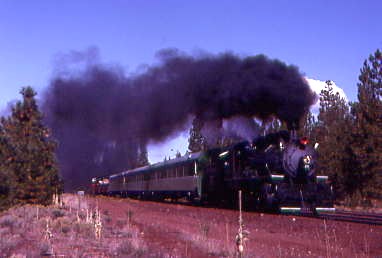
McCloud River Railroad 25 reversed out of sight before charging forward, smoking nicely with its bell clanging. Once back aboard, we started the journey toward Hambone, diverging from the line to Burney and started up the grade with both the steam engine and diesel working hard. The views of the 14,162 foot Mount Shasta were outstanding and we climbed to MP 43.25, the location of the former Car A, where the original line to Hambone used to rejoin after coming via Pondosa from Bartle.
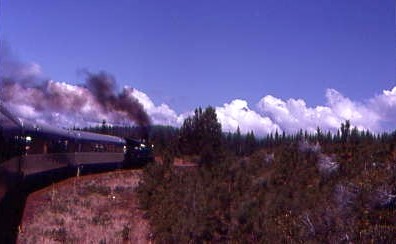
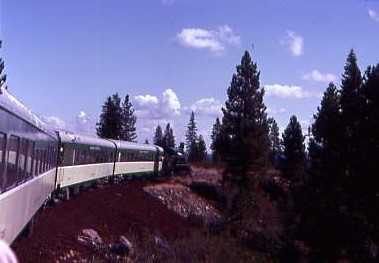
We continued climbing along the western flank of Bear Mountain as we proceeded northeastward to Hambone.
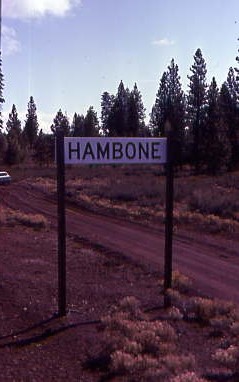
Station sign Hambone, Milepost 50.17 from 1929-1939, then 49.46 from 1939-1955 and finally 31 from 1955-2008. The lumber company first established a log camp named Camp 2 and then Pondosa at this spot that operated from around 1919 until 1927, when the camp and the name moved south to the present Pondosa location. The site sat idle for about a year, until the lumber company broke ground on the main line east to the White Horse country.
The McCloud River Railroad reached Old Pondosa in 1929 when it purchased the lumber company line from Slagger to the site. The railroad established a section gang headquarters and applied the present name, which the railroad borrowed from a nearby butte and water well. The Hambone name reportedly originated with a ham bone nailed to a tree to mark a water location; the name probably dates back to the Mayfield Wagon Road, which passed through the vicinity in the 1880s/1890s. The McCloud River, Great Northern and Western Pacific railroads chose Hambone as the interchange point between the three railroads, primarily because it was one of the few places with enough flat land to build the needed interchange yards and locomotive servicing facilities. However, once GN evaluated the logistics of operating a branchline from nowhere to nowhere in the middle of nowhere, they hired the McCloud River to operate the line east of Hambone for them, which negated the need for the planned facilities, though the ownership point remained at this spot. GN did station several administrative employees and a section gang out of Hambone at least until the end of the 1950s.
In 1934, the Elkins Cedar Mill moved their sawmill from Bartle to here and built a small community to support it. The camp and the sawmill remained in operation and provided a steady business to the railroad until 1942, when Elkins sold the mill. The new owner operated the mill until a fire destroyed the plant in 1944, after which the camp was demolished. The railroad retired the Elkins spur in 1946. Another small sawmill also operated next to the depot area for a short time in the late 1940s/early 1950s.
The McCloud River Railroad completed a major line change bypassing the entire site to the north in 1956. Some foundations, many railroad grades, lots of rubbish and one or two more modern structures mark the spot of the original camps.
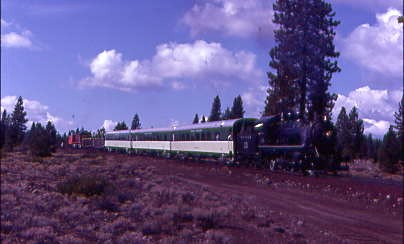
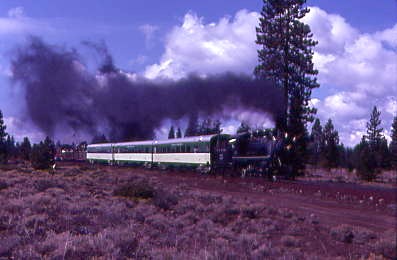
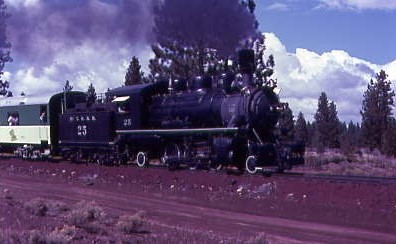
Once we arrived, another photo runby occurred before the locomotive was cut off for servicing, which provided excellent photographic opportunities. Boxed lunches were distributed and it was a rather nice location for a picnic lunch. Afterwards, McCloud River 37 pulled us back down to Bartle where the train was wyed and McCloud River Railroad 25 returned to the point.
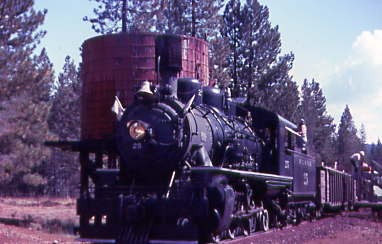
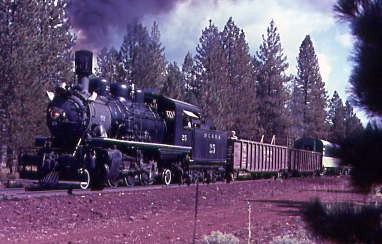
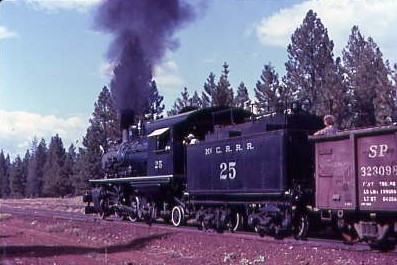
The steam locomotive was watered again before the final photo runby of the day, then the return journey to McCloud found Jeff and I in great spirits, thus ending our first excursion on the McCloud River Railroad. We drove to Redding for the night before driving home the next day.
2/18/1984 The Second McCloud Steam Trip - Snow and Sun
My father and I left at 2:00 AM and drove up to Mount Shasta, arriving there mid-afternoon in the rain, then had an excellent dinner at The Tree House Restaurant before calling it a night.
2/19/1984 We went back to The Tree House Restaurant for breakfast then drove over the divide to McCloud.
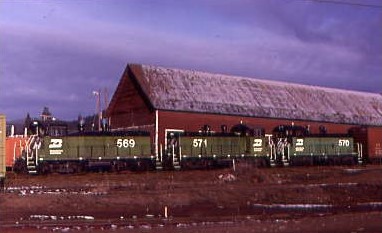
Burlington Northern NW-2 569 (nee Chicago, Burlington and Quincy 9411B, built by Electro-Motive Division in 1949), 571 (nee Chicago, Burlington and Quincy 9412B, built by Electro-Motive Division in 1949) and 570 (nee Chicago, Burlington and Quincy 9412A, built by Electro-Motive Division in 1949) greeted us.
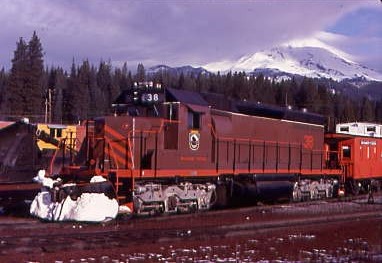
Resting before today's excursion was McCloud River Railroad SD38 38, built by Electro-Motive Division in 1969. It was sold to McCloud Railway Company in 1992 and ownership was conveyed to Williams Equipment Leasing by 2014.
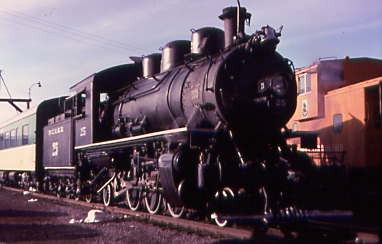
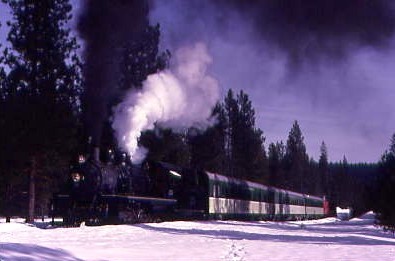
Our train this time was McCloud River Railroad 2-6-2 25, Southern Pacific coach 500 "San Joaquin", Southern Pacific coach 510 "Tuolomne", Southern Pacific coach 511 "Stanislaus" (leased from Sierra Western Tours) caboose 102 and SD38 38. It was sunny but quite cool with the promise of deep snow east of town, but the bad news was that we would not be going to Burney as planned because of a mud slide. The new plan was to take the train to past Obie, where the line to Pondosa took off then travel west to the top of the switch back on the divide at Signal Butte. I was both disappointed and excited, since I really wanted to go to Burney but Signal Butte was a good compromise as I had never been there.
When all passengers were in the warmth of the coaches, we departed east past the engine house, curved around the wye then went by the sawmill and yard. Once out of town, snow started covering the ground and became deeper the further we travelled. Mount Shasta was standing guard over us on a beautiful winter morning as we made our way to Bartle.
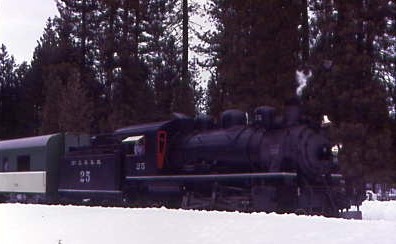
McCloud River Railroad 25 took water from a tank car then reversed for a photo runby.
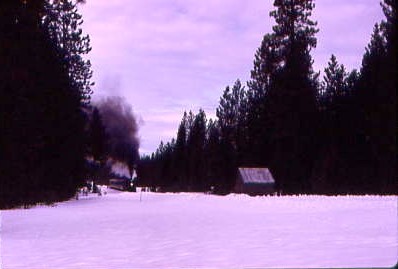
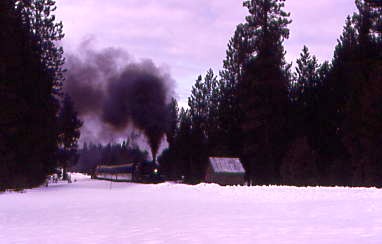
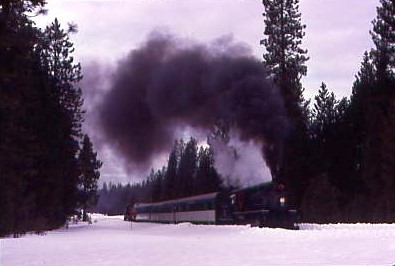
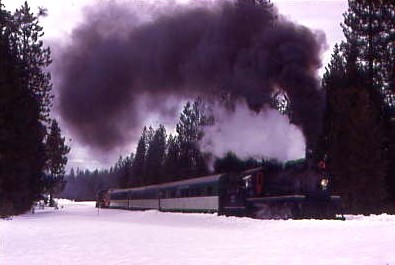
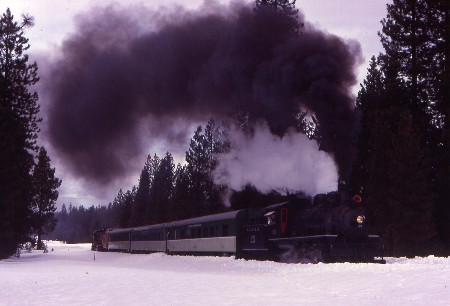
A beautiful runby in the deep snow.
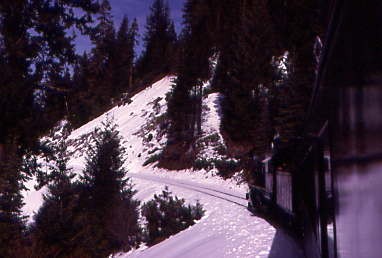
We reboarded and travelled around the south end of the wye on our way to Obie then crossed State Highway 89 and started to climb the grade as the snow became even more deep. We ascended into the forest curving our way to Curtis, MP B-25, then rounded a series of tight horseshoe curves before arriving at Obie, MP B-31, but the train pulled down to the junction of the Pondosa Spur, MP P-34.
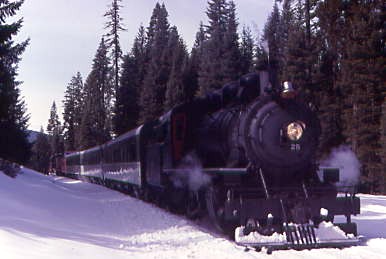
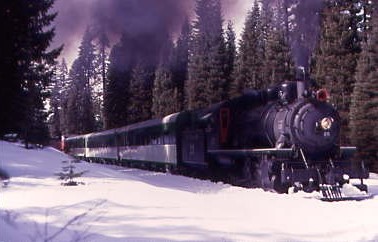

Here we were allowed off into the knee high snow and a third photo runby was performed. McCloud River Railroad 38 then pulled us backwards to Bartle, MP 18, where the train was wyed to put the steam engine back in the lead. We stopped as the train was watered once more with the passengers given their boxed lunches.
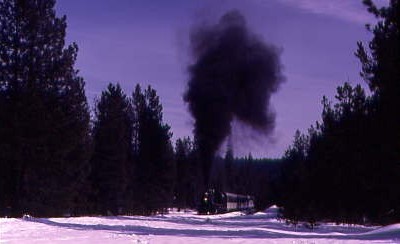
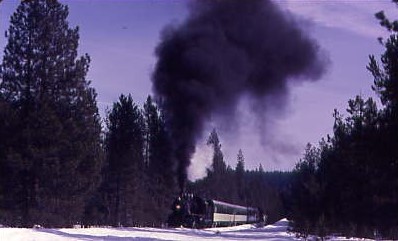
After lunch was another photo runby before we proceeded west to McCloud, although we did not go into McCloud but rather up the grade to Hooper, MP 14.54 where we passed the 8,000 gallon water tower built in 1917 and retired in 1935. We continued to climb through the forest before negotiating the switchback reach Signal Butte, MP 11.84 from 1897-1907, then 10.90 from 1907-1955, then M-5 from 1955-1977 and finally M-5.1 from 1977-present.
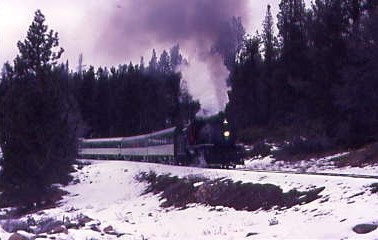
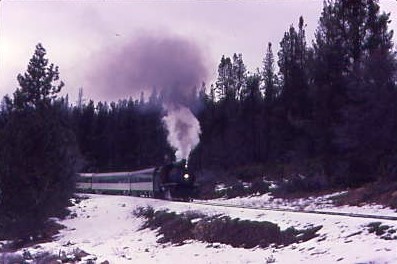
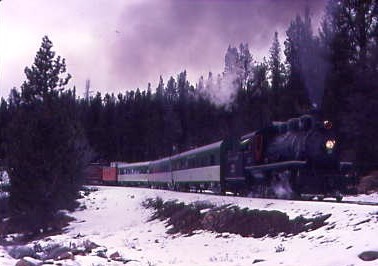
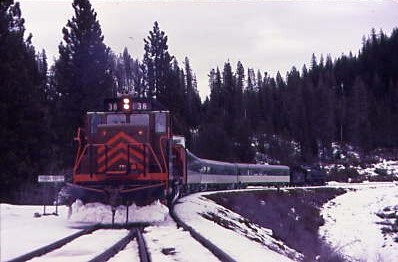
We were allowed to detrain as McCloud River 38 then pulled the train upgrade out of sight towards Summit before the steam engine took charge for one last photo runby with trackside patches of snow. McCloud River Railroad 38 then pulled the train back down the grade to McCloud, ending a wonderful winter excursion. My father and I drove back to Chico for dinner then to Motel 6 in Yuba City before driving home the next day.
5/11/1985 The Third McCloud Steam Trip - Mount Shasta City East
This time it was going to be both my parents and good friend Bill Compton who joined me. We left Santa Ana early and after picking up Bill, we drove to Mount Shasta City and spent the night there.
5/11/1985 After a good breakfast we went down to wait for the train at the Southern Pacific interchange and Bill and I walked to the grade crossing.
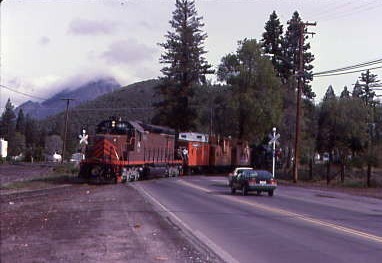
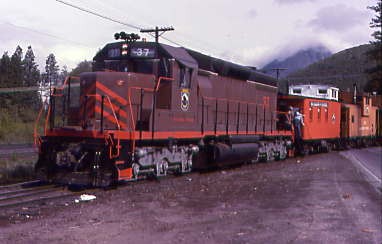
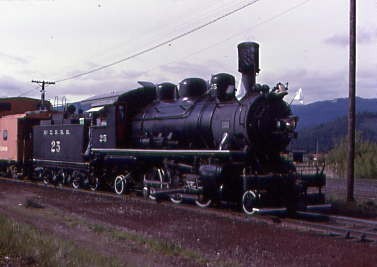
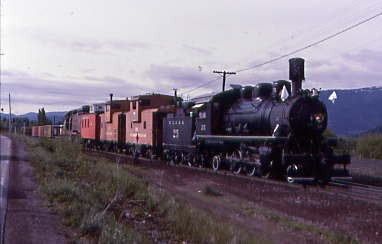
A few minutes later, our train entered Mount Shasta City, led by McCloud River Railroad SD38 37 with a consist of cabooses 037, 101 and 102 and McCloud River Railroad 2-6-2 25. After a bit of switching to put 37 on the rear of the four vista gondolas, the rest of the cabooses were coupled and the steam engine was ready to pull the train. The four of us boarded the open cars and while we waited for departure, Southern Pacific 8371 East roared through then when everyone was aboard, the whistle sounded and our excursion to Bartle commenced.
We quickly departed Mount Shasta City and started climbing the grade to Summit and as we ascended, there was an excellent view of Black Butte as one looked back downgrade. We passed through Big Canyon, MP 6.83 as we climbed the southwest flank of Mount Shasta on a beautiful clear May day. I was surprised to see some snow on the ground as we neared Summit then we crested the grade and started a brief descent to Signal Butte, where we pulled past the switch and McCloud River Railroad 37 pulled us downgrade past the water tower at Hooper and into McCloud. We entered the track towards the depot only far enough to clear the wye switch to put the steam engine back on the point of our train.
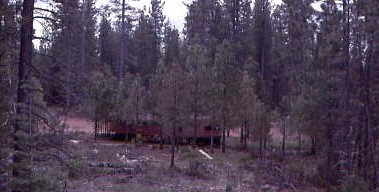
We ran east and passed the Vinegar Valley Express, a railbus built by the McCloud River Railroad that carried loggers to camps in the woods then arrived at Bartle where lunch was distributed while the steam engine was watered and serviced.
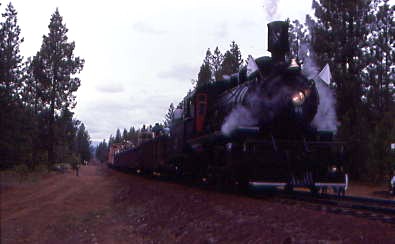
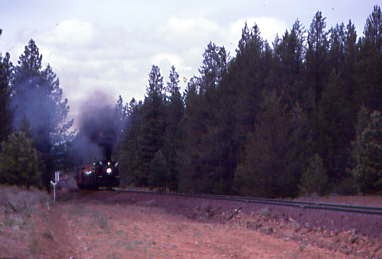
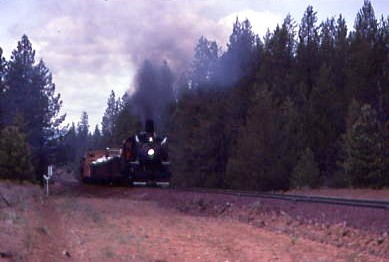
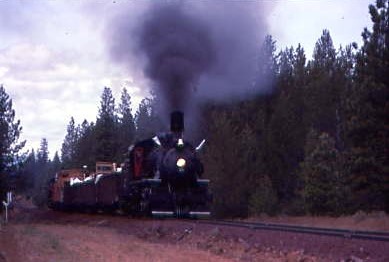
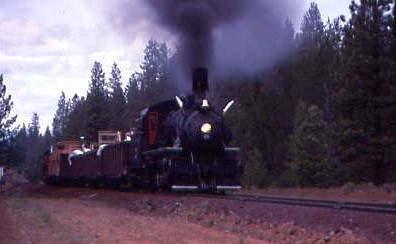
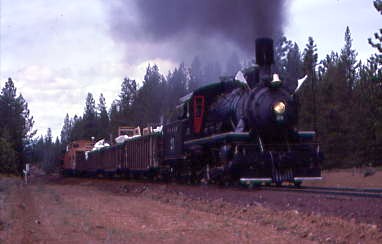

The one and only photo runby before we proceeded east to the wye and turned the train then retraced our rails back to Mount Shasta City with the steam engine leading to Signal Butte, and McCloud River Railroad 37 taking its place the rest of the way. Although I became sick on the return journey, it was an excellent third steam excursion, after which the four of us drove to Oroville for the night and the next morning, I felt my normal self and we drove home.
| RETURN TO THE MAIN PAGE |