



In late spring, it was announced that Southern Pacific Daylight 4-8-4 4449 would pull an all-Daylight passenger consist from Portland to New Orleans, Louisiana for the World's Fair and was called the World's Fair Daylight. Tickets were sold for each of the train's daylight-running segments and my first choice was the two-day trip from Oakland to Los Angeles over the Tehachapi Loop, but that was naturally extremely popular and almost sold out overnight. A two-day Phoenix-to-Los Angeles excursion on the train's return from Portland was then announced and since it covered the route over which that the Sunset Limited ran during the night, it seemed to be the perfect option for me. I called Mountain Outin Tours and the price included my Amtrak tickets to Phoenix and back from Los Angeles to Santa Ana, the 4449 west from Phoenix to Los Angeles and hotel, with transfer in Yuma.
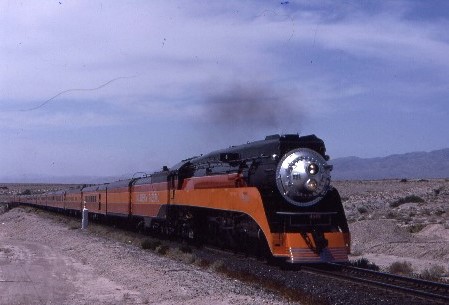
Southern Pacific 4449 is the only surviving example of Southern Pacific Railroad's GS-4 class of steam locomotives. GS stands for "Golden State", a nickname for California (where the locomotive was operated in regular service), or "General Service". The locomotive was built by Lima Locomotive Works in Lima, Ohio in May 1941; it received the red-and-orange "Daylight" paint scheme for the passenger trains of the same name which it hauled for most of its service career. No. 4449 was retired from revenue service in 1957 and put into storage. In 1958 it was donated, by the railroad, to the City of Portland who then put it on static display in Oaks Park, where it remained until 1974. It was restored to operation for use in the second American Freedom Train, which toured the 48 contiguous United States for the American Bicentennial celebrations. Since then, 4449 has been operated in excursion service throughout the continental US; its operations are currently based at the Brooklyn roundhouse in Portland, where it is maintained by a group of dedicated volunteers called Friends of SP 4449. In 1983, a poll of Trains magazine readers chose the 4449 as the most popular locomotive in the nation.
Revenue Years: 4449 was the last engine manufactured in Southern Pacific's first order of GS-4 (Golden State/General Service) locomotives. 4449 was placed into service on May 30, 1941, and spent its early career assigned to the Coast Daylight, SP's premier passenger train between San Francisco and Los Angeles, California, but it also pulled many other of the SP's named passenger trains. After the arrival of newer GS-4s and GS-5s, 4449 was assigned to Golden State Route and Sunset Route passenger trains. 4449 was re-assigned to the Coast Division in the early 1950s. One of 4449's career highlights happened on October 17, 1954, when 4449 and sister 4447 pulled a special 10-car train for the Railway and Locomotive Historical Society from Los Angeles to Owenyo, California, and return. In 1955, after being one of the last few Daylight steam engines in Daylight livery, 4449 was painted black and silver and its side skirting (a streamlining feature of the Daylight steam engines) was removed due to dieselization of the Coast Daylight in January of that year. 4449 was then assigned to Southern Pacific's San Joaquin Valley line, occasionally pulling passenger trains such as the San Joaquin Daylight between Oakland and Bakersfield as well as fast freight and helper service. 4449 was semi-retired from service on September 24, 1956, and was kept as an emergency back-up locomotive until it was officially retired on October 2, 1957, and was placed in storage along with several other GS-class engines near Southern Pacific's Bakersfield roundhouse.
On Display: In 1958, when most of the GS class engines had already been scrapped, a then black-and-silver painted 4449 was removed from storage and donated to the city of Portland, Oregon, on April 24, 1958, where it was placed on outdoor public display in Oaks Park. Since the equipment was considered obsolete, 4449 was not actively chosen for static display. It was picked simply because it was the first in the dead line and could be removed with the least number of switching moves. During its time on display, 4449 was repeatedly vandalized and had many of its parts stolen, including its builder's plates and whistle. The locomotive quickly deteriorated due to neglect. It was evaluated for restoration in 1974 after becoming a candidate to pull the American Freedom Train. Its size, power, and graceful lines made it a good fit for the Bicentennial train. After finding that 4449's bearings and rods were in good shape, it was chosen.
American Freedom Train: 4449 was removed from display on December 14, 1974, and restored at Burlington Northern's Hoyt Street roundhouse in Portland and returned to operation April 21, 1975, wearing a special paint scheme of red, white, and blue. As part of the American Freedom Train, the engine pulled a display train around the most of the United States. Afterwards, 4449 pulled an Amtrak special, the Amtrak Transcontinental Steam Excursion. After nearly two years on the road, 4449 was returned to storage in Portland, this time under protective cover and not exposed to the elements.
Present Day: In 1981, SP 4449 was returned to its original "Daylight" colors for the first Railfair at the California State Railroad Museum in Sacramento, California. In 1984, 4449 pulled an all Daylight-painted train from Portland to New Orleans, Louisiana and back, to publicize the World's Fair. The 7,477-mile round trip was the longest steam train excursion in US history. In 1986, 4449 went to Hollywood to appear in "Tough Guys", and pulled business trains for the Southern Pacific. No. 4449 had another famous moment in 1989 when 4449 and Union Pacific 844 made a side-by-side entrance into the Los Angeles Union Passenger Terminal in 1989 for the station's 50th anniversary celebrations. No. 4449 returned to Railfair in Sacramento in 1991 and again in 1999. In 2000, 4449 was repainted black and silver for a Burlington Northern Santa Fe employee appreciation special, then was repainted into the American Freedom Train colors again in early 2002 after the events of the September 11th terrorist attacks. In 2004, the locomotive was returned to Daylight colors again, this time in its "as delivered" appearance.
Sunset Limited 6/15/1984My friend Bill Compton and I extensively photographed the train's eastbound run from north of Bakersfield to Ferrum along the Salton Sea three days earlier. I finished another school year at MacArthur Fundamental Intermediate School and boarded San Diegan 581 for the quick journey to Los Angeles where I met up with the group from Mountain Outin Tours. Our group was split into two smaller ones for the ride to Phoenix, mine would be taking the Sunset Limited straight there, while the other group would take the Southwest Chief to Flagstaff then a bus to Phoenix. We boarded our assigned Sunset Limited and had the entire car to ourselves; I chose a full window seat on the right and managed to have a window seat throughout.
The train departed on time and our group took over the Sightseer Lounge car. I enjoyed an evening of drinking and sharing railroad stories with my newly-found friends as we travelled via the Alhambra trench, much to everyone's liking. Conversations were briefly halted at Pomona when we saw the deplorable condition of the station building there, but returned to high spirits as we continued east through Southern Pacific's West Colton Yard and then interests turned to the train's passage by Colton Tower. We twisted and turned to climb up San Timoteo Canyon where we met three opposing freight trains, then as the Sunset Limited crested the grade at Apex, I returned to my seat and fell asleep.
Phoenix 6/16/1984We arrived at Phoenix on time on a bright and already hot Saturday morning beside the beautiful Daylight train and our group was immediately taken by bus to a hotel fifteen minutes away for a really good buffet breakfast. We returned to the depot and most of our group migrated to the steam engine. Departure time came and went as we learned that the other group on the Southwest Chief arrived at Flagstaff two-and-a-half hours late and would be here as soon as possible. The desert temperatures continued to rise into the low hundreds with almost everyone seeking shade either in the depot or under the overpass by the engine. The buses then finally arrived and I boarded a former Shasta Daylight coach.
Extra 4449 West 6/16/1984For some reason, I did not photograph the excursion's consist, but for comprehensiveness, here is the roster and history of the cars, taken verbatim from a September 6, 2013 posting to RyPN Interchange.
Southern Pacific 4-8-4 4449 built by Lima Locomotive Works in 1941
Water Car DLMX 4219, modified from the tender of SP AC-10 4-8-8-2 cab forward 4219 by Daylight Locomotive & Machine Works, the group that maintains and operates the 4449 for the City of Portland. It is still on the DLMX active roster for use with the 4449 and is Amtrak-certified.
Crew Car PNWC 3300 "Miln D. Gillespie" was originally built for the Southern Pacific Daylight in 1937 by Pullman-Standard in Lot 6500 to Plan 7375 as 44 seat baggage coach 3300. To the Pacific Northwest Chapter as PNWC 3300 "Miln D. Gillespie". It was heavily damaged while being switched by the Southern Pacific in Portland in 1990 and has been out-of-service since.
Buffet Lounge Sleeper PNWC 600 "Mount Hood" was built for the Mid-Century Empire Builder in 1950 by Pullman-Standard in Lot 6829 to Plan 4163 with 22 seats in the lounge, 6 roomettes and 3 double bedrooms. Owned by the SP&S as 600 for the Portland section of the Builder. Along with the other SP&S-owned cars, the 600 was repainted from EB colors to SP&S green & yellow in 1955. To BN 1205. Retired in 1971. Donated by BN to the Pacific Northwest Chapter in 1972 in original condition as PNWC 600. Amtrak certification 800198. Currently painted in EB colors with "Empire Builder" in the letterboard and "S. P. & S. RY. CO." at the ends of the letterboard.
Daylight Coach SW 542 "Sonoma" was built for the SP Shasta Daylight in 1954 by Pullman-Standard in Lot 6940 to Plan 7571B as 48 seat coach 2355. To Amtrak 4842. Retired 10/1981. To Sierra Western Railroad Company as SW 542 "Sonoma" for use on Eureka Southern-North Coast Daylight excursions on the Northwestern Pacific. After the NWP washouts and end of operations, stored in Scotia.
Daylight Coach SW 544 "Mendocino" was built for the SP Shasta Daylight in 1954 by Pullman-Standard in Lot 6940 to Plan 7571B as 48 seat coach #2358. To Amtrak 4844. Sold 9/1983 to Sierra Western RR Co. as SW 544 "Mendocino" for use on Eureka Southern-North Coast Daylight excursions on the NWP. After the NWP washouts and end of operations, stored in Scotia.
Daylight Coach SW 546 "Humboldt" was built for the SP Shasta Daylight in 1954 by Pullman-Standard in Lot 6940 to Plan 7571B as 48 seat coach #2361. To Amtrak 4846. Sold 9/1983 to Sierra Western RR Co. as SW 546 "Humboldt" for use on Eureka Southern-North Coast Daylight excursions on the NWP. After the NWP washouts and end of operations, stored in Scotia.
Daylight Coach SW 507 "Shasta" was built for the SP Shasta Daylight in 1949 by Pullman-Standard in Lot 6805 to Plan 7571 as 48 seat coach 2387. To Amtrak 7507 in 1973. Retired 11/1977. To Sierra Western RR Co. as SW 507 "Shasta" for use on Eureka Southern-North Coast Daylight excursions on the NWP. After the NWP washouts and end of operations, stored in Willits.
Daylight Coach SW 511 "Stanislaus" was built for the SP Shasta Daylight in 1949 by Pullman-Standard in Lot 6805 to Plan 7571A as a 48 seat coach. There is confusion over the Amtrak 75xx-series number. To Sierra Western RR Co. as SW 511 "Stanislaus" for use on Eureka Southern-North Coast Daylight excursions on the NWP. After the NWP washouts and end of operations, stored in Willits.
Daylight Coach PAR 397 "Shasta Springs" was built for the SP Shasta Daylight in 1949 by Pullman-Standard in Lot 6805 to Plan 7571A as 48 seat coach 2397. To Amtrak 7512 in 1973. Retired 11/1977. To William Gawzner-Miramar Hotel in Santa Barbara. To Pacific Railroad Society as PAR 2397 "Shasta Springs" with Amtrak certification 800229. Currently located at the Orange Empire Railway Museum in Perris.
Daylight Coach SW 500 "San Joaquin" was built for the SP Shasta Daylight in 1949 by Pullman-Standard in Lot 6805 to Plan 7575 as "Timberline" coffee shop tavern lounge 10317. Rebuilt to 86 seat coach 2241 in 1963. To Amtrak 7500 in 1973. Retired 1976. To Sierra Western RR Co. as SW 500 "San Joaquin" for use on Eureka Southern-North Coast Daylight excursions on the NWP. After the NWP washouts and end of operations, stored in Willits.
Daylight Coach SW 510 "Tuolumne" was built for the SP Shasta Daylight in 1949 by Pullman-Standard in Lot 6805 to Plan 7571A as 48 seat coach 2395. To Amtrak 7510 in 1973. Retired 1976. To Sierra Western RR Co. as SW 510 "Tuolumne" for use on Eureka Southern-North Coast Daylight excursions on the NWP. After the NWP washouts and end of operations, stored in Healdsburg.
Coach GW 568 "Red River" was built for the GN Red River in 1950 by American Car and Foundry in Lot 3125 as 21 seat diner 20 seat lounge observation 1147 "Red River". Rebuilt to 68 seat coach 1147 in 1962. To BN 6800 (number was applied). To Amtrak 6800. Retired 11/1977. To private ownership (in 1978?). To Great Western Tours as GW 568. To the Pacific Northwest Chapter as PNWC 6800. Currently in Daylight paint.
Diner SW 156 "Lake Pepin" was built for the SLSF-MKT Texas Special in 1947 by Pullman-Standard in Lot 6768 to Plan 7540 as SLSF 36 seat diner 650 "Alexander Doniphan". Sold to the GN in 1966 as renumbered/renamed to 1156 "Lake Pepin". To BN. To Sierra Western RR Co. as SW 156 "Lake Pepin" for use on Eureka Southern-North Coast Daylight excursions on the NWP. After the NWP washouts and end of operations, stored in Asti, California, alongside SW 151 (ex-GN Ranch Car 1242 "Hidden Lake"). The SW 156 "Lake Pepin" was acquired by Jon Clark; the SW 151 was acquired by Matt Munson.
Buffet Lounge Observation GS 1290 "Appekunny Mountain" was built for the Mid-Century Empire Builder in 1950 by American Car and Foundry in Lot 3447 as GN 1290 "Appekunny Mountain" with 36 buffet lounge seats and 3 crew roomettes. To BN 1290, renumbered to 1200. To Grant Supply Company as GS 1290 "Appekunny Mountain" with Amtrak registration 800005. To the Arizona & California Railroad for use on the California Northern as CFNR 100.
With a long blast of the whistle, Extra 4449 West slowly started moving and as the train curved, I could see the engine bellowing a large amount of black smoke into the very hot desert sky. The train's air conditioning certainly felt good after being out in the legendary Phoenix heat, and all around me there was excitement. We departed via the industrial areas of the city and people were everywhere, watching and waving their hearts out as we went by since it was not every day a steam locomotive travelled through a city in the United States and there was probably more excitement on the ground than aboard the train. At one grade crossing, I spotted two people from JVC video in Florida whom I had met in Phoenix and were going to be following the train all the way to Los Angeles.
Past Buckeye, the special escaped the urbanized congestion of the Maricopa County for the desert where the Saguaro cacti started to be seen. I love Saguaros, as each was an unique individual with no two exactly alike and they are fascinating plants and amaze me just how well they have adapted to their hot and dry environment. The countryside had turned more rocky and the cacti seemed to thrive in such environments. The desert had a beauty all of its own with nothing hiding the beautiful visits.
Extra 4449 West made an unexplained stop on this single tracked railroad and I went to an open vestibule to find we were stopped at a red signal. However, it was not the regular searchlight type, but instead an upper quadrant semaphore, a strange sight indeed to see a steam train semaphore signal in the 1980's. It turned out that we had to stop due to the red signal and after a call to the dispatcher from our engineer, we were allowed to continue on our journey. The train's route had been following the Salt River down its valley to the west with the sidings of Dixie, Arlington, Gillespie, Saddle, Hyder and Kofa and we passed each of them with no more delays. We were out in true Sonoran Desert with little traces of man except for the two ribbons of steel upon which our train was riding.
The countryside was turning more hilly as Extra 4449 West steamed into the heat of the afternoon on this a perfectly clear day with visibility unlimited. With views such as these, I was very glad I was riding this excursion, which allowed me to see the countryside in broad daylight from a Daylight train. It was announced there was going to be a photo runby at the Gila River bridge and everyone was looking at their trip literature or AAA maps to see exactly how far away that was. Eighteen miles was the universal answer and twenty-four minutes later, Extra 4449 West was crossing the Gila River and slowed to a stop once completely off the bridge.
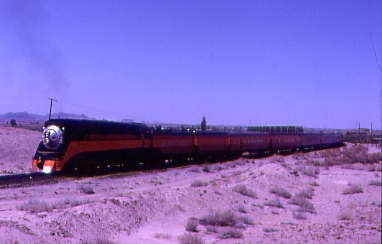
Everyone detrained and was ushered across a small ravine to along side a road whose edge was the photo line. The steam train reversed slowly across the bridge and kept on going for a mile, then once the passengers were ready, the trip's coordinator gave the call on the radio and the show began.
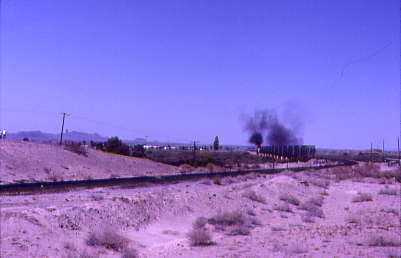
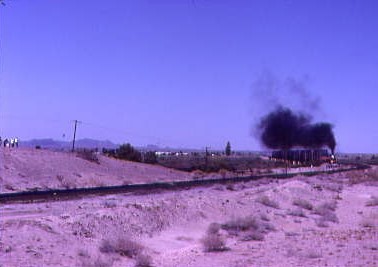
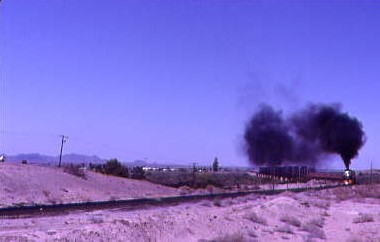
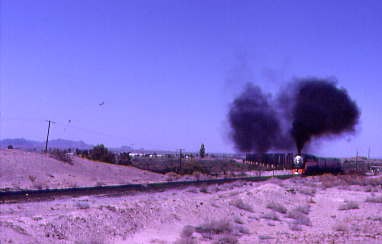
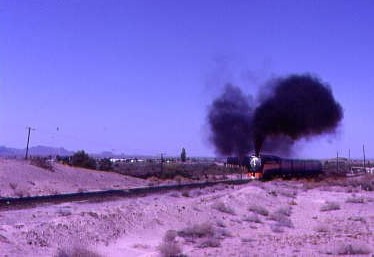
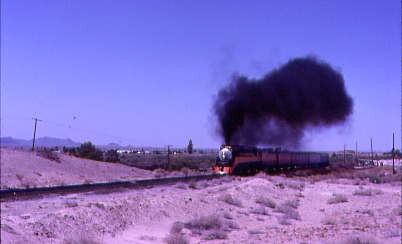
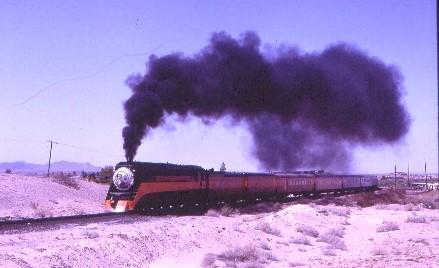
Here came Southern Pacific 4449 charging, bellowing out black smoke and blasting its whistle across the Gila River bridge and the ground shook as it passed the photo line location with a vast multitude of photographs and videos being taken. Once the runby was finished, the train reversed and all boarded. The location was excellent but the only drawback was the sun was on the wrong side due to our late departure from Phoenix. The air conditioning inside the train was very welcome and I found an open vestibule as we passed through Roll and slowly made our way to Welton, where we joined Southern Pacific's main freight line to tonight's layover point at Yuma. We proceeded down the double tracked mainline to Dome, where the route reverted to single track to Yuma and entered the Gila River Canyon to travel through the mountain range east of there. We passed the siding at Kinter at the west end of the canyon before emerging onto the flatlands and passing through orange groves and other agricultural interests then sped through Fortuna and the final miles into Yuma, first passing East Yard before Extra 4449 West arrived at the station, ending day one.
I detrained and stopped to look what was called the most beautiful train in the world, having enjoyed the 163 miles of daylight running and looking forward to tomorrow's 250 miles aboard Extra 4449 West.
Yuma 6/16/1984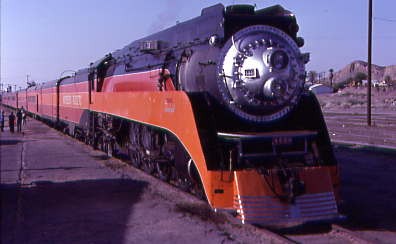
Passengers were taken by bus to hotels and everyone freshened up then we were taken to the San Diego Padres spring training facility where the City of Yuma treated us to an excellent steak dinner and the Yuma High School choir, who were about to go to Hawai'i for a competition, entertained us. I returned to my hotel room and a well-deserved rest in a hotel bed to be ready for tomorrow's adventure.
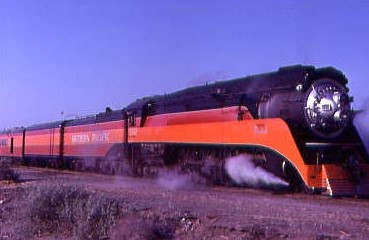
6/17/84 The next morning, I prepared myself for the day and had a breakfast of pancakes, sausage and juice with other members of our group and we discussed the miles of railroad that lay in front of us to Los Angeles. We were supposed to be bussed to the Amtrak depot but the driver let us all out beside the steam engine which was on a spur track.
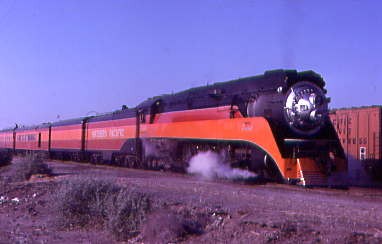
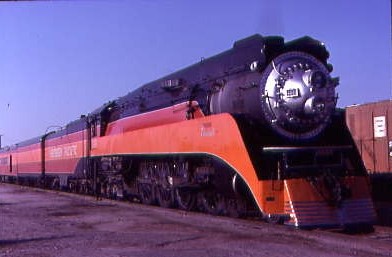
After numerous pictures, the train reversed out of the spur track onto the main line.
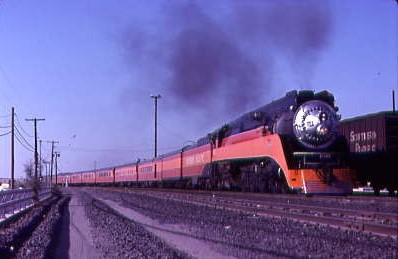
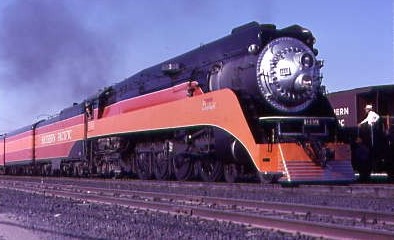
While that was occurring, we quickly walked to the station to be in place for an unofficial photo runby as the special was pulling into the station, then we walked around the rear and boarded our coaches to wait for the on-time departure.
Extra 4449 West 6/17/1984For some reason, there was a heightened level of excitement among the passengers this morning. The train puffed past the Yuma Territorial Prison before steaming across the Colorado River and entering the state of California. 4449 looked very impressive as it crossed the bridge in the morning light then picked up speed through Winterhaven as it travelled across the agricultural rich floodplain of the river. There were a few people photographing our passage although I know that their numbers would grow exponentially once we reached the Los Angeles area. 4449 climbed out of the Colorado River Valley through some nice sand cuts and once it had crossed the All American Canal, slowed and stopped for a photo runby.
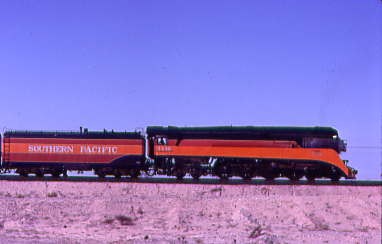
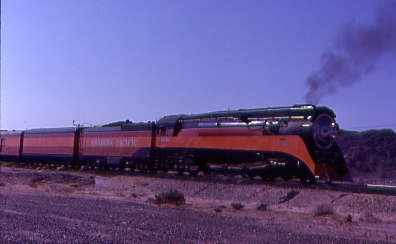
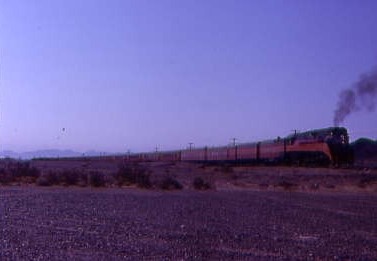
The passengers detrained, the train reversed around a curve out of sight and all became quiet then Southern Pacific 4449 blew its whistle and started its charge towards us.
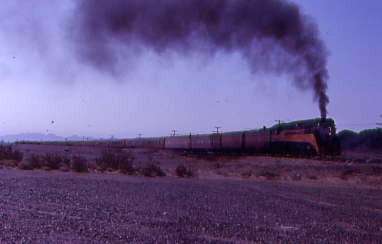
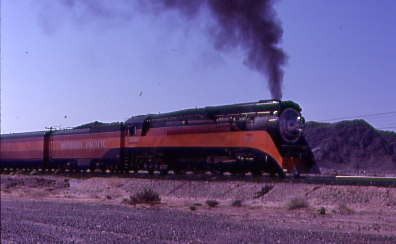
The sound was absolutely incredible although the scene was backlit and my photograph looked as though the steam engine was a coal burner because of a background hill. It was a very special engine and I was glad to have this opportunity to ride behind it.
All re-boarded and the special proceeded northwest once more, running between the Chocolate Mountains to the east and the miles of Glamis Sand Dunes to the west. We made track speed, passing the sidings of Dunes, Cactus, Clyde, Glamis and Acolita, all which were in very sandy environments. The countryside was very interesting to see in daylight and in the area between Regina and Iris, the railroad had planted tamarack trees to keep the sand off the tracks as the railroad passed through the heart of the sand dunes.
Extra 4449 West crossed the Highline Canal then descended to Niland, where the paved highway returned and the train chasers waited. The train steamed on through and the races began between the drivers, each trying to beat each other to another photo location ahead of the train. Impeding their efforts were those people who felt they must pace the engine and watch the steam engine's drivers rotating. Added to all of that madness were the innocent drivers coming the other way and not knowing we were coming. As we approached Wister and from my vantage point in the vestibule, I saw many traffic laws being broken and the whole circus was highly entertaining. While riding behind any steam engine is most enjoyable and fun, watching the people on the ground is also fun.
We were now cruising along the Salton Sea to the west of with Mount San Jacinto standing guard to the northwest. The sea did not exist until 1905, when the All-American Canal was being constructed and a flood in the Colorado River sent water rushing down into the natural depression that was located here. As the new lake rose, the railroad had to relocate to higher ground before they could stop the rush of water and stabilize the height of the new lake. With all the salt on the ground, the lake became saltier and was given the name the Salton Sea. What was a man-made disaster become something very beautiful.
For the chasers, some good news was that the border checkpoint was closed and I was thoroughly into the whole atmosphere as we continued along the sea, passing Frink siding then rounded a large "S" curve to Bertram and crossed Salt Creek to Ferrum, the connection to the Eagle Mountain Railroad.
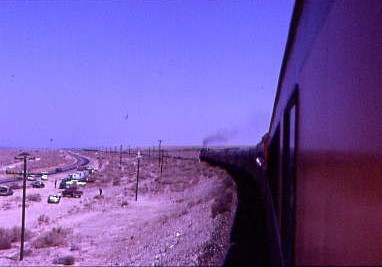
This railroad hauled iron ore from Eagle Mountain to here where Southern Pacific would take it to Kaiser Steel's plant in Fontana.
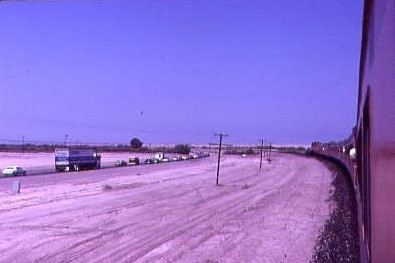
We next passed Mortmar before we left the Salton Sea and made our way through the date and orange groves to Mecca, Thermal, Coachella and Indio. Here we stopped to water and service the steam engine then proceeded up the grade west of town to Thousand Palms. Two special helper locomotives were added to the point, namely Southern Pacific SD40R 7347, nee Southern Pacific 8479, which was painted for the 1984 Summer Olympics in Los Angeles and Southern Pacific SD40R 7342, nee Southern Pacific SD40 8470 was in a Daylight paint scheme. These additions were for the climb over Beaumont Hill, the low point between Mount San Jacinto to the south and Mount San Gorgonio to the north. We passed between the tamarack trees and came out of them at Garnet then the train was working hard up the grade, crossing the many channels of the Whitewater River to West Palm Springs, where even more chasers were waiting.
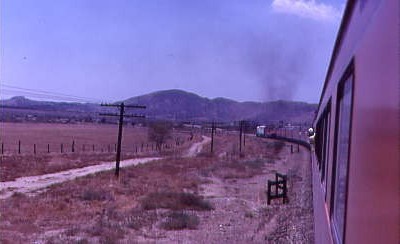
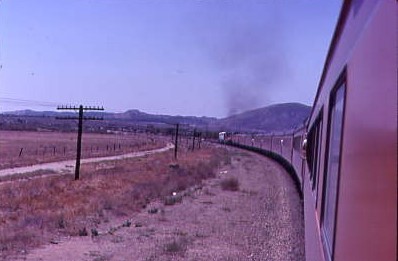
Never slowing, we climbed to Cabazon with its two dinosaurs standing to the north before ascending to Banning and up to the summit of Beaumont Hill at Apex.
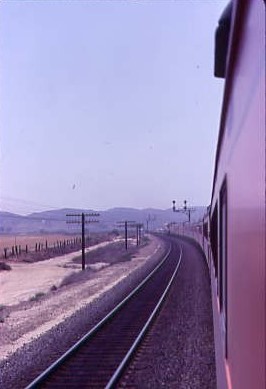
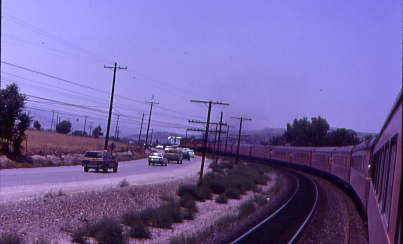
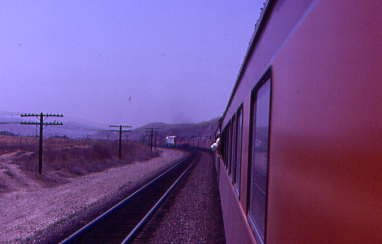
We descended through Beaumont to San Timiteo Canyon where I knew the chasers would be the most interesting. Indeed, they were jockeying for better position, only to be made stopped in their tracks at the grade crossing above El Casco. The road was empty until the train cleared, when here they all came again, now in a more maddening chase.
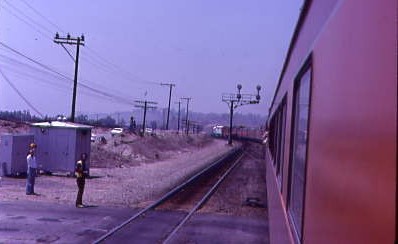
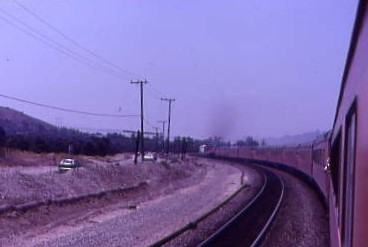
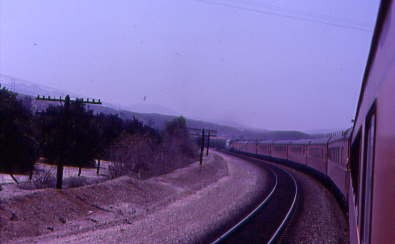
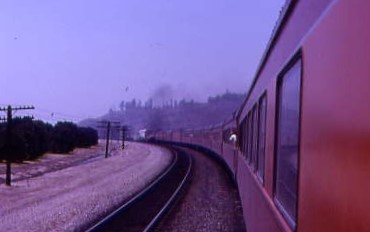
It was certainly different seeing San Timiteo in daylight from the train as opposed to watching a train travel this route and I saw a variety of items I had not seen before.
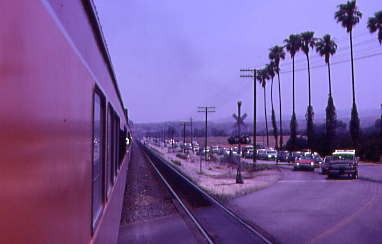
Near the west end of the canyon we passed through the orange groves near Redlands before we again stopped all the chasers dead in their tracks at the lower grade crossing of San Timiteo Canyon Road. The special train then sprinted through Loma Linda, crossed the Santa Ana River, passed through the old Colton Yard and went by Colton Tower before climbing the short hill to Southern Pacific's West Colton Yard, where our helpers were cut off.
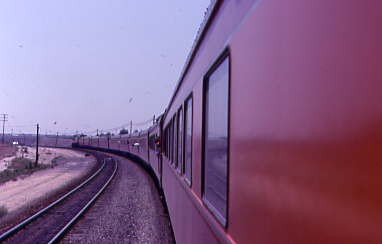
From West Colton, Extra 4449 West made its way across the San Bernardino Valley with the San Gabriel Mountains to the north, Santa Ana Mountains to the southwest and the Chino Hills directly west. We sped through Fontana, cruised by the Ontario Airport, went west into Ontario, Montclair and onto Pomona, where thousands of people watched the steam train pass through their city. The engineer was really blowing the whistle which was music to my ears and everyone was waving as we roared by and we were all waving back. We passed through the Chino Hills near Walnut before going through Southern Pacific's City of Industry Yard then traversed the San Gabriel River.
The question now was would Extra 4449 West be routed down the State Street line or via San Gabriel? At El Monte, we received the answer as we had a high green signal and proceeded straight for San Gabriel, travelling through the concrete trench through Alhambra prior to splitting the hills, going along the north side of the Los Angeles Transportation Centre and crossing the Los Angeles River. We went by Mission Tower and entered Track 5 at Los Angeles Union Station, where we were greeted by a large crowd. This ended my first mainline steam excursion.
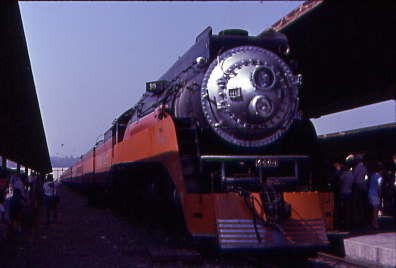
I detrained from the Daylight trainset and walked through the crowd to the front for one last picture then stared at the engine, not really believing that I had just ridden an all-Daylight trainset pulled by a Daylight steam locomotive in 1984, and felt as though I had just stepped out of a time machine. What an adventure I had had these last two days! However, reality caught up as I now had to catch a San Diegan to home to Santa Ana, where some day, another adventure would begin.
| RETURN TO THE MAIN PAGE |