



My friend Bill Compton and I decided to go to the Powder River Basin in Colorado via the Joint Line and Sherman Hill. We left on July 19, 1984 and drove to Flagstaff for the night.
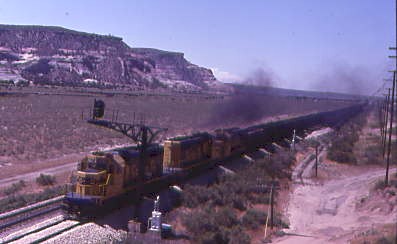
7/20/1984 We caught Santa Fe 5152 East having just entered New Mexico at Lupton.
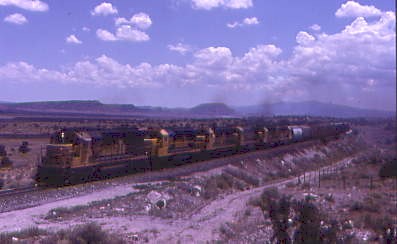
Santa Fe 5689 West about to cross the Continental Divide at Thoreau, New Mexico.
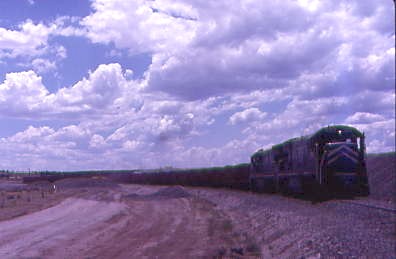
The first surprise was Missouri Pacific U30-Cs 2973 and 2974 in work train service at Baca, New Mexico.
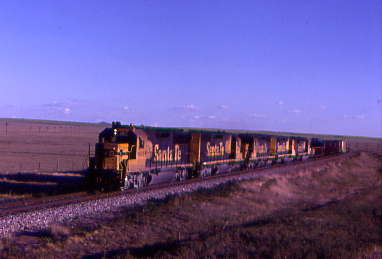
A late afternoon shot of Santa Fe 3817 East at Colmar, after which we drove to Trinidad, Colorado for the night.
7/21/1984 After breakfast, we drove over to the Santa Fe station.
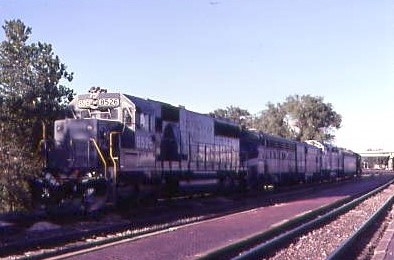
Here we found the EMD Test Set with SD50 8526, F7A 462, EMD Drag Unit 902, SDP40F 169, Test Car ET 800 and SD50 8525.
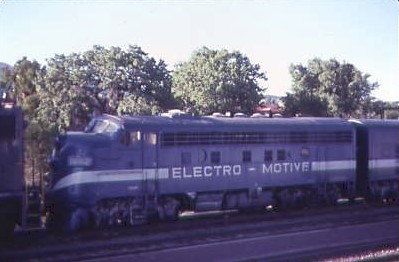
EMDX F7A 462, nee Chicago and North Western 6501A built by Electro-Motive Division in 1949. EMD used this unit for testing purposes for two decades and it last saw service in the mid-1980s. It was sold to Midwest Metallics for scrap, but was not cut up until 1998.
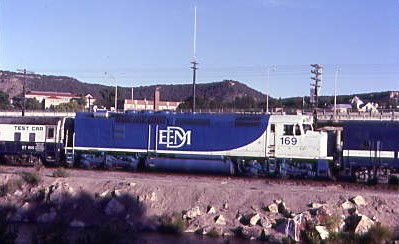
Across the Purgatoire River was EMDX SDP40F 169, nee Amtrak 609, built by Electro-Motive Division in 1974.
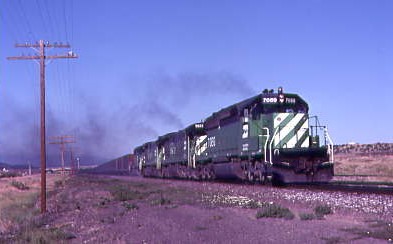
Burlington Northern 7080 West on its way out of Walensburg. We made our way to Palmer Lake.
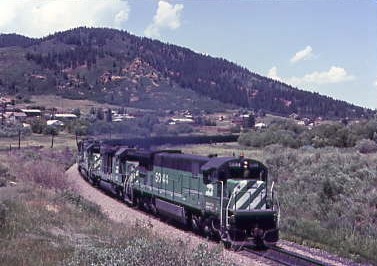
Burlington Northern 5044 East starting down the grade.
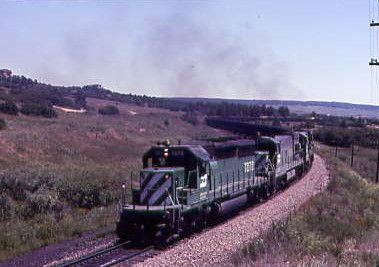
Burlington Northern 7878 West about to crest the grade.
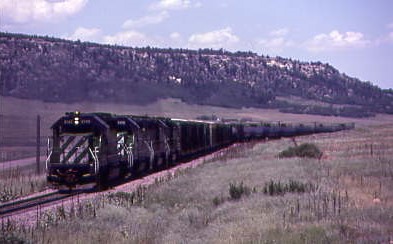
Burlington Northern 8140 East climbing the last of the grade.
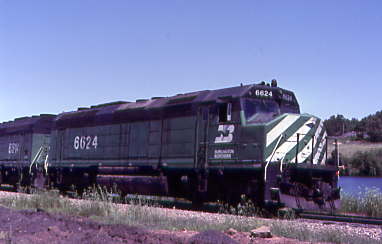
Burlington Northern F45 6624, built by Electro-Motive Division in 1970 was being used in helper service. It was retired in August 1985.
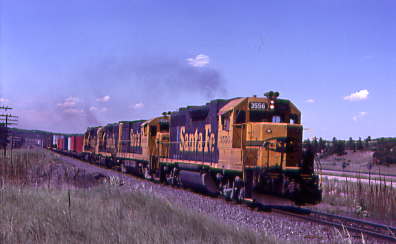
Santa Fe 3556 East speeding though Castle Rock.
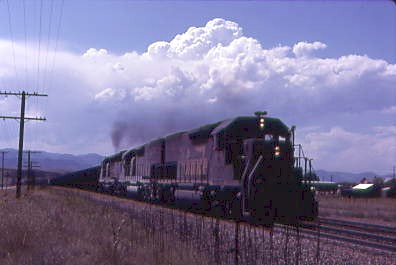
Denver and Rio Grande Western 5395 East climbing through Sedalia starting the journey down the Joint Line.
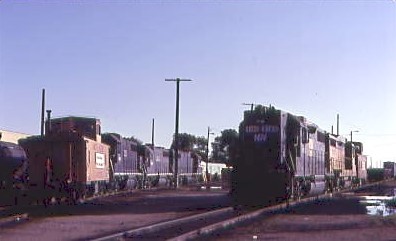
At La Salle, we found the local power including Missouri Pacific GP38-2s 2011, 2032 and 2033.
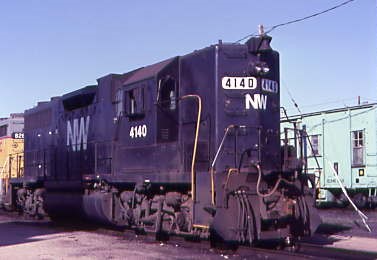
Norfolk and Western GP38AC 4140, which became Norfolk Southern 4140, then First Union Rail 5520 and is currently Norfolk Southern 5520, built by Electro-Motive Division in 1971. With that, we drove to the Motel 6 in Greeley, where we found the ground covered with locusts and crunching sounds emanated from our footsteps as we stepped on hundreds walking from the car to the room.
Sherman Hill 7/22/1984Sherman Hill is located in southern Wyoming between Cheyenne and Laramie and is on Union Pacific's Denver Division, Laramie Subdivision. It crests at the highest point, 8,015 feet above sea level, on the transcontinental Overland Route and is the part of the original transcontinental railroad, built in the 1860s. Between Cheyenne and Laramie, the Union Pacific climbs over the Continental Divide with its three-track main line. The Harriman Cutoff, the third track, was added 1952 and 1953 with a lower gradient. The two earlier main tracks, still in use, have a 1.55 percent grade; the cutoff has less than one percent.
Bill and I drove north into Wyoming and over to Sherman Hill.
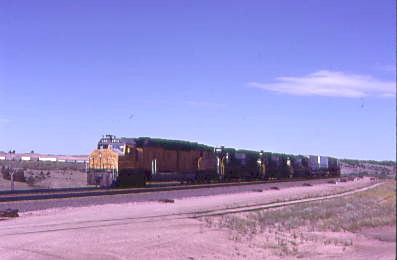
We caught our first train at the big curve at Buford with Union Pacific DD40AX 6913, built by Electro-Motive Division in 1969 leading four Norfolk Southern units east. This Centennial is preserved at the Museum of the American Railroad in Frisco, Texas.
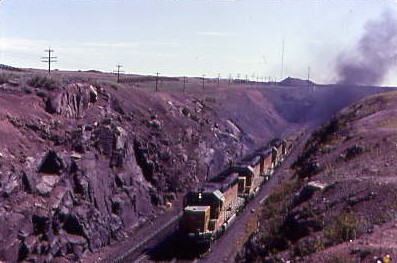
We travelled to the western end of the Hermosa Tunnel and caught Union Pacific 3757 West on a steel slab train exiting the only tunnel on Sherman Hill.
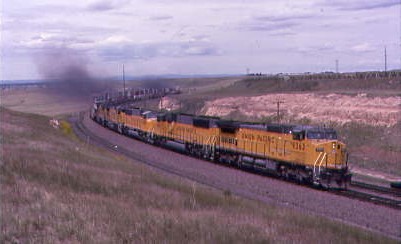
A few trains later, we caught Union Pacific 9363 East climbing through Hermosa to reach the tunnel. After our fill here, we went to Dale and found the hill where so many famous pictures had been taken over the years.
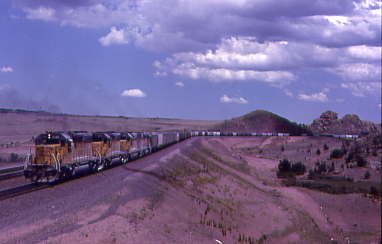
Union Pacific 3780 West slowing to a stop.
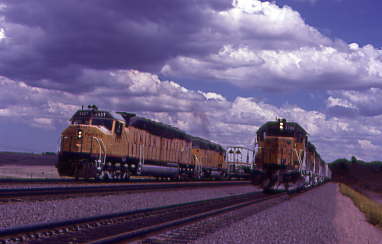
After one eastbound, Union Pacific 3780 did not move, so we went up to its locomotives when DD40AX 6927 led its westbound train into our scene.
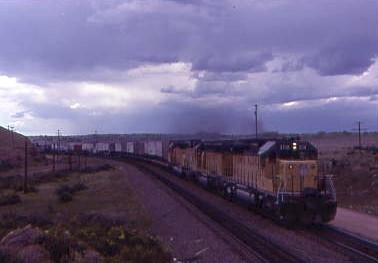
With storm clouds gathering, we drove towards Sherman when Union Pacific 3718 East appeared.
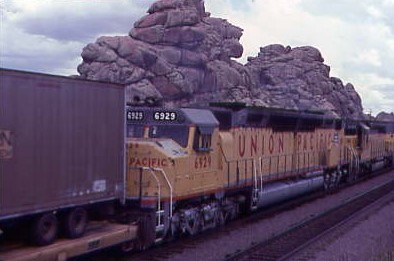
Union Pacific DD40AX 6929 passing the unique rocks found on the hill. We returned to Greeley, Colorado and beat the storms out of Wyoming.
7/23/1984 This morning, we drove north into Wyoming towards the Powder River Basin.
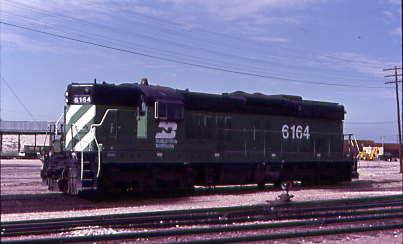
We stopped by the Burlington Northern yard in Cheyenne, catching Burlington Northern SD9 6164, nee Chicago, Burlington and Quincy 362, built by Electro-Motive Division in 1955. It later became BNSF 6164 then Port of Tillamook Bay 6164 in 2003, before being scrapped in 2012.
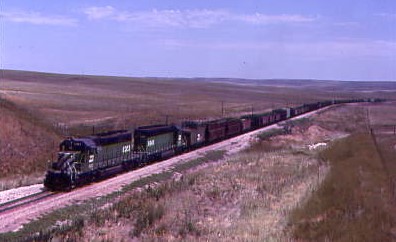
Further north, at Dwyer, we caught the local on the former Colorado Southern line from Wendover to Texline, Texas. From there we went to Guernsey and continued west.
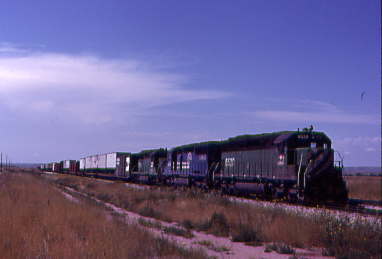
On the way to Douglas, we saw Burlington Northern 6520 East with a Conrail unit in the consist at Bona, Wyoming.
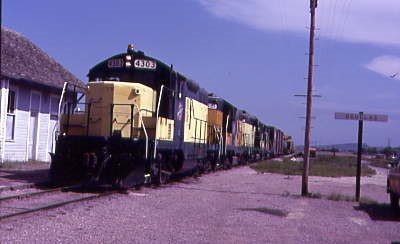
In Douglas, we lucked out, catching Chicago and North Western 4303 West on a local coming into town. My luck was good as the crew gave me an Employee Timetable.
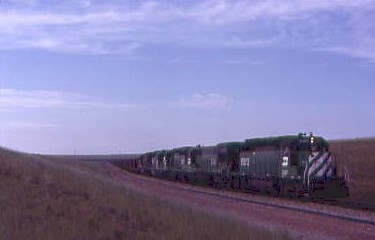
We made our way north into the Basin and after catching a few trains, Burlington Northern 8002 East came through Reno Junction near sunset. As I took this picture, my lens came apart, thus ending the use of that camera forever. Bill and I camped near Reno Junction and as it was in the middle of nowhere, was extremely dark.
7/24/1984 The two of us drove into Douglas to find a camera and found a Rexall Drug Store where I purchased an Olympus camera.
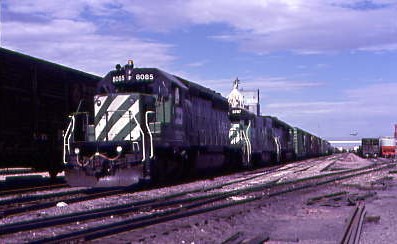
Moments later, Burlington Northern 8085 East during a crew change was my first photograph.
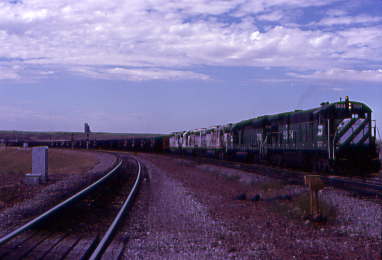
We proceeded south to East Caballo Junction, where we found Burlington Northern C30-7 5024, built by General Electric in 1979, along with three Kansas City Southern locomotives.
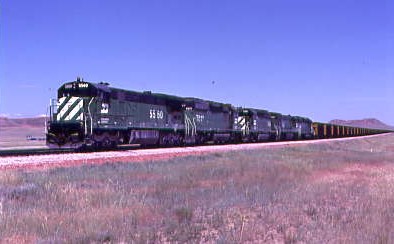
We returned to Reno Junction, catching another eastbound waiting to enter the mine under the Wyoming big sky.
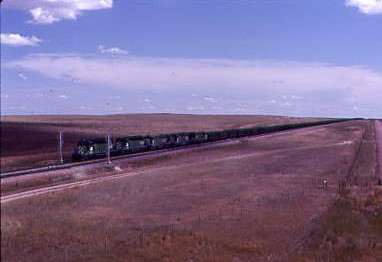
Next we caught Burlington Northern 5560 West at Antelope.
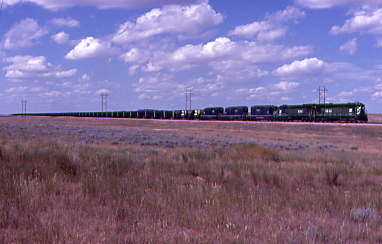
Back to Reno Junction and Burlington Northern 5063 West.
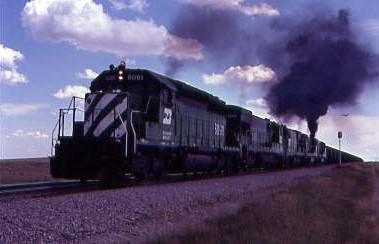
A little later, was the smoky Burlington Northern 8091 East cresting a little hill.
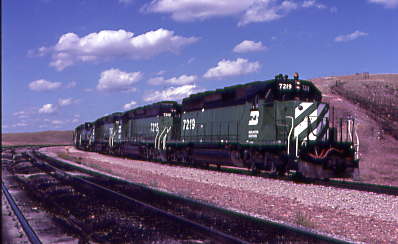
Back to East Caballo Junction, we caught Burlington Northern 7219 West.
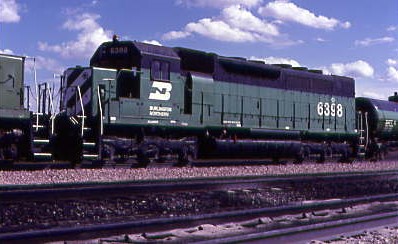
In its consist was a fuel tender as well as Burlington Northern SDP40 6398, nee Great Northern 324, built by Electro-Motive Division in 1966. It later became Burlington Northern 9854 then BNSF 6326.
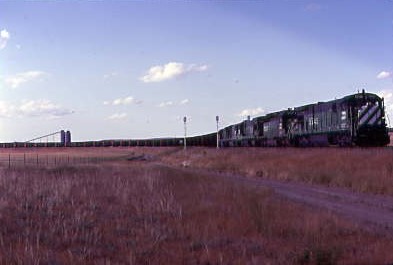
A little later at Belle Ayr Junction, we caught Burlington Northern 5546 loading at the mine.
7/26/1984 Our target this morning was Edgemont, South Dakota.
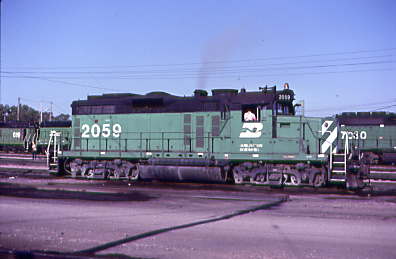
Here we found Burlington Northern GP20 2059, nee Chicago, Burlington and Quincy 923, built by Electro-Motive Division in 1961.
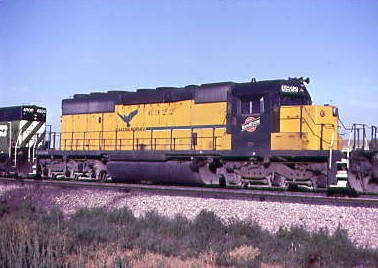
On another train was Chicago and North Western SD40-2 6922, built by Electro-Motive Division in 1975. It later became Union Pacific 3085 and then Union Pacific SD40N 1919. Note the Falcon Service paint scheme, one of only two locomotives to be painted this way. Falcon Service was the moniker given to the railroad's high-speed piggyback service from the west coast to Chicago, which started in 1973 and lasted until the mid-1980's.
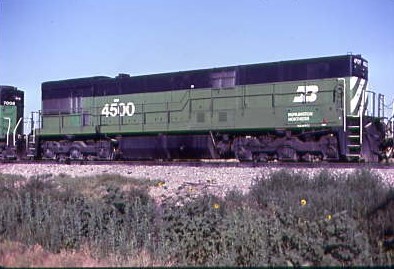
Behind him was Burlington Northern U30C 4500, nee Burlington Northern 5336, built by General Electric in 1972. It was wrecked at Cassa, Wyoming in July 1981, rebuilt at West Burlington, Iowa and numbered 800B, though it never wore that number. It was renumbered 4500 and was active until it was retired on February 11, 1987, cannibalized for parts at West Burlington on May 4, 1987, and sold to Precision National Corporation on November 11, 1987.
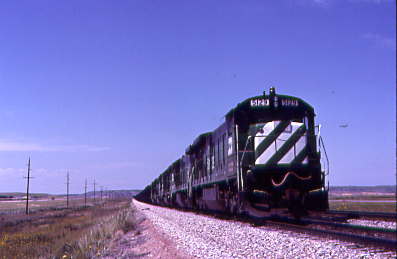
Down the road at Elkhorn, we found Burlington Northern 5129 East waiting in the siding.
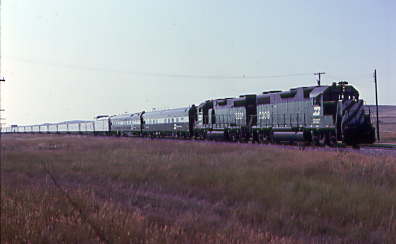
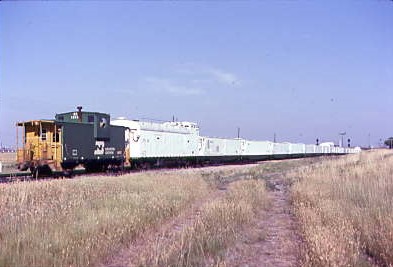
At Provo, here came the White Train, as Burlington Northern 2309 West. For as long as the United States has had nuclear weapons, it has struggled with the question of how to transport America's most destructive technology throughout the country without incident. Today the United States relies almost entirely on million-dollar, Lockheed Martin tractor-trailers, known as Safeguard Transporters (SGTs) and Safe Secure Trailers (SSTs) to move nuclear material. But from the 1950s through the 1980s, the great hope for safe transit was so-called "white trains."
These trains looked entirely ordinary, except for a few key details. They featured multiple heavily armored boxcars sandwiched in between "turret cars", which protruded above the rest of the train. The turrets had slit windows through which armed DOE guards peered out, prepared to shoot if they needed to defend the train. Known in DOE parlance as "safe, secure railcars", or SSRs, the white trains were highly resistant to attack and unauthorized entry. They also offered a high degree of cargo protection in event of fire or serious accident. Though nuclear trains staffed by snipers guarding powerful weapons sounds like something out of an action-adventure film, the trains were far from glamorous. They moved slowly, maxing out at 35 miles per hour, a virtual crawl compared to the average Amtrak train. This meant very long cross-country journeys for their seven-member crews.
One of the most common routes for the train took nuclear bombs from Texas to Bangor, Washington, delivering the weapons at a submarine base on the banks of the Puget Sound. Another frequent route took bombs from Texas to Charleston, South Carolina, where a set of submarines sat poised for missions in the Atlantic.
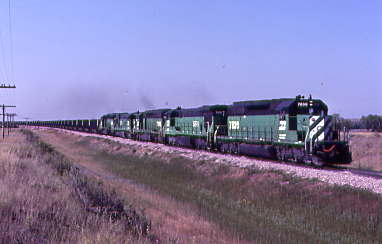
Further down the road at Ardmore, South Dakota was Burlington Northern 7830 West.
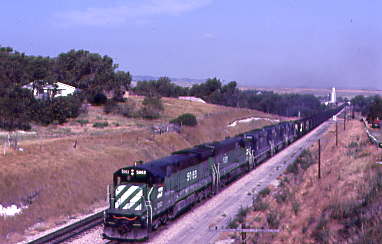
Now into Nebraska, Burlington Northern 5063 East from the highway overpass in Crawford.
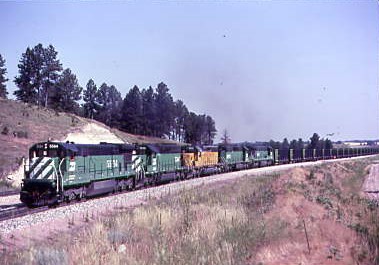
We went to Belmont, at the top of Crawford Hill and drove through the only railroad tunnel in the state, catching Burlington Northern 5564 East climbing the last of the grade.
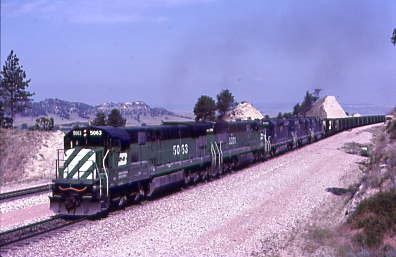
Next came Burlington Northern 5063 East climbing towards the summit at Belmont.
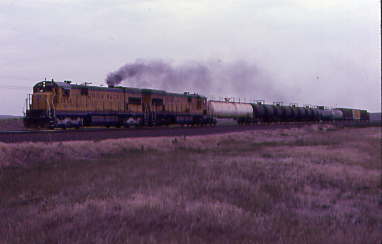
We made our way towards North Platte, capturing Union Pacific 2854 West at Sunol, Nebraska.
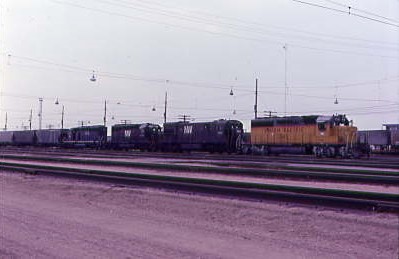
At North Platte was Union Pacific 3541 East with pool power in its consist.
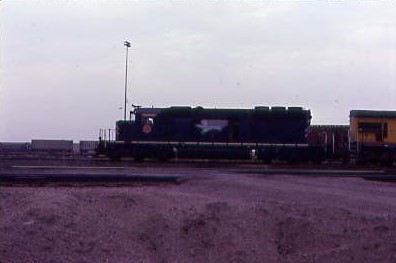
In full Eagle paint was Missouri Pacific SD40 3160, nee Chicago and Eastern Illinois 3160, built by Electro-Motive Division in 1974. It later bcame Union Pacific 9908.
7/27/1984 Today, we drove to CP 276, west of Keith, Nebraska to watch trains and were rewarded with much variety.
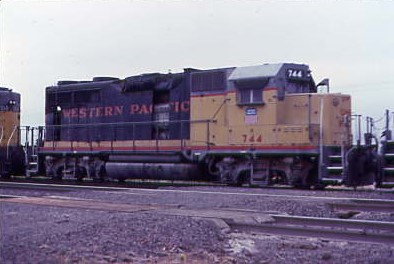
Union Pacific GP35 744 was originally Union Pacific 793, nee Western Pacific 3014, which was wrecked on July 27, 1982 near Reno, Nevada. It was rebuilt by at the railroad's Salt Lake Shops, using the long hood from Union Pacific GP35 744 and became Union Pacific 793 in late June 1985.
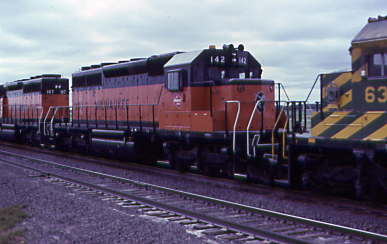
A nicely painted Milwaukee Road SD40-2 142, nee Milwaukee Road 3012, built by Electro-Motive Division in 1972, in their new Hiawatha paint scheme. This became Kansas City Southern De Mexico 1424.
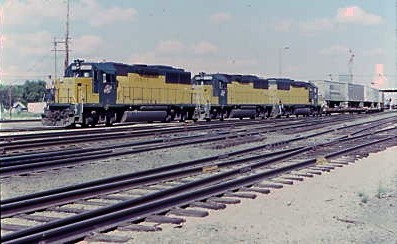
Later, back in North Platte, we caught Chicago and North Western 5057 West arriving.
7/28/1984 The penultimate day of our railfanning expedition found us crossing the state line into Kansas.
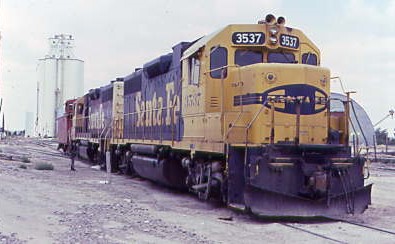
A Santa Fe local in Scott City, Kansas, led by GP38 3537, built by Electro-Motive Division in 1970. It later became BNSF 2227 and is currently BNSF GP39-3 2568.
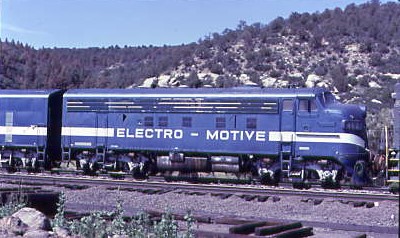
Back in Colorado, we found the test set again, this time testing on Raton Pass.
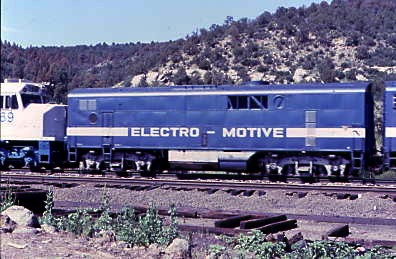
That was followed by EMDX F3B ET-909, built by Electro-Motive Division as a test car in 1948 at Gallinas, Colorado.
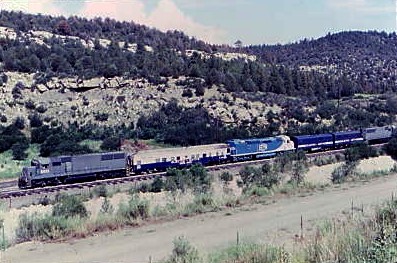
The test train climbing Raton Pass. That night we stayed in Grants, New Mexico.
7/29/1984 We returned home the same way we had started this journey.
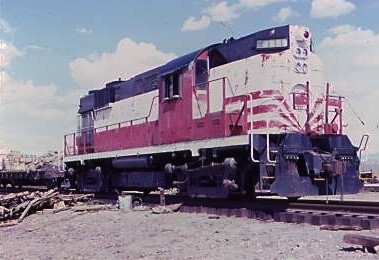
At Baca, New Mexico was Apache Railroad RS-11 901, ex. Southern Pacific 2921, nee Southern Pacific 5856, built by American Locomotive Company in 1959. It was scrapped in 2000. From there, we overnighted in Kingman before driving home the next day.
| RETURN TO THE MAIN PAGE |