




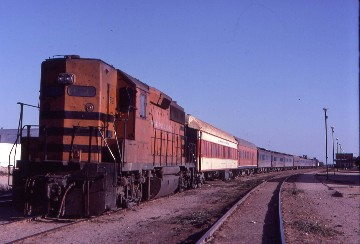
The thought of riding a train in Mexico started to cross my mind and I wondered what would it be like. Questions arose such as how it would compare to riding trains in the United States, would I be riding with pigs and chickens and could I travel without speaking Spanish? Also, I was unsure about the safety, the condition of the washrooms and if the coaches would be filled with anything other than dust?
There was only one way to find out so I booked a trip with the Pacific Southwest Railroad Museum in Campo for my parents and I on a "One Day Train Trip in Mexico".
My First Mexican Train Ride - The Puerto Penasco Trip 4/7/1984We drove to El Centro on April 6th and stayed in a motel to be close to Mexcali for Saturday's trip. After a restful night's sleep, we drove the ten miles to Calexico and parked on the street near the United States/Mexico border then walked across the border for my first time and we were all surprised that there were no Mexican officials waiting for us. We had filled out our tourist permits in advance, but I presumed those would be collected on board the train. We joined the group of Americans and at 7:30 AM, the train approached in push mode in the median of Adolfo Lopez Mateos Boulevard and stopped at the border gate.

It took about fifteen minutes for everyone to board then ten cars, eight of which were Mexican railroad coaches, two had open windows and the other six were built from Japanese kits with six large air conditioning units on their rooves. They all came from the car stock of the Sonora Baja California (SBC) and Ferrocarril del Pacifico (FCP). The first car was reserved for the local people going one way to Puerto Penasco and on the rear were the privately- owned sleeper "Mexicali Rose" and lounge car "Maria Elena". The train was filled to capacity except for the local Mexican coach.
At 8:00 AM, we departed and passed through the old section of Mexicali where all the stores and signs were in Spanish and loud Latin music emanated from the shops. I saw an "Alto" sign and realized that was equivalent to Stop. On the right, we passed a large cemetery, then the bull fighting stadium before the Capitol Building of Baja California Norte and diverging from Adolfo Lopez Mateos Boulevard to the station. Here, Mexican Customs officials boarded to take our tourist permits. Any trip to Mexico past a certain distance from the border requires all out-of-country visitors fill out such a permit. It was explained to me that this way, the Mexican Government always knows where the tourists are. I found these permits to be quite amusing since rather than checking a box for male or female, one crossed out the picture of what you were not. Similarly, for transportation, one crossed out the car and the plane, and in our case, left the steam engine to represent our mode of travel. The agents did their jobs quickly and we were on the move with only a ten minute delay.
We proceeded through the SBC yards before making our way out of town along Federal Highway 5. Trash was spread all over the ground, the houses had become shacks and children ran out from their homes to wave at our passing train, which returned the greeting by leaving them in a cloud of dust. We passed through an area of fields where the Colorado River reaches Mexico and geothermal wells were located in these fields, producing a great deal of electricity for Mexicali, Tecate and Tijuana. I decided to explore the train, going to the front first and walked through the six coaches of Americans finding no surprises, but when I entered the Mexican rider coach, was transferred to the Third World. Children were running out of control wearing only diapers, men were drinking tequila straight out of the bottle while playing cards, a man had a heap of manure in the middle of the aisle and a woman was breast-feeding her baby in the open. I walked out of the door behind the locomotive for some fresh air and to be able to return to my part of the train, I had to hold my breath, then hop, skip and jump through the rider coach and back to the reality of our excursion coaches.
I walked back through each of the coaches reaching the sleeper, and finally the lounge, to watch the kilometers (Mexico uses the metric system) disappear. The railroad ties were concrete and were the first such ties I had seen. I walked forward and found an open vestibule window on the right then the train slowed and shared the toll bridge with the highway bridge over the Colorado River to enter Sonora. The highway toll goes to the railroad for the automobile use of the bridge. The river, very mighty in the United States, was just a trickle by the time it reaches this point. We curved off the bridge and stopped short of the siding in the town of Coahuila. The brakeman detrained and threw the switch to line us into a siding blocked by box cars then shut the switch and took a cigarette break. Five minutes later, a distant headlight appeared, belonging to SBC Train 2, one of the two daily passenger trains which originated in Guadalajara and travelled over both the FCP and SBC to reach Mexicali. He slowed to pass us before leaving us in his dust cloud then the brakeman re-lined the switch, we reversed out of the siding and returned the switch to the original position before we continued towards Puerto Penasco once more.
Leaving the farmlands behind, we made our way into the Altar Desert, a sea of sand and low-lying bushes with a distant mountain range to the north. Apart from the railroad was a lone telegraph wire that paralleled the tracks and there were no roads to be found, just the vastness of the empty desert. Temperatures here could reach the 130 Farenheit mark and rainfall was a rare occurrence. Every so often, there was a passing siding and a set of maintenance-of- way workers' houses with a few trees. The distance between these sidings was thirty kilometers and nothing in between but the barren desert which was becoming sandier and sandier. All this sand was making me thirsty so I went and bought my first Tecate Beer.

Suddenly on the left side of the train, we passed a monument called The Crosses built in the middle of the sand dunes to the memories of four railroad workers who lost their lives in a sandstorm while they were surveying the route. The next four sidings were named for them: Sanchez Islas, Torres B., Lopez Collada and Gustavo Sotelo.
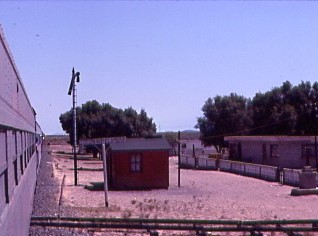
Gustavo Sotelo. Off to the right I could see the clear blue waters of the Gulf of California then we cut inland and a few buildings appeared, becoming greater in number as we entered the outskirts of Puerto Penasco. The train slowed and entered a yard track, passed the wye then pulled down near the station before stopping at Puerto Penasco.
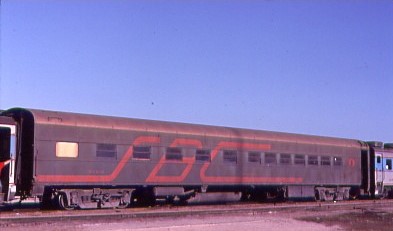
SBC heavyweight coach.
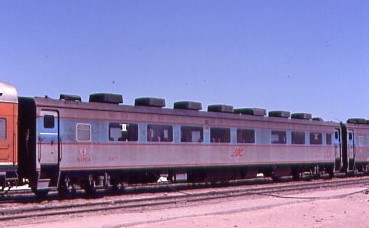
SBC coach 5153 built by Kinki-Sharyo Company and CNCF, a Mexican freight car builder. This type of car became the standard on the SBC, CHP and FCP.
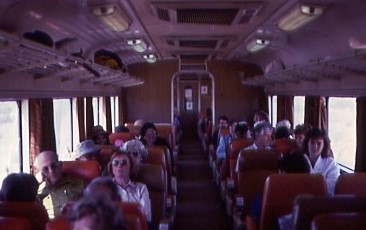
The interior of one of the SBC coaches.
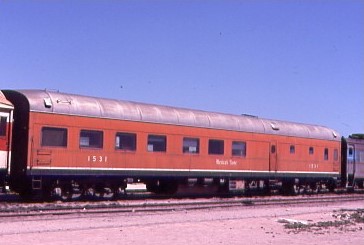
SBC dormitory-lounge 1531 "Mexicali Rose", ex. Union Pacific 1531:2 1954, nee Union Pacific club-dormitory 1527 built by Pullman Company in 1924.

SBC 8-1-2 sleeper 1257 "Maria Elena", ex. SOO Line 1257, nee Pullman "Centburne" built by the company in 1928.

SBC Train 3, the Rapido. Mexican trains always stopped with their engines in front of the station so the crews could obtain their orders on the "dark", or non-signalled, railroads. During the layover, we visited a hotel which had a fiesta for the passengers then took a bus around town. I finally left my parents to shop and found a hotel on the point, a perfect setting with the view of the Sea of Cortez and the waves gently breaking on the rocks below. With the afternoon almost gone, I returned to the train and we departed towards the sunset.
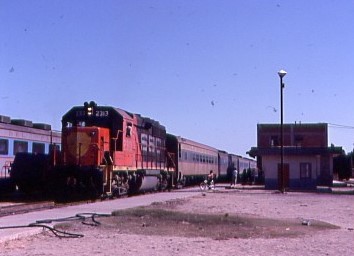
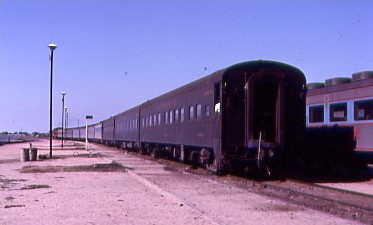
SBC Train 3 departed with the through sleepers from Mexico City on the rear. Our train made its return to Mexicali under the cover of darkness except for the first half hour when we were travelling straight into the setting sun. At Sanchez Islas, we met an eastbound SBC freight pulling twenty-one cars with a single GP35. After re-entering Baja California Norte by crossing the Colorado River, we entered the siding at Delta for SBC Train 4 then stopped at the Mexicali station before travelling in the median of Adolfo Lopez Mateos Boulevard with the horn blaring to warn everyone of our passage back to the border. We dashed to Customs, passed through them quickly and returned to the car to drive home to Santa Ana and my first train trip to Mexico was complete.
The Second Puerto Penasco Excursion 4/5/1986
This journey was undertaken with my dear friend Jeff Hartmann, who was on his first Mexican train ride. With my visit two years ago, I acted as a tour guide. Our train was led by Sonora Baja California GP40-2 2110, built by Electro-Motive Division in 1976.
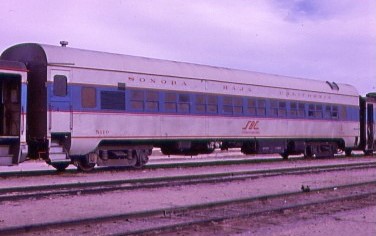
SBC first class coach 5116, ex. Texas and Pacific, nee Missouri Pacific, built by American Car and Foundry, year unknown.
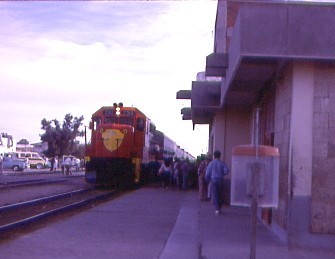
SBC Tren 3 "El Mexicali".
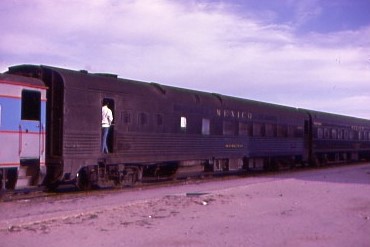
Servicio de Coches Dormitorio y Conexos Diner (SCD) dining ca 3664 "Saltillo", nee New York Central 693 built by Budd Company in 1947. SCD was created by the Mexican government to operate sleeper, diner and lounge passenger service, and take ownership of passenger cars previously owned and operated by the state-owned railroads.
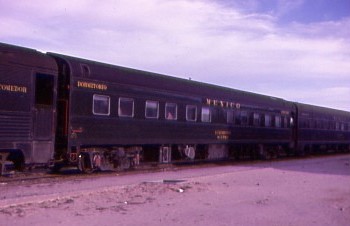
Servicio de Coches Dormitorio y Conexos Diner (SCD) dormitory car 580 "Luxemburgo", nee Missouri Pacific 10-6 sleeper 613 "Roaring River" built by Budd Company in 1949.
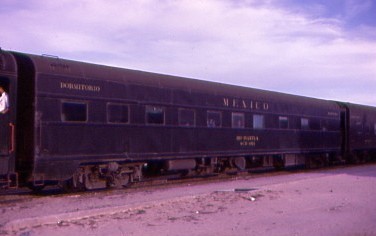
Servicio de Coches Dormitorio y Conexos Diner (SCD) dormitory car 461 "Rio Piaxta, ex. FCP 262, exx. Texas and Pacific 672 "Eagle Beach", nee Texas and Pacific 14-4 sleeper 2 built by Pullman-Standard, year unknown.
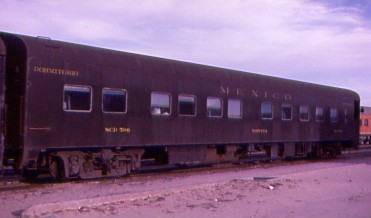
Servicio de Coches Dormitorio y Conexos Diner (SCD) dormitory car 506 "Noruega", nee New York Central 10163 10-6 sleeper "Little Osage River" built by Pullman-Standard in 1948. It was sold to National Railways of Mexico on September 11, 1964.
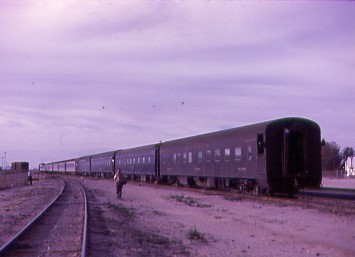
SBC Train 3 departing Puerto Penasco. We both had a really good time and enjoyed our Mexican train riding experience together.
The Third Puerto Penasco Excursion 11/5/1986My father joined me on this trip and it went off without a hitch. My highlight was asking to go up into the engine before it was wyed then being asked to stay while the wyeing occurred. I had to climb off the engine to remove some scrap metal that was across the tracks and after that, our crew allowed me to throw all of the switches. I was therefore able to live out a railroad worker's fantasy for about half an hour. The crew thanked me by giving me a Sonora Baja California Employee Timetable.
The Fourth Puerto Penasco Excursion 4/4/1987This was most memorable of my four trips and was with my former friend Brad Tarr, who was making his first train trip in Mexico. We drove to the Motel 6 in El Centro on a Friday afternoon. then the next day, drove to Calexico and walked across the border and boarded the waiting train. The morning passed in the same manner as above and we arrived at Puerto Penasco two very happy people. I acted as a tour guide, taking Brad to the fiesta, shops and to my hotel on the point then we reboarded the bus and after a few minutes, Brad announced that he was going to buy something for his wife and exited the bus. I called to him from the window to make sure he returned by to the train by 5:00 PM.
I went back to the train and talked with the crew then after about forty-five minutes, the "all aboard" call was given and I climbed aboard and off we went. I searched the train high and low for Brad but he was nowhere to be found so he was left in Puerto Penasco, Mexico and I was bound for the border.
My Journey HomeWith Brad having the car and hotel keys with him, I had to come up with a plan so explained the situation to the trip's director, Sylvia. She was able to get me back to San Diego on the group's bus, so at least I would be back in the United States. I took her up on the offer and we arrived at the Amtrak Depot at 12:30 AM. The San Joaquin bus had left but a nice couple offered to take me to the Greyhound Depot, which I agreed to. I walked into the depot with an ice box in one hand and a Mexican blanket that I had bought draped over my shoulders. The people in the station at that hour of the night were not the nicest and upon learning that the next bus to Santa Ana would arrive until 4:30 AM, saw a door with a hotel name on it which said to use the street entrance. I opened the street door, looked both ways to make sure no one was coming then walked out into the night and into the lobby. The desk clerk gave me an odd look but I presented my American Express card and asked for a room and a 5:30 AM wake-up call. I went up to the fifth floor overlooking the Greyhound buses and fell fast asleep.
The wake up call came too soon and after freshening up, I checked out and walked down Broadway Avenue toward the station with my ice box and blanket then bought a one-way ticket to Santa Ana. As I boarded Amtrak Train 570, the conductor asked me what happened and once on board, I told him. I still had no idea where Brad was. I arrived at Santa Ana on time and walked to 21st Street before the long block walk home, where I called Brad's wife Mitra to tell her what happened and was very surprised at her uncaring reaction.
Tarr's TaleUpon exiting the bus, Brad had found a bar, then became sick and when he returned to the station, found that the train had left without him. He went back to the bar, met three Mexicans who spoke no English, taught them their names in English and they in turn, took him bar-hopping. At the last bar of the night, was put out on the streets at closing and basically fell into a Red Cross Hospital. The doctor said he could use a bed as long as no one else needed it then the next morning, the doctor took him to the bus depot and bought him a ticket back to Mexicali via Sonyaitta at the Arizona border. He crossed into the United States and since he had the key to the motel room, decided to freshen up. The maid heard him and alerted the manager who charged him for another night. He drove home via Julian and called saying he was alive and well in the United States, thus ending this saga, but that whole experience brought an end to our friendship.
A special thanks to the Pacific Southwest Railway Museum for these great trip and for their assistance on my last.
| RETURN TO THE MAIN PAGE |