



Amtrak's Spring timetable introduced a change on the former Santa Fe's Coast Line. A new concept in corridor service was being experimented with on the West Coast in the form of a limited express train with only two stops, Anaheim and Del Mart, between Los Angeles and San Diego. It would be the fastest schedule in years on the San Diegan line and patterned after the highly-successful Metroliner service between New York City and Washington, DC. I was eager to be on the inaugural run so a few days beforehand, I purchased a one-way ticket to Los Angeles, a San Diego Metroliner ticket to San Diego and a one-way ticket back to Santa Ana.
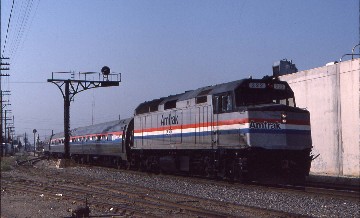
The day came and I drove to the Amtrak station on 4th Street and rode Train 583 to Los Angeles, which was usual for me. We arrived in Los Angeles on Track 10 and sitting on Track 9 was a three-car train, led by Amtrak F40PH 222, waiting for me to board.
San Diego Metroliner First Southbound Run Train 580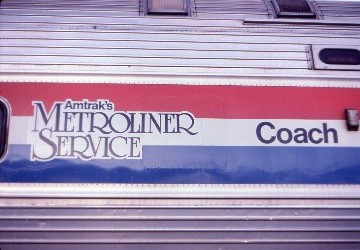
I walked across the platform to a cheerful car attendant who welcomed me aboard. On the side of the car, it read Metroliner Service. Inside, a couple of Amtrak officials greeted me then I chose a seat on the right with a large window to enjoy the ocean views later on. Another car attendant greeted me and explained the features of the service. I was offered roast beef finger sandwiches when we departed on time as the conductor pulled my ticket, then we passed Terminal Tower.
We travelled along the west bank of the Los Angeles River and ducked under US Highway 101, where the former Santa Fe freight yard and freight house were on the right, then passed the 8th Street coach yards. The Los Angeles River bed was concrete lined with a multitude of graffiti on its east bank and as I looked down, people were in the water. We slowed on our approach to the Redondo Junction roundhouse where Amtrak's motive power is serviced then reduced speed to twenty miles an hour for the crossing of the Union Pacific, guarded by the Redondo Junction tower before rounding the very sharp curve to reach the bridge over the Los Angeles River. The train crawled through the industries, including the UPS facility, before reaching Hobart Tower which protected the crossing of Union Pacific's Harbor Line then picked up speed as it ran along the south side of Santa Fe's main yard in Los Angeles, Hobart Yard. The train passed the fertilizer plant seen in a Bandini Hill skiing television commercial then sped under Interstate 710 then went by Levar Brothers warehouse before crossing over Interstate 5. Now running at track speed passed between the trackside industries, we then crossed Rio Hondo and the Pico Rivera yard was next prior to our traversing the San Gabriel River.
We passed DT Junction under Interstate 605 before crossed the former Pacific Electric, now Southern Pacific, line and turned to the south to reach Santa Fe Springs with its oil wells and refineries. The tracks curved again to the southeast at Norwalk then we passed the large oil tanks on the way to La Mirada, where the tracks dip under the roads and a small freight yard. The train then crossed Coyote Creek to enter Orange County and crossed Beach Boulevard before making a beeline to Basta and passing the Fullerton Airport. At Basta, we crossed Union Pacific's Anaheim Branch before proceeding directly east to Fullerton station and for the first time since I started riding trains, we did not stop nor slow down
I continued to enjoy the complimentary sandwiches as the Train 580 departed the Third District for the rails of Santa Fe's Fourth District, passing beneath California Highway 91, then reaching Anaheim siding and flying by it. We sped through Anaheim before slowing for the Southern Pacific crossing then crossed both State College Avenue and Katella Avenue to arrive at our first stop of Anaheim, located at the north end of the parking lot of Anaheim Stadium, where we paused briefly. Upon our departure, we passed under California Highway 57 then bridged the Santa Ana River, which was at the worst flood threat west of the Mississippi River, then travelled through the area of light industries before turning south at the junction with the Olive District, passing the old orange packing houses and the former Orange station.
After crossing Chapman Avenue with the Orange Circle four blocks east, we went through a residential neighbourhood of Orange, passed under California Highway 22 and crossed Santiago Creek. The next portion of the journey had us paralleling Lincoln Avenue through my neighbourhood, where I normally watched the trains, then crossing 17th Street before bridging Interstate 5, curving to cross 4th Street and flying past the Santa Ana station. It felt really odd to not stop, since all my train rides to this point commenced or finished here.
The 40 mph curve after Chestnut Street was navigated before the engineer opened the throttle and in minutes, we were racing along at 90 mph, ducking under California Highway 55 and crossing Red Hill Avenue. At this point, we were on a slight downgrade to Peters Canyon Wash and off to the right were the two blimp hangers, one of which is the world's largest wooden structure. We were now on what used to be Irvine Ranch, which now and in the future is the planned City of Irvine. We maintained our speed as we crossed Jamboree Avenue and Culver Avenue then entered the orange groves, for which this county was once famous and flew by Valencia siding before crossing Sand Canyon Road and another packing house. We passed beneath Interstate 5 and El Toro Marine Base was on the left, after which we climbed a short hill, still doing 90 mph, and passed between El Toro subdivisions. We dipped for a moment to cross Aliso Creek before finishing the grade and making it over the other side.
We then ducked under La Paz Road and Interstate 5 proceeding straight down the valley, sped by Galivan siding then crossed Trabuco Creek with orange groves on both sides and continued through San Juan Capistrano with its fabled mission and old town; the locale to where the swallows return every year. At the south end of town, we crossed San Juan Creek and slid through the "S" curve as more finger sandwiches arrived. At CP Serra, I saw northbound Amtrak Train 585 waiting for us to clear the main line then we crossed the Pacific Coast Highway after the south end of Serra, rounded the 40 mph curve and off to the right was the Pacific Ocean.
Starting south along the beach, we first passed Doheny State Beach as we travelled along the bottom of the bluffs, then went past a private community before a beachside mobile home neighbourhood and North Beach San Clemente.
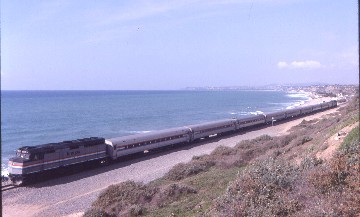
We started our shoreline running, rounding a point where the tracks are right against the bluffs and only the rocks protect the tracks from the crashing waves of the Pacific Ocean. The elevation of the tracks is only fourteen feet above sea level.
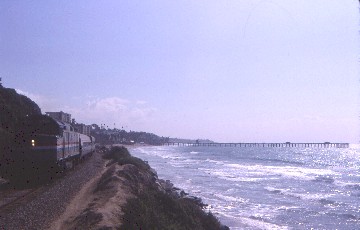
We rounded the bend into San Clemente, where we slid through at 40 mph, with the pier jutting out into the blue Pacific then continued our beach running with the houses either high on the bluffs or in a valley right next to the tracks with the beach to the west. South of here, the train passed through San Clemente State Beach before rounding another point to County Line as we entered San Diego County. The train crossed San Mateo Creek on a trestle made famous in the Beach Boys song "Surfin' USA" and proceeded through the wetlands before rounding a point and crossing San Onofre Creek. We then passed the United States Marine Corps Del Mar Beach campground, climbed up onto the bluff to San Onofre with its siding before passing the twin dome reactors of San Onofre Nuclear Generating Station.
With our train back at track speed, we were paralleling Interstate 5 on the left with San Onofre State Beach campground on the old highway. We passed the highway border checkpoint then entered Camp Pendleton Marine Base and went underneath Interstate 5 again. The old highway was beside us then we ducked under a tank bridge before descending to Las Pulgas Creek and sped away from it under another tank bridge before flying across Stuart Mesa with agricultural pursuits taking place on the base. We then crossed the Santa Margarita River on a truss bridge before going through Fallbrook Junction, where the original Santa Fe main line used to connect before it was washed out for good and the Surf Line was built in 1888.
We left Camp Pendleton and passed Oceanside Harbour then bridged the San Luis Rey River and entered Oceanside, flying through downtown, the pier and the Santa Fe station and siding without stopping, before we reached Escondido Junction with a twenty-one mile branch to its namesake city. We passed the small Loma Lagoon and creek before the neighbourhoods of homes and crossed Buena Vista Lagoon then flew through Carlsbad at 90 mph past its Santa Fe station. Next, we sped onward, crossing the Agua Herronda Lagoon then travelled along the bluff to Ponto, where in the siding was another northbound Santa Fe freight train waiting for us. The train crossed Batiquitos Lagoon then sped through Lecaudia, Encinitas and Cardiff-by-the-Sea, crossed San Elijo Lagoon and through Solana Beach to the crossing of the San Dieguritos River, passed the world-famous Del Mar Race Track before arriving in Del Mar, our second and last intermediate stop.
Upon our departure, a few more finger sandwiches as we crossed the Coast Highway and paralleled the edge of the bluffs with residences to the east and a cliff to the west, then curved under the Coast Highway and started to travel up the Sorrento Valley crossing the wetlands first. We flew by Sorrento siding where the 90 mph running ended and slowed down for the twisting and turning grade of Miramar Hill. We then ducked under Interstate 5, started our journey up the grade and looking out of the window, you could see the front of the train on the numerous curves. It was a short but steep 2.2 percent grade as the tracks ascended steadily away from the creek below. We rounded the last curve then went under Miramar Road to a section of double track down Rose Canyon, which was still wild with only a few housing developments under construction. Our speed increased down the straight tracks of the canyon until the curves and the end of the double track at Elvira, where we twisted our way down the rest of the canyon until it opened and San Diego was down the hill ahead.
We sped along the tangent track with Mission Bay to the right then crossed the San Diego River and gained double track again at Old Town. Ducking underneath Interstate 5 one last time, we passed the former Consolidated Aircraft plant, went past San Diego International Airport on the right and arrived on the house track of the 1915 Mission Revival style Santa Fe Depot eight minutes early. I stepped off the first San Diego Metroliner and my fastest journey down the Santa Fe Coast line.
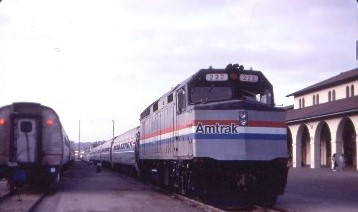
I waited patiently on the platform for San Diegan 587 back to Santa Ana after a most unique trip to San Diego.
Postscript: In April 1985, Amtrak officials announced plans to abandon Metroliner service between San Diego and Los Angeles after criticism that the train catered only to occasional, high income riders, and was opposed by officials of the Orange County cities for which it did not stop. Early projections had been that that about 90 passengers would be carried per run on the Metroliner, but it actually averaged only 50 in the morning and 40 in the evening, and replaced a train that averaged more than 200 passengers per trip. An Orange County Transportation Committee study showed that 80 percent of regular San Diegan passengers relied on intermediate stops. Caltrans had submitted a plan for standardizing intervals between trains to allow for better service and safer passage of trains along the corridor. By the issuance of the April 2 National timetable (revised June 11, 1985), there were no Metroliners in the schedule, but a few trains still skipped both Commerce and San Clemente.
| RETURN TO THE MAIN PAGE |