




My foray into the Copper Canyon and my multi-year friendship with the owners of Bananafish Tours started when I saw a small advertisement on the lower left hand corner of the back page of the Sunday travel section of the Los Angeles. after the first delightful Puerto Penasco trip in 1984, my parents and I decided to go on this tour and my mother made all the arrangements. As the days grew closer, I became even more excited about riding the most spectacular train trip in North America, which would allow me to see by rail what was beyond Puerto Penasco.
We drove down to Calexico via San Diego and parked at AA Parking where we were met by the Bananafish Tour representatives and we were taken by van to the Holiday Inn into Mexicali. My parents shared one bed while I had the other since the wife of the owner of Bananafish Tours, Sandy, was under the impression that I was a small child.
12/31/1987 We were taken down to the Mexicali station and joined the queue to go through Customs, which was just to get one's tourist permit stamped. We then boarded our private sleeping cars on the rear of the all-coach Sonora Baja California (SBC) train that ran the entire length of the railroad from Mexicali to Benjamin Hill, with through cars added to the Pacifico's train from Nogales to Guadalajara.
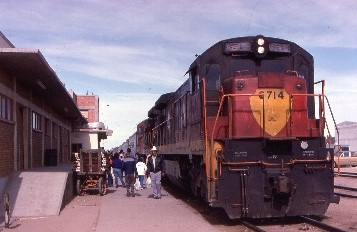
After finding my roomette number five, I walked to the front of the train, led by National Railroad of Mexico C30-7 6714 and the tour group had six of the seven cars in the consist. We departed on time and I rode in the vestibule as we left town, passing through the SBC yard then went by some nice homes before the squatter-type dwellings along the tracks, where it was very dry and dusty. At Pascualitos I saw where the former Inter-California Railroad tracks diverged from the SBC mainline. We then passed the thermal electric project at Cerro Prieta, whose construction was progressing well, followed by a dusty run to Delta and Victoria.
I heard a "hello" and turned to meet Michael and his travelling companion Sands; Michael was a teacher at Canyon High School in Anaheim Canyon and Sands worked as a travel agent. We started talking and the three of us became instant friends. Sandy finally found us and upon seeing me, remarked that I was not what she expected and we laughed at that.
We proceeded out into the Altar Desert and when the sand, as well as the dust, became too much, everyone else returned inside for the freedom that the cars provided. I, however, had learned on those Puerto Penasco trips to wear a pair of cheap sunglasses and a handkerchief over my nose and mouth. The longer the train, the more dust it would produce, thereby making the Altar Desert the dustiest place I had been. Deciding that I had enough of its beauty and dust for the late morning, my friends and I decided to walk through the train and once in the SBC section, we had changed worlds. The adults were all asleep with their children running wild, so we returned to the Bananafish section in time to detrain at Puerto Penasco so I could stretch my legs.
Upon departure, I was back in the vestibule as this was new mileage and the best way to see it. Penasco faded into the distance as did the Gulf of California. This part of the Altar is far less sandy and more enjoyable and I frequently switched sides so I had equal time viewing either side of the train. We sped past the Golden Spike Monument before passing the sidings and section housing at Los Enchilayas, El Coyote and Las Sapas then arrived at Caborca, where we waited for our sister train, SBC 1, allowing for a fresh air break on the ground. Word was spreading that it today was my birthday, so perfect strangers were wishing me a Happy Birthday.
I went back to my room and found Michael and Sands waiting for me then we fixed a drink and were talking when Sandy arrived, then returned to the vestibule for the rest of the late afternoon's run to Benjamin Hill. After the mostly straight running of the day, the tracks curved to cross a river then curved again to gain elevation. We passed Trincheras and had a speedy thirty minute journey to Benjamin Hill, beating the train from Nogales by thirty minutes. The "Three Amigos" went for a walk then returned to the depot.
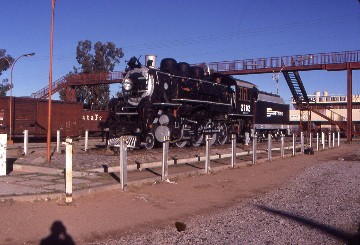
National Railways of Mexico 2-8-0 2702, nee Sonora-Baja California 1137, built by American Locomotive Company in 1921. Sister engine 2703 is displayed in Mexicali. The train from Nogales arrived, our engines from Mexicali cut off and the six cars of the Nogales train coupled onto ours. Soon we left Benjamin Hill as Pacifico's Train 2 with seventeen cars sped off down the Pacifico's track into the night.
I was sitting in my room just thinking about today's ride, when Michael and Sands came to remind me of the New Year's Eve party in the lounge car. I said goodnight to everyone as tomorrow was the day I had been waiting for and wanted to be well rested. On my way back to my sleeping car, I stood in the vestibule as the train sped through the darkness, reflecting how most people forget my birthday so I never looked forward to it. But here, a bunch of strangers gave me the best birthday and I had to thank Bananafish Tours for bringing us together. I returned to my room and fell fast asleep.
My First Encounter with Copper Canyon 1/1/1988I awoke in Sufragio, a division point on the Ferrocarril del Pacífico, so decided to photograph the trains and engines in the yard, but could not find my shoes. Not to be stopped, I used the 'no problem' attitude and walked barefoot through the yard.
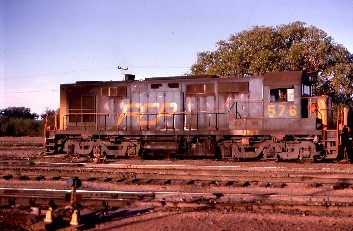
Ferrocarril del Pacífico RSD-5 576, nee Ferrocarril del Pacífico 807, built by American Locomotive Company in 1953. I returned to the train to look for my shoes and found the porter, who started laughing, went to his room and came out with my shoes; he had played a birthday joke on me. It seemed that when I had taken them off last night, they went out into the hallway and he found them just as I closed my door. Shoes returned to my feet, I did some serious walking and photography waiting for the first class train from Los Mochis.
It was a beautiful bright sunny morning as Chihuahua Pacifico Train 3 arrived, cutting off its caboose then switched onto a gondola car (the open car) and spotted it in front of the caboose. The train then pulled forward and reversed onto our cars on the interchange track, pulled us out and connected to the open car and caboose. The crew connected the air lines and performed the air test. My car, which formerly led the Bananafish consist was now on the rear with the open car right outside the rear door.
I made a beeline into the open car just as we departed and proceeded north right beside the FCP tracks to San Blas, where we turned off northeast towards the mountains and made our way up a rather flat valley, where to the north, the Rio El Fuerte was coming down the valley. We made good speed as we passed the station at El Fuerte and also to the north, I could see the lake of the large reservoir that was constructed on the El Fuerte River. We began to twist and turn up the grade before passing the large cement plant outside Loreto then stopped at the railroad's division point, where the children were begging for anything. We continued to twist and turn on our ascent before plunging through a deep cut and starting our descent. It was at this point that The Three Amigos were reunited as Michael and Sands finally came out into the open car.
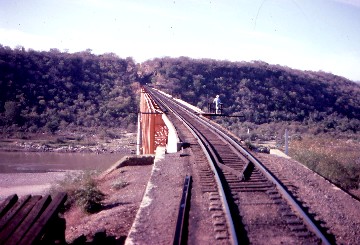
At the end of our descent, the train started to cross the El Fuerte Bridge, the longest on the railroad and the most impressive I had crossed. I thought the bridges on BC Rail were incredible, but this one was a lot longer. As we crossed it, I noticed a pedestrian trying to stay out of the way of the train and one would have thought he would have heard the train coming. Down at the water level, there was a rope ferry to shuttle cars from one side to another. The river was about a quarter of the way across the channel, which reminded me that this was the dry season here as rainfall occurs with the high sun of summer.
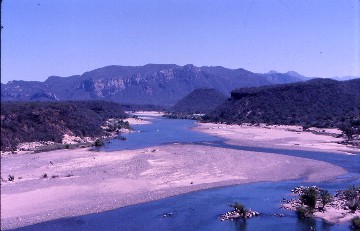
Passing through Aguacaliente, the railroad proceeded into the hills and we were now turning and reversing through curves to gain elevation. The hills were covered with saguaro cacti and other flowering plants. We passed through Los Pozos and continued our snaking climb to the first of eighty-six tunnels, including the longest, El Descanso Tunnel which we entered. Exiting from the longest bore, we went into the short tunnel 85 then had the first good view of the Sierra Madre Mountains which we would be crossing. There were two canyons visible, the Rio Serpentine which the railroad climbs, and the Rio Urique, both which plunged into the high front range of the Sierra Madres.
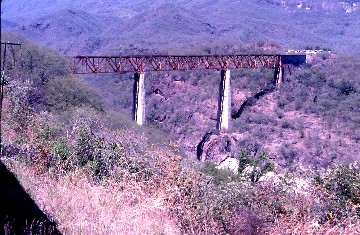
We were on a high ledge above the Chinipas River and after following it for a while, we swung across it on the highest bridge on the railroad, the Chinipas Bridge, with a great view looking up its canyon. We passed through Jesus Cruz before crossing a smaller bridge at KP 774 (Mexico is metric, so KP is kilometer post rather than mile post) then passed through a series of short tunnels. Down along the river was a grain car that derailed then just left where it had rolled. The canyon walls were getting progressively higher as we continued our climb with interesting side canyons. We passed Santa Ninño followed further by more tunnels to Julio Ornelas and we had left the state of Sinaloa for the state of Chihuahua.
More tunnels followed and I noticed that the railroad put a siding and section houses anywhere possible where they could fit, although nature did not provide too many. The train entered an area which was called "The Narrows" according to the rail guide that Bananafish Tours provided. The tracks curved to the left, followed by more tunnels some of which had been designed to keep the rocks from falling onto the tracks. Along the canyon side of the train were some really nicely-built masonry retaining walls to hold back the rocks. We crossed the Mina Plata Bridge then plunged into another tunnel and it was beginning to make some sense to me why it took so long to build this railroad.
After Arthur Stillwell lost control of the Kansas City Southern, which he had conceived, he decided to build the shortest rail line between Kansas City and the Pacific Ocean, choosing the bay at Topolobampo as the railroad's destination. The line would be about five hundred miles shorter than any other rail line to the Pacific coast and construction would be in segments, with the western portion running from only Topolobampo to El Fuerte, while the eastern portion would be built to start from Chihuahua to Creel. In the United States, the Santa Fe gained control of the railroad and built the line to the Mexican border and then into Chihuahua. It was in the Barrancas that construction proved impossible and was halted for years. In 1958, the Mexican government decided that the line must be finished and poured money into that goal then in 1963, the line was finally completed at Temoris, only after the most modern construction techniques were used.
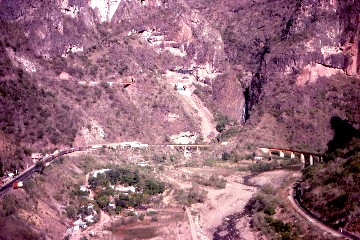
Once we travelled through a series of tunnels, everyone had their first view of the most spectacular and famous spot on this railroad, Temoris, where there are three levels of tracks. We approached on the lower level, crossing the curving Santa Barbara bridge to start reversing direction, then crossed another curved bridge with a waterfall cascading down from above, went underneath the two monuments built for the completion of this railroad and its twenty- fifth anniversary, before entering the station on the middle level, where we stopped for orders. It was here that Bill Wallace, owner of Bananafish Tours, gave a history of the railroad and Temoris, then upon our departure, we passed the line of railroad workers' homes in former freight cars and continued to climb the middle level, providing a fantastic perspective of Temoris and the valley below.
We plunged into the Le Pera Tunnel which allowed the train, while inside, to make a 180 degree turn to reach the third and highest level as we exited the tunnel well above Temoris. Everyone gained a more fantastic view of Temoris below before passing through a short tunnel between the two commemorative monuments, made out of old hopper cars that had a metal face attached in the shape of the State of Chihuahua, complete with a shell of a Fairbanks-Morse H12-44 locomotive extending out from it on a set of rails. On the top was the original monument built in 1963 and below was the twenty-fifth anniversary of the line's completion. It was here that one has the last view of Temoris before one enters another tunnel.
We journeyed through the multi-tunnel segment of this railroad high above the Rio Serpentine then crossed that river again before climbing into another canyon, going through a tunnel and around a horseshoe curve to gain more elevation. After another set of tunnels, the scenery changed to a more oak grass setting, reminding me of the Eureka Southern in northern California. The river climbed almost to track level with the canyon opening up a little then there was yet another tunnel, followed by crossing the river on a rather ordinary bridge to the siding at Irigoyen. After traversing over the river, we stopped at Bahuichivo, at the edge of timber country. We passed a log reload facility where tractors were busy loading bulkhead flat cars with logs and was the first industry on the line since the cement plant at Loreto.
Sandy brought me lunch, which was chicken cooked in El Pollo Loco-style by a woman who lived in San Blas and it was the best I had had in that style. We chatted for a bit, then Bill came out and introduced himself, apologizing for not doing so earlier. As we talked, we realized we both had a love of trains and he gave me more technical details of running a trip such as this, which I found most fascinating. By the time we reached Cuiteco, Bill went back about his duties and I was joined by my other two Amigos.
The train continued its climb as we passed small farms and the trees changed from deciduous to pine with the gain in elevation. The tracks left this valley by making another set of reversing curves before a series of tunnels leading us into the next little canyon the train would follow.
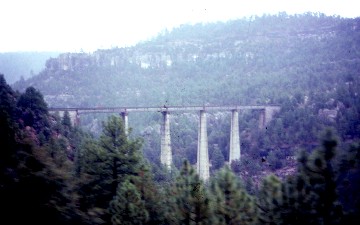
After some tangent tracks and a few more tunnels, we crossed the slightly-curved Cuiteco bridge then curved up and around another canyon before crossing the La Mora bridge in the middle of a curve. We next passed Chihuahuicame then rounded another horseshoe curve as we continued to climb before plunging through a rather long tunnel then crossed the La Laja bridge, is the second highest on the railroad. We entered the last tunnel before twisting and turned our way to the next division point on the railroad, San Rafael and returned to the open car and the vendors. There are two types, the usual ones selling food and the Tarahumara Indians selling their crafts. I found the Indians to be far more interesting than any of the food, which I would never eat for health reasons.
We departed San Rafael and continued the climb with a series of swinging loops which led to another short tunnel and within minutes, arrived at Divisadero where all passenger trains stop for at least fifteen minutes. The town had two major attractions, namely the view of Canyon Urique and the Taramuharas selling their wares. The Indians took the perfect spot between the train and the canyon and one must pass them in order to reach the view.
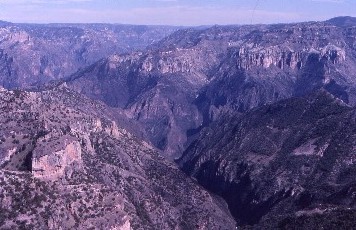
What a view it was looking out and down into Canyon Urique, the same scene that one sees in tour brochures of Copper Canyon Tours and in travel magazines. This is part of the Copper Canyon, a group of six distinct canyons in the Sierra Madre Occidental in the southwestern part of the state of Chihuahua, 25,000 square miles in size. The canyons were formed by six rivers that drain the western side of the Sierra Tarahumara (a part of the Sierra Madre Occidental), all which merge into the Rio Fuerte and empty into the Gulf of California. The walls of the canyon are a copper/green colour, which is the origin of the name.
I was most impressed and thought that everyone should see it once, then returned past the vendors as I went back to the train. Departing Divisadero, we travelled along the ridge that separates Canyon Urique from Otero Canyon to the northwest, which was occasionally seen, and twisted and curved while ascending as we passed Nacaibo gaining a few more glimpses of Otero Canyon as the train speed increased on this relatively curve-free section of the railroad. There were canyon views on both sides of the train before we were lined into the siding at Pitorreal by the crew of CHP Train 3, whom we met on the mainline. They lined both ends of the siding so we continued without stopping then resumed our climb along a side canyon before looping around at its head.
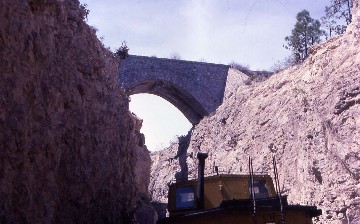
El Lazo, a 360 degree loop, one of only three in North America but very different from the others. The most famous is the Tehachapi Loop, which has a hill in the middle, and the other is the Williams Loop in the Feather River Canyon, which has a marsh in its middle. However, El Lazo is just one continuous rock surface through which the train cuts to make the loop, starting at the bottom, going through a tunnel with an arch bridge above before curving hard to the left upgrade to the point where you cross over the track below with Urique Canyon in the background.
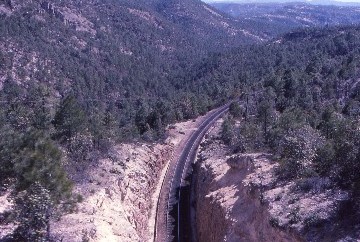
Just east of here, we crossed the highest point on the CHP and in less than eighty miles, had climbed over 8,000 feet. It was the most incredible railroad over which I had ridden. At Frederico Lopez, we met CHP Train 7, the second class train, sitting in the siding and running late waiting for us to pass. Our three locomotives were running in full dynamic braking for the first time today as we were now descending towards Creel, our destination, and made a series of sweeping curves before approaching Sanchez. The train then rounded another series of curves then a horseshoe curve before entering the valley where Creel is located. A final horseshoe curve was negotiated then we ducked underneath a highway overpass and on a long straight track into Creel, where we stopped at the depot, thus ending today's ride.
I was assigned a room at the Parador Montana, as were my other two Amigos, so we walked the six blocks to the hotel and checked in as the cars were cut off the train and put into the siding.
Creel 1/1/1988
After I settled in my room and freshened up, I met my parents in the lobby to watch the 74th Rose Bowl game, which the Michigan State Spartans won, defeating the University of Southern California Trojans 20-17. I had such a great day that I had forgotten it was New Year's Day. I went for a nice long walk after the game in the clear cold mountain air before returning to my room and a good night's rest.
1/2/1988 The next morning I arose and had a breakfast of hot cakes before returning to my room to pack. My bag was to be taken back to the train while I joined the Tarahumara Indian Cave tour so met the group outside the hotel and we piled into a tour bus, leaving town on the paved highway and crossing over the tracks before we turned onto an uneven dirt road, over which we travelled five miles until we turned off and arrived at cave.
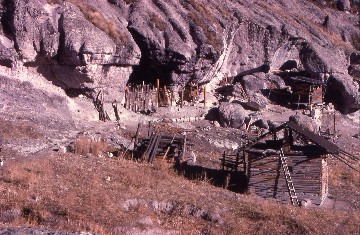
We explored the cave and its surrounding area and it amazed me how the Indians had a place for everything with everything in its place, and there was no rubbish anywhere. The outside was nothing special but the interior was the opposite with a cooking area, separate sleeping areas for the children and the parents, along with a general living area. It made me think of the modern conveniences I was used to to be happy. Outside was an area underneath the cliff where there were pens for their goats, sheep and chickens. To the right of the cave was a field for their crops, mainly corn and it is a very well thought-out plan for their living environment.
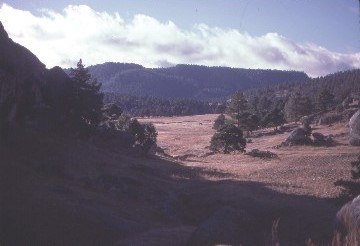
The view from the front of the cave. Everyone returned to the tour bus and were taken to the Valle de los Hongos (Valley of the Mushrooms).
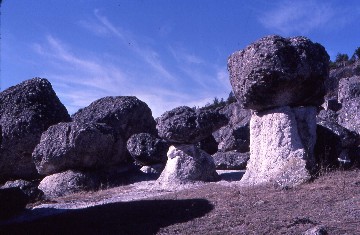
This valley is known for its rock formations, of volcanic origin, sculpted by erosion, which are approximately 20 million years old and resemble mushrooms. The natural beauty of this place is surprising, since the process of chemical weathering, in which the rock decomposes and disintegrates due to the passage of time and climatic conditions, has resulted in a unique and impressive landscape. Furthermore, although there are theories and legends that suggest that the rock formations were superimposed and sculpted by humans, land erosion better explains the rock conditions.
Our next stop was the Valle de los Monjes (Valley of the Monks), a short drive from the rocks. The group explored both the exterior and interior then returned to Creel and had three free hours to look around. Today we were going back on the first class train so I waited at the east end of the platform to watch it arrive before I dashed back to our cars to board. It was interesting to watch everyone arrive at the station because of the vendors and it was similar to a three-ring circus.
The Return 1/2/198CHP Train 4 arrived four minutes early, received his trainorders and within minutes, had our cars coupled to the rear. I was out in the open car where Michael joined me with our now customary Tecates and we enjoyed the beautiful scenery. We rounded El Lazo again then arrived at Divisadero where we had a layover. Sands and I went shopping and I purchasing a wooden cooking set for Vicki Rossman, the activities secretary at McArthur Fundamental Intermediate, then saw a handmade wooden violin but did not have enough money. I returned to the train to put my purchase away, then Sands popped in, saying she had a big surprise which was that she had purchased the violin for me. I was very surprised and thankful. When Michael joined us, the "Three Amigos" returned to the open car just as we arrived at San Rafael, CHP Train 3 was waiting in the yard.
We crossed the La Laja Bridge then met a very late-running CHP Train 7 at Chihuahuicame just as the shadows began to take hold in the canyon. "Three Amigos" were reunited once again as we continued our descent then arrived at Temoris in twilight and I enjoyed the trip through there almost as much as yesterday. Everyone went inside for dinner, leaving me in the open car where it was beginning to become very cold. After the Chinipas River was crossed, I returned to my room but went back outside twice for the El Descanso Tunnel and El Fuerte River Bridge under a star-filled night before I called it a night.
1/3/1988 The next morning found me waking up to the high-speed clickety-clack of the Pacifico's mainline.
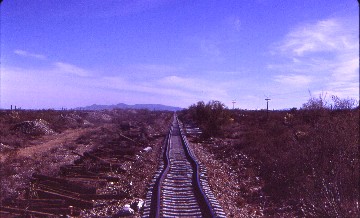
I went to the vestibule to work out our location and after a few kilometers, we passed Carbo, which meant we were an hour or so from Benjamin Hill. I made up my room and stayed there until we reached Benjamin Hill, where the SBC put together our train and we departed two hours late. We were delayed further west where the SBC was putting in ribbon rail and concrete ties and I surmised they must have started yesterday, and was amazed the train stayed on the tracks. We met eastbound SBC Train 2 at El Coyote as we waited in the siding for twenty minutes then arrived at Puerto Penasco almost at sunset.
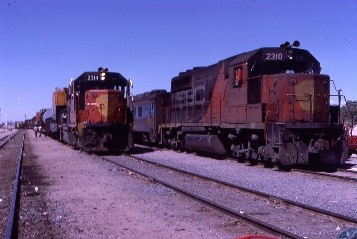
Following our last servicing stop, we proceeded out into the Altar Desert and I thanked Bill and Sandy for such a wonderful time and they both invited me to join them on future trip, which I would work around my schedule at MacArthur. It was a quick journey back to Mexicali and Bill had arranged to have the train taken up to the border, saving everyone parked at AA Parking a cab fare. I detrained and slept the entire way back to Santa Ana, ending my first Bananafish Tour trip to the Copper Canyon trip in Mexico.
| RETURN TO THE MAIN PAGE |