




Riding this line was sparked by Ted Benson's picture of the lone Southern Pacific RDC acting as the Northwestern Pacific's Redwood train crossing the Eel River at South Fork found on page 17 of "Journey to Amtrak" by Harold A. Edmondson.
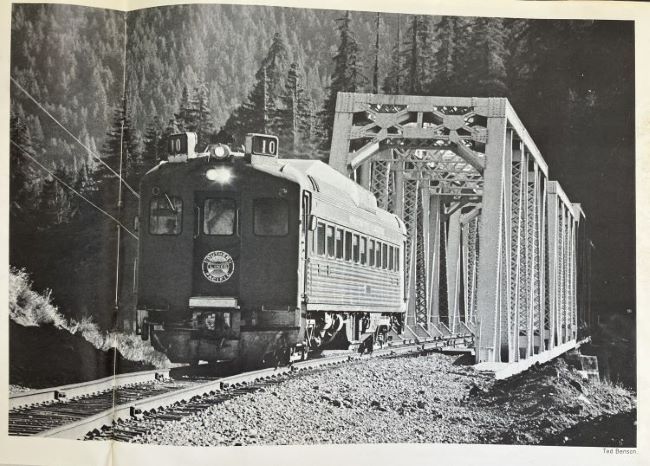
This photograph lived on in my mind for years.
Brief OverviewThe line north of Willits was opened by Northwestern Pacific in 1907 and owned jointly by Southern Pacific and Santa Fe. It merged with Eureka & Klamath Railroad in 1914, then Southern Pacific bought out Santa Fe's half in 1929. They sold the portion of line north of Willits to Eureka Southern in 1984. Arcata & Mad River Railroad was acquired from Simpson Timber by Eureka Southern in September 1988, then they went bankrupt and assets were sold to North Coast Rail Authority in April 1992.
Within two years of the Southern Pacific sale to Eureka Southern, passenger service returned to the fabled Eel River Canyon.
Eureka Southern HistoryThe Eureka Southern Railroad (reporting mark EUKA) was a shortline freight and excursion railroad that ran over former Northwestern Pacific trackage from Willits to Eureka, California. On September 8, 1981, Bryan Whipple purchased the soon-to-be abandoned northern end of the Northwestern Pacific mainline. His Eureka Southern Railroad holding company purchased the segment of the line from the Southern Pacific Railroad for $4.95 million, and commenced operations on November 1, 1984 using four EMD GP38-2 locomotives it acquired from Conrail.
Over the course of its life, the line struggled to make money. Though wood products had historically been the top source of revenue for the Northwestern Pacific and subsequently the Eureka Southern, historic over-harvest on private lands limited timber availability, and coupled with rising environmental restrictions in the area, caused traffic numbers to fall consistently. The EUKA also faced a constant battle with the elements in the famed Eel River Canyon, historically one of the most expensive to maintain stretches of track in the United States. Finally, on December 15, 1986, the road filed for chapter 11 bankruptcy, but continued operations.
The line operated an excursion train, the "North Coast Daylight", as a joint venture with Sierra Western Corporation, the owners of historic passenger cars. Several of the cars had originally been Southern Pacific Daylight cars; others were a mixture of vintage passenger, diner and dome cars of the same era, painted in the iconic "Daylight" orange-striped scheme. The trains were pulled by Eureka Southern locomotives. On Saturday mornings, the North Coast Daylight passengers rode excursion buses from the San Francisco Bay area to Willits, where they boarded the train. The train followed the scenic Eel River Valley north to Eureka, a route never served by the original Southern Pacific Daylight trains. Meals, snacks and beverages were served throughout the trip in dining, lounge and dome cars, lunch menus were limited but were well-prepared. Passengers stayed overnight in Eureka, then boarded again on Sunday mornings for the return trip to Willits and (by bus) to the Bay Area.
The North Coast Daylight was never financially stable and operation was interrupted several times by reorganizations and damaged tracks. The service lasted from about 1985 through 1990. The vintage cars were "marooned" in several rail yards when all rail service south was abandoned.
In September 1988, EUKA purchased the 7-mile shortline Arcata and Mad River Railroad from Simpson Timber Company for $300,000. In 1991, the line was shut down due to an earthquake and related landslide that caused expensive washouts. The railroad was then sold at court order to the North Coast Railroad Authority in 1992, as a protection by local government agencies to ensure continued railroad service to the counties. The line was renamed the North Coast Railroad and consisted of many former employees of the Eureka Southern. The North Coast Railroad continued to run North Coast Daylight trains into the mid-1990s using the same passenger cars. The EUKA GP38 locomotives were not included in the sale, so NCRA used a mixture of leased Southern Pacific GP9s and SD9s, as well as former Central California Traction Railroad GP7 70. Most of the locomotives ended up marooned on the line in Eureka and were scrapped in autumn 2015 after sitting idle for nearly 20 years, including 70.
Faced with constant washouts, derailments, unreliable schedules and a dwindling customer base, operations shut down in 1995 and have not reopened. The Eel River canyon segment of trackage, faced with two decades of no repair, is in some places non-existent. Experts who surveyed the trackage in the late 2000s estimated it would cost $20 million to bring the line up to FRA minimal operating standards.
Railfanning Eureka Southern's North Coast Daylight 7/3-4/1986My friend Bill Compton and I drove to Willits to see both Eureka Southern and California Western in action.
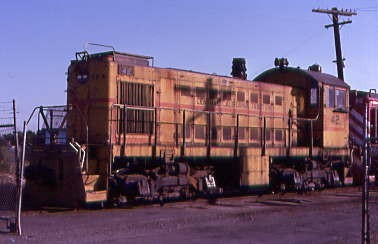
On the way, stopped at Stockton at the California Central Traction and caught their S-1 42, nee Northern Pacific Terminal 34, built by American Locomotive Company in 1942.
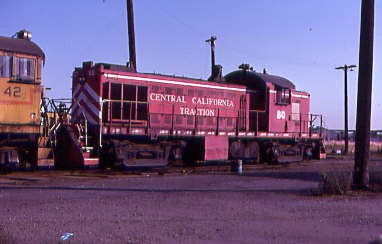
Central California Traction RS-1 80, ex. Tidewater Southern 746, exx. Chrome Crankshaft (dealer), exxx. Union Pacific 1218, exxxx. Spokane International 1218, nee Spokane International 207, built by American Locomotive Company in 1949. We drove to Santa Rosa for the night.
7/4/1986 We continued the journey to Willits.
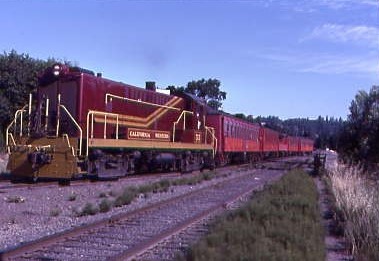
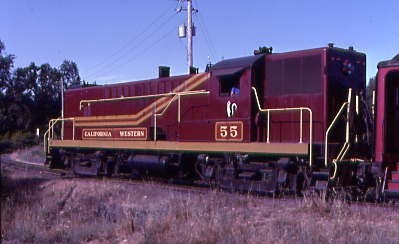
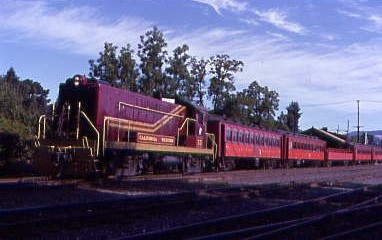
The Skunk Train preparing to depart, led by California Western RS-12 55, nee McCloud River Railroad 32, built by Baldwin in 1955. It was scrapped in 1994.
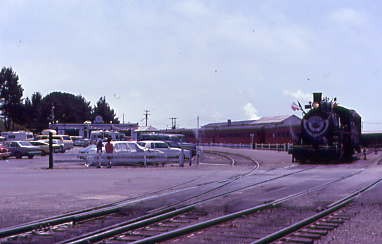
We drove to Fort Bragg to catch the California Western Steam Super Skunk getting ready to leave for North Spur.
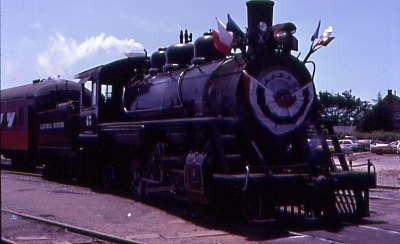
California Western 2-8-2 45, ex. Medford Corporation 3 1932, nee Owen-Oregon Lumber Company 3, built by Baldwin in 1924, dressed up for the Independence Day holiday. We returned to Willits to scout out locations for the next day's chase of the North Coast Daylight.
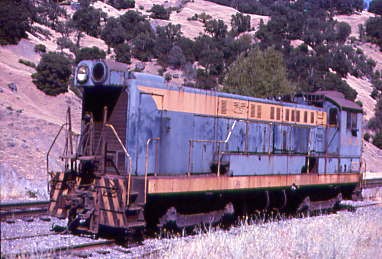
We found some good locations and at Dos Rios, came upon California Western S-12 57, ex. Southern Pacific 2148, nee Southern Pacific 1541, built by Baldwin in 1953. It was privately-owned and stored and later, scrapped.
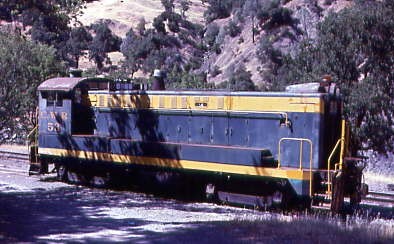
California Western DS4-4-1000 53, ex. Pan American Engineering W8380, nee United States Army Corps of Engineers W8380, built by Baldwin in 1949. It had been equipped with water tanks and sprays for rail lubrication on the sharp curves between Willits and Fort Bragg. The locomotive sat on the old Ten Mile siding in Fort Bragg until November 1984 when John Bradley rescued the locomotive from the scrappers. Included in the sale was the condition that John could use the Fort Bragg Roundhouse and the assistance of the CWR crew to return the locomotive to operating condition. The repairs took about a month and included changing all the cylinder heads, removing and replacing all four wheel-traction motor sets and trying to find and cure many electrical problems. The locomotive was then moved to Willits and transferred to the new Eureka Southern Railroad at Dos Rios for eventual work train use. The work train was never implemented because the railroad went into bankruptcy. The engine also suffered some unresolved electrical problems.
When the railroad reopened in early 1986, the engine was moved back to Willits for storage. During its retirement there were some modifications made to upgrade 53. Chris Baldo bought the locomotive from John Bradley in 1993 and subsequently donated it to Roots of Motive Power in 1995.
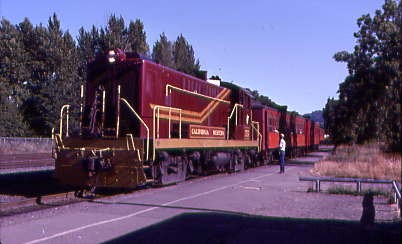
Upon our return to Willits, the Skunk Train had returned from its afternoon run and with that, we called it a day.
7/5/1986 The next morning we were ready for a chase.
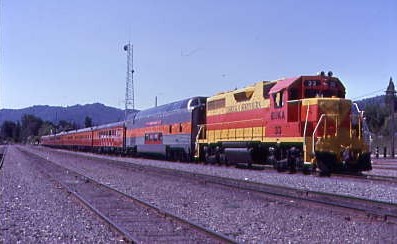
The North Coast Daylight preparing to depart Willits.
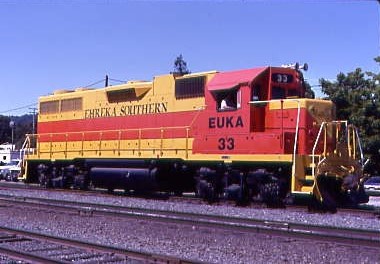
Eureka Southern GP38 33, ex. Eureka Southern 7821, exx. Conrail 7821, nee Penn Central 7821, built by Electro-Motive Division in 1969. It would be sold to Dakota, Minnesota and Eastern as their 3803 in 1993, then sold to Helm Leasing Company as their 3600 and as of October 2025, is Rio Valley Switching Company 3600.
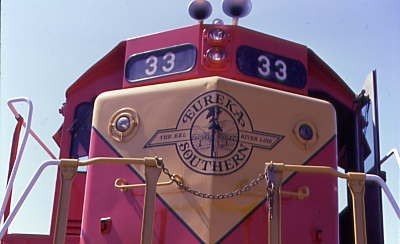
A most impressive emblem.
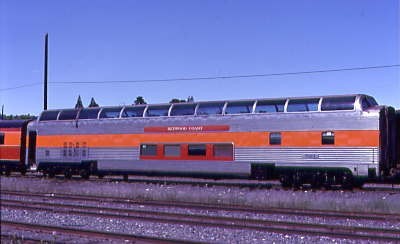
Sierra Western dome 523 "Redwood Coast", ex. Great Western Tours 1981, exx. Auto Train 523, nee Santa Fe 511, built by Budd Company in 1954. For the North Coast Daylight's first season, this car was leased through Great Western Tours' partner Neil Ferguson, the window band was painted orange and was named "Donner Pass" inside the car only. It was re-sold in 1986 to Westours and named "Nenana" PPCX 800124 and entered service in 1987. It was then listed for sale in 2003 and four years later, acquired by Iowa Pacific's San Luis & Rio Grande and re-lettered "Rio Grande Scenic" and named "Scenic View" in 2009 for Denver "Ski Train" service. The car was then used in general excursion service after Ski Train terminated.
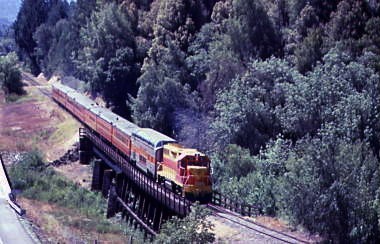
We went to Outlet Creek and waited for the North Coast Daylight to pass through.
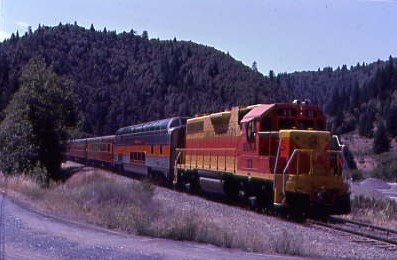
The track returned to Highway 101 at Arnold.
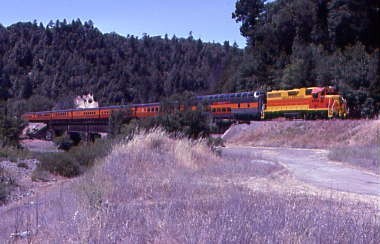
We went a few miles north on Highway 101 and turned off at Longvale, where we caught the train again.
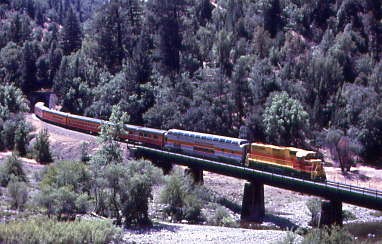
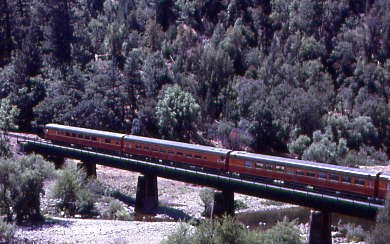
Our last photographs were at Farley just south of Dos Rios as the North Coast Daylight proceeded north through the wild Eel River Canyon and on to Eureka.
Riding the North Coast Daylight in 1987Flimsies Magazine had the advertisement in one of their issues so my parents, my friend Jeff Hartmann and I decided to ride this train over Labour Day Weekend. Jeff and I drove up by ourselves and met my parents in Willits the next morning, having stayed at the Skunk Motel the night before.
We boarded the all-Daylight painted train in the yard across the street from the California Western depot, with Eureka Southern GP38 31 as our power. The train departed on time and pulled north through the yard in the Little Lake Valley then crossed Highway 101 at the north end of town before reaching Outlet and followed Outlet Creek to the Eel River at Farley, which we would cross twelve times. We travelled through Maple Grove before coming to a sharply-curved shoofly around damaged Tunnel 11 and the flanges really squealed there, then we ducked under Highway 101 before reaching Longvale and crossing Outlet Creek for the last time.
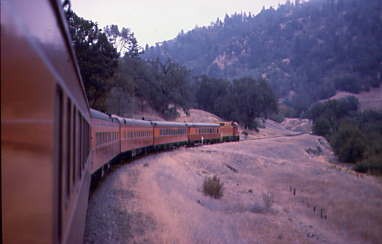
Paralleling Eel River.
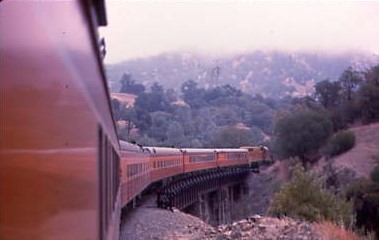
Crossing Eel River.
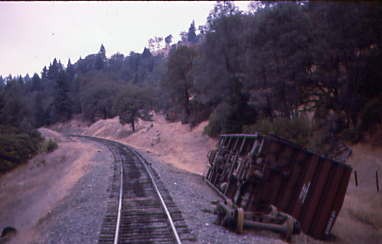
Off to the right was a derailed box car.
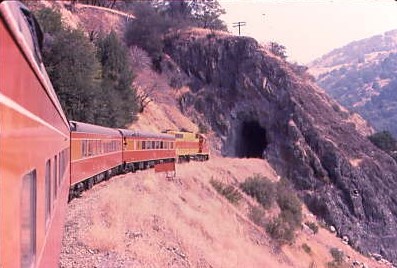
In the shadow of the redwood trees, we made our way to Arnold before passing through the 881.2 foot Tunnel 12.
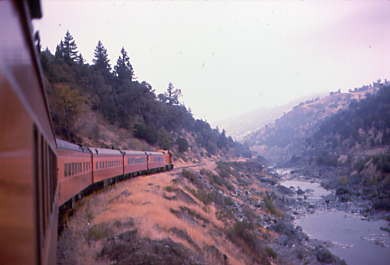
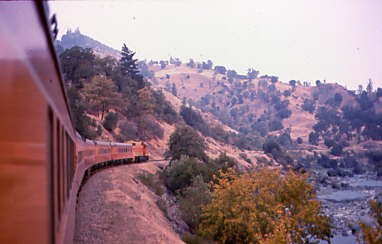
The Eel River represents California's third largest watershed. The main stem flows more than two hundred air miles and travels over 800 river miles from the headwaters above Lake Pillsbury in Lake County to the ocean. It has received both state (1972) and federal (1981) wild and scenic river designation, which protects the river from dams and ensure that environmental concerns rank equally with development and industry.
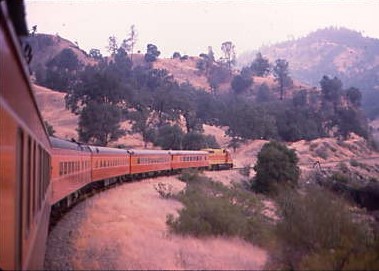
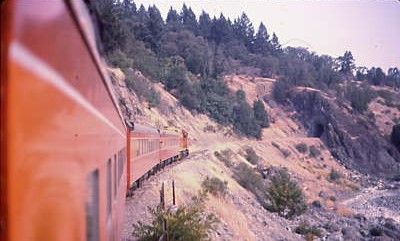
Running high above the river.
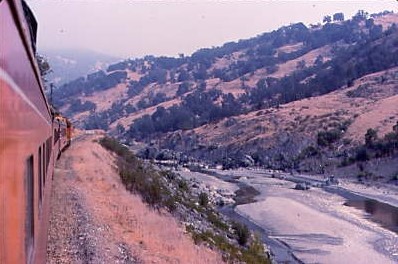
The ever-present Eel River.
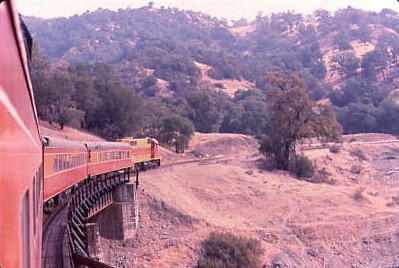
Yet another crossing. Adding to the scene was a smoky sky, almost orange at times, from wildfires north of us. The Shimmin Ridge was to the east as we travelled down the canyon through Tunnel 13 to Farley, where Eel River joined us. We travelled onward through Tunnels 14 and 15 to Dos Rios, where we left the paved roads behind and our top speed was forty miles an hour where track conditions allowed, but was restricted to five miles an hour in spots. We proceeded north through Indian Springs and Deer Lodge before entering Tunnel 17 prior to Woodman, where Windy Ridge was to the southeast and Eberly Ridge to the northeast. The countryside on these drier slopes was full of oak with dry grasses. We went through Tunnels 18 and 20 over some very questionable track between the two and more railroad cars were located along the river.
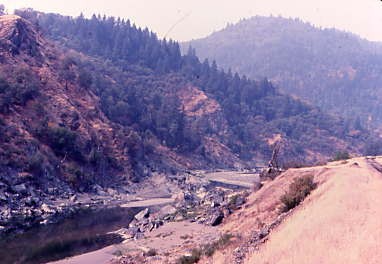
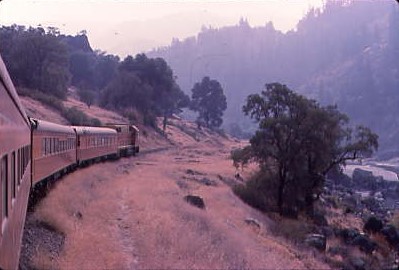
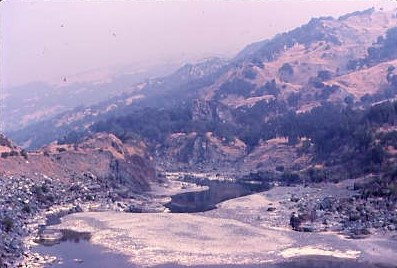
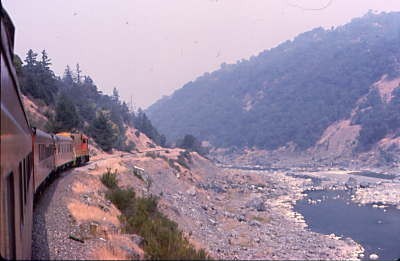
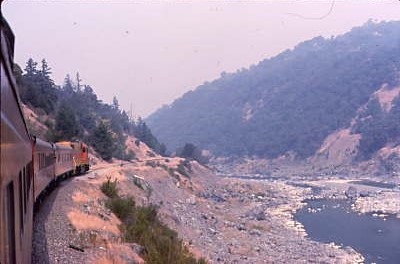
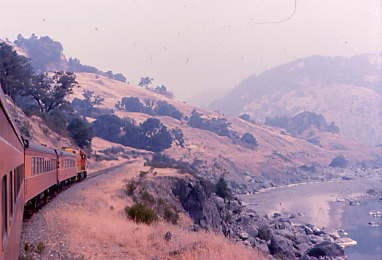
The scene as we made our way to Eureka. The tracks curved with the river's bends so there were very few sections of straight track. We passed through Nashmead before Tunnels 21 and 22 that led us to Spyrock, with the rock itself on the other side of the river. We continued slowly through Tunnel 23 into Bell Springs, a town and stage coach stop on Bell Springs Road. A post office operated here from 1920 to 1961 and the town was named in 1861 by Jim Graham for the cowbells he found at the site. What was once Bell Springs is now the location of the Bell Springs Ranch. Bell Springs Road, 28 miles of steep narrow unpaved mountain road, was originally called Mail Ridge, and was the only through road connecting Mendocino County and Humboldt County before Highway 101 was built.
We made our way above the Eel River through Richards to Tunnel 24 then past Two Rocks into Island Mountain, where we were allowed to detrain while we waited for the southbound Eureka Southern freight train.
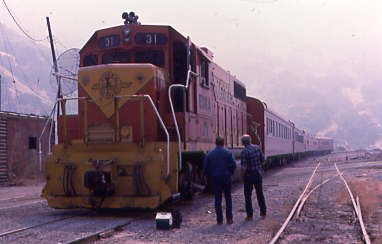
Our train at Island Mountain.
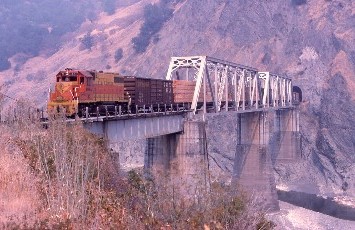
The freight would come exit from the 4,313.1 foot Tunnel 27 and onto the bridge.
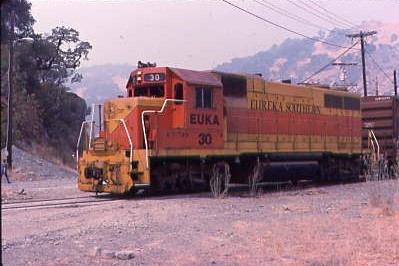
Eureka Southern GP38 30, ex. Conrail 7667 1984, nee Pennsylvania Reading Seashore Line 2007, built by Electro-Motive Division in 1969. It was retired in 1992 and became Dakota, Minnesota and Eastern 3800 in 1993.
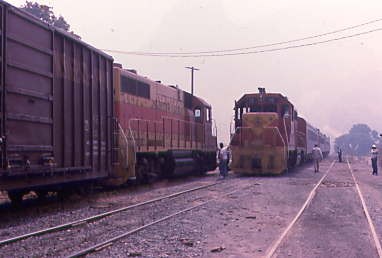
The trains meet before I reboarded the North Coast Daylight.
177 DaysTrains were not the only commodity to use Tunnel 27. A huge flood occurred during the week of Christmas 1964 when a 100-year flood of over 50 inches of rain destroyed the bridge and sent water through the tunnel, which was about 84 feet above the river, as the water rose above the tunnel entrance. The torrent of water carrying logs inflected damage all along the route and there were airborne rails throughout the canyon. 100 miles of rail were swept away by the waters of the Eel River and one-third of the Northwestern Pacific would need to be rebuilt. The Island Mountain bridge lost two trusses, a span girdle and a pier, the Cain Rock Bridge was severely damaged and the South Fork bridge lost two truss spans and a pier.
A call went out to Morrison-Knudsen to rebuild the line and machines were taken from projects from all over the West to be brought in to rebuild the railroad through the Eel River Canyon. Thirty miles of new access road had to be built so smaller machines could reach the job sites. When built in 1915, it took four years to build the 106 miles through the canyon. The workers in 1964/5 just needed 177 days to rebuild the line and on June 16th, 1965, the Northwestern Pacific reopened for business.
Back to 1987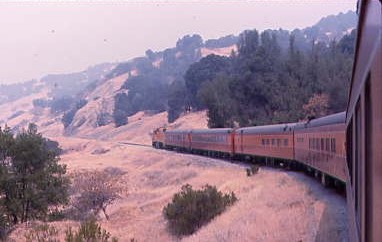
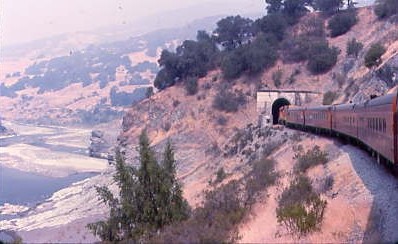
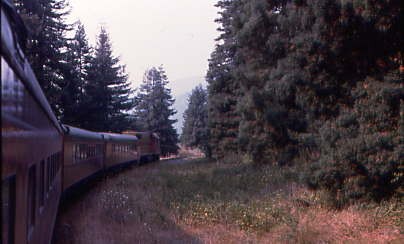
Once everyone was aboard, we had our turn going over the bridge and through the longest tunnel on the railroad. A few minutes after the time in the darkness of the 413.1 foot Tunnel 27, the passage through Tunnel 28 just seemed like a blink of your eyes at only 263.8 feet. We passed through Kekawaka before plunging into Tunnel 29 and four miles later, crossed Haman Gulch before arriving at Cain Rock then passed the Golden Spike location at MP 206.4, where the Northwestern Pacific was completed on October 23, 1914.
We crossed the Eel River on the Cain Rock Bridge then rounded a large curve at Alderpoint, a small community located on the bluff above the tracks and passed through Tunnel 30 before Steelhead. That was followed by Tunnel 31 prior to Fort Seward, where the station building still stood, and we stopped to load the boxed lunches, then crossed over Brock Creek, travelled by Eel Rock and into Tunnel 34 to reach Smith. Tunnels 35 and 36 were next, then the locations of Morani, Sequoia and McCann were journeyed though as we were dwarfed by the redwood trees. We went through Camp Grant before reaching South Fork, where we traversed the Eel River on a long three-span truss bridge. About four miles later, we crossed Larabee Creek and Bridge Creek before plunging through Tunnel 37 to reach Shively.
Tunnel 38 was next then we passed the former locations of Camp Nine and Elinor, ducking under Highway 101 before we reached Scotia, where Eureka Southern GP38 33 rested with a local for next week. We passed along the company town of the Pacific Lumber Company that operates a railroad on its grounds, ducked once more under Highway 101, crossing Nanning Creek before slowing for the passage along the Scotia Bluffs, the maintenance headache on the entire railroad due to the soft nature of the soil which was apt to slide at any time. The train cautiously made its way along the bluff and we passed the location of Stone, with Rio Dell across the Eel River and went by the location of the historic town of Metropolitan before arriving at Alton, where the Carlotta Branch took off.
Our route took us through Rohnerville and Fortuna, whose railroad depot was a museum, followed by Fernbridge and Loleta before going through the 1,946.7 foot long Tunnel 40, the last one, and passing Table Bluff and the south end of Humboldt Bay. We ran through Beatrice, South Bay and Bucksport before entering Eureka and stopping at the Old Town Station at 1st and F Streets, thus ending a very interesting journey.
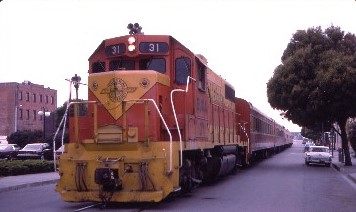
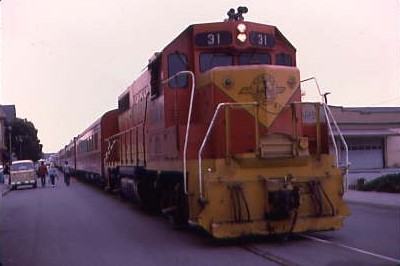
We all detrained then Jeff and I walked to the Comfort Inn for the night, had dinner and returned to the hotel.
9/6/1987 We returned to the train and had a very relaxing trip back to Willits, where I enjoyed the early morning along Humboldt Bay and Eel River.
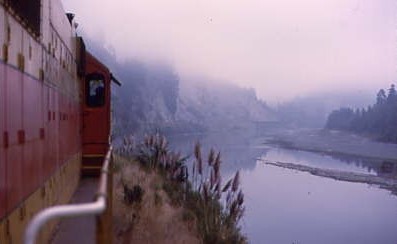
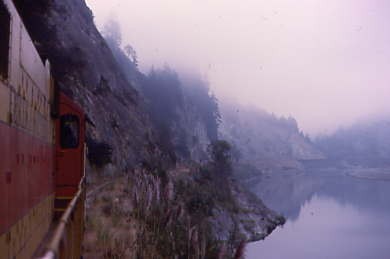
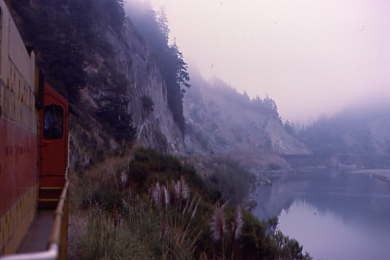
Later we slowly passed the very unstable Scotia Bluff.
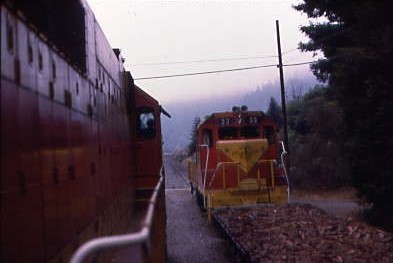
At Scotia, Eureka Southern GP38 33 was on a log train.
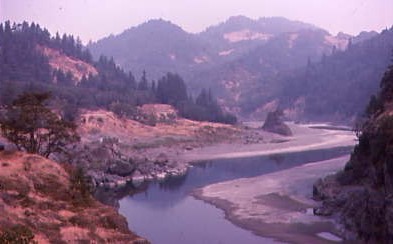
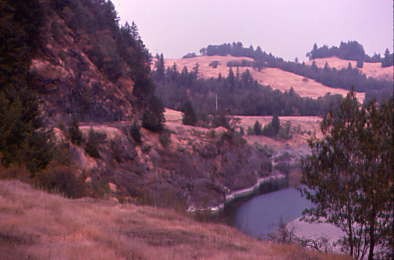
Between Scotia and Fort Seward.
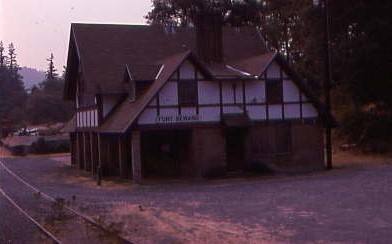
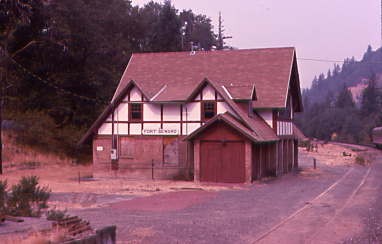
Northwestern Pacific station in Fort Seward. The area which became Fort Seward was originally established by the United States military and a fort was established in 1861. However, it was quickly abandoned due to the difficulty of sending consistent supply trains from Fort Humboldt. Once the Fort was abandoned, many ranchers moved to this area and a small community was established. The depot is one of the few on the NWP which survived the catastrophic 1964 Christmas Flood and the station was only one of the two stops for passengers in the Eel River Canyon. In the early 1920's, it served as an early-day resort hotel and later was used as one of the two cookhouses.
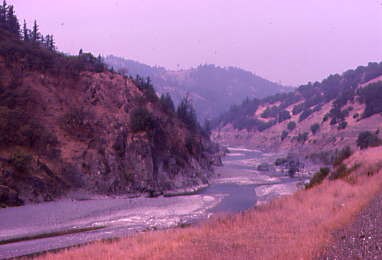
Eel River Canyon.
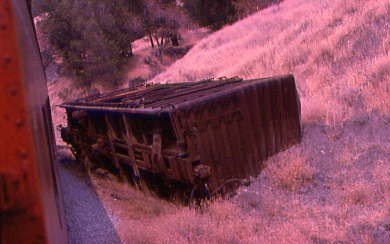
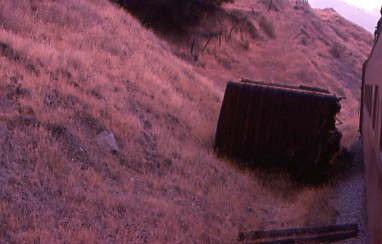
A derailed box car.
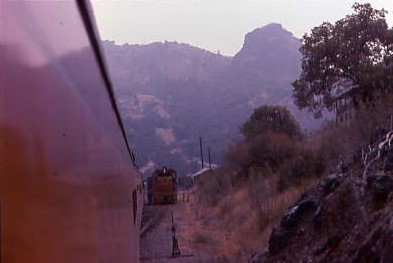
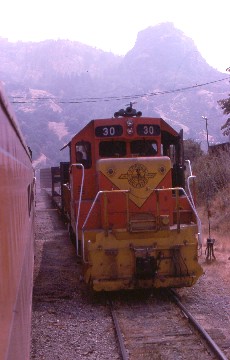
We passed the northbound freight at Island Mountain.
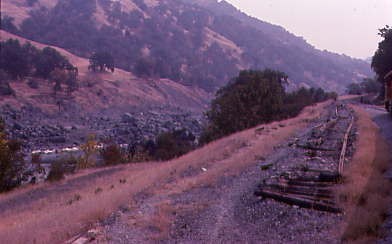
A derailment scene where a shoofly was built around the spot.
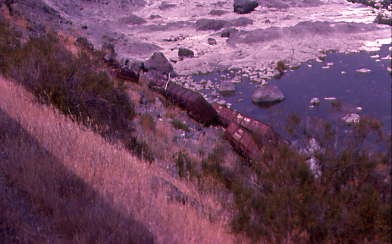
Derailed cars left along the bank of the Eel River.
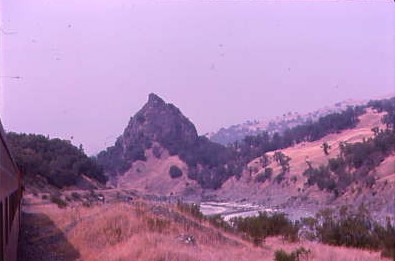
Spyrock, the 540 foot conical rock towering over the Eel River's eastern shore, surrounded by the 5,832 acre Spyrock Reserve, which has five miles of frontage on the National Wild and Scenic Eel River. The habitat is a mosaic of white oak, live oak, maple and bay laurel woodlands, grasslands and clustered stands of fir. From classic white oak savanna, dramatic rock outcroppings, and two year-round creeks roams abundant wildlife including deer, bears, mountain lions and bobcats. Bald eagles, osprey and Pacific pond turtles can be seen along the river. Anadromous fish species include Chinook and the endangered Coho salmon as well as steelhead trout. Spyrock is the first acquisition of The Wildlands Conservancy's Eel River Emerald Necklace which envisions a system of preserves stretching 110 miles from Spyrock Reserve to the Eel River Estuary Preserve, each spaced within a day’s kayak trip apart.
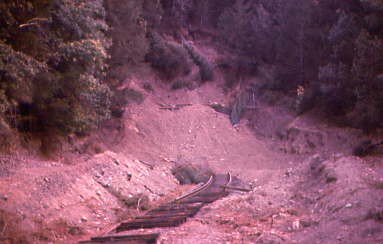
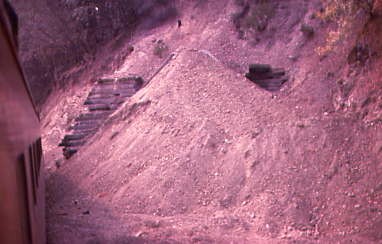
Tunnel 11 had caught fire so had to be extinguished by bulldozing both ends to cut off the flow of fresh air and the railroad then built a shoofly around the tunnel. We made our way back to Willits, ending a historic ride aboard the North Coast Daylight.
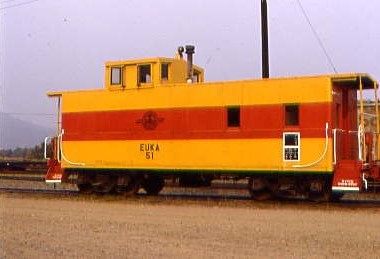
Eureka Southern caboose 51, nee Southern Pacific 1101, built by the railroad in 1942. It was privately-owned and in 1995, went to the Pacific Locomotive Association/Niles Canyon Railway for restoration. As of 2022, it has been restored to represent the 1954 timeframe when the toilet was moved and berths removed.
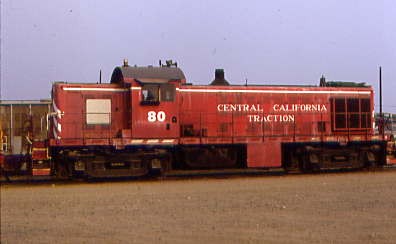
Central California Traction RS-1 80.
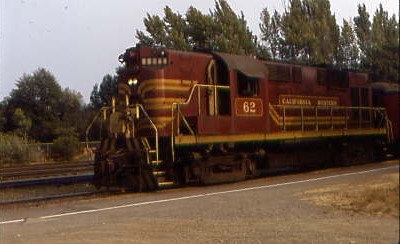
The California Western Skunk train arrived led by California Western RS-11 62, ex. Southern Pacific 2919, nee Southern Pacific 5854, built by American Locomotive Company in 1959. Since about 2008 (no later), it has been working on the Napa Valley Railroad as their 62.
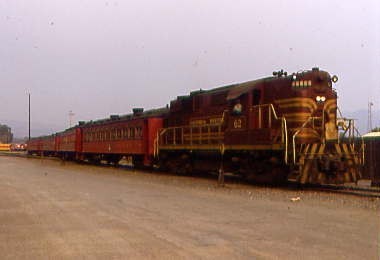
The Skunk train was put away for the night.
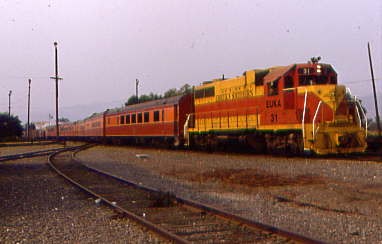
Next the Eureka Southern train was stored until next weekend. Jeff and I stayed the night.
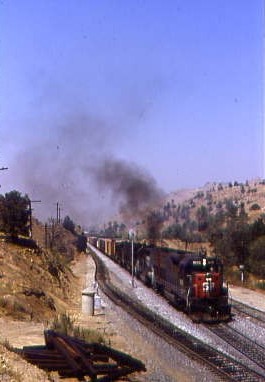
We returned home via Tehachapi and caught Southern Pacific 9256 East at Woodford. I will always have great memories of the Eureka Southern.
| RETURN TO THE MAIN PAGE |