




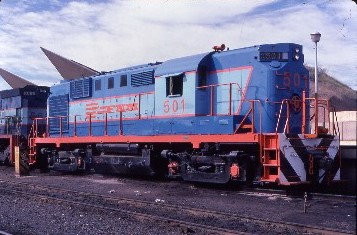
After reading an article in the January 1987 edition of Pacific Rail News and seeing Pentrex's Best Of 1987, I decided I wanted to go to Nacozari, Mexico. Let's Travel Tours of Riverside sponsored a trip in September 1988 and booked space for my father and I.
Destination Nacozari Information and HistoryNacozari is the terminus of a 75 mile branch line, operating south from the United States border city of Douglas, Arizona. Built as the independent Nacozari Railroad in 1904, it later became part of the vast Southern Pacific empire which had been operating nearby trackage, expanding west from Naco, along the United States-Mexican border through Cananea to Nogales, a major Mexican city 64 miles south of Tucson.
These branch lines have a colourful history, dating back to 1882, when the Santa Fe Railway, as owner of the Sonora Railway, started construction in the state of Sonora to reach the seaport city of Guyamas. However, it soon became apparent that the region was rich in copper, gold, silver and manganese which would need rail transportation to reach the industrialized cities of North America. Other companies, such as the Cananea Consolidated Copper Company and the Cananea Rio Yaqui y Pacifico soon entered the picture. Even the Douglas family interest of the El Paso and Southwestern had a hand in the development of these roads.
Generally thought of as an arid zone, the "high desert" country of northern sonora comes as a pleasant surprise to the first time visitor. One finds rolling hills and open grassland at times, the railroad follows well- watered valleys and canyons with a mixture of scrub oak and deciduous vegetation. In the higher elevations, conifers are found. Along the stream courses, larger trees line the railroad right-of-way, with branches hanging low and sweeping the tops of passing trains. Summer is the rainy season, so by September, the landscape is usually verdant with many wild flowers. When you consider that elevations of 5,265 feet are reached via grades of three percent and maximum curvature of 11.29 degrees, it hardly merits the term desert.
In 1986, when we approached the Pacifico Railway about running over this route, they could not believe that we would be able to sell a train through t his region, and to some degree, this was the question from those who received our brief announcement of the trip. However, those 120 passengers who did sign up came back raving with positive comments on how much fun and enjoyment the weekend had brought.
Our friends south of the border will again assemble a special train, consisting of three wide window, air-conditioned, reclining-seat chair cars, one open window coach and a caboose. It is not a luxury "Orient Express' tour, nor is it priced that way, but if you are looking for an unusual weekend away from the daily routine, then you should review the itinerary and plan to come along with us to Nacozari!
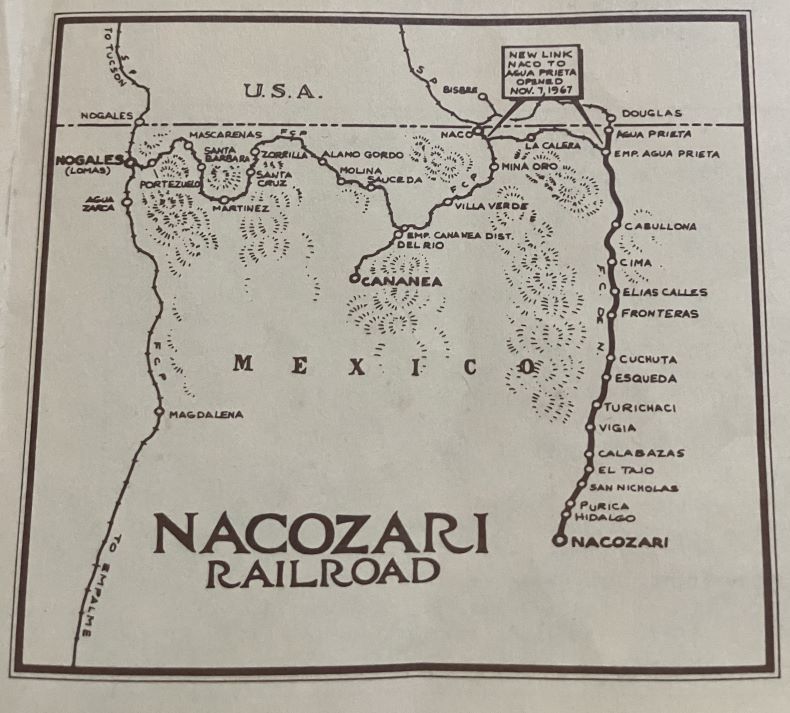
The excursion map.
The above taken from "Destination Nacozari" foldout brochure published by Let's Travel Tours9/22/1988 We drove to Tucson, Arizona, following the Southern Pacific main line from Yuma east.
9/23/1988 We spent the night at the Rodeway Inn-Benson Highway and following a group breakfast, we were driven in a bus down Interstate 19. Our luggage would never travel inside Mexico as it was taken straight to Motel 6 in Douglas and placed in our rooms awaiting our arrival since we returned to Douglas each day. Meanwhile all the passengers with their camera equipment went to Nogales, Arizona, where we crossed the Mexican border into Nogales, Sonora with its narrow streets and numerous shops. We were taken straight to the station but our train had not yet been made so this allowed me time to walk over to the Pacifico's engine shop.
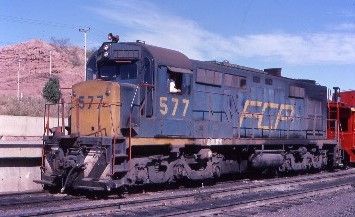
Ferrocarril Del Pacifico BX620 577, nee Ferrocarril Del Pacifico RSD5 808 built by American Locomotive Company in 1953. The five photographers and I were asked by a Mexican railroad worker if we would like to go for a short ride while they made up our train. We all gladly accepted and were pulled down the yard tracks then switched onto the main line and coupled onto our waiting train, which consisted of RS-11 501 , wooden open window coach, two Primera Japanese-made coaches, an open window steel sided coach, another open window wooden coach and an Ferrocarril Del Pacifico caboose.
With everyone aboard, the train departed proceeding towards the border then turning east on the south leg of a wye and travelling up a ravine with houses and shacks on its side and quickly left Nogales behind. We travelled through some green hills with oak trees abounding then the countryside opened up into a short valley where there were ranches. The valley narrowed to the point where our train crossed the Santa Cruz River on a brand new bridge and it was announced that we would hold our first photo runby of the day here.
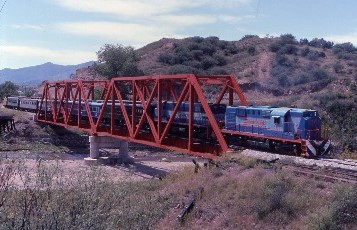
After detraining and choosing our spots, the train reversed out of sight and came past us as our cameras caught the action. We reboarded the train and I decided to ride on the rear steps of the caboose for about an hour then enjoyed a Tecate Beer with my lunch and taking the occasional picture. The valley opened up with scrub bushes and rugged mountains in the distance and apart from the Spanish lettering on the caboose steps, there was no evidence I was in Mexico. We passed through the town of Santa Cruz and afterwards, went by a small reservoir making a nice little lake in the green countryside. I then made my way through the train and out onto the front of the locomotive. On any Let's Travel Tours excursions, all part of the train were able to be ridden, except the engineer's seat, so I enjoyed the open air until Del Rio, our next photo runby location.
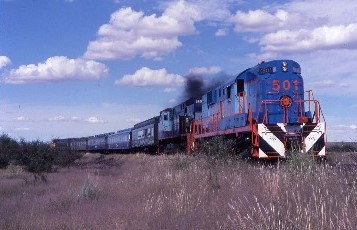
I climbed off the locomotive which put me at the rear of the photo line, so walked away from the train and found there was not only better lighting but the plants would hide the other photographers. Two other people joined me then agreed to stand by me as the photo runby commenced.
Del Rio was the junction of the branch line to the mining town of Cananea. The line was almost perfectly straight and after a twenty minute climb, we came to the literal end of the line at Cananea. The train crew, all railroad employees, were then posed on the front of the engine for a group picture then we had twenty minutes to look around town and I explored the stone depot. Once the train's horn blew, signalling the need for our return, the train was wyed so we could continue our eastward trek and retraced the path back to Del Rio and rounded the eastward leg of the wye to begin our run for Naco and today's destination of Aqua Prieta.
We crossed the treeless hills covered with low grasses and mountains off in the distance; those to the north were in the United States. We proceeded north and fast approached the town of Naco. The tracks used to go up into the United States and trains went east on the Southern Pacific's Douglas Branch then crossed back into Mexico at Aqua Prieta before continuing south to Nacozari. On November 7th, 1967, a new line was completed between Naco and Aqua Prieta, thereby keeping the entire operations within Mexico.
At Naco, the former line through town was visible and we passed the former station with its trainorder signal still standing as we turned to the east, travelling down the new line and keeping us in Mexico. Across the border was Bisbee, Arizona with its copper industry remnants of a smoke stack. Climbing out of the valley, the line was straight before we descended into the valley with Aqua Prieta. We approached the town's junction before reversing into town, stopping two blocks from the International border then detrained and walked to the border. Since so few people cross here, everyone was asked just one question, that being our citizenship. When all answered that it was the United States, we were bid a good evening and my father and I walked through Douglas, past the large El Paso and Southwestern depot and under the railroad bridge to Motel 6. We obtained the key to our room and found our luggage inside. I went to McDonald's for Chicken McNuggets before calling it a night.
9/24/1988 Saturday morning was sunny and cool and started by visiting to McDonald's for hot cakes and sausage. We retraced our path from last night and walked back into Mexico, immediately noticing the differences of paved streets in America and dirt roads in Mexico. At the small train yard I walked into a coach used on the mixed train which smelled so horrible I had to make a rapid escape into the fresh Sonoran air. I bought a one-way ticket to Nogales for a dollar as a souvenir of this trip then the rest of the group arrived and we were off for Nacozari.
Our train today had an extra locomotive, National Railways of Mexico U23B 9110, so that the point of our train would always have a cab unit. We proceeded out of town, passed through Aqua Prieta Junction and met cows out on the track in the open range lands then went up the long valley away from Aqua Prieta and passed through a little open canyon before the valley opened up again.
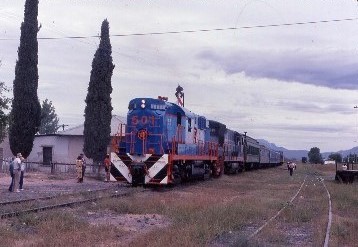
We came to the town of Fronteras where a static photo stop was made with the train order board and depot, while our crew went into the station to acquire their new orders since this was track warrant control territory. Once on the move again, we continued south for another twenty minutes for another photo runby with the train crossing a nice wooden bridge. On this trip, there were no public address announcements and all information was conveyed by word of mouth and I heard we would meet Mixed Train 12 at Turichaci, so I walked up to the front of the train through two locomotives and out onto the lead unit's front walkway.
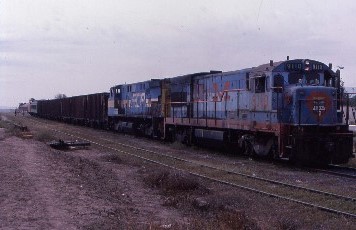
We travelled for about twenty minutes and at Turichaci, I saw a headlight approaching far down the main line. We pulled up to the switch and detrained past the point where our train would stop in the siding and photographed Mixed Train 12 with a combination of a U23-B and M420W for power, eighteen cars of freight, one coach and caboose, then I caught that train passing our special train. Once aboard and on the mainline again, we started our final climb, twisting and turning to gain elevation before arriving at today's destination of Nacozari.
Nacozari 9/24/1988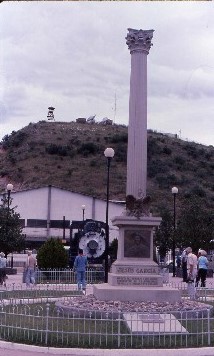
I detrained and walked into town searching for a small steam locomotive and monument to Jesus Cruz, the Casey Jones of Mexico, a national hero of this country. He worked for the railroad and one day when a car of dynamite caught fire, he took his locomotive, coupled it to the car and took it out of the area, saving the town of Nacozari. Unfortunately, the dynamite exploded before he could uncouple the car and thus Jesus Cruz was blown up along with his locomotive.
The steam engine is Nacional de Mexico 2-8-0 69, nee Interoceanic Railway of Mexico 501 built by American Locomotive Company. When a local saw me trying to read the Spanish plaque, he translated it into English for me. I noted how the town was against the mountains on three sides with narrow side streets and while there was not a lot of automobile traffic, many people were walking. It was a rather clean town and I was most impressed with the friendliness and caring nature of the people I met.
The Train BackI walked back to the train about twenty minutes early and when everyone was accounted for, we started to Aqua Prieta and I decided to ride the front of the locomotive so went to the front end. We descended down through the canyons and valleys and by Fronteras, the sun was setting so the rest of the journey was in the dark with a sky full of stars only, being blocked by the occasional high clouds. We made really good time and when I saw the lights of Aqua Prieta, I returned to the coach and found my father. Upon arrival, we were not asked any questions coming back into the United States and walked back to the Motel 6 after a great day of train riding and a visit to the neat Mexican town called Nacozari. I fell into a delightful slumber.
9/25/1988
It had rained through the night and we walked to the town hall for a pancake breakfast, arriving early, then crossed the border and beat the rain shower back to the train. It was raining quite hard so by departure time, many of our group arrived somewhat wet. We had added another locomotive to the point of our consist, a M-420W, so now we had three locomotives for a five-car train. The talk of the morning was that sometime today, the newly-rebuilt former Delaware and Hudson, originally Santa Fe PA 19, built by American Locomotive Company would be added as well. In North America, there were only four of these locomotives left. Number 17 was in the National Museum in Puebla, and 16 and 18 were in the dead line at Empalme, with 19 was just restored to operating condition. I hoped the talk was true as I always wanted to ride behind one of these locomotives.
It was back to reality as we reversed to Aqua Prieta Junction and started the ride towards Naco. It was raining but that did not stop me riding in that Montreal Locomotive Works-built locomotive so I walked quickly in and around the other locomotives reaching the M-420W's rather roomy cab. We were to have a photo runby at Naco if it stopped raining and as if on cue, it did upon our arrival so the passengers photographed the train rounding the curve then we continued to Del Rio. We crossed the highway with people out of their cars waving at the train then returned to the green hills, stopping just short of a little bridge for another runby, which was done in quick fashion and I was back on the front pilot of the train as the day was finally warming up.
We passed through Del Rio, stopped at Santa Cruz for new train orders and learned we would have the PA added to our consist outside Nogales, which had been sent up from Empalme on the first class train and was making its first trip since returning to service. Everyone was counting the kilometer posts to Nogales awaiting the big moment then when we were almost into the town, I spotted the rear of a cab unit and there it was, the PA waiting just for us. We proceeded up to it and almost everyone detrained to photograph it.
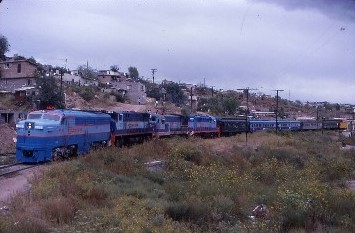
A dream had now come true and I saved an entire roll of film for this. A runby was planned with it on the point of our train so everyone found their spot and I choose a vantage point with perfect light. As the now four-unit, five- car train approached, everyone's attention was on the lead unit and a lot of Kodachrome film was used. With the photography and runby over, now it was time to live out the dream of riding behind a PA and for the last few miles into Nogales, that is exactly what we did. Arriving in Nogales, we took a quick tour of the locomotive's cab, thus bringing 1988's Destination Nacozari trip to a close in perfect fashion.
Homeward BoundWe boarded buses back to Tucson and crossed the border with the Customs agent just looking at us, then we sped on Interstate 19 back to Tucson. After collecting our bags and starting the drive home, we stopped at Casa Grande for dinner and I drove most of the rest of the way. We arrived in Santa Ana at 3:30 AM and I was up ready at 6:00 AM for work at MacArthur Fundamental Intermediate after a great trip by Let's Travel Tours, Bill Farmer Ed Van Nordeck.
| RETURN TO THE MAIN PAGE |