



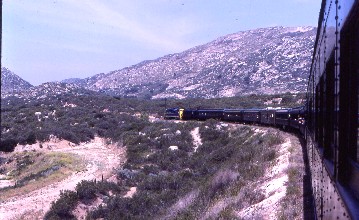
I had bought "San Diego and Arizona, The Impossible Railroad" by Robert M. Hanfts when I saw it in the stores for the first time and dreamt of riding it. With Tropical Storm Kathleen destroying the east end of the line, Southern Pacific sold it to Metropolitan Transit System, who used the San Diego-to-San Ysidro portion for their popular trolley service. The line through the Carrizo Gorge was reopened and Kyle Railways operated it until a bridge and tunnel fire in the gorge closed the line again. The City of San Diego found a shortline operator, the San Diego and Imperial Valley, to handle the limited freight operations. In 1983, the Pacific Southwest Railroad Museum moved their collection to Campo and established a museum site there, with most of their equipment moved in what was called the "Great Freight."
I was hearing rumours of another excursion to Puerto Penasco, Mexico and a Campo-to-San Diego trip for a railfair to be organized the museum. I joined the society and a week later, received a flyer in the mail about the trip. I called my friend Jeff Hartmann and he wanted to go, then told my parents about it and so had a group of four. On April 30th, 1988, we drove to San Diego and parked at the Santa Fe depot then rode a bus to Campo to board the train back to San Diego. I was about to ride the entire length of the Tijuana and Tecate in Mexico, a division of the Sonora Baja California Railroad, so this would provide me the entire mileage.
Our train was made up of six former Lackawanna electric coaches, a 1942 US Army kitchen car with portable bathrooms in the middle of the consist. At the front was "Robert Peary", a 1926 Pullman business car being used by a private party and on the rear, a Santa Fe café-observation Car with an open platform open to all. On the point was San Diego and Imperial Valley's GP7 2151 and the museum's MRS-1 1809. We departed Campo on time as Jeff and I explored the train, then entered a narrow canyon to the west, crossed Campo Creek and passed through the first of four tunnels, this one taking us under the International border with Mexico and bursting out into Mexican daylight.
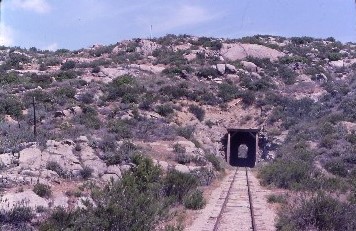
The former station of Lindero was passed before we entered tunnel three and three-and-a-half, where the center of the tunnel collapsed from a fire in 1933, thereby creating two tunnels. There were now had kilometer posts since we left the mileposts back in the United States. We entered the valley of Tecate Creek and followed it down to Tecate with its famous brewery and had our only scheduled stop so that the mayor could have his picture taken on the front of the train. The town's station still looked nice with the Tecate Beer Plant behind, although people on this train could only look at the brewery because there was no beer nor liquor allowed on our train. Upon our departure, we following the creek west, before crossing it at The Door (the narrows), then passed the former station site of La Puerta. As I gazed at the scenery, there was no clue that we were actually in Mexico and it could have been anywhere in rural California.
As we crossed the main Tijuana-Tecate Highway, a group in a car with Baja Norte plates pulled along the tracks and were shouting at us in Spanish. We then reached the point where we had to negotiate two balloon curves to descend off the mountain; the first was an eight degree curve with a 255 degree center angle and looking out, you could easily see both ends of the train and many photographs were taken.
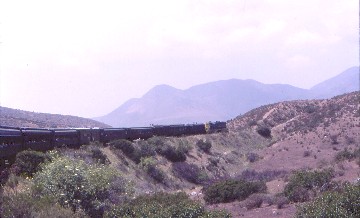
This balloon curve has only twice had a SD&AE train on it long enough to see its caboose. I was very impressed by it and tried to imagine how the designers built this railroad and had the idea for these curves. We were now on the middle level descending northeast, passing the former station site of Loma before coming to the six degree, 180 degree center angle that brought us to the valley with San Ysidro Creek. I looked back at the mountain we came down and felt amazed by the whole experience.
We passed through Redondo in a very nice valley, passed the former Eduardo station and the ranch of former Mexican President Lázaro Cárdenas. We continued west going by the Matanuca spur before the valley narrowed into a steep canyon and we entered tunnel two.
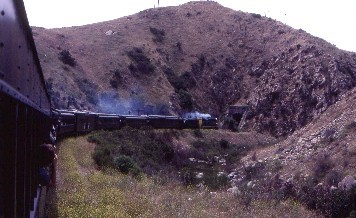
We then crossed San Ysidro Creek.

Off to the left was Rodriguez Dam, a very impressive structure blocking the flow of the Tijuana River. We proceeded on a ledge high above the river before we crossed it on a very high bridge and passed Garcia, which was the beginning of the greater Tijuana area and a variety of homes could be seen from really nice hacienda-style to anything in-between to squatter shacks. This was first trip to Tijuana and it was fitting that I was doing it by train. We passed the few industries that still shipped by rail, mainly a cement plant, went by the former station site of Arguello then passed through Aqua Caliente where the greyhounds once raced. Our route then took us through Tijuana proper, where all the locals were out waving at us or giving us peace signs. We crossed the Tijuana River on a new bridge that replaced the one Hurricane Kathleen washed out then as we approached the United States border, more squatter's shacks were all over the hillside. We passed the former Tijuana station and proceeded through the border gate, bringing to an end the Tijuana and Tecate kilometer posts.
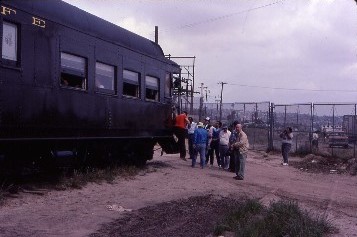
Once back inside the United States, the gate was closed behind us and the train stopped then after a few minutes, a United States Customs agent boarded and ordered everyone off the train but to leave all possessions on the train. We did just that and stood in a large dirt area surrounded by the agents then watched as some illegal aliens tried to run for freedom but were caught to be taken back, where they would undoubtedly try again. After about five minutes, a van arrived and out came the drug-sniffing dogs who were taken inside our train. As we reboarded, we were asked what our nationality was and the line moved quickly, then we made our way north towards San Diego.
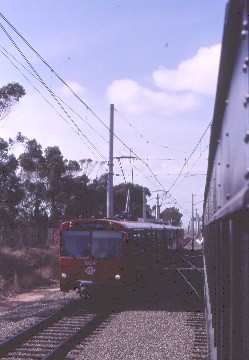
We proceeded through the San Ysidro freight yards and down to the junction with the trolley line and waited for a northbound trolley to pass before we entered with our eleven-car passenger train. The looks we received from people waiting for their trolley and seeing our train was unbelievable then when their shock wore off, everyone was waving at our train with smiles as we were bringing a lot of joy to them. The ride under the wire was quick and all too soon we arrived at the junction to switch off the trolley route and into the SD&IV yard, which we proceeded through, passed the Trolley's maintenance buildings and shops before stopping at the Gaslamp District of San Diego, ending a great day of train riding across the International border twice.
Now that I had ridden the west end of the line from Campo, I still dreamt of riding the east end from Campo through the Carrizo Gorge. Maybe in the future, this impossible railroad will make what now seems impossible, possible.
| RETURN TO THE MAIN PAGE |