



Railfair 1991 in Sacramento meant that three large re-positioning moves would occur to bring the steam locomotives to the event, namely Southern Pacific 4449, Santa Fe 3751 and Union Pacific 8444 and 3985. Southern Pacific 4449 would travel from its home in Portland, Oregon, pulling an all-Daylight consist on a two-day trip. While I had tickets for Santa Fe 3751's excursion from Barstow to Bakersfield over the Tehachapi Loop, it did not happen because the engine was not finished its restoration; that trip occurred in December. The double-headed Union Pacific steam excursion from Portola to Sacramento, jointly operated by the Central Coast Chapter of the National Railway Historical Society and the Feather River Rail Society was a one-way trip and I bought my ticket through the latter group as I was a member. My ticket included a bus trip from the Sacramento Amtrak station to the Holiday Inn in Sparks, the next morning a bus to Portola, the journey through the Feather River Canyon and the Sacramento Valley to the former Western Pacific yard in South Sacramento and a return bus to Amtrak.
I planned my trip to and from Sacramento on Amtrak with a one night stay at the Travelodge six blocks from the station.
4/26/1991 My father drove me to the Amtrak station very early in the morning to wait for the Thruway bus to Bakersfield and the connecting San Joaquin train for points north. The bus arrived about thirty minutes late and I boarded and slept for most of the drive to Bakersfield to the waiting San Joaquin Train 711, an all-Horizon consist, which I rode to Stockton. On the train, I met several other people who were also riding the excursion and we all detrained to board buses to Sacramento, where I had time there to walk over to Old Sacramento to see the preparations for Railfair 1991.
Back at the depot, several of my new friends decided on the spot to take the California Zephyr to Reno and after thinking about it for a few minutes, realized that the bus would beat the train to Sparks and it would save me some money, so I declined. The bus arrived and those choosing that mode boarded for the journey over Donner Pass to Sparks. We stopped at Truckee where everyone took advantage of visiting the Southern Pacific station then continued on our way and upon our arrival, checked in to the hotel and we were on our own until breakfast the next morning. I had an early dinner then walked over to where the Amtrak trains stops in the yard, gambled a bit in the casino, winning enough to cover what I spent on dinner then enjoyed the view before calling it an early night as I had a 5:00 AM wake-up call to start a dream come true, to ride a train down the former Western Pacific's Feather River Route.
Railroad History in the Feather River CanyonIn 1820 Spanish explorer Don Luis Arguello found a river flowing in solitude through deep gorges and named it El Rio de Las Plumas (the River of the Feathers) for the many feathers floating in the river from molting wild pigeons. In 1850, scout Jim Beckwourth discovered Beckwourth Pass, 2,000 feet lower than popular Donner Pass then being used by wagon trains. Arthur Keddie, a young Scottish surveyor, came to California in the early 1860's and set up shop at Quincy, county seat of Plumas County. Keddie explored the North Fork of the Feather for the newly-organized Oroville & Beckwourth Pass Wagon Road Company. A pass near Spring Garden Ranch between the Middle Fork of the Feather and Spanish Creek, a tributary of the North Fork, would make a natural railroad route through the canyon.
The Middle Fork canyon became impossibly steep below this point and the North Fork was almost as bad above it, so this low divide offered a means of utilizing the best part of both canyons. Keddie tried to persuade the builders of the Central Pacific Rail Road to build through the Feather River Canyon, promising an easy grade of 1.5 percent and a route relatively free of snow. The Central Pacific dismissed the route and stuck with the line over Donner Pass with its maximum grade of 2.5 percent and miles of snow sheds.
Keddie continued to promote construction of a railroad through the Feather River Canyon. In April 1867, the Oroville & Virginia City Railroad started construction near Oroville but failed to raise sufficient capital and could not get government support. In 1889, the Union Pacific showed interest in the route and sent Chief Engineer Virgil c. Bogue west to explore it. Nothing further was done on this venture. In 1892 the San Francisco & Great Salt Lake Railroad staked out a route through the canyon but, like its predecessor, failed to raise enough money.
In the East, financier and speculator Jay Gould controlled a railroad empire that stretched from Buffalo, New York to Ogden, Utah. Gould had acquired the Denver & Rio Grande Railroad and Missouri Pacific. At the time, Central Pacific divided traffic at Ogden evenly between Union Pacific and D&RG. However events were about to happen that would change the transcontinental railroad picture. In 1900, financier Edward H. Harriman gained control of Union Pacific and Central Pacific, effectively shutting out the D&RG at Ogden. George Gould, flamboyant heir to Jay Gould's empire, was not about to be bottled up at Ogden. George Gould considered building a railroad from Ogden to Los Angeles but was again shut out when Harriman acquired control of the Los Angeles & Salt Lake Railroad. Gould next turned his attention to building a new railroad west from Salt Lake City to San Francisco using the Feather River route.
In 1902, shortline promoter Walter J. Bartnett incorporated the Stockton & Beckwith (sic) Pass Railroad, using Keddie's 1892 SF&GSL survey. Gould and Bartnett joined forces and on March 6, 1903, the Western Pacific Railway Company was incorporated to build west from Salt Lake City to Oakland. Grading started in November 1905. Between Oakland and Oroville, the work was done by contractors E.B. and A.L. Stone; between Oroville and Salt Lake City by Utah Construction Company. Plans called for the Western Pacific to be ready for business by September 1, 1908. The first spikes were driven on January 2, 1906 in Oakland and on May 5, 1906 at Salt Lake City.
For much of the distance through the Feather River Canyon, not even a footpath was handy. Surveyors hung suspended by cables over cliffs to set their line stakes. Small construction camps supplied by pack mules were used as bases for building a wagon road over which supplies and equipment for building the railroad could be hauled. On May 14, 1907 tracks reached the Utah-Nevada state line from Salt Lake City. On October 3, 1907, a connection was made with the Nevada Northern Railroad at Shafter. On November 9, 1908, regular operation from Salt Lake City to Shafter commenced. Just before Christmas 1908, trains were running to Elko.
The D&RG was providing the construction funds for WP and as fast as money became available, work was being pushed from both ends toward the middle. Progress was slow through the Feather River Canyon where the right-of-way was carved from the canyon walls. Many tunnels and bridges were required. The 7,343 foot Spring Garden Tunnel connecting the Middle and North Forks was the longest tunnel on the WP. Chilcoot Tunnel beneath Beckwourth Pass, at 6,002 feet, was the second longest on the railroad. At 4:05 pm on November 1, 1909, the rails were joined at Milepost 280.51 on the steel bridge across Spanish Creek near Keddie. The only spectators were a pair of local women and their little girls.
The WP was the last transcontinental railroad, just after Chicago, Milwaukee & St. Paul's extension to Tacoma, which was completed in May 1909. The WP stretched 924 miles from Oakland to Salt Lake City, plus three miles in San Francisco. The route was 150 miles longer than the competitive Central Pacific (now Southern Pacific) route to Ogden, but against the latter's steep grades, sharp curves, heavy snows and 7,017-foot elevation, the new railroad had maintained a one percent compensated grade with a maximum curvature of 10 degrees and crossed the Sierra at a 5,003 foot elevation. Along the line there were 41 steel bridges and 44 tunnels.
Through freight service was inaugurated on December 1, 1909. Prior to that there had been local freight service, largely between Salt Lake City and the Nevada Northern at Shafter. Regular passenger service was not started until August 22, 1910. In 1929 construction started on the 112 mile Inside Gateway line from Keddie north to Bieber to meet the Great Northern Railway that was building a line south out of Klamath Falls. On November 10, 1931, the gold spike was driven at Bieber.
On March 20, 1949, the streamlined, vista-domed California Zephyr started service between Oakland and Chicago over the Western Pacific, Denver & Rio Grande Western and Chicago, Burlington & Quincy. The train featured the scenic Feather River and Colorado Rockies on its itinerary. By the late 1960's, WP was sustaining heavy losses and applied to discontinue the train. The Interstate Commerce Commission held hearings on WP's petition and gave its approval. The last run of the California Zephyr was on March 22, 1970. Since then, the scenic vistas of the Feather River Canyon have been reserved for freight train crews and occasional detouring Amtrak trains and business trains operated by the railroad. On October 20, 1982 the ICC approved the merger of the Western Pacific and Missouri Pacific into the Union Pacific. On December 22, 1982, the UP assumed control of WP and MP.
Following the merger, the UP spent over $116 million during the following three years upgrading the former WP line between Salt Lake City and Oakland. 428 miles of new rail were laid, 920 miles of track resurfaced, seven tunnels were relined, eight mainline timber trestles were replaced with new steel structures and tunnel clearances were improved. Today the Feather River Canyon route of UP handles a wide variety of traffic between the Bay Area and Northern California to and from the midwest and east. Automobiles and auto parts, double-stack containers, coal, grain, perishables, rolled steel and coil steel, canned foods and chemicals are among the many commodities handled over the Feather River Route of UP.
The above from the April 1991 issue of "The Ferroequinologist", the monthly newsletter of the Central Coast Chapter of the National Railway Historical Society. Union Pacific 8444/3985 West 4/27/1991 The Canyon ExpressThe day started with a group breakfast then checking out of the hotel. It was clear and cold as I boarded the first bus to Portola which arrived in time for us to walk around the Feather River Railroad Museum where I saw the newly- arrived Simplot RS-32 4004 of Southern Pacific heritage from their plant in Don, Idaho, an old friend from my visits with my brother Bruce in Pocatello and Milwaukee Road U25B 5057. The museum had one of the greatest collections of preserved diesel locomotives anywhere in North America.
I then chose Union Pacific coach "Columbine" for the day and put my belongings on a large window seat on the right before going back outside. The consist was Union Pacific 4-8-4 8444, Union Pacific 4-6-6-4 3985, auxiliary water tender, Union Pacific C40-9W 9427, tool car 24336, crew car 904304, power car 206, crew car 202 "Cabarton", crew car 104 "North Platte", crew car 103 "Cheyenne", baggage car 5714 "Western Lodge", coach 5480 "Sunshine Special", coach 5483 "Texas Eagle", lounge 6203 "Sun Valley" coach 5473 "Portland Rose", diner 4808 "City of Los Angeles, coach 7001 "Columbine", dome coach 7015 "Challenger", museum car 5779 "Western Star, boiler-dormitory-baggage 208, business car 114 "Feather River", "Overland", dome 9004 "Harriman", sleeper 1610 "Portola" and observation-lounge 100 "Arden". A most impressive twenty-three car train. All passengers boarded but our departure was delayed as some of the cars needed to be watered.
Route GuidePortola MP 321: Once a bustling railroad town. An eight-stall roundhouse was built here in 1910. In 1923, four additional stalls were constructed and in 1925, the original 80 foot turntable was replaced with a 110 foot one. A large two-story depot and hotel building was built in 1910. In the early 1950's, a two-track, eight-unit capacity diesel house was built at Portola and in 1953, the roundhouse was retired and dismantled. In 1993, volunteers of the Feather River Rail Society started acquiring WP rolling stock. The Union Pacific donated the diesel house and 36 acres, which include a balloon track, for the Portola Railroad Museum. Today the museum houses the largest collection of historic diesel locomotives and operates trains during the summer. Leaving Portola, the railroad passes through Humbug Valley and crosses the Middle Fork of the Feather River before reaching Mabie.
Mabie MP 318.3: Once location of the first siding west of Portola. From Mabie the tracks pass through Tunnel 36 and cross the river on a through truss bridge.
Clio Viaduct MP 313.6: Tracks pass over the highest trestle on the former WP route. 172 feet below the trestle lies Willow Creek and the old roadbed of the narrow gauge Sierra Valley & Mohawk.
Blairsden MP 310.4: Trains are now passing through Mohawk Valley and a small resort community.
Two Rivers MP 305.4: The railroad is now passing through Long Valley with the Middle Fork of the Feather on the left.
Sloat MP 301.8: This is a small lumber settlement with the lumber mill providing the railroad with one of the few sources of freight revenue in the Feather River Canyon.
Spring Garden MP 296.6: Leaving Long Valley, the railroad plunges into the long 7,343-foot Tunnel 35. The tunnel allows the railroad to leave the Middle Fork of the Feather by crossing a low saddle in the mountain.
Williams Loops MP 294.38: Named after W.T. Williams who designed it to maintain a steady one percent grade. The loop is approximately one mile in circumference. Westbound, a train descends around the loop and then passes under itself (if it has 90 or more cars) in a concrete tunnel.
Quincy Junction MP 287.8: The railroad is now in American Valley. The three-mile-long Quincy Railroad, owned by Sierra Pacific Lumber Company, runs from the lumber mill in East Quincy to connect with the Union Pacific here. This line climbs out of American Valley on a 2.77 percent grade to reach the UP connection. The Quincy Railroad uses former Western Pacific S-1 504 (nee Sacramento Northern 405), now Quincy Railroad 4. It also has a General Electric 44 ton switcher, 3, held in reserve. Quincy Junction was named Hartwell from 1910 to 1914 when it was changed to Marston. It was renamed Quincy Junction in 1922. Leaving Quincy Junction, the railroad follows Spanish Creek to Keddie.
Keddie MP 281.5: This little resort community was named after Arthur Keddie. It was a crew change point and had a modest yard. Keddie is the junction with the Inside Gateway line running north to meet the Burlington Northern (former Great Northern) at Bieber. When the Inside Gateway, or High Line, was opened in 1931, a four-stall wood-frame corrugated iron-sheathed roundhouse with 120-foot turntable was installed. Today, Keddie serves as a marshalling area for maintenance-of-way crews and equipment.
Departing Keddie, the tracks cross the famous steel bridge over Spanish Creek where rails were joined on November 1, 1909. The right leg of the wye trestle was built in 1929-31 to connect the Inside Gateway line to Bieber. The third leg of the wye tunnels through the mountain to connect the Inside Gateway line with Keddie yard. After crossing the trestle, the tracks plunge into Tunnels 32 and 31, still following Spanish Creek.
Paxton MP 277.3 Located on a ledge above the canyon with the river hundreds of feet below, Paxton once was the junction with the Indian Valley Railroad, a 21-mile short line built in 1917 to the copper mine at Engel northeast of Paxton. The Indian Valley was abandoned on March 1, 1938. The Paxton depot was closed in 1939. Paxton was once a thriving community with a lodge. Spanish Creek and Indian Creek join here to form the East Branch of the North Fork of the Feather River.
Gray's Flat MP 272.6: Site of abandoned spur and logging mill. One mile beyond Gray's Flat tracks pass through Tunnel 26.
Virgilia MP 270.5: The approximate mid-point in the Canyon and site of the longest siding at 9, 810 feet, Virgilia also serves as a maintenance-of-way staging area. From Virgilia, the heavy growth of evergreen trees is left behind as the canyon walls turn to solid rock. The rails are perched high above the river entering Serpentine Canyon.
Rich Bar MP 264.6: Location of many rock slide detector fences. Just before reaching Rich Bar, the tracks pass through Tunnel 25. From Rich Bar, Tunnels 24 and 23 are encountered.
Belden MP 260.1: A small recreational community that sits across from State Route 70. A long, well-used siding is located here. Beyond Belden, the tracks pass through Tunnels 22 and 21. The canyon narrows at Rock Creek Reservoir where trains pass in quick succession through short, solid rock Tunnels 20, 19, 18, the so-called Honeymoon Tunnels and Tunnels 17 and 16.
Camp Rogers MP 255.6: Pacific Gas & Electric has a large maintenance base located here and the tracks pass Rock Creek Power Dam. One of the longest sidings in the lower canyon at 6,713 feet, is located here.
Tobin MP 253: The highway, State Route 70 and the railroad swap sides of the canyon. The 260 foot through truss railroad bridge crosses the river. Tobin is a small community that caters to fishermen and hunters. Three miles west of Tobin the tracks pass through Tunnel 15.
Rock Creek MP 248: The railroad crosses Rock Creek on a curved, open deck girder bridge.
Merline MP 247: Just after passing over Rock Creek trestle, the tracks pass Merlin, location of a 3,683 foot siding. Between Merlin and Cresta, tracks pass through Tunnels 14 and 13.
Cresta MP 243.5: In the 1940's, Pacific Gas & Electric Company built several dams and hydroelectric generating stations in the Feather River Canyon, one of which is located at Cresta. The railroad follows the river on a shelf carved from the granite base of Sugar Loaf Mountain.
Pulga MP 239.5: The highway and railroad again change places in the canyon as the railroad crosses the river on a large steel bridge, while high above State Route 70 crosses both the railroad and river. This is a favourite location for railroad photographers. Pulga is home for a small number of maintenance workers and the 6,091 foot long siding is a favourite place for dispatchers to stage meets between trains. Beyond Pulga, tracks traverse Tunnels 12, 11, 10 and 9.
Poe MP 234.9: In many ways, the lower canyon between Pulga and Poe is the most spectacular, with many areas having a shelf literally blasted out of the rock walls to hold the roadbed. This area is the most prone to slides and washouts in winter.
Intake MP 232: At Intake, the railroad leaves its original route to cross a 943 foot reinforced concrete structure spanning the North Fork of the Feather River. This marks the beginning of a 23 mile relocation opened in 1962. The railroad vacated its old route along the North Fork of the Feather River from Oroville to Intake when the State of California built Oroville Dam in the early 1960's which inundated the former right-of-way with the backed- up waters from the dam. This relocated line is four miles shorter than the original line. After crossing the North Fork Bridge, the railroad plunges into 8,856 foot Tunnel 8. Between Tunnels 8 and 7 lies Dark Canyon, a small patch of daylight spliced in the middle of two miles of tunnel. After passing through Tunnels 6 and 5, the railroad shares a 1,825 foot long bridge with Highway 70 as it crosses the West Branch of Lake Oroville. The highway is located on the upper deck.
James MP 226: The railroad ducks under Highway 70, curves right, then plunges into Tunnel 4. Emerging from the tunnel, the track continues to circle the base of a small mountain and again passes under Highway 70.
Elsey MP 220: A quarry provides car loads of crushed basalt. The railroad is now in the Sierra foothills as it descends toward Oroville. A 6,385 foot siding is located at Elsey. The tracks are now travelling along the back side of Table Mountain.
Kramm MP 213.9: Location of a 6,311 foot passing siding. This location overlooks Oroville and the Northern Sacramento Valley. Continuing around the base of Table Mountain, the tracks approach Oroville and cross the North Fork of the Feather River on a deck girder bridge.
Oroville Depot Mp 205.1: The one-story Mission style passenger depot was built in 1910. It served Western Pacific passengers until abandonment of passenger service in March 1970. The railroad then sold the depot to developers who currently operate a very fine restaurant and shops in this former railroad facility. Across from the depot, at Hewitt Park, former Western Pacific 0-6-0 164 is on display. This is one of only five former WP steam locomotives saved for posterity.
Oroville Yard MP 202.9: Once a major yard and crew change point with extensive facilities. In 1910, an eight-stall roundhouse was constructed here. In 1926, a 110 foot turntable replaced the 80 foot original unit. In 1937 and 1943, four additional stalls were added along with a shop area. Oroville served as Western Pacifies principal diesel service point until new facilities were opened at Stockton in 1969. The roundhouse has since burned down and much of the former yard area is being developed for industrial use. In 1986, Union Pacific eliminated through crew changes at Oroville and began running freight train crews through from Stockton to Portola. Oroville continues as a crew point for locals serving Marysville, Yuba City, and Oroville and Oroville-Bieber trains operating over the Inside Gateway route. On the WP, Oroville was the dividing point between the Second Subdivision (Stockton-Oroville) and the Third Subdivision (Oroville-Portola).
Departing from Oroville, trains can stretch their legs as they head down the speedway known as the Northern Sacramento Valley. Speed limit through the Feather River Canyon is limited to 25 miles per hour except from Portola to Sloat, which has a maximum speed limit of 30 mph. Most of the Oroville Dam relocation line from Intake to Oroville has a 45 miles per hour speed limit. Most of the line from Oroville to Sacramento has a 70 mph speed limit. As the tracks head south from Oroville to Sacramento, they pass through an agricultural area of orchards known for growing plums, pears, peaches, apricots and various other fruits. A large number of livestock ranches are also located in the Sacramento Valley.
Craig MP 193: A 6,249 foot passing track is located here.
Binney Junction MP 180.2: The trains slow to 30 miles per hour for this crossing of Southern Pacific's East Valley Line running from Roseville north to Oregon. A two-story frame tower was located here from 1911 to 1964.
Marysville MP 178.8: A one-story Mission style depot was built here in 1910 serving WP passenger trains until 1970. Empty in the 1970s, the depot was restored for use as an architectural office and is now a shelter for the homeless. An ice house and stockyards were also located here. Marysville is the junction with the former Sacramento Northern electric line to Yuba City, across the Feather River. SN electric freight motors worked the line until 1965. The present UP Yuba City Branch runs to Sutter.
Cleeland MP 175.6: Junction point with former SN line, now UP's 5.3 mile Pearson Branch.
Pleasant Grove MP 156.6: Typical Sacramento Valley town, once had frame combination freight and passenger depot until 1956. Now location of a 6,337 foot passing track.
Sankey MP 152.6: Former junction with Sacramento Northern mainline between Sacramento and Chico.
Del Paso MP 143.6: Tracks now entering the Sacramento suburbs; location of 6,234 foot siding.
Globe MP 140.7: Former junction point for Sacramento Northern branch.
Haggin MP 139.7: After crossing the American River, tracks pass under Southern Pacific mainline and pass a small yard at Haggin. Cars are interchanged between SP, UP and Central California Traction Company at this point.
Sacramento MP 138.6: After travelling through residential areas, the tracks pass the former WP Sacramento depot, a Mission-style structure built in 1909. Retired from railroad service, the depot now houses a very popular Old Spaghetti Factory restaurant.
South Sacramento MP 136.6: Location of WP's Jeffery Shops, the major locomotive shop until the new diesel shop at Stockton opened in 1969. Shops then handled WP system freight car maintenance and repair. Work transferred by UP in 1982 and shop buildings razed in mid-summer of 1986. UP still retains a yard and piggyback terminal at this location.
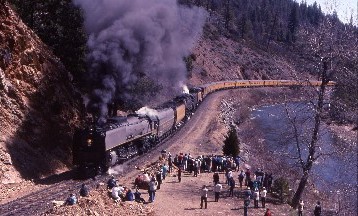
The above from the April 1991 issue of "The Ferroequinologist", the monthly newsletter of the Central Coast Chapter of the National Railway Historical Society.We departed Portola twenty-three minutes late but no one cared as the excitement of the trip was in all of us and I was starting to live a dream. We proceeded west past the museum and out into the valley to Mabie, before passing through the tight canyon then the canyon dropped below us and we crossed Willow Creek on the famous Clio Viaduct, 172 feet above the stream. We continued west to Blairsdan where the pacers in their cars were waiting for us on Highway 70. Along the Middle Fork of the Feather River, we travelled through Two Rivers to Sloat, where we met an eastbound Union Pacific freight train then proceed to Milepost MP 299.8, the site of our first photo runby of the day.
I climbed up onto a rock and was rewarded with a fantastic shot of the train as it steamed past the photographers. Once back on board, we went a few more miles along the Middle Fork before plunging into the Spring Garden tunnel and upon exiting, were back in the world of photographers and pacers. We passed through Spring Garden siding before making our way to the Williams Loop where hundreds of photographers were waiting and while we were to have a second runby after we circled the Williams Loop about two miles west, it was cancelled due to the amount of freight traffic on the line. We climbed high above the Quincy Valley and went through Quincy Junction, where the Quincy Railroad interchanges with the Union Pacific, then curved along the hillside that led us high above Spanish Creek to the yard at Keddie.
Boxed lunches were distributed just before we arrived at Keddie where we curved out onto the Keddie Wye, the most famous structure on the entire Western Pacific. On the hillside along and above the highway turnout, every spot had a photographer taking pictures of our double-heading steam train crossing the wye. We plunged into the tunnel and out onto a shorter bridge before passing under a highway bridge with a horde of picture-takers then plunged into another tunnel. Across the canyon was the trackage of the Highline climbing out of the canyon, while down on the highway was a traffic jam with the California Highway Patrol making sure no driver did anything stupid, thus no one could get ahead of the train.
At every possible photo location through the canyon, spectators were everywhere. We travelled through Paxton and Virgilia before passing through the Honeymoon Tunnel along Rock Creek Reservoir, then through Belden, Camp Rogers and at Tobin, crossed both the North Forks of the Feather River. The train crossed over the Rock Creek Trestle before it arrived at Merlin, where another runby was cancelled due to the powers that be wanting to keep the freight trains moving but the railroad promised double photo runbys at the last two stops. I did not mind since the fantastic scenery of the Feather River Canyon was spectacular. Across the river was Elephant Butte then we arrived at Pulga, where we crossed the Feather River under the high Highway 70 bridge. The hills were mobbed with railfans then we passed through Poe on the way to the North Fork concrete arch bridge on which we crossed the Feather River and plunged into a tunnel, taking us out of the Feather River Canyon.
We came out into daylight briefly at Dark Canyon then travelled through more tunnels that led our train to the lower level of the Highway 70 bridge over the West Branch of Lake Oroville. Here we went through James siding, which was alive with photographers, crossed beneath Highway 70, where the bridge was jammed with people then entered the last tunnel of the excursion, making a 180 degree turn to the lower Highway 70 bridge with most of the same people from the other bridge now there, after they had taken a hundred yard walk while we took about a mile-and-a-half ride. We rounded a curve before stopping for the photo runby.
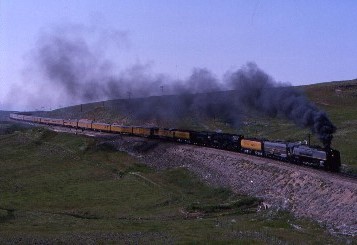
The train reversed beyond Highway 70 before charging by us as everyone stood on a hillside then a second runby occurred with the crew reversing even further. Both times, 3985 was obscured by the smoke of 844, which was leading. Everyone reboarded to just short of Kramm siding, where another double runby was performed, this time with 3985 being seen. The locomotives were then posed for pictures and once back on board, we made the fast twenty minute journey to Oroville as I enjoyed a couple of drinks in the lounge car, which was now serving since there were no more runbys. We crossed the Feather River for the last time on our way into town and stopped at the Oroville depot, now the Depot Restaurant, where we all detrained to pick up our dinners.
I walked to the front for a picture of our train surrounded by the mob of townspeople before they cut off the diesel helper that had served braking duty then walked over to the park to see Western Pacific 0-6-0 164 on display before I picked up my dinner and took it back to my seat to enjoy. We departed Oroville fifty-five minutes late but that did not matter. I sat in the lounge car and we made a fast run down the Sacramento Valley through Marysville and by the former Western Pacific depot. At the south end of town, we crossed the Yuba River then through Pleasant Grove to Del Paso, where we stopped to wait for an eastbound freight train to clear the main line then we continued south into north Sacramento, where everyone was waving at our train.
Union Pacific 8444 West then crossed the American River, ducked under the former Southern Pacific mainline at Haggin and passed through the east side of downtown Sacramento and the former Western Pacific station. We ducked under Interstate 80 before arriving at Western Pacific's South Sacramento Yard, ending a wonderful excursion and a dream come true. I was bussed back to the Amtrak station where I walked to the Travelodge for the night.
4/28/1991 The next morning, I strolled back to the station to board the Thruway Bus for Stockton, where I boarded San Joaquin Train 708 for Bakersfield, then rode a Thruway Bus to Los Angeles Union Station, where I boarded San Diegan Train 580 and Santa Ana. The next weekend, I was back in Sacramento for Railfair 1991.
| RETURN TO THE MAIN PAGE |