



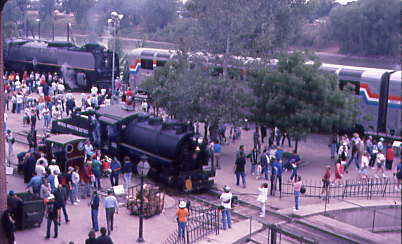
A couple of weeks after the double-headed steam excursion behind Union Pacific 884 and 3985, I drove up to Sacramento railfanning along the way. My friend Jeff Hartmann accompanied me and we stayed at my brother Bruce's house in South Sacramento. On May 11, Jeff and I drove into the state capital for our big day at Railfair 1991.
Railfair 1991The California State Railroad Museum celebrated its 10th anniversary in fine style by inviting dozens of locomotives to Sacramento from May 3rd to 12th and would be the largest gathering of steam trains in the world in more than four decades.
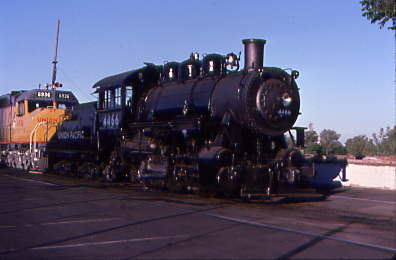
We first stopped along the riverfront south of Old Sacramento where Union Pacific 0-6-0 4466, built by Lima in 1924, Southern Pacific 0-6-0 1233 and Union Pacific DD40AX 6936 were located.
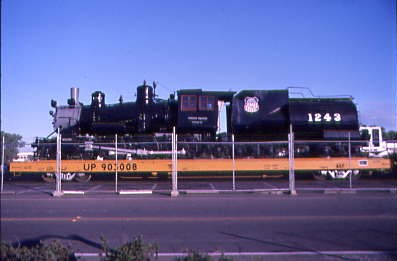
On a flat car was Union Pacific 4-6-0 1243, ex. Union Pacific Railroad Company 1477 1897, nee Union Pacific Railway Company 1477, built by Cooke Locomotive & Machine Works in 1890 and is housed at the Durham Museum in Omaha, Nebraska. We parked in a parking structure and waited for the grounds to opens.
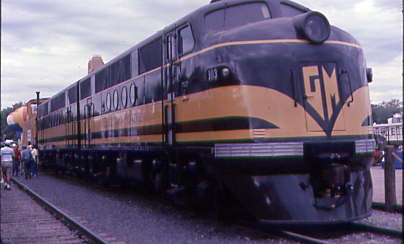
General Motive FT103A and FT103B built by Electro-Motive Division in 1939, painted in GM demonstration colors. They were built to promote the locomotive as a freight-hauling diesel-electric (the "F" stood for freight, a "B" unit is a cabless coupled unit) and the set toured thirty-five states and twenty Class 1 railroads in 1939 and showed itself superior in operation and running costs to steam freight locomotives. It consequently convinced many railroads to convert to diesel power in the ensuing years and is the first in EMD's highly successful F series. 1,096 FTs were built between 1939 and 1945.
103 was sold to the Southern with the A unit was donated to the National Museum of Transportation in Kirkwood, Missouri in 1961 and the B unit donated to the Virginia Museum of Transportation in Roanoke, Virginia in 1985.
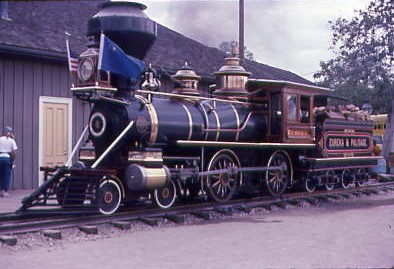
Under steam on a narrow gauge piece of track in front of the Central Pacific depot was Eureka and Palisade 4-4-0 4, ex. Dan Markoff 1986, exx. Old Tucson Studios 5 1978, exxx. Warner Brothers-Severn Arts Ltd. 5 1967, exxxx. Warner Brothers Pictures 1939, exxxxx. Unknown Iron Company 5 1938, exxxxxx. Hobart Estate Company 5 1917, exxxxxxx. Sierra Wood and Lumber Company 5 1896, nee Eureka & Palisade Railroad Company 4 "Eureka", built by Baldwin in 1875.
We found our seats in the stands for the pageant, which told the story of railroading in America from a stage with music, actors, and of course, some locomotives.
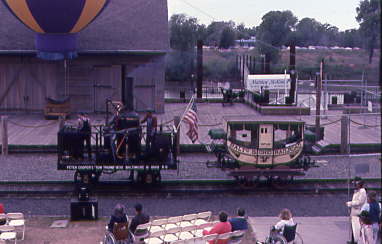
The program started and our first engine was a replica of Baltimore and Ohio 2-2-0 "Tom Thumb" built by the railroad in 1927 for the Fair of the Iron Horse. The original was built in 1830 by inventor and businessman Peter Cooper as a demonstrator locomotive. On August 28, 1830, it carried the Baltimore and Ohio directors in a passenger car to Ellicott's Mills, to their amazement, travelling at the then impressive speed of 10-14 miles per hour. It was later dubbed "Tom Thumb" because of its small size and weight of less than a ton. "Tom Thumb" was the first successful American steam locomotive, although it only hauled passengers until March 1831 and never went into regular service. It was salvaged for parts in 1834. This locomotive resides at the B&O Museum in Baltimore, Maryland.
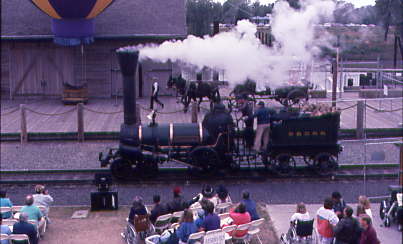
That was followed by a replica of Baltimore and Ohio's 4-2-0 13 "Lafayette" built by the railroad in 1927 at the Mt. Clare workshops for the Fair of the Iron Horse where it was displayed as the "William Galloway". William Galloway had driven the first, horse-drawn train from Mt. Clare to Elllicott's Mills in 1830. He later became an engineer on the B&O and apparently worked in that capacity for over fifty years. The Fair of the Iron Horse marked the 100th anniversary of the chartering of the B&O by the states of Virginia and Maryland.
William Norris and his Norris Locomotive Works in Pennsylvania built the Lafayette for the Baltimore and Ohio Railroad in 1837. Named after the Revolutionary War hero, the 4-2-0 engine was the world's first locomotive to feature a leading truck that swiveled as the engine went around curves in the track, thus improving performance. In addition, the Lafayette may have been the first standardized production model locomotive, leading to more engines being built in a shorter period. The positioning of the cylinders ahead of the smokebox and the horizontal boiler, rather than vertical as on earlier engines, established the familiar configuration that steam locomotives would follow until the end of the steam era over a hundred years later.
The Lafayette began service with the B&O Railroad on a premier passenger route from Baltimore to Washington, DC. Not too dissimilar to the trains following the same route today, the locomotive pulled closed coaches with platforms at both ends and an aisle down the middle. In 1839, new and more up to date locomotives began service with the railroad and the Lafayette and her sister 4-2-0s were finally retired in the 1860's. This locomotive resides at the B&O Museum in Baltimore, Maryland.
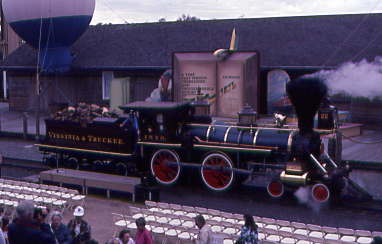
Moving into the late 1800's in the story, here came Virginia and Truckee 4-4-0 22 "Inyo", ex. sold to State of Nevada 1978, exx. leased to National Parks Service in Promontory Point, Utah 1969, exxx. Paramount Pictures Corporation 1949, exxxx. Paramount Pictures, Inc. 1937, exxxxx. Virginia and Truckee Railway 22 19905, nee Virginia & Truckee Railroad Company 22 "Inyo", built by Baldwin Locomotive Works in 1975, with an Indian on a horse leading the engine into the show. This came from the Nevada State Railroad Museum in Carson City, Nevada for the event.
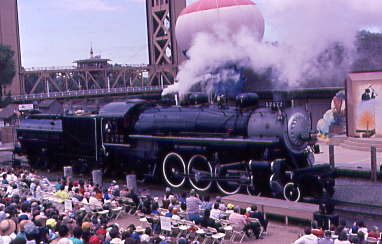
Now into the 20th Century, Southern Pacific 4-6-2 2472, ex. donation to Project 2472 1985, exx. donation to County of San Mateo 1958, nee Southern Pacific 2472, built by Baldwin in 1921 came into the show. It is owned by the Golden Gate Railroad Museum.
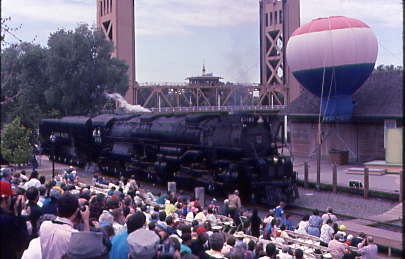
Once 2472 had reversed, Union Pacific 4-6-6-4 3985, built by American Locomotive Company in 1943, took its turn and lives at the Union Pacific roundhouse in Cheyenne, Wyoming.
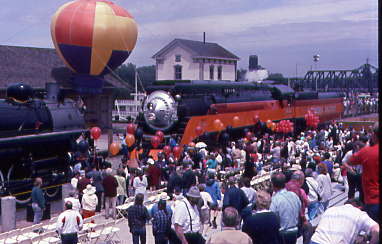
Union Pacific 3985 held its ground as from the other way, Southern Pacific 4-8-4 4449, built by Lima in 1941, entered, having travelled from Portland. Then Union Pacific 3985's and Southern Pacific 4449's pilots came together to recognize the completion of the Transcontinental Railroad on May 10th, 1869. It was a really well-done pageant put on by the California State Railroad Museum.
The rest of the day was spent exploring Railfair 1991.
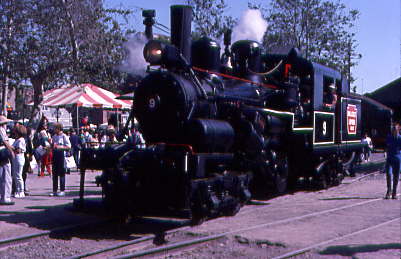
An old friend from the Duncan Forest Museum in Duncan, British Columbia was Hillcrest Lumber Climax 9, ex. Hillcrest Lumber Company 2 (to avoid confusion with other logging engines using Victoria Lumber and Manufacturing trackage), exx. Abernathy Lougheed Lumber Company 44 in Fraser Valley, British Columbia, exxx. Smith Dollar Lumber Company 1, exxxx. Canadian Robert Dollar Company 1, exxxxx. McNair Logging Company 1, nee M.D. Olds Lumber Company 1, built by Climax in 1915.
Hillcrest Lumber’s Stone Family donated No.9 to the (then) Cowichan Valley Forest Museum in 1968, where it was on outdoor display until 1989. It was moved to a newly constructed locomotive shed and restored to operation by Museum staff and volunteers for RailFair 91 in Sacramento, California.
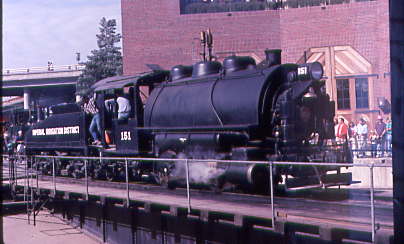
A newly restored engine was out on the museum's turntable that was Imperial Irrigation District 0-4-0T 151 built in 1918. In 1951, it was sold to the Imperial Irrigation District where, as 151, it worked at Andrade, California, a small town close to the Colorado River near the border with Mexico. The Imperial Irrigation District was formed in 1911 under the California Irrigation District Act to acquire the properties of the bankrupt California Development Company and its Mexican subsidiary. It was formed as a public agency, acquiring thirteen mutual water companies in the valley, which had developed and operated water distribution canals. Now, it is the largest irrigation district in the United States, with more than 3,000 miles of canals and drains delivering water to farmland and local municipalities. It is also the sixth largest public power utility in the state of California, providing generation, transmission and distribution services to more than 145,000 residential, commercial and industrial customers. The steam engine was donated to the California Mid-Winter Fairgrounds Pioneer Society in 1953.
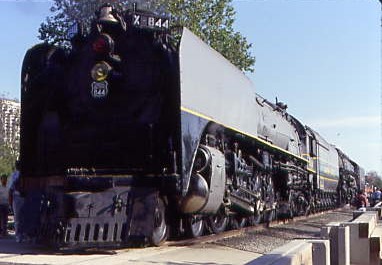
One of my all-time favorite engines Union Pacific's 4-8-4 844 built by American Locomitive Company was sitting along the river wall.
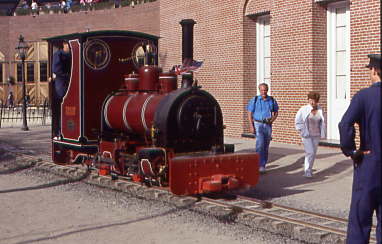
From England there was John Knowles and Company 0-4-0T "Gwen" built by Hunslet Engine Company in England in 1920. In 1958 it was sold to Billy Jones at Los Gatos, California then two years later, sold to the Overfair Corporration. At a later date, it wa sold to Quenton Jervis in Los Angeles and in 1983, Richard Farmer acquired it at the Jervis Estate auction. Its current home is Northridge, California.
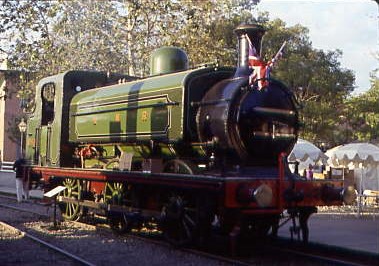
Another engine from England was Great Northern Railway's 0-6-0 1247 built by Sharpe, Stewart and Company in Glasgow, Scotland in 1899. It started life allocated to Doncaster where it remained until February 1950 when it was transferred to New England. Here it stayed until March 1956 when it moved to Hornsey before being allocated to Kings Cross in February 1959. As BR 68846 it worked at the top shed at Kings Cross shunting the larger engines allocated there around the shed until withdrawn from service in May 1959. Whilst at Kings Cross it acquired the nickname of Old Lady.
It was the first locomotive to be purchased directly from BR when it was purchased by Captain W.G. Smith in 1959. He had wanted to own an Ivatt designed engine and it was a toss up between 68846 or an ex GNR 4-4-2T of the LNER C12 class. He is reputed to have said that 68846 was the only one he could afford to buy. The 68846 was repainted in GNR green livery and renumbered back to 1247.
From 1959 the locomotive was based at the Marshmoor depot of Mowlem where Captain Smith was depot manager. It was used to haul railtours on southern and eastern territory including on the Bluebell Railway. This ended in 1962 when BR banned the private running of steam trains. From March 1965 until 1968 the locomotive was based on the Keighley & Worth Valley Railway. In 1968 it moved to Tyseley where it remained until 1974. From 1974 until 1980 the locomotive was based on the North Yorkshire Moors Railway.
As the owner and the engine grew older he decided to donate it to The National Railway Museum which he did in 1980. In recognition, W G Smith was made the first Honorary Life Member of the Friends of the National Railway Museum. After being acquired by the museum it made regular visits to other preserved railways and museums on its two boiler ticket durations in preservation. In 1991 it was displayed at Railfair 91 in Sacramento in California. The engine remains owned by the National Railway Museum and is on static display in its GNR green livery and numbered 1247 at York.

We stopped by the riverbank again for the Wisconsin Southern business train led by Wisconsin Southern E9A 10C, ex. Northern Rail Car 10C 1986, exx. Alaska Railroad 2402 1982, exxx. Amtrak 434, exxxx. Milwaukee Road 32A, nee Milwaukee Road 202A built by Electro-Motive Division in 1956.
Northern Railcar started Scenic Rail Dining to operate a high-end dinner train which operated out of North Milwaukee, on a portion of the former Milwaukee Road to Horicon. Immediately prior to starting the dinner train, Northern Rail Car purchased the route to Oshkosh and started operating it as the Wisconsin & Southern Railroad. When the dinner train was discontinued, WSOR retained the locomotive for their private train. Eventually 10C was renumbered 101 when an E9B was acquired/rebuilt to operate with E9s 10C and 10A. 32A had come full circle as part of an A-B-A set of E9s, albeit with two former Union Pacific E units completing the set as 101, 102 and 103.
That completed Jeff's and my day at Railfair 1991.
| RETURN TO THE MAIN PAGE |