



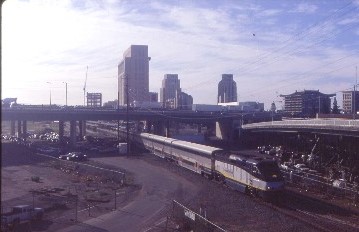
I had taken the San Joaquin overnight bus from Santa Ana to Bakersfield, then the San Joaquin to Stockton, where I boarded a Thruway bus to Sacramento. I met my brother Bruce and spent two nights at his house with his family on the south side of Sacramento. On December 28th, Bruce drove me and his son Adam to the Amtrak station where Adam and I would be riding together for the first time, and aboard Amtrak's newest service, the Capitol Corridor, on a Sacramento-to-San Jose round trip.
Capitol Corridor HistoryThe Capitol Corridor is a 168 mile passenger train route operated by Amtrak between San Jose and Auburn. The route is named after the two points most trains operate between, San Jose (was the first state capital of California) and Sacramento (the current capital). The route runs roughly parallel to Interstate 880 and Interstate 80. Capitol Corridor trains started in 1991 and like all regional trains in the state, the Capitol Corridor is operated by a joint powers authority, in this case the Capitol Corridor Joint Powers Authority, which is governed by a board that includes two elected representatives from each of eight counties the train travels through. The CCJPA contracts with the San Francisco Bay Area Rapid Transit District to provide day-to-day management of the service, Amtrak to operate the trains, and Transit Services America to maintain the rolling stock. The California Department of Transportation (Caltrans) provides the funding to operate the service and also owns the rolling stock.
The First transcontinental railroad was completed to Oakland from the south in 1869. Following the completion of the California Pacific Railroad in 1879, most long-distance service of the Southern Pacific reached Oakland from the north. Long-distance service from the south ran to San Francisco via the Peninsula; some trains had Oakland sections. The Western Pacific Railroad (completed to Oakland in 1910) and Santa Fe (completed to Oakland in 1903 over the former California and Nevada Railroad track) ran primarily long-distance service with limited local stops. Commuter service around Oakland was largely provided by the electric interurban trains of the SP-owned East Bay Electric Lines (1911–1941) and Key System (1901–1958).
By the end of the 1930's, the SP operated five daily local round trips plus a number of long-distance trains between Oakland and Sacramento. The Oakland Lark and an unnamed local train (an Oakland connection for the Coast Daylight) provided local service between Oakland and San Jose on the Coast Line. The inland Niles Subdivision was served by a daily Oakland–Tracy local and a commute-timed Oakland–San Jose local (which ran via Centerville and part of the Coast Line on the northbound trip and Milpitas southbound).
The increasing prevalence of automobile ownership and improvements in local roads meant that numerous commuters began to drive their own vehicles rather than take the train. The decline in ridership resulted in SP discontinuing the Oakland–San Jose trip on the Niles Subdivision on September 29, 1940, followed by ending the Oakland–Tracy trip in 1941. The two Oakland–San Jose trips on the Coast Line were discontinued on May 1, 1960 and the last local service between Oakland and Sacramento was the Senator, discontinued by the SP on May 31, 1962 (though long-distance service continued).
From the 1970's to the beginning of the 1990's, three Amtrak intercity trains operated in the Bay Area: the long-distance California Zephyr (Oakland/Emeryville–Chicago) and Coast Starlight (Los Angeles–Seattle), and the regional San Joaquins (Bakersfield–Oakland). Of the three lines, only the Coast Starlight ran between San Jose and Sacramento—once a day in each direction, and at inconvenient times (southbound early in the morning, northbound in the evening). In 1977, Amtrak approved an additional Oakland–Sacramento round trip, the Sacramentan; the service was never operated. In 1990, California voters passed two ballot propositions providing $105 million to expand service along the route.
The new service, named Capitols, debuted on December 12, 1991, with three daily round trips between San Jose and Sacramento. Of these, a single round trip continued to Roseville, an eastern Sacramento suburb.
Our JourneyTrain 721 rounded the curve on its way from Roseville, where it had originated, to Sacramento where Adam and I boarded. We found seats facing each other with a nice large window between then an on-time departure was the order of the day and followed the same route as the Coast Starlight for the first half. For me, it was just another trip over this route to Oakland after purchasing some goodies from the lounge car, relaxed in my coach seat. The train was half full on its way to Davis and was across the Yolo Bypass by the time I returned to my seat. This trip enabled me to spend some quality time with my nephew. Before long the train was climbing to the bridge over the Carquinez Straits to our next stop at Martinez.

The Capitol made really good time along the bay on what turned out to be a rainy morning, thereby obscuring the view across to San Francisco then made its way to Richmond, with the connection to BART, then Berkeley before stopping at the nice new Emeryville station. We then passed the former 16th Street station and Southern Pacific's West Oakland Yard before running down the middle of the street through Jack London Square to where the new Amtrak station was being built. The train proceeded to Elmhurst where, rather than curving off to the right as I had done in the past, we kept travelling straight onto new trackage.
As a result, we were on Southern Pacific's Hayward Line and this line, as well as the Tracy Line we would be riding over, had been upgraded thanks to the California-voted funds which included money for new locomotives and a fleet of passenger cars. The track was now rated at 79 miles per hour and the train was really flying along, out-running a BART train. We continued southeast through San Leandro, San Lorenzo and Hayward, a future stop, then reached Niles, where we crossed the former Western Pacific (Union Pacific) before turning west onto Southern Pacific's Centerville Line. At the junction, we skirted a lake before passing part of the collection of the Niles Canyon Railway, waiting to be moved to Sunol, then stopped at Fremont, still under construction, before reaching Newark and the Mulford Line, on which I had previously travelled, which brought an end to my new mileage.
Back on the route of the Coast Starlight, we passed the large salt plants before crossing the wetlands and the ghost town of Alviso. We stopped at Santa Clara/Great America with the amusement park in the distance then reached Santa Clara and entered the Caltrain commuter line for the rest of the journey to San Jose, arriving on time minutes after a heavy rain shower passed through. Adam and I walked over to the gift shop of the San Jose Sharks at their Arena which used the dwell time between trains well, then returned to the station to find that our train had been turned for its journey back to Sacramento.
This trip was uneventful, except for waiting for a ship to pass through the Carquinez Strait drawbridge, and was the first time I had been delayed there. We arrived back twenty-five minutes late, finishing Adam and Uncle Chris' first train trip together. I returned to Santa Ana the next day, in plenty of time for my traditional birthday train ride on the 31st, when I turned thirty-six years of age.
| RETURN TO THE MAIN PAGE |