



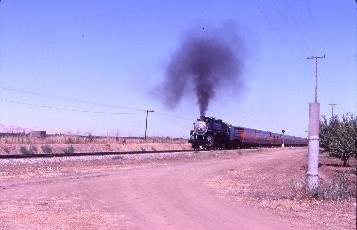
7/28/1993 From Flimsies, I learned of the Tracy Dry Bean Festival and the Southern Pacific 2472 excursion to the event, so I drove north from Santa Ana to my brother Bruce's house in Sacramento.
7/29/1993 The next morning, Bruce took me to Bass Tickets so I could buy a ticket to Nolan Ryan's last game when the Texas Rangers visited the Oakland Athletics.7/30/1993 I drove to Napa Valley to ride the Napa Valley Wine Train. The story of the Napa Valley Railroad, where the Wine Train travels every day, is over 175 years old. From the gold rush and wealthy citizens of early California to the inaugural Wine Train voyage, the rail line has a rich history of resilience and transformation, one that continues to be written today.
The history of the Napa Valley Railroad starts just before the gold rush in 1848. James W. Marshall, who lived and worked at Sutter's Fort in midtown Sacramento, was the first to discover gold in California. During testing, a piece of this gold was used to buy goods in Samuel Brannan's Sacramento mercantile store. Leveraging his newspaper business to spread the word, Brannan ingeniously persuaded Marshall and Sutter to reveal their gold while promising more would be discovered. The next year, before printing "Gold Found" in his New York City and San Francisco newspapers, Brannan purchased all the available mining supplies in the Western US, stockpiling them in San Francisco and Sacramento. News of gold spread fast throughout America between 1848 and 1855, enticing over 300,000 people to chase a dream of striking it rich in the West. Then, on September 9, 1850, California, the 31st State, was born.
In 1861, after becoming California’s first millionaire, thanks to his flourishing mining supply business, Brannan purchased 2,000 acres in North Napa that he named Calistoga. As part of the new town's infrastructure, including his new store, city hall, main street and resort, Brannan built a train depot where the Napa Valley Railroad line terminated. It was the first step in his vision of a luxurious mode of transportation through Napa. Brannan finished building the rail line in 1864. It was a direct route for visitors, a way to transport patrons from the San Francisco Bay ferry boats in Vallejo to his Calistoga resort—known today as Indian Springs Resort and Spa. Brannan’s rail line and trains took vacationers on a voyage through the Valley in lavish style.
After Brannan made a number of poor financial decisions, the Napa Valley Railroad was eventually sold in foreclosure to California Pacific in 1869. The line became a mixed-use freight and passenger train, servicing Napa's agriculture and tourism industries. In 1885, Southern Pacific bought California Pacific and the Napa Valley Railroad with it. During the late part of the 19th century and the early part of the 20th century, the railroad played a vital role in the economic and agricultural development of Napa Valley, providing regular passenger service to its communities.
With the birth of the automobile, the train began to lose much of its importance since people were able to drive freely with their own means of transportation and no longer relied as heavily on public modes of travel. Passenger service was discontinued in the 1930's and the line began to fall into disrepair. Southern Pacific abandoned the right-of-way between St. Helena and Calistoga in 1960 and eventually, Southern Pacific was only running one freight train a week on the remaining tracks. Southern Pacific sold the property in 1984 but a group of Napa Valley residents, known as The Society for the Preservation of the Napa County Railroad, banded together to save it. Ultimately, their efforts fell short, but the group inspired Dr. Alvin Lee Block, who founded the Napa Valley Wine Train Inc. This new vision sought to preserve the transportation corridor for future use and reduce traffic congestion in Napa Valley.
Block and his partners went on a hunt to find investors and their search led them to Vincent DeDomenico, one-time-owner of Ghirardelli Chocolate and other successful ventures. The Napa Valley Wine Train Inc. sold him most of the company’s shares and appointed him President and CEO. Finally, the Napa Valley Wine Train was able to buy the line from Southern Pacific and begin its transformation into the business it is today. The company began acquiring and renovating antique rail stock, transforming them into elegant cars. The Napa Valley Wine Train also began to hire a dedicated team to provide guests with an unmatched luxury rail experience, including food and service experts, engineers, and conductors. September 16, 1989, marked the inaugural passenger voyage of the Napa Valley Wine Train.
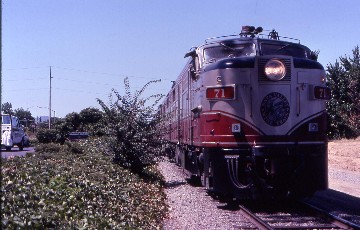
Napa Valley Wine Train FPA-4 71, ex. VIA 6775, nee Canadian National 6775 built by Montreal Locomotive Works in 1959.
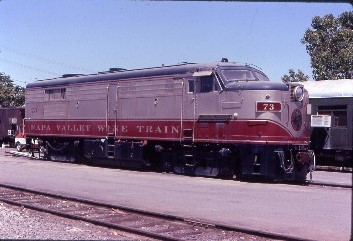
Napa Valley Wine Train FPA-4 73, ex. VIA 6790, nee Canadian National 6790 built by Montreal Locomotive Works in 1959. I had lunch on the journey north and wine-tasting on the return. The food and service was excellent and I would recommend this train to anyone. I then drove to Pinole and stayed at the Motel 6 for two nights and saw a film at the theater next door before driving to Richmond and riding BART to the Oakland Coliseum, where Nolan Ryan pitched seven strong innings and had to take three curtain calls as the fans really gave him a good farewell. However, the Athletics won 4-1. I rode BART back to Richmond before returning to the hotel and a good night's rest.
Southern Pacific 2472 East 7/31/1993Southern Pacific 2472 History
The Golden Gate Railroad Museum began in 1975 as Project 2472, a group of volunteers formed to restore the former Southern Pacific 4-6-2 2472. It had been donated to the San Mateo County Fairgrounds and left sitting for more than 29 years. The locomotive was built by Baldwin Locomotive Works and delivered to Southern Pacific as a member of the "P-8" class in 1921. It was specifically designed to haul passenger trains on the Overland Route between Sparks, Nevada and Ogden, Utah. On the Pacific Limited and the Overland Limited trains, it averaged more than 10,000 miles a month. As newer power in the form of the MT Class 4-82 Mountains were purchased, the Pacifics were reassigned to California and used on secondary trains.
In the 1940s, many of the P8 Class of engines moved to the Peninsula Commute service between San Francisco and San Jose. In the 1950s, all the P8 locomotives were scrapped except for two — 2467 in Harrison Park, Oakland and 2472 at the San Mateo Fairgrounds. 2472 was moved from San Mateo in 1990 to a newly-acquired restoration faculty at the Hunters Point Naval Shipyard. The restoration was completed in time for the 2472 to participate in Railfair '91 held at the California State Railroad Museum in Sacramento, where it was joined by many other locomotives from around the country. 2472 operated many mainline excursions in the 1990's including trips to Los Angeles, San Luis Obispo, Watsonville (doubleheaded with Southern Pacific 4449), Sacramento, Tracy and many trips on the San Jose to San Francisco line.
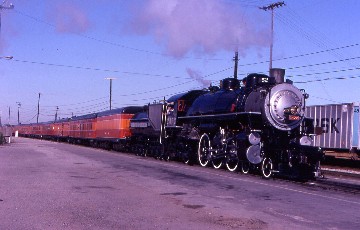
I was up early and drove down to the 16th Street station in Oakland and found a safe parking spot then out onto the platform to wait for the train to arrive. About fifteen minutes before departure time, Southern Pacific 2472, trailing Southern Pacific 4449's auxiliary tender and an eleven-car Daylight train, with a former California Zephyr dome car two cars from the rear, duly arrived and all the waiting passengers boarded. We departed on schedule and I rode on the right side of a Daylight coach to enjoy the views of San Francisco Bay and the Carquinez Straits. We passed beneath the maze of bridges that led to the San Francisco-Oakland Bay Bridge before going through Emeryville. We saw the Bayside Racing Track prior to running under Interstate 80 into Berkeley then made our way through Richmond, past the joint Amtrak/BART station and by BART's shops. Ducking under the Santa Fe mainline, we travelled north to San Pablo and turned to run along the bay at Point Pinole, going by the famous photo location with many photographers out in force.
We were now paralleling San Pablo Bay, curving along its shore past Wilson Point, through Rodeo and by Lone Tree Point then ran below the oil refineries and at Davis Point, plunged into the only tunnel of the day then turned the corner to run east through Crockett and under the Carquinez Straits bridge. We passed the C&H Sugar Plant before travelling along the Carquinez Straits to Port Costa, where ferries once took passenger trains across the straits before a bridge was built at Martinez. We then turned south to Nevada Point before turning east to Martinez and steamed past the Amtrak station and the junction with the Sacramento line at the approach to the Martinez-Benicia bridge and went under California Highway 680 prior to crossing Pachero Creek before running through the Concord Weapons Station.
2472 steamed through Port Chicago then went under Santa Fe's Valley main line then whistled its way through Shore Acres, Pittsburg and Antioch before travelling under California Highway 4 and turning southeast into the northern end of the San Joaquin Valley, then crossed the Contra Costa Canal and Marsh Creek before going through Brentwood.
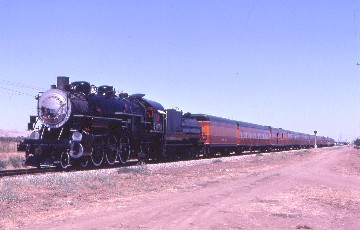
We stopped for a photo runby in the orchards away from the highway before we reached Bryon. Once on the move again, we crossed the California Aqueduct and miles later, went under Interstate 205 and into Tracy, where the majority of our train's passengers detrained to enjoy the Tracy Dry Bean Festival.
To Lathrop and BackThe City of Tracy sold family tickets for $5.00 so when we took the train out to Lathrop, it was standing room only and you could not walk down the aisles as they were full. The air conditioner failed and it became oppressively hot. When one of the excursion's officials saw me, he apologized and asked me to sit in the First Class section on the way back to Oakland to make up for this unpleasant situation, although I was not that bothered as I was quite happy just to be riding on all new trackage since we left Martinez this morning. We passed the junction of the West Side Line before reaching Banta then travelled northeast to Mossdale before crossing the San Joaquin River on a drawbridge. We rounded a large sweeping curve to the left and within minutes, arrived at Lathrop, the junction with Southern Pacific's Fresno line. We pulled forward before reversing down the Fresno line to be pointed in the correct direction to return to Tracy.
The journey back was much quicker and in almost no time, I was detraining at Tracy for the Dry Bean Festival and it amazed me what people can do with dry beans.
Southern Pacific 2472 WestOn the return to Oakland, I was seated in the round-end observation car "James J. Gilmore" and met some of the Friends of 2472 group. We made our way west with signal maintainers activating the crossing gates on this moth-balled line. As we were passing through Antioch, it was announced that we would do a photo runby just west of the Santa Fe overpass so we stopped and everyone detrained before the steam engine reversed out of sight. While all of this was going on, the Concord Weapons Station military police were not too happy with us for doing a runby within their base and called the Southern Pacific dispatcher to ask them not to do it again there tomorrow since we were all trespassing on government land. However, they allowed this runby to occur.
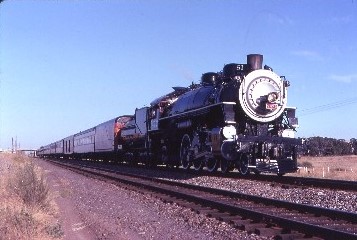
The reverse move.
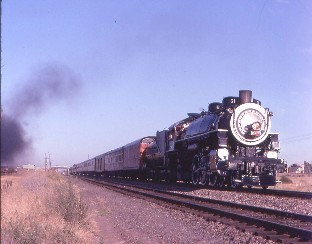
The photo runby at Port Chicago. It was a great show by Southern Pacific 2472 and we were all very lucky. Once on the move again, I rode the vestibule along the Carquinez Straits on a most beautiful late summer afternoon which turned into evening. We rounded the corner after passing through the tunnel at Davis Point and ran along San Pablo Bay in the last light of day and the sun had set as we steamed through Richmond. We arrived in Oakland just as it was getting dark then I drove back to Pinole for the night.
8/1/1993 The day started with me on the hill overlooking Pinole Point waiting for 2472's second trip Tracy. I chased it for until outside of Brentwood then drove to Fresno and checked into the Motel 6 for a restful afternoon and night.
8/2/1993 I was up early the next morning for the drive home to Santa Ana.
After losing my job of eleven years at McArthur Fundamental Intermediate, I ended up at McFadden Intermediate School as a Regional Special Person/Special Day Class Instructional Assistant for six hours a day working with Mrs. Carnett.
| RETURN TO THE MAIN PAGE |