




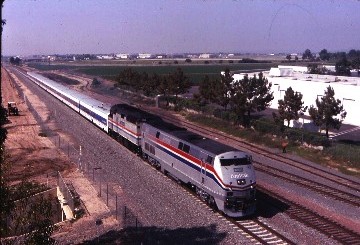
The Spanish-built Talgo train demonstrated in San Diegan service for a two-week period, running daily, except on Fridays and since I rode the San Diegan service so frequently, was able to sample it every day.
Brief History of TalgoTalgo (officially Patentes Talgo, SAU) is a Spanish manufacturer of intercity, standard and high-speed passenger trains. Talgo is an abbreviation of Tren Articulado Ligero Goicoechea Oriol (English: Lightweight articulated train Goicoechea Oriol). The company was founded by Alejandro Goicoechea and José Luis Oriol and was first incorporated in 1942.
The creation of Talgo can be largely credited to the work of Alejandro Goicoechea and José Luis Oriol. During the 1930's, Goicoechea, a pioneering railway engineer, sought to produce a new generation of rolling stock that would be primarily composed of metal, rather than wood; to reduce operational cost, he also emphasised lightweight yet sturdy construction, while a low center of gravity would deter derailing and thus permit higher operating speeds. In 1942, financial backing for the construction of a prototype train was provided by Oriol, which believed in Goicoechea's concepts. The two produced the agreement that established Patentes Talgo as a company that same year. The prototype train would emerge as the Talgo I.
During the late 1940's, Talgo came to recognise that Spain, and the wider European continent, were in a poor economic condition following the World War II and so were unlikely to be customers for new rolling stock from an unproven manufacturer. Furthermore, the company was keen to acquire advanced technical knowledge and designs, so a favourable agreement was struck with American Car and Foundry to collaborate on the manufacture of the Talgo II in the United States. The first vehicles arrived in Spain in 1950, enabling the first commercial Talgo II service to be run on 14 July of that year, between Madrid, Spain and Hendaye, France. It was the first train in Spain to be authorized to travel at a service speed of up to 75 miles per hour. Continued collaboration with ACF led to the creation of the Talgo III during the 1960's and it was brought into service between Madrid and Barcelona in August 1964.
International rail travel between Spain and the rest of Europe had been historically hampered by the differing track gauge at either side of the Pyrenees. Recognising the value in effectively overcoming that impediment, Talgo developed its own variable-gauge vehicle system, which permitted the first international Talgo to be introduced on passenger service between Barcelona, Spain and Geneva, Switzerland, in 1969. Variable-gauge trains were soon a common feature of overnight services between various Spanish cities and destinations across Western Europe. Even into the 21st century, the variable-gauge system has largely remained unchanged, even on newly-built rolling stock. La Gineta is the site of a test track of the Talgo RD railway gauge changer.
During the 1970's, Talgo sought to better accommodate the demand for higher speed trains in Spain. As a consequence of its mountainous terrain, curved tracks prevailed, despite restricting line speeds due to the centrifugal forces exerted on the trains and their contents. To permit higher operating speeds under such conditions, the company developed a tilting train, the Talgo Pendular, that automatically compensated for centrifugal forces by tilting appropriately on bends. Without needing to modify the track infrastructure, this tilting train allowed operating speeds to be increased by up to 25 percent over conventional trains.
During the 1970's and 1980's, the company focused its activities largely on the manufacturing of coaching stock rather than locomotives. A renewed focus on locomotive development, incorporating the automatic variable gauge system, came about during the 1990's. The Talgo XXI pioneered various technologies for the company, including new high-speed running gear and hybrid propulsion technology. In 1988, the Spanish government announced its decision to construct a new dedicated high-speed line between Madrid and Seville. Talgo was keen to produce rolling stock for the new venture and immediately set about designing a new series of trains, the Talgo 350. A key feature of this trainset would be its maximum speed, which was 300 km/h. In 1998, Talgo partnered with the multinational rolling stock manufacturer Adtranz to collaborate on its bid to secure a contract to provide the rolling stock for the new high-speed line.
Talgo Train DetailsThis Talgo set was twelve cars with a power car, a sleeping car, one first class car, a diner/lounge, the Bistro car, six coaches and a baggage car. It is a self-contained train and can be pulled by any type of motive power. The first class car has two/one seating for 36 passengers, while the regular coaches have two/two seating; the total carrying capacity of the train is 244 passengers. The cars have panoramic windows, reclining seats, seat-back tray tables, AC outlets at your seat and 17 inch television monitors below the ceiling. The train is really comfortable and a real joy to ride.
My Journey On The TalgoWe departed San Diego on time with Larry Wheeler as our conductor on this leg of my round-trip home. The train rode very smoothly as there are no seats over the wheelsets and the ride was quiet as there were doors at both ends of the cars. Each car seats 26 people and are much smaller than regular passenger cars. I did not even notice the first curve, then we rolled northbound, passing through Elivira before taking the east track up Rose Canyon. I was really looking forward to the train's descent down Miramar Hill's steep and curving northern grade but did not feel any of the curves, which was amazing to me. We reached Sorrento where our engineer opened up the speed to 90 MPH and the Talgo glided along at that speed then we slowed for the run along the Del Mar bluffs then went through Del Mar and passed the darkened Del Mar Race Track before reaching Solana Beach.
After picking up a few passengers, we resumed speed and raced through Cardiff, Encinitas and Carlsbad before sprinting to Oceanside, where the train was met by the US Border Patrol looking for illegal aliens. We boarded just a few passengers as six people were removed then continued north through the night across Camp Pendleton before passing the brightly-lit San Onofre Nuclear Generating Station and made our way along the empty beaches of San Clemente, where not a single bonfire was lit tonight. We passed the well-lit San Clemente Pier before resuming track speed at North Beach. I was waiting for the curve off the beach and as we neared, closed my eyes to try and feel it but nothing was felt. We arrived at San Juan Capistrano early and after dropping off our passengers, proceeded north, climbing El Toro Hill and the Talgo glided up the grade and a few minutes later, arrived at Irvine. From there, it was a quick and smooth 9.8 miles home to Santa Ana, where I detrained after another interesting and exciting ride on the train from Spain, the Talgo.
| RETURN TO THE MAIN PAGE |