



I had finished my first full year at McFadden Intermediate as a special education instructional assistant, then summer came and I felt restless so it was time to plan another train trip. The State of Washington's Department of Transportation had been looking at ways to improve passenger train service in the Seattle-Portland corridor and leased a Spanish-built Talgo train on a trial basis. They started a new train running between Seattle and Portland that made one round trip per day so in August 1994, I planned a journey to Seattle to ride the Talgo south to Portland.
San Diegan 571/573 8/19/1994I started this trip like any other, boarding in Santa Ana and going to the Amcafé for a morning screwdriver to dedicate the start of another train trip. 571 was running late due to a major engine problems and we stopped at Anaheim before we creeping very slowly to Fullerton, where everyone was instructed to detrain and it was then taken out of service and put into a siding. Train 573 arrived a few minutes later and accepted all Train 571's passengers, thereby creating a standing room-only train. I managed to board the cab car first and went straight to the rear door where I sat on my suitcase with a great rear view all the way to Los Angeles Union Station, where the Coast Starlight was patiently waiting.
Coast Starlight 14 8/19/1994I walked off my second train of the day right onto the third, a Superliner coach for Seattle on the Coast Starlight. We departed fifty-five minutes late and considering the problems with Train 571 I felt very lucky being only that few minutes late. I settled into my coach seat long enough to have my ticket taken before going to the lounge car and settling in for the Pacific Ocean view later in the day. The train was not as crowded as usual and very few lounge car seats were taken. We made our escape from the hot and smoggy San Fernando Valley on this August morning, through the tunnels and out into the Simi Valley then reached Oxnard. From Ventura north along the coast, the train was travelling through the dense fog which limited the view to just the surf crashing on the rocks. Highway 101 traffic was creeping along with everyone keeping a safe distance and driving with their lights on as the train sped through the fog. Santa Barbara was reached with very few new passengers boarding before we continued west to Point Conception, where we turned north through even denser fog across Vandenberg Air Force Base, barely being able to see anything out of the windows. It made me think that I was on a train traveling through a dense fog bank with the next stop the Twilight Zone.
The low clouds rose as we turned away from the Pacific Ocean to Casmalia but returned in force near Pismo Beach before we arrived at San Luis Obispo, following our meet with the southbound Starlight, an hour and twenty minutes late. We climbed into the clouds as we conquered the Cuesta Grade and proceeded for the upper reaches of the hot and sunny Salinas Valley. Near Templeton, we passed a ranch with llamas, definitely not something I would expect to see in North America. That is one of the neat things about train travel - you never know what you are going to see.
I had made a notebook for this trip with copies of employee timetable pages, grade profiles and maps so I could learn this route a little better. For as often as I rode this route, I really did not know where all the sidings were, the river's names or the names of all the small towns that the Starlight passes through. I had the route covered all the way to Seattle so was using this trip as a learning experience. We made good time down the Salinas Valley and following the station stop at Salinas, made our way through Watsonville, the Pajaro Gap, Gilroy and on to San Jose, where I had dinner in the dining car, which was a half-baked chicken, almost all bones and very little meat. The sun set as we passed through the ghost town of Alviso prior to making our way through the evening gloom, past the Oakland Coliseum where the Oakland Athletics of Major League Baseball call home, down the streets through the lit Jack London Square, to the darkness of the West Oakland Yards and the Amtrak station in Oakland. After a brief walk upon departure, I turned in for the night.
8/20/1994 The next morning I awoke to the train twisting and turning through the upper reaches of the Sacramento River Canyon to Dunsmuir, where we departed two-and-a-half hours late. I was off to the lounge car with my notebook awaiting it to open as we rounded the Cantara Loop and climbed out of the Sacramento River Canyon. The lounge opened so I purchased some cookies and a couple of screwdrivers and was sitting looking out at Mount Shasta as the train was travelling towards Black Butte when an attractive lady with a beautiful smile sat near me and we introduced ourselves. Her name was Carol and she was from Cottage Grove, Oregon and had been to Denver on the train. She noticed my notebook and was fascinated by it and I started to talk about the places I had been and she was amazed. We discussed music and soon discovered we both liked many of the same groups as well as "Monty Python" and the two of us launched into the Argument Clinic skit, much to the amazement of the other passengers, who at first thought we were having a real argument. We agreed that neither of us had met anyone like each other before.
While we were having a wonderful travelling experience, the train continued north, stopping at Klamath Falls then paralleled Upper Klamath Lake as we continued our conversation. The old saying of "Time flies when you are having fun" had a completely meaning this morning as the next thing I knew we had reached Chemult then as the Starlight crossed the Cascades, I mentioned that it was a pity this was not a winter crossing because it is really beautiful when it is snow-covered. We talked of our love for mountains and canyons before changing subjects to the Denver-Salt Lake route, which is the most beautiful route in the United States and I told Carol that Ruby Canyon was my favourite canyon on the Amtrak system and she agreed, having only made one round trip through it. We enjoyed the passing of Odell Lake before the train plunged into the Cascade Summit Tunnel and as the train wound its way down the scenic west slope, our conversation continued, only interrupted when I pointed out some scenic highlight.
Nearing Oakridge, I went downstairs for some lunch and returned to a discussion of what we did for a living, as well as family. I was amazed at the number of topics we discussed then as we neared Eugene, we exchanged addresses and phone numbers, promising to keep in touch then bid each other goodbye and off she went to her coach to gather her belongings. The Coast Starlight arrived at Eugene and I saw Carol on the platform, wishing she was still onboard.
As the Starlight departed, I felt alone and we made our way to Portland Union Station, where I detrained for some fresh air and my first view of the Talgo train between its journeys. Leaving Portland two hours late, I went to the dining car for a New York Strip steak, which was quite good and after a leisurely dessert, I returned to the lounge car for a few rounds of nightcaps. The train rolled along the shore of Puget Sound to Tacoma as the long day of August turned into twilight. The Coast Starlight rolled the last miles to Seattle, arriving one hour and thirty minutes late and I detrained and took a taxi to the Travelodge near the Space Needle for the night.
Mount Baker Talgo 751 8/21/1994Brief History of Talgo
Talgo (officially Patentes Talgo, SAU) is a Spanish manufacturer of intercity, standard and high-speed passenger trains. Talgo is an abbreviation of Tren Articulado Ligero Goicoechea Oriol (English: Lightweight articulated train Goicoechea Oriol). The company was founded by Alejandro Goicoechea and José Luis Oriol and was first incorporated in 1942.
The creation of Talgo can be largely credited to the work of Alejandro Goicoechea and José Luis Oriol. During the 1930's, Goicoechea, a pioneering railway engineer, sought to produce a new generation of rolling stock that would be primarily composed of metal, rather than wood; to reduce operational cost, he also emphasised lightweight yet sturdy construction, while a low center of gravity would deter derailing and thus permit higher operating speeds. In 1942, financial backing for the construction of a prototype train was provided by Oriol, which believed in Goicoechea's concepts. The two produced the agreement that established Patentes Talgo as a company that same year. The prototype train would emerge as the Talgo I.
During the late 1940's, Talgo came to recognise that Spain, and the wider European continent, were in a poor economic condition following the World War II and so were unlikely to be customers for new rolling stock from an unproven manufacturer. Furthermore, the company was keen to acquire advanced technical knowledge and designs, so a favourable agreement was struck with American Car and Foundry to collaborate on the manufacture of the Talgo II in the United States. The first vehicles arrived in Spain in 1950, enabling the first commercial Talgo II service to be run on 14 July of that year, between Madrid, Spain and Hendaye, France. It was the first train in Spain to be authorized to travel at a service speed of up to 75 miles per hour. Continued collaboration with ACF led to the creation of the Talgo III during the 1960's and it was brought into service between Madrid and Barcelona in August 1964.
International rail travel between Spain and the rest of Europe had been historically hampered by the differing track gauge at either side of the Pyrenees. Recognising the value in effectively overcoming that impediment, Talgo developed its own variable-gauge vehicle system, which permitted the first international Talgo to be introduced on passenger service between Barcelona, Spain and Geneva, Switzerland, in 1969. Variable-gauge trains were soon a common feature of overnight services between various Spanish cities and destinations across Western Europe. Even into the 21st century, the variable-gauge system has largely remained unchanged, even on newly-built rolling stock. La Gineta is the site of a test track of the Talgo RD railway gauge changer.
During the 1970's, Talgo sought to better accommodate the demand for higher speed trains in Spain. As a consequence of its mountainous terrain, curved tracks prevailed, despite restricting line speeds due to the centrifugal forces exerted on the trains and their contents. To permit higher operating speeds under such conditions, the company developed a tilting train, the Talgo Pendular, that automatically compensated for centrifugal forces by tilting appropriately on bends. Without needing to modify the track infrastructure, this tilting train allowed operating speeds to be increased by up to 25 percent over conventional trains.
During the 1970's and 1980's, the company focused its activities largely on the manufacturing of coaching stock rather than locomotives. A renewed focus on locomotive development, incorporating the automatic variable gauge system, came about during the 1990's. The Talgo XXI pioneered various technologies for the company, including new high-speed running gear and hybrid propulsion technology. In 1988, the Spanish government announced its decision to construct a new dedicated high-speed line between Madrid and Seville. Talgo was keen to produce rolling stock for the new venture and immediately set about designing a new series of trains, the Talgo 350. A key feature of this trainset would be its maximum speed, which was 300 km/h. In 1998, Talgo partnered with the multinational rolling stock manufacturer Adtranz to collaborate on its bid to secure a contract to provide the rolling stock for the new high-speed line.

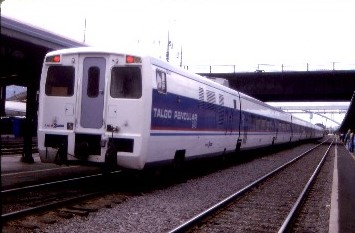
I took a taxi back to King Street Station and acquired my boarding pass with an assigned seat for the trip on the Talgo train to Portland. My coach had thirty-two seats with a restroom at one end. The coach was low to the ground and the whole train tilted through curves to increase speed. The seats have a jack for headphones that lets you listen to three channels of music, or the soundtrack of a film that is watched from overhead monitors. There are sliding doors at each end of the car that when closed, cut off almost all of the outside noise, so the cars ride extremely quietly. At one end of the car, where the restroom, is a WC sign that lights up anytime the door is locked, thereby letting passengers know when the bathroom is occupied.
I was assigned to a single window seat on the right so I could view Puget Sound and the Columbia River. The Talgo has a Bistro Car which is a lounge that has a bar with five stools and several tables and there is a small kitchen where meals are prepared for an adjacent car which is a diner. At each end of the Talgo trainset are power cars that power the train, as well as house the on-board entertainment equipment. These power cars allows the Talgo to be pulled by any model of locomotive, making Talgo trains practical for all types of service and one of the main reasons the State of Washington selected Talgo for their trains.
We departed Seattle on time proceeding south past the Kingdome and the industrial south side of Seattle. The Talgo ride was smooth through all of these switches since a single wheelset is at each end of the car where there are no seats. I sat waiting for the first curve by Union Pacific's Argo Yard and Talgo's passive tilting system made this curve hardly noticeable. As we passed Boeing Field, the video monitors came alive with a Talgo-produced video which provided historical background as well as information about the Talgo train. Following the ten minute video feature, I went to the Bistro Car to get my lunch of hot dogs, chips, a pair of mixed drinks plus a Talgo hat and Talgo T-shirt then returned to my seat as we sped through Auburn and made our way to Tacoma.
From here to Olympia, we ran on the curving water level route along Puget Sound and as the train made its way through the curves, it handled them well and I enjoyed the feel of noticing the curves and provided an enjoyable smooth ride. Additionally, the view out of the large windows of Puget Sound was quite good also. Following the stop at Olympia-Lacey, the film shown was "Greedy" starring Michael J. Fox, which I enjoyed as I watched both it and the passing scenery; it was the first film I had watched on a train from my own seat. Before the film started, however, the Talgo representatives walked through the train selling headphones to passengers as the sound comes out of the jacks in the armrests rather than over the train's main speaker system.
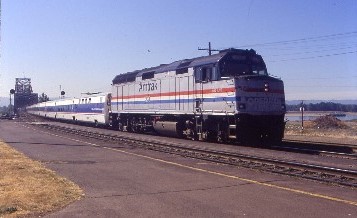
During the course of "Greedy", the train made its stops at Centralia and Kelso-Longview then the film finished as we were paralleling the Columbia River and made our last Washington stop of Vancouver before crossing the Columbia River into Oregon for the remaining miles into Portland Union Station. All in all, I had a wonderful Talgo experience and enjoyed all features of the train, mostly impressed with the passive tilting system. It was the quietest-running train I had ridden and lived up to all of my expectations. I can see the use of Talgos on other Amtrak lines and would take any opportunities to ride the Talgo in my train-riding future.
Portland 8/21/1994I detrained and found a taxi to take me across the Steel Bridge to the Travelodge on the east side of the Willamette River for my one-night stay. I chose this location since it was close to Portland Union Station and its location is right off the MAX Light Rail line. After checking in, I rode the Portland Vintage Trolley for three blocks before riding MAX Blue Line to the eastern terminus at Gresham then rode into downtown Portland and back. I then found a fast food restaurant for dinner before spending a quiet evening in my motel room and calling it a night.
Vancouver, Washington 8/22/1994The next morning I arose early to a heavy Northwest overcast sky and following check-out, rode MAX back to downtown Portland where I walked over to Union Station to buy a one-way ticket to Vancouver and boarded the Amtrak's Mount Rainier Train 750, a four-car Superliner train, for the ten mile journey across the Columbia River to Vancouver. I spent the morning photographing trains and by noon, had stored my bags at the depot.

The reason for storing my bags was so I could walk over to a restaurant called The Crossing, comprised of former passenger cars for an excellent lunch. On my way back to the station, I stopped at Esther Park to see Spokane, Portland and Seattle 2-8-2 539 before returning to the station before my southbound Coast Starlight arrived.
Coast Starlight 11 8/22/1994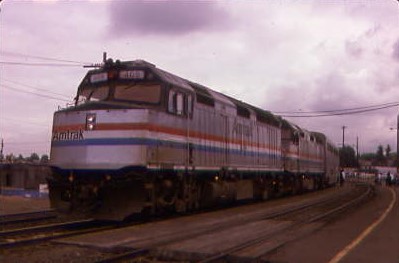
I boarded the Starlight had my choice of seats while the train crossed the Columbia River. Since I was only going as far as Martinez on this train, I chose a window seat on the left and had my ticket taken before going to the lounge car for my first drink since lunch and enjoyed the trip into Portland. I stayed on the train during the servicing stop then we departed on time and crossed the Steel Bridge over the Willamette River and turned south, proceeding along the east bank through Southern Pacific's Brooklyn yard and passed Oregon Falls. There was a wild party going on in the rear of the lounge car and the conductor walked through, warning the passengers to keep it quieter. He left and within an hour, they all detrained at Salem. I received a dinner reservation as I enjoyed the trip along the fertile Willamette Valley with stops at Albany and later at Eugene, where I thought of Carol, before my time for dinner was called.
I went to the diner and sat with a retired couple from Spokane, who were going to Santa Barbara to see their grandchildren. We spent the whole dining experience talking about the Pacific Northwest while enjoying our New York strip steaks, then I visited the lounge car for my usual nightcaps as we climbed Cascade Summit in the very late afternoon light with the mountains looking so peaceful and calm and the lounge car having that same feel. It was one of those magical moments that can only happen on a train. The only sound heard was the flanging against the wheels on the rails and the locomotive working hard inside a tunnel. We topped Cascade Summit then descended to Chemult in twilight and returned to my coach seat to sleep the night away.
8/23/1994 The next morning was hazy as I awoke and we were arriving at Sacramento on time. I went to the lounge car for breakfast then enjoyed the morning's run of crossing of the Yolo Bypass, Davis, Dixon, Suisan-Fairfield, the Mothball Fleet and the Carquinez Straits Bridge before we arrived at the wooden station at Martinez, where I detrained into a cold fierce wind. I took refuge inside the station with a good-sized crowd waiting for the southbound Valley train.
San Joaquin 712 8/23/1994The San Joaquin arrived on time and I found a nice large window seat in the Horizon coach before I was off to the lounge car. We paralleled the straits east of Port Chicago where we switched from Southern Pacific tracks to those of the Santa Fe for the reminder of our trip to Bakersfield. We stopped briefly at Antioch before proceeding out across the California Delta country where the San Joaquin and Sacramento Rivers converge to create a very wet environment. I love water crossings of any kind and the delta, full of passages and channels, is unique for California and a favourite of mine to travel across on train trips. At Stockton, we were joined by passengers from the buses from Sacramento and San Jose and with the influx of new passengers, the train filled up.
The San Joaquin trains are a leader in the nation for having passengers using the train from connecting Thruway buses and you can reach most major areas of the state by using the combination of a San Joaquin train and a Thruway bus. For example, you could leave San Diego on the overnight connecting bus to the first northbound San Joaquin train, take it to Martinez and transfer to another Thruway bus to Eureka and by doing that, you would have travelled almost the entire length of the California. That ability was the concept of, and implementation by, the late Stephen Miller of Sacramento, who was a good friend of mine for many years until he passed away in 2023.
The train passed Stockton Tower, a favourite train-watching site with three major railroads crossing each other, followed quickly by Santa Fe's Mormon Yard, before we escaped the city limits and returned to the rich agricultural parts of the San Joaquin Valley for the reminder of the journey. We passed our sister northbound train before the next stop of Riverbank then sped through Empire, with its piggyback facilities and connection with the Modesto and Empire Traction Company, followed by crossing the Tuolumne River and Turlock-Denair. Our route continued south as we crossed the Merced River then flew by the Castle Air Museum before arriving at Merced, then turned east for eight miles before turning southeast again, running close to the foothills of the Sierra Mountains and on into Madera, an Amshack on the eastern end of town.
Back up to track speed miles later, we crossed high above the San Joaquin River then made our way carefully into Fresno. I went to get lunch of a hot dog and chips then we departed Fresno on time and ran along the Santa Fe yard before crossing the Southern Pacific Valley main line directly south, miles later crossing the Kings River before stopping at Hanford. Here the train was met by buses to Visalia, San Luis Obispo, and points in-between.
We departed on schedule bound for Corcoran where I obtained a seatmate for the reminder of the trip who was carrying only a brown grocery bag. He had just been released from the Men's Correctional Facility at Corcoran and was going home to Los Angeles having finished a five-year sentence with six months off for good behaviour and was extremely happy to be free. We went to the lounge car to have a few rounds of drinks as the train continued its journey He told me his tale of his third stay in prison. Number one was for burglary, number two was attempted breaking and entering with a weapon and his third for carjacking with a weapon. He said that if he ever went back, he would be in prison for twenty years to life, so was planning on doing anything illegal again and I wished him luck with his new start.
The train passed another northbound San Joaquin before our stop at Wasco before we made our final on time-sprint to Bakersfield, where the passengers rushed to one of the eleven buses to such places as Las Vegas, Santa Barbara, Van Nuys, Torrance, Palmdale, Indio and Los Angeles, where I was going. I chose the front seat and with no one joining me, stretched out once the bus was on the freeway and fell fast asleep, staying that way to Los Angeles Union Station, where I debussed to wait for my train to Santa Ana.
San Diegan 580 8/23/1994I walked straight to Track 8 and the conductor recognized me and allowed me to board an empty Amcafé car. The passengers showed up and we left nearly a full train, passing Hobart Yard then accelerating and quickly making our way to Fullerton, Anaheim and Santa Ana, where I arrived at home in time for dinner, ending another Amtrak trip.
| RETURN TO THE MAIN PAGE |