



Following three months of planning, hotel reservations and the possibility of a national railroad strike, the morning finally arrived that I was standing on the platform at the Santa Ana station with two bags in hand awaiting the start of my completion of the Amtrak system. San Diegan Express 571 arrived on time and I chose a table in the new California dining car "Imperial". As the train departed, my mind raced with thoughts such as will I pull this one off and maybe a few more nights in hotels along the way would have been a good idea? Some of my connections were going to be tight and should I have changed them? Should I have learned French in school? Then my old favourite, "Am I nuts?"
By Fullerton, reality returned and the motto of this journey and every one from here on will be "Every trip is an adventure!" It seemed as though in no time at all, I had arrived in Los Angeles.
The Desert Wind 36 8/8/1996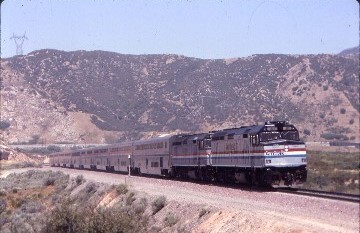
I boarded the Wind and chose my usual window seat on the right and pondered my memories of my first ride on the Desert Wind in 1980. We departed on schedule and the conductor took my ticket then I was off to the Sightseer lounge car for a choice seat. Travelling through Santa Ana Canyon, I wondered where all those orange trees went and we left the now-solvent Orange County and I purchased a California Zephyr/Desert Wind coffee mug, which assured me free tea all the way to Chicago. I sat back and watched the Inland Empire pass outside and since this was a non-smoking train, there are smoking or fresh air stops at several stations along the route. On this day, those passengers had to brave temperatures of 105 degrees in San Bernardino, the trip over a busy Cajon Pass, 112 degrees in Barstow and 108 degrees in Las Vegas. I was very happy that I never took up smoking.
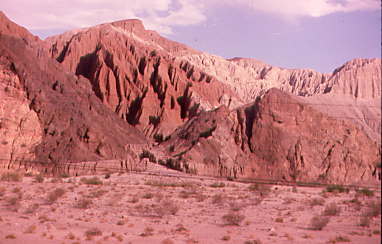
Afton Canyon with its colourful rocks was one of the desert scenic wonders, as well as Devil's Playground, the Kelso Dunes and Cima Hill with its Joshua trees. Entering Nevada, it was time to play "spot the new casino" from the last time that I passed through here. Tonight's dinner was an excellent prime rib and arriving in Las Vegas, it always amazed me what they will do to attract gamblers. Pyramids, towers, theme parks and the like may bring in hordes of people, but they will never seduce me. Leaving Lost Wages, we proceeded to Meadow Valley Wash and the night, which meant it was time for the evening's film "Golden Eye", one of the James Bond series and I gave it a five out of ten.
Sharing the film, and most of the afternoon for that matter, were three Australian gentlemen who were drinking Coors Beer as if it was water. They had flown to Los Angeles, ridden the train to San Diego and then visited Tijuana. Now they would be with me on the Desert Wind to Chicago then to Washington, DC, South Carolina and Florida. They were three of the nicest Australians I had met and were full of questions about the scenery and surroundings. The conductor had sold them a family bedroom and at Las Vegas, they rushed into the liquor store for another case of beer, so with that bedroom, they would have a good place to sleep it all off. I returned to my coach seat, fell asleep quickly and dreamed of what awaited me tomorrow.
8/9/1996 Waking up southeast of Provo, today's scenic adventure was just starting and I was back on the former Denver and Rio Grande Western Railroad and today's route was considered the best scenery on the entire Amtrak system. I found a seat in the lounge car and just sat watching the views change with Soldier Summit and its tough grades, the Gilluly Loops and tunnels, all of which seemed more alive than ever. We passed five long freights and a couple of helper sets before passing Castle Rock, where Butch Cassidy and the Sundance Kid robbed the Rio Grande in the early 1900's. We arrived at Helper, named for what the railroad does to its trains here, and I detrained for the smoking/fresh air stop and the 48 degrees air certainly woke me up as it was so cool and clean.
Leaving Helper, we descended into the Utah desert where little grows, few people live and one can see for at least a hundred miles since the landscape is so desolate. My thoughts turned to what it might have been like to cross it as a pioneer and just how tough it must have been to build that first narrow gauge railroad through here on the same route we were travelling 90 mph today. Water is scarce out here with two exceptions, one being a geyser along the highway where cars pull off to gaze in wonder, and the other, the low point of the day, at Green River, which gets its name from the algae that gives it the colour green. To the north were the Book Cliffs, which if you would stare at them long enough, you can see anything you could imagine, such as battleships, steam engines, buildings, faces, et cetera. We climbed to the flag stop of Thompson, but no one flagged us down today.
The Train Chief came over the public address system to alert us that our engineer has spotted a herd of jackalopes crossing the tracks ahead and passengers were rushing to the windows to look at these creatures. I laughed since an idea had just occurred to me - stop the train and we could have the first Amtrak snipe hunt. All we would need is some gunny sacks, sticks to bang and these gullible people. With all this excitement, one of the Australians joined me as his other mates slept in their room.
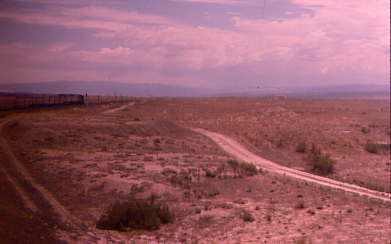
We descended to Westwater to start the 232 mile journey up the Colorado River and through the canyons that it created. We quickly entered Ruby Canyon, my favourite on the whole Amtrak system, and there are only two ways to see it, either by train or on the water by rafts, canoes and the like. There are no roads and only a few traces of man, so it has remains unspoiled.
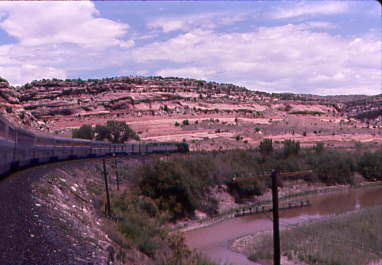
A few ranchers live here but most of the ranching is done by truck. The canyon walls stood tall and the river ran wide. In the middle of Ruby siding, up on the canyon wall, is a painted line that is the state line of Utah and Colorado. But with anything that is good, it was over too soon as we plunged into a tunnel and left Ruby Canyon behind for the Grand Valley. Grand Junction was next and I was off the train to the hobby shop to buy some railroad magazines. I have always liked this town for some reason and am not sure if it was the friendly people, the view or the climate, or maybe all three, but to me, it is a nice place. Passengers were buying fruit at the fruit stand, a unique characteristic of this station then with the train serviced, the smokers satisfied and our new passengers boarded, the engineer blew the whistle and we were off to continue our eastward journey.
The route remained parallel to the Colorado River as we entered De Beque Canyon. Each of the canyons is the river cutting through one or more geological layers, so each is very different than the others. The river is dammed here so a lake fills its bottom with the railroad on one side and Interstate 70 on the other. We passed through Rifle and I thought of the old West and gunfighters, then we arrived in Glenwood Springs, where Doc Holliday of Tombstone fame is buried, but it is better known for its world-class hot springs and scenic location. That brought us to Glenwood Canyon and what a change from the first time I rode through here on the Rio Grande Zephyr in 1983. The railroad and the river were basically the same, but where there was once a two-lane highway is now a four lane interstate highway along with a riverside bicycle path beside. It was the most expensive highway project in the country's history and cost more than sending a man to the moon. However, I must give the builders their due since they did not destroy the beauty of Glenwood Canyon.
People were amazed at the sight and the lounge car was standing room only for the only time on the whole trip, with some of them wondering out loud what would happen if a rock fell and hit the train; thank God for slide-protecting fences. The other two Australians then joined their friend but had missed the fantastic scenery of the day so far. We passed through Dotsero and our westbound sister train after Red Rock Canyon. The name gives this one away and there were many deer seen. The remains of the State Bridge was visible, which was built in 1860 and was one of the oldest vehicular bridges in the state, pivotal in the development of North Park and the Yampa Valley regions of northwest Colorado. It was replaced with a modern bridge in 1966.
We proceeded into Gore Canyon, which was used in the film "Under Siege 2-Dark Territory" and it was an amazing place with slide detector fences, short tunnels, the tracks high above the Colorado River with its rapids and very steep canyon walls. No matter how many times one travels through it, one would always see something new. I then went to the dining car and had a meal of an oven-baked chicken but it was not very good. We had now travelled from the low point of the morning at Green River, Utah to our highest point of the day as the train entered the Moffat Tunnel. The train crew asked that no one move between the cars during our fifteen minutes inside the tunnel to keep the diesel fumes out of the train and I managed to get the rear lounge car door closed; it was the only time it was closed.
The Moffat Tunnel is numbered twenty-nine, so we had that many to travel through during our four thousand foot descent to Denver down the front range of the Rockies. Once we exited the mountains, I had an excellent view of the lights of Denver, similar to descending on an airplane and it was incredible. Coming out of Tunnel 1, we descended around the Big Ten Curve, where hopper cars filled with sand are located on the inside, to help prevent trains from being blown off the tracks by the wind. We made a quick trip the rest of the way to Denver, where we reversed into the station fifty-six minutes late and were told that the train would leave at 8:30 PM with or without everyone.
The Australians asked where they could go to have a few beers during their layover and I suggested Wynkoop Brewing Company across the street, reminding them that the train departed at 8:30 PM. I detrained, mailed a postcard, went to Grandpa's Depot and then to Wynkoop for a non-alcoholic beer and found two of the Australians; the third had decided to walk to a liquor store a mile away. I asked them what time the train left and they responded 9:30 PM, to which I explained it was 8:30 PM since we were on Mountain Time. One of them went to find the other and I returned to the station 8:25 PM Mountain Daylight Time. 8:40 came and no Australians but three minutes later, they arrived and I boarded.
However, all was not well since two of them detrained to go back into the station when someone told them that they could buy beer there and they were left behind. The train duly departed Union Station but sat in the BNSF yard for forty-five minutes and while the Australians did not know this, our delay allowed them to catch the train at Fort Morgan. They hailed a taxi cab, went by a liquor store, bought a case of beer and were driven to Fort Morgan. It was 77 rail miles to Fort Morgan, but over 125 by highway as the route is not direct and the taxi arrived at that station just as the train did. Their cost was $18.75 for the beer and $160.00 for the cab ride, for a total of $178.75 for one case of beer. One very expensive endeavour indeed!
8/10/1996 Following a very good night's sleep, I was wide awake at Omaha and was waiting for the Missouri River crossing. We travelled across the gentle rolling landscape of Iowa, which is not as flat as most people think and passengers were watching cumulonimbus clouds develop and when they became dark, started a game called "spot the twister" after the popular film. They did not understand tornado mechanics because there was nothing necessary today to produce one so they were just wasting their time. Iowa is known for corn and we passed through miles of nothing but corn and it surprised me that the plants were not all the same height until I remembered that they are planted at different times in the spring. Since the scenery was rather repetitive, I did nine word search puzzles before our last stop in the state at Burlington then upon our departure, we crossed the Mississippi River and entered Illinois, speeding across the last state on the Desert Wind's route to our final stop at Chicago.
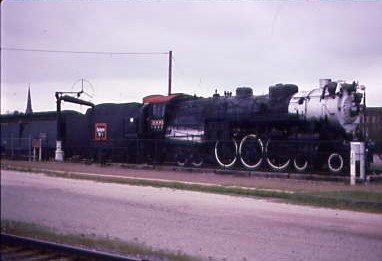
At Galesburg I detrained for Chicago, Burlington and Quincy 4-6-4 3006 built by Baldwin in 1930. Princeton came and went then we reached the triple track raceway at Aurora for the sprint to Chicago, where the train was wyed and reversed into the station for an on-time arrival. I said goodbye to the Australians and wished them luck and after that Denver debacle, they needed all the luck that they could get.
Chicago 8/10/1996I could not find a luggage cart anywhere on platform number eighteen so carried my bags upstairs and had a pair of char dogs at Gold Coast which were really good, eating with a few of my new friends from the train. I mailed another set of postcards before going downstairs to the waiting area for my next train.
Twilight Limited 353 8/10/1996The first of the new trains of the trip and routes that I would be completing was a mixture of Amfleet and Horizon coaches with the front end of an Amcafé as the custom class section. This train was originally a New York Central one, introduced in 1926 but lost its name in 1967. Amtrak kept the route but re-named it "St. Clair" and extended the route to Pontiac; its prior terminus was Detroit.
We departed Chicago on time and I noticed a different crew hat-check procedure. Numbers were used for the stops between Chicago and Detroit but I received one with the three letter station code for Pontiac, PNT, because my station stop was number twelve. It was a different way of doing things, but as I always say, if it works for you, just do it. I reached the new tracks at Porter, Indiana and the train lived up to its name as first twilight arrived followed very closely by the darkness of night at Niles, Michigan. My conductor from Battle Creek to Pontiac was a former San Diegan-based crewmember who wanted to return. Tonight's scenic highlights were the lights of the Ford Motor Plant and the Detroit skyline.
8/21/1996 The train arrived at Pontiac at 2:15 AM, half an hour late and I had to wait ten minutes for the only taxi cab in town that was contracted to Amtrak to take the Lead Service Attendant to his hotel before he returned for me then was taken to the Motel Six in Auburn Hills to a long hot shower and a hotel bed for a good night's sleep.
The Lake Cites 353 8/11/1996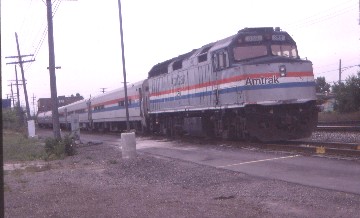
I returned by cab to the Pontiac station for the second morning train to retrace my route to Battle Creek with a consist of an F40PH leading assorted Amfleet and Horizon cars and my first Capitoliner car. We departed on time and quickly travelled to Royal Oak and I was watching everything intently from my coach seat since it had been night time when I travelled through here several hours ago. Detroit was not the prettiest sight to see with worn-out brick buildings, graffiti and junk and nothing has changed my perception of the city since the cross-country family camper trip in 1971.
Once out of the urban jungle, we followed the Huron River for part of the journey to Battle Creek and I started noticing purple flowers growing everywhere. These plants would be in evidence for the whole week and six days later, I was informed that they came from Japan and were called Purple Loosestrife, or in the Latin, Lythrum salicaria. This perennial had been around since the mid-1800's but does its fair share of damage since the seeds of this flowering groundcover spread so rapidly that it prevents new growth from taking hold and it poses a massive challenge to agriculture and native wildlife. Approaching Battle Creek, we passed the Kellogg Plant with Mr. Tony the Tiger standing in front then detrained at the nice modern station and sat outside on a pleasant August afternoon to await my next train.
The International 364 8/11/1996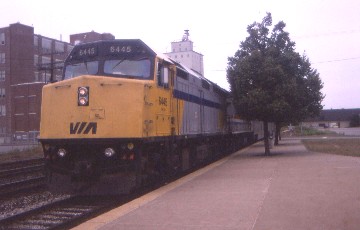
Arriving on schedule was the International, a train of former Santa Fe hi-level and Superliner cars being pulled by VIA F40PH 6445 and an Amtrak locomotive. I bought lunch in the snack coach and was going to relax and enjoy the scenery all the way to Toronto. However, the crew announced that we would be bussed from Port Huron to London, Ontario due to a Canadian National freight train derailment, so riding through the Sarnia tunnel and into Canada was not going to occur this time. I learned from my train crew that this is deemed a VIA train from Port Huron to Toronto, so it would not affect my goal to ride every mile that Amtrak operates. Customs forms were distributed and I let four people borrow my extra pens but did not receive them back then observed to the other passengers that Customs would be much quicker on the bus than on the train.
We arrived at Port Huron and it was a case of the station people knowing what they were supposed to do but unsure how to do it. The eastbound passengers for Canada were standing on the platform and the westbound passengers from Canada on the buses. There was forty-five minutes of indecision before someone gave the order for the bus passengers to exit so we could board. We were finally off over the St. Clair River, instead of under it, as I was supposed to do on the train, and entered Canada. Customs took about twenty minutes before the bus was speeding down the highway towards London then at the London exit, I thought that if we stayed on the highway, we could be in Toronto by 9:30 PM.
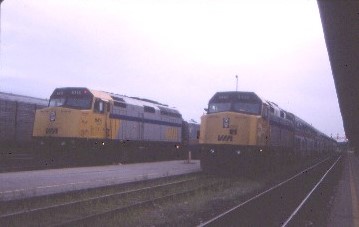
Arriving in London was the train, the passengers and an engine crew, but no train crew. We could not leave because our crew was told the wrong time and arrived to work back to Toronto an hour late. This consist had a Superliner lounge car, so I spent the entire journey there, watching the Ontario countryside under the cover of night and wee arrived in Toronto Union Station forty-five minutes late and I walked past the CN Tower on the walkway to the Skydome and my hotel for the night.
The Maple Leaf 64 8/12/1996Another day, another new train and part of a new route. Six years ago, when I was on the Lake Shore Limited, I had ridden over the tracks from Albany-Rensselaer to Buffalo during the night in a Slumbercoach, so this journey would provide a daylight view of the countryside on this Toronto-to-New York City train, the other joint Amtrak/VIA train, but with an all-Amfleet consist. My new mileage was from Toronto to Buffalo and from Albany to New York Penn Station. I arrived back at Toronto Union Station to find a long line for the boarding gate and there were a lot of Canadians going to Niagara Falls. I found a window seat on the right behind the engine to take advantage of the two main scenic highlights, namely Niagara Falls and the Hudson River Valley.
The crowded train departed on time and the Canadian miles passed quickly with Lake Ontario visible across the car for the first twenty minutes and was surprised that Hamilton was not a stop. The countryside was hilly and we crossed a canal that is part of a system to reach Lake Erie from Lake Ontario around Niagara Falls on the Niagara River, before we reached the station at Niagara Falls. Canadian Customs inspectors did their work outside while the VIA crew disembarked and the Amtrak crew took their place, then we proceeded onto the International railroad bridge over the Niagara River and halfway over, I had a glimpse of the American Falls, or at least the mists that were created from it.
Welcome back to the United States and Customs did the most complete search of a train I had experienced, inspecting above, below and around every seat, including lifting several passengers' seat cushions. Each of us were questioned in detail and if you were are a foreign traveller, your passport needed to be in order. They did not let five passengers in my car enter the United States but for me, it was smooth sailing as I had my birth certificate and itinerary to hand. One quick look and two simple questions were asked and it could not have been any easier.
The Maple Leaf made its two Buffalo stops, one in downtown on Exchange Street and the suburb stop at Depew on the Conrail mainline, also used by the Lake Shore Limited. We travelled east on the old Water Level Route of the New York Central towards Albany. While most people think of New York City with its hustle and bustle when they think of New York State, that only accounts for a tiny percentage of what New York really is, and this trip was allowing me to explore this very beautiful state with plenty of farmlands, forest and hills. We paralleled the Erie Canal, followed the Mohawk River east then a Amsterdam, were stopped for thirty minutes.
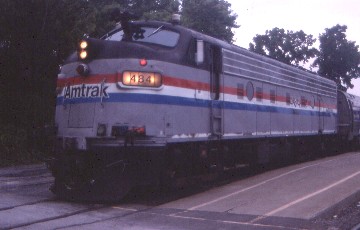
Arriving in Albany-Rensselaer, we switched our F40PH for FL9 484, nee New York, New Haven and Hartford 2029, built by Electro-Motive Division in 1957, so we could use the third rail pickup to power the train into New York City from Croton-Harmon. The FL9 was the last type of Amtrak locomotive I had not ridden behind, so for me this was going to be a special trip and it was in front of my coach. We proceeded down the Hudson River Valley towards the Big Apple and I was enjoying the sound of the locomotive. My seatmate was a jazz musician from New York City and we share our love for music and after dark, she let me read her newspaper, the first I had seen in five days and it was nice to find out what was going on in the real world. We joked about baseball, the weather, earthquakes, blizzards and my trip thus far and since I would see this route in daylight tomorrow morning, I relaxed and travelled through the night then we arrived at Penn Station fifty-five minutes late and I went to find the Amtrak waiting area for the train from Boston to Washington, DC.
Northeast Direct 179 8/12/1996Rather than spend money on a hotel in New York City, I decided to ride this night-time round trip train to Washington, DC and sleep in both directions, thus providing me a faster trip down the Northeast Corridor and the additional miles that went with it. I cuddled up in the two seats and fell fast asleep then was woken by the conductor after we arrived at our destination.
Washington, DC 8/13/1996This station, like almost any in the country, was deserted at 3:30 AM and it was just me and six janitors cleaning up after the daily ritual of people using the station. Two of them stopped to ask me why I was here so early in the morning and when I explained my trip, they were both amazed at what I was doing. I then thanked them for their great job and both said I was the first person they had met who appreciated their daily hard work.
Northeast Direct 180 8/13/1996Returning to New York City, I boarded Northeast Direct 180 and fell back asleep then was awoken in Wilmington by boarding passengers who did not realize people were trying to sleep. At Philadelphia, where it was raining, the train filled and while this was a non-stop to New York, we were stuck behind a New Jersey Transit train which delayed our progress. We arrived in New York at 8:28 AM, giving me a mere two minutes to cross the platform to board my train to Montreal.
The Adirondack 69 8/23/1996As I quickly walked to this train, I noticed the coaches were of Santa Fe vintage that had been used in Clocker Service, which, when built, had 44 seats but now had 80. The consist also included an Amdinette car and the train was being pulled by a new P32AC-DM built by General Electric. I boarded and chose a seat on the right, foregoing the Hudson River for the journey's later scenic highlight of Lake Champlain. I stored my bags in the overhead luggage rack and stretched out in my coach seat which had less leg space than on an Amfleet coach but with a much larger window. When the train started to move, the ride quality took over and I would describe it as smooth.
We departed Penn Station twenty minutes late and started the journey to Montreal on my first daylight ride over the Westside Connection that allowed Amtrak trains from upper New York to use Penn Station instead of Grand Central, as they have done in the past, thereby necessitating Amtrak to have only one station in New York City. I went to get breakfast and who was behind the counter but the none other Dara Lee, a former San Diegan Lead Service Attendant, who had served me just three weeks ago back home. We both wondered what the other was doing here and throughout the day, discussed our lives. Old friends turn up in the strangest places when you least expect it! We sped north along the Hudson River and the rain stopping at Poughkeepsie, enabling a few views of the Catskill Mountains across the river to the west.
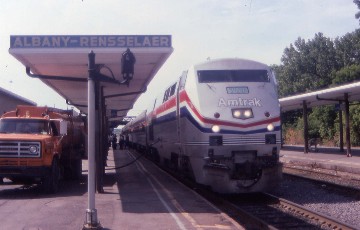
We stopped at Albany-Rensselaer to refuel the locomotive then crossed the Hudson River with the view of Albany and the New York State capitol building across the train before we stopped at Schenectady. From here, I was on new trackage and a dream coming true as I started to travel on the former Delaware and Hudson Railroad, now Canadian Pacific. The D&H had been a long-time favourite eastern railroad of mine which had an attractive paint scheme, an interesting assortment of locomotives and a fascinating history. Most of all, it was photographs in books that really caught my eye. Curving onto the D&H main line, we went under one of those familiar signal masts that the D&H was known for then outside of Schenectady, we passed the remains of American Locomotive Company's headquarters before travelling to Saratoga Springs and the start of our crossing of the Adirondack Mountains, from which the train gains its name. The new train crew who boarded in Albany was full of details about the route and I received a first class education as we proceeded north, travelling past Lake George, below Fort Ticonderoga and stopping at Port Henry.
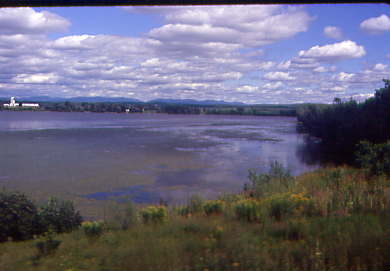
Now for what I have been waiting for, the one hundred miles of paralleling the west shore of Lake Champlain, which I first saw in a picture with the D&H passenger train The Laurentian on a ledge high above the lake. From that point on, I had dreamt of riding over these tracks and today my dream was coming true. The tracks at some points are right along the water's edge, reminding me of British Columbia Railway, and at other times, high above, or even away from, the lake. However, the views of the Lake were omnipresent.
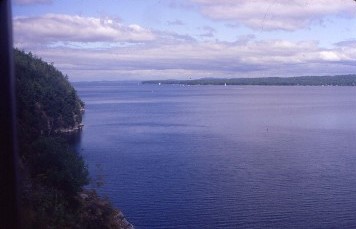
I saw Vermont for the first time across the lake and knew I would be there tomorrow. We then passed through the lakeshore communities of Westport, Port Kent (with ferry service to Vermont) and Plattsburgh. Following a final view of Lake Champlain, the continued north to Rouses Point and the Canadian border. There were no fences here, just a marker in the middle of a field, and with that we stopped at Lacolle, Quebec for Canadian customs. I displayed my various forms of identification on the seat and a female Canadian Customs agent had one look and said "Have a nice stay in Canada!" We sprinted to Montreal, stopping briefly at St. Lambert before crossing the St. Lawrence River where the train was wyed and reversed into Central Station ten minutes early. What an excellent journey it had been and the train lived up to its reputation of being the most scenic Amtrak line east of the Mississippi River.
Montreal 8/13/1996I stayed the night at the Fairmont Queen Elizabeth Hotel next to the station and there was a MacDonald's in the station, where I ordered a plain hamburger. The server must not have known what the word 'plain' meant in English, or in her native French, because when I returned to my room and opened it, it had the works. I went back downstairs and tried again but she asked if I wanted cheese, to which I am allergic, and managed to have a plain hamburger.
I asked two people, one of them an Amtrak employee, where the bus to St. Albans, Vermont departs from and he pointed to the large train departure sign that says "Vermonter 3:45 AM" and told me to be there ten minutes early so that the driver would come and get me. With that information, I went up to my room, called for a 3:00 AM wake up call, freshened up and called it a night.
Taxi Grab or the Nightmare Chase 8/14/1996The wakeup call came and I checked out at 3:25 AM then was down below the sign at 3:32, awaiting the bus driver but by 3:45, no sign of anyone so I thought he was running late. The next thing I knew, it was 4:15 AM so I called Amtrak's toll-free number and talked to a reservation agent, who called the bus company and was told the bus had left on time. She asked me what time I arrived and asked if I had the correct time, to which I responded that I arrived at 3:32 AM, the same time on the station clock and nobody had arrived to pick me up as I was told would do so by one of the company's employees. After discussing with a supervisor, she advised me to take a taxi to St. Albans and said that Amtrak would most likely pay for it; the cost was $120.00.
I walked out to the taxi cab stand but there were no taxis to be found at this early hour but I found a cab phone and the operator gave me the same price and said he would have a taxi there in three minutes. A cab arrived at 4:46 AM and I was off, asking the driver if he had ever been to Vermont, to which he in the negative. We crossed the St. Lawrence River and followed the only sign I saw in Canada that said 'Vermont', taking that road south in search of a train, passing all sorts of junctions and towns in Vermont. We journeyed further south and the driver stated that he thought we were on the wrong road but we continued on, passing a sign that read "Phillipsburg" then found two police officers along the road, but they did not know if this was the road to Vermont.
We sped along blindly, passing another Phillipsburg sign and I asked the driver if he had a map, which should have consulted before we left. First I found Lake Champlain and to the east across the border was Phillipsburg. Hallelujah! We were within fourteen kilometers of that town when we spotted a sign that read "St. Albans, Vermont 21 miles", much to my relief. At the border, I identified myself and the agent asked the driver if he was Canadian, which he was, and who was paying for the taxi. I asked if this happens frequently and was not too surprised with his answer of 'all too often'.
Back in the United States, we arrived at the Amtrak station and while the agent did not have the cash, I paid for the taxi fare but was reimbursed when I returned home. Then it dawned on me that I was standing in Vermont for the first time and this was the last of the 48 continental states in which I had been. I was in a much happier mood upon realizing that and enjoyed the clean cool Vermont air before boarding the train and asking the conductor which side was the most scenic. I chose a backwards-facing seat on the left for the ride on the New England Railroad to Palmer, Massachusetts, where we would switch directions to continue south.
Vermonter 55 8/14/1996Our on-time departure would allow me to travel by train in Vermont and a slight part of New Hampshire for the first time and I relaxed and just took in the countryside after the crazy start to the day then I napped to recharge my batteries so was out between Burlington and Montpelier-Barre and forty-five minute later, felt like my old self. We went into the siding at Randolph to let one of the New England Railroad's freight trains pass then we stopped at White River Junction where Boston and Maine 4-4-0 494 was on display.
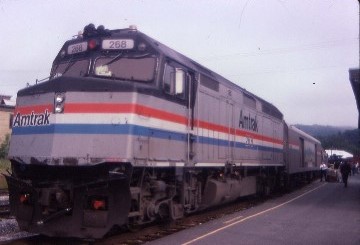
Amtrak F40PH 268 on the point of our train before we departed, following the Connecticut River and I spotted the only covered bridge of the whole trip. We then crossed the Connecticut River to enter New Hampshire with a stop at Claremont and this was the last state that Amtrak serves which I have now visited.
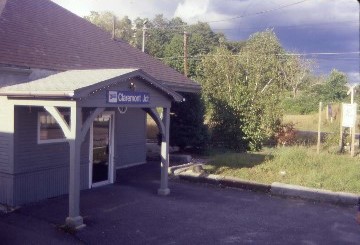
After a brief stop at the Boston and Maine station built in 1920 and a few more miles, we crossed back over the Connecticut River into Vermont. Bellows Falls was the next stop, which used to be the home of Steamtown, a railroad museum which has since moved to Scranton, Pennsylvania. At the depot, I saw a Green Mountain Railroad passenger train and with our departure from Brattleboro, and the final crossing of the Connecticut River in Vermont, we entered the next state on this ride, Massachusetts.
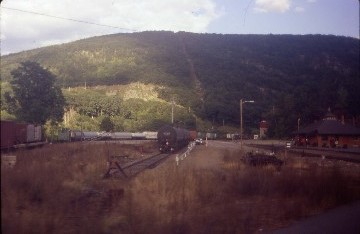
We were scheduled for two stops in this state, namely Amherst, from which we departed on time, and Springfield two-and-a-half hours later. We continued to Palmer, where more problems awaited me and almost jeopardized the whole goal of this trip. On a normal day, the train comes off the New England Central and enters Conrail's Boston and Albany mainline. The engineer then walks from the locomotive to the cab car on the other end of the train, performs an air test, receives a signal and off the train goes to Springfield and points south.
Today, we arrived at Palmer but Conrail would not accept the train to their railroad since they had decided to replace some welded rail and their railroad was out-of-service and the passengers would be bussed within two-and-a-half hours to resume the journey south. Our train crew was very upset since if Conrail knew that they were going to do this, why did not they tell Amtrak so that the buses would have already been here? I explained my unique situation to the conductor and he called the Conrail dispatcher to find out what time the tracks would be open. While he was on the phone, the buses arrived and the answer was 1:30 PM, and we would be the first train though. That was going to make my connection in New Haven work, but was going to be tight.
Since all short-distance Amtrak trains are non-smoking, the crew opened the cab car during the delay as a smoking area and it was interesting to watch the various ways in which the passengers handled the delay. At 1:30 PM, Conrail allowed the train to move onto their main line and we proceeded towards Springfield and passing the work site, we crept by, with the engineer blowing his whistle freely to warn men and machines at the work scene. As the conductor left the train at Springfield, he wished me luck with my goal and assured me that I should make it to New Haven with ten minutes to spare before my return train to Springfield departs.
The journey to New Haven was relatively uneventful with good track and short station stops and this train crew's motto was "Get them off and put them on with no delay!" All the rest of this segment's stops were in Connecticut after we crossed the Connecticut River then all too soon, arrived under the overhead wires that marked the present end of the Northeast Corridor electrification at New Haven fifteen minutes to spare. The customer service representative was on the platform but was at all sympathetic to the taxi situation this morning. I bought and mailed some postcards before I went up to the platform and Track 10 to wait for my next train.
Northeast Direct 486 8/14/1996I boarded the Northeast Direct Train 486 to take me back to Springfield so I could connect with the Lake Shore Limited to Chicago. This was a three-car Amfleet train with no food service and I chose a seat on the right so I could see what I had missed coming down. Most of the stations were on this side and passing through Hartford, I saw the most-English looking capitol building in the country and of all those I have seen, this one left a lasting impression.
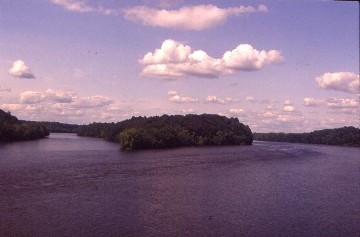
Crossing the Connecticut River. I met a businessman who thought that the "M" on my hat stood for Michigan and we engaged in conversation around our love for trains, rock music and our nation which passed the time. Once back at Springfield, I saw an agent who copied my taxi cab receipt, gave me the computer printout of the message about me being left in Montreal and gave me the address for refunds, after which I called home before my next departure at 6:04 PM
Lake Shore Limited 449/49 8/14/1996Climbing aboard a sixty-seat Amfleet II coach, I found an aisle seat, which turned out to be a new sleeping experience, and sat next to an Amtrak engineer who worked out of Boston sitting across the aisle from his mother and grandmother who were going to Chicago to visit family. We talked trains, what he does for a living and what I do for a hobby and I showed him my mileage book which he started reading every entry out loud from page one. His mother offered me dinner which turned out to be the best cold fried chicken I had ever had. Following the unexpected dinner, I excused myself for a window seat in the lounge car to watch the crossing of the Berkshire Mountains. To me, eastern mountains look as though they are hills compared to their western counterparts, but remembering my history, if I had to cross them on foot, I would have called them mountains as well.
We entered the State Line Tunnel and exited into the state of New York with our next stop of Albany-Rensselaer and the schedule called for us to be here an hour and twenty minutes while the New York section arrived and one long train is made out of the two. I took this opportunity to write Amtrak Customer Service in Philadelphia about the whole taxi cab situation, the agent gave me an envelope and I mailed it off and put the whole event behind me (note: I received a cheque in the amount of $120.00 for the cab fare on December 16, 1996). I went for a good walk then when the New York section finally arrived, it gave me an opportunity to inspect a Viewliner Sleeper. With no sleeping car reservation tonight, I returned to my coach seat for our on-time departure and unpacked my pillow and blanket from my suitcase, curled up and fell asleep in the aisle seat.
However, four time during the night, my hand hit the seat recline button, popping the seat back to the full upright position and made what seemed to be the loudest noise you could make on a train, which woke me up. I never appreciated those handles on the Superliner seats until now. The funny thing was that I was not the only passenger to which this happened since the next morning, I talked to four others who had done the same thing, all in aisle seats. We formed the brief Button Club and shared cups of tea to help keep us awake for the day after that long night.
8/15/1996 Awaking in Cleveland, I was off to the dining car for a breakfast of pancakes and sausage while Lake Erie passed outside, hence the train's name of Lake Shore limited. The Button Club had its one and only meeting then we reached Toledo and time for a fresh air break, after which I returned to the lounge car and met a man from Lincoln, Nebraska who had a deck of cards and we played until past South Bend, Indiana. While we were playing, we passed the National New York Central Railroad Museum in Elkhart. Nearing Chicago, we skirted the steel mills of Gary, Indiana and the gambling casinos on the lakefront of Lake Michigan, then the skyline of Chicago appeared and we passed Comiskey Park, home of the Chicago White Sox before reversing into Chicago Union Station on time.
Chicago 8/15/1996Stepping off onto the platform, there was no luggage cart to be found, so I lugged my bags to the Amtrak First Class Lounge to check them in, since I was going be a sleeping car passenger on Train 30. My next stop was Gold Coast for a pair of Char Dogs for lunch and then the Metra ticket counter for a round-trip ticket to Orland Park, the terminus of the Southwest Service.
Metra 7 and 14 8/15/1996I walked to Track 28, boarded the train and wrote postcards until departure. This train would provide my first look at what is on the south side of Chicago from a commuter train and the route was once that of the Wabash Cannonball, but today sees only commuter trains and Norfolk Southern locals. We passed through BNSF/Metra yard and Norfolk Southern's yards, then the junctions with other Metra lines serving the Chicago area before we proceeded out to Orland Park. I was amazed how, unlike the north side of Chicago, where you pass buildings for miles, how quickly the south side ends. We passed through some very nice communities such as Oak Lawn, Worth and Palos Heights then crossed the Calumet Sag Channel and I was surprised at the large amount of undeveloped land there was. There were three stops for Orland Park and I detrained at the last one, 179th Street, which had a small parking lot and overnight holding tracks for commuter trains.
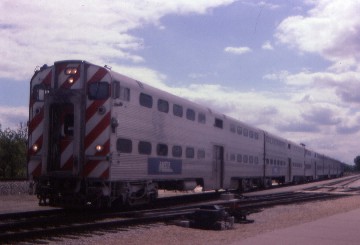
My train at 179th Street in Orland. The temperature was in the low seventies, making me wonder if this was really August in the Midwest. The train pulled down into the yard and the engineer switched ends, picked me up and we started to journey to Chicago and I sat on the opposite side to take in the sights from that side. Within an hour, I was back in the first class lounge at Chicago Union Station watching World News Tonight as I sipped a soft drink.
Capitol Limited 30 8/15/1996It was another walk out to Track 28, but from the First Class Lounge, it was a long walk. The track was right outside the door but I had to pass the front end of the Empire Builder, a gap of 100 feet, the three low-level cars of the Three Rivers then the cars on the rear of my train, a transition sleeper which connected the sets, three Superliner coaches, the lounge car and the dining car before I reached my sleeping car. The car attendant was waiting, greeted me and crossed my name off his list before I went upstairs to Economy Bedroom 5, my first trip riding in a Superliner II sleeper. I noticed the various changes and improvements to the room from the original Superliner 1 set of cars. The Train Chief visited and introduced herself then gave me details about dinner. I told her the purpose of my trip, showed her my mileage book and she was most impressed. The attendant came next with my dinner reservation and an explanation of the car's features.
We departed on time and as we passed Comiskey Park, it was time for dinner and I was seated with three other people who enjoyed riding trains so we swapped stories and one part of the conversation was what the slowest section of track that any of us had ridden? All agreed that I was the winner with the five miles an hour on the Eureka Southern in Northern California. I had a filet mignon with a borderlaise sauce which was excellent. Following my meal, I walked back to the lounge car to be greeted by a queue extending into the next coach, which was passengers who had missed their connections from western trains to their eastern trains yesterday, so they had to take today's train to reach their destinations. My attendant brought me a gift of a Capitol Limited glass coffee mug before I made my bed and fell fast asleep.
8/16/1996 Awakening east of Pittsburgh to old deserted buildings of the steel industry, I went to the dining car for a breakfast of French Toast and sausage followed by a visit to a nearly-deserted lounge car. During the night, we lost an hour but with a two-and-a-half-hour window between this train's arrival and my next departure in Washington, DC, I was not worried. We also had travelled over a new section of mileage between Cleveland and Pittsburgh. I chose my favourite seat in the Superliner Lounge car for this morning's ride over the former Baltimore and Ohio Sand Patch grade across the Appalachian Mountains. The most noticeable difference from my first trip in 1990 was where I was sitting since then, I was in the front seat of the dome car looking out over the train. Today, I was in the lounge car looking straight out of a side window. In the dome seat, I saw the tunnels as we approached them but now I had to anticipate where they were, which made it a little more interesting. We passed through the forest and small town America which line the Youghiogheny River of Pennsylvania to the valley of the Casselman River at Confluence, which we would follow to Rockwood Tunnel at the summit of Sand Patch Grade.
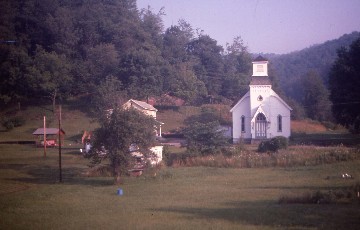
Twisting and turning, we climbed steadily until we popped into the tunnel cresting the Appalachian Mountains to the headwaters of the Potomac River, which we would follow to Washington, DC. Passing through the CSX yards after Cumberland, I decided nap then awoke at Martinsburg to a public address announcement about connecting trains in DC. We had lost another forty-five minutes during my slumbers due to CSX track work, so I went to the dining car to find out about my connection. The Chief informed me I would have no problem and gave me a fifty dollar service voucher to make up for the train's poor performance. That showed me that Amtrak took pride in their service.
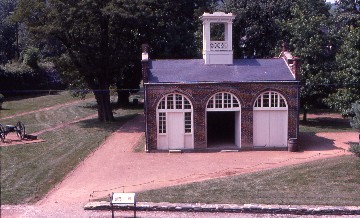
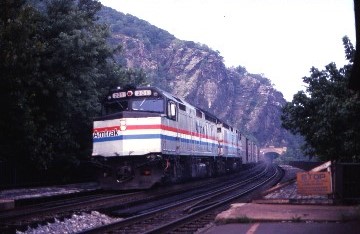
John Brown's Fort as seen from the train, which was erected in 1848 as the Armory's fire engine and guard house. John Brown (1800-1859) was a militant abolitionist best known for the part he played in the violence of Bleeding Kansas (1854-1859) and his raid on Harpers Ferry, Virginia (now in West Virginia) in October 1859. Brown developed an intense hatred for slavery as a child and this, coupled with his evangelical Christian upbringing, convinced him that God had called him to end slavery in the United States. Although there were many factors leading to the American Civil War (1861-1865), Brown's raid on Harpers Ferry was a significant catalyst in the secession of the Southern states, and many abolitionists of the time and historians afterward have claimed John Brown started the Civil War that ended slavery, just as he claimed he was called to do.
After we stopped at Harpers Ferry station, I managed a glimpse of the Hilltop House where I stayed in 1990 while we crossed the Potomac River and entered Maryland. We paralleled the river and the remains of the Chesapeake and Ohio Canal, then briefly stopped in Rockville and passed through the suburbs of Washington, DC before we travelled along the route of Washington Metro subway for the final miles into Washington Union Station, arriving one hour and forty- five minutes late.
Silver Star 81 8/16/1996With less than eight minutes to spare before the Silver Star was scheduled to depart, I detrained from the Capitol Limited and walked the length of the Star to find my heritage sleeper, boarded the car and found Roomette 6 in the Tampa section of the train. The Silver Star splits into two sections at Jacksonville, Florida, with mine going to Tampa via Orlando while the other goes to Miami via Ocala. In November, there was not going to be a Tampa section anymore so Amtrak will close their Tampa maintenance facility and the Silver Star will be re-routed via Orlando to Miami and a new train, the Silver Palm, with serve Ocala and pass through Tampa on its way to Miami.
I could have walked very slowly to board as it departed thirty-five minutes late and walking back to the lounge car though the coaches, I found out why the Tampa coach section had been sold out three months in advance. Two-and-a- half cars of Girl Scouts and their families from Philadelphia were on their way to Disneyworld in Orlando and I called these coach cars the "Zone". Children were playing games and some were blocking the aisle, food was being passed, or in some cases, thrown, headphones from the television monitors which showed films were left on the seats with the volume at full strength so the soundtrack could be heard, trash was being batted around like a volleyball and it was akin to a picnic in the park, but on a train. Walking through this "Zone" required great care and patience as it was the largest group of coach passengers I had ever encountered.
Once in the lounge car and with a ginger ale, I decided to only cross the "Zone" for my meals, then returned to the peace, quiet and the sanity of my room. At 5:15 PM, it was back through the "Zone" to the dining car for the best chicken dinner I had had on an Amtrak train, then a visit to the lounge for a fresh supply of ginger ale and my last crossing of the "Zone" for the night. Entering North Carolina, I was treated to an amazing display of Mother Nature in a combination sunset/lightning storm of multi-coloured clouds and brilliant flashes of light. I then made my bed and was asleep before Raleigh, the state capital.
8/17/1996 The next morning I awoke after Jacksonville, Florida, having slept through the splitting of the train and was travelling this route southbound for the first time. Breakfast awaited me so I made my way through the "Zone" to the lounge car; it was much wilder with the anticipation of Orlando. Since the dining car goes to Miami, the Amlounge served a tray meal of French Toast and sausage as part of the sleeping car package, then upon completion of breakfast, I chose a table in the lounge section, which also serves as the smoking section, rather than return through the "Zone" and in addition, it enabled me to have a rear door view. At Winter Park, I moved to the other end of the car, meeting a foursome going to Tampa who pointed out the sights to me as we travelled south through the Sunshine State. The conductor stopped at our table when he heard the purpose of my trip, looked through my mileage book and was completely amazed.
Orlando came and the "Zone" detrained, leaving nearly three empty coaches, now known as the "Quiet Zone". We passed the Miami section of our train at Auburndale, going in the opposite direction, since the trains shared the same route for about five miles before we reached the junction with the Ocala route.
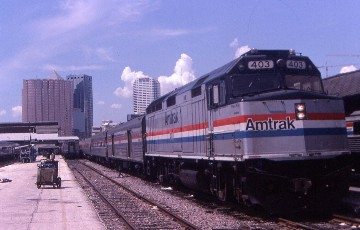
I was on the last section of new mileage then we stopped briefly at Lakeland before reaching the outskirts of Tampa, where the train was wyed and reversed into the Tampa Union Station, stopping at 12:17 PM Eastern Daylight Time. With that, I had completed riding every route of the Amtrak system. As I stepped off the Silver Star, the conductor announced that "Passenger Christopher Guenzler has just completed riding every route on the Amtrak system, let us all give him a hand!" Station workers, the train crew and passengers all came over to shake my hand and it ranks as one of the proudest moments of my life.
Tampa 8/17/1996The Holiday Inn shuttle arrived and took me to their hotel. The corridor air conditioning was not working so the ninth floor hallway was 125 degrees.
8/18/1996 A good full breakfast cures the hungry and I watched a few hours of television before checking out and returning to the Amtrak station and I waited for the Thruway bus to take me to Winterhaven and a connection to the Sunset Limited. Tampa in August is not what I expected since it was very pleasant in the very low eighties with low humidity outside but inside the station it was quite cold as the air conditioner was set for higher temperatures and humidity. It was announced that the bus would leave an hour late since the Silver Meteor was running that late, so I watched some television then later opted for the fresh air and met two nuns, one with forty-six years and the other one forty-two years of service to God and the sisterhood.
Thruway Bus 8/18/96While I am not a bus fan by any means, I was looking forward to this journey as it would allow me to see some more of Florida since this route differs from the train's. There were no passengers in Lakeland and the agent waved to us, then it was a quick ride under threatening skies to Winterhaven, where I waited for my train back to California and home. I was treated to two CSX freight trains and the Silver Meteor before the Sunset Limited arrived.
Sunset Limited 8/18/1996Thunderstorms abounded all around as the Sunset Limited came in. My attendant arranged for a window seat on the right once we departed Orlando, so I was off to the lounge car to watch the train pass through the great thunderstorm at Auburndale. There is nothing like a storm when you are safe inside a train. There were not many passengers aboard so no dinner reservations were necessary and I took the first opportunity and was seated with the two nuns, who were two of the nicest people I have met and were so full of life. After a New York strip steak, I watched "Sgt. Bilko" in the lounge car as we proceeded north and stepped off at Jacksonville to call home. We departed on time and I retired to my coach seat for the night.
8/19/1996 I awoke in Mobile, Alabama and was off to the lounge car for a light breakfast then returning to the upper level, I chose a window seat on the Gulf of Mexico side to enjoy the coastal trip to New Orleans. The sky was overcast with periods of rain as we moved west. Some of the most striking features of this route are the above-ground graveyards, homes built off the ground, the many bays the train crossed over and each of the small towns we passed. Once in Mississippi, I noticed that the gambling industry was much more intense than last April with many new hotels and casinos being constructed. As we arrived in Biloxi, I was listening to a live tape of the Rolling Stones in New Orleans and Mick Jagger asked "Anyone from Biloxi, Mississippi?" Crossing Bay St. Louis, we entered Louisiana and within an hour were passing the City of the Dead before reversing into New Orleans Union Passenger Station. With a three-hour layover, I elected to stay on the train this time, although visited the station to say goodbye to the nuns, mail some postcards and buy a Subway sandwich. Returning to my coach on a near-empty train, I had my lunch and a nice quiet nap for an hour-and-a-half.
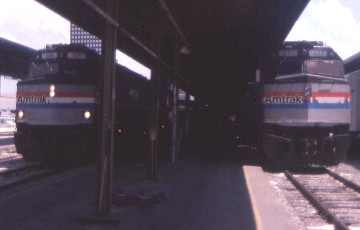
The City of New Orleans on the left and the Sunset Limited on the right. Departing on time, the cast of characters changed with our newly-boarded passengers. I went to the lounge car for the crossing of the Huey Long Bridge and met two park rangers from the Jean Lafitte National Park who would point out sites of interest New Orleans and Lafayette. Jean Lafitte (circa 1780 to circa 1823) was a French pirate, privateer and slave trader who operated in the Gulf of Mexico in the early 19th century. I learned about the bayou region and also what sugar cane looked like. The most common question passengers ask is "When do we see alligators?" The answer is always near Morgan City but I have yet to see one from the Sunset Limited.
I was sitting with a truck driver from near San Jose, whose family moved from New Jersey and he was returning to California after closing his business, something he was hoping to have complete by December so he could retire. He really enjoyed train travel and told me some interesting stories. My dinner tonight was off the lounge car menu, a hot dog, chips and Coca-Cola. As darkness settled across the sky, I witnessed another thunderstorm and tonight's film was "Two of a Kind" which I really enjoyed and it reminded me of "The Parent Trap." I was fast asleep and in dreamland by the time the Sunset Limited reached Houston.
8/20/1996 Sunshine came blazing in through my window awakening me to West Texas about sixty miles west of San Antonio. I went to the lounge car for a light breakfast and found my favourite seat for today's twenty-six hour day ride since we would cross into Mountain Time at Alpine, Texas and into Pacific Time at the Arizona border. I spent the next two hours with the truck driver who was telling many jokes, some of which were quite funny. There was more conversation taking place than usual because there was nothing to see out of the window unless you are looking for something out of the norm, which was a sea of brush extending as far as one can see, with the odd cattle trail thrown in for a diversion. What we spotted as something different were the beautiful pinkish flowers in bloom from the last rainfall in the low spots along the tracks and the elevated hunting towers where the hunters of fowl await their targets. Other than the occasional mountain range thrown in, that was West Texas until Del Rio.
Del Rio had all the characteristics of a Mexico border town and the train stopped briefly then upon departure, paralleled the Rio Grande River for a few miles before the river comes the long way from El Paso via Big Bend National Park. Everyone was staring across the river wondering what Mexico was really like, which I knew having been there a few times. We climbed away from the Rio Grande, saw the Amistad Reservoir and crossed over one of its branches which made me wonder why nothing was being grown, but I surmised it must be bad soil.
More West Texas and more emptiness but the train was on a long ascent to Paisano Pass, the highest point on the Sunset route. We crossed the famous Pecos River High Bridge and everyone was in the lounge car waiting for a diversion to the West Texas norm. We passed freight trains in the numerous sidings along the way and after one long climb then a dip before a short climb, we arrived in Alpine. If the word 'Alpine' conjures up beautiful snow-capped mountain slopes covered with trees and cool mountain air, try Colorado, Montana, Washington or California. This Alpine was hot and dry with every crack on the mountains visible because of a lack of vegetation. Alpine is the gateway to Big Bend National Park and a watering stop for the Sunset's dining car.
We climbed the final miles to the summit of Paisano Pass where we sliced through it then made the 180 mile desert trek to El Paso and I had my headphones on watching the rest of West Texas go by, realizing just how wide the state really was as we reached our servicing stop of El Paso at 5:45 PM. I beat everyone to the phones and upon our departure, we left Texas and crossed the Rio Grande into New Mexico, where we passed within 150 feet of Mexico with a shack city just across the border. It was then trivia time on the Sunset Limited and most of the questions were about presidential running mates. Then came a question I could answer. "We just left El Paso, Texas, what three states are we near?" People were coming up with Oklahoma, Arkansas, Colorado and Kansas. At least I knew the true answer was Texas, New Mexico and Chihuahua, for which I received a Sunset Limited T-shirt as a prize, which coincidentally was very similar to the one I was wearing.
The trucker rejoined me for the journey across New Mexico as we watched the sunset then both of us had an 8:30 PM reservation. Five minutes after we sat down, we crossed into Arizona and it was 7:30 PM again as we were on Mountain Standard Time. The last dinner of the trip was a filet mignon which was prepared excellently and tonight's dessert was a walk to the rear of the train to enjoy this evening's thunderstorm as we ascended and descended the grades of the Dragoon Mountains. The journey to Tucson was quick and I stepped off for my last fresh air break.
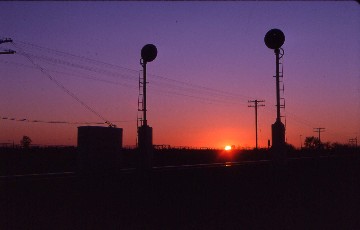
When the Sunset arrived at Picacho, I started to ride over the last miles (not route) of the Amtrak system that I had not ridden, namely Picacho to Wellton, Arizona. The reason for that was until June this year, the train ran via Phoenix. Since the Southern Pacific Railroad ran just one train over the route west of Phoenix on the joint rail route, they put the line up for abandonment and unless Amtrak paid for its maintenance, could not continue to run the Sunset over it. Amtrak would not pay, so now the train now bypasses Phoenix and goes to Maricopa instead. I decided to go to bed after Casa Grande instead of staying up, as the effects of a twenty-six hour day were taking their toll. I asked our conductor to let me know the time of arrival at Wellton, so I would know what time I finished riding every mile of the Amtrak system. That turned out to be 1:37 AM Mountain Standard Time on August 21, 1996.
8/21/1996 The next morning I awoke at Garnet, California outside of Palm Springs as the Sunset climbed Beaumont Hill. This morning there was no Southern Pacific freight trains on the line, something that was very uncommon for a very busy Sunset Route. We had a fast journey down San Timiteo Canyon, crossed the Santa Fe at Colton Crossing and managed to get through West Colton Yard without even slowing. We then stopped at both Ontario and Pomona, had a five minute delay at Industry due to a Southern Pacific switching move, rode down the middle of the San Bernardino Freeway during rush hour and arrived at Los Angeles Union Station one hour and forty-five minutes late.
I gave the trucker a tour of Union Station and bid him farewell then walked down the tunnel to my last train.
San Diegan 772 8/21/1996I climbed aboard the Amfleet train for the quick journey to Santa Ana and home. After an on-time departure, we reached Redondo Junction and entered Santa Fe's Harbor Subdivision to turn the train so I had some unexpected new mileage but at this point, I just wanted to get home. I arrived back at Santa Ana twenty-seven minute late and thirteen days from when I left, having completed the goal I had been working on for 16 years.
| RETURN TO THE MAIN PAGE |