



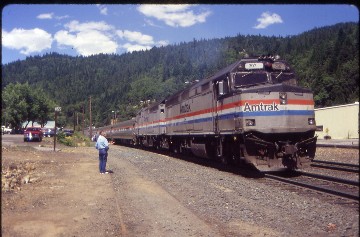
For years, I wanted to see the whole Coast Starlight route in daylight and the Portola Railroad Museum operated an excursion to Dunsmuir as a fundraiser. Passengers had the option to ride to Black Butte, where a wye was located and the crew had to take the train here to turn it in preparation for its return to Sacramento, so that is the one I booked. I took the overnight Amtrak Thruway San Joaquin bus to Bakersfield and found something completely unexpected.
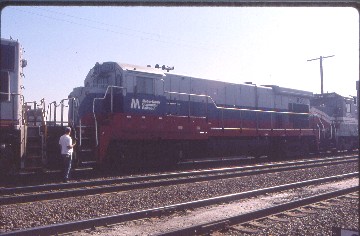
Still in Metro-North paint was BNSF 4206, exx. Metro-North 807, exxx. Metro-North 1909, nee Conrail 1909, built by General Electric in 1978. It was an uneventful ride on San Joaquin Train 713 up its namesake valley to Stockton, where I took the Thruway Bus to Sacramento and spent the next two nights at my brother Bruce's house with his family.
Mount Shasta Daylight 880 Route Information from the museum's handout 6/20/1998Our trip will take us up the Sacramento Valley to Redding, where the train then follows the Sacramento River Canyon to Dunsmuir. From Sacramento, we travel northeast to Roseville. This part of the line was first laid from 1863 to 1864 as part of the Transcontinental Railroad. At Roseville we turn north on a section that predates the Transcontinental Railroad, built in 1861 to Lincoln. From here to Redding the tracks were first laid by various companies, each only going a short distance until they went bankrupt or were bought out by another. Rails reached Marysville in 1868 and Chico in 1870.
North of Chico we cross the Sacramento River on what was once a swing bridge that allowed steamboats to pass, as the river was once a navigable waterway. The bridge is the original, but the swinging machinery is gone now. Just after this bridge we come to Gerber, once a major railroad town with an engine house and servicing facilities. Today the only trackside building left is a lonely warehouse. Here also is the junction with the old 'Westside Valley' line, now the California Northern Railroad. We will then pass through Red Bluff reached in December 1871. We now begin climbing out of the valley, through the rolling hills towards Redding, passing through Cottonwood. The rails reached Redding in September 1872, but ended here for three years while politicians and financiers battled over the routing and financing of the line to connect with the Oregon & California Railroad (building south from Roseburg, Oregon).
As we leave the station, we leave the original mainline, crossing the Sacramento River on the historic Redding Viaduct, the beginning of the Shasta Lake bypass built in 1941-1942. This new route required 12 tunnels (five more than the old line, now under Shasta Lake) and crosses seven bridges. Thirty-six miles later it rejoins the old line, just below Delta. At Delta first reached in 1884, construction halted for a year (again financing problems). Construction finally resumed in 1885 under the Central Pacific's control.
The weather that winter caused many problems. It is estimated that 2,000 men were working on the railroad construction at this time. Rails finally reached Dunsmuir in August 1885. It was around this time that Alexander Dunsmuir of British Columbia, was passing through and offered the residents of Cedar Flat a fountain; if the future community would bear his name. In January 1887, Cedar Flat was moved to the present townsite, then known as Pusher (as this is where extra, pushing, locomotives were added to trains). That spring a station was built and the fountain installed. The fountain is now located in the Dunsmuir City Park, about a mile north of its original location which was at the north end of the raised area now serving as a railroad employee's parking lot.
The train will continue passing under the Interstate 5 highway bridge and traversing a long curve past Upper Soda Springs, an early stagecoach stop and site of one of the many carbonated mineral springs for which this area was noted. In the early days the track in this area was covered with a snowshed, like those over Donner Summit. The train will pass Mossbrae Falls, source of Dunsmuir's 'Best Water on Earth'. Although the forest growth nearly hides it, you may catch a glimpse of it as we cross a bridge over the Sacramento River. Just past the bridge is the former site ofthe Shasta Bottling Works and Shasta Springs. Here there once was a station, warehouses and a siding. Here passengers could stop and taste the mineral water or ride the funicular up the hillside to the resort in the meadow above. The famous water was bottled and shipped from here. Do you remember the phrase, "It Hasta be Shasta"?
After passing through some of the most rugged portions of the canyon, the train finally curves over the river and almost back on itself at Cantara Loop. On long trains, you can see the locomotive going south while you are still going north! We climb up the canyon wall almost to the Shasta Springs resort before the tracks turn north again at Sawmill curve. As we pass Mott, the grand vistas of Mount Shasta open before us. We will travel through the town of Mount Shasta, where the McCloud Railway's tracks take off for their rugged journey across the flanks of the mountain to the town of McCloud. We will continue on to Black Butte. Here the train will turn on the wye where the line to Ashland, Oregon takes off. This is also the site of one of the few remaining functioning water towers, used to refill the steam locomotive tenders. This is as far north as we go on today's journey.
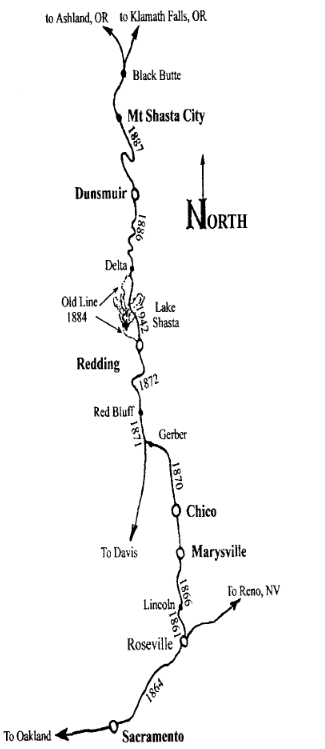
The map of our route. My brother drove me to the Sacramento depot where I found a waiting Amtrak West excursion train of Amfleet cars and the full-length dome car "Ocean View" as the first class car.
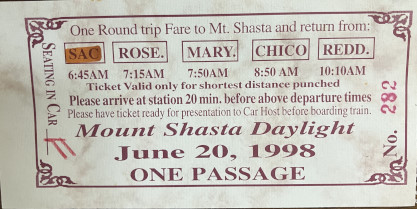
My ticket for this unique trip. I chose a seat on the left seat in the rear Amfleet coach as was my custom when riding San Diegan trains and felt right at home. We departed on time and proceeded northeast to Roseville and did not have any interference from freight trains. After my usual interest in the yards and shops there, we passed the new depot before turning north on the East Valley Line. It was a bright and clear morning with unlimited visibility, a great day for an excursion, as well as to be alive and sober. We went through Lincoln before turning northwest to the crossing of the Bear River and Marysville then crossed the former Western Pacific tracks at Binney Junction before traversing the Feather River and going north-northwest, where off to the west, past Berg siding, were the Sutter Buttes.
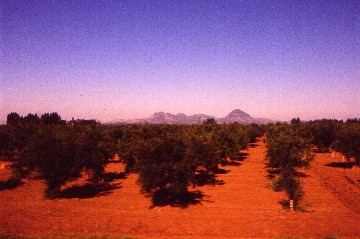
We paralleled Highway 99 to Gridley before curving slightly to run perfectly straight for about 45 miles then went through Chico to Vina, where we turned west to cross the Sacramento River to reach Tehama. Here we turned north to run to Red Bluff and followed Hooker Creek between the foothills to Cottonwood, followed by Anderson and on to Redding. After passing the Redding Transportation Center, we crossed high over the Sacramento River on that long curved trestle on the relocated mainline whose construction started in 1938. Our train made its way north through Silverthorn, Central Valley and Grays Rock then plunged into two tunnels before crossing the Pitt River on the lower level of the joint highway bridge. We entered the next five tunnels which took us to the siding at Obrien and saw the low level of one of the branches of Shasta Lake due to lack of rain and snowfall. Tunnels 8 and 9 were passed through before bridging Salt Creek Inlet to Mead siding, after which we went through the long tunnel 10 and crossed Lake Shasta.
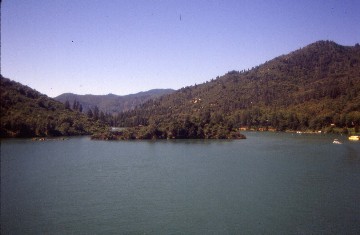
Our special train passed through Lakehead before starting our trek up the Sacramento River Canyon and we crossed the river passing through Tunnels 11 and 12 and back across the river to Delta, where we completed our trip over the relocated mainline. We passed Lamoine where the damage from the Sacramento River flooding was visible and there was a lot of new rock along the river banks. I was really enjoying the views along the river as we would switch sides of the canyon and travel through tunnels, as well as the ever-changing views. Gibson and Sims siding were passed then Mount Shasta started to make an appearance.

We went by Connat before passing through the tiny locales of Sweetbrier, Castella and Dirigo before the Castle Crags came into view then went by the siding of the same name and after that, Mount Shasta was easily seen. It was just a few more minutes before we reached the lower Dunsmuir Yard and continued to pull forward, stopping at the Amtrak stop. For the passengers only going this far, this was their destination, while for us going further, we were allowed detrain.
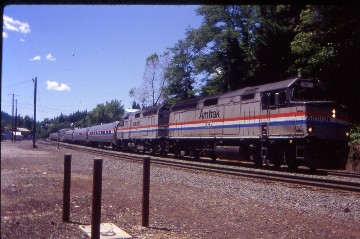
Our special train at Dunsmuir. After the Sacramento passengers reboarded, as well as the locals who wanted a train ride, we departed for Black Butte and passed under the Interstate 5 bridge by the site of the former Shasta Retreat as we followed the Sacramento River to Shasta Springs.
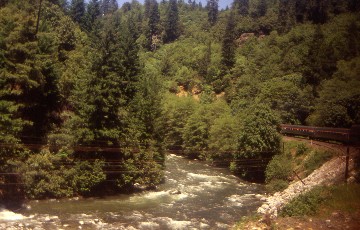
The train passed by Small siding before crossing the river to the Cantara Loop where we crossed the river one last time. This was the scene of Southern Pacific's chemical spill into the river which killed the fish population. As always, nature restored what man destroyed.

We climbed out of the canyon with a fantastic view looking down then past the site where a boulder came from the top of the canyon and rolled all the way down to the river, pushing everything out of its way. This took us to Mott siding, where we met Southern Pacific's RoadRailers I-5 train, which travelled from Seattle to Los Angeles, followed by Azalea. We continued to Mount Shasta City with great views of Mount Shasta but no action on the McCloud River Railroad.
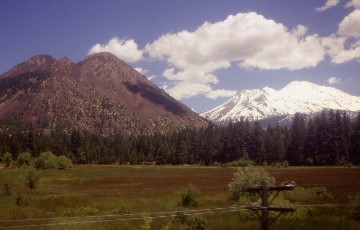
We made our way to Upton, where both Black Butte and Mount Shasta were in the same view. Minutes later, we arrived at Black Butte where our train was wyed and our number changed to Amtrak Train 881, a number used for special movements. We returned to Dunsmuir, where I detrained.
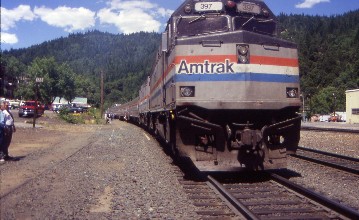
Our train at Dunsmuir, led by F40PH 387. After a relaxing interlude, it was all too soon time to return to Sacramento and the journey back down the canyon was beautiful.
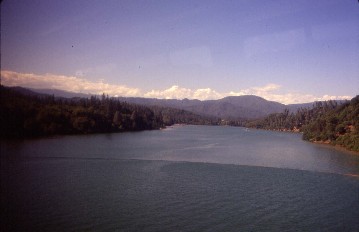
The view from the Pitt River Bridge with clouds in the distance. I enjoyed a relaxing ride to our state's capital, where my brother was waiting for me. The next morning I rode the Thruway bus to Stockton, took train San Joaquin Train 712 to Bakersfield then another Thruway bus to Los Angeles, catching the San Diegan Train 590 home, ending another excellent, but quick, adventure.
| RETURN TO THE MAIN PAGE |