



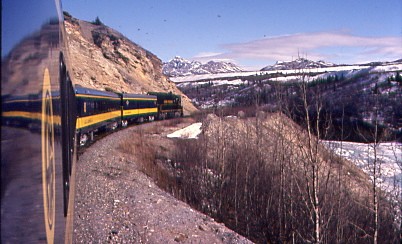
My Alaska trip happened rather suddenly. It all started with a conversation with my friend Mike Norton on San Diegan 589 one night who said that he had Reno Air miles that had to be used before the company was merged into American Airlines, and if I wanted to use some of them I could. I responded "I have always wanted to go to Alaska!" and Mike said that they had one flight a day out of Orange County. "Sounds like a plan to me," I replied. Then Mike made a dummy reservation for me and I changed it to the wrong dates, only later to correct it with the true dates since I was not looking at the correct year's calendar. My next step was to call the Alaska Railroad for a round trip from Anchorage to Fairbanks, the only service offered in April. This was followed by calls to two hotels and with that, I had the journey to Alaska all planned.
4/15/1999 Tax Day found my parents dropping me off at John Wayne Airport (Orange County) for my two-part flight to Anchorage. Leaving John Wayne, I was warned by my Learning Centre partner Pat Conner about the decrease of power that occurs over the residential area to the south of the airport that caused looks of terror on the faces of the passengers who did not know about it. Flight highlights were looking down on the California Zephyr descending Donner Pass at Yuba Gap, Williams Loop, the BNSF Highline, Mount Shasta and Crater Lake. The plane arrived in Seattle on time and I had a four hour wait for my night flight to Anchorage, where I stayed awake the entire journey and as we neared Anchorage, I could look over the top of the earth, seeing the light of day on the other side. It was incredible.
4/16/1999 We landed at 1:00 AM and a van from the hotel picked me up and took me to the hotel for check-in and a good night's rest.
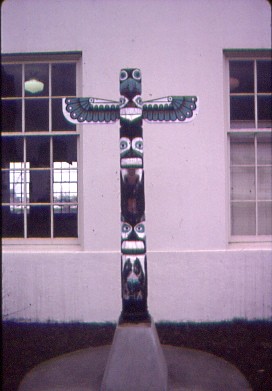
The totem pole outside the Anchorage station.

Alaska Railroad 0-4-0ST 1 built by Davenport in 1907 as narrow gauge Isthmian Canal Commission 802 at Colon, Panama. It was then transferred to United States Engineering Commission 6 in 1917, later becoming Alaska Railroad 6 and in 1930, was converted to standard gauge. In 1947, it was re-numbered Alaska Railroad 1.
This day just happened to be my 1,549th day of sobriety, so all the post cards that I sent had Day 1,549 in the 49th State on them. I went out and explored my new environment, walking down to the station, around Ship Creek and the downtown area, where I found a hobby shop and bought an Alaska Railroad T-shirt before I found a food court in the mall for dinner.
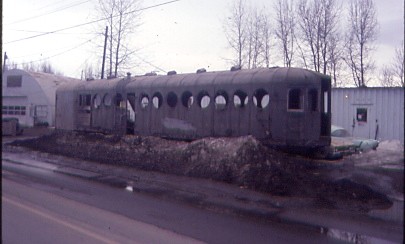
This is the last place I expected to see a McKeen car. San Diego, Cuyamaca, & Eastern Railway motor car "Cuyamaca" built in early 1908, it ran between San Diego and Foster, by way of La Mesa, Lemon Grove, El Cajon and Lakeside, California. It was the main source of rail travel. In 1914, the car was sold to the Yuma Valley Railroad, part of the U.S. Bureau of Reclamation and was used to clean the Colorado/Gila River Valley, to prevent flooding of American Land. The railroad suffered a flood and it is believed that is when the baggage doors were added.
The railroad having done its job, no longer used the car and at about this time, many small railroads were being conglomerated by the Department of Interior in Alaska, forming the Alaska Railroad. The McKeen Car was purchased in 1925 and shipped in 1926. The Alaska Railroad used the motor car in its configuration with the original McKeen engine, McKeen trucks and such, for one year, then they purchased two gasoline sub-floor-mounted engine trucks, with a 104HP engine each, to install under the car. The McKeen trucks and engine removed and controls were installed in both ends of the car to operate in forward or reverse. The car body was also cut and the knife edge nose removed. The C channel was recycled, reshaped and reinstalled.
The re-motorization did not last too long as by 1935, the Alaska Railroad decided to remove the motor trucks and turn the car into a simple combination car, baggage and passenger sections. Between 1945 and 1950, it is believed the car was removed from the rails, someone found a use for the body, as it was not scrapped. There have been accounts of it being in a scrap yard in the 1970s, by the late 1990s, it was owned by a historian and in 2004, it was sold to Anchorage Historical Properties.
I went for a twilight walk around town before calling it a night to be well-rested for my first train ride in Alaska.
The Aurora - 4/17/1999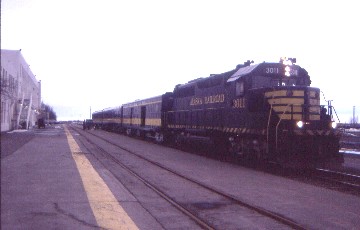
I had a large breakfast before walking down to the station to find Alaska Railroad GP40-2 3011 built by Electro-Motive Division in 1976 in its original paint scheme on the point of our three-car train which included a baggage car and two Korean-built coaches with large picture windows. There were twenty-one passengers assembled waiting to start their journeys inside the nice warm Anchorage depot on a very overcast and cool morning. The door was opened and all passengers were greeted by conductor Steve, who welcomed each aboard. I chose a left side seat and waited patiently for my train ride in my 49th state to commence.
The train departed on time and proceeded north through the Alaska Railroad's yards before leaving town. Conductor Steve started his running commentary of the line which gave sufficient information to keep it interesting but not too much to be boring. The rear car was full of future line guides who on a training trip since this was a pre-tourist season train. Summer trains can run up to eighteen cars with the inclusion of the tour groups' cars from Princess Tours and Holland America.
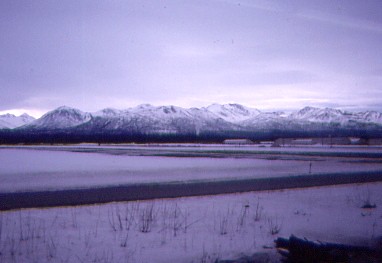
We passed Elmendorf Air Force Base, which is the largest in Alaska. Off to the right were the Chugach Mountains, the ground was covered with a blanket of snow and the high forties-degree temperatures allowed limited Dutch door riding, which is where I took pictures then explored the train, ending up in the rear open vestibule before returning to the warmth of the inside.
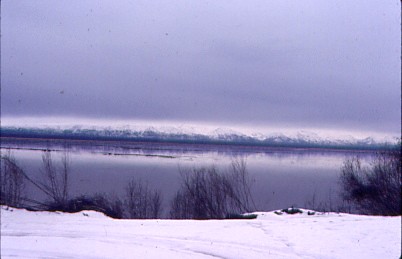
We crossed Eagle River at Milepost 126 prior to running along the Knik Arm of the Cook Inlet with Mount Susitna standing guard on the far side of the inlet to the west.
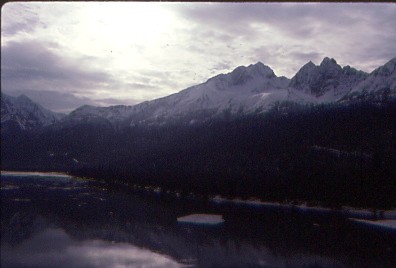
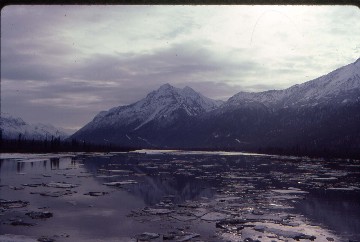
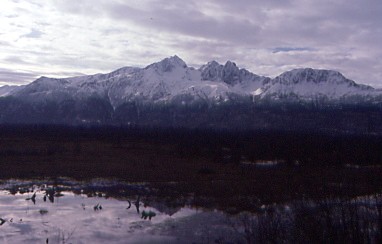
The train reached the crossing of the Knik River with floating ice and the mountains reflecting in the water, making a most beautiful scene. As the train passed through Birchwood, Twin Peaks and Pioneer Peak, all came into view.
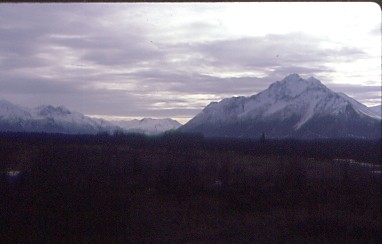
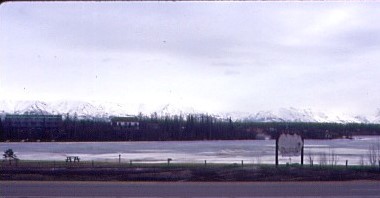
The branch line to Palmer took off at Matanuska, Milepost 151.0 before we crossed the river with the same name. The views that looked east up the river valleys were very impressive then the tracks turned to the west towards Wasilla, which is a regional center and has the world's largest fly-into mall. There are more airplanes than cars in Alaska. Wasilla is one of those palindromic names which if you reverse, becomes "All I Saw." Wasilla is also the home of the Museum of Alaska Transportation and Industry, which has a large railroad collection.
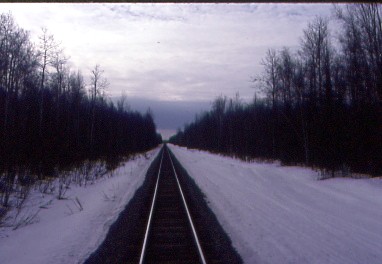
The train next passed by the very frozen Nancy Lake, one of the few lakes along the Aurora's route, then traversed the Little Susitna River before passing through Willow and began to follow the frozen Susiina River, where we passed through Montana at Milepost 209.3 and Sunshine at Milepost 215.3 before arriving at our next station stop of Talkeetna, Milepost 226.1.
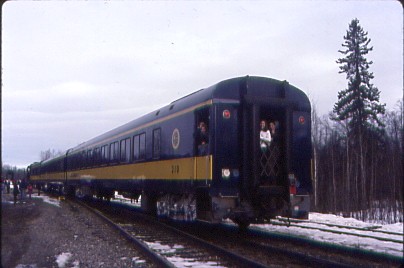
This town has the last highway access along the route for many miles so we had an extended stop here while the new passengers loaded the baggage car with and boarded the coaches.
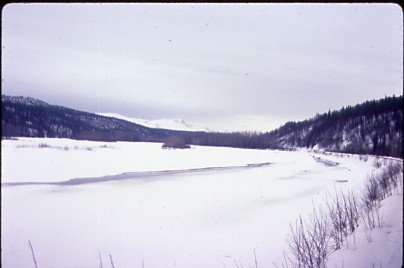
The Aurora departed and continued north into the frozen wilderness.
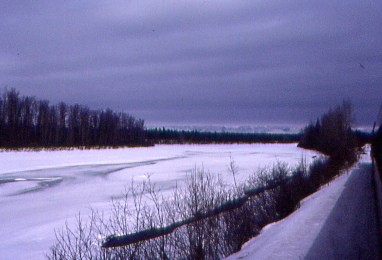
We crossed the Talkeetna River at Milepost 227.1 before returning to the banks of the Susitna River; the Chulitna River joined it a few miles north.
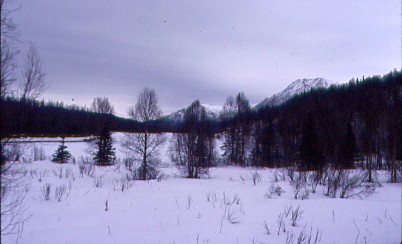
To the west was the Alaska Mountain Range with the Talkeetna Mountains to the east. The Aurora would make flag stops and drop people or supplies off anywhere on its route.
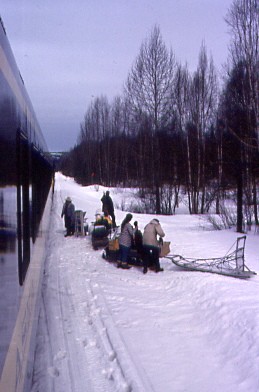
We were met by snowmobiles pulling sleds to pick a family up from the train. Conductor Steve dropped off newspapers for people who live along the route.
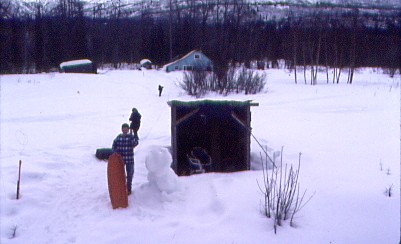
At Milepost 244, we stopped for a family with a half-built snowman standing guard and a shelter with a chair, a deluxe flag stop with their cabin a quarter of a mile away. Conductor Steve had a cabin along the tracks and we stopped to drop off his daughter Carrie at a neighbour's house for the night.
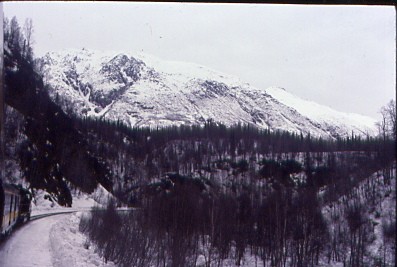
We crossed the Susitna River prior to making one last snowmobile-with-sled flag stop then continued upgrade, crossing the Indian River at Milepost 269.9 and following its course into Indian River Canyon.
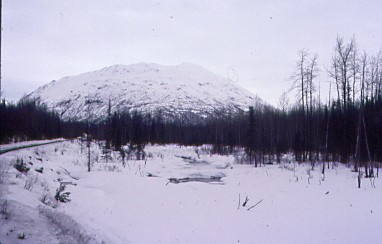
The train passed some beaver dams and Steve taught a lesson on the beaver's winter survival patterns. It was a pity that it was cloudy because my guide book mentioned that excellent views of Mount McKinley could be seen along the last eighty miles on a clear day. Maybe I will have better luck on the way back.
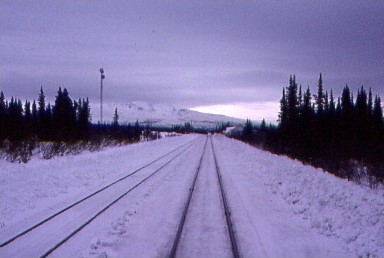
The Aurora passed Canyon Siding and continued the climb to one of the most famous and impressive places on the Alaska Railroad, the Hurricane Gulch bridge at Milepost 284.2
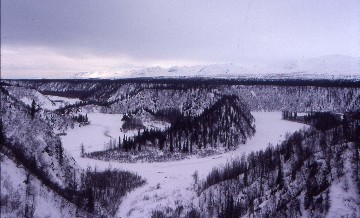
Built in 1921, Hurricane Gulch bridge spans 918 feet and rises 296 feet above the creek. We stopped on the bridge for ten minutes so all could enjoy the fantastic view and it almost looked as though it was a black and white painting with the Moose Tooth Mountains in the background.
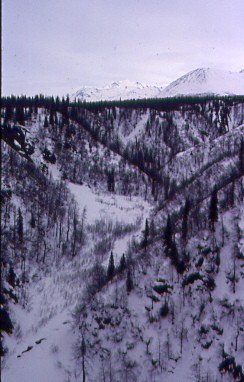
A truly awe-inspiring view.
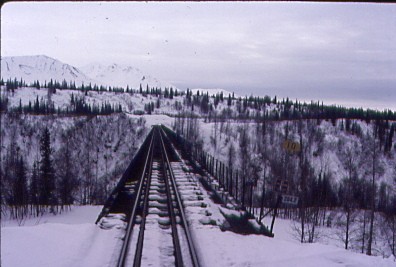
Once on the move again, we proceeded to Honolulu at Milepost 288.7, crossing the creek of the same name. The name was reported as coming from prospectors.
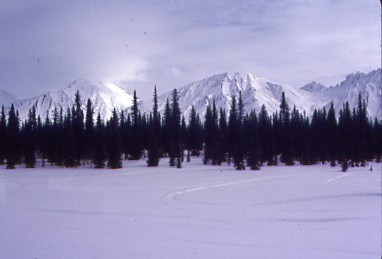
The setting for the siding at Colorado, Milepost 297.1, does look as though it could be up in the mountains of Colorado. However, it was a flag stop listed in the 1922 timetable, serving an access route to once dormant gold mines that later became active again. The valley opened to become wider as we arrived at Broad Pass with its treeless environment.
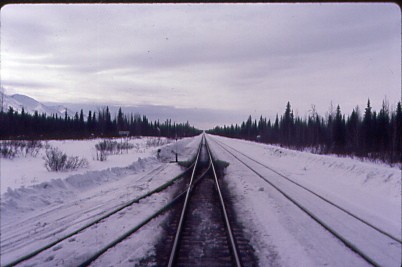
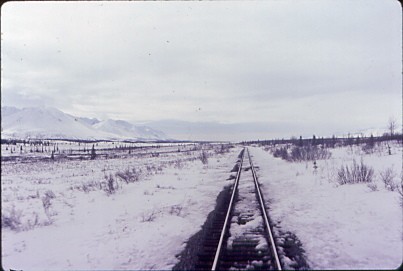
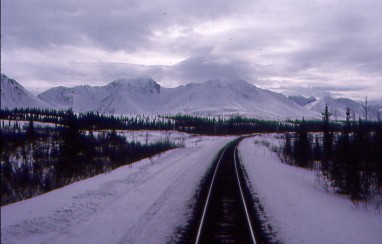
When the train reached the summit of Broad Pass at Milepost 304.3, we crossed the Continental Divide at an elevation of 2,363 feet, the lowest rail crossing of it in North America.
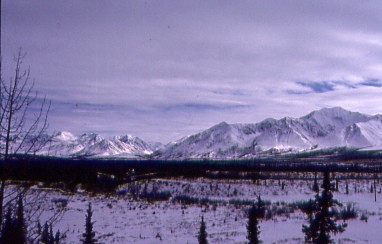
The view of the mountains was outstanding. Summit Lake was off to the west hidden under a blanket of snow this time of year.
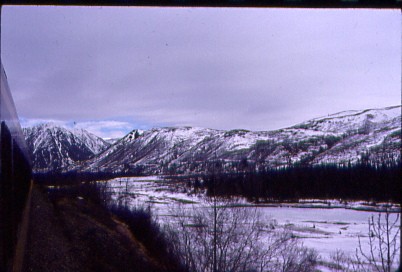
Continuing north, off to the west was the University of Alaska Reindeer Research Institute at Cantwell, Milepost 319.5. The sun was seen for the first time today and the skies were clearing as we made our way north towards Fairbanks.
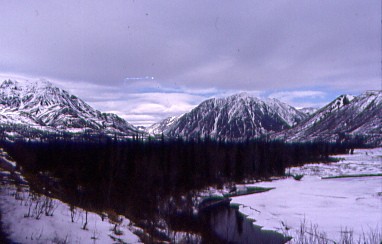
The tracks joined the valley of the Nenana River, which the Aurora followed for the next eighty-five miles to the town of Nenana on the banks of the Tanana River.
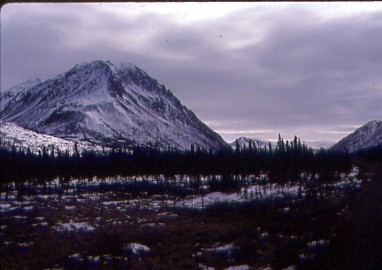
To the right of the train were the Panorama Mountains and to the northwest were the Fang Mountains. We then passed Windy siding at Milepost 326.7, named for a very obvious reason.
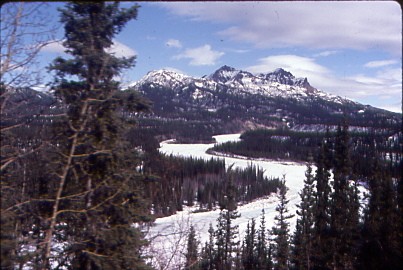
This was the start of the train's descent of thirty-two miles through the Nenana River Canyon. The River was frozen and made for a beautiful scene near Oliver at Milepost 342.7.
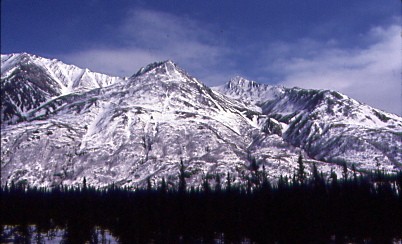
Pyramid Peak loomed high over the canyon to the east.

We then crossed Riley Creek just prior to our next stop at Denali Park, Milepost 347.7, where a single passenger detrained.
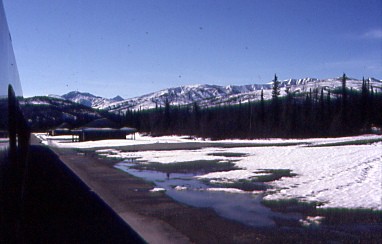
The Denali Park station had a very large asphalt waiting area and Conductor Steve asked me to join him on the ground for a few minutes. He then said, "Chris, picture in your mind a thousand people standing here waiting for the train to pull in. Here comes our 18-car train with the tour group cars on the rear with a thousand people waiting to get off. The train comes to a stop and in ten minutes, the thousand people have all switched places in what can be only called unorganized chaos".
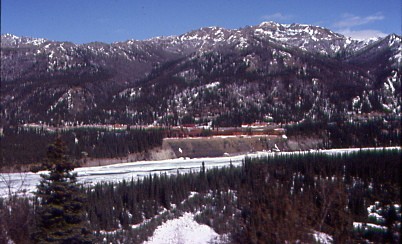
Across the river was the Denali Park Lodge.
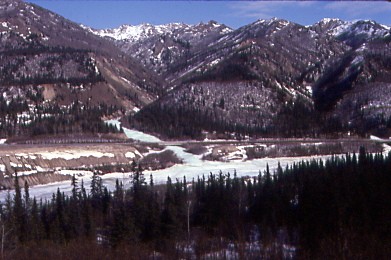
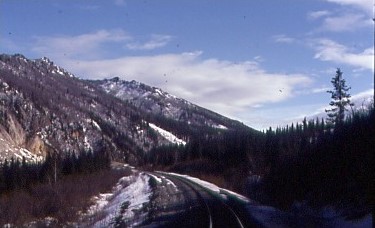
Now we made our way into the narrowest part of Nenana River Canyon and the river stood out beautifully frozen against the rock walls.
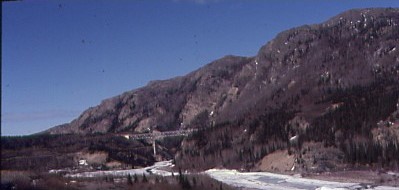
Just before the Moody highway bridge, we travelled over a length of track in the canyon where the slope was in a state of slippage then we ducked under the highway bridge and entered the first tunnel of the day, Moody Tunnel, at Milepost 353.6.

The rock walls were almost vertical here and the waterfalls entering the canyon were all frozen in time.
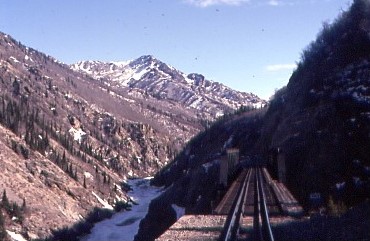
This section reminded me of the Durango and Silverton Railroad's line through the Animas River Canyon in Colorado.
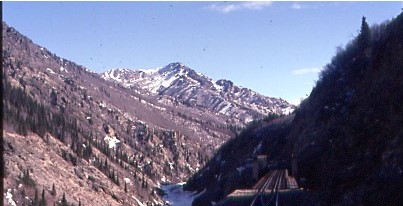
We went through Garner Tunnel at Milepost 356.2
The tracks made a hard right turn followed by another to the left that brought us into Healy at Milepost 358.7.
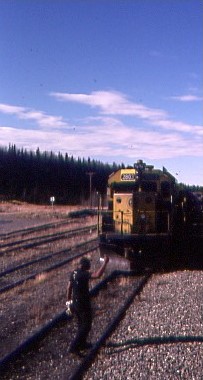
Healy, with its lignite coal mines, was where we met Alaska Railroad 2803 South, a coal train. Upon departing, we passed the Usibelli Tipple, a special loading facility with a railroad track running through the centre for coal loading. The coast is mined across the river and transported to the tipple by conveyer. The coal is sub-bituminous with a relatively BTU per pound, but it is relatively clean-burning due to its low sulphur and nitrogen content.
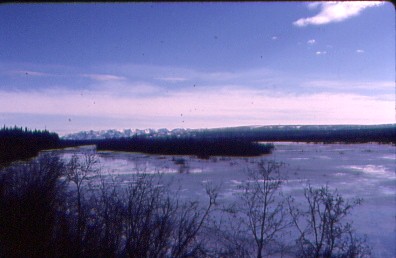
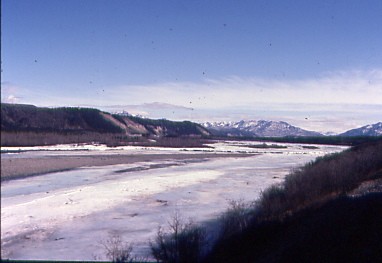
Nenana River was then traversed for the only time. When the river is running ice-free, people will keep a car on both sides and use the railroad's bridge to cross the water then when the river is frozen, they drive right across it and by using these methods, it allows for year-round access to this area of the state.
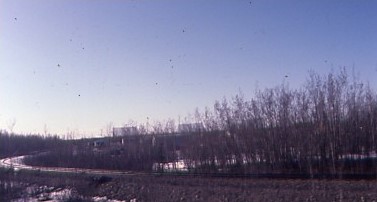
We travelled on the east bank of the Nenana River before diverging away to Clear Site at Milepost 392.9, a Ballistic Missile Early Warning Site, one of three in the world. Built in 1959, Clear Site was designed to detect enemy missile attack. It is now used to track satellites and space debris. Air Force personnel stationed here receive overseas pay and their families are not permitted on the base due to its top secret security status. There are several spurs into the facility as well as a 6,212 foot siding to the east. The station's antennas stood out against the clear blue Alaska sky.
We reached the trees of the Taiga and this was my first time seeing them but knew it would not be my last if I continue to ride trains in the northern parts of Canada, Europe and Asia.
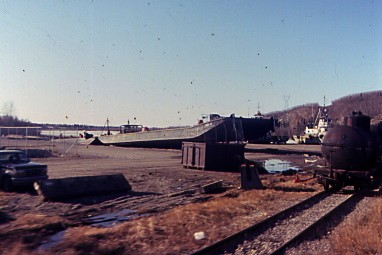
The Aurora had now reached Nenana, Milepost 411.7, on the banks of the Tanana River, where grounded barges wait for the spring thaw.
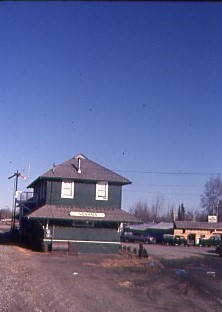
The town has an active train station, built in 1923, complete with an order board and I saw two Harriman-style coaches.
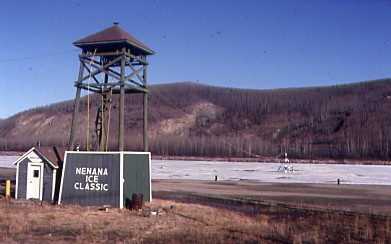
However, it was what was out on the middle of the frozen Tanana River that Nenana is most famous for. The Nenana Ice Classic, a contest which began in 1917 among surveyors for the Alaska Railroad, is held each year. A four-legged 'quadpod (tripod) connected by a cable to a tower which is hooked up to GPS and other devices so that when it starts the move, the winner is chosen. Bets are made on the exact day and time the river ice will break up. The winnings exceed $200,000 and are usually split between multiple contestants.
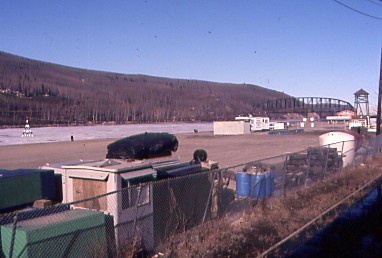
Off to the east, the Mears Memorial Bridge was seen but to gain elevation to cross it, the Aurora looped back to the southwest.
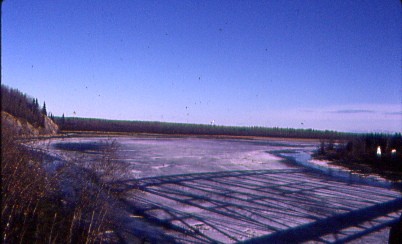
Crossing the Tanana River on the Mears Memorial Bridge. It includes a 704 foot steel through truss span, the largest of its type in the world when constructed, 60 foot deck plate girder spans and four 30 foot deck plate girder span and a 118 foot deck truss span. The bridge was designed by Modjeski and Angier and was fabricated and built by the American Bridge Company. When built, the south end also featured a long timber trestle which created the curved, climbing approach that is now a large fill. The bridge is named for Frederick Mears, head of the Alaska Engineering Commission that built the railroad.
It also marked the completion of the Alaska Railroad in 1923 and the Golden Spike was driven by President Warren Harding on July 25, 1923. Mount McKinley could be clearly seen in the distance and further north at Dunbar at Milepost 43.6, a -70 degree Farenheit temperature was once recorded. The train passed through the low hills with Taiga trees abounding then at Saulich, we encountered a track grade problem where a culvert was still frozen and the water was seeping through the fill, causing our train to gingerly creep across this section of track.
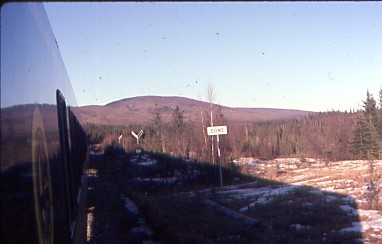
When the Aurora reached Dome at Milepost 456.2, the furthest point north by rail in North America, it was a complete coincidence that I passed my 434,000.0 rail mile and hard to believe that the both occurred at the same time.
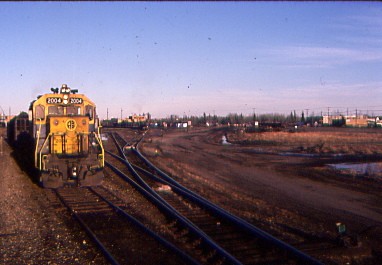
From Dome to Fairbanks, the tracks turned to the southeast and were built on the narrow gauge railway of the Tanana Valley Railroad, which for years had a third rail for the narrow gauge trains. We passed the University of Alaska, where a gas-electric passenger car, the Toonerville Trolley, once provided a way for students to get from Fairbanks to the school. The Aurora crossed the Chena River before entering the yards of the Alaska Railroad in Fairbanks and we passed the railroad's northern shops before stopping on time at the depot, the end of the northbound trip at Milepost 469.8.
FairbanksI managed to get the first taxi which took me to the Comfort Inn in a woody section of town then walked to K-Mart, visited a fast food eatery and stopped at a store for some snacks for the return trip. The walk back to the hotel was very relaxing and there, I fell right into a deep restful sleep.
The Aurora 4/18/1999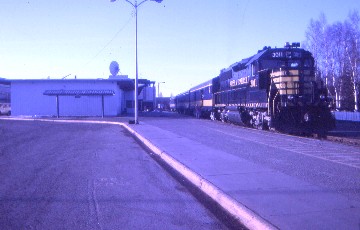
I was back down at the train station early with the train bathed in perfect morning light.
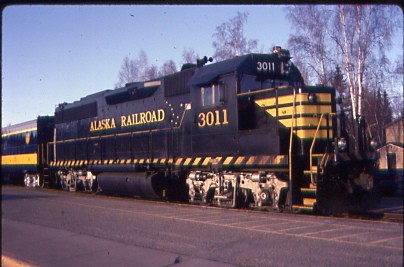
My camera would most have a rest today. We departed on time and started the journey south to Anchorage.
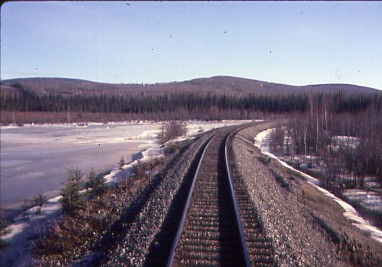
With last night's low temperatures, the train had no reason to slow for that seeping fill as it was still frozen. It was a beautiful clear day and I relaxed and enjoyed the experience.
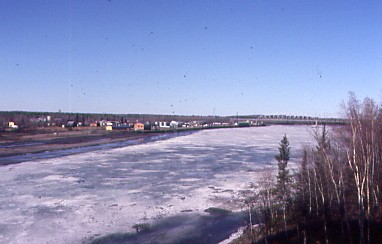
I went to the vestibule for our crossing of the Tanana River.
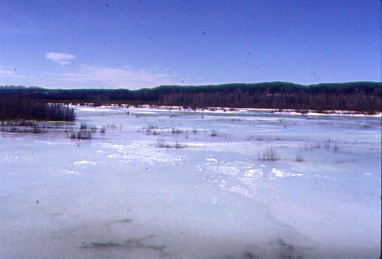
We paralleled the still-frozen Nenana River but the spring thaw was very near.
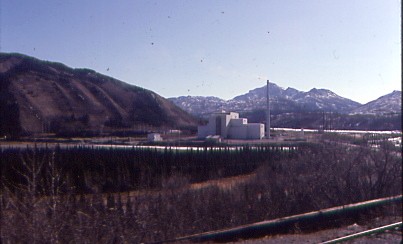
The Aurora passed the coal mining district of Healy.
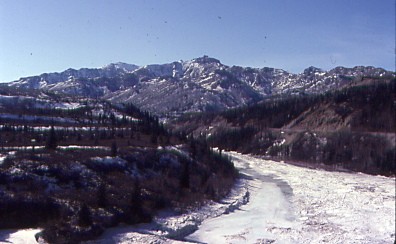
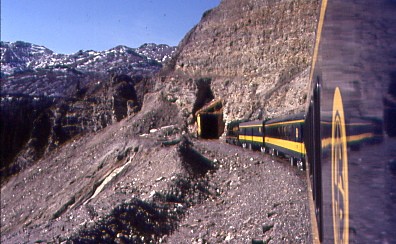
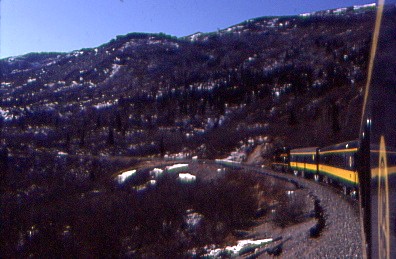
Our southbound passage through Nenana River Canyon was very beautiful.
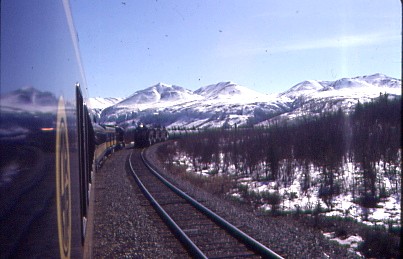
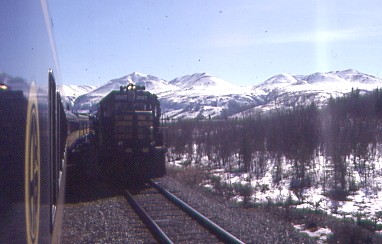
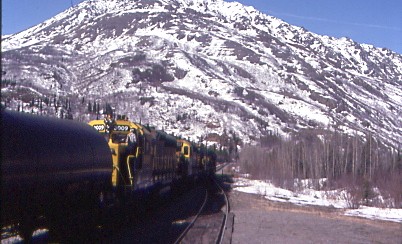
The next highlight was meeting Alaska Railroad 3007 on a northbound coal train at Windy, with the place living up to its name. The rest of the trip I was hoping for a clear view of Mount McKinley but that was impossible since the 20,320 foot south peak rises 14,000 feet above the surrounding mountains so that the clouds are attracted to it. I did manage to catch the top of the peak standing out above the clouds.
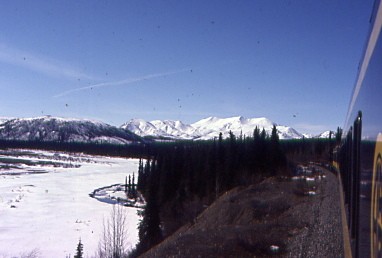
We continued along the Nenana River towards Broad Pass.
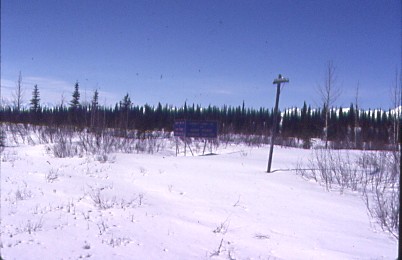
Passing the Continental Divide sign at Broad Pass.
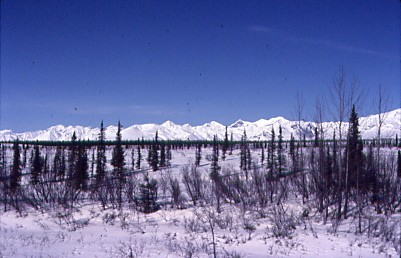
We next travelled through Colorado.
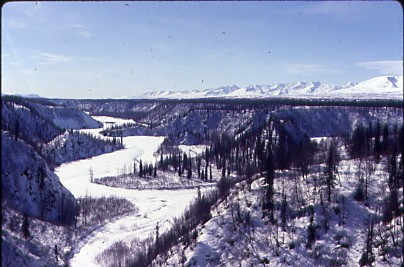
Hurricane Creek was crossed and another short photo stop was made.
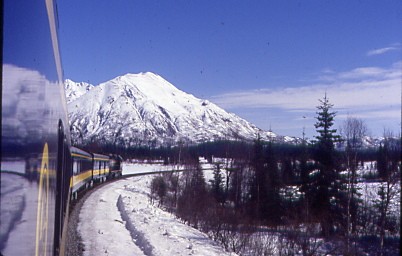
Rounding the curve near Chulitna.
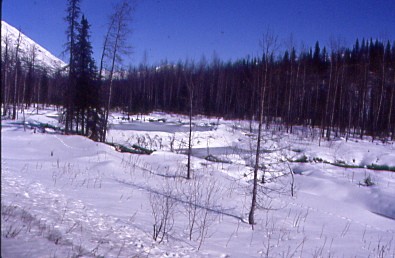
A better view of the beaver dams.
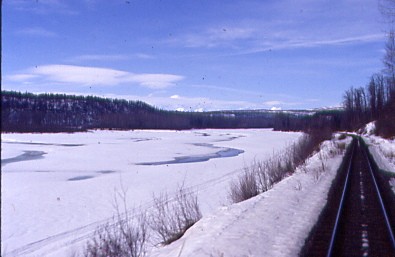
The very top of Mount McKinley could be seen popping out of the clouds as we travelled along the Susitna River.
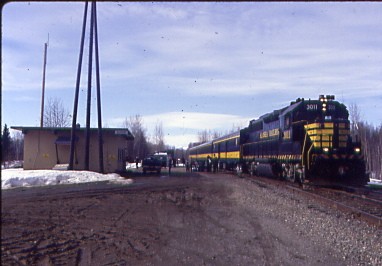
The Aurora at Talkeetna.
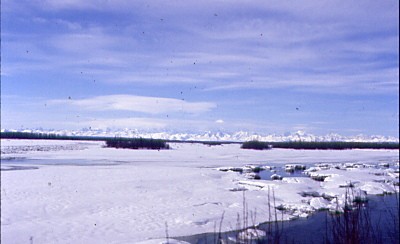
Another view along the Susitna River.
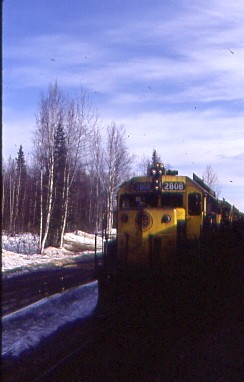
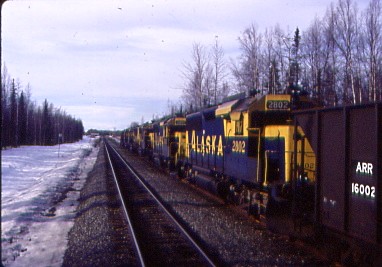
Continuing southward, we met Alaska Railroad 2808 North at Willow.
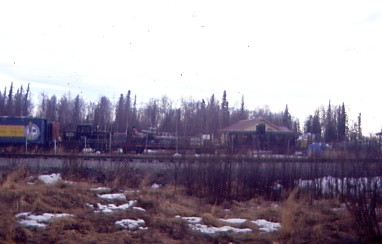
The Museum of Alaska Transportation and Industry at Wasilla.
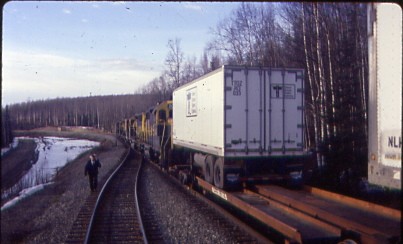
We went into the siding at Reeves for Alaska Railroad 3002 North.
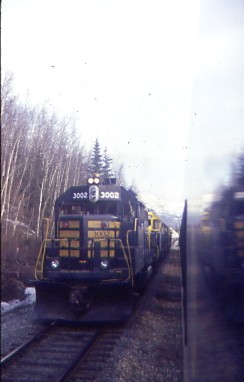
Conductor Steve had to throw the switch to send the freight on its way then we rolled the last few miles and arrived back in Anchorage on time. As I said goodbye to Steve, he gave me a couple of employee timetables and the train orders for our trip and I walked away, thinking what a perfect time of the year to visit Alaska. No tourists - just the true Alaskans as they really are. Snow and ice with pleasant temperatures, normal days and nights and no insects. Just a group of very helpful, friendly and caring people because you are special being there at this time of the year. Yes, April is a great time to visit Alaska.
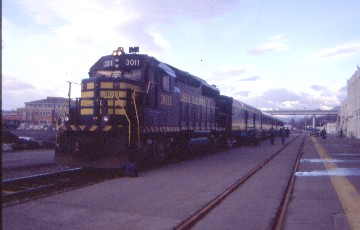
The Aurora returned to me to Anchorage.
The Journey HomeFollowing an excellent final meal at the Hilton Hotel, I waited for the van to take me back to the airport for my 1:40 AM flight to Seattle.
4/18/1999 I boarded my flight and had three seats to myself so slept the whole way, where it became rainy after we landed. My flight home to Orange County started with 'no fuel' report being left for the pilot so they had to test the fuel. Due to a schedule change, we went via Reno, Nevada with clouds all the way to the state line of California then after a quick in-and-out of Reno, we flew to John Wayne Airport, where my Alaska adventure came to an end. That night, I was back doing my daily San Diegan train riding thinking 49 states down and one more to ride a train in for all 50 states.
| RETURN TO THE MAIN PAGE |