




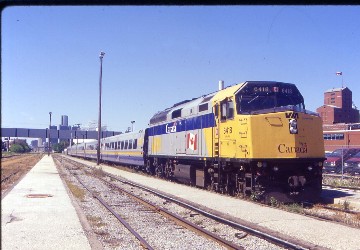
I decided to reclaim Canada for my sobriety in summer 1999 and would go back over all the routes on which I drank except where the train no longer operates and add as many new routes as possible. Since I had ridden every mile of the Amtrak system, I needed a new goal, which was to ride every mile of VIA Rail of Canada then set my sights on other passenger routes in that country. I started planning the trans-Canada trip last November by writing schedules of trains I wanted to ride on 3x5 cards and arranging them in a long process of trial and error. After many errors, it all came together thanks to an Intercar bus to Jonquière. My friend Barry Christensen wanted to join me but when he saw my final itinerary, thought that it would cost too much in August so he decided to do a slimmed-down version in May when it was off-season.
On February 5, 1999, I made my reservation with the North American Rail Pass desk and that same night, purchased it from Karen, the Amtrak agent in Solana Beach. Unfortunately that station did not have any of the Pass books so she called Julie in Oceanside and one was brought out to me when I stopped there on San Diegan 589. With all the Amtrak and VIA routes ticketed, I had to wait for Amtrak to add the Heartland Flyer schedule to their internal ticketing system Arrow, which was done the last week of May.
Once I had my North American Rail Pass, hotel reservations were the next task for the overnight stops so went to AAA and booked everything except Senneterre, since it was not in the tour book. When I returned home, I did not like the price of the hotel in Chicago and since I had toyed with the idea of staying in Milwaukee so I could ride the Hiawatha Service, cancelled the hotel Chicago and booked one in Milwaukee then called Amtrak to add the round trip. Once that was done, it was time to get a room in Senneterre so I called the Quebec Tourism Board, who sent me an Abitibi regional guide book and I called a particular motel and managed to talk to someone whose only words of English were "Can I make a reservation for you!" I said yes and he just kept repeating his one line. Trying my best to get him to change his line, I could not, so thanked him and realized I needed someone who could speak French. One morning at work, I was talking to fellow teacher Anne Divine and told her my story, to which she replied that she spoke French and offered to call for me. About a week later, I went to her seventh period class, used my calling card and reserved the hotel on the line and she took over speaking a language that I could not, but with great success. My room choices were Bad, Good or Very Good and I naturally chose Very Good but was dying to know what a Bad room looked like. With that done, all I had to do was finish the school year at McFadden Intermediate then work six weeks doing a pair of special handicap classes at Santa Ana High School.
The Thruway Bus to Bakersfield 8/7/1999It was 12:45 AM when that bus finally arrived at Santa Ana station and there was a van waiting in case our bus broke down as it had come from Long Beach rather than San Diego. I did not sleep due to the excitement of the trip but with my headphones on, the ride passed very quickly and when I arrived in Bakersfield, it was a nice cold morning.
San Joaquin 711 8/7/1999I boarded a California coach-baggage car choosing the single end seat for the five extra inches of width and enjoyed the pre-dawn speed of the train after having a Belgian waffle without any syrup because the Oakland commissary did not bother to put any on the train and it made me wonder if that would happen on a VIA train? I improvised with whipped cream then north of Fresno, I slept until the attendant's bell ringing from the bathroom woke me up. After the almost constant ringing, I went downstairs, assuming that it was some children just having fun. However, a lady was trapped in the bathroom and I forced the door open to get her out and she told me that she had helped someone get out who was trapped before her. I used the public address system to alert the conductor to lock the offending door before any other passengers were in the same boat and we all shared a good laugh when all was said and done.
The only delay of this first train segment was at Riverbank when the wheelchair lift on the last car had a problem, but other than that, it was another nice trip across the Delta and brought back the memories of June's National Railway Historical Society excursion to Richmond. There was no longer any reason to wish to go over the tracks through Franklin Canyon because I did that already.
We arrived in Martinez on time and the city was having an antique street fair, which struck me as funny, as all of this part of Martinez is nothing but antique shops. However, a nice tri-tip sirloin stand was set up and knowing that this would be better than anything on the California Zephyr's lunch menu, I decided to have a sandwich which was excellent.
The California Zephyr 6 8/7/1999This train arrived fifteen minutes late and for the last week I had been tracking the Zephyr, with its best trip eighteen minutes late and its worst six-and-a-half-hours late due to brush fires, the centralized traffic control system being out in Nevada and just being out of its normal time slot. It just showed how much Amtrak is at the mercy of the operating railroads and the forces of nature.
Once on the move, I noted that the mothballed United States Navy fleet had grown since my last passage in June then we passed four freights on the way to Sacramento, with the California Pacific was once again a busy freight railroad. On the way to the Sacramento station, the former Railfair grounds in Old Sacramento were empty of people and equipment, a vast difference from the festivities in June. We departed thirty-nine minutes late and were passed by two more freights while we did our station work there. Elvas Tower was still standing and the Swift Roadrailer train was waiting for our passage through this important junction.
Even in August, the American River was running high as we crossed over it then along McLellan Air Force Base, we were passed by two more westbound freights then as the Zephyr made its way past the Roseville Yard complex, it dawned on me that this would be my first sober eastbound ride over Donner Pass. I was so grateful for the freedom I had now instead of being a slave to the bottle. The new J.R. Davis yard was very impressive and trains were ready to go in all directions from this important hub of the Union Pacific Railroad. As we ascended the eastbound tracks, horses ran away and I thought of Karen, the Amtrak station agent, who loved horses; there were also llamas and ostriches standing guard. We entered the first of the many tunnels followed quickly by a second then gained elevation to allow for a grand view of the Sacramento Valley below.
We reached Colfax before crossing the Long Ravine bridge prior to rounding Cape Horn with that impressive view of the North Fork of the American River a thousand feet below. At Gold Run, we were stopped for thirty minutes by a freight train having to set out a box car with a hot journal then proceeded east to Midas and waited for Amtrak 5, the westbound California Zephyr, before a crew member threw a hand switch to reverse onto the other track to pass the now very-disliked Union Pacific 9134 East, the train which caused all our delays. During all of this, I won the trivia game that the lounge car attendant led with the question being "What four state capitals are named after Presidents?" The answer is Madison, Wisconsin; Lincoln, Nebraska; Jefferson City, Missouri and Jackson, Mississippi.
The American River was now two thousand feet below us and despite all the delays, I was happy and relaxed as the California Zephyr continued to cross historic Donner Pass, my favourite part being from Yuba Gap to Soda Springs, especially around Shed Ten. I received a 5:30 dinner reservation and after we exited the Big Hole (Summit Tunnel), I went to the lounge car to wait for dinner and Donner Lake looked absolutely beautiful in the late afternoon light. For my first dinner of this trip, I had the New York strip steak with a Turtle cake for dessert and during the meal, we passed the location of the River Inn, where I once stayed as a child photographing Southern Pacific trains on my way to Expo '74 in Spokane, Washington. We departed Reno two hours late and made our way to Sparks and the servicing stop, which allowed time for an early evening walk. Once on the move again, we made our way away from the last rays of sunlight of my first day and out into the Nevada night. The colours along the Truckee River were beautiful in the last light of that day and I slept soundly all the way to Salt Lake City, Utah.
8/8/1999 It was going to be a great day as we did not lose any more time during the night, so I had a daylight trip through the Salt Lake and Provo Valleys, as well as over Soldier Summit on a beautiful clear Sunday morning. Crossing Soldier Summit in daylight is always a joy and I saw what was left from the 1993 Thistle landslide and the now dry lake that had formed behind it. The California Zephyr ascended the Gilluly Loops and Soldier Summit then down past Castle Rock before arriving in Helper, Utah, which still looked as though it was a Denver and Rio Grande Western town with all the locomotives in the Rio Grande paint scheme, even though the merger with Southern Pacific then that company's merger with Union Pacific was well over ten years ago. We then ran fast across the Utah desert with the Book Cliffs to the north and the wonderful barren views to the south, crossed the Green River, which was the lowest point on today's journey, and raced over the divide to Thompson, passing two large herds of antelope running away from the train. We descended to Westwater for the run up Ruby Canyon, my favourite on the entire Amtrak system.
We departed Grand Junction with what should be the hottest temperature of my whole trip. After passing through Fruita, we entered DeBeque Canyon with its reservoirs to keep the mighty Colorado River in check then left Glenwood Springs two-and-a-half hours late and entered the ever breath-taking Glenwood Canyon. Just after Dotsero, we reduced speed for a slow order of tie replacement caused by a derailment of a coal train last week then we encountered a much later-running westbound California Zephyr at Dell, where I was hoping that what happened to them did not happen to us. I had Prime Rib and a Turtle cake dessert then was back in my coach seat for the much larger and impressive Gore Canyon with its major rapids in its upper end. We were stopped by a red signal at the east end of the canyon and had to wait for a freight train to go into the siding at Gore. Byers Canyon was completely in the shadows which gave a very different character to it. Granby came and went before another trivia game was played. "What was the highest grossing soundtrack of all time?" The answer was "Body Guard". At Tabernash, we waited for another freight train then did a double stop at Winter Park/Fraser due to the train's length.
To pass the fifteen minutes inside Moffat Tunnel, I did a word fill-in puzzle and still had five minutes of darkness to spare. In the twilight, the Zephyr made it through Rollins before the darkness took hold and the lights of Boulder, Colorado were seen from above Tunnel 6 and then those of Denver before Tunnel 4. A great lightning show occurred in the south sky as we rounded the Big Ten Curve then arriving in Denver, we pulled into the BNSF yard before reversing into Denver Union Station, two hours and forty-two minutes late. I detrained long enough to buy a new cassette player since the new one bought for this trip had already died, as well as some postcards which I quickly wrote and mailed. I reboarded and managed to keep the two seats to myself, allowing me to stretch out and on this trip, I was listening to Chicago from their first album "Chicago Transit Authority" to the most current, "Chicago 17", which included one of my favourite singers, Peter Cetera, as well as a few of his solo albums. We left Denver the same amount of time late as we were when we arrived and I went to sleep wondering how much more time would we lose during the night.
8/9/1999 I awoke at 6:30 AM Central Time not knowing where I was and went to the dining car for pancakes then arrived at Lincoln, Nebraska just as I was finishing and we departed three hours late. Riding east to Ashland, memories of the Milwaukee Road 261 steam excursion last summer from North Kansas City to Minneapolis came flooding back to me.
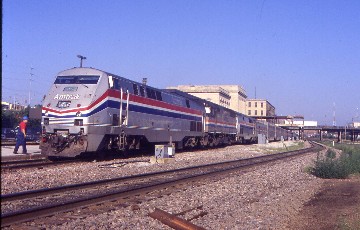
At Omaha, I stepped off for a picture of our train while it was given its 500 mile inspection and saw two workers under the rear truck of the second sleeper, after which an announcement came over the public address system that the brakes on that car had to be replaced. This was a first for me in all my miles of riding, but as I always say "Every trip is an adventure." I went into the station to look around and we departed three hours and eight minutes late. Within a mile of leaving Omaha, we were stopped by a Canadian National/Illinois Central transfer train with Grand Trunk motive power in its consist. That just shows where locomotives can end up after mergers have taken place. We crossed a very brown and muddy Platte River before crossing the Missouri River and entering Iowa, travelling on some of the roughest tracks on which I had ridden, passed fifteen coal trains and lost another hour and thirteen minutes before exiting the state with our crossing of the Mississippi River. The Iowa highlight was the crossing of the Des Moines River, the low point was the small corn stalks caused by this year's drought.
We glided through the Illinois forest and across the rolling hills before reaching the farmlands and our first Illinois stop at Galesburg, where the passengers for the Texas Eagle would be taken by a bus to Normal to catch their train. Upon departure, it was announced that all Michigan passengers would be bussed to their destination and all other connecting passengers were to report to lounge G in Chicago. For myself, I would just catch the last Hiawatha to Milwaukee on Train 341. We sped to our next station at Princeton and made a twenty second stop, the quickest so far. While I was thinking of the positive, dining car steward Mona Lisa's staff did an first rate job and Mr. Long ran the best lounge car with all the comic relief, trivia and good service; he is a one and only on the entire Amtrak system.
We made our final approach to Chicago through the outbound commuter rush as I listened to Aerosmith's "A Little South of Sanity" since I was arriving on the south side of Chicago, and sometimes people wonder about my sanity with my train-riding hobby. As I tell people, there is never a bad train ride, just an adventure to live through. We dropped the mail cars and arrived at Chicago Union Station three hours and five minutes late and must have heard thirty passengers say that they would never take the train again. You know that I would.
Chicago 8/9/1999With thirty-five minutes before Train 341 was due to leave, I ran upstairs to Gold Coast for my traditional Char Dogs before attempting to get my VIA tickets since there are times when food comes before trains. It ended up taking too long to print my tickets so the agent asked me to come back in the morning and give yourself thirty minutes. I made it aboard Train 341 with three minutes to spare.
Hiawatha Service 341 8/9/1999I boarded a two-car Amtrak train with a locomotive on the point, a cabbage car behind followed by a Wisconsin Southern private car dead-heading back to Milwaukee. The train was full and we raced there as I finished listening to Aerosmith and eating my Char Dogs then sat back and counted the minutes to my first hotel room of the trip, a hot shower and a nice large bed. We arrived on time and I made the three block walk to the Ramada Inn where I checked in, called a few people then called it a night, after having added another Amtrak service to my riding career.
Hiawatha Service 330 8/10/1999I was sound asleep when the alarm went off and a long shower preceded my walk back to the Amtrak station. A full three-car train departed on time for the Windy City and a daylight trip down this corridor. Other than having to dodge a couple of Metra trains, we made it to Chicago early and I walked straight through a sea of commuter madness to get my VIA tickets, armed with a newspaper. Imelda Sajna solved last night's problems and in mere minutes, I had all my tickets in hand. I went upstairs to McDonald's for breakfast before I was pre-boarded on the International, due to my Canadian destination of Toronto.
International 364 8/10/1999The Superliner train departed on time led by a VIA F40PH-2 with a VIA attendant in the snack coach. We were delayed at Hammond-Whiting, Indiana by freight train interference and the crew read a letter of apology by Amtrak and Norfolk Southern, who had just acquired this part of Conrail on June 1, 1999 and was experiencing a major growth in traffic because of it. I napped through the worst of it and awoke once we were on the future Amtrak high-speed Michigan line from Niles to Kalamazoo. Leaving Battle Creek, both the Post Cereal and Kellogg plants were passed with no signs of Tony the Tiger as in a popular television commercial. We were stopped by track work, this time grade crossing replacement and at least it was not rails and ties as it was the last time I came through here westbound.
If you like stone stations, this route is for you with excellent examples in Niles and Durand. Outside Flint, we passed the large General Motors plant and it seemed that the children in Flint had nothing better to do than throw rocks at the train since I counted twenty-five as well as graffitied walls. I should counter that statement as in every town, you tend to see the works of the towns' low life not that of the excellent children who live there also, which goes for every other place in North America, if not the whole world. Leaving Flint, the first rain occurred as the Canadian Customs forms were distributed to those passengers going to Canada.
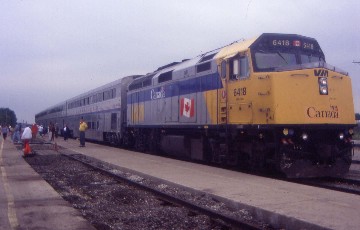
At Port Huron, the VIA train crew arrived, minus the engineer, so we were allowed off for the forty minute delay until the rain sent everyone back on the train. We reversed onto the mainline before going through the tunnel and into Canada. Customs went well and I explained what a North American Rail Pass was and how much it cost and the agent was impressed with my homemade itinerary. We proceeded towards Toronto under overcast skies with the ground fog trying to form as we departed Sarnia and I had a seatmate for the first time, a really nice man going to Kitchener. At Milepost 12.2, we stopped to let a long Canadian Pacific Railway freight cross our path and by the time we reached London, we were only a minute late. At London Junction, we switched onto the rails of the Goderich-Exeter Railway, which operates this line to the junction of the Halton Subdivision at Silver. The last time I rode this line, it was still under Canadian National ownership and was a spin-off by a major carrier of a lightly-used freight line. Night took over and at St. Mary's, we sat for ten minutes waiting for departure time then stopped outside Georgetown to let a freight train by with not a single light anywhere, just pure darkness outside my window. We were delayed thirty minutes and arrived in Toronto that late then I visited the automatic teller machine for some Canadian funds before taking a taxi to the Executive Motel Inn with a light rail line in front on King Street.
VIA 44 The Capital 8/11/1999Following another taxi ride and a McDonald's breakfast at Toronto Union Station, I stood in line to board my first VIA train of this trip, the LRC train, to Ottawa. We departed on time and after our first stop at Guildwood, the train flirted with the shoreline of Lake Ontario on a very cloudy morning. At Port Hope, we slowed from the usual 95 mph pace to 30 mph and what struck me was how good my memory was from my drinking days, especially on a train and I was amazed at how much I remember about what was along the line. I started to nod off after the pace of this trip and the last two short nights caught up with me, so when the service attendant wheeled her cart down the aisle, I purchased a Coca-Cola which woke me right up. We diverged from the lakeshore inland across the fields and through the forest of eastern Ontario with the sun trying to break through the few blue patches in the now opening sky.
At Brockville, we left Canadian National's Kingston Subdivision and took the former Canadian Pacific Railway, now St. Lawrence and Hudson Railway, to Smith Falls and my first new mileage of the trip. To my surprise, the train maintained its high rate of speed so it was a quick run through the forest to Smith Falls. From here, we returned to Canadian National's Smith Falls Subdivision to Federal, which VIA owns from Milepost 34.4 to Milepost 13.0 and as we made our way to Ottawa and as I stared at the trees, I was thinking "Get used to it Chris, there are so many more miles to pass through them." I then thought of using my West Texas idea: look for the unusual to make the journey more fun". The gray skies returned and it grew gloomier as we approached Ottawa, the capital city of Canada the we returned to civilization on the outskirts of the city and for our last six miles, travelled over Canadian National's Beachburg Subdivision.
Ottawa 8/11/99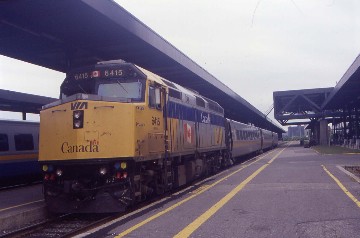
VIA Rail F40PH-3 6415 built by General Motors Division in 1987 led the LRC train into Ottawa six minutes early which allowed plenty of time before my next train and I bought a postcard and had a Burger King lunch before storing my bags in a locker and walked to the mall to buy stamps to last for the rest of the trip. I had a nice walk back to the station and wrote my friend Heidi a nice long letter which I planned to mail later on.
VIA 34 8/11/1999I boarded the exact same trainset to Montreal that I had ridden from Toronto and this way, VIA does not have to turn trainsets in Ottawa. We departed on schedule, travelling down Canadian National's Alexandria Subdivision, which they still own as far as Milepost 72, while VIA owns the rest of the way to Coteau Junction. Near Alexandria, the countryside became more rolling in nature before it flattened out again then at Glen Robinson, Train 35 was in the siding on its way to Ottawa. Next it was our train's turn to be stopped at Coteau Junction to wait for a Canadian National freight to clear on its Kingston Subdivision, the same one we left at Brockville. When we entered that line, it ended my new mileage for now. We rode the very eastern end of the Kingston Subdivision to Dorval before running the final miles on Canadian National's Montreal Subdivision to Central Station then prior to the crossing of the Ottawa River, the train announcements switched to French first then English, as is the custom in Quebec. We arrived eight minutes early at Montreal and had an excellent view of Mt. Royal and the downtown skyline upon approach and I went up into the station to a deli for a plain roast beef sandwich and was surprised by the cheese roll which I really liked. I started the boarding line for the Chaleur to Gaspé.
Via 16 The Chaleur 8/11/1999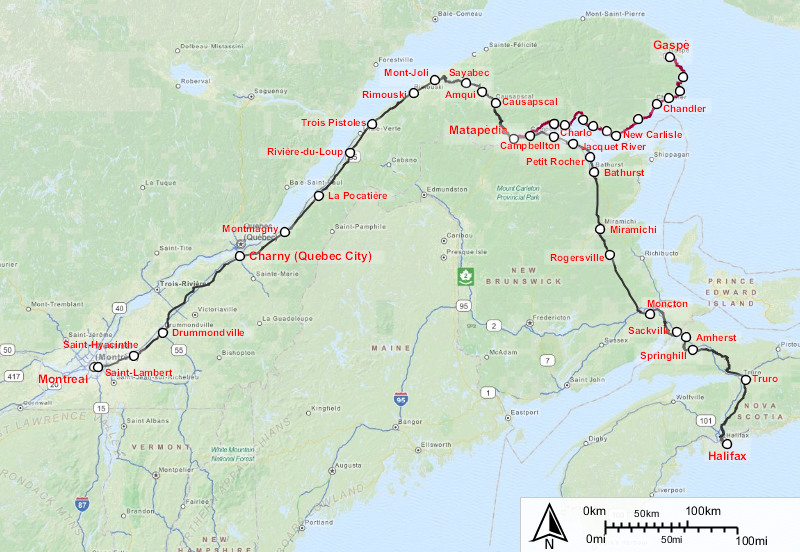
The Chaleur is a thrice-weekly passenger train operated by VIA Rail between Montreal and Gaspé, Quebec. In 1907, the Quebec-Atlantic Oriental Railway was built from Matapédia through New Carlisle to Port Daniel, and gradually extended until it reached Gaspé. Before that, inhabitants had to drive by horse or sleigh 180 miles to catch the Intercolonial Railway from Matapédia to Montreal, a journey of four days. The train left Montreal in the evening and arrived in Gaspé at about noon the following day. The train departed Gaspé mid-afternoon and arrived in Montreal in the morning. In later years, the train was normally merged with the Ocean between Montreal and Matapédia. After 1995, the Montreal–Gaspé train was composed exclusively of cars built by the Budd Company, many originally used by the Canadian Pacific Railway's Canadian.
I first learned of the Chaleur in the Revelation Rail's video "Black Diamond to Gaspé", which made me want to ride the route after seeing it. The walk to my coach was the very long, about three-quarters-of-a-mile all the way out on the platform that extended out into the open so I was able to see the downtown skyline while waiting for departure. The train was so long today that it had to be broken into three sections. The Chaleur was really the front part of the Ocean bound for Halifax which is broken off at Matapedia into a separate train for Gaspé.
At departure time, all sections were combined into one train and today's was twenty-four cars. Leaving Montreal twenty-four minutes late, we crossed the St. Lawrence River and I experienced the first triple stop at Saint Lambert, which would be common the rest of the way to Matapedia tomorrow morning. I rode the Skyline dome in the Chaleur section for an hour until after the lit-up view of Quebec City across the St. Lawrence then returned to the former Richmond, Fredricksburg and Potomac coach for the night. An enjoyable and unexpected bonus about VIA is the history of the cars in which one rides. This particular one was VIA 4121, ex. PPCX 6028, exx. S.L. Feilhauer 1984, exxx. Amtrak 6028 1974-1984, exxx. Amtrak 5217 1971-1974, nee Richmond Fredericksburg and Potomac 851 built by Budd Company in 1947. On Amtrak, it was only the baggage cars, low-level diners, a few coaches and the odd 10-6 sleeping cars in the east and the hi-level coaches on the Oklahoma trains.
8/12/1999 After a night of tossing and turning, my usual deep sleep was either spoiled by hotel beds or the rough track, despite the fact that VIA supplies coach passengers with pillows and blankets on their overnight trains to make them more comfortable. I woke up when we were arriving in Matapedia over another line that Canadian National spun off to New Brunswick East Coast, which operates the line from Riviere-Du-Loop, Quebec to Catamount, New Brunswick. Here in Matapedia, the Chaleur was cut off from the Ocean into its own eight-car train and today's consist was F40PH-2 6400, a baggage car, three sleepers, a diner, a Skyline car and two coaches. We waited for the Ocean to depart before venturing off onto another set of Canadian National spun-off lines, the Chemin De Fer Baie des Chaleurs Railway (Chaleur Bay Railway) as far as Chandler East, then the remaining miles to Gaspé over the rails of the Corporation du Chemin De Fer De La Gaspesie, with all of this being new mileage.
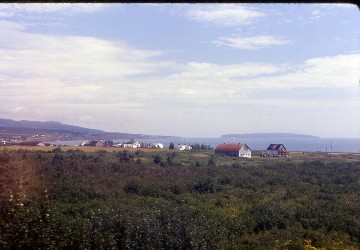
It was a rainy morning as the Chaleur started down the Gaspé Peninsula on its eastern side and upon departure from Matapedia, I was in the dining car having breakfast. The line to Halifax crossed the Restigouche River and we followed its west bank until it turned into Chaleur Bay with New Brunswick across the water. My meal was finished before Nouvelle and I went to the Skyline's dome for most of the rest of the journey with Chaleur Bay never far away on this route, which was very stunning at times. We crossed the first of the many high bridges, this one over Stewart Brook then made our first solo stop at Carleton before crossing the Cascapedia River prior to stopping at New Richmond, where we met two New Brunswick East Coast Railway locomotives built by Montreal Locomotive Works, the Canadian version of American Locomotive Company. The tracks had many twists and turns along the route and as the train returned to Chaleur Bay, the rain stopped and allowed for an excellent view of the bay just before Caplan. The Chaleur then travelled along the top of the cliff in a beautiful setting and as a regular passenger rightly observed "It does not get any better than this".
A view of a small quaint boat harbour was seen next in a nice coastal setting followed by our passage through Bonaventure before we crossed the river of the same name. Our next station stop was New Carlisle, followed by a breath- taking waterside view then we traversed the high Shigawake Viaduct and Port Daniels as we circled into town before going through the only tunnel on the route, Cap à l'Enfer, also known as Cap du Diable, with a length of 630 feet cut through the solid rock of a headland extending into the bay. In 1907, workers building the railroad at Port-Daniel faced a major obstacle which was perforated to create a tunnel. The infrastructure, unique in eastern Canada, took two years to build and cost the lives of eight workers.
The Chaleur continued to run along the cliffs with the waters of the bay far below before it crossed a bay with a sheltered harbour located way down below then crossed the Gulley Viaduct, the highest on the line at 106 feet above the stream. As we approached Chandler, out in the bay stood a Peruvian freighter which became grounded and split in two in 1983 and I was told an interesting story. The harbour master ordered the boat out of the harbour, thinking it would damage the other boats during a storm. The storm then grounded it right in the middle of the harbour and the cost of salvaging the boat was more than the cost of the boat itself, so the owner left it there as a reminder of that harbour master's choice. The rumour is that the residents ran the harbour master right out of town.
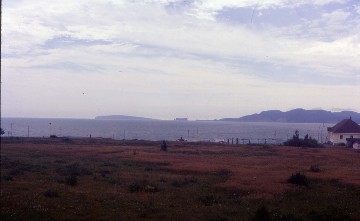
As the Chaleur continued down the peninsula, it crossed the Grand River and soon Bonaventure Island came into view before we made our way inland to the station at Percé, which is outside of town. Percé is the home of Percé Rock, a monolith off the Gaspé Peninsula, is one of the world's largest natural arches and 49 feet and is considered a geologically and historically-rich natural icon of Quebec. Percé Rock, translated to English as Pierced Rock, was given its name by the explorer Samuel de Champlain in 1607. He felt that the arch on its seaward end looked as though a needle had cut through the rock. However, it cannot be seen from the train since the route takes it over a headland that protrudes out into Chaleur Bay. We next ran over a three mile-long causeway with a great view of Percé Rock looking back but one the best views of the Rock is from the station stop at Barachois.
The bay now to the right was Gaspé Bay and the large land mass across it is the Cape Gaspé which makes up the northernmost end of the peninsula. The Chaleur continued inland one last time, crossing the L' Anse-a-Brillant Viaduct before returning to water level-running and crossing a causeway before we arrived at Gaspé forty minutes late.
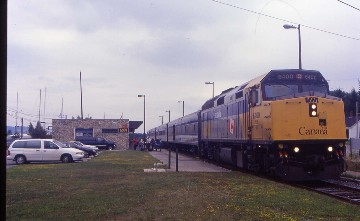
The Chaleur at rest.
Gaspé 8/12/1999With a layover of two-and-a-half hours, I walked across the bridge with Sandy from Sydney and had lunch at Tim Horton's, followed by my usual postcard shopping and a telephone call home to my mother. The sky had a very threatening look to it of impending rain so we made a run for the train and returned just as the sky let loose with full fury and I was so glad that the crew let me leave my bags on the train during the layover, which proved once again just how friendly Canadian railroaders are.
VIA 17 The Chaleur 8/12/1999We departed on time for the return to Montreal and by the first causeway had escaped the Gaspé storm. We crossed the high trestle then near Barachois, one minute I was looking at Percé Rock clearly then I turned to talk to Sandy for a minute and when I looked back, it had been swallowed up by a wall of clouds. Crossing the second causeway, the wind had whipped up some pretty good-sized whitecaps on the bay and the Gaspé Peninsula was now completely hidden with the day turning very dark again. The Chaleur proceeded straight into that curtain and the wall of rain then plunged through it, giving the dome's front window a good cleaning. Returning through Percé, I could not even see the harbour the rain was so heavy. It was a good thing that photographed the journey on the northbound trip due to the difference four hours made.
As if almost on cue, the rain stopped as I went to the dining car for dinner and chose pot roast with my first maple cakes for dessert, an excellent meal. I returned to the dome for the rest of the ride to Matapedia, enjoying the coastal scenery and a sky that was reminiscent of a watercolour painting. I met a family from Jasper who were going to a farm outside Brandon North and just happened to be scheduled on the same westbound Canadian that I was when I travel through Jasper. A small world indeed! We arrived in Matapedia early and when the Ocean arrived, we were made into that triple-stopping twenty-five car train.
8/13/99 I slept soundly through the night and at Mont Joli, I went to the restroom and upon my return, had a new seatmate. New rule: "Never go to the washroom during a station stop while new passengers are boarding." I slept through the reverse move at Charny, which was necessary because the tracks through Levis had been abandoned since my previous trip on the Ocean. I went to the Skyline's dome for the rest of the run to Montreal with the children from Jasper joining me and it appeared to be a nice day in Montreal. The train was wyed into the station just as a future train I planned to ride, bound for Jonquière and Senneterre, was leaving town. We were split into two sections which caused us to be twenty minutes late. All in all, the Chaleur to Gaspé is one train I recommend to anyone and with the outstanding VIA service and some of Canada's most beautiful scenery, it has everything.
Montreal 8/13/1999 The Commuter Train DayAfter checking my bags for the day with VIA for two dollars, I ate a McDonald's breakfast before going out to spend the day riding commuter trains, all of which was new. I walked across the street from Central Station into the STCUM (Société de transport de la communauté urbaine de Montréal, or Montreal Transit) headquarters building and picked up the timetables I needed for three lines I planned to ride. Trains Magazine had reported that the line to Blainville had been closed but the truth was that due to construction and track upgrading, it stopped its inbound run at Jean Talon, close to the Parc subway station. That made me really happy as now I would be able to sample all three of commuter train routes.
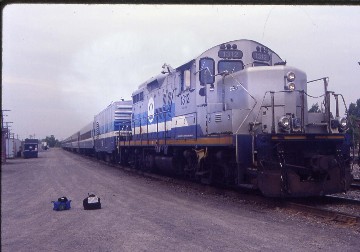
My first stop was Windsor Station, where the Canadian Pacific's Canadian once departed from for Vancouver, which was right behind the Molson Center where the NHL Montreal Canadiens play. I bought a one-way ticket to Dorion and walked down the platform to photograph the low level train led by GP9 1312, nee Canadian National 4299 built by General Motors Division in 1990. The engineer, Peter Smith, saw me and asked if I wanted to ride in the cab car, saying "All you can see from the windows are trees, up here you can see the world!" I told him that I was from California, about my trip and my train-riding experience and we hit it off and instantly became friends. We departed on time with Peter pointing out interesting items as we made our way west and I was riding the same route that the Canadian once did leaving Montreal. A VIA corridor train passed us then stopped at Dorval, where we passed him then we did six station stops before he passed us for good on his way to Toronto. Our route took us off the Island of Montreal to our final stop at Dorion, with only a few rush hour trains going further to Rigaud.
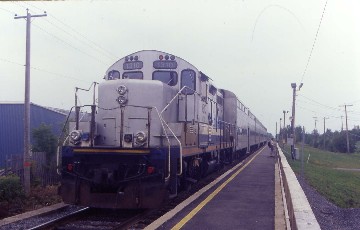
As we pulled down into the overnight storage yard to switch ends of the train, Peter asked if I would like to ride in the engine back to Montreal and we climbed aboard STCUM GP9 1310 (nee Canadian National 4346 built by General Motors Division in 1990.
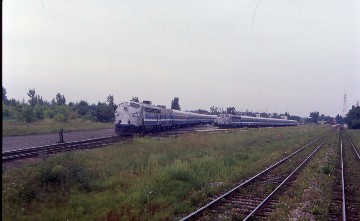
It was refreshing to still see a commuter train led by FP7As in the year 1999. Peter told me about an Amtrak F40 that was being tested which had air conditioning and that the engine crews fought over it in order to operate it, as well as new motive power was on order and the next time I visited, the conductors would no longer be selling tickets as they will only be available from a machine on the platform. We had a really nice ride back to Windsor Station and Peter gave me three subway tickets and directions on how to use them. We shook hands, he wished me well and a safe trip before I was off on my first Montreal subway ride.
I descended the stairs far deeper than the ones on the Los Angeles Red Line Subway and finally reached the platform then not seeing a map, I asked a passenger which platform that I should be on for Jean-Talon. Thanks to the Internet, I knew the route I needed rather than just the line's end points. Pointed to the correct platform, I found a map and counted my stops to Jean-Talon since I knew that all public address announcements would be in French. What sounded more like a jet airplane taking off was the approach of the rubber-tired subway train and I boarded and sat in a position to be able to see the onboard map so I could keep track of the stations and see their names as they were pronounced in French. Everything went smoothly and I even learned the line's end point of my connecting train to Parc. I made a perfect connection and three minutes later, detrained at Parc and followed the signs with a picture of an F unit on it, which led me to my next bi-level commuter train.
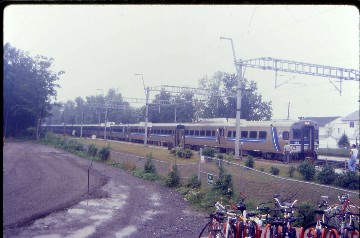
I now used my first Montreal commuter train ticketing machine and thanked God that they were just as easy as the Metrolink machines back home, managing to purchase a one-way ticket to Blainville and minutes later we were off. It was a thirty minute trip that passed backyards and industries, apartments with triple spiral staircases and I was again off Montreal Island. All the stations seemed to be temporary, so it would be interesting to see if this service lasts. Arriving in Blaineville I purchased a ticket back to Parc with the train returning me there in the pouring rain and made a mad dash back to the subway station dodging raindrops before I rode to Central Station to continue my commuter train adventure.
Now a veteran of the new ticketing machines, I purchased a one-way ticket to Deux Montagnes and wished that these machines had a round trip feature. I went downstairs to board my first electric multiple unit train then departed on schedule and spent the next five minutes in the Mount Royal Tunnel. The VIA trains that go to northern Quebec used to be pulled through here by former Canadian National electric boxcabs which were retired a few years ago and now they go the long way around, just as I will do in five days. We popped out of the tunnel at Grand-Moulin station which started the afternoon's entertainment of people detraining, running and covering themselves to protect them from the pouring rain as they made mad dashes to their cars.
The electric trains moved very quickly and quietly as they passed houses and apartments and I noticed the use of spiral staircases from the second and third stories of these buildings was much more prevalent than any other place I have travelled in North America. The rain continued more heavily and the commuters played the dashing game with more intensity although maybe one out of five walked slowly, not caring if they were wet. We crossed off the island for the third time this day before arriving at Deux Montagnes and it was now my turn to play the game so I made a mad dash for the station to purchase a snack. The train had gone down to the overnight storage area to change ends before returning to pick me up to go back to Central Station where I picked up a chicken nugget dinner to go, retrieved my luggage from the baggage room and became the sixth person in the queue to wait for my sober return to Halifax as I sat eating my dinner.
VIA 14 The Ocean 8/13/1999Those needing assistance, as well as those who really did not, were boarded first then after about ten minutes, the rest of us were allowed to board. One of my rules is to always be in the first ten people in a queue although that cannot always happen. Since so many had been pre-boarded, I chose the last end seat in coach 8147, ex. Gettysburg Railroad 2922, exx. Livonia, Avon and Lakeville 2922 1968, nee New York Central 2952 1947-1966 built by Budd Company, South East Pennsylvania Transportation Authority and AMF in 1947.
We departed Montreal as was done two days ago and did triple stops which made us later. However, the main difference from the other night was tonight I was on the Ocean section of this twenty-six car train and it was raining. We proceeded northwest into the storm as I was in the dome car until darkness took its hold on the outside world. Inside the train, the lights had been turned off so people could go to sleep and a group of French Canadian students became very loud and boisterous, so much so that I had to ask them to be quiet, suggesting that they return to the lounge car to continue. My fellow passengers thanked me and the leader of the students stopped by to say he was sorry and now knew that anytime the lights were out, they would be quiet, realizing that meant that people are trying to sleep. If only it could have been that easy on the California Zephyr two years ago.
At Charny after we did our station work, we reversed the 1.7 miles to West Junction and travelled up Canadian National's Diamond Subdivision to St. Charles, then back onto the Montmagny Subdivision, all because the line through Levis which I rode last time on the Ocean was removed. I slept all through this on the Chaleur, but tonight stayed up for it then went to sleep and during the night, our combined train lost even more time.
8/14/1999 I slept soundly all the way to Matapedia where the Chaleur was split off from our Ocean and we were three hours late. I thought "Thank God I went to Gaspé on Thursday when I had a chance to enjoy Gaspé, not today when it would be get there and turn right around!" I tried the buffet breakfast and I must say that it was the worst railroad breakfast since it was cold, soggy and without the proper syrups, et cetera. I could not believe that this was a VIA meal. With just that one meal and talking to the other passengers, I decided to avoid the dining car on the Ocean. There were shades of my last trip on this train as we were running three hours late, but unlike last time, I am sober!
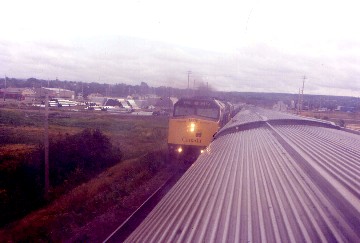
It was still raining out and the low clouds hid the Gaspé Peninsula from view. At Campbellton, New Brunswick, the clouds lifted somewhat but I tired of the Skyline dome view of trees and low clouds, so returned to my seat to read "Last Train to Toronto" by Terry Pindell and read steadily to Moncton. Here, VIA cut off two sleepers to be sent back to Montreal this afternoon, thereby adding the beds to that train since they are not needed on this train anymore.
The Ocean crossed the lowlands to Sackville before twisting and turning over the ridge to Truro and if I ever have the opportunity to ride a fall colours trip through here, this would be the ideal section. By Truro, the rain stopped, the coach emptied out and the last hour-and-a-half was spent relaxing. When we reached the Bedford Basin, my memory kicked in and it seemed as though it was only yesterday that I was here; a deja vu moment more than anything else. Everything was the same except the locomotives and the now ever-present graffiti.
We arrived in Halifax only an hour and twenty minutes late and I had now reclaimed this line and two more provinces in Canada, New Brunswick and Nova Scotia.
Halifax 8/14/1999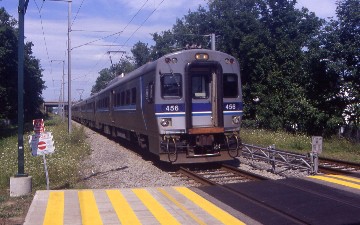
I stayed above the train station at the Westin Nova Scotian, which had changed names since I was here last. Following check in, I did my laundry before going to the Atlantic Super Store for some dinner which I took back to my room to eat.
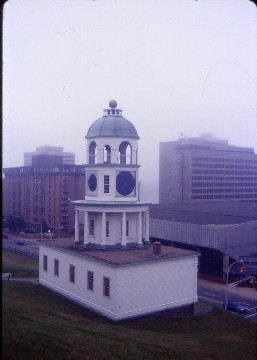
I went for a walk to Citadel Hill, a National Historic Site. Four fortifications have been constructed on Citadel Hill since the city was founded by the English in 1749, and were referred to as Fort George, but only the third fort (built between 1794 and 1800) was officially named Fort George. According to General Orders of October 20, 1798, it was named after King George III. The first two and the fourth and current fort, were officially called the Halifax Citadel. The last is a concrete star fort. The hill was first fortified in 1749, the year that Edward Cornwallis oversaw the development of the town of Halifax. Those fortifications were successively rebuilt to defend the town from various enemies. Construction and leveling have lowered the summit by ten to twelve metres. While never attacked, the Citadel was long the keystone to defence of the strategically important Halifax Harbour and its Royal Navy Dockyard.
My walk took me down to the harbour where there was a festival including a man playing the bagpipes who reminded me of Woody Lamberth, the great Amtrak conductor back home and another, dressed as Fred Flintstone, juggled fire and was quite entertaining. I returned to my room to write twenty-five postcards and watched "Wayne's World" before calling it another sober day and thankful to be that way. Later, shades of Boston, the fire bell rang after a chef in the restaurant, who was preparing a flaming dish of some kind, set off the fire alarm and the hotel's loud speaker announcements. With all this going on, I went to bed.
8/15/1999 Sleeping in late until 8:30 AM, I walked to Tim Horton's for some doughnuts and to a store for Coca-Cola and cookies for my next trip. It was raining again so I was glad I had packed my umbrella, then returned to the Westin to buy a Lighthouses of Nova Scotia T-shirt as a souvenir and watched an NFL preview show before checking out. I walked into the VIA Station and started the line to board the train.
V15 15 The Ocean 8/15/1999Watching someone's luggage fall off the baggage cart was just another reason why I never check my bag then followed the accident-prone cart to coach 8116, nee Canadian Pacific 116 built by Budd Company in 1955. This car featured a model of a CN F unit in the mid-coach glass separation, while the other side had a model of an Atlantic Coast Line GP35. The seat behind the glass separation was one of the best on the train since it was in the middle and one could put one's feet against it and there was no way that someone could recline a seat into your space, the reason why I chose that seat. On my last westbound trip from Halifax, I did not take the Ocean but since VIA was still running the Atlantic at that point, I took it through Maine and that was how I gained the state of Maine on my rail map.
We departed Halifax five minutes late in the rain and passed the Bedford Basin with the low clouds hanging down at water level. Since there was not anything really to see, I caught up on my writing, which I find much easier than waiting until I get home. Over time, I developed systems for doing such mundane things such as numbering each pair of my socks with steam engine or hockey player numbers so pairing them is simple and my daily system of staying sober is a prayer to God each morning thanking Him for my sobriety, the number of the day it is and the gifts He gives me, to take away my character defects and guide me through the day sober. Today was my 1,670th day of sobriety.
We arrived at Truro after meeting the eastbound Ocean and although there is nothing like a train ride on a rainy day, while photography is pretty much futile, I still enjoyed the view, then went to the dome for the climb to Folly Lake followed by the twisting descent. I tried the automated food machine in the Skyline car and the lady in front of me tried to get a cheeseburger but received a hot dog instead then tried the next machine but her chips became stuck so she had the attendant open the machine for her. It was then my turn and no hot dog came out of the machine so for the second time in less than three minutes, the attendant had to open the machine. I cooked it in the microwave and I will never complain about another Amtrak hot dog again since it was barely edible. Later I tried the popcorn with better success and I wondered why have an automat when you have an attendant? While I was enjoying my popcorn, the attendant walked through as an ice cream lady which me think of Jethro Tull's "A Passion Play". At Moncton, the front coaches were boarded first before picking up the two sleepers that had been set out this morning by the eastbound Ocean to go back to Montreal with us.
West of Pacific Junction, we switched off the Canadian National and onto the New Brunswick East Coast Railway where the rain stopped and the clouds lifted to producing a beautiful sky reminiscent of a watercolour painting. It was a perfect name for this sky since clouds are nothing except dust particles and water vapour, with the amount of vapour in the cloud determining its colour. We passed through miles of forest and you always have the option to look up and when you do, unless it is a perfectly clear day, you will be rewarded with some kind of art show.
At Rogersville, VIA removed a drunken man from my coach, although the police had to board to remove him and was so drunk that he had trouble getting into the police car. As someone said, "It is a long walk to Montreal" and it made me think of how many miles I ridden in that same condition and was only thrown off the train once in New Orleans. I guess I was lucky as I was always quiet. I felt so happy that all my drinking days were behind me with God's help and that I was sober here in New Brunswick to witness the whole event.
The sky to the north cleared while the clouds to the west made the best reddish orange sunset of the trip so far and the end of another great day of train riding. At Campbellton, I acquired a female seatmate who was going to Brockville then once we turned in for the night, we both tossed and turned. When the car became really cold, I added my Amtrak blanket to the VIA one and became nice and warm before sleeping the night soundly away.
8/16/99 The next morning dawned perfectly clear so I went to the dome for the rest of the journey from Charny. A group of Canadian exchange students returning from Halifax to their hometowns had every seat taken except one. VIA sent a Student Exchange Newspaper up and it was interesting to listen to their stories that went along with each. I also listened to their wide topics of jokes, some good, others not so. One of the boys spotted the flying saucer at one of the parallel freeway exits and no one believed him and while I saw it, did not want to spoil their joke on him. At Saint Lambert, I returned to my seat to pack and since we did not have the Chaleur today, pulled straight into Central Station.
Montreal 8/16/1999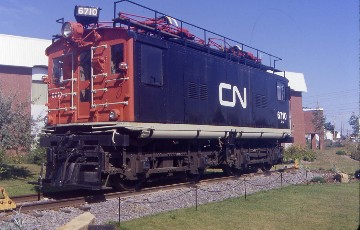
For my second brief stay in Montreal, I had my usual McDonald's breakfast before taking AMT's electric Deux Montagnes train back out to its terminus, where I worked on my sun tan, did some paperwork and just relaxed. On display here is Canadian National boxcab electric 6710:2 1995, exx. Canadian National 100:1 1969, exxx. Canadian National 9100:1 1949, nee Canadian Northern Railway 600 1919 built by General Electric in 1914. The line was created in 1918 as a Canadian Northern Railway service, then Canadian National Railway ran the line starting in 1923 following the merger of CNoR into CN. CN transferred the Deux-Montagnes Line to the Société de transport de la communauté urbaine de Montréal (STCUM) on July 1, 1982 and the line was refurbished from 1992 to 1995. It was transferred to the RTM's predecessor agency, the Agence Métropolitaine de transport (AMT) on January 1, 1996. This line linked Central Station in downtown Montreal with Deux-Montagnes to the northwest of the Island of Montreal.
What a beautiful August day with bright sunshine, pleasant temperatures and a gentle breeze and once in awhile, everyone should stop and enjoy their surroundings; such a simple way to enjoy your day and be grateful to where you are on God's great blue planet. I returned all too soon to Montreal and started the queue for my next train to Quebec City, with new mileage from Charny to there.
VIA 22 8/16/1999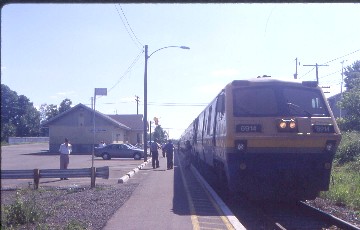
My train to Quebec City was pulled by LRC-2 6914 built by Bombardier in 1981. The route retraced the Ocean's route to Charny that I had travelled over four times on this trip, but this time all in daylight. After crossing the St. Lawrence River, the ancient volcanic hills come into view to the east and we sped across the Yamaska River after we stopped at Ste. Hyacinthe then upon leaving Drummondville, the St. Francis River was next. Outside of the towns, there was nothing except farmlands and forest, followed by the Leonard and Bécancour River which were crossed at the LRC's top speed. About thirty minutes later, we crossed the Henri River and three minutes from Charny, the Chaudiere River.
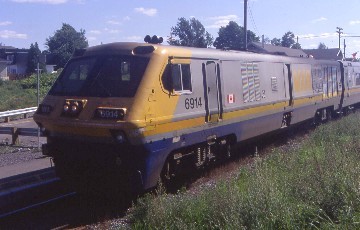
At Charny, there was fifteen minutes built into the schedule which allowed for a photograph, then upon departure, I was on new trackage as we bridged the St. Lawrence River, although the view of Quebec City was blocked by the parallel highway bridge. The train stopped in Sainte-Foy before looping around the bluff to the west to approach Quebec City down a valley. There were many excellent views of Quebec City's skyline before we arrived on time at the Gare du Palais, the most unique train station in all of North America.
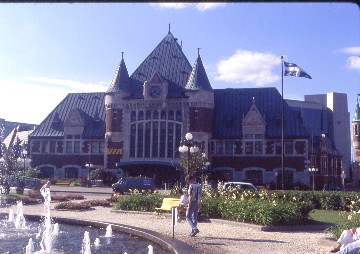
Built in 1915 by the Canadian Pacific Railway, the two-storey châteauesque station is similar in design to the Château Frontenac hotel. The station had no passenger rail service from 1976 to 1985, at which time it reopened and is the eastern terminus of VIA Rail's Corridor services in Ontario and Quebec, serving regular daily services west to Montreal's Central Station and Ottawa via Drummondville for at most ten trains per day. It was designated a Heritage Railway Station in 1992. After Quebec Bridge construction in 1917, Palais Station was called a Union Station because the Canadian Pacific shared the facilities with the National Transcontinental Railway and the Quebec Central Railway; the Canadian National until 1929 used the former QLSJR station built in 1891 on Parent Square nearby. The Quebec Railway Light and Power also had its station nearby (former Quebec, Montmorency & Charlevoix).
Quebec City 8/16/1999I stored my bags and bought my Intercar bus ticket to Jonquière before having my first fresh meat sandwich and a local root beer. I then walked down several streets soaking up the local charm and visited a hobby shop before going to the mall and a T-shirt shop where I had a Quebec shirt made.
Intercar Bus 8/16/1999As this was the only way that I could make the whole trip work, I forced myself to take the bus from Quebec City to Jonquière. While I am not a bus fan and only use them to get to or from trains, I must say that it was a very beautiful ride over Quebec Highway 175, crossing the Laurentian Mountains and passed twenty lakes. The bus did allow me to see more of Quebec than I could see from the train and we passed in front of my hotel in Avida on the way, so had to take a taxi for ten dollars back to it since the hotel's van did not pick up passengers after 8:00 PM.
Jonquière 8/16/1999I checked in at the Holiday Inn and was resting peacefully in my room when suddenly the fire alarm went off on the third floor while I was on the fifth, so I exited down the stairs to the lobby and spent quite a bit of time there while the hotel, the police and the fire department all tried to work out why the fire alarm was ringing. Once they did, I had to take the stairs back to my room since the elevators were shut off and as I lay in bed, I thought about the joys of being a traveller then had an excellent night's sleep.
VIA 600 The Saguenay 8/17/1999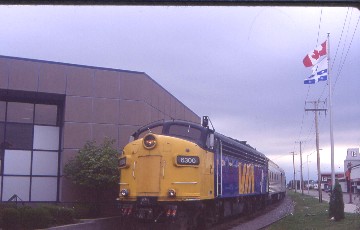
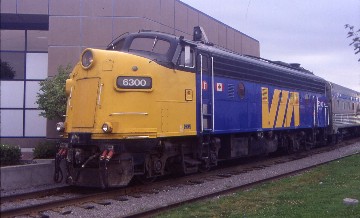
Staying at the Holiday Inn was to my advantage as the train crew, who were also staying there, gave me a ride to the yard and I was able to ride the extra distance from there to the station. My train was led by my favourite type of locomotive, an FP9A, specifically 6300, ex. VIA 6524, nee Canadian National 5524, built by General Motors Division in 1983. The consist was a baggage car, a 4000-series coach, mine, (former Southern Railway) which had been remodelled to resemble an LRC car, and VIA coach 4119, ex. Rail/Sea Cruises 6007, exx. Amtrak 6007, exxx. Amtrak 4830, exxx. Amtrak 4401, exxxxx. Seaboard Coast Line 5101, exxxxxx. Atlantic Coast Line 271, nee Chesapeake and Oho 1600, built by Budd Company in 1948, bringing up the markers.
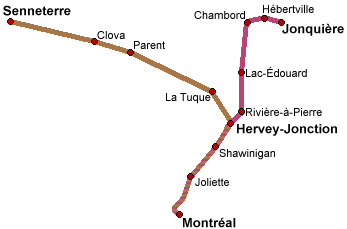
The train is named for the region of Quebec that it serves and once operated as far as Chicoutimi. Many small hunting and fishing clubs operate along the route and appear as optional stops on the timetable. It is also possible to make a reservation to detrain at an unmarked spot. The Saguenay is a tri-weekly service and between Montreal and Hervey-Jonction, it travels together with the Montreal–Senneterre, another regional train.
I had the time to write a couple of postcards then walk the two blocks to a mailbox to post them. It was another overcast day with more rain expected and after watching the Canadian Weather Channel last night, I knew I would encounter more wet weather today. It always takes my mind a few seconds to realize that 26 degrees Celsius is a warm day. I wished Canada was still on the imperial system rather than metric.
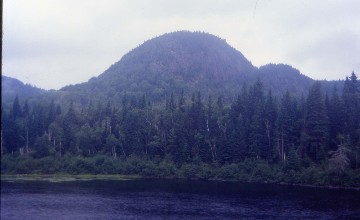
We departed Jonquière on time and with 24 possible flag stops on today's trip to Montreal, it would be interesting to see how many of them that we make. We proceeded due west, slicing through a ridge before the landscape opened with wheat farming and other agricultural pursuits taking place. At Hérbertville, eight more passengers boarded and this being a new route, I expected nothing but trees, although this section looked more like Kansas and was quite enjoyable for how far north I was. We paralleled the south shore of Lac St. Jean, one of the largest lakes in the province, but behind a slight ridge and once at the top, the lake came into view. Photography was bleak this morning as it was very dark and pouring rain. I decided to have a cup of tea and used a brand new 1999 quarter with a train on it. To celebrate the millennium, Canada launched a two-year contest with the theme of 1999 looking back to Canada's past and 2000 looking to the future. This particular quarter was issued in June, titled "Coast to Coast" and featured a design by Gordon Ho.
We curved away from Lac St. Jean to our next stop at Chambord where nineteen more passengers boarded then from there, our route turned south towards Montreal and made a giant "S" in its attempt to gain elevation with a lumber mill and a lake to the east. The sky had ceased raining and I was back into the forest then we stopped at our first flag stop of Lac-Bouchette where two passengers boarded. The train's route entered an area with no roads so that was the reason this train still exists, since it is an essential service as deemed by the Canadian Government and thus can not be cut, such as the Abibiti that I was riding tomorrow. After passing the Lizotte Club, the train passed Lac Kiskissink and a few miles further was outstanding beaver dam. Next on the east side of the train was Lac Long with a siding of the same name then at Milepost 119, I was very impressed with the size and different types of trees. When we reached Brook, I found that the land had been cleared on both sides of the tracks bringing a brief respite from the continuous forest and we stopped at the Summit Club where we ended our climb from Lac St. Jean and started our southerly descent. We passed Summit Lake before the train suddenly stopped at Milepost 105.7 to pick up a female passenger with no signs of where she had come from.
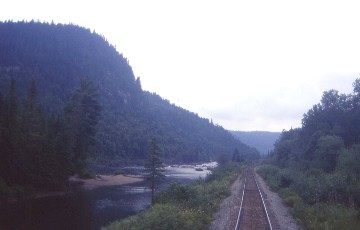
The train stopped for eight minutes so I examined the former Canadian Pacific Railway baggage car while we waited, then passed Lac Édouard as the rain resumed then made a brief stop along its shoreline to pick up a troop of Boy Scouts. Within a few miles, the Saguenay started to follow the Batiscan River into its canyon with beautiful cliffs and large rapids. As I was enjoying all of this beauty, I met the man who was at Club Triton who did not come out of the shelter until the last moment so we went by him and crossed a bridge before we reversed to pick him up, and we had a good laugh about it. I went to get a hot dog and small can of Pringles for lunch from the food service area of the car and the hot dog was excellent and very tasty, then enjoyed the Batiscan River Canyon even with the clouds, which had some of the best scenery of this trip. What was surprising was that although there were plenty of rapids in the river, no one was enjoying them. This was truly an unknown scenic rail line in North America.
Following the trek through the canyon, we stopped at Rivière-à-Pierre with the lovely service attendant Manon assisting passengers with their luggage to their vehicles. We crossed the Batiscan River on a large bridge before running between the hills to Hervey Jonction. Once there, the crew added the Abitibi from Senneterre to our rear, as well as their F40PH-2 to the point of our train and I was hoping that maybe the F unit will go to Senneterre tomorrow. A Canadian National freight train then came in from the south and the word 'junction', or 'jonction' in French, lived up to its name.
We crossed a landscape of low hills with farming, dairies and forest and houses scattered throughout. Suddenly out of nowhere, Canadian National's Triage Garneau Yard appeared, a rather large yard with an engine facility, which I would have expected to be at Hervey Jonction instead of here.
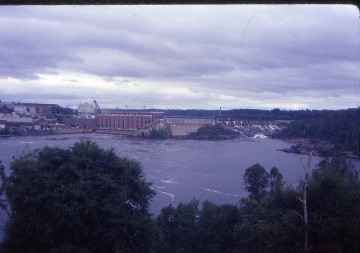
The train crossed the St. Maurice River on a rather high trestle over its gorge before we passed the large Grand Mere hydro-electrical plant then just prior to Shawninigan, we passed through a large steel plant that was located on both sides of the tracks. A 610 foot tunnel, the only one on today's trip, was travelled through and within a few minutes, we crossed both the east and west Yamachiche Rivers then bridged the Riviere-du-Loup on a long span before soaring above the Maskinongé River. Dairy cows dotted the landscape along with fields of corn with low forested hills. At St. Justin, we took the siding for Canadian National 5748 West then from here to Montreal, there was very little land that man had not altered from its natural state.
With the train flying through the last flag stop of the day, we stopped at only five of the twenty-four possible stops then crossed onto the Island of Montreal and stopped at Point-Aux-Trembles followed by the one at Ahuntsic where the troop of Boy Scouts who had been riding in the rear car from Lake Éduard detrained. We crossed over the Blainville commuter line and at Junction de L'Est, we crossed the Deux Montagnes commuter line. In past years, the train would have turned onto that line then coasted through the Mount Royal Tunnel to Central Station but we travelled the long way around Mount Royal through the middle of Canadian National's Taschereau Yard then crossed under the Dorion commuter line and turned east onto Canadian National's Montreal Subdivision, ending my new mileage for the day. We retraced our route from Ottawa into Central Station and arrived in Montreal only ten minutes late. Special thanks to Manon and Sebastin for an excellent day of train riding.
Montreal 3 8/17/1999As usual, when I was in Montreal, I stayed at the Queen Elizabeth Hotel which is attached to Central Station and received a VIA 1 upgrade card from Sebastin, who thought that I might like to have the experience so went to the ticket counter and upgraded my ticket to Toronto in two days with the help of Sylvie Roy, the wonderful ticket agent. It was a night in the lap of luxury. I watched "Martial Arts" on CBS before retiring for the night and receiving nine hours of sleep.
8/18/1999 I felt so good the next morning that if I did not have a train to catch, I could have stayed in bed all morning. I forced myself to get up and caught the train at 8:30 AM for Senneterre and new mileage from Hervey Jonction to there.
VIA 603 The Abitibi 8/18/1999I boarded coach 4119 and after an on-time departure, noticed the motive power was a pair of FPH40-2s, so no F units today and I felt blessed that I had the one yesterday. It was a new day, another trip and another rail adventure. The Abitibi rode on the tail end of the Saguenay to Hervey Jonction, the same route I rode south yesterday so I just sat back and relaxed but sat on the opposite side.
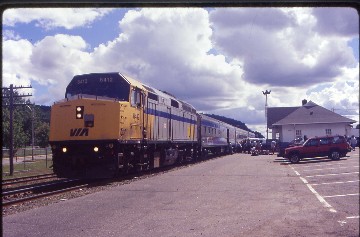
Today's total possible number of flag stops was thirty, with the first being at L'Assomption to pick up a lady and two children. Before leaving Garneau yard, we waited for Canadian National 5768 east to enter, then Canadian National 5454 East at Hervey Jonction, as the train crew picked berries from the trackside bushes. They split the train into two sections and waited until our departure time and my new trackage and upon leaving, I was riding on the rear vestibule platform. We quickly entered a river canyon and made a steady climb northward passing several lakes including Lake Chat.
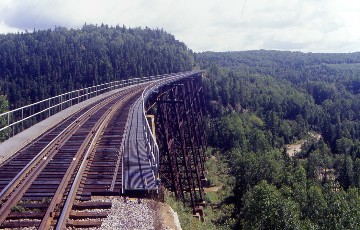
We climbed high on the valley's south slope and at Milepost 95, crossed over the Rivière du Milleu viaduct, the highest bridge in eastern Quebec at 196.1 feet above the river, which reminded me of the Clio Viaduct in the Feather River Canyon in California. At Milepost 117, the Abitibi went through a seven hundred foot tunnel and a few minutes later, we arrived at La Tuque where we picked up more passengers, their backpacks and a canoe. It was here where our route turned to the west. As we departed, we passed Lac Tuque then climbed a line relocation and through another 769 foot tunnel before passing a large hydroelectric plant seen through the trees. We followed its lake for many miles with it again reminding me of the former Western Pacific route through the Feather River, then crossed the lake on a truss bridge and a few miles later, crossed the river again on a high bridge where we stopped to let some backpackers off at a very good fishing hole, so I was told. We passed several more lakes and stopped at McTavish to drop off and pick up a few more passengers.
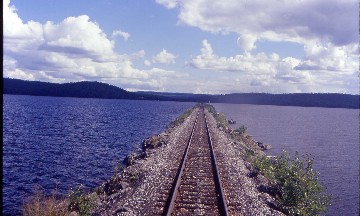
The line then ran along a three mile-long causeway down the middle of the elongated lake.
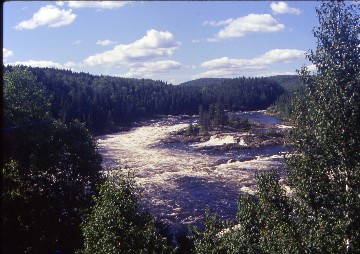
Once back on mother Earth about eight minutes later, we slowed for the Rapide de Coeurs, a beautiful set of waterfalls. Further along at Sanmaur, we dropped off a family and one of their little girls waved at the train until we were out of sight. The Abitibi then passed through a burnt area caused by a fire about three years ago and no one knew if this was caused by a lightning strike or man. Either way, I saw firsthand how nature began to bring back the landscape after a destructive fire. Miles later at Hibbard, we were lined into the siding around Canadian National 9469 East and just before Casey, we came to a halt as there was a work train doing some work ahead and we waited for him to finish. I wondered just how much work that crew thought they could do between the passage of the freight train and our passenger train. I passed out root beer barrel and cinnamon disks to anyone who wanted them, which allowed me to meet some of our passengers, including our engineer for the westbound trip out of Parent, to whom I talked at great length and he invited me for a cab ride when we stopped there.
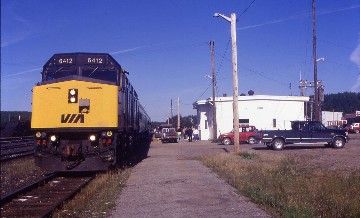
Following a couple of photographs at Parent, I was led through the baggage car and the engine compartment to the cab of VIA Rail F40PH-2 6422 built by General Motors Division in 1987. There were not many differences from the Amtrak locomotives in which I have ridden in the United States so I felt right at home in the fireman's seat. The line was straight for the most part and curved to align itself around lakes, which were found in every low spot. We passed through another fire area, this one from four years ago and this part of Quebec was still so wild and with so few roads that once a fire started, it was almost impossible to put it out quickly. The engineer received his orders from the dispatcher in French which was fascinating to listen to, after which we passed a trackside detector that only gives information in French, while on other parts of the Canadian National in this province, the detectors are bilingual.
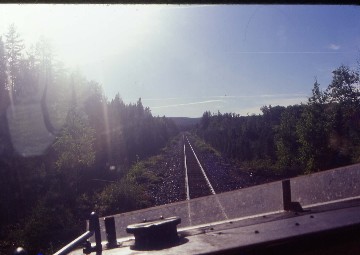
Since this line runs almost dead west, I kept on having to adjust the shade to keep a clear view down the tracks and rode up front until Milepost 200, so this was my longest Canadian cab ride at 81.1, then thanked our engineer for the unique experience and returned to my coach with a memory I would never forget. There were only two road crossings in eighty miles, something my engineer friends back home may never believe. The day ended with a beautiful reddish pinkish and orange-streaked sunset with darkness approaching before we reached Senneterre, where we arrived an hour late on a very interesting day of train riding. The total flag stops made were nine of the possible thirty and it had been a journey of surprises. I would never have guessed tunnels, high bridges, a causeway, rapids, a cab ride and beautiful scenery when I boarded in Montreal this morning. It was an unknown gem of Canadian passenger train routes.
Senneterre 8/18/1999Armed with good directions, I walked the ten minutes to the Motel Senabi which was decked out with neon green lights. Following check in and a lesson on how to use the phone to book a wakeup call, I had a most wonderful Quebec shower, as all the showers here have the most intense water pressure and it was like similar to standing under a waterfall; from here on, I will always refer to this type of shower as a waterfall shower. It was absolutely quiet here so I fell fast asleep.
8/19/1999 I stayed that way until 4:30 AM when the phone alarm went off, had another waterfall shower and walked under a star-filled sky with a temperature of 10 degrees Celsius to a restaurant where I had the largest pancakes I had seen then boarded the train for my last visit to Montreal on this trip.