




The Esquimalt and Nanaimo Railway had its beginnings in the negotiations over British Columbia (hereafter called "B.C.") becoming part of Canada. When B.C. joined Confederation in 1871, the distant province was promised a railway connecting it to the provinces in the east. Although it was not explicitly stated, Victoria, as the capital city and located on southern Vancouver Island, was seen as the terminus of the great transcontinental railway that was envisioned. This was confirmed in 1873 by Prime Minister Sir John A. MacDonald, but the enduring difficulty was that the promise was easier to deliver than the railway was to survey and construct, let alone finance. No one knew how the proposed railway, that was to become the Canadian Pacific Railway, was to cross the great barriers of the Rockies, Selkirks and Coast Ranges that separated the Pacific Coast of B.C. from the endless prairies to the east.
Building a railway along the east coast of Vancouver Island was never seen as easy, but it was far less of a challenge than building through the Rockies. Construction of the E&N began in 1884 and completion occurred on August 13, 1886 at Cliffside, above Shawnigan Lake. The E&N was extended, first northwards from Nanaimo to Wellington in 1887 then to Victoria across the harbour by a swing bridge in 1888.
The railway operated at a loss for some years before beginning to show modest profits by the turn of the century. At that time, James Dunsmuir, son of E&N's owner, was the sole owner and heavily involved in provincial politics. since the railway was in need of substantial modernization and expansion, he was ready to sell the railway and it was sold to Canadian Pacific in 1905.
Freight traffic increased substantially under Canadian Pacific control. The facilities at Victoria were completely inadequate and in the last six months of 1907, yard tracks were continually blocked by cars and as many as sixty cars were on sidetracks between Victoria and Ladysmith, waiting to move into Victoria. To add to the E&N woes at this time, the one-stall engine house in Victoria burned down in 1907, however, it was replaced by the unused engine house from Ladysmith, which was dismantled and rebuilt in Victoria at modest cost. Canadian Pacific did install more trackage in Victoria and along the line.
By this time, the Victoria Board of Trade was pressuring Canadian Pacific to build a yard on the city side of the harbour that would allow the merchants of Victoria quick and easy access to cars and express consigned to them. In response, the CPR proposed that it would run a railway from the present terminus on Store Street in a northerly direction along that street to connect with the Albion Iron Works. The CPR had purchased the iron works property and planned to demolish the buildings to make way for a new yard and freight shed in the block bounded by Store, Discovery, Government and Chatham Streets.
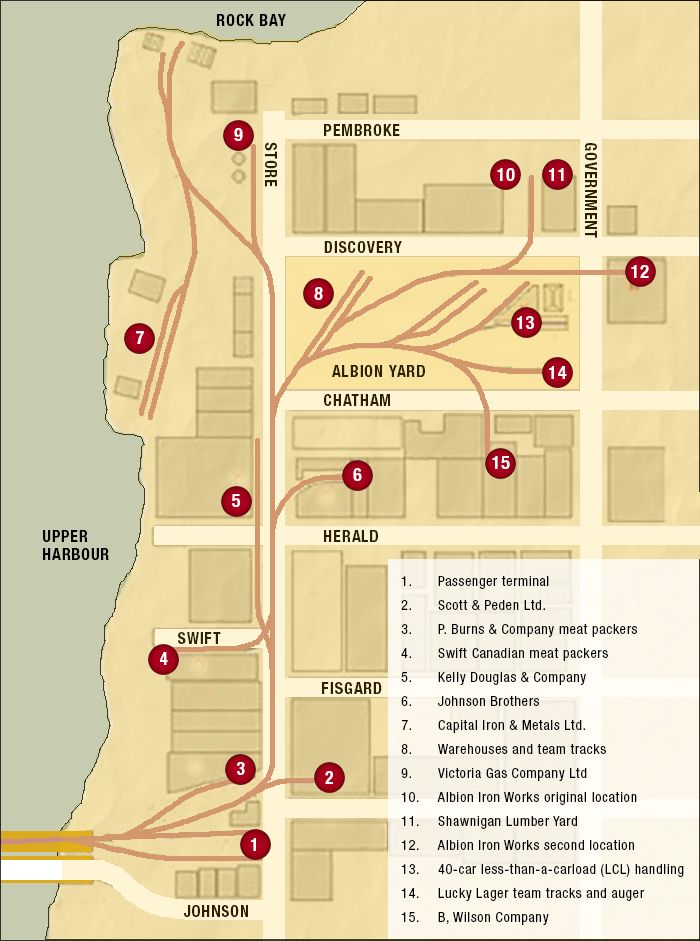
The City agreed to the Store Street extension and granted the E&N permission to lay spurs from the railway line to the former Albion property or into businesses that might require it, with the stipulation that "the Railway must do all necessary excavations, alterations and to grade the street, provided that the existing grade would not be altered without consent, in writing, of the city engineer".
On March 26, 1908, construction crews began grading and laying the track from the station to the new yard. Meanwhile, the demolition of the old Albion Iron Works was well underway. Once the tracks were complete, B.C. Electric Railway crews installed overhead wires for electric railway operation and on May 21st, the first six freight cars were shunted into the yard by a B.C. Electric freight motor and unloading began immediately.
There was a marked improvement in the speed of delivery of freight cars destined for Victoria's merchants once the yard was completed. A year later, the CPR installed a spur off the Albion Yard and across Chatham Street to service a new warehouse being built by Wilson Brothers, a wholesale grocery firm. This was the first business in Victoria to have a direct connection with the railway, which allowed it to ship and receive goods in carload lots at the warehouse.
Victoria's waterfront to the north of Johnson Street Bridge was a prosperous industrial area with sawmills, shipyards, logging and industrial suppliers, including foundries and machine shops, the Albion Iron Works (which manufactured a wide range of goods including stoves and cast building components) and wholesale and warehouse establishments, as well as retail businesses. Some of the business in later years with direct rail service access were Shawnigan Lake Lumber, Scott & Peden (later Buckerfield's), Swift Canadian Company, P. Burns & Company, Macdonald's Consolidated, Dowell's Cartage, Wilson Brothers and W.H. Malkin Company. Many other business were served by deliveries to the freight shed or by using cars spotted at the loading platforms. The Victoria Phoenix Brewery (later the Lucky Lager Brewery and finally the Labatt Brewery), was just across Government Street from the yard, and installed an auger system under the street to take grain into the brewery from railway cars in the yard.
Immediately north of the Albion Yard were the car barns and yards for the B.C. Electric Railway streetcar system. However, in 1948, streetcar service was discontinued and the street railway system was dismantled. The Albion Yard and surrounding businesses served by the railway made up one of the main distribution centres for Victoria and the surrounding areas of southern Vancouver Island. Also of importance to the region were the industries serviced by the railway on the Songhees lands to the west of the Johnson Street Bridge. These included Sidney Roofing, cordwood distributors, Esso and Shell Oil, shingle mills and in earlier years, shipyards.
As late as the 1960's, this area was still receiving many carloads of goods from the mainland and tracks extended as far as the south side of Rock Bay. Only with the de-industrialization of Victoria and southern Vancouver Island, which gained force in the 1960's and later decades, did this railway service fade away. Canadian Pacific itself, diverted its less-than-carload shipments away from the railway to its trucking subsidiary, Canadian Pacific Transport, on August 1, 1959. Increasingly, merchandise of all sorts destined for Vancouver Island, that was once transported by the E&N, was trucked to outlets on the Island, bypassing the railway completely. Moreover, the nature of rail traffic was changing as containerization and specialty freight cars, using modern terminals or intermodal facilities, replaced the once commonplace box car and intricate spur lines through city streets to individual commercial customers.
The E&N freight shed was destroyed by fire on May 6, 1976. In the mid-1980's, declining freight traffic on Vancouver Island caused closures and downgrades and one by one, the freight customers along the E&N were closing, re-locating to the mainland or shifting to trucks for their transport need. Swift Canadian Company, P. Burns & Company and grocery wholesaler Kelly Douglas all stopped receiving rail shipments and closed or re-located, as did Scott & Peden, by then sold to the long-established firm of Buckerfield's. This firm later closed and the building was modernized, becoming Swan's brewpub and hotel.
The reduction of E&N traffic to and from Victoria meant the frequency of train service also declined to one freight every second day. On November 1, 1981, Train No. 51, originating in Victoria, was abolished and replaced by a crew working out of Wellcox in Nanaimo. With very little switching required in Victoria, the yard crew assignment was cancelled on May 1, 1982 since it was reasoned that the road switcher could do any necessary Victoria switching and then run to Malahat, where it could exchange cars with a train run down from Wellcox. That was soon changed and the road switcher ran to Duncan, where it exchanged cars with the Wellcox crew and returned to Victoria.
The railway built a loading ramp near the roundhouse in Victoria West to take cars that previously had to be unloaded at Albion Yard. This permitted the sale of Albion Yard-Block D property in the 1980's, as well as more efficient switching of freight cars. The street trackage along Store Street to the Albion Yard was removed in 1992. The last customers were B.C. Hydro for propane and Garden City, a wholesale grocery store that was located across from the Albion Yard. Both warehouses had limited track space and the CPR purchased a small strip of land and added a second track for the gas shipments. For the E&N, this meant fewer calls for trains and fewer cars to be stored in the yards pending delivery.
Those changes, implemented in 1986, meant the E&N could eliminate the Victoria-based crew and operate a train from Wellcox to Victoria and return three days a week. A diesel switcher was retained in Victoria because of the sharp curvature of the track into Garden City warehouse across from Albion Yard. By the spring of 1993, the Garden City warehouse and B.C. Hydro were no longer needing rail service over the trackage along Store Street and in April, the rails were removed, ending eight decades of E&N trains threading their way along the city street to the yard.
The yard that once had been so happily received as an essential facility for the commercial growth of Victoria was a thing of the past. It became a parking lot for Capital Iron and other local businesses, and a number of new buildings were constructed on the site. The end of track on the city side of the harbour was just past the VIA Rail station, east of the Johnson Street bridge, and the only service into the city was VIA's E&N Dayliner with its morning departure and early evening arrival.
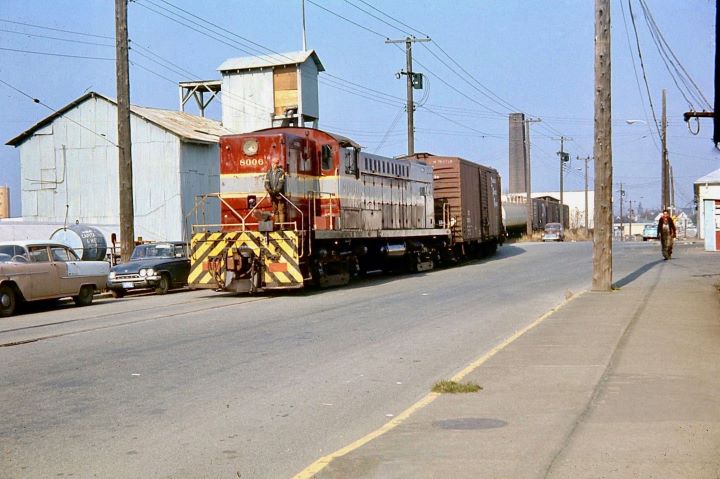
Canadian Pacific 8006 working along Store Street on October 18, 1969.
This DRS4-4-1000 was built by Baldwin in 1948 and was wrecked near South Wellington on June 12, 1973. While the 8000's did venture onto the street trackage when heavy tonnage was moved, they were too long in their wheelbase for easy working on the tight curves.
Canadian Pacific 8006 working along Store Street on October 18, 1969.
This DRS4-4-1000 was built by Baldwin in 1948 and was wrecked near South Wellington on June 12, 1973. While the 8000's did venture onto the street trackage when heavy tonnage was moved, they were too long in their wheelbase for easy working on the tight curves.