




|
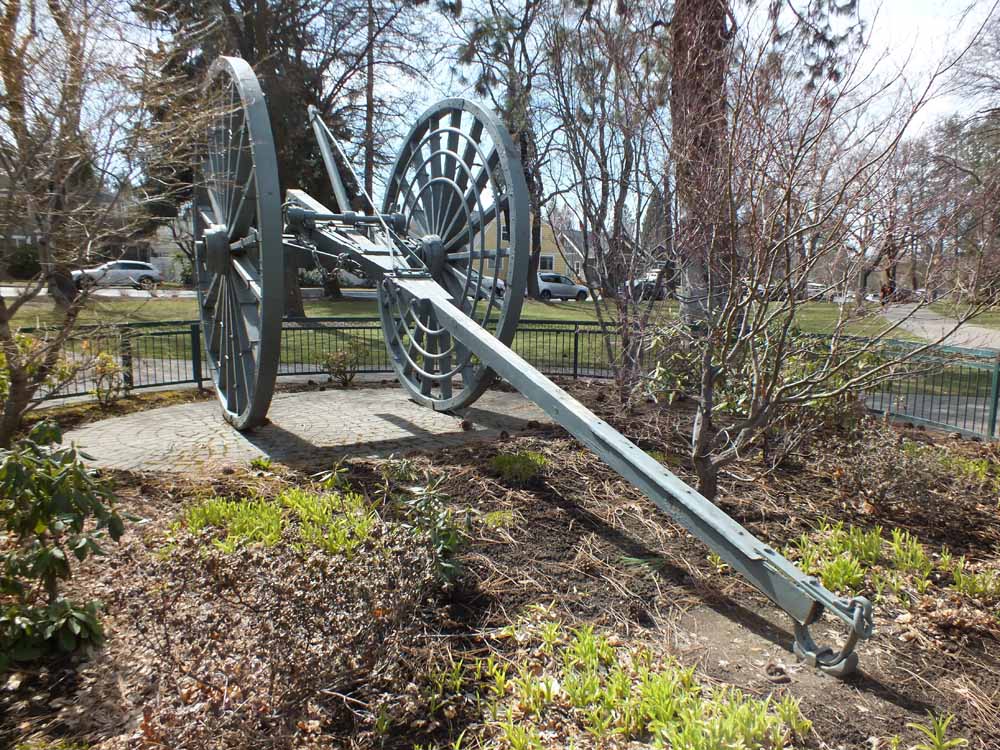
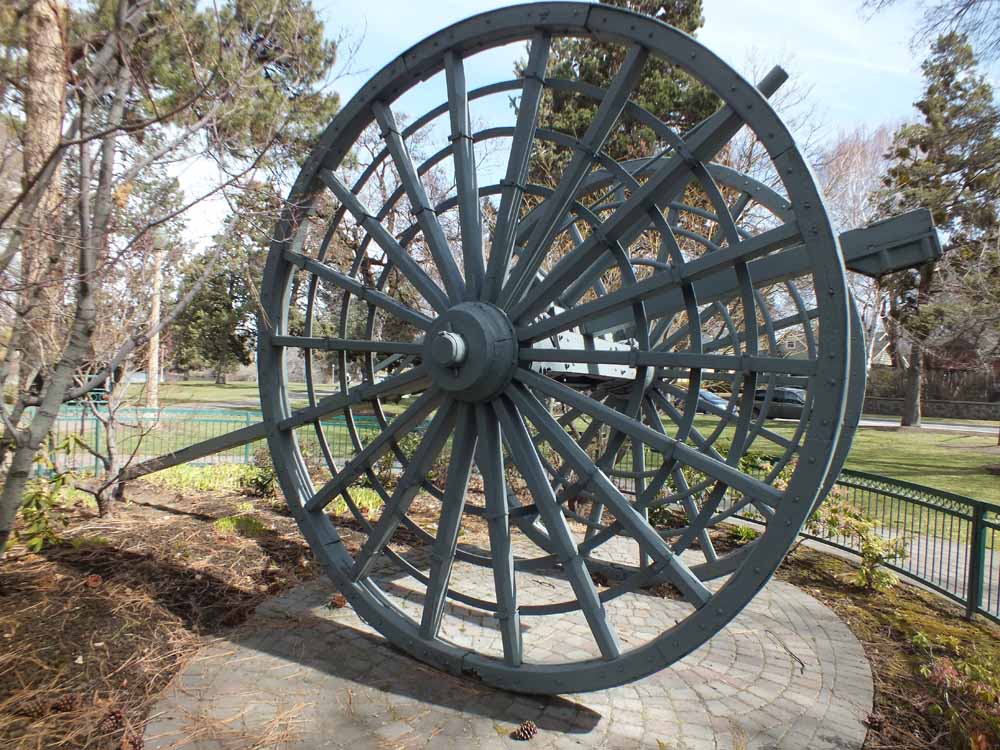
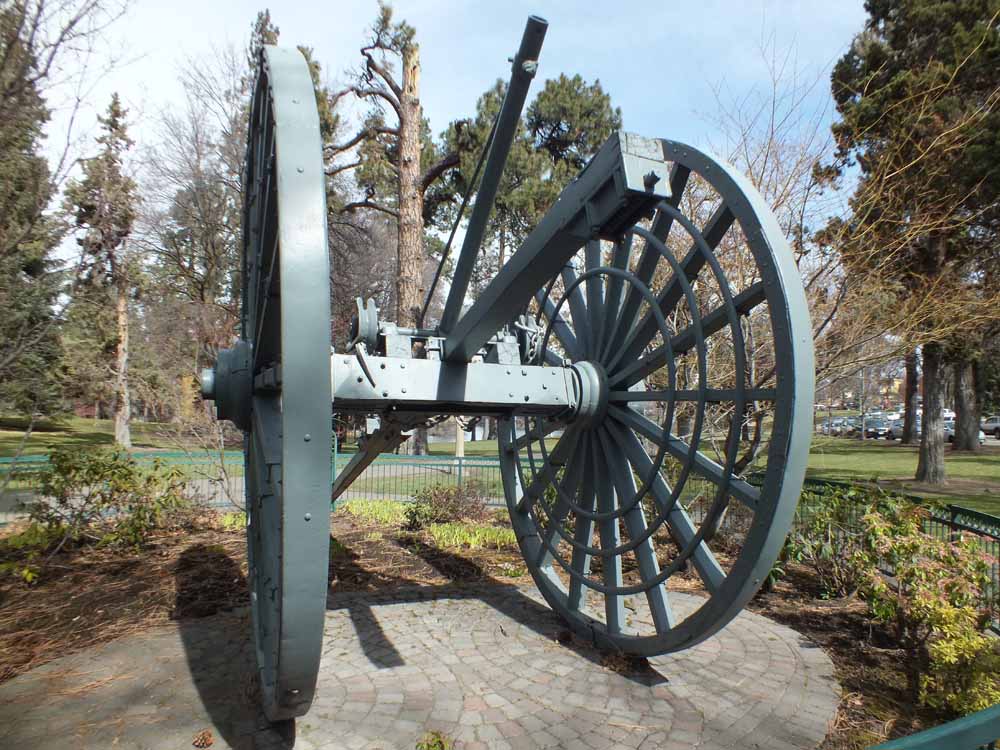
Brooks-Scanlon Lumber Company High Wheels on Display in Drake Park |
|
|
|
The basic technology of animal-drawn high wheels used to move logs out of the forests appears to have existed in Europe since at least Midevil times and got imported to the Americas during the colonial period. High wheels in their ultimate form consisted of a set of 12-foot or more diameter wheels connected by an axle, with a tongue extending out the front end. Logs would be chained to the axle for movement. Early high wheels had no brakes, but several manufacturers, including Redding Iron Works, developed slip tongue models in which the tongue was allowed to slide, which would lift the front end of the logs off the ground when the wheels started to move. On downgrades the tongue would slide backwards, lowering the logs to the ground where they would serve as a brake. High wheels were extensively used in the upper Midwest region and south by the last half of the 1800s and very quickly spread to the western states. The pine regions stretching from northeastern California through central Oregon were ideally suited to high wheel logging, and both Brooks-Scanlon and Shevlin-Hixon made extensive use of horse-drawn wheels until logging tractors and arches started replacing them in the later 1920s. Brooks-Scanlon donated one set of their high wheels to the City of Bend for display, at least one published source placed that event as happening around 1941 though another story suggests the company conveyed the wheels to the City in 1953 after it turned down Shay #3. The city placed the wheels on display in Drake Park adjacent to Mirror Pond on the Deschutes River. The wheels have remained on display ever since except for a couple times the city sent the wheels elsewhere for stabilization or restoration work, most recently in 2025. As of this writing (November 2026) they do not appear to have been placed back on their display stand in the park. They remain one of the last major artifacts in Bend to mark the history of the timber industry in the region. |
|
|
 |
|
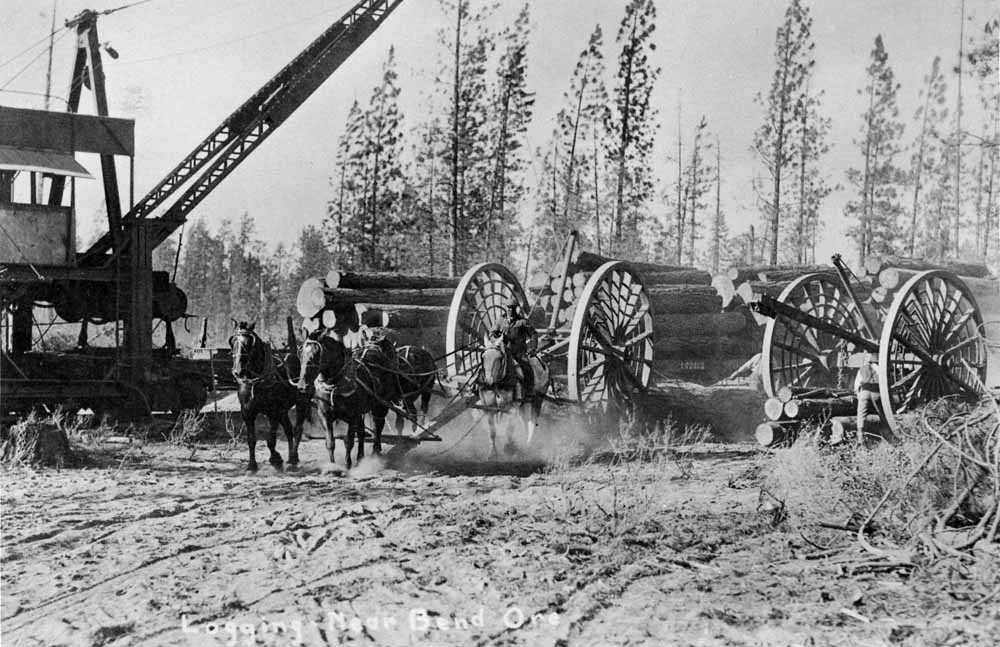
Several sets of big wheels are seen here delivering logs to one of Brooks-Scanlon's McGiffert loaders. Jeff Moore collection.
|
|
|
 |
|
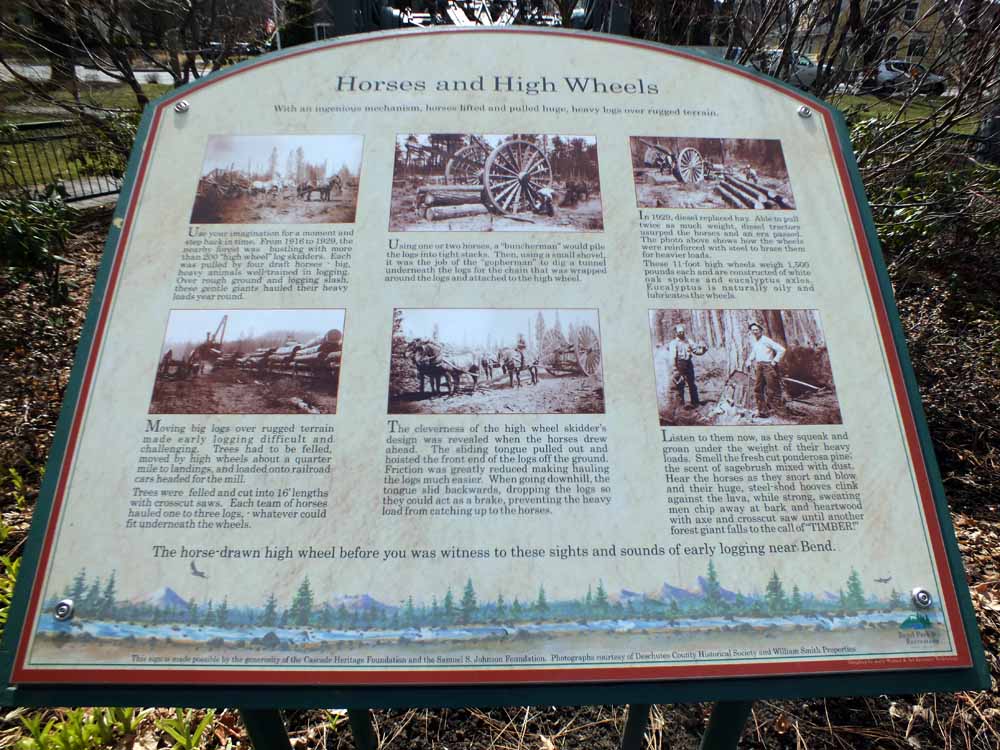
The interpretive panel placed next to the wheels in 2018. The captions under the photos read as follows:
Top Row, Left: "Use your imagination for a moment and step back in time. From 1916 to 1929, the nearby forests was bustling with more than 200 "high wheel" log skidders. Each was pulled by four draft horses- big, heavy animals well trained in logging. Over rought ground and logging slash, these gentle giants hauled their heavy loads year round." Top Row, Center: "Using one or two horses, a "bunchman" would pile the logs into stacks. Then, using a small shovel, it was the job of the "gopherman" to dig a tunnel underneath the logs for the chain that was wrapped around the logs and attached to the high wheel." Top Row, Right: "In 1929, diesel replaced hay. Able to pull twice as much weight, diesel tractors usurped the horses and an era passed. The photo above shows how the wheels were reinforced with steel to brace them for heavier loads. These 11-foor high wheels weigh 1,500 punds each and are constructed of white oak spokes and eucalyptus axles. Eucalyptus is naturally oily and lubricates the wheels." Bottom Row, Left: "Moving big logs over rugged terrain made early logging difficult and challenging. Trees had to be gelled, moved by high wheels about a quarter mile to landings, and loaded onto railroad cars headed for the mill. Trees were felled and cut into 16' lengths with crosscut saws. Each team of horses hauled one to three logs, whatever could fit underneath the wheels." Bottom Row, Center: "The cleverness of the high wheel skidder's design was revealed when the horses drew ahead. The sliding tongue pulled out and hoisted the front end of the logs off the ground. Friction was greatly reduced making hauling the logs much easier. When going downhill, the tongue slide backwards, dropping the logs so they could act as a brake, preventing the heavy load from catching up to the horses." Bottom Row, Right: "Listen to then now, as they squeak and groan under the weight of their heavy loads. SMell the fresh cut ponderosa pine: the scent of sagebrush mixed with dust. Hear the horses as they snort and blow and their huge, steel-shod hoobes clink against the lava, while strong, sweating men chip away as bark and heartwood with axe and crosscut saw until another forest giant falls to the call of "TIMBER"." |
|
|
 |
|
|
 |
|
|
 |
|
|
 |
|
|
 |
|
|
 |
|
|