





By 1846, the railroad had reached Kalamazoo, Michigan. However, the state sold the railroad to the Michigan Central Corporation for $2,000,000 and a commitment by the new owners to complete the railroad with sixty-pound T-rail and upgrade the poorly-constructed line between Kalamazoo and Detroit with similar quality rail.
This new, private corporation changed the western terminus from St. Joseph to Chicago, and completed the line in 1852. Michigan Central’s early freight service relied on hauling of natural resources including Michigan's extensive stands of timber. The Michigan Central Railroad also operated passenger service from Chicago to Detroit, with some trains routed over the Canada Southern line to Buffalo and on to New York City.
In 1890, the Michigan Central Railroad came under the financial control of the New York Central and Hudson River Railroad, but it continued to operate as a separate railroad.
In the early 20th Century, with service in and out of Detroit, the Michigan Central became a major carrier of autos and auto parts. Unlike other railroads that operated in Michigan like the Ann Arbor, Pere Marquette, Grand Trunk, and Pennsylvania, the Michigan Central had a direct line on their own rails into Chicago, thus eliminating the need to operate ferries across Lake Michigan. Michigan Central was, however, part owner of Mackinaw Transportation Company, which operated the SS Chief Wawatam ferry service to Michigan’s upper peninsula.
The Michigan Central also owned the Canada Southern Railroad which ran across Ontario from Windsor to Niagara Falls, plus operated a tunnel beneath the Detroit River. Car floats (train ferries) were used to cross the Detroit River between Detroit and Windsor for high-and-wide loads that could not fit through the tunnels. An international bridge crossed the Niagara Gorge at Niagara Falls. Control of the Canada Southern subsequently passed from Michigan Central to the New York Central.
Because it was mortgaged and paying off bonds, the Michigan Central existed, at least on paper, into the mid-1950's when it was formally merged into New York Central. A number of the lines later became a part of Penn Central, then Conrail.
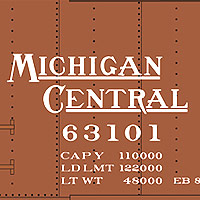
Close-up of unique Michigan Central font. Note that abbreviated reporting marks were not used.
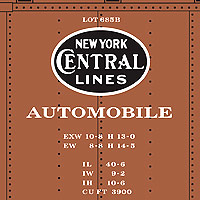

Close-up of New York Central Lines logo. Note that these 40' double-door boxcars were specially equipped for hauling automobiles.