Your Ad Here
Old Main Line Photo Tour

B&O Old Main Line
OML Stringers

Accompanying each photo below are:

Click a photo to see a larger view. Please send your comments and corrections to Steve.


Easternmost
Photo courtesy JD Hiteshew

Easternmost
Mile: 3.6 Date: 2007
Ease: B+ View:
Area: B+ IC2:
Map: Ba 42 E 7 Topographic Maps

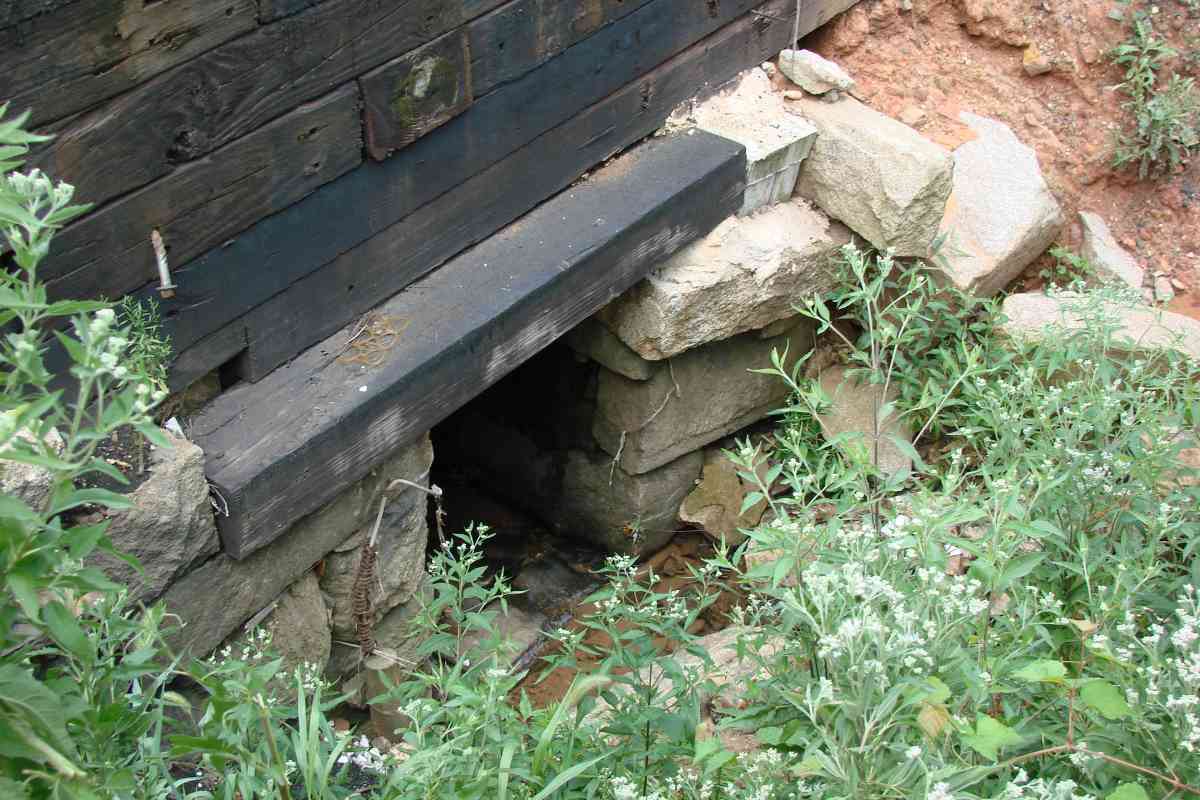
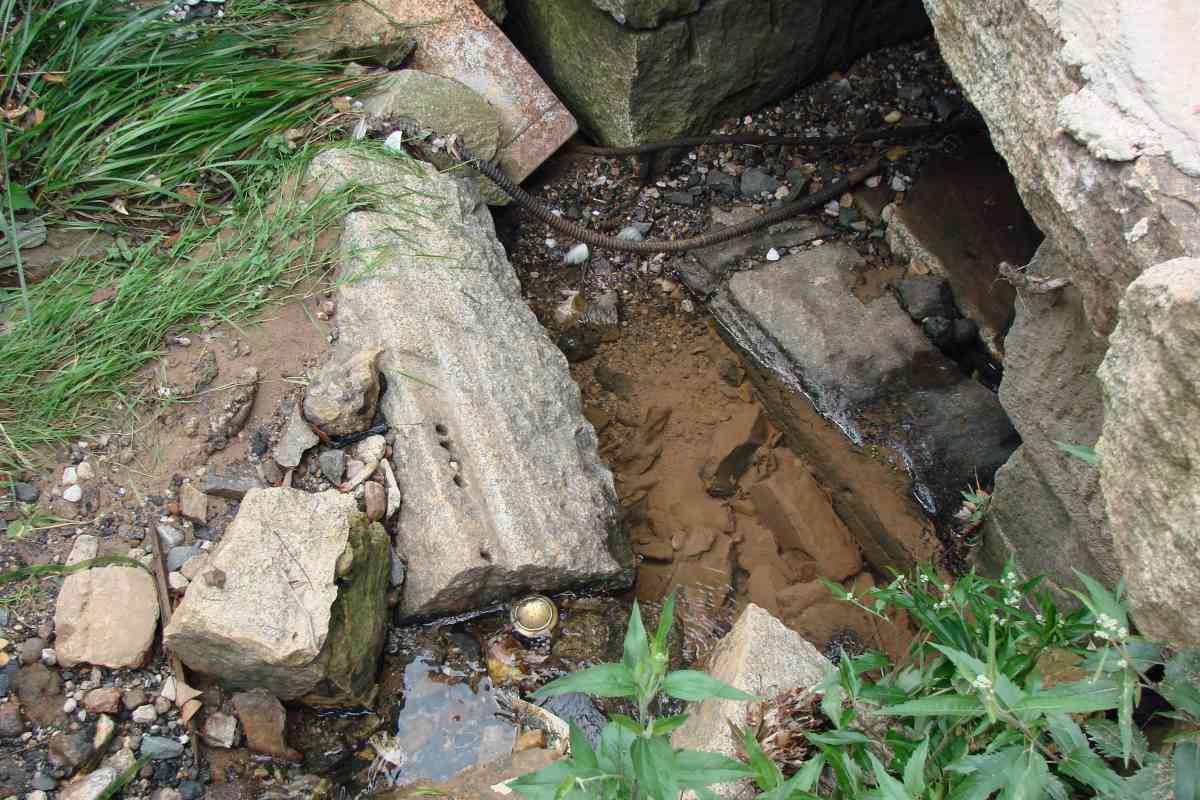
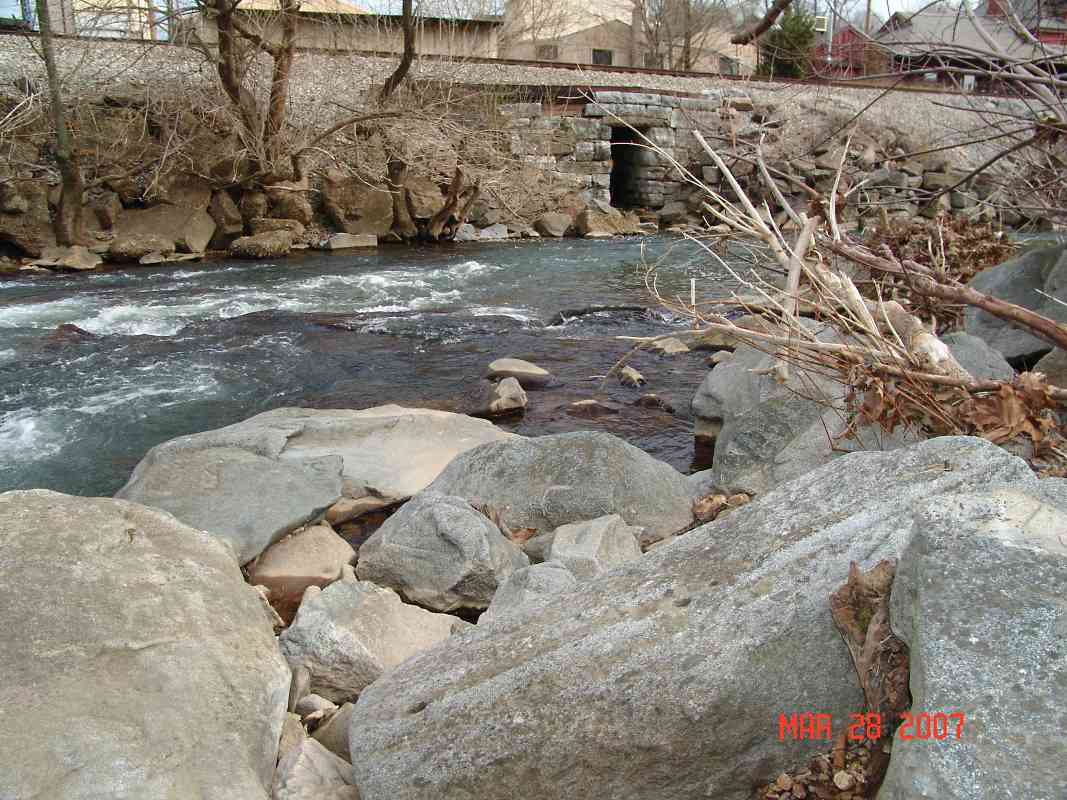
After giving up on the stone stringer track design, the B&O recycled the durable granite for others purposes, such as culverts. This example in the Lansdowne area contains the easternmost known extant stringers still in railroad use. In this picture, one can be seen as the middle of the three large stones to the right of the culvert opening. Note the indentation parallel to the long edge; this is where the iron strap rail had been affixed.


Wall

Wall
Mile: 10.1 Date: Jul 2004
Ease: B View: E
Area: B IC2: 339
Map: Ho 13 C 13 Topographic Maps

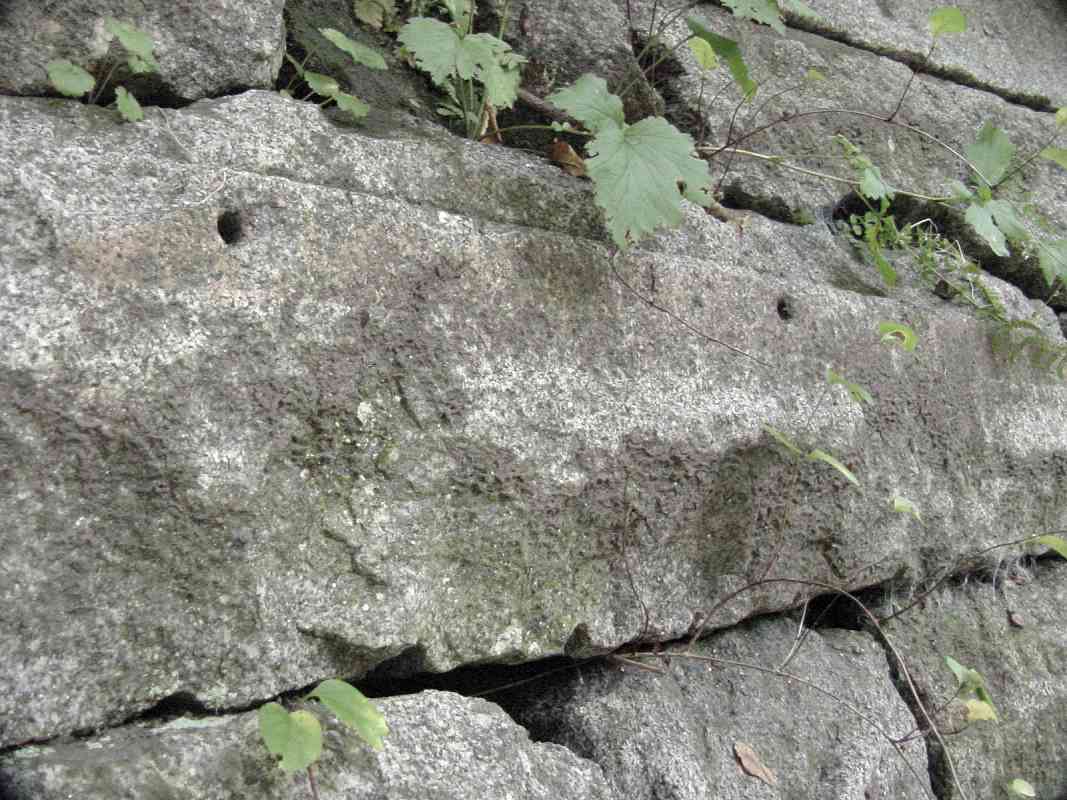
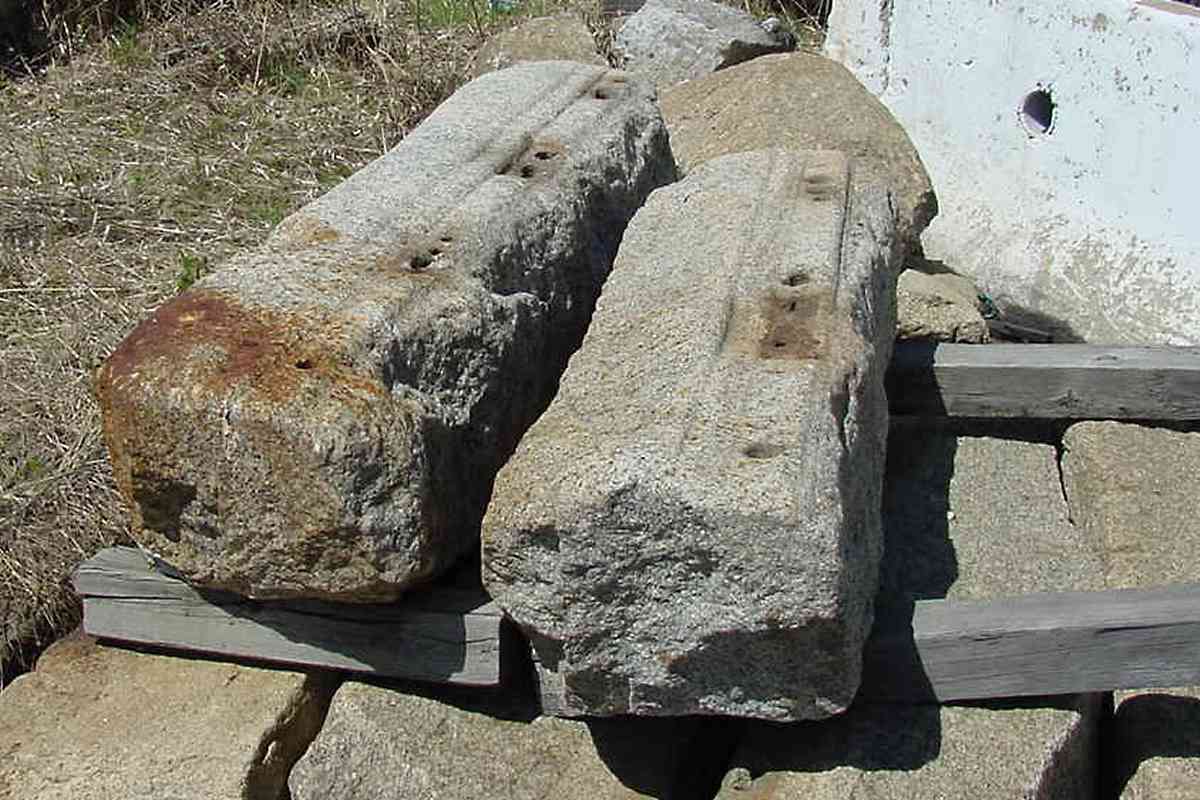
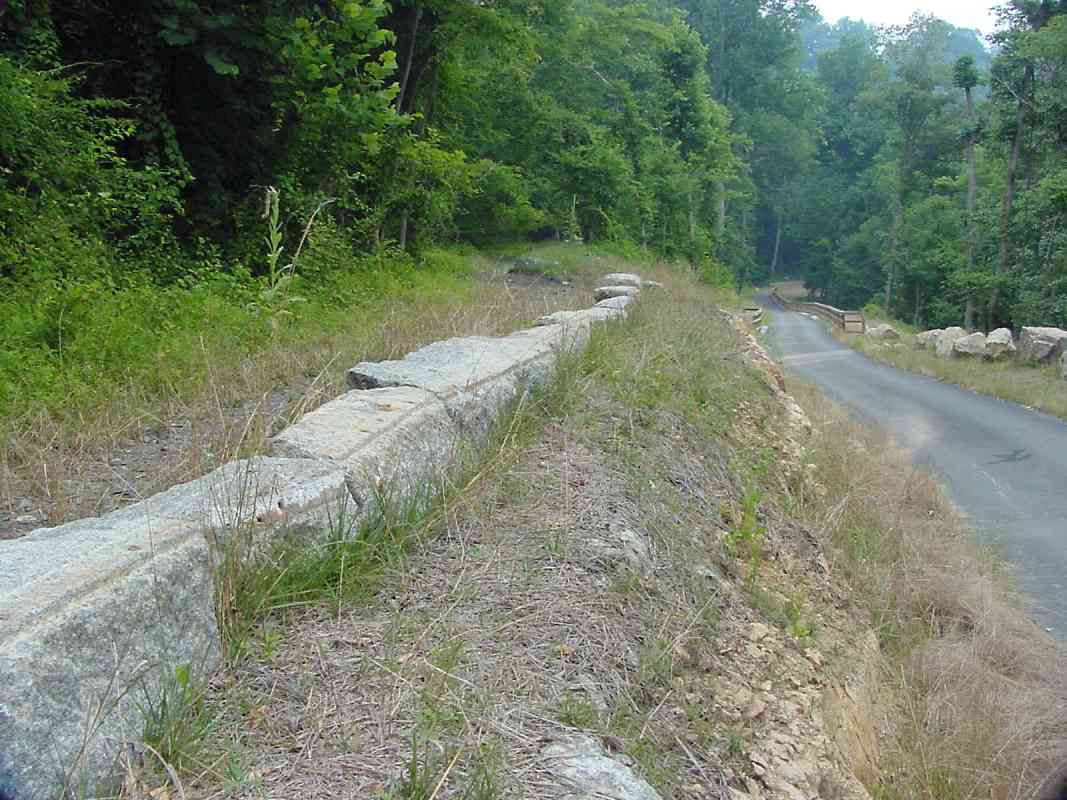
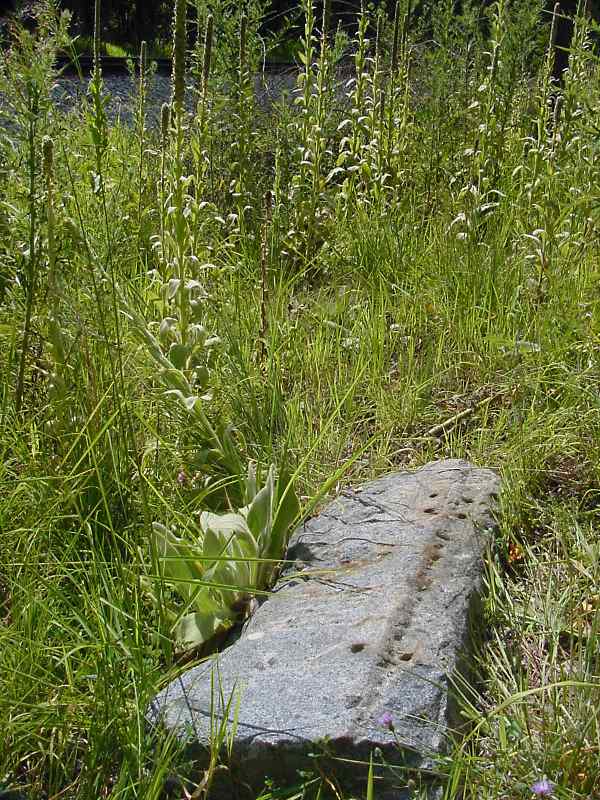
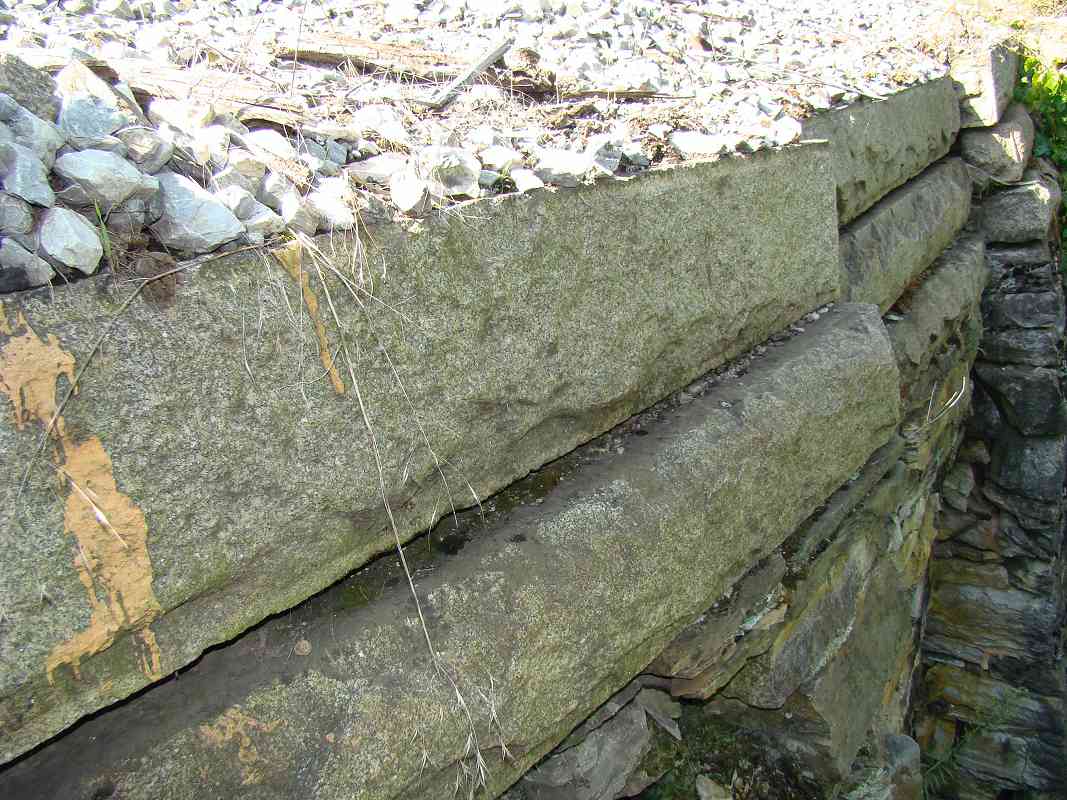
A retaining wall west of Orange Grove hosts many recycled stringers, such as this one. The holes represent where the iron strap rail had been nailed through its center into the stone. The separation between most holes is approximately 18 inches (45 cm).

Indications are many miles of stringers (and the even-older stone blocks) remain buried underneath the still-active railroad. Floods such as the one from Tropical Storm Agnes in 1972 exposed them in various places.


Groovy

Groovy
Mile: 10.1 Date: Jul 2004
Ease: B View: N
Area: B IC2:
Map: Ho 13 C 13 Topographic Maps

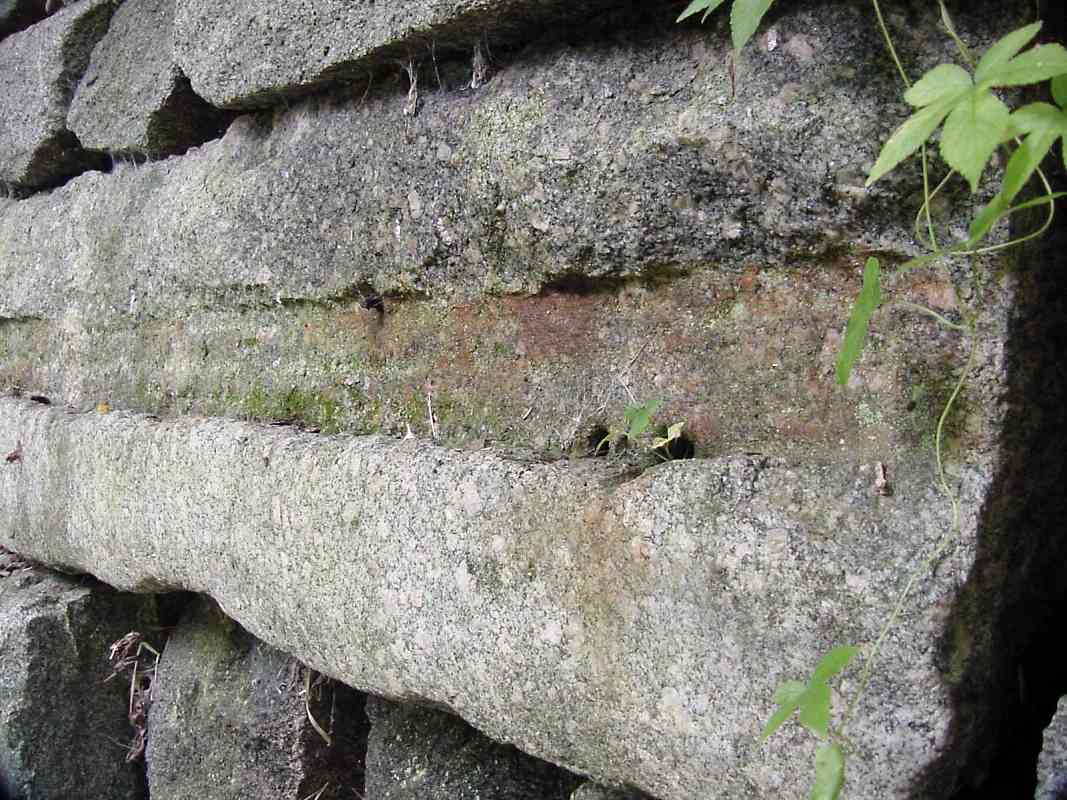
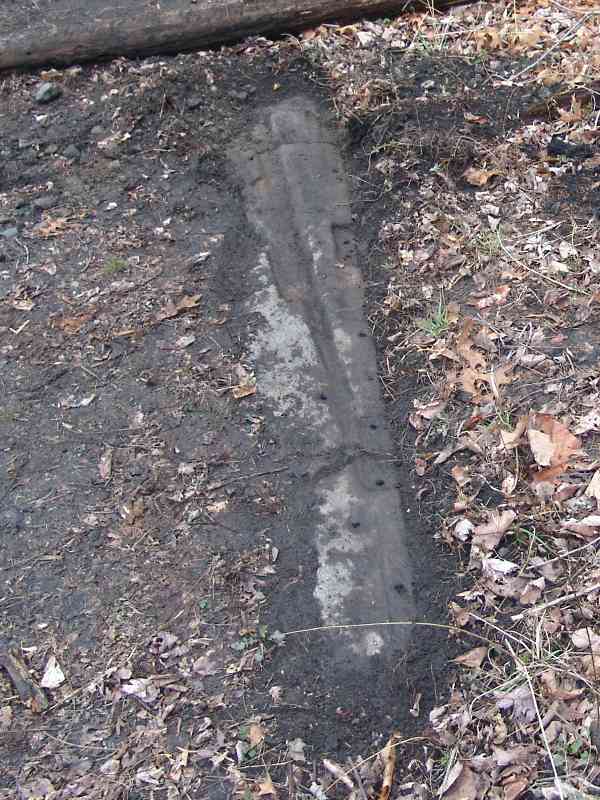
This groovy stringer pre-dates not only the 1960s but also the 1860s. It exhibits characteristics undescribed by any B&O history reference. Note 1) the deep groove in the center of the stone, rather than along the edge, and 2) the nail holes alternating along the sides of the groove, rather than in the center.

I suspect this stringer was topped by T-rail in an 1830s experiment to test the suitability of the combination. The red staining of the stone is due to rusting of the rail.


Two Grooves

Two Grooves
Mile: 0.1 Date: Apr 2001
Ease: B View: NW
Area: B IC2:
Map: Ba 42 J 1 Topographic Maps

Back at the B&O Museum, this pair of stringers also shows unusual characteristics. Both stones have two grooves for strap rail, a lesser one and a deeper one. The stone on the left shows multiple pairs of closely spaced holes (more about these later), indicative of short pieces of track. Were these somehow used in a switch? Does anyone know the location from which the Museum acquired these?


Ilchester

Ilchester
Mile: 10.4 Date: Nov 1999
Ease: C View: W
Area: A IC2: 202
Map: Ba 41 A 8, Ho 13 B 13 Topographic Maps

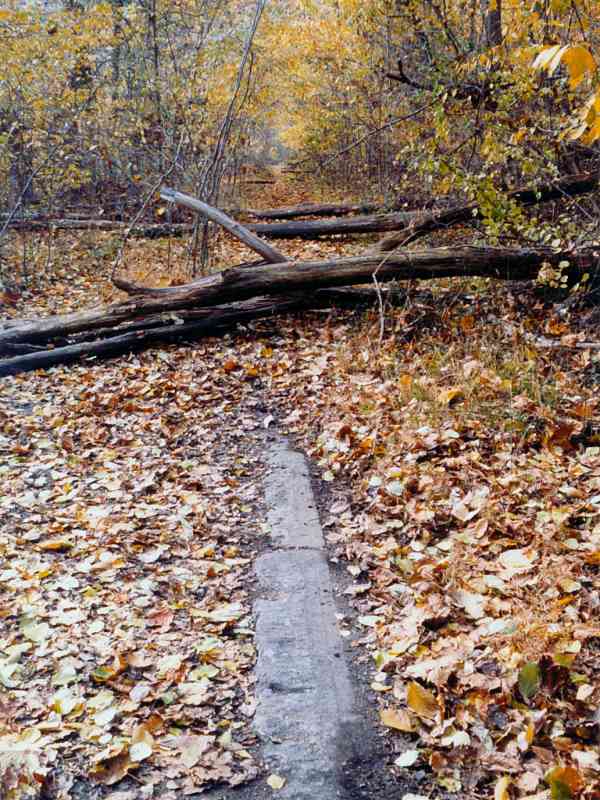
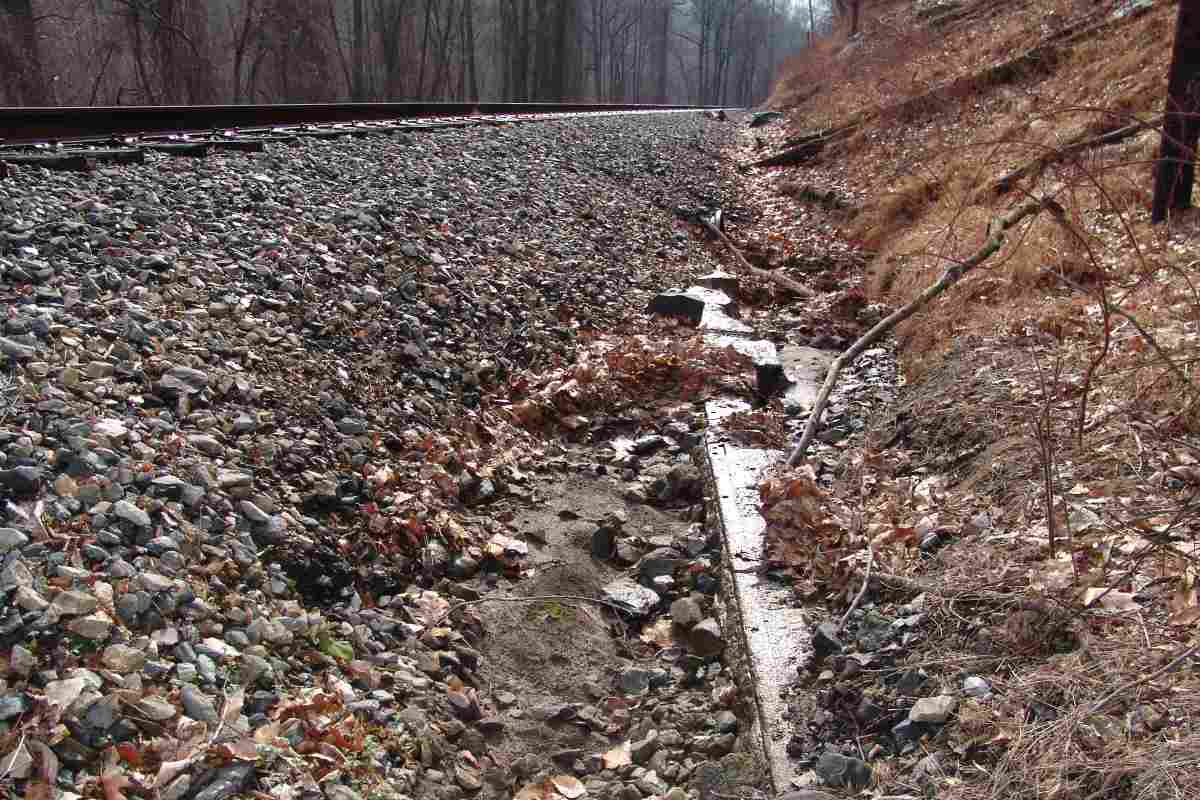
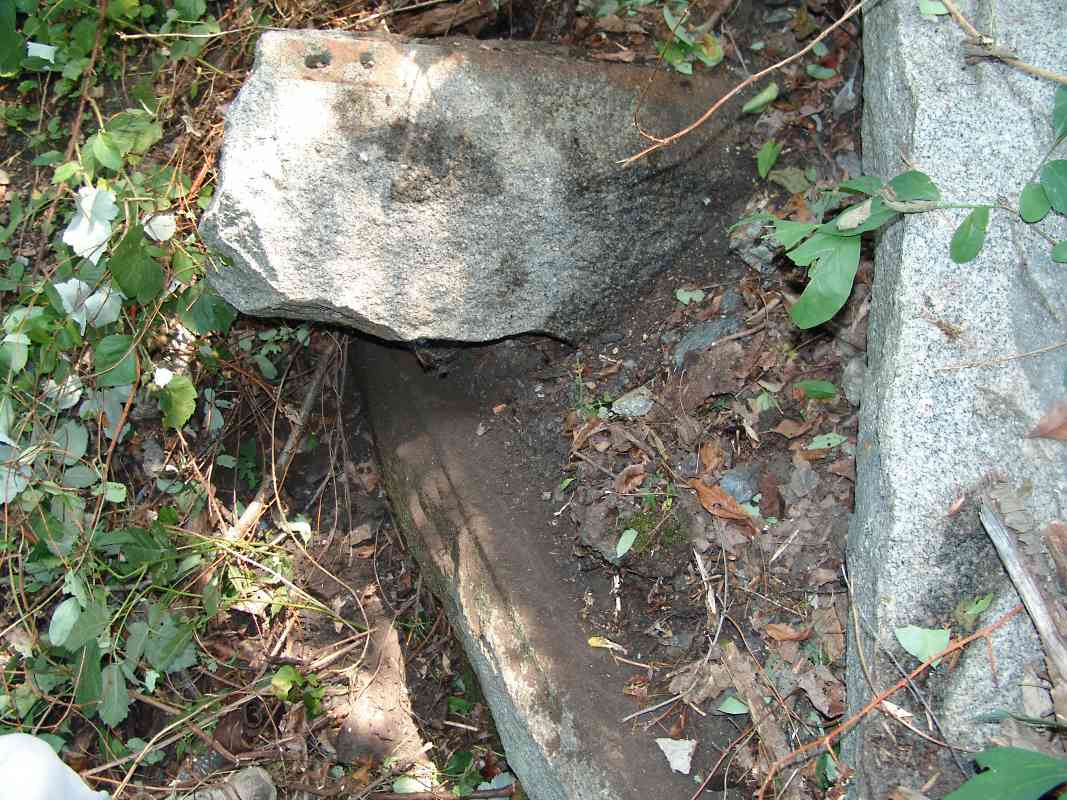
Following the OML west from Baltimore, the first glimpse of stringers in their original placement lies here along the disused right-of-way near Ilchester Tunnel. The iron strap rail was long ago pulled up (and reused on sidings into the 1860s), but you can still see where it had been nailed to the granite.

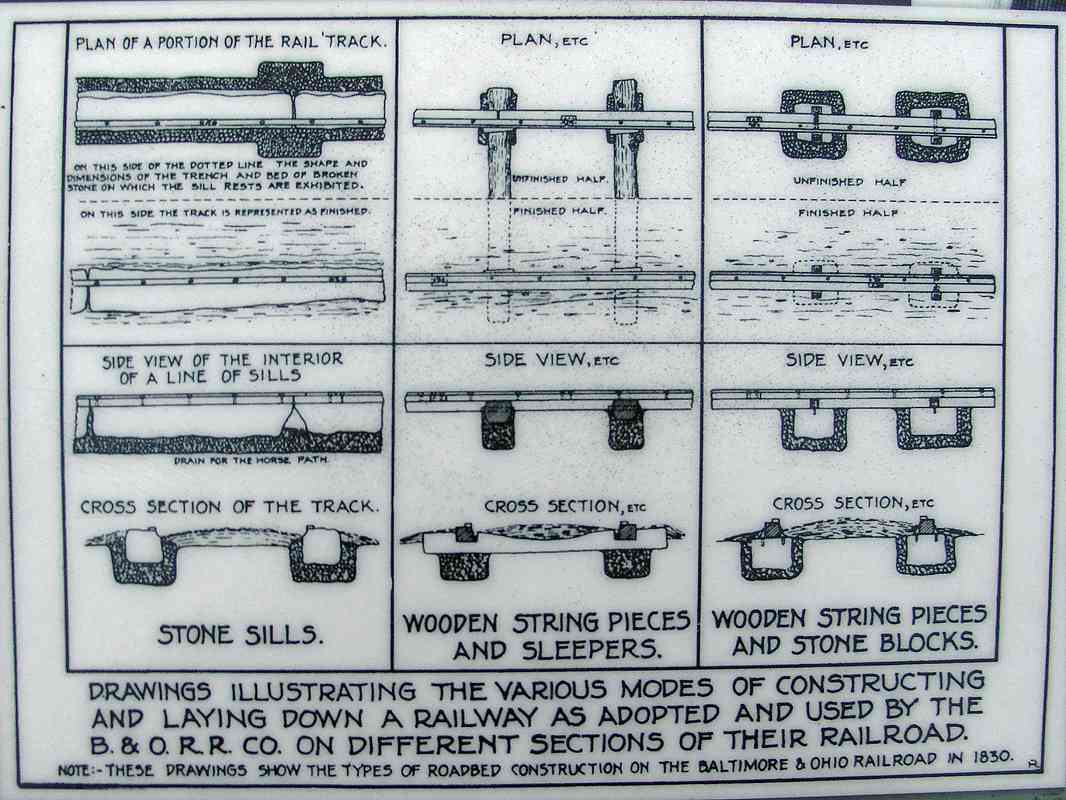
All but one contractor employed by the B&O to build the OML was bankrupted by the unexpectedly high cost of building the stone track. Work progressed too slowly as well, and eventually the company relented, and allowed additional track to be constructed with wood ties, similar to those used today. They learned the wood-style track construction could be completed 10 times faster, and that sealed the fate of the stone.


Holes

Holes
Mile: 10.4 Date: Nov 1999
Ease: C View: NW
Area: A IC2:
Map: Ba 41 A 8, Ho 13 B 13 Topographic Maps

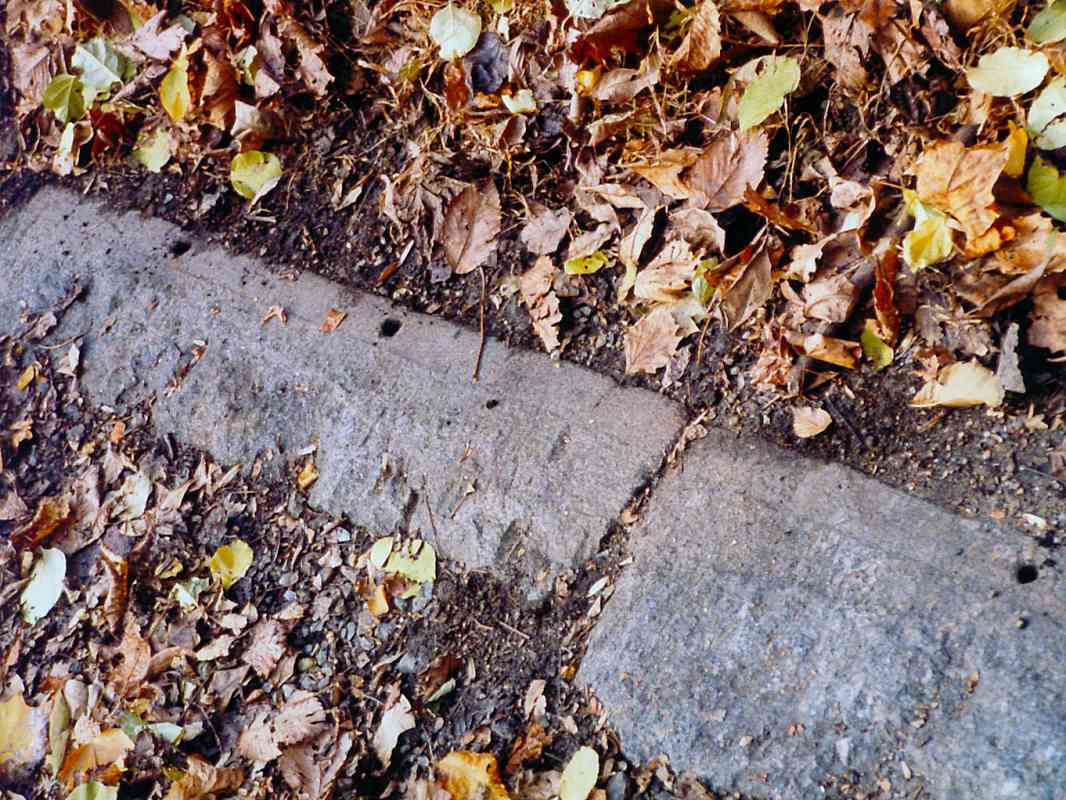
Here's a closeup photo. The holes indicate where strap rail was affixed via nails, and you can still see the groove left behind by the rail strip. Strap rail was employed because it used less iron than other designs; iron was in short supply and most had to be imported from mother England. The strap rail had the frightening tendency to peel off the granite, then curl up and pierce the cars that rolled above; these were called "snakeheads", though some modern references contend they rarely occurred.

Probably far more likely was for the strap rail to become loose, and out of proper gauge (distance between pair of rails). Another challenge to the gauging was the stones themselves, which were not connected by crossties. Frankly it amazes me the B&O was able to make and keep this system workable under loads and speeds that increased quite rapidly during the roughly 20 years the strap rail remained in use.


Path

Path
Mile: 10.5 Date: Jul 2004
Ease: C View: E
Area: A IC2:
Map: Ba 40 K 8, Ho 13 B 13 Topographic Maps

In 2003 the Patapsco Heritage Trail bulldozed its way through, excavating some of the stringers, and putting them on display.

Behind the photographer, on the way to the Patterson Viaduct, the stringers were simply paved over, better preserving them for future archeologists who will someday marvel over our "stone age" of railroading.


Bridge
Photo courtesy JD Hiteshew

Bridge
Mile: 11.5 Date: Mar 2007
Ease: C View: N
Area: A IC2: 339
Map: Ho 12 K 12 Topographic Maps

The stringers can turn up just about anywhere, such as in this disused bridge (look for the holes in the stone slightly left and up of center). This bridge near Lees is otherwise notable for a sloppy construction appearance. Perhaps it was built in a hurry, and thus any available stones were used, even ones that had been prepared for track.

The rusty stains on the stringer indicate it had seen at least some use in the trackbed before being incorporated in this bridge, but this bridge is along one of the oldest sections of B&O track. Perhaps the bridge had to be rebuilt after an early failure.


Flat

Flat
Mile: 16.9 Date: Aug 2005
Ease: B View: NE
Area: A IC2:
Map: Ho 12 G 1 Topographic Maps

Stringers litter the landscape all along the Patapsco River valley. The more you look, the more you find, and the durability of granite assures they'll be around for thousands of years. This example displays an unusually flat shape.

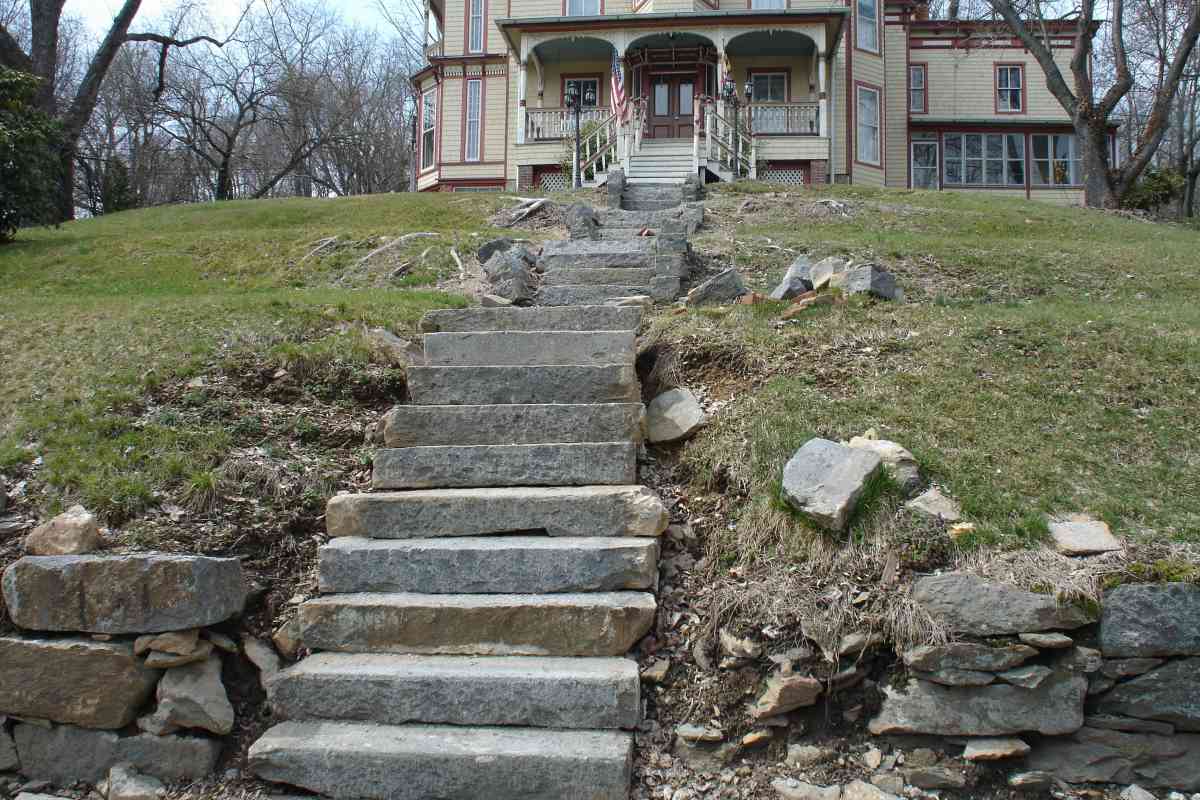
Some found their way into private hands. I've received reports of the heavy stones being used for foundations and outdoor stairways of homes along the OML.


Muddy

Muddy
Mile: 18.8 Date: Mar 2000
Ease: C+ View: E
Area: A IC2:
Map: Ho 12 B 1 Topographic Map

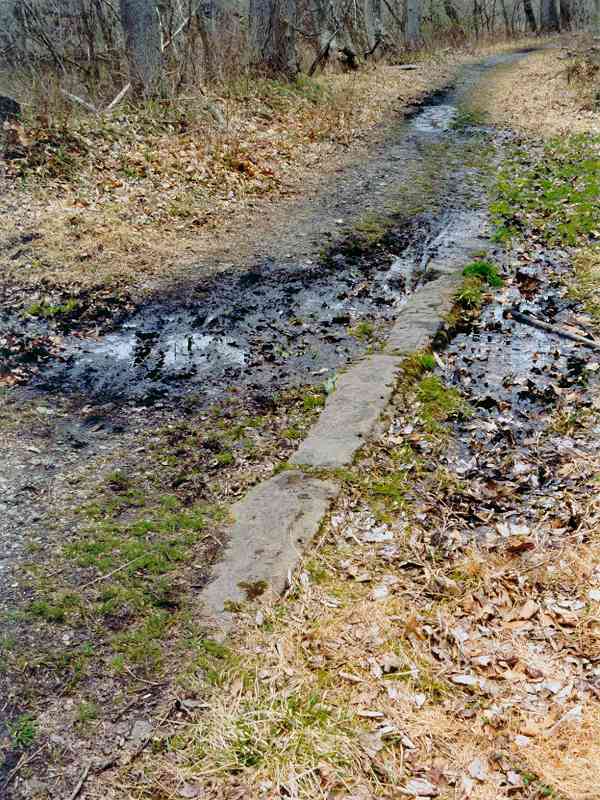
Erosion has exposed a group of stringers along the muddy disused right of way between Daniels and Davis. I am puzzled as to why there appears to be only one column of stringers. There should be at least one more for wheels on the other side of the train, if not three more columns for double track.


Mystery

Mystery
Mile: 18.8 Date: Mar 2000
Ease: C+ View: N
Area: A IC2:
Map: Ho 12 B 1 Topographic Maps

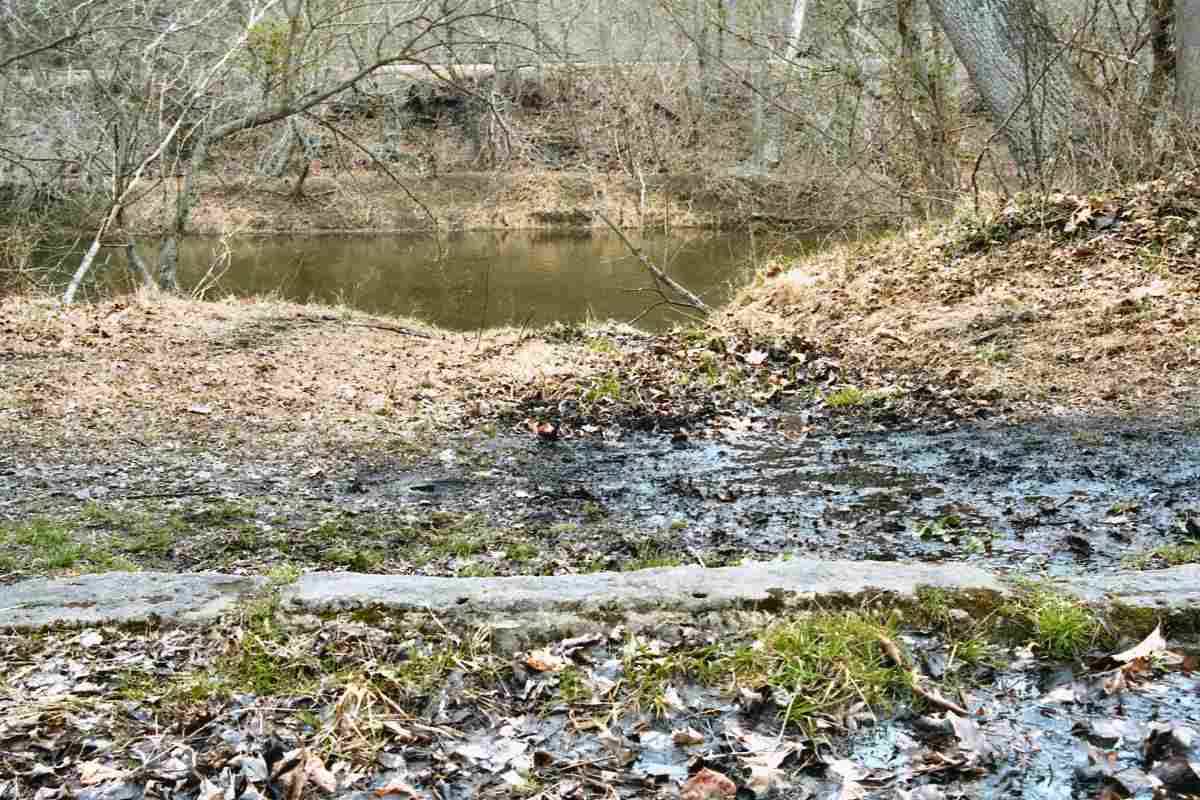
In this view at the same location, at the top of the picture you can glimpse the active railroad where it was relocated across the river around 1906. Note also the deeper indentation in the stone at the right edge near where two nail holes are close together. This mystery will be discussed more below.

Not U Rail

Not U Rail
Mile: 23.4 Date: May 2005
Ease: C View: S
Area: A IC2:
Map: Ho 6 D 8 Topographic Maps

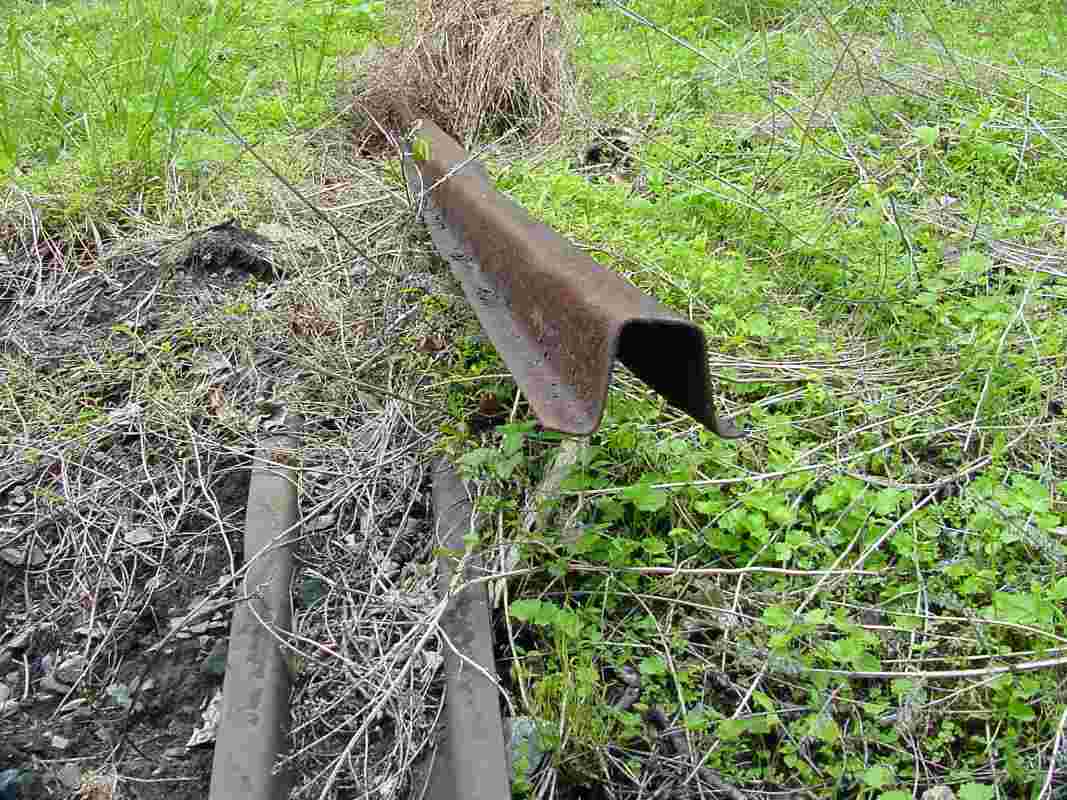
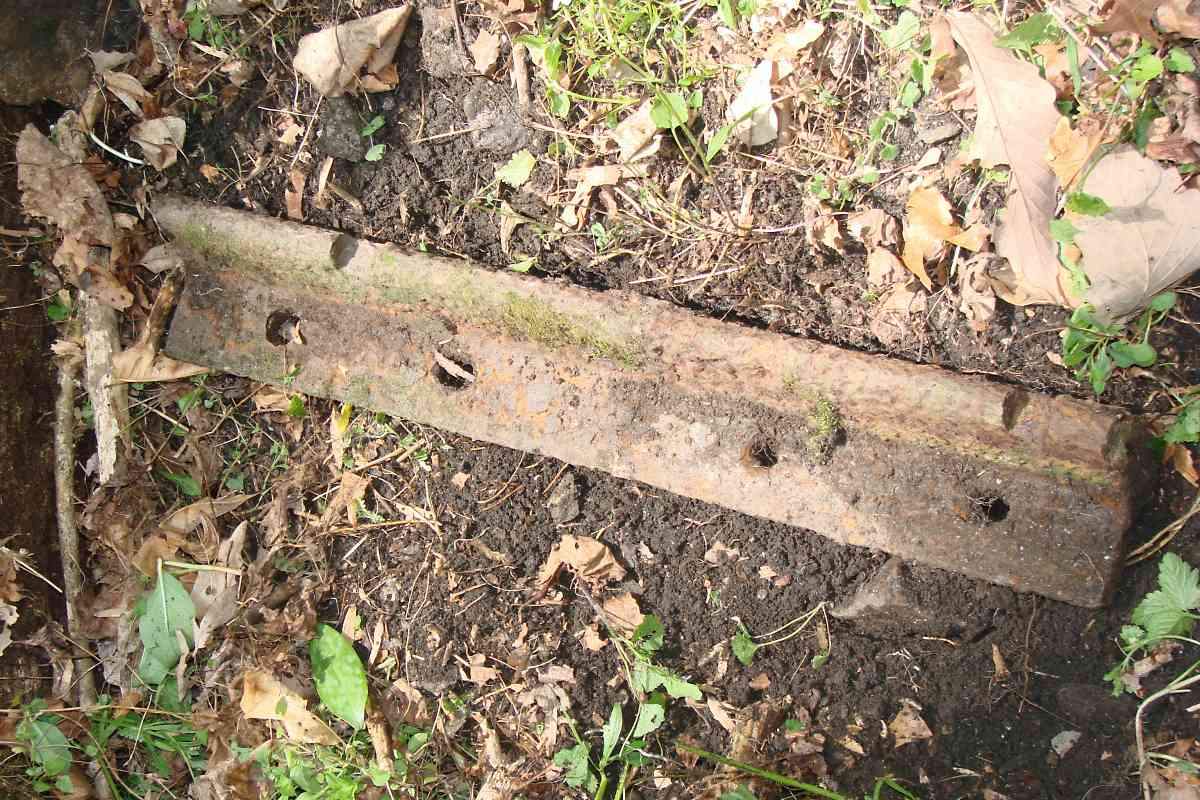
In the process of switching from strap rail to T rail, the early B&O reportedly tried alternate rail designs such as U or H rail. When I happened upon these discarded materials trackside, I intially thought they might be artifacts of such rails, however this material is too thin, and my guess is it had peeled off a modern rail car.

Can scraps of real iron strap rail still be found? The answer is yes...


Strap Rail
Photo courtesy JD Hiteshew

Strap Rail
Mile: Date: 2007
Ease: View:
Area: IC2:
Map: Topographic Map

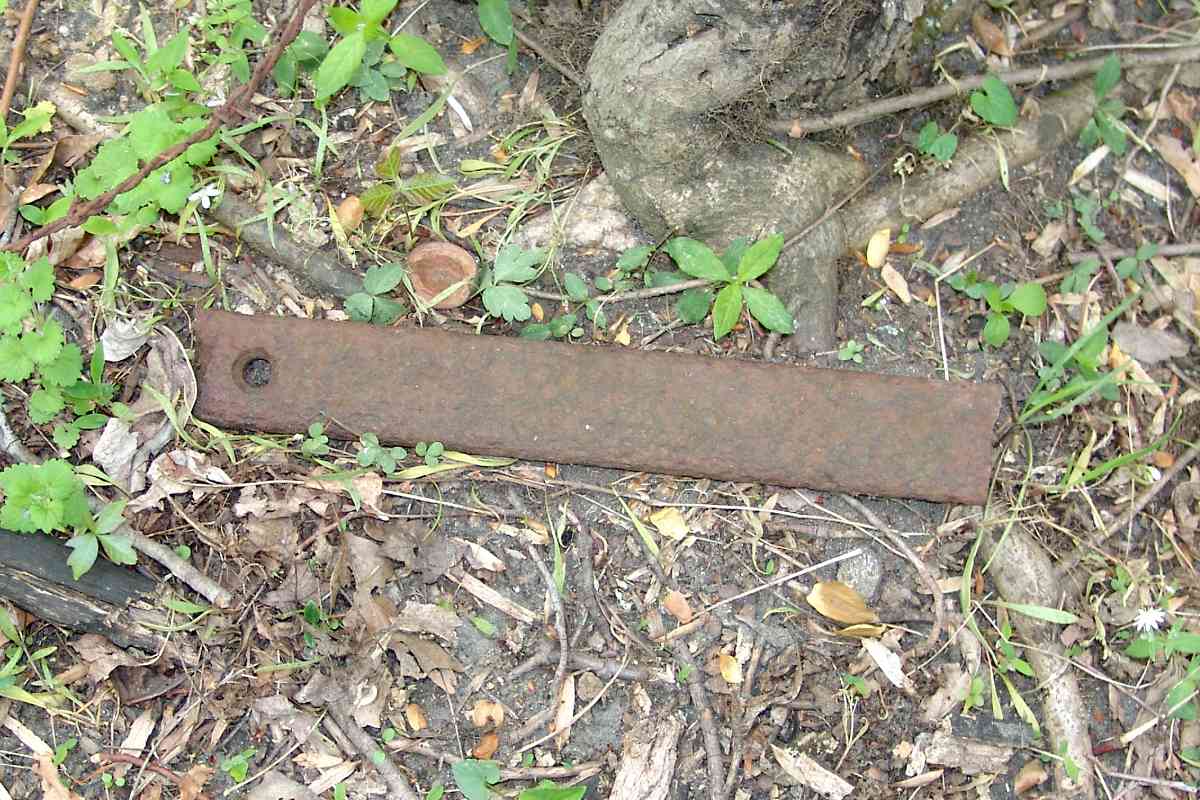
Sharp-eyed reader and contributor Dave Hiteshew found this rusted piece of strap rail in Patapsco Park. Observe the left edge closely: it is cut at a non-perpendicular angle, as you would expect. Such a cut allows train wheels to roll from one rail segment to the next with less track-pounding clickity-clack.

The iron is roughly 2.5 inches (6.5 cm) wide and 0.5 inches (1.3 cm) thick. According to statistics published by Harwood, the rail weight was 15 pounds per yard, and the segments as manufactured were 15 feet in length; in metric that's about 7 kg/m and segments of 4.5 m.


Pangborn

Pangborn
Mile: 0.0 Date: Apr 2001
Ease: A View:
Area: A IC2:
Map: Ba 42 K 1 Topographic Maps

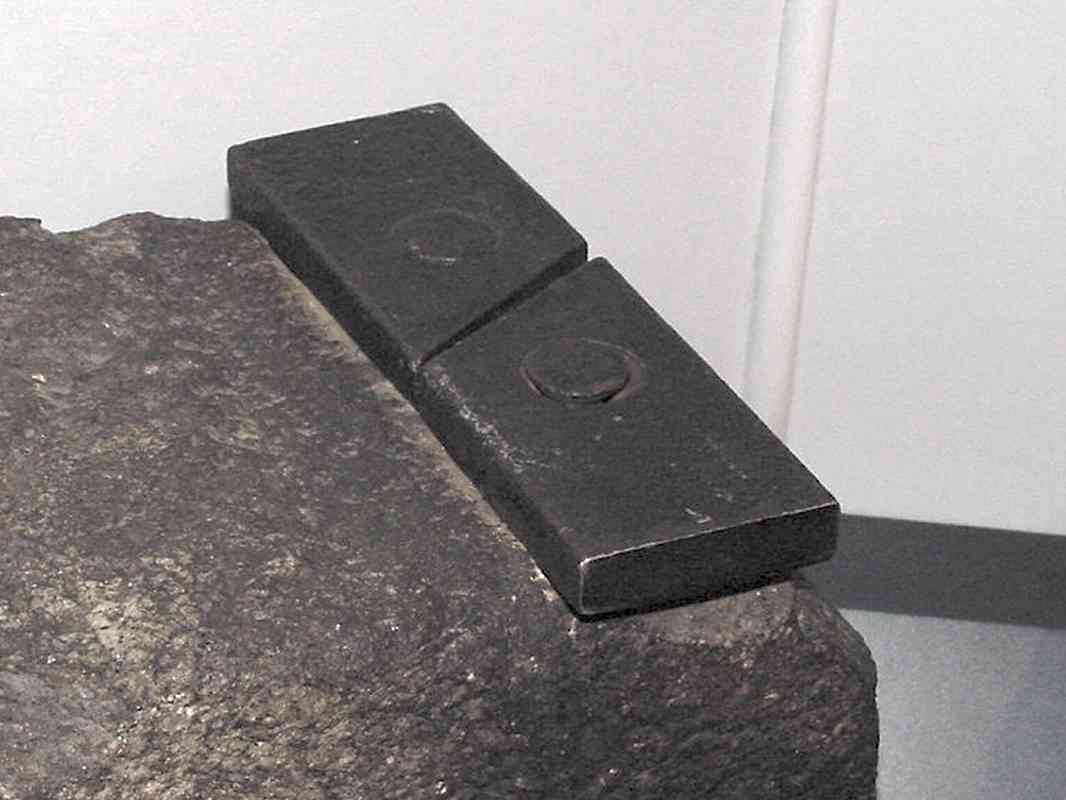
Note the similar edge angle on this strap rail sample that had been exhibited at the B&O museum. Opinion is this is a "Pangborn item", one recreated by 19th century B&O-hired promoter Joseph Pangborn, whose efforts were later described as heavy on promotion and light on historical accuracy.


Joint Plate
Photo courtesy JD Hiteshew

Joint Plate
Mile: Date: 2007
Ease: View:
Area: IC2:
Map: Topographic Map

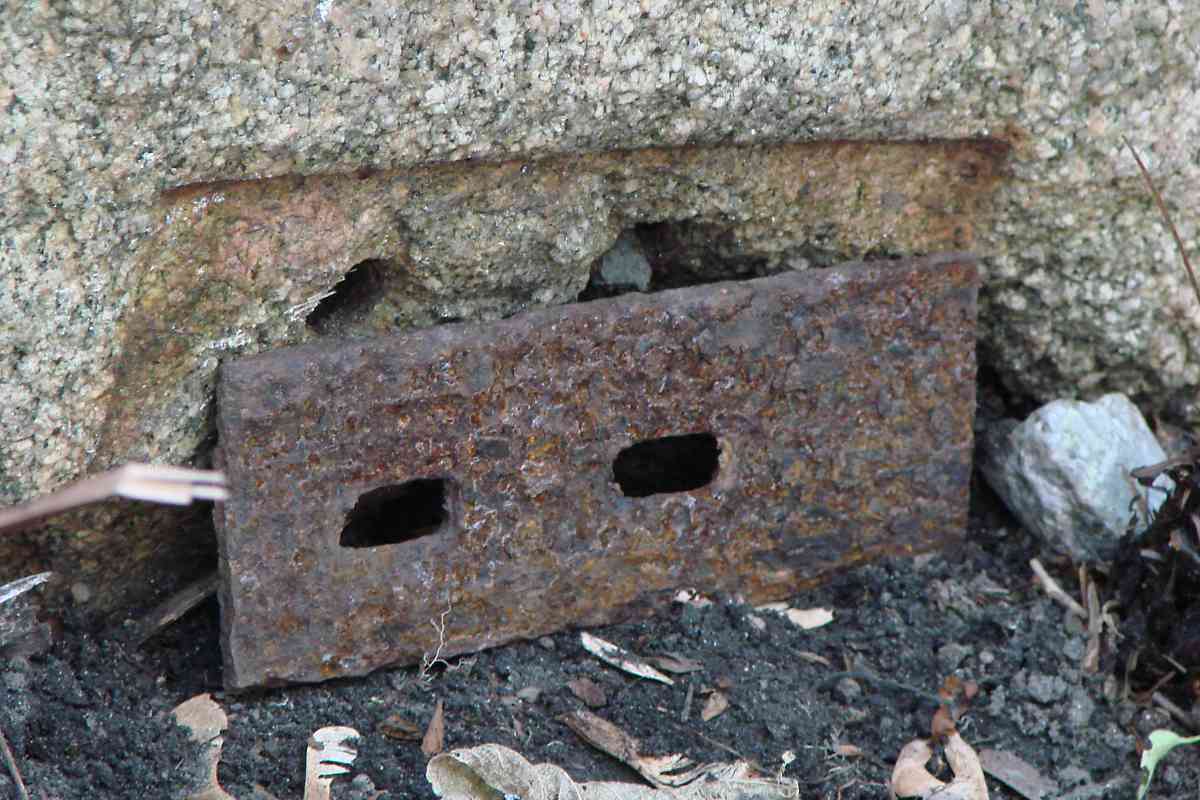
Perhaps the most interesting discovery by Dave is that of a small iron plate that via this picture he convinced me is a surviving joint plate used underneath the gap where long segments of strap rail had met. The iron piece fits in the stringer recess where two nail holes are close together. This particular joint plate may have lost a portion on its left side, which had it survived, would have made it fit perfectly in this recess. The recesses vary slightly in size from one example to another.

Credit goes to Dave Hiteshew for not only finding the relic, but defining where and how it was used, and solving the mystery. The Pangborn recreation omitted this important detail.


Oops

Oops
Mile: 26.2 Date: Aug 2002
Ease: C View: SW
Area: A IC2:
Map: Ca 35 G 6, Ho 5 G 7 Topographic Maps

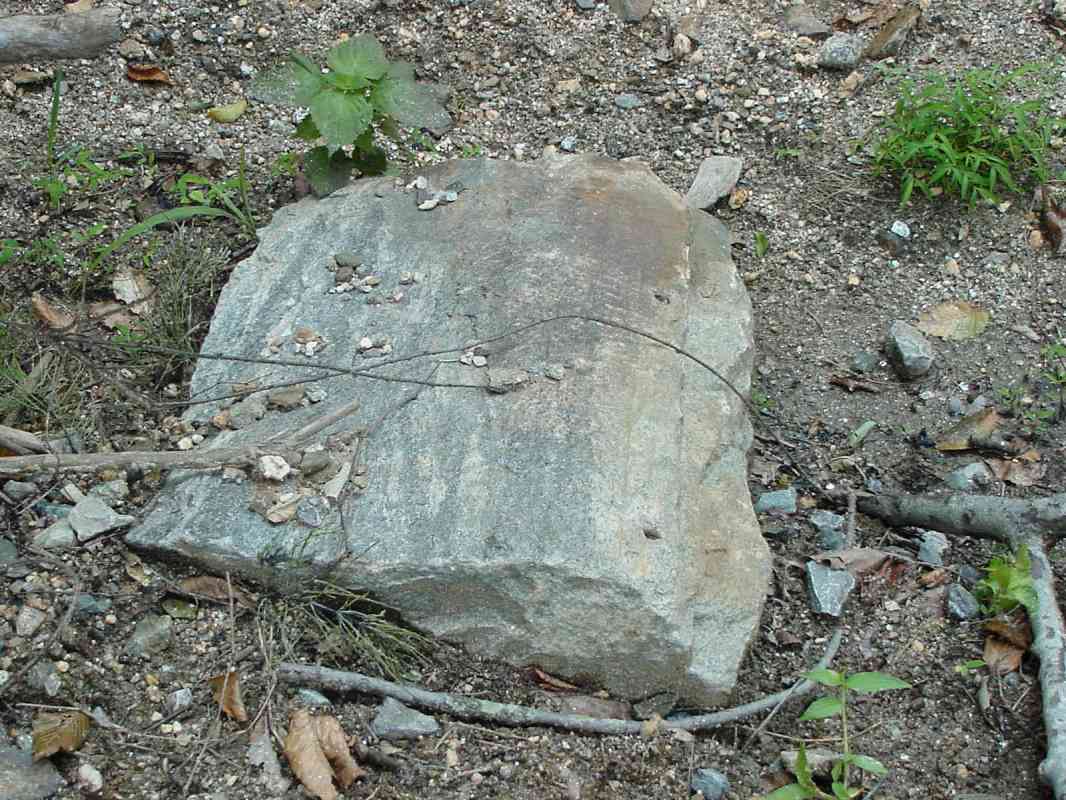
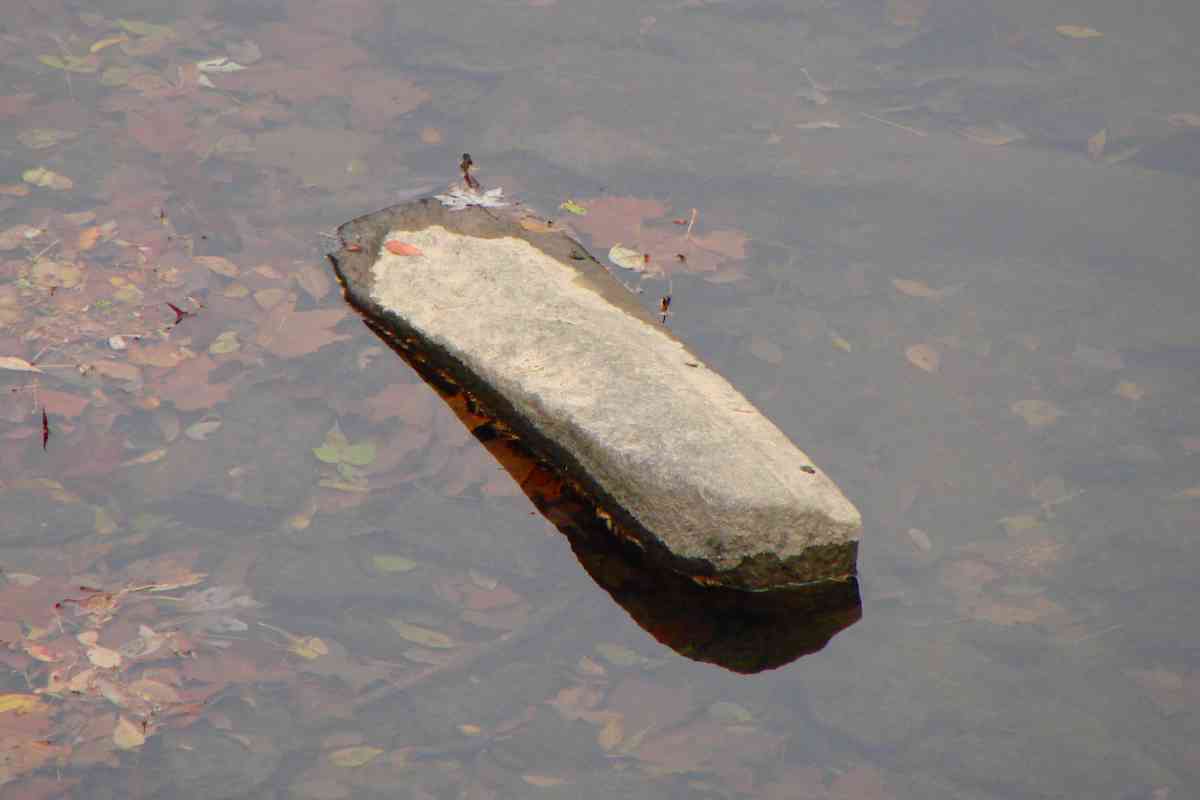
This deposed stringer has an odd set of nail holes: note how they are paired laterally. I surmise the first set of holes was drilled incorrectly, then the stone turned a bit and a new set drilled.


Loop Culvert
Photo courtesy JD Hiteshew

Loop Culvert
Mile: 41.3 Date: 2007
Ease: B View:
Area: A IC2:
Map: Fr 42 A 2, Ho 1 K 4 Topographic Maps

The granite stringers here on a Mt. Airy Loop culvert are a puzzle. Records say as the B&O built west, when it reached Sykesville it gave up on the idea of using the heavy stones, and switched to wooden stringers. Sykesville is 10 miles east of here, and on the other side of the ridge. We're left to speculate how the stringers found their way to the Loop: one possibility is that they were used to test how much weight the primitive "tea kettles on wheels" could haul up over Parrs Ridge.


Westernmost
Photo courtesy Dave Hiteshew
NEW! Sep 2009

Westernmost
Mile: 56.1 Date: Sep 2009
Ease: B View: NW
Area: A IC2:
Map: Fr 38 J 1 Topographic Maps

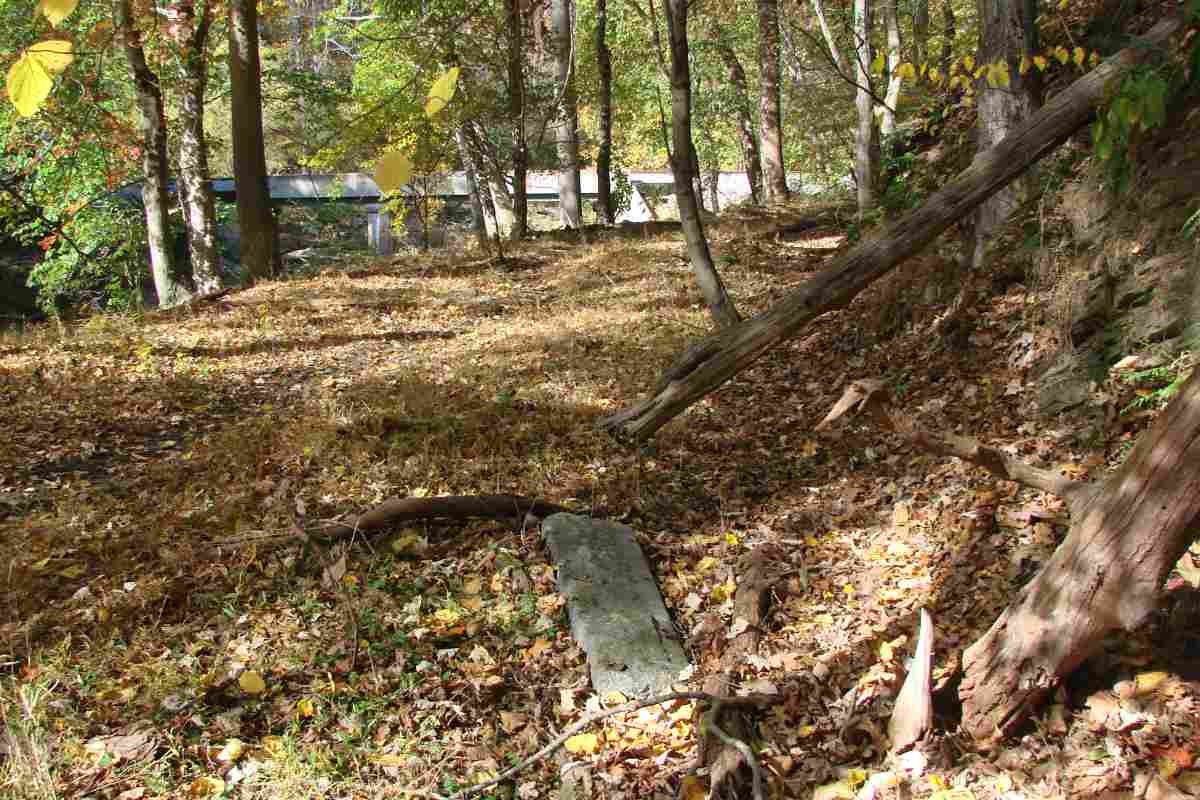
This is the westernmost known stringer. Dave located it recycled within an abutment for the Monocacy River bridge.


Nail
Photo courtesy JD Hiteshew

Nail
Mile: Date: 2007
Ease: View:
Area: IC2:
Map: Topographic Map

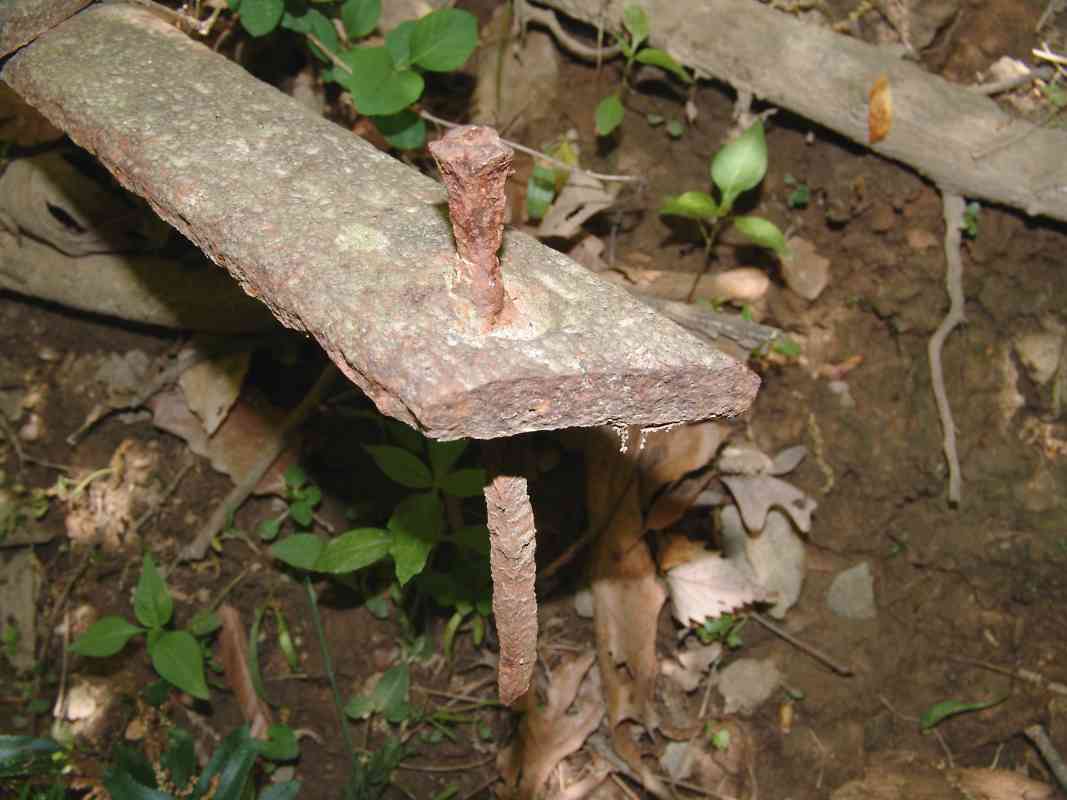
Dave also discovered this strap rail with a nail still in place. Do not bother asking me where this was found as the location is being kept confidential for now.

In addition to granite stringers, in some areas, the B&O affixed strap rail to wooden stringers. It is not known if the rail specifications varied depending on which material it was nailed to.


Tie
Photo courtesy JD Hiteshew

Tie
Mile: Date: 2007
Ease: View:
Area: IC2: 25
Map: Topographic Map

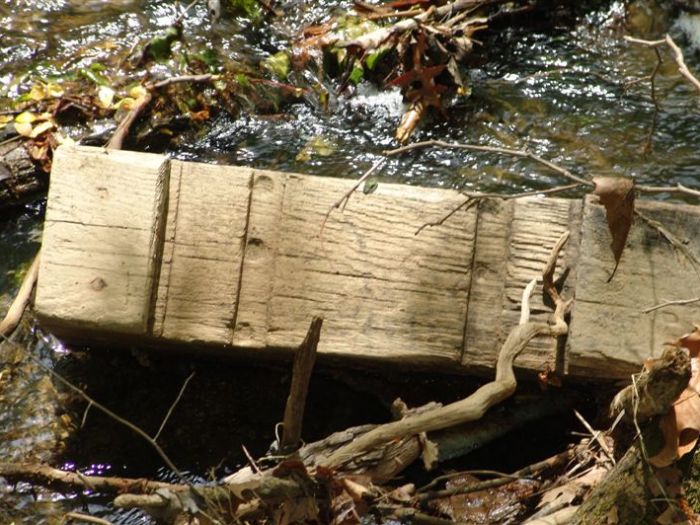
Dave's finds answer one puzzle, but create another. He noticed this wooden tie near where he found strap rail. It is approximately the size of a modern tie, yet displays unusual indentations. A used, modern tie will show evidence of a modern tie plate having been spiked into it. Rather than spike holes, this piece shows indentations.

Could this be part of the strap rail system? The strap rails in this area were affixed to wooden stringers by spikes, and those stringers were laid upon perpendicular wooden ties/sleepers. Could this be a surviving sleeper, recently uncovered from a streamside burial that had protected it for over 150 years?


Tie Plates

Tie Plates
Mile: 24.2 Date: May 2005
Ease: B View: E
Area: A IC2:
Map: Ho 6 B 7 Topographic Maps

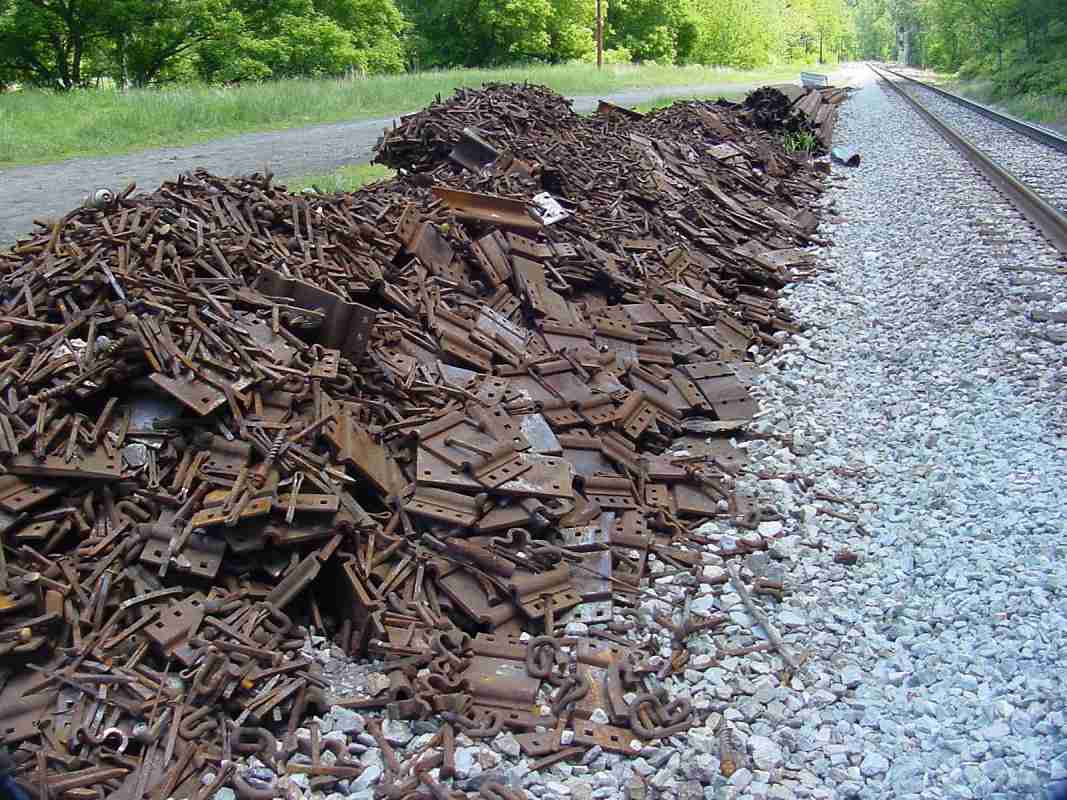
For reference, here is a pile of used, modern tie plates courtesy CSX track work. Note how the spike hole pattern does not match the puzzling wood indentations...


Washington Branch

Washington Branch
Mile: Was 5.5 Date: May 2002
Ease: C View: NW
Area: B IC2:
Map: AA 5 K 1, Ho 20 E 12 Topographic Maps

Not wanting to be left out, the Washington Branch also found uses for the Old Main Line's stringers. The sturdy stones make up the bulk of this culvert that spans Licking Run north of Jessup.

The conclusion is these stringers were imported from the OML because, according to Harwood, the Washington Branch's first trackbed in 1835 was T rail laid on wood ties, an early version of the design still in use today.


Thanks for looking.

Off site link: England's
Hey Tor Granite Tramway

Or, Return to main page


Copyright Notice
  Free Web Hosting Since 1996. Join & Become Part of the TrainWeb's Railroad Community.
The following uses RAILsearch.com to search just rail related websites: Google Custom Search
About Us  |  Advertise | Contact Us Tell a friend about this page  |  Sign up for the TrainWeb Email Newsletter