




ABOUT THE GREAT LAKES AND WESTERN RAILROAD
The Great Lakes & Western Railroad captures the essence of railroading in the American West in HO Scale. The imaginary route map of the GL&W runs from Superior, Wisconsin to Salt Lake City where separate lines continue on to San Francisco and Seattle. This route permits us to model an incredibly diverse array of scenery and industries including the largest HO scale model of an oil refinery in the world.
The current incarnation of the GL&W has been under construction for more than fifteen years at its present location. The layout is about 2,000 square feet and features almost 800 feet of mainline. Mainline Engineers use one of six (6) infrared walk-around throttles to operate their train around the layout. We have no duck-unders or fixed mainline cab positions, so mainline engineers follow their trains around the layout, simulating the closest thing to a real cab ride that a model railroad has to offer.
To further augment the GL&W's highly realistic infrared throttle system, the LAMRS has installed a computer dispatching system. Just like the dispatchers in the control centers of today's major railroads, the GL&W dispatcher authorizes the movement of trains through the use of a computer by monitoring a track diagram of the GL&W mainline. The GL&W dispatcher assigns the mainline throttles to operating blocks and controls mainline switches with the simple click of a computer mouse. The dispatcher and the six (6) mainline cab operators are in constant communication with each other using radio headsets.
Track authority is granted orally by the dispatcher using the headset radios. This is model railroading the way real railroads do it every day. To futher enhance the realism of the GL&W RR, the LAMRS is currently creating the specifications and design for a realistic CTC system which will be implemented over a period of time.
What follows is a map of the Los Angeles Model Railroad Society's Great Lakes & Western Railroad.
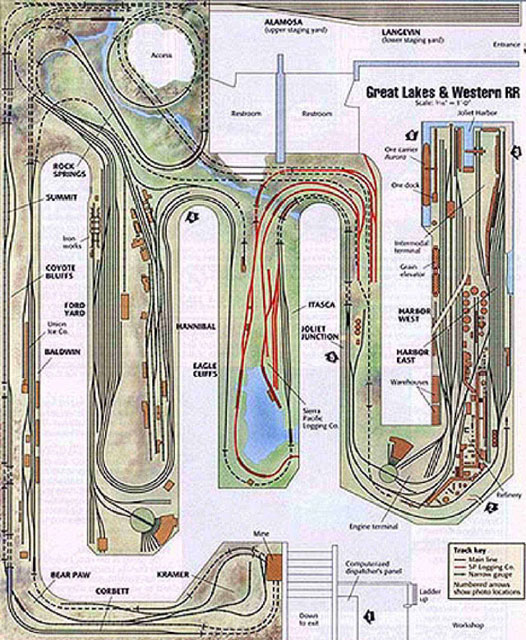
Illustration by Rick Johnson, © MODEL RAILROADER Magazine 1996, used with permission.