|
|
-
1.
Toy Train Expo, December 1998
|
The following two photos were
taken December 1998, at the Lycoming County Historical Society Museum's
Annual Toy Train Expo in Williamsport PA.
-
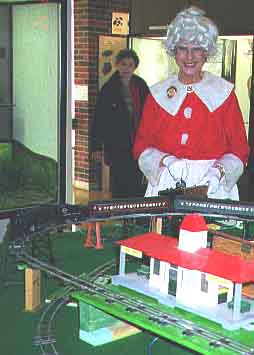
Photo 01
|
Mrs. Claus (Petie
Waltman) operates Santa's favorite scale of train, at the Susquehanna
S-Gaugers display,
|
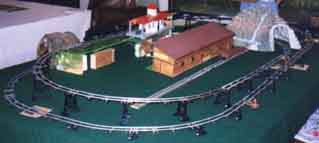
Photo 02
|
An adjustable timer
underneath the wood building, activated by an electric eye in the
track, pauses the train at station for about 25 seconds. This pause
gives the engine a rest, and also breaks the monotony of continuous,
non-stop around-the-loop running.
|
2.
Toy Train Expo, December 1999
|
The following photos were taken
December 1999, at the Lycoming County Historical Society Museum's Annual
Toy Train Expo in Williamsport PA.
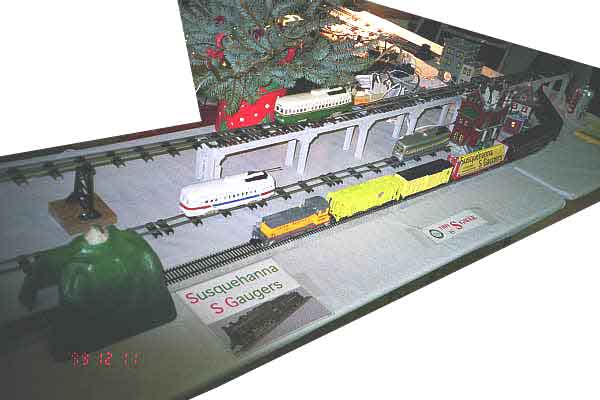
Photo 03
Comments About The Above
Photo, The Mainline
- The S Helper Service Union
Pacific SW-9 is running on DCC.
- A "Robo-Cupp" "black box"
(picture, below, made by Fred Cupp) uses adjustable timers to cause the
train gradually
deaccelerate to stop with the passenger
cars in front of the station
(as shown above) every second time around the loop.
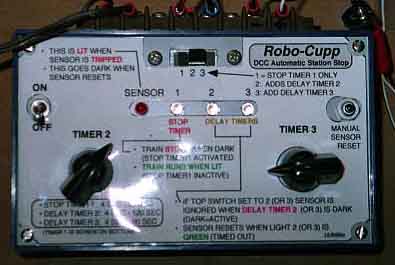
Photo 04 -
Robo-Cupp Automatic DCC Station Stop Controller
- The stopping cycle is
initiated when the train travels over an electric eye in the track. In
the photo, the eye is located just in front of the Flyer switch, where
you see the bright light in the upper right corner of the photo.
- The train gradually
deaccelerates, then stops for about 20 seconds, with engine headlight
and car lights at full intensity, then gradually accelerates again.
- The "Robo-Cupp" accomplishes
this stopping by changing the track current from DCC to reverse
polarity DC, which causes the train to deaccelerate and remain stopped.
It then changes the polarity from DC back to DCC which causes the train
to acclerate.
- This
deacceleration/stopping by using a decoder that conforms to NMRA DCC
Recommended Practice RP-9.2.4. Note that some decoders conform to this
practice and some do not.
Comments About The PCC Cars On
The Elevated Viaduct
- The green & white PCC
car on the viaduct is a James Edwards PCC car, which runs on DC. Two
spare cars are parked on the ground track.
- A PH Hobbies automatic
reversing timer cause the car to run point-to-point on the viaduct
track.
- This point-to-point
control is accomplished by a simple, commonly-used method of reversing
the polarity with a timer, and having a gapped rail at each end, with a
diode across the gap. The trolley will travel to each end and then sit
there and wait until the polarity reverses.
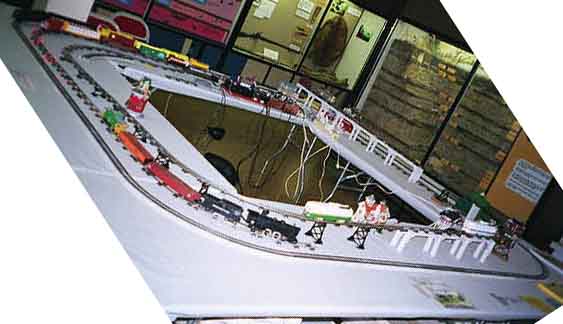
Photo 05 -Overall View Of 1999 Layout
3.
Wellsboro Rail Days, October 2000
|
Dennis Oberholtzer's
10/27-28/00 Display Layout At Wellsboro Rail Days
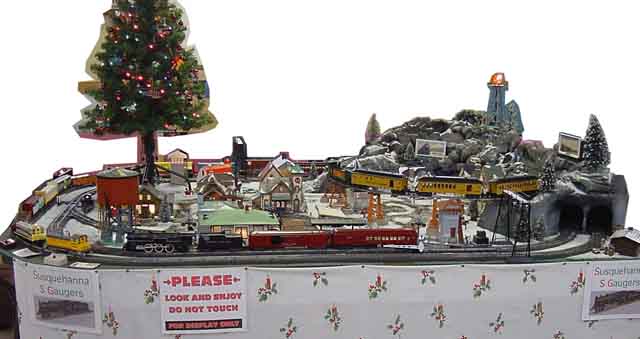
Photo 06
- This impressive display was
part of the displays done for Wellsboro Rail Days.
- Dennis and his wife Karen
and two sons spent about 6 hours assembling this layout, which included
putting up the four modules, attaching legs, making umpteen
inter-module wiring connections, buildings, people, crossing gates,
automobiles, little signs, snow, and the "whole nine yards".
- Dennis and his family may
well have set a record for setting up the most impressive S-Gauge
temporary display layout in Central Pennsylvania--a record that may
stand unmatched for the rest of the 21st century, as there is just not
much S-gauge activity going on in Central Pennsylvania.
- Dennis was kind enough to
let Jim Ingram run two S-Helper Service SW-9s on the outside loop of
what is usually an all-Flyer layout (plus display the Susquehanna
S-Gaugers signs).
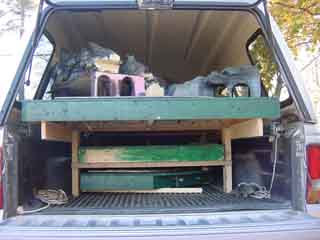
Photo 07
This layout requires 2 vehicles
to move: the truck as shown above for plaforms, and a car to haul all
the buildings and accessories.
4.
Scranton Train Show, October 2000
|
10/29/00 Scranton Train Show
at the Lackawanna Station Hotel
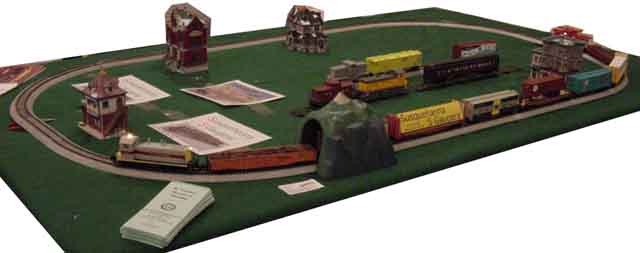
Photo 08
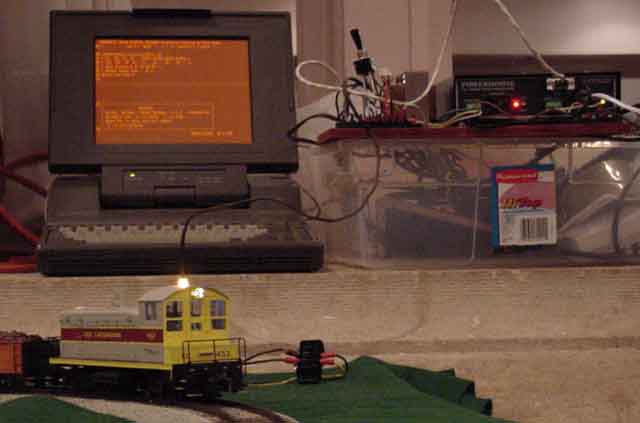
Photo 09
The laptop computer sends commands to the NCE DCC command station,
which sends commands to the track to control the engine
- Jim Ingram set up this
display, which consists of a small loop of S-Trax with an S-Helper
Service SW-9, equpped with the following add-ons:
- Soundtraxx DCC decoder
- flashing strobe light on
top of the cab roof
- cab light
- special high-intensity
headlights
- (all installed by Chick
Viggiano of Chicks' Hobby Shop in Gibbstown NJ)
- The engine is controlled by
a 386 laptop computer running QuickBasic to automatically control the
North Coast Engineering DCC command station. The computer "ramps" the
train up, "cruises" the train, ramps the speed back down down, then
holds the train at idle for about 20 seconds. Then it repeats the whole
cycle.
- (The laptop and the
"smarts" of the Basic code were both borrowed from Fred Cupp.)
- Thare are several reasons
for using the computer to vary the speed of the train:
- the person manning the
layout can focus his attention on talking to people, while the computer
handles the "busywork" of running the train
- the varying speed-cycle
is intended to break the monotony of a train just running endlessly in
a circle
- the idle period
gives the motor a rest from constant running
- having the engine idling
and "creeping", with full lights and sound, demonstrates the DCC
capability
5.
Toy Train Expo, December 2000
|
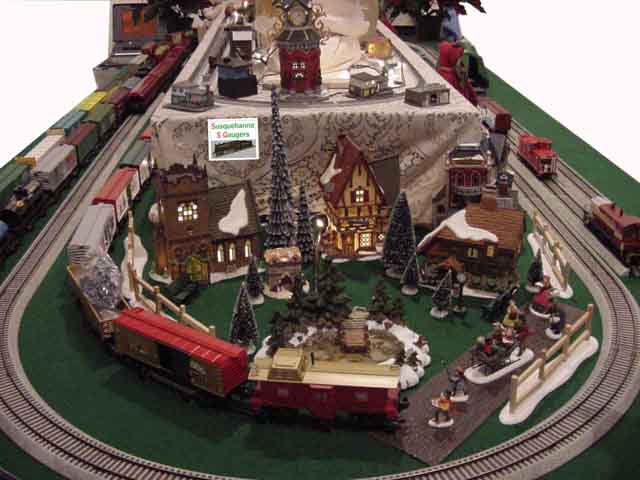
Photo 10
- Most of the flyer trains in
this view belong to Milton Sholley
- The upper platform contained
a loop of N-gauge
- Larger size versions of
these same photos, plus other displays, can be seen on the "Toy Train Expo 2000" photo page
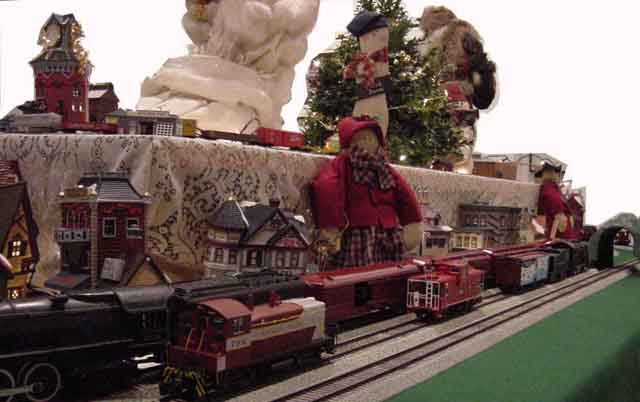
Photo 11
6.
Toy Train Expo, December 2002
|
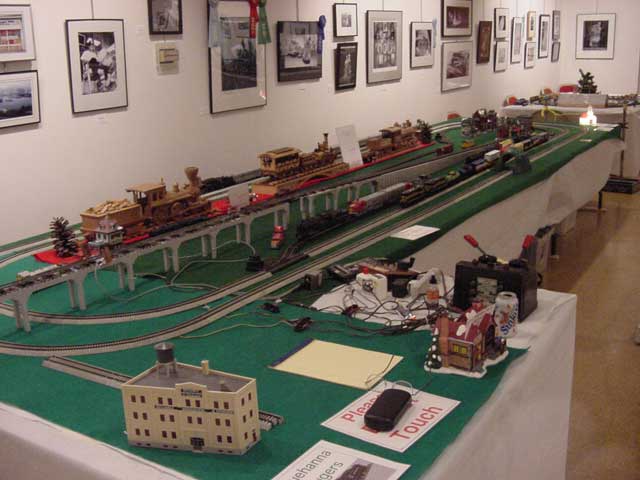
Photo 12
-
-
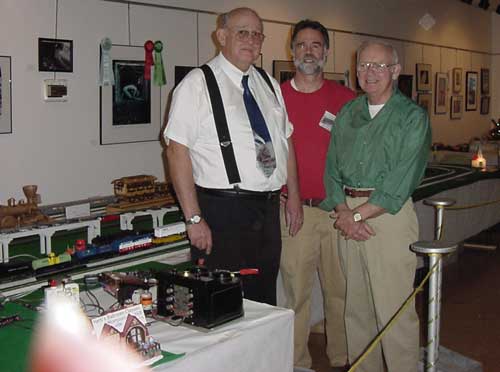
Photo 13
|
Operating
Personnel, from L to R:
Supervisor wearing
tie is Frank Smith; workers are James Ingram, and non-member Richard
Dill
|
-
This page
modified 9/25/2010 by James R. Ingram . . Williamsport
PA
|