




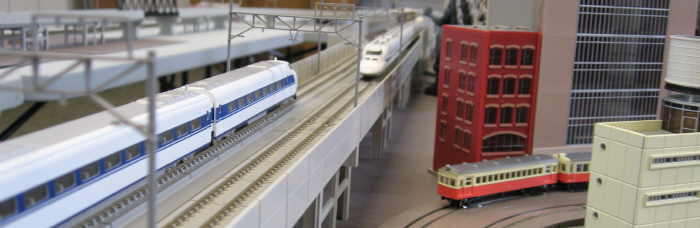
Tomy, Tomix, Tomytec: History and family tree
How big are the Tomix and Tomytec model railway product lines?
Compatibility of Tomix and Tomytec products with other N and HO trains
N-gauge versus N-scale
More about Tomix track
The Tomix Track System
Tomix train control systems
How do the changes made in track and control systems relate to each other?
Use of Tomix power systems outside of Japan
OK, track, power and control. What about Tomix trains themselves?
The Tomytec Tetsudou (Railway) Collection
Tomix and Tomytec buildings
Tomix product number series
The best-known Tomix product
The Kato "Snap Track" Adapter Track myth
Tomy, a company originally formed as Tomiyama in Japan in 1924, was incorporated as Tomy Kogyo Co., Ltd. in 1963. In 2006, Tomy, by then the second-largest toy manufacturer in Japan, merged with Takara, the neighboring third-largest toy manufacturer that began in 1955. The resulting Takara Tomy Co., Ltd. is referred to as "Takara Tomy" in Japan, where both names carry recognition value, and simply as "Tomy" in the rest of the world.
Tomy largely produces a wide range of toys for young children and baby supplies. It has grown to include many subsidiary companies, including sales offices and factories in outside countries. One subsidiary, Tomytec Co., Ltd., produces model railway products (among other products) under its own name, and also manages Tomy's "Tomix" product brand for model railroad products. Tomy offered its first N-gauge locomotives and cars under the "Tomy" name a few years before creating the "Tomix" brand name in 1976. The word "Tomix" is always shown in English characters, since it does not directly translate into Japanese. In very general terms, the Tomix-branded line contains on-going products, while the Tomytec line consists of one-time, limited-production products.
 |
The combined Tomix and Tomytec model railroad product line is the largest in Japan (Kato follows in second place) and possibly the world. Japan is blanketed with railways, with a high proportion of passenger service, so public interest runs high. While Tomy is worldwide, its primary international focus is on toy products aimed at a younger audience.
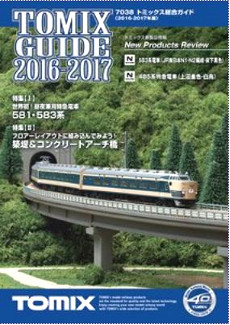
A typical recent Tomix Guide catalog (in Japanese) is over 440 pages thick, almost entirely full-color on glossy coated paper stock. Many Tomytec-branded products are in addition to what is in a Tomix catalog, and they have been extensive in recent years. Despite being marketed only in Japan, a product base this large draws attention and followers around the world. In recent years, information sharing and international sales through the Internet have helped to make Tomix and Tomytec products better known and available worldwide. |
N-gauge is N-gauge, defined as nine ("N") millimeters between the tops of the two rails. Tomix trains will run on other N-gauge track, and other N-gauge trains will run on Tomix track. Slight incompatibilities do exist over the decades, due to varying heights of the metal rails and depths of wheel flanges made by various manufacturers, but in general nearly everything inter-operates. Tomix makes no HO scale track, but their HO trains can run on HO and OO track made by other manufacturers.
This compatibility does not mean other manufacturers' track pieces use the same connection system as Tomix track (or each other's track), or that rolling stock coupler systems are always compatible (they sometimes vary even within one manufacturer's own products).
The term "N-gauge" has been used here very deliberately, since the 9 mm track gauge is the common denominator worldwide. The term "N scale" does not have as universal a meaning. In North America and Europe, model trains that run on N-gauge track are generally built to a scale of 1:160. Manufacturers in the United Kingdom use a scale of 1:148. In Japan, where most rail lines are narrow-gauge, a scale of 1:150 is used to fit models of these trains to N-gauge track, although standard-gauge shinkansen "bullet" train models are built in 1:160 scale. These differences are slight, however, and N-gauge trains from around the world look fine when mixed together.
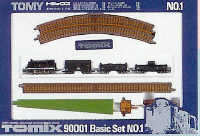 |
Tomix sectional track first appeared in 1976 in the first Tomix set 90001 "Basic Set No. 1." Since living space is limited in Japan, most layouts are temporary setups on tables or floors also used for other purposes. Tomix track has the metal rails attached to a durable plastic roadbed made to look like ties (sleepers) and ballast stone. When track pieces are joined together the rails are connected with formed metal rail joiners. |
Underneath, plastic prongs at the end of the roadbed slide into openings on the other track piece, adding to the strength of the connection. (By comparison, Kato uses a separate removable Unijoiner to join its Unitrack pieces, and the Unijoiner provides both the rail and roadbed connection.)

The original Tomix track had a brown base to represent a weathered roadbed. In 1990 Tomix added track pieces with a plain grey roadbed, designated by a "(G)" suffix added to the part descriptions. Both "brown" and "grey" track pieces were replaced in 2002 with "Fine Track" with an "(F)" suffix. Fine Track has a speckled grey roadbed, an improved metal rail joiner, and features a click-together roadbed prong instead of the earlier simple tapered prong. This further strengthens the track piece connections. (Note: a small amount of Fine Track has been produced as part of third-party, subscription-based micro-layout projects. It is painted brown on top, but retains the speckled grey underside and the click-together prong. It has appeared for separate sale on Internet auction sites.) When buying Tomix track, especially used track, it is important to know the differences and to know exactly what you are buying. All Tomix track is compatible, but the appearance and durability of connection vary.
One piece of track that Tomix does not make is a terminal track -- the piece with the power wires attached. Tomix uses a "DC Feeder" clip instead. This clip (with attached power wires) has two unequal-length prongs on it. When pushed into slots in the roadbed of any Tomix track piece (except points/turnouts, crossings and very short straight track pieces), each prong makes electrical contact with a rail and provides power. This system is much more flexible than a terminal track. More recently, with the advent of Slab, Wide PC and Wide Tram track types, Tomix has produced additional power clip designs that snap in under the roadbed, out of sight.
Other manufacturers also offer sectional track with cast roadbeds, but many are not designed with the forethought of the Tomix system. The Tomix track system is robust and carefully engineered with respect to easily designing realistic and sophisticated multi-track layout designs. With a temporary setup or a tabletop layout not fastened down as a "permanent" layout, it is possible to endlessly change and expand a layout, keeping it fresh and entertaining.
Beyond basic straight and curved track pieces, Tomix offers single-track and double-track elevated viaducts, concrete "slab" track, "wide" track with extended ballast stone (so the roadbeds of parallel tracks touch), bridges, and tight-radius curves for tramway or streetcar use as well as in small "micro-layouts." In addition, Tomix offers the widest range of N-gauge crossings and points/turnouts, including wye, curve-on-curve, three-way, double crossover, double-slip, and so on, all designed to adhere to the overall system philosophy.
Separate sections of this website list current track pieces and delve fully into an analysis of the system design of Tomix track, piece by piece, with a direct comparison to the wider-known Kato N-gauge Unitrack system.
An important part of the Tomix product line is the power and control system, also well designed for completeness and ease of use. There have been four successive generations of improving control systems since 1976. None require screwdrivers or other tools. The original system featured green-cased power packs based on simple rheostats, with matching accessory controls for points/turnouts and block/polarity control. The 5021-series system introduced a more modern, modular system of power supply, train controls and points/turnout controls. The "NECST" system, in putty-colored cases like the 5021-series, introduced improved electronic transistor "power units," from basic units up to a realistic simulated engineer's cab controls.
The fourth and current system, known as "Neo," further improved the control and cabling systems. It also changed the control of points/turnouts from an AC 3-wire control to a DC 2-wire system. Thus Neo control and Fine Track are the current state of the art, and the older products are not fully compatible with them. They can be carefully combined, however, if one wishes to do this.
A separate section of this website provides photographs and basic descriptions of all generations of Tomix control system items.
The green-cased, 5021-series and NECST control systems all were designed to be compatible with brown track. The present Neo control system was first introduced in conjunction with brown track, using a different track power feeder cord and necessitating new electric points/turnouts with 2-wire DC operation and cable connectors. Therefore brown track has a mix of points/turnout designs, including 3-wire AC and 2-wire DC points/turnout motors in both left-hand and right-hand versions. The later grey track and present Fine Track are designed for compatibility with the Neo control system. Fine Track points/turnouts use a single motor design that snaps in under the roadbed, out of sight.
The Japanese commercial power system provides households with 100 volts AC and uses unpolarized plugs with 2 parallel flat blades (similar to older U.S. plugs before the wider polarized blade and the rounded third "ground" prong were introduced). Household power in North America is 120 volts. While some people in North America simply plug Tomix power units directly into a 120 volt outlet, this represents a nominal 20 percent voltage exceedance, which might damage older power units. The other choice is to purchase a small 120 to 100 volt converter. Interestingly, in the late 1980s Tomix itself sold a converter from 110-130 volts down to 100 volts for this purpose, as well as a 220-240 volt converter for use in Europe and elsewhere. In any event, it is a good precaution to physically unplug the power pack (or converter) when not in use.
More recent Tomix power units feature more input power flexibility and are capable of handling 100 volts up to 240 volts. The printed specifications on the power unit or its separate power "brick" will indicate this.
Another choice is to use a locally-made model train power pack that provides variable 0 - 12 volts DC to run the trains, and constant 12 volts DC for point/turnout control and accessories. In the U.S. an AC to DC converter for accessories (such as the Tomix 5500) may be needed, since most U.S. power packs provide AC for accessories. In any event, you can either cut the connector off one end of the Neo cables and strip the wire ends to connect to the power pack, or (my preference) buy an appropriate Tomix extension cord and cut it instead, leaving the base cord undamaged. (A number of people in the U.S. have cut the connectors off Kato points/turnout cables, and then had trouble selling them to others second-hand due to this "damage.")
The Tomix rolling stock offering is enormous. It takes up the great majority of their annual catalog, and includes electric locomotives, diesel locomotives, some steam locomotives, high-speed shinkansen passenger trains, electric passenger trains (both multiple-unit and integral train), passenger coaches, private railway passenger trains (non-Japanese National Railway or its successors), freight cars (wagons), and HO trains. All are models of Japanese trains, both present and past, except for the fictional Thomas the Tank Engine series.
There are simply too many model train items to keep an up-to-date list on these pages. If you are really interested, the best way to study all of these model trains is to spend the money to buy (and have shipped) a Tomix catalog. The next best way is to browse through the webpages of vendors that sell Tomix products internationally, especially those that have extensive photos online. Similar Ebay sellers are another good source.
Tomytec continuously issues collection sets of N-gauge model railway cars, Japanese buildings, automobiles, trucks, human figures, and so on. The Tetsudou (or "railway") collection consists of unpowered rolling stock, mostly small private railway electric passenger equipment, which can easily be powered with separately sold power chassis that snap into place. The Tomytec Tetsudou Collection has produced many hundreds of additional, different pieces of rolling stock. Some Tomytec items are especially made for sale only at certain store or show events in Japan. While Tomytec focuses on models of Japanese trains, some would look at home almost anywhere. As a potential buyer, you must track the announcement and production of these collection items, because they sell out pretty quickly and generally are not re-issued later. Some linger at certain Internet shops or Ebay sellers, either as the whole set (typically 10 items, sometimes 1 to 4) or individually. This also applies to the separate power chassis used to make them operable instead of static models; these are only produced to support models produced at the same time, and they may or may not come back into production at a later date. It is worth doing Internet searches and persisting if you really want to find something that is "sold out."
This website has a section showing a typical Tetsudou Collection multiple unit passenger car pair and how to power it.
Tomix produces an assortment of pre-assembled buildings, ranging from traditional Japanese designs to modern office buildings and shops, and various railway stations and other railway structures. The office buildings and condominiums are made in a sectional snap-together manner, and midsections of floors can be added to create even taller urban buildings.
The Tomytec product line has offered a much greater, limited-run assortment of buildings. These include many traditional Japanese homes and shops (both urban and rural), office buildings, docks and so on. Tomytec buildings are pre-painted kits which generally only need to be snapped together.
Tomix has used a consistent product numbering system over the years. At present, it has grown to the following:
| 1001-2000 | Track |
| 2001-2020 | Steam locomotives, sold separately |
| 2021-2100 | Freelance locomotives, sold separately |
| 2101-2200; 9101-9200 | Electric locomotives, sold separately |
| 2201-2300 | Diesel locomotives, sold separately |
| 2301-2400; 2901-3000; 8301-8400; 8901-9000 |
Rolling stock, sold separately |
| 2401-2500; 8401-8500 | Diesel cars, sold separately |
| 2501-2600; 8501-8800 | Coaches, sold separately |
| 2601-2700 | Private railway, sold separately |
| 2701-2800 | Freight wagons (cars), sold separately |
| 2801-2900; 8801-8900 | Shinkansen ("bullet") trains, sold separately |
| 3001-4000 | Scenic accessories |
| 4001-5000 | Stations and structures (buildings) |
| 5001-6000 | Control systems |
| 6001-6900 | Auxiliary items |
| 6901-8000 | Printed matter, video and CD-ROM |
| 8001-8300 | Layout landscape items |
| 90001-91000 | Complete model railway sets, with or without train |
| 91001-92000 | Rail sets |
| 92001-93000 | Train sets |
| 93701-93900 | Thomas the Tank Engine series |
| 0001-1000; PC-series | Repair and exchange parts |
| HO-series | HO scale locomotives, rolling stock and parts |
 |
You might think trend-setting shinkansen "bullet" trains represent the best-known Tomix products, or maybe the "Thomas the Tank Engine" series so popular worldwide with young and old, but you would be wrong. |
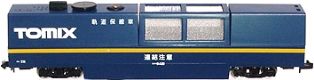
The most widespread Tomix product is a utilitarian Track Cleaning Car. This freelanced car can use spinning abrasive disks or polishing pads (with a cleaning fluid reservoir) to clean the rails, as well as a vacuum to remove dust and small debris. It has been produced in many color schemes, and has been also sold in the U.S. under the Atlas brand. An HO scale version has been sold by Dapol in the United Kingdom. For a thorough account, see Doug Coster's Japanese Model Train Newsletter blog item:
http://jmtn.wordpress.com/2011/05/09/tomixs-cleaning-sytems/
Kato sells an item called "20-045 62mm Snap-Track Conversion Track" (S62J) as part of its N-gauge Unitrack line. Unfortunately, this useful item is inappropriately labeled, and as a result many people buy it that do not need it. This short, straight adapter is not needed to connect Unitrack to Atlas Snap Track or other brands of regular track.
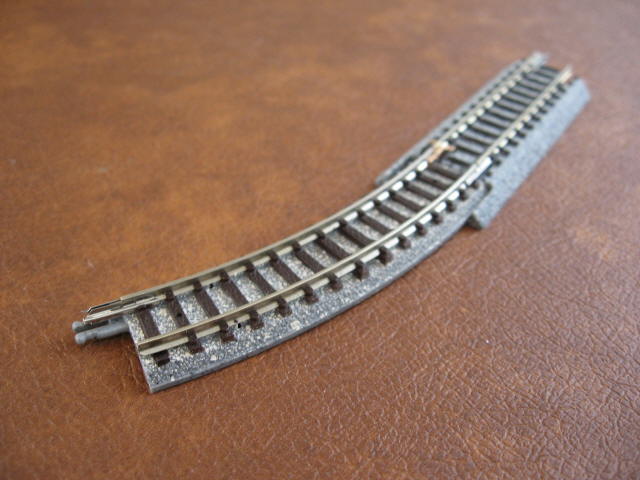 |
It is specifically designed to connect Unitrack to the track of Kato's larger Japanese competitor, Tomix. One end of the Conversion Track features a regular rail joiner instead of a Unijoiner. There is a square hole in the end of the roadbed under the other rail. That hole is there for a Tomix roadbed prong to pass through. There is also a short shelf on the end that is just wide enough and high enough to support the Tomix roadbed. |
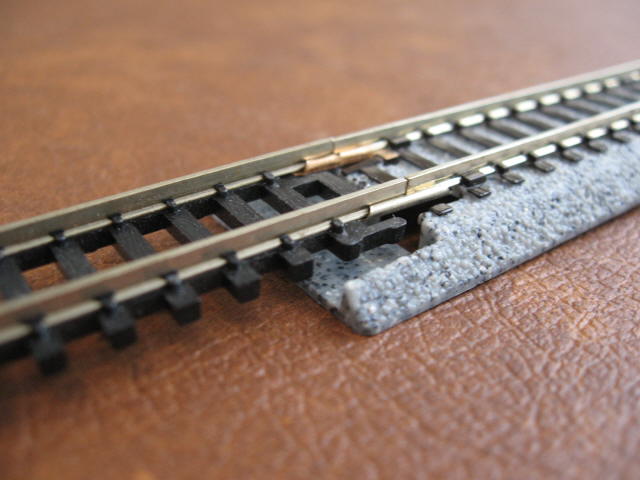 |
Fit a piece of regular Code 80 track (0.080 inch metal rail height) to the Conversion Track and it will work, but the regular track is left hanging in mid-air over the shelf. You will be unnecessarily buying and installing the straight Conversion Track piece where you do not really need it and may not really want it. Examples would include in the middle of a curve, or in a yard throat or other compact track situation. |
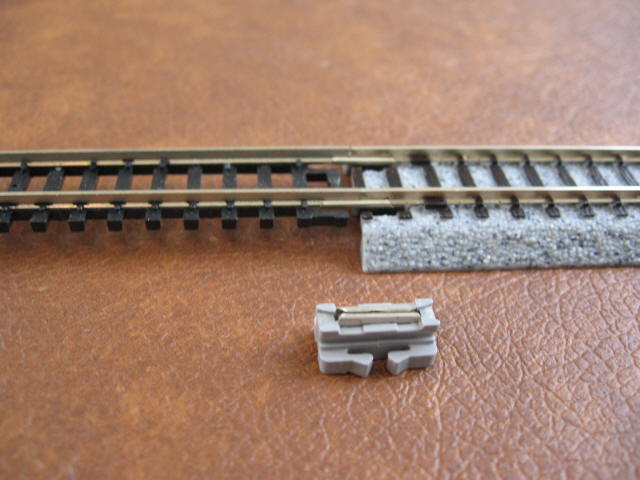 |
To join regular track directly to any piece of Unitrack, you can skip the Kato Conversion Track entirely! Simply remove the Unijoiner from the Unitrack, place a regular metal rail joiner on the other rail and join the tracks. You will still need to shim up the regular track to support it. This is the method Kato USA itself recommends for HO Unitrack. I believe Kato has done modelers a disservice by mislabeling its Conversion Track. But it does a fine job of connecting to Tomix track! |