




 |
Steam Locomotion in the 21st Century The Recent History of Steam Locomotive Development |
updated 3 February 2022
Although ACE was the most-publicized attempt in the U.S. to build a new coal-fired locomotive, they were not the only company working towards this goal, nor were they the last.
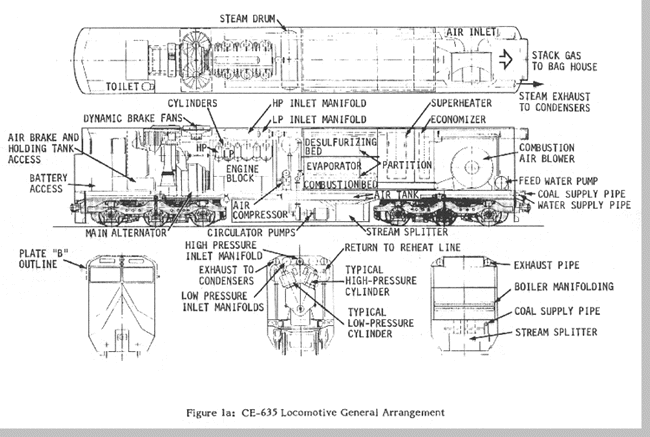
In 1982, another company formed for the purpose of introducing coal-fired power to railways in the United States, the National Steam Propulsion Company (NSPC) of Woburn, Massachusetts. The fundamental aspect of this locomotive was that it was to be built on an existing diesel-electric locomotive chassis. This arrangement would allow maximum re-use of existing railway technology and maintenance practices and facilities, and it was hoped this would give the locomotive a significant advantage over much of its competition. This would also allow the conversion of existing motive power, possibly reducing the cost of the conversion to coal fuel.
The NSPC locomotive was to be known as the CE-635 and was to be rated at 3500 horsepower. The locomotive was to use a patented Wormser fluidized combustion boiler which would generate steam at 1000 PSIG. The steam was to be fed to a 12 cylinder, single-acting, compound expansion steam engine, based on an existing diesel engine block. A second locomotive chassis would serve as the tender, which could feature traction motors (serving as a "slug") if desired for added tractive effort at low speed. Condensing operation would have been used, but at slightly above atmospheric pressure to simplify certain features of the condensing circuit. The fluidized combustion boiler allowed even low grade, high sulfur coal to be burned while still meeting environmental limits. The thermal efficiency of the initial locomotives was calculated to be about 18%, but it was stated that this could be gradually raised to around 27% on succeeding generations of locomotives.
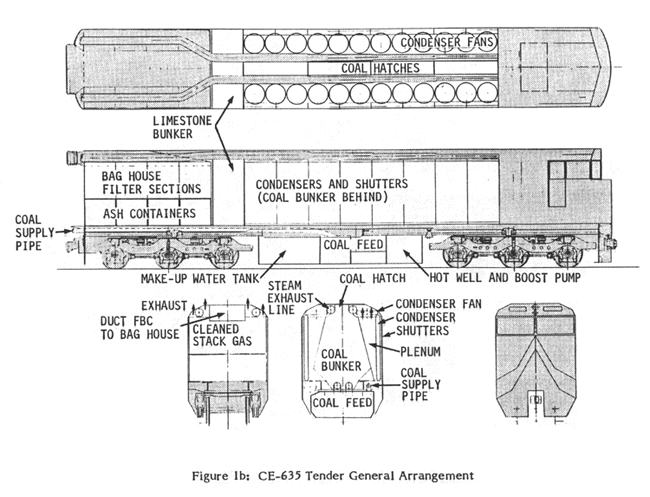
Cost savings showed a considerable life-cycle savings over diesels, and the retention of so much existing hardware was very attractive. Several railroads as well as EMD were interested in the concept, but lack of investors kept the project from being successful.
thanks to Mr. Fred Prahl, the former president of NSPC, for the information on this project
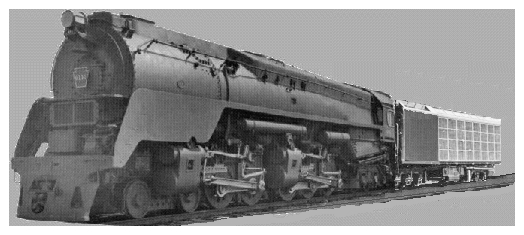
| Another company trying to build modern steam locomotives was the North American Locomotive Corporation (NALC), headed by Mr. Riley Deem. Mr. Deem had been a consulting mechanical engineer and had worked with the Lima Locomotive Works. According to Wardale, Deem tried for many years to generate interest in constructing one of Andre Chapelon's post-WWII designs, a 3-cylinder compound 2-10-4. In the 1980's, Mr. Deem felt the time was right for new steam construction. While published information was somewhat vague, NALC's designs appeared to be updated "traditional" steam locomotives equipped with condensing tenders of the Henschel design as developed in Germany and used there and in South Africa. One design shown was an updated Pennsylvania Q-2 4-4-6-4, modified with a condensing tender and an internal gear drive to connect the front and rear driver sets. The interconnected drivers would have been a vast improvement to the basic duplex design, which were noted for extreme "slipperiness" both when starting and at speed. One source says Deem planned to first modify an existing 2-8-0 in use at the time on a short line railroad to demonstrate his concepts. Wardale's book The Red Devil mentions an even more adventurous scheme: to overhaul a Union Pacific 4-8-8-4 Big Boy and convert it to condensing operation. |
| Another promising design was touted by Shoemaker & Associates. Mr. Shoemaker, who had been associated with North American Locomotive Company, evidently left to start his own project. It was to be a 9000 horsepower, coal fired steam turbine electric (STE). Similar in arrangement to the Norfolk & Western's Jawn Henry, the Shoemaker locomotive updated the arrangement with a Henschel condensing tender, dual end-mounted cabs, and powered axles under both the locomotive and the tender. With a 6-6-6-6+6-6 wheel arrangement, it was intended to compete against three 3000 horsepower 6-axle diesel-electric locomotives, a typical power consist for many U.S. freight trains of the time. |
![[New Garratt]](pics/sharpe.gif)
| In England, this 4000 horsepower variation on the
Beyer-Garratt was proposed by Dr. John Sharpe as a
practical layout for a modern coal-burning locomotive.
This engine features 2-cylinder compound condensing
units utilizing a turbo re-compressor between
the two stages of expansion. This device would have used
excess energy in the steam exhausting from the low
pressure cylinder to re-compress the steam exhausting
from the high pressure cylinder, prior to its admission
to the low pressure cylinder.
This device would have been essentially the steam equivalent of a turbocharger as used on many internal combustion engines to increase power and efficiency. Calculations showed that this locomotive would have had an operating thermal efficiency of about 15%. Dr. Sharpe was also involved with the ACE project. thanks to John Wild for information on Dr. Sharpe's locomotive Another proposal which surfaced about this time was
mentioned in the January 1980 issue of Railfan
Magazine, which means it pre-dated the ACE 3000 by
about a year. The Swiss Locomotive and Machine Works
(SLM), a division of Sulzer, proposed an advanced
rack-and-adhesion 4-8-4 for use in Indonesia. It was
to be equipped with computer controls, a high-pressure
watertube boiler, and was to burn lignite coal. I
attempted to find additional information on this
locomotive some years ago from personnel at DLM, but
current personnel were not familiar with the project
and apparently no records survived. |
| Another group proposed a method for using coal to fuel
locomotives using a completely different technique.
William Brobeck and Roy Renner of California published
ASME Technical Paper no. 83-RT-7 entitled "the Gasified
Coal Locomotive". This concept involved the use of a
gas-producing tender coupled behind what appeared to be
a diesel-electric locomotive. The tender contained a
coal hopper and a set of chambers in which the coal was
processed to make producer gas, using much the same
process which takes place in Porta's gas-producer
firebox. This producer gas was then filtered, cooled and
piped to the engine in the locomotive. Since producer
gas has a relatively low heating value, the engine would
have to have a significantly larger displacement than an
equivalent diesel in order to produce the same
horsepower. Otherwise, the locomotive was identical to
contemporary diesel-electrics. The main advantage of
this concept was that it would retain virtually all of
the locomotive technology that railroads had become
accustomed to, while allowing them to convert to coal
fuel. Interestingly, the claimed overall efficiency from
coal-to-rail was about the same or a little lower than
that claimed for the ACE 3000, around 15%. Similar systems have been used to power internal combustion vehicles using wood or coal since the 1920's. This article at Hemmings Motor News shows the setup on a Ford Model A. https://www.hemmings.com/stories/2017/01/22/from-gasoline-to-gasification-or-why-we-dont-power-cars-with-wood-today |
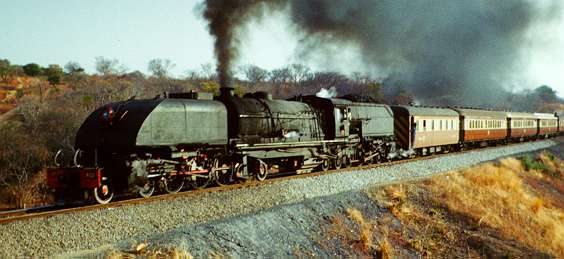
| Although none of the "new" steam projects of the
1980's came to fruition, there was one notable instance
of a whole-scale return to steam traction. In the late
1970's Zimbabwe made the very logical decision to
reverse their previously implemented dieselization
policy. Zimbabwe had been on the road to full
dieselization for many years when due to political
instability and the possibility of war, they found their
imported oil supplies shut off. Possessing massive
reserves of high-quality coal, a significant number of
relatively modern (though thoroughly worn-out) Garratt
steam locomotives, and no fuel oil, Zimbabwe took the
bold step of resuscitating their steam fleet. Working
with local contracting firms, the National Railways of
Zimbabwe, (NRZ) restored nearly 90 Garratts. Each engine
was given a thorough rebuild, and was converted to
roller bearings on all axles (if not already equipped)
to improve reliability, availability, and power. Many of
the Class 15 4-6-4+4-6-4's received locally designed
improved exhaust systems. The construction of a new
series of thoroughly modern 2-10-2's was seriously
considered, and was almost carried out. These engines
would have had roller bearings on all axles and rods,
48" drivers, and about 67,000 pounds of tractive effort;
quite powerful for 42" gauge locomotives. New Garratts
were proposed as well.
While the overhauled Garratts proved capable machines
(even in the 1980's) as soon as political conditions
eased NRZ was quickly seduced by the next wave of
diesel salesmen. Canadian railway consultants were
hired to suggest improvements to the railway system,
the first of which was, naturally, "get rid of these
awful steam engines!". Of course, United Nations loans
(supported by nations such as Canada and the U.S. who
export diesel locos) were soon forthcoming, and
Zimbabwe again began withdrawing their Garratt fleet.
Although NRZ officially ceased steam operations in
1993, steam continued on for years in switching
(shunting) and industrial service. Sadly, today steam
is limited to one or two Garratts on occasional
excursion trains, and many of the other remaining
Garratts have been scrapped. |
|
Return to The Ultimate Steam Page |





![[turbo
re-compressor]](pics/turbo.gif)
 Back to Top