
|
Steam Locomotive Improvements on the
FCAF
(Ferrocaril Austral Feugo)
updated 27 January 2011
photos and info courtesy Shaun McMahon
except as noted
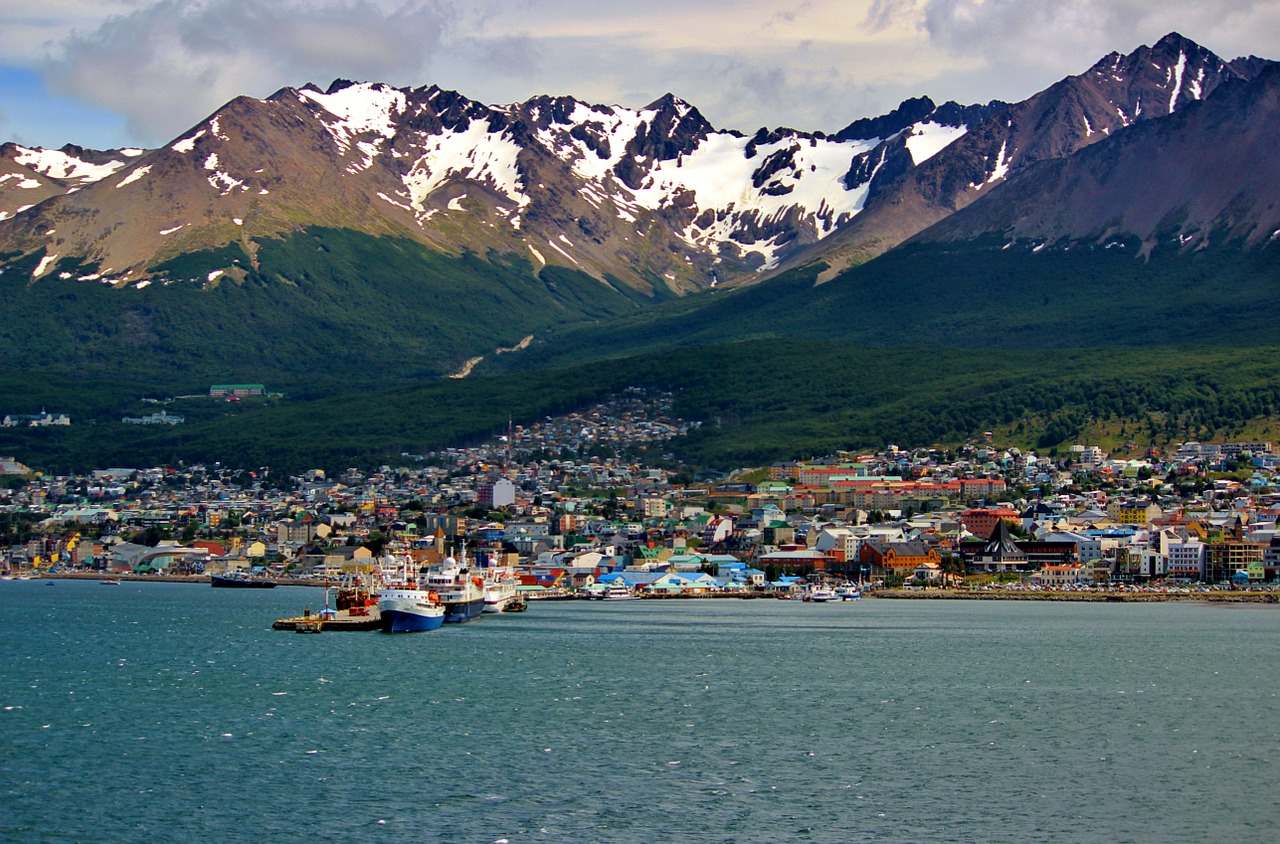
At the southern tip of South America, near the city of
Ushuaia, Tierra del Feugo, Argentina, a small tourist train operation
has become a proving ground for modern steam motive power. This railway
is known as the Ferrocarril Austral Fueguino (FCAF).
Ushuaia was originally settled as
a penal colony in the late
1800's. Among the duties of the prisoners was harvesting timber from
local forests. Around the turn of the century, a 600 mm gauge railway
was constructed and used to haul the timber. The prison in Ushuaia was
active until the 1950's, at which time it was closed down. The railroad
was abandoned, and the line's single small steam locomotive was
displayed in the city.
In the 1990's, it was seen that the tourist industry was
growing in Ushuaia. Tourist ships brought many travelers came to visit
the National Park Tierra del Fuego there.
Eventually, it was determined that a tourist railway, located on parts
of the original right-of-way of the old prison railway, would be built
to capitalize on this tourist traffic and to provide easy access to the
national park. The use of a railway had the advantage of minimizing
environmental impact compared to the building of roads for automobiles.
Tierra del Fuego is subject to very harsh winters and its
remote location makes the acquisition of parts and supplies difficult.
This was a significant challenge to the construction of the railway.
Suitable rails for the railway were located in Buenos Aires
(3,000 kilometers away) and shiped down. Cross ties were located at the
northern end of Argentina, and shipped down. The original right-of-way
was excavated, and track construction began. A gauge of 500 mm was
chosen for the new railway, narrower than the original gauge of 600 mm.
It was decided next to manufacturer passenger coaches and
locomotives locally. Since the value of steam locomotives in attracting
tourists was realized, it was decided that the locomotives would be
steam. Oil firing was chosen to minimize the fire risk to the forests
of the national park.
The first locomotive constructed was of the Beyer Garratt
arrangement (0-4-0+0-4-0), loosely based on the first Beyer Garratt
locomotive ever constructed. Construction began in early 1994 and took
9 months. Designated as "Nora", this was the first steam locomotive
constructed "from scratch" in Argentina. While parts were being
manufactured for this locomotive, a complete set of parts which could
be used as spares or for the construction of a second locomotive were
also manufactured.
The second locomotive acquired by the FCAF was built in by the
Winton locomotive works in England. A small 2-6-2T, it was based on an
1890 Lynton & Barnstaple prototype. This locomotive was smaller and
less powerful than the Garratt, but was suitable for most service on
the railway.

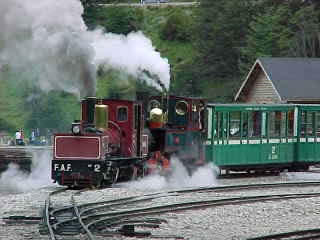
No. 2 and No. 3 on a Rare "Double-header"
A small industrial diesel locomotive was also acquired to
serve as backup power for the line's steam locomotives and for use on
work trains and other duties.
While both steam locomotives gave good service for the first
year or two of the railway's operation, it soon became apparent that
their design was far from optimum. Both of the engines were based on
prototypes built nearly 100 years ago, and virtually the only modern
features which had been added were welded boilers and roller bearing
axles. The engines used saturated steam, which limited their power and
gave them relatively high fuel and water consumption. Mechanical
problems
resulted from some poor design details, and it became apparent that the
locomotives could not be expected to provide continued reliable service
without modification. Shaun McMahon has spent the last several years
working with steam designers L. D. Porta of Argentina and Phil
Girdlestone of South Africa to design and implement improvements to the
line's steam locomotives. In 2005, a third modern steam locomotive was
added, Garratt No. 5, named "Ing. H. R. Zubieta".
Another on-going project at the FCAF is the
development of improved steam locomotive water treatment. This system
uses water treatment developed by L. D. Porta based on a system used in
France in conjunction with boiler internal monitoring equipment based
on a system developed by the Dearborn Chemical Company of the U.S.A. in
the 1940's. For more information on this work, visit Martyn Bane's page
on the Porta water treatment system at: http://www.portatreatment.com/
Details of the railway's locomotives follow below.
FCAF's Locomotive "Camila"
photos and info courtesy Shaun McMahon
except as noted

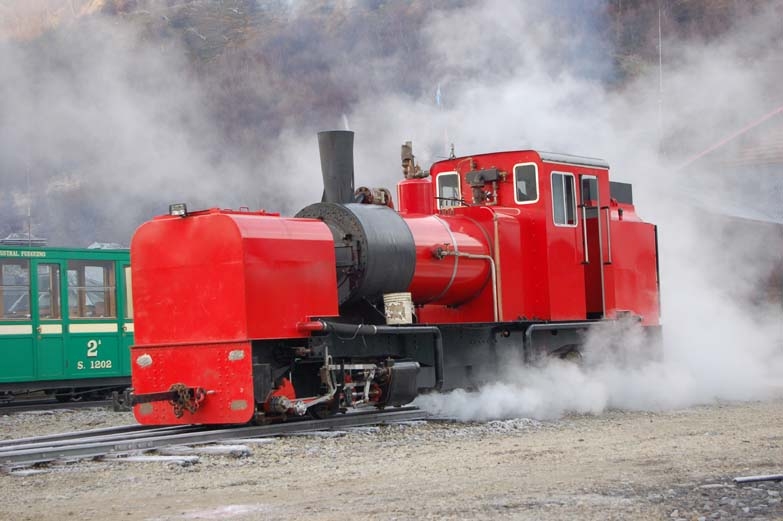
Camila Before Modifications
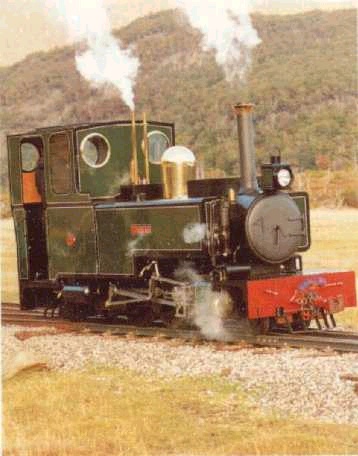
Camila, the FCAF's second steam locomotive was designed and
built in the UK by "Winson Engineering". It is of 2-6-2T arrangement
and weighs an estimated 7.5 tons. The design was based on the steam
locomotives of the Lynton & Barnstaple Railway in England. Camila
was built between December 1994 and February 1995 in Daventry. Camila
gave good service during the FCAF's early days, but as passenger
traffic increased and demands on the line's locomotives became more
severe, it became clear that the engine had some serious shortcomings.
While Camila was built with some modern items (roller bearing
axles, welded boiler, oil firing) in most other respects it was a late
19th century design. Winton's design was very simple, no doubt to
minimize first cost and maintenance costs. The engine lacked
superheating, an efficient exhaust system, or a streamlined steam
circuit, which gave it dismal thermal efficiency and low power. When
the engine was overhauled, it was found that some frame components were
improperly aligned, which resulted in excessive friction and wear.
Shaun McMahon, the Technical Manager of the FCAF, worked with
L. D. Porta to devise a plan for improving the performance and
reliability of Camila. It was determined that a two-stage modification
plan would be implemented, to allow the work to be accomplished within
the allowable time (dictated by the railway's operating season) and
budget. It was believed that Stage I of the modifcations would result
in significantly improved operational economics (larger trains hauled
on less fuel with less labor) which would help justify the second stage
of the modifications. Phil Girdlestone in South Africa, via his company
Girdlestone Rail, assisted in the work by fabricating the entire Lempor
Exhaust system as well as supplying replacement parts and components
for the overhaul.

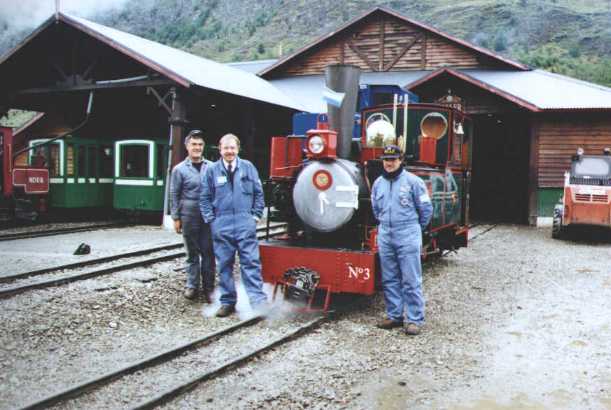
FCAF No. 2 "Camila"
in present form, Stage I modifications complete
showing (left to right):
regular seasonal driver Chris Parrott, Shaun McMahon, technical manager
of the railway,
and Fabian Papatrypmonot, senior driver on the FCAF
In late 1999/early 2000, Camila was overhauled and "stage I"
modifications were implemented. The major modifications include:
| Installation of Lempor
exhaust system |
| Provision of streamlined
main steam pipes |
| Improvements to oil burner |
| Heavy insulation of
cylinders, boiler, and steam pipes |
| Thorough overhaul of
mechanical components |
| Turning drivers to "high
adhesion" profile developed by
Porta |
| Ergonomic modifications to
cab and controls |
Upon its return to service, Camila was a complete success,
with noticably improved performance, both in terms of power and fuel
and water economy.
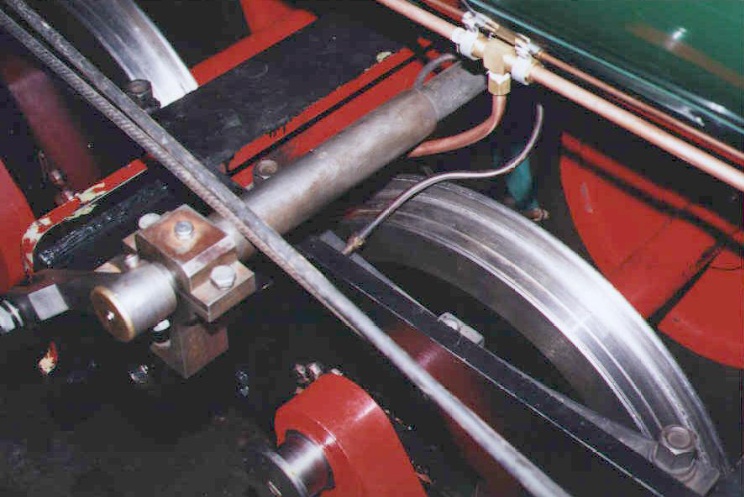
The photo below shows the highly insulated cylinder and steam
chest- "sealed for life" as advocated by David Wardale. Wardale notes
in his book The Red Devil that steam locomotive cylinder
insulation was typically maintained in deplorable condition. (For
example, I have yet to find a photo of a single engine operating in
Zimbabwe with insulated cylinder heads!) The insulation applied to
Camila's cylinders appears to be an excellent start towards Wardale's
recommended permanent cylinder insulation.
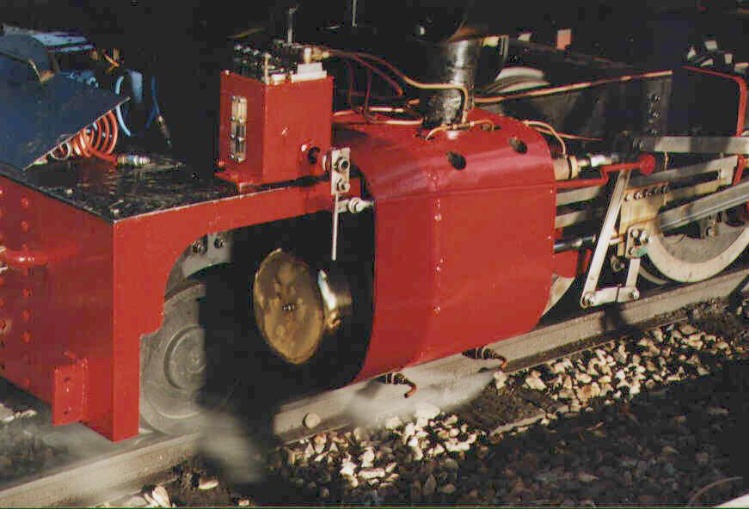
View shows Camila's cylinder showing heavy
insulation, and proportional feed lubricator drive with "between the
rings" oil delivery to the valve heads. Also note direct,
well-insulated steam delivery pipe to steam chest.
Camila's high adhesion wheel profiles are
clearly visible in this photo. Copper pipe runs are for flange
lubrication. (Note- the "high adhesion" tire profile was developed by
Porta and includes a step and a groove in the running surface of the
wheel, the idea being to keep contaminants such as oil or grease away
from the part of the wheel in contact with the rail.
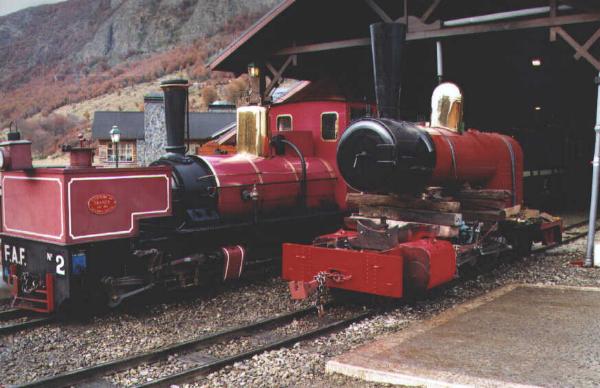
Camila with raised boiler next to Garratt locomotive
"Nora"
This photo shows Camila's boiler temporarily
installed in a raised position. Shortly after Camila's return to
service after the Stage I modifications, an unrelated boiler fault
occurred. The boiler had to be removed and shipped to Buenos Aires for
repairs. While the boiler was disconnected, the opportunity was taken
to develop some data for Camila's Stage II modifications. This
anticipates the probable mounting of the new or modified boiler to be
fitted to Camila for Stage II of the modifications to the engine. The
much higher mounting position will allow a much deeper firebox to be
fitted, providing a great increase in firebox volume. The Lempor
exhaust stack was temporarily installed and the engine was towed around
the railway yards to check clearances which were just (!!) sufficient.
The degree to which the boiler was raised (385 mm) can be judged from
the distance between the Lempor exhaust nozzles (normally located
within the smokebox) and the bottom of the smokebox.
This photo also gives a good idea of the probably
proportions of the Second Generation Steam (SGS) locomotive (0-6-0T or
0-6-2T wheel arrangement) that may be built in the future for the FCAF
and for
production for other narrow gauge tourist railways. This new engine is
to be a 2-cylinder compound, incorporating and optimizing all the
existing and planned improvements for Camila.
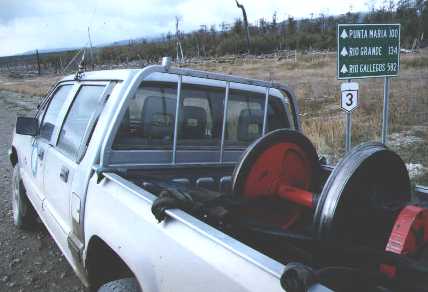
Camila's Drivers On Route to Machine Shop
Taken March 2001, drivers were being trucked to
"nearby" Rio Grande (only 250 km from Ushuaia) for replacement of a
defective axle roller bearing. The sign gives distances of 100 km to
Punta Maria, 134 km to Rio Grande, and 582 km to Rio Gallegos, where
the "neighboring" RFIRT terminates.
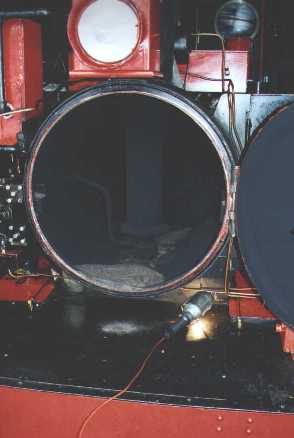
Camila, June 2001
Smokebox after 41 days in steam. Note very low
mounting of the Lempor exhaust nozzle to maximize available total
height of stack. Also note fully contoured radius of stack inlet,
rather than just a "bellmouth" inlet as was traditionally used, which
minimizes flow restriction of exhaust gasses into the stack.
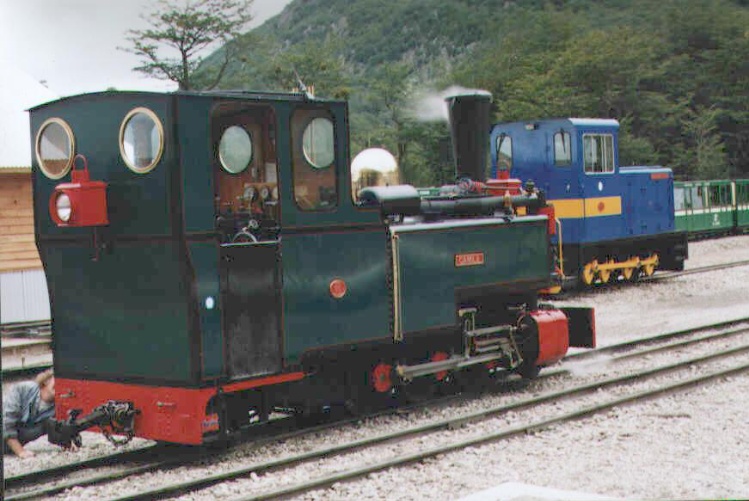
Side/rear view of Camila. Clearly visible are
Lempor chimney (note significant taper compared to original stack), air
pump exhaust external to chimney, high degree of insulation fitted to
air pump steam delivery pipe, water tank gauge, and extra test
instrumention fitted inside the cab. New diesel "Tierra del Feugo"
built by Girdlestone Rail is visible in the background.
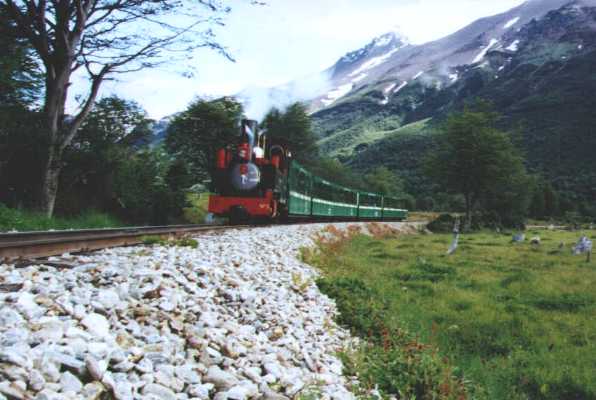
Camila's modifications show that "tourist"
locomotives need not be brutally simple engines devoid of any modern
design features. The value of the modifications has been proved in
day-to-day service on a heavily trafficed, geographically isolated
railway where reliability and economy are paramount.
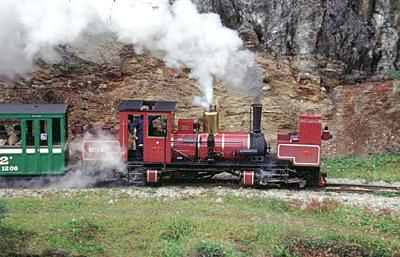
FCAF
No. 2- "L. D. Porta"

As-Built Photo of FCAF No. 2
"Nora"
prior to extensive overhaul in 2001 and
renaming as "L. D. Porta"
photo ® by Martin Coumbs
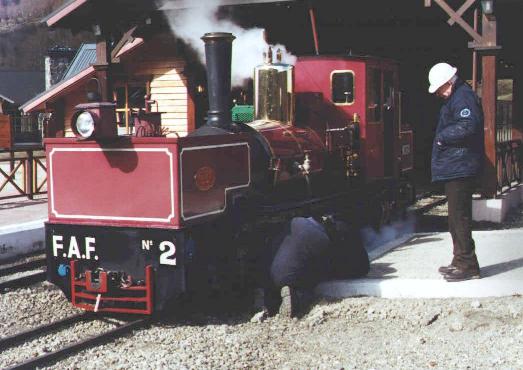
No. 2 is an 0-4-0+0-4-0 Beyer
Garratt type locomotive,
designed and manufactured in Argentina in 1994. It is based on the
first Garratt type locomotive to be built by Beyer Peacock in
Manchester in 1909, the K1. No. 2 is reported to be the first steam
locomotive built from scratch in Argentina. No. 2 as built had an
estimated weight of 9 tons and was designated KM Class.
Much like its sister British-built locomotive Camila, No. 2 was
constructed using modern techniques and certain components, but to a
very old design. No. 2 has welded steel cylinders and boiler, roller
bearing axles, and oil firing, but few other concessions to modern
technology. On the other hand, No. 2's Beyer Garratt 0-4-0+0-4-0 wheel
arrangement provides a relatively powerful locomotive which rides well,
can negotiate tight curves, and which utilizes all its weight for
traction.
As a result of the success gained following
the overhaul and first stage modification of Camila, Tranex gave
sanction for similar work to be carried out to FCAF's other steam
locomotive No. 2. The first step in planning No. 2's modifications was
to thoroughly evaluate the design and condition of the locomotive. The
photos
below
show Ing. L. D. Porta supervising steam leakage tests on
No. 2 as part of this work. A significant amount of work had
to be performed on No. 2 to bring it up to the standards established
nearly 40 years ago (!!) by Porta on the Rio Turbio Railway in
Argentina.
One of the first steps taken prior to beginning the rebuild was to
perform detailed steam leakage experiments. Ing. L. D. Porta
himself came down to Ushuaia to supervise the work.

"At the age of 77, Ing. L.
D. Porta supervises steam leakage tests on FCAF locomotive 'No. 2'-
October 1999."
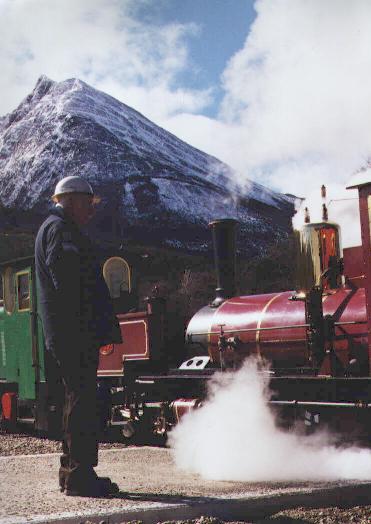
"L. D. Porta looks on as steam
escapes from static steam leakage test to FCAF "No. 2". The result was
67% leakage!! Porta still holds the world record at 2% (only) with Rio
Turbio Mitsubishi 2-10-2s! Note snow capped mountain in background.
Porta has a particular affection for Patagonia and says his best years
were spend in Rio Gallegos!"Photo: Shaun McMahon, October 1999
The design of a variety of
improvements to the locomotive was conducted in 2000 and the locomotive
was extensively rebuilt in 2001. For details of the extensive
re-build of No. 2, follow this link: Rebuild
of
FCAF
#2
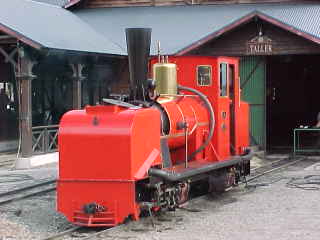
"L. D. Porta" After Complete Rebuild in late
2001
Garratt
Locomotive
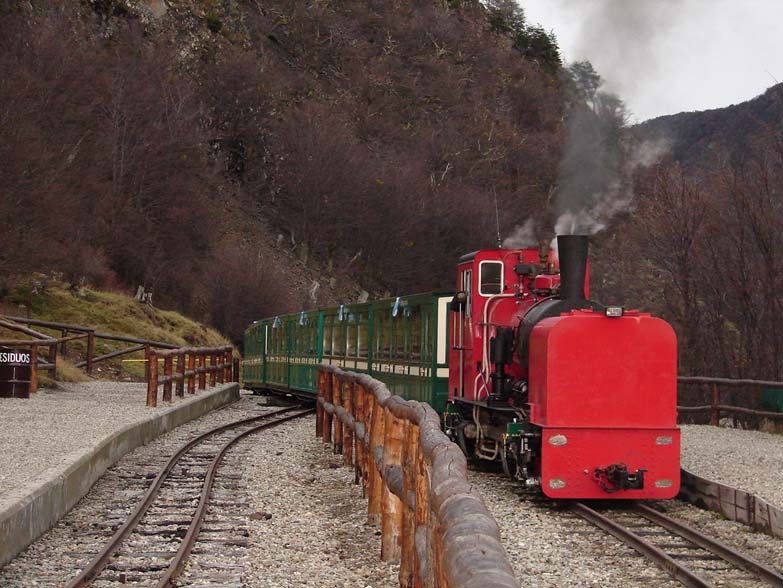
No. 5, "Ing H. R. Zubieta"

Following the experience gained by the
modernizations of locomotives No. 2 and Camila, the FCAF elected to
construct a new locomotive with these and additional
improvements. No. 5 was constructed in South Africa by Phil
Girdlestone and associates and delivered to the FCAF in 2005.
Some parts fabricated in Argentina and originally intended for a sister
engine to No. 2 Nora (now L. D. Porta) were used. However, the
majority
of the locomotive is new construction. An all-new boiler,
designed to appropriate codes and incorporating both a Belpaire firebox
and superheating was provided. This locomotive incorporates
lessons learned from the modernizations and operation of other FCAF
steam locomotives and is the line's most powerful steam locomotive.
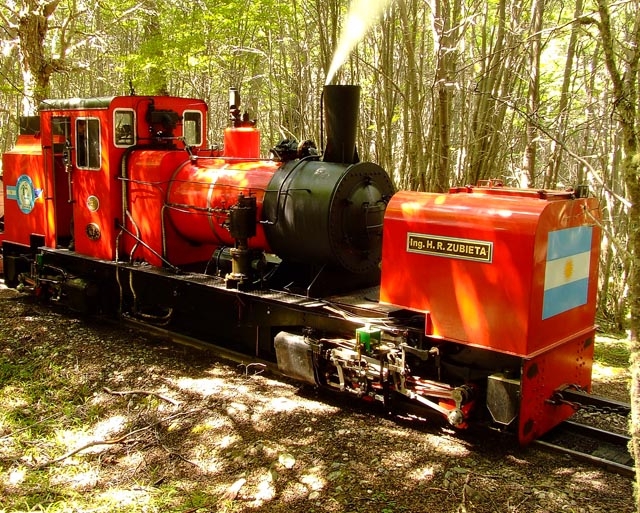
For more details on the engine, see Martyn Bane's
page at:
http://www.martynbane.co.uk/modernsteam/pg/fcaf5/fcaf5.html
Future Steam for the FCAF

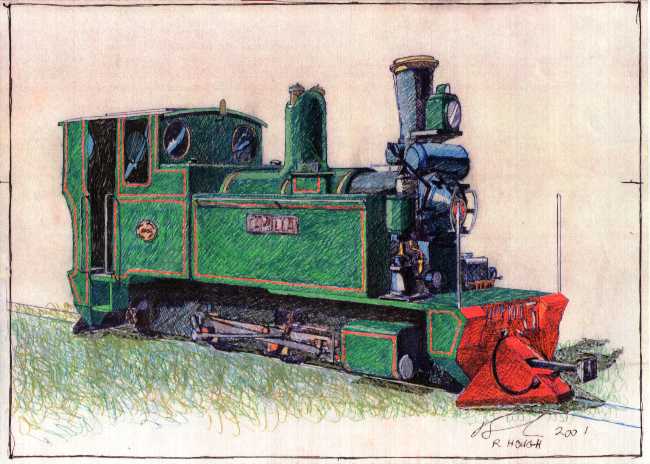
Artwork by Rudi Hough Showing Camila After
Completion of Stage II Modifications
Stage II improvements were planned for Camila, to consist
mainly of improvements to the steam circuit, including high
superheating, larger, improved piston valves with larger steam chests,
a re-designed Lempor or new Lemprex exhaust system (to suit the
superheated steam circuit), a feedwater heater, and an enlarged firebox
and improved oil burning system. Depending on the extent of
modifications required, a new boiler may be fabricated rather than
modifying the existing one.
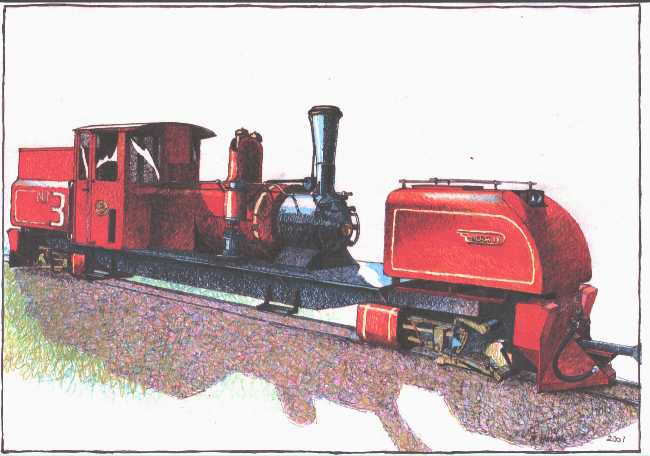
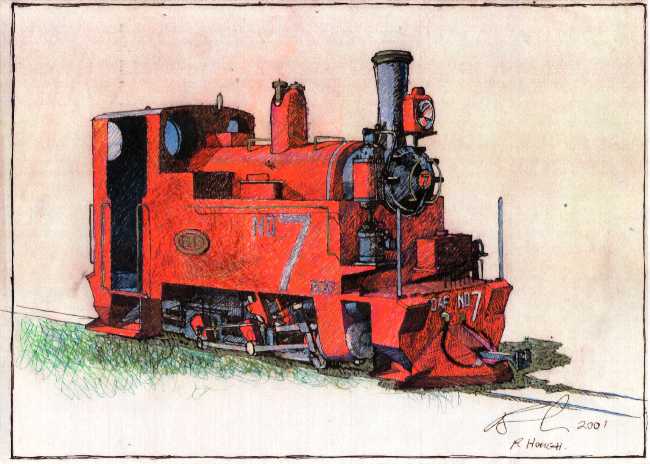
"Stage 2" Modifications for L. D.
Porta
Additional modifications were
planned for Garratt No. 2 which would have looked something like Mr.
Hough's painting above. The status of these planned modifications
is unknown.

Future New Steam for the FCAF
LVM 803
Art by Rudi Hough
New steam was also planned for the FCAF and other
tourist railways in the form of
the locomotive shown above. Design work began in 1998 on this
locomotive, planned for use on the FCAF and other
small tourist railways. While several design details have changed since
the sketch above was prepared, the image gives a good idea of what the
locomotive will look like. The locomotive will be a 2-cylinder
compound, with an 0-6-0T or 0-6-2T wheel arrangement. The LVM 803
designation is in keeping with the other modern steamers planned or
designed under Ing. L. D. Porta's guidance: the LVM 800 0-6-2T shunting
locomotive for
Cuba; LVM 801 2-8-2T/tender passenger locomotive for Tren a Las Nubes
(Train to the Clouds), Salta, Argentina; LVM 802 "standby" steamers for
Spain; and LVM 803, Tranex Turismo S.A.'s FCAF, Ushuaia.
Since Ing. Porta's death in 2003 the fate of
these projects is uncertain.
|