| Normal coal-fired steam locomotives burn
coal on a (relatively) flat grate, usually
consisting of cast iron segments which can
be rocked back-and-forth with a mechanism to
shake the ash down into the ash pan. Air
holes are provided in the grates which allow
most of the air required to burn the coal to
come up through the coal bed. Locomotives
typically generated much more steam for a
given physical size boiler than a stationary
boiler would (for example, a power plant
boiler). They accomplish this by using a
power draft-inducing mechanism (the
smokestack and nozzle) which draws huge
amounts of air through the grate to allow
coal to be burned very rapidly.
While this allowed locomotives to produce
ample power, it was not very efficient.
The main reason for this is the velocity
of the air which comes up through the
fire. As the lumps of coal on the fire
burn, they shrink in size. Eventually,
they become sufficiently small that the
force of the airstream lifts them off of
the firebed, carrying them through the
firebox, into the flues, and eventually
out of the smoke stack where they are
discharged as cinders. In a locomotive
operating at high power output, more than
50% of the coal that was fed into the
firebox could be ejected from the stack in
this way before it could be completely
burned. This effect was somewhat worse on
stoker-fired engines as the coal was
ground up in the stoker and blown into the
firebox with steam jets. Many particles
would be caught in the airstream without
ever landing on the firebed. This
represented a tremendous loss of
efficiency in the boiler.
Besides the efficiency loss, this
carryover of unburned coal causes several
problems. The coal particles act much like
sand-blast grit as they fly through the
boiler at high velocity. This causes wear
on the surfaces in the boiler, including
the rear tube sheet, rear tube ends,
superheater ends, and internal parts of
the smokebox. The cinders, if of sufficent
size, can ignite line-side fires along the
railroad tracks. A conventional steam
locomotive firebox is illustrated below.
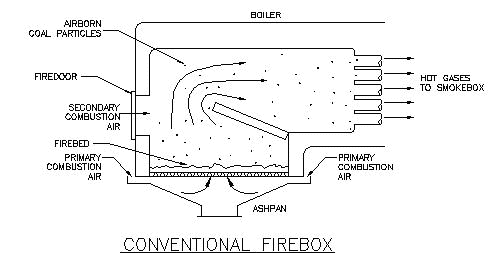
This drawing shows a simplified
cross-sectional view of a typical steam
locomotive firebox. Most of the air
required to burn the coal (about 90%)
enters through the ashpan and comes up
through the grate. A much smaller amount
of air (about 10%) enters the firebox
through holes in the firedoor, and
sometimes through openings installed in
the sides of the firebox (such as
over-fire jets).
Another problem with conventional coal
combustion was clinker formation. All coal
contains non-combustible components. Some
of these components can melt at the
temperatures attained in the coal bed.
When this happens, the molten substance
flows together to form a clinker. Since
the clinker can't burn, it blocks off a
portion of the firebed, reducing the
engine's output (sometimes by extreme
amounts). The fireman has to attempt to
break it up manually using a steel rod and
then shake the engine's grates to get the
broken pieces to drop into the ash pan.
This was a laborious task, especially on a
moving train.
A final problem with conventional coal
combustion is uneven heating. A good
fireman tried to maintain his fire "light,
level, and bright". To do this, he had to
keep the firebed relatively thin (a few
inches thick). Problems with the stoker or
with his shoveling technique could cause
the fire to be thicker in some areas and
too thin in others. This produced uneven
heating in the firebox, causing stress on
the hot firebox surfaces. Occasionally,
the fire could actually burn out in a thin
location. This would immediately allow a
stream of cold air to come up through the
grate causing further firebox stresses.
Burning coal (not fresh coal) had to be
spread over this spot and then fresh coal
added.
All of these problems with conventional
coal combustion made the fireman's job
difficult, increased maintenance on steam
locomotives, and severely limited the
efficiency which could be attained.
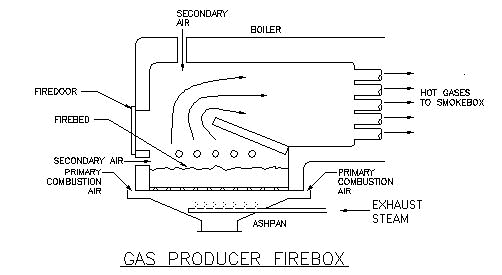
The illustration above illustrates the
same firebox after conversion to a GPCS
configuration. The coal grates are
replaced with grates having smaller air
openings, so that only about 30% of the
air (primary air) required to completely
burn the coal enters through the grates.
For proper operation, the grates must fit
tightly when closed to prevent uneven air
flow up through the firebed. A number of
air admission ducts are installed through
the walls of the firebox, along the sides,
back, top, and/or front. These ducts are
sized to admit about 70% of the air
(secondary air) required to completely
burn the coal. Finally, dispersion tubes
are installed below the grates to admit
steam to the fire. This steam comes from
the exhaust nozzle (3-4% of the exhaust
flow from the cylinders) and from various
other steam-powered accessories on the
locomotive. The steam must be evenly
distributed and mixed with the primary air
to ensure proper operation. The firebed is
maintained much deeper than in a
conventional firebox.
An integral component of the GPCS is an
improved stack/nozzle arrangement in the
smokebox of the locomotive. To ensure
complete combustion of the firebox gases,
the secondary air is introduced through
small openings at high velocity into the
firebox. This produces turbulence so that
the air thoroughly mixes with the burning
gases. Because of the small primary air
openings in the grates and the small
secondary openings in the firebox walls,
more energy is required to "pump" this air
through the boiler than with a
conventional firebox. If a conventional
nozzle and stack arrangement were used (as
on most U.S. locomotives), a very
restrictive nozzle would be required which
would produce excessive back pressure on
the pistons. This would negate much of the
advantage of the increased steam
generating capacity of the GPCS. To
overcome this problem, the locomotive is
fitted with a high efficiency front end
such as a Lempor or Kylpor ejector, both
of which were developed by Porta. These
systems produce the maximum draft for the
minimum back pressure, maximizing the
power developed in the locomotive's
cylinders, even with the increased pumping
that is required with the GPCS.
In the GPCS, the coal burns at a lower
temperature than in a normal locomotive.
The admission of only 30% of the required
air combined with the steam flow causes
the solid constituents of the coal to
burn, while the remaining components are
converted to mostly carbon monoxide gas
and water vapor. In the space above the
firebed, the secondary air ducts provide
the remaining air necessary to completely
burn this gas. The low velocity of the air
through the firebed combined with the
thick fire reduces the carry over of coal
particles which greatly reduces the
sand-blasting effect and the risk of
line-side fires. The firebox is inherently
maintained at a more-even temperature
which reduces thermal stresses. The thick
firebed, cooled by the flow of underfire
steam, makes the fireman's job easier as
it is much less likely to form clinkers or
develop thin spots. On the Rio Turbio
engines, the stoker steam jets are not
normally used; the coal just spills out of
the stoker and is allowed to spread across
the firebed.
As a comparison, the efficiency of a
typical modern locomotive boiler with a
huge combustion chamber was less than 50%
at maximum output. Porta's 2-10-2's, built
in the late 1950's and early 1960's,
attained 78 to 80% efficiency at high
output under documented tests.
The GPCS can be adapted to virtually any
solid fuel, and has been successfully
tested with wood, charcoal fines mixed
with oil, and sawmill waste. Some of
Porta's final efforts were in Cuba,
working to adapt the GPCS to burn baggasse,
the discarded waste left when sugar cane
is crushed to produce sugar. One steam
locomotive was extensively modernized but
retained oil fuel for the initial trials.
Sadly, the sugar industry declined rapidly
shortly after this and further development
of the project stopped.
Porta equipped one locomotive on the
RFIRT with a refinement of the GPCS, known
as the cyclonic gas producer
firebox. This locomotive had the air ducts
arranged to produce a swirling effect in
the firebox gases, augmented through the
use of steam jets. This causes the air to
more completely mix with the firebox gases
for even more complete combustion, and
centrifugally separates the few airborn
coal particles to allow them to completely
burn before exiting the firebox. New
firebox designs shown in Porta's technical
papers would have had a different shape to
maximize this cyclonic affect.
A refinement developed by Wardale in
China was to allow the secondary air ducts
to be closed off when the locomotive was
standing and when first accelerating after
an idle period. This increased the primary
air flow, rapidly increasing the firebed
temperature for optimum formation of
producer gas. This was an effort to
counter "sluggish" action of the firebed
with earlier GPCS locomotives when
starting from an extended stop. Porta
envisioned additional detail improvements
to eliminate this issue completely and
maximize the combustion efficiency of GPCS
locomotives.
The GPCS has been applied to locomotives
in Argentina, Paraguay, Brazil, and Cuba
by Mr. Porta, to locomotives in South
Africa and China by David Wardale, and to
locomotives in England and South Africa by
Phil Girdlestone. At least one new-build
narrow gauge steam locomotive in the UK is
equipped with the GPCS. The GPCS has even
been applied to miniature steam
locomotives (7-1/2 inch and 15 inch gauge)
in England, South Africa, and the USA.
While the GPCS is a simple concept, it
requires careful attention to its design
and tuning to ensure its proper operation.
|










 Back to
Top
Back to
Top