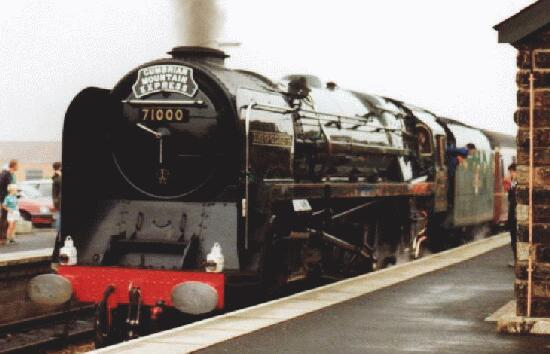
| The Duke of Gloucester was
designed by Robert Riddles in 1952 as the
prototype for a new generation of steam
passenger engines for British Railways.
Chief among the locomotive's advanced
features was the use of
British Caprotti valve gear, a form of
rotary cam poppet valves. The locomotive
was completed by Crewe Works in 1954.
When the Duke
was tested on the Swindon Test Plant, it
was found to have the highest cylinder
efficiency of any simple expansion
engine on record and subsequent trials
showed it to be significantly more
powerful than any comparable type.
Despite this, however, the locomotive
was known for having difficulty steaming
and was unusually heavy on coal
consumption. Shortly after Mr. Riddles
retired, BR management decided to
withdraw steam and dieselize as soon as
possible. This prototype was destined to
become a "one of a kind" locomotive, and
due to the short future of steam the
locomotive's problems were not
investigated and corrected.
When the
locomotive was retired in 1962, it was
initially planned tobe preserved as part
of the British National Collection.
However, because of the steaming
difficulties, the engine was considered
unsuccessful and deemed not worthy of
preservation. The locomotive's cylinders
with Caprotti valve gear were removed,
and the right one was sectioned and
placed in the Science Museum in
Kensington. The Duke languished for the
next 10 years in the famous Barry Scrap
Yard without much hope of being saved.
In 1973, a
group was formed which rescued the
locomotive and declared that it would be
restored to service. Not only did new
cylinders have to be cast and machined,
but a myriad of smaller components
required fabrication as well.
During the
restoration, two significant flaws were
found in the engine. The ashpan had been
constructed incorrectly, restricting the
airflow to the grates. A comparison of
the locomotive's double exhaust stacks
showed the entire exhaust system to be
too small compared to other British
locomotives of comparable size. Based on
this, a new dual Kylchap system was
designed and fitted to the locomotive
during its restoration. The group gained
confidence that the engine's mysterious
steaming difficulties had been solved.
When No.
71000 re-entered service in 1996, the
locomotive proved to be a transformed
machine. It easily exceeded its former
performances and astounded former
enginemen who had known it during its BR
days.
Very
interestingly, the work required during
the initial restoration generated an
enthusiasm for researching and
developing continuing improvements for
the engine. After several years of
service, further improvements were made
to the ashpan. The water capacity of the
tender was increased and a coal pusher
was constructed and added to ease the
firemen's jobs. New camshafts of an
altered profile to provide more complete
steam expansion were later fitted. An
auxillary water tender was constructed
to increase the engine's operating
range. Finally, a design flaw was
discovered in the cylinder heads, which
restricted the steam flow into and out
of the cylinders. This was corrected on
4 newly fabricated cylinder heads which
significantly increased the locomotive's
already high cylinder efficiency.
For more on
the Duke, visit their website at: https://www.dukeofgloucester.co.uk/
|