




New Steam
from Switzerland
|
||||||||||||||||||||||||||||||||||||||||||||||||||||||||||||||||||||||||||||||||||||||||||||||
| Early in the 1990's, a former steam locomotive builder in Winterthur, Switzerland re-entered the business after a nearly 40 year absence. This was the Swiss Locomotive and Machine Works (SLM), at this time a division of Sulzer, a large Swiss manufacturing company and famous builder of diesel engines. SLM engineer Roger Waller was convinced at this time that there was a market for new steam locomotives, and he did research to back up his ideas. Waller had worked with Wardale in South Africa and was familiar with the work of L. D. Porta and the possibilities for truly modern steam locomotives. Several rack railways in Switzerland, the UK, and India still operated SLM-built steam locomotives and there at least appeared to be a market for spare parts. This was soon confirmed and production of some replacement parts was resumed to fill this need. Waller finally convinced Sulzer management that there was a market for new, improved steam locomotives, and he pursued this possibility. Eventually, this led to orders for new rack steam locomotives, incorporating Porta thermodynamic principles and modern construction techniques. |
![[New Swiss Steam]](http://upload.wikimedia.org/wikipedia/commons/0/07/Mh_brb14.jpeg)
This photo was taken by Martin Hawlisch photographed
and published under the GFDL.
SLM's greatest success was the
construction of 8 new modernized rack steam
locomotives 1990's in Switzerland for
mountain tourist railways in Switzerland and
Austria. While the engines replaced locos
previously built in 1891 and 1933 by SLM,
they were of completely new design
incorporating Porta's principles, and using
modern construction techniques and
technology. Featuring welded boilers, roller
bearings, modern drafting arrangements,
light oil firing, extensive thermal
insulation, and arranged for one-man
operation, they have been very successful.
The boilers are so well insulated that they
will maintain a head of steam overnight,
allowing the engine to leave its shed under
its own power in the morning and attain full
working temperature and pressure in only 10
to 15 minutes after lighting the fire. An
interesting innovation on these engines is
the provision of an electric boiler
pre-heater. This is used to pre-heat the
boilers after their monthly boiler wash to
save fuel. The thermal efficiency of these
locomotives is over 10%. The new SLM
locomotives compared to the 1933 design SLM
steamers as follows :
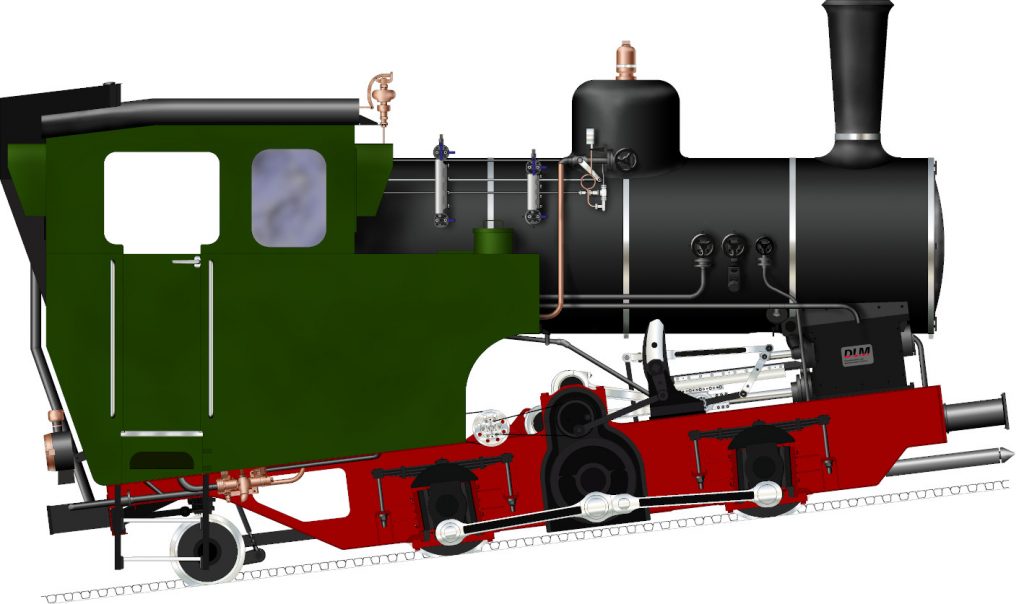
Rendering of 0-4-2RT by
DLM
|
||||||||||||||||||||||||||||||||||||||||||||||||||||||||||||||||||||||||||||||||||||||||||
|
Locomotive Specifications |
|
| Grate Area | 0.9 m2 |
| Tubes, number | 62 |
| Tubes, dimensions | 38 x 2.9 mm |
| Flues, number | 15 |
| Flues, dimensions | 114.3 x 3.6 mm |
| Total evaporative surface | 30 m2 |
| Firebox | 5.14 m2 |
| Tubes | 13.80 m2 |
| Flues | 10.92 m2 |
| Superheater surface | 13.23 m2 |
| Boiler Pressure | 16/18 bar |
| Oil firing System | Sonvico/SLM-type |
| Fuel | Extra light heating oil (#2 heating oil) |
| Cylinders | 2 |
| Diameter | 280 mm |
| Stroke | 400 mm |
| Valve Gear | Heusinger (=Walschaerts) |
| Gear ratio | 2.3:1 |
| Rigid wheelbase | 2070 mm |
| Total wheelbase | 2650 mm |
| Rack system | Abt (Riggenbach) |
| Driving cogwheels | 2 x 2 (2 x 1) |
| Cogs per driving wheel | 15 (18) |
| Length over couplers | 6260 mm |
| Maximum width | 2200 mm |
| Service speeds on gradients | |
| 1 in 4 | 12 km/h |
| 1 in 4.55 | 13 km/h |
| 1 in 5 | 14 km/h |
| Gauge | 800 | 1000 mm |
| Carrying wheel diameter (worn/new) | 637/649 | 693/705 mm |
| Pony wheel diameter (worn/new) | 426/440 | 479/493 mm |
| Maximum height | 3200 | 3230 mm |
| Weight, empty | 13000 | 13300 kg |
| Water in boiler | 1200 | 1200 kg |
| Water in side tanks | 1300 | 1300 kg |
| Oil (545 l, 0.86 kg/l) | 470 | 470 kg |
| Weight in full working order | 15970 | 16270 kg |
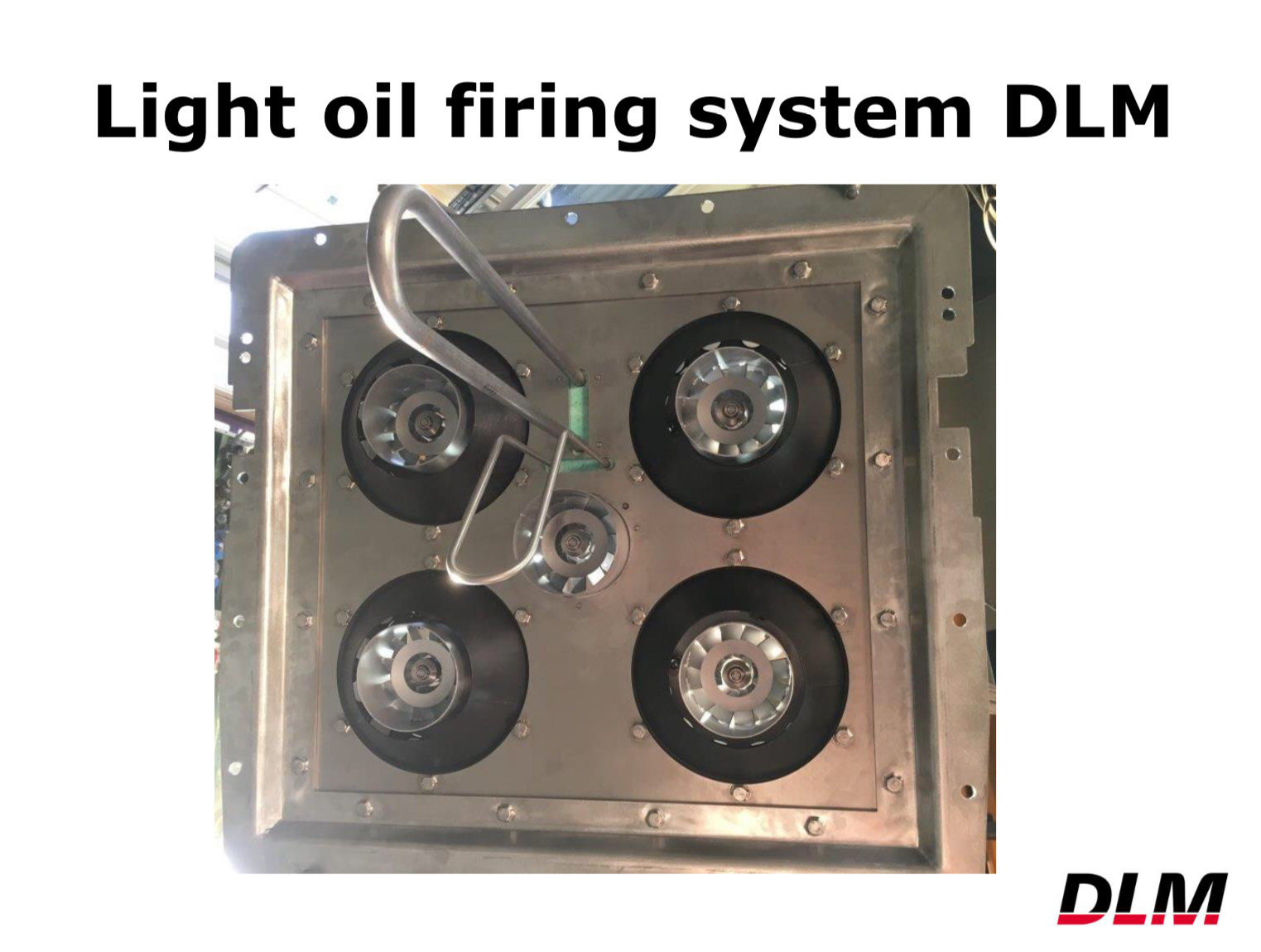
| This interesting photo, from a DLM brochure, shows the oil firing system first used on the new build rack steam locomotives built by SLM in the 1990's, and recently fitted by DLM to a 2-6-2T on the Puffing Billy Railway in Australia. This arrangement allows very efficient combustion of light oil (no. 2 or similar) under standing, part load, and full load conditions. The center burner is a pilot burner which stays lit at all times. The small piece of tubing above the burner is the steam feed to the pilot burner, used to atomize the fuel oil as it is injected into the firebox. This tube superheats the steam, allowing less steam to be used and more thoroughly vaporizing the oil for efficient combustion. The surrounding burners admit fuel oil to the firebox during operation and are also supplied with superheated steam from the larger tube above the pilot burner. |
Roger Waller in the cab
and world-renowned steam designer L. D.
Porta inspecting the motion work
Above photo courtesy Andreas Schwander
After the success of the new rack steam
locomotives, Waller continued to research
possibilities for building new or
modernizing existing steam locomotives. A
good candidate for an extensive rebuild
was found on the Eisenbahnfreunde
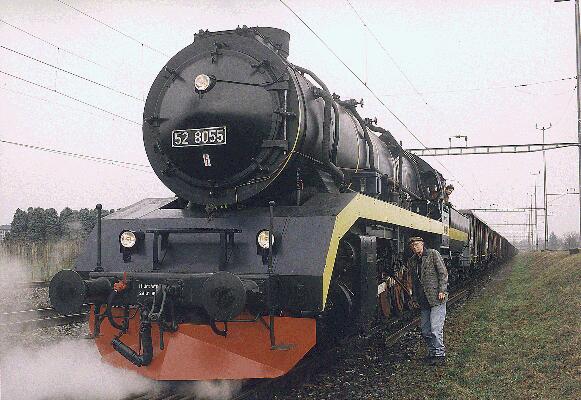
Zollernbahn EFZ. In late 1998, SLM
completed the extensive modernization of
52 series German Kriegslokomotive 2-10-0
no. 8055 for use on the Orient Express in
Europe. The locomotive was extensively
tested prior to being modified so that the
benefit of the modifications could be
documented. Over 70 percent of the parts
of the locomotive were replaced or
modified. As a result of these
modifications, the top speed of the engine
was raised from 70 km/hr to 100 km/hr and
the horsepower was increased from 1600 to
3000. The engine now burns light oil and
features sealed roller bearings, a central
lubrication system, light weight
motion-work, and extensive thermal
insulation. A side benefit of light oil
firing in an external combustion engine
(i.e.- steam) is very low exhaust
emissions. This engine emits about 80
percent less toxic exhaust gases per kW
than a state-of-the-art diesel. The
modifications were performed to provide a
steam locomotive which could keep tight
schedules and "time windows" to be allowed
to run on the main lines without causing
interference with normal trains. Testing
of the modified locomotive began in March
1999 and the locomotive pulled its first
passenger trains in April 1999.
The locomotive suffered from some teething
problems, but these difficulties were
gradually solved. Unfortunately, after
delivery to the EFZ, German railway
inspectors disapproved certain features of
axles on the modified engine (features
which were allowed in Swtizerland) and it
never operated as intended in Germany.
During this time, SLM sold off its
locomotive business and the steam
department formed a new company called DLM
(see below). After 2 years of sitting
idle, 8055 was sold to DLM in late 2003
and returned to Switzerland. Since then,
minor repairs were performed on the engine
followed by test runs. In December 2003,
the locomotive was placed on display
together with the Orient Express in Zürich
Hauptbahnhof. Test runs were successful
and the locomotive pulled the train on
mainlines at 80 km/h between express
trains and fast electric commuter trains.
Since then, the locomotive
operated on the Swiss Orient Express
trains (Nostalgie Istanbul Orient
Express) which was re-introduced under
the new management in 2004. 8055
has operated on many excursions since
2004 and is available for hire from DLM.
More information on NG
8055 is available at DLM's
website: http://dlm-ag.ch/en
Photos of the modernization of 52 8055
can be found here: https://www.eisenbahnfreunde-zollernbahn.de/loks/1bild52n.htm#
Specifications for 52 8055 (in German)
can be found here: https://www.eisenbahnfreunde-zollernbahn.de/loks/5280daten.htm
Another likely customer for modern steam locomotives was the Nilgiri Mountain Railway in India. For several years in the late 1990's and early 2000's, Indian Railways indicated interest in purchasing new steam locomotives for both Nilgiri and the Darjeeling Himalaya Railway, and SLM pursued both these orders. Calculations showed new steam locomotives to be the most economically viable solution to the Nilgiri's motive power requirements, but an order proved illusive. Since then, news from India indicates that some of the Nilgiri locomotives were heavily rebuilt and some were converted to oil firing. Evenually, India's Golden Rock workshops built new locomotives (to the original SLM design) for the Nilgiri as well as new locomotives for the DHR. Unfortunately, neither of these designs appeared to include any modern features apart from all-welded boilers. hardly "modern steam".
About 10 to 15 steam projects total were under consideration at SLM during the 1990's. Calculations for steam in Russia, for example, showed that a natural gas fired steam locomotive would save an estimated 60 percent in fuel costs compared to diesels and 80 percent compared to electric locomotives. Air pollution would also be considerably reduced. Examination of the conditions in different countries show diverse reasons for considering new steam locomotives: low cost of fuel, local availability of fuel, low pollution, and simplicity of construction resulting in long service life and making long-term local maintenance practical. Also of interest, SLM built new marine steam engines for Lake Geneva ships, actually converting them back to steam from diesel propulsion.
In 2000, Sulzer Winpro (formerly SLM) in Winterthur sold its steam business to Hug Engineering, a company which makes ceramic catalysers for diesel engines. Hug also owns a machine building company which works partly for its catalyser business, but also as a supplier for the rolling stock industry.
The steam business formed a new company called Dampflokomotiv und Maschinenfabrik AG DLM (Steam Locomotive and Machine Works Ltd..) DLM is headed by Dipl. Ing. Roger Waller and its aim is to develop and to market modern steam locomotives and steam engines for naval purposes.
DLM secured its first order,
the modernization of the rack steam
locomotive "Breithorn", owned by
Brig-Visp-Zermatt-Bahn (BVZ), which
operates a highly profitable line to the
mountain resort Zermatt with its famous
mountain "Matterhorn", of which a little
copy can be found in Disneyland in
California. DLM also further wants to
market its rack steam technology and will
develop a new narrow gauge adhesion steam
locomotive. It also intends to take part
in tenders for other new steam
locomotives, especially for Nilgiri
Mountain Railways in India.
More recent steam proposals
by DLM include a narrow gauge 0-4-0T for
general service (including a variant
styled for the Darjeeling Himalaya Railway
in India), 4-8-4T's for service in the
Netherlands, and 2-8-2T's which would be
suitable for the narrow gauge railways of
former East Germany as well as other
services. DLM has performed extensive
modernizations of several steam
locomotives, and continues to build new
steam engines and integrate them into
existing ships in Switzerland.
DLM has also done
considerable research on fireless steam
locomotives and owns several relatively
modern units which were built in Germany.
F
The establishment of DLM was
very good news for the continuation of
steam locomotive production. It is
particularly interesting that an
established, successful Swiss company (Hug
Engineering) was sufficiently confident in
the market for new steam that they would
invest substantial money to acquire the
engineering expertise and infrastructure
to support it.
See DLM's webpage for up-to-date information on new steam locomotive proposals.
many thanks to Andreas Schwander for much of this information
Complete information on
DLM appears on their corporate website at:
http://dlm-ag.ch/en




 Back to
Top
Back to
Top