|
|
|
|
|
|
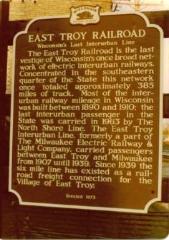
Once part of TMER&L's interurban line connecting East Troy to Milwaukee, the seven-mile segment from East Troy to Mukwonago is the last remnant of Wisconsin's network of interurban lines. It has been continuously electrically operated since 1907.
|
|
|
|
Historical Highlights
June 1903 - Line opens from Milwaukee to Hales Corners. Constructed by
Milwaukee Light, Heat & Traction (MLH&T) a subsidiary of The
Milwaukee Electric Railway & Light Co. (TMER&L).
June 21, 1904 - Operation extended to St. Martin's. This will become the
junction for the East Troy and Burlington branches.
Sept. 1, 1904 - Cars now operating from Milwaukee to Muskego Centre.
1906 - Service extended to Big Bend.
July 3, 1907 - Line officially opens Milwaukee to Mukwonago.
October 23, 1907 - Service now provided as far as Lake Beulah.
Dec. 13, 1907- Line officially opens Milwaukee to East Troy. John I.
Beggs, President of TMER&L arrives on first car.
April 1, 1910 - New East Troy substation building finished and equipment
turned on. Rotory converters supply power to the line at 1200v dc.
Dec. 1, 1915 - Freight and express service begins.
1919 - United Milk Products builds condenser plant next to East Troy
Lumber. Equity Feed & Fuel build new facility along track.
April 23, 1923 - New Mukwonago freight and passenger station opens.
June 24, 1924 - East Troy station remodeled. Agents living quarters moved
upstairs, waiting room enlarged.
November 1925 - Standard Oil constructs three large storage tanks west of
Division Street.
1927 - New substations built along line, power changed from 1200v dc to
600v dc. Trainshed built adjacent to East Troy station to provide shelter for
interurban and bus passengers.
Oct. 31, 1938 - TMER&L becomes WEPCO. TMER&T formed to take
over transit operations.
Aug. 5, 1939 - After being modified at Cold Spring Shops, M-15 leaves
express terminal for East Troy.
Aug. 12, 1939 - Passenger operations abandoned between Hales Corners
and East Troy. Portion of line from East Troy to Mukwonago purchased by
Village of East Troy for $10,000 to maintain freight connection to SOO
Line. Line is operated by TMER&T under contract using former
TMER&T M-15 and D-13. The 10-year agreement officially begins Jan. 1,
1940.
Sept. 5, 1939 - End of freight service east of Mukwonago.
Jan. 1, 1950 - TMER&T turns over operation to Village. Village hires own
crew.
1954- Following derailment of M-15 and box cars, SOO Line crews replace
many ties in "Cemetery Curve".
1966 - Jerry Fischer citing railroad losing money and being supported by
taxpayers, proposes to purchase and operate railroad for $12,000. When
Village Board turns him down, he forces a referendum, but the voters also
reject his plan.
1969 - Trent Tube builds new plant and Village builds new spur. Rather
than electrify the spur, they purchase a 44-ton diesel.
1972 - TWERHS enters into contract with Village allowing operation of its
"East Troy Trolley Museum" trains. TWERHS members begin replacement
of ties bringing line up to FRA standards, and take over maintenance of
rotory converter and overhead wire system.
1970's- CETA program replaces hundreds of ties with ties and tie-plates
supplied by TWERHS.
1975 - Entire line designated a Wisconsin Landmark. Marker
commemorates TMER&L history.
1979-1980 - $700,000 Government funded major rebuilding of line includes
replacement of ties, rail joints and ballasting. Bridges at Phantom Woods Rd.
and Beach Rd. are replaced, bridge at Stewart School Rd. is removed.
1980 - Village purchases an used 80-ton diesel, and sells 44-ton diesel.
1983 - Village adds more trackage in industrial park.
1984- Village cancels contract with TWERHS and forces museum to close.
1985 - Operation of railroad turned over to Paul Averdung. He opens his
"East Troy Electric Railroad Museum", using his own equipment.
1986 - TWERHS sells all its equipment to other museums.
?? - Diesel sold, line returns to electric freight operation.
Jan. 1995 - Friends of East Troy Railroad purchase line from Paul
Averdung.
1995-1996 - Line rebuilt again. Original parallel rail joints are staggered for
smoother operation.
2000 - Friends purchase final lot of museum equipment from Averdung.
Dec. 13, 2007 - Line is 100 years old. Has been continuously operated
electrically.
|
|
 |
|
|
|
|
|
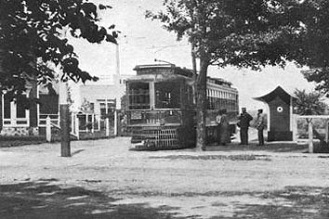
Early postcard view. The house on the left
would become the station. Waiting room
downstairs, living quarters an second floor.
|
|
|
|
|
|
 |
|
|
|
|
|
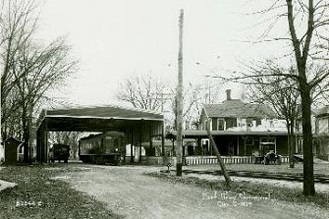
1927 shed erected to shelter riders on the
interurbans and connecting motor bus lines.
Although passenger service ended in 1939,
the shed remained into the 1960's.
|
|
|
|
|
|
 |
|
|
|
|
|
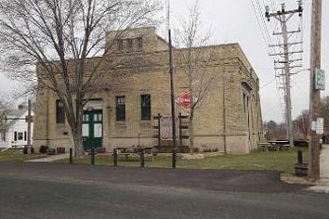
Substation, based on Egyption design built
in 1910 to provide power to the railroad
now serves as the depot for the museum.
|
|
|
|
|
|
 |
|
|
|
|
|
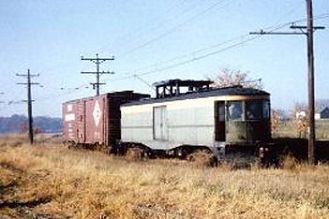
TMER&L M-15 fitted with platform for
overhead line work hauls the freight.
|
|
|
|
|
|
 |
|
|
|
|
|
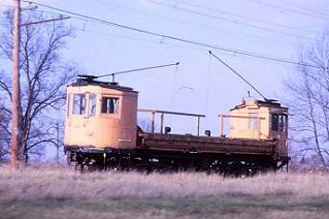
Differential Dump D-13 served as backup
and snow plow.
|
|
|
|
|
|
 |
|
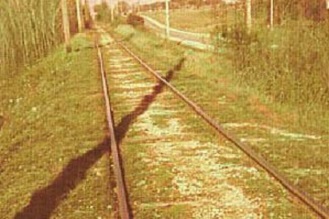
This was the condition of the track in the early 1970's.
Note the line was built without tie plates, and the rails have
actually sunk through the ties, and are supported only by the
edges of the ties and dirt.
Also of interest, the line was built with parallel rail joints
instead of the more common staggered joints.
Replacement of ties and addition of tie plates by TWERHS
and subsequent re-buildings (including staggering the rail
joints) have brought the line up to modern day standards.
|
|
 |
|
|
|
|
|
|
|
|
East Troy Trolley Museum - 1972 - 1984
|
|
|
|
 |
|
 |
|
|
|
 |
|
|
|
|
|
|
|
 |
|
 |
|
 |
|
|
|
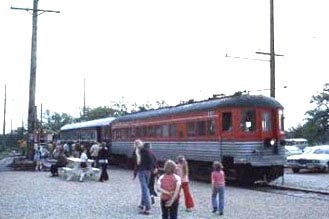
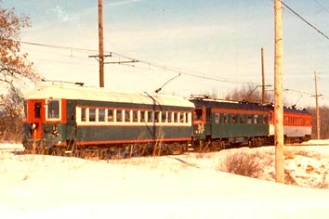
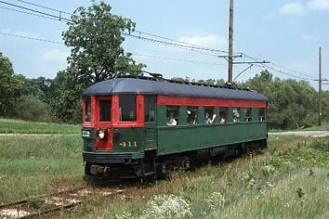
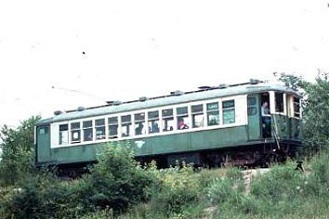
Former North Shore Line interurbans were the main passenger equipment of TWERHS from 1972 to 1984. Usually operated as single
cars, they could be combined into 2, 3 or 4 car trains for special occasions. Chicago Transit Authority "L" car 4258 filled in on busy days.
|
|
|
|
 |
|
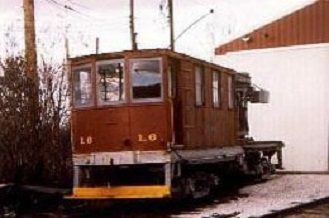
TWERHS collection also included the
largest collection of work equipment
from a single railroad. (TMER&L)
When the museum closed, most was
sold to the Illinois Railway Museum, but
a few pieces are now in the collection of
the East Troy Railroad Museum.
Click here for roster of equipment
|
|
 |
|
|
|
|
|
|
|
|
Wood body utility crane L-6 now at East Troy
|
|
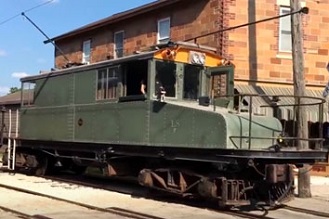
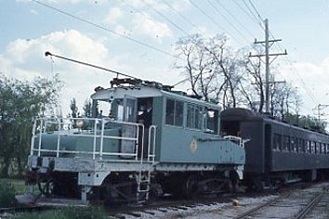
Loco L-8 now at East Troy
|
|
|
|
 |
|
 |
|
 |
|
|
|
|
|
|
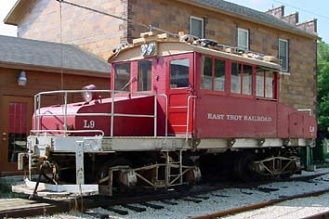
Loco L-9 was modified and painted to
serve as the loco for East Troy Railroad
|
|
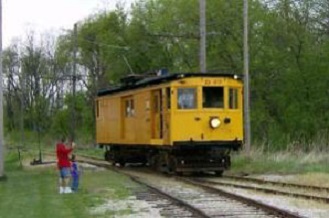
Wood body Line car D-23 is over 100
years old and still operational at East Troy
|
|
Loco L-4 among equipment now at the
Illinois Railway Museum
|
|
|
|
East Troy Railroad Museum - 1986 - Present
|
|
|
|
 |
|
 |
|
|
|
 |
|
|
|
|
|
|
|
|
|
 |
|
 |
|
 |
|
|
|
|
|
|
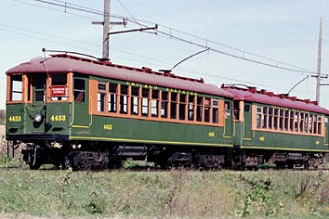
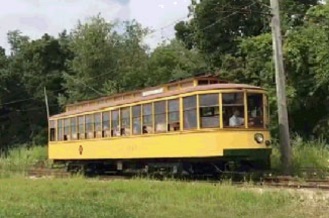
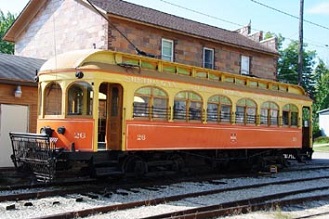
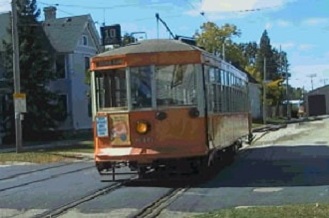
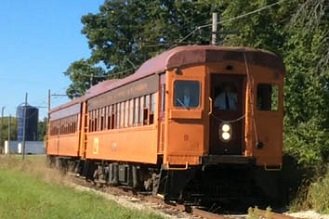
Various CTA cars, a Duluth streetcar, a vintage wood Sheboygan interurban, a Milwaukee streetcar and South Shore Line cars are among
the passenger equipment now operated by the East Troy Railroad Museum.
|
|
|
|
 |
|
|