|
|
|
|
|
|
The Chicago, North Shore & Milwaukee Railroad (CNS&M) is often referred to as "America's Fastest Interurban". Its trains raced
between Milwaukee and Chicago at speeds in excess of 80mph.
The CNS&M began in 1895 as the Bluff City Electric Railway, a local streetcar line in Waukegan, IL. Soon the owners changed the
name to Chicago & Milwaukee Electric Railway (C&ME) and set their sights on connecting the two name cities.
A branch was also constructed to Mundelein.
Later, the name was changed to Chicago, North Shore & Milwaukee Railroad. More often referred to as the North Shore Line
(NSL). It saw its greatest advancements as part of the Insull empire of electric railways and utility companies.
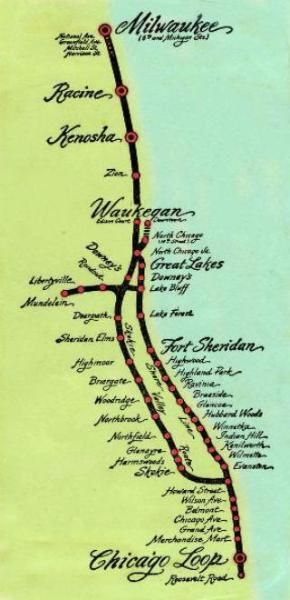
In 1926 they opened their Skokie Valley Route, which bypassed most of the shoreline communities. This high speed line became the
showcase of the system.
With the Great Lakes Naval Base and the Army's Fort Sheridan on the line, servicemen were always steady customers. Through the
years, especially during WWII and Korea they carried thousands of trainees to camp and to the cities for "leave".
Their two sleek, modern Electroliners were the pride of the system, but their skilled shops kept the older cars in shape to maintain
the fast (80+mph) and frequent (hourly) service.
In addition to the interurban line, they also operated several streetcar lines in Waukegan, and one in Milwaukee. The Waukegan
streetcar service ended in 1947. The Milwaukee streetcar service ended Aug 12, 1951.
Despite being fast and convenient, interurban service all across the country fell victim to improved highways and rising costs. Service
on the "Shoreline" ended July 24, 1955. All remaining interurban service ended on a bitter cold Jan. 21, 1963.
Ironically, while the line was facing abandonment, Japanese engineers came to study it while planning their high speed "Bullet Trains".
|
|
|
|
HISTORICAL HIGHLIGHTS
May 29, 1896 - Bluff City Electric Railway begins streetcar operations in Waukegan.
May 12, 1898 - Line is expanding with vision to reach Chicago and Milwaukee. Becomes
Chicago & Milwaukee Electric.
Dec. 2, 1905 - Service reaches Kenosha.
Sept. 2, 1906 - Service reaches Racine.
Sept. 1, 1907 - Local streetcar operations begin in Milwaukee.
Oct. 31, 1908 - Interurban service begins Evanston to Milwaukee.
July 26, 1916 - Sam Insull takes control. C&ME becomes Chicago, North Shore &
Milwaukee (CNS&M) aka North Shore Line (NSL).
Aug. 6, 1919 - Direct service begins between Milwaukee and Chicago "Loop".
Sept. 14, 1920 - New Milwaukee station opens.
1923 - Parlor-Observation service begins.
June 5, 1926 - New Skokie Valley route opens bypassing shoreline communities.
June 24, 1926 - Eucharistic Council near Mundelein draws over 75,000 riders from
Milwaukee, Waukegan and Chicago. North Shore Line operates 445 trains in one day using
their equipment and Chicago "L" cars. Most trains running 2 to 15 minutes apart.
May 1926 - Begin "Ferry Truck" (Piggyback) freight operation.
April 23, 1932 - End of Parlor-Observation service. Cars rebuilt into regular coaches, but
lacking restrooms.
Sept. 30, 1932 - Line in bankruptcy and receivership. Insull resigns.
1936 - Cars equipped with new wheel design offering more stable ride.
1930's - WPA project separates grade of CNS&M and CNW eliminating road crossings
through Glencoe, Winnetka and Kenilworth.
Feb. 1941 - Two Electroliners begin service. They were the most modern electric railway
equipment of the time. Self contained four-car articulated trains, with electric heating and
air-conditioning and a tavern-lounge car. Cooking of burgers and light meals was done on an
electric stove. Although capable of speeds over 100mph, they were limited to the 80mph
range of the standard cars.
1947 - End Waukegan city streetcar service.
April 30, 1947 - End of "Piggyback" service.
1951 - Several cars remodeled as "Silverliners".
Aug. 12, 1951 - End of Milwaukee city streetcar service.
1953 - Railroad reorganized as CNS System later known as Susquehanna Corp.
July 24, 1955 - End of Shoreline route service. Single track remains to Highwood shops.
Jan. 19, 1963 - Last operation between Lake Bluff and Mundelein
Jan. 21, 1963 - End of all interurban passenger service.
Jan. 26, 1963 - Last of passenger cars and freight cars removed from line.
|
|
 |
|
|
|
|
|
 |
|
|
|
|
|
 |
|
|
|
|
|
 |
|
 |
|
 |
|
|
|
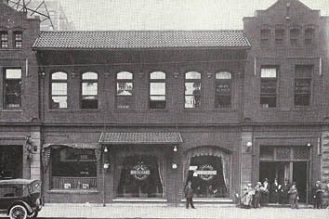
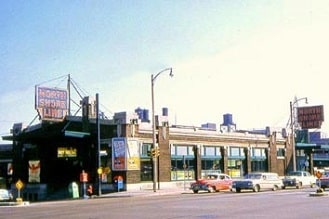
The original Milwaukee station was a storefront building mid-block on 2nd Street between Wells and Wisconsin. Trains loaded and
unloaded in the street. In 1920 they opened a new station at 6th & Michigan. The passenger facilities faced 6th and Michigan while the
trains entered from 6th and Clybourn after coming off the 6th street viaduct. A freight terminal and additional storage tracks occupied the
remainder of the block. People not old enough to have experienced the NSL, may find it hard to visualize where the station was, and
when the trains traveled the city streets.
|
|
|
|
 |
|
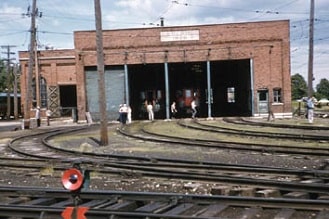
The main ofices and shops were at Highwood, IL, but they maintained a smaller
Milwaukee shop at 5th & Harrison. When employees knew the end was near, they
removed the NSL emblem exposing the original C&ME Rwy letterboard.
|
|
|
|
|
|
 |
|
|
|
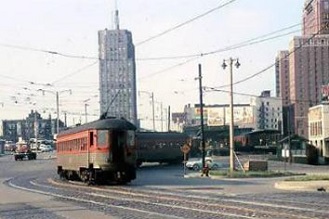
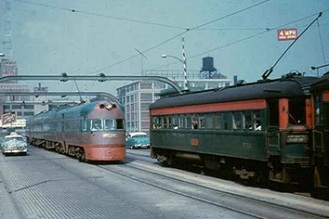
After leaving the Milwaukee station a
southbound Electroliner meets a
northbound train of standard cars on the
6th street viaduct. The 'Liners were the
pride of the system, but the standard
cars held down the majority of the runs.
|
|
|
|
|
|
|
 |
|
|
|
|
|
|
|
|
|
|
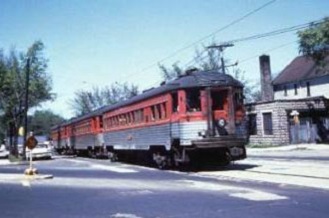
Unlike the 'Liners, the standard cars could be combined into trains of 2, 4, or 6 cars as
needed. Except for very rare occasions, a six-car train was the limit due to the length of
loading platforms. A train of standard cars heads south on 5th street at Chase Ave. Street
running from 5th & Harrison brought the trains into downtown, but the slow tedious run
among traffic added time to the schedules.
|
|
|
|
|
|
 |
|
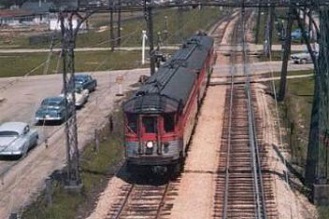
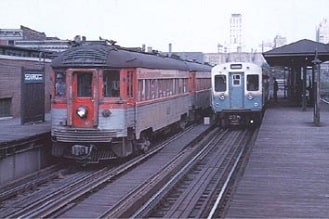
Left: Once out of the city, their
right-of-way was built to the highest
standards and well maintained permitting
speeds of 80mph.
|
|
 |
|
|
|
|
|
|
Right: Entry into Chicago was into the heart
of the Loop over the CTA elevated lines. If
there was a problem on the "L", they could
also run through the subway.
|
|
|
|
|
|
|
|
 |
|
 |
|
|
|
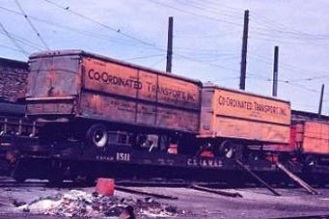
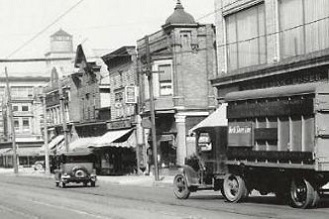
Freight was an important part of their
operation, and handled in several ways.
Left: They pioneered the concept of
piggyback trailers on flatcars.
Right: A NSL trailer truck on Mitchell St.
|
|
|
|
|
|
|
|
 |
|
 |
|
 |
|
|
|
Less than carload package freight was
carried in these Merchandise Express cars.
Some were refrigerated.
|
|
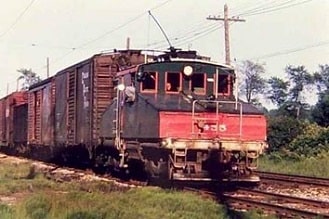
Steeplecab locos handled carload freight.
Some were equipped with batteries to run
on industrial spurs lacking overhead wire.
|
|
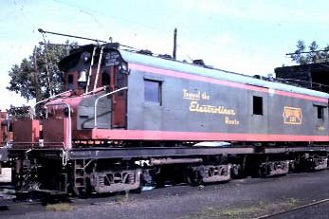
They also purchased two large locos from
Oregon Electric for longer, heavier trains.
They were also faster than the steeplecabs.
|
|
|
|
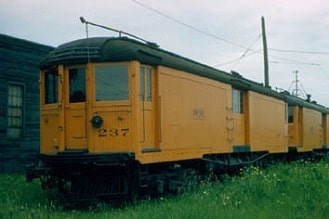
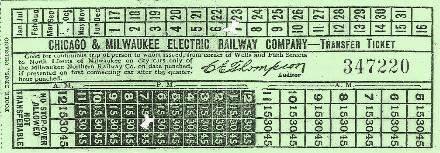
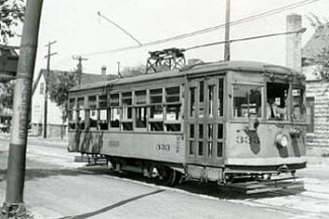
The North Shore Line started as a streetcar line in Waukegan, and they
continued to operate several lines there. They also operated a single line
in Milwaukee. In Milwaukee, they exchanged transfer privileges with the
Milwaukee Northern Rwy, but not with The Milwaukee Electric Railway
& Light Co. Due to the franchise, the streetcars continued to operate
under the C&ME name. Through the years they operated several types of
streetcars. Below are two examples.
|
|
 |
|
|
|
|
|
 |
|
 |
|
|
|
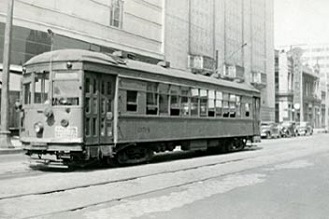
Left: A double-truck car 354 waits on 2nd
Street near Wisconsin Ave. Former station
is in the background near Wells St.
Right: Single-truck Birney 333 heads south
on 5th street. Although the Birney's only
spent a short time in Milwaukee, mostly
during WWII, they earned the nickname
"Dinky" for the city streetcar line.
|
|
|
|
|
|
|
|
 |
|
 |
|
|
|
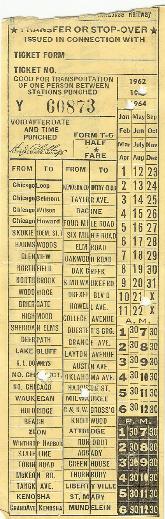
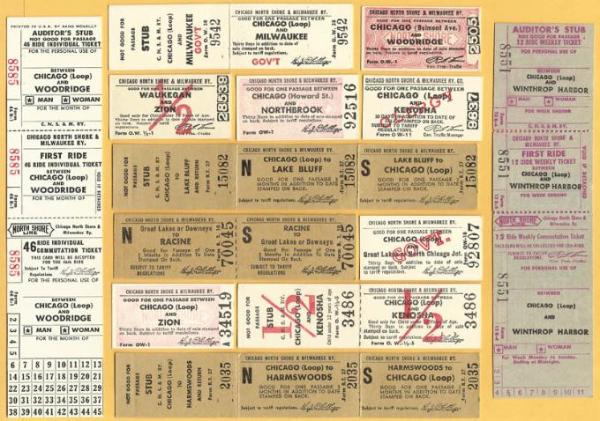
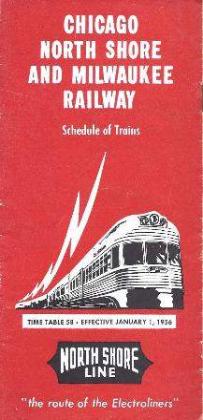
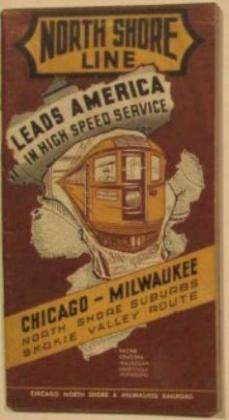
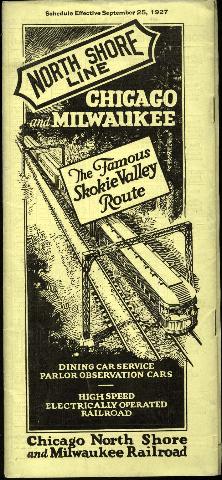
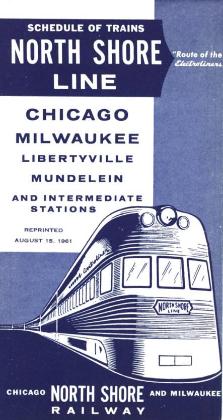
Here are just a few
examples of the public
timetables and the
hundreds of various tickets
used by the North Shore
Line.
They needed tickets for
travel from each station to
every other station, as well
as different types for
commuters, students,
clergy and service men.
|
|
|
|
|
|
|
|
 |
|
|
|
|
|
|
|
|
|
 |
|
|
|
 |
|
|
 |
|
|
|
|
|
|
 |
|
|
|
|
|
|
|
|
|
|
|
|
|
Although the line has been abandoned for over 50 years (as of Jan. 2013), it remains one of the favorites among those old enough to
remember it, as well as newer generations with an interest in transit. Collectors have preserved the memory through an abundance of
artifacts, brochures, slides, movies and photos. It is the subject of numerous books and videos. Many of the cars built in the 1920's and
1930's and the Electroliners are preserved and still operate at several rail and trolley museums.
|
|
|
|
 |
|
|
|
|