|
|
|
|
|
|
In addition to TMER&L's interurban and streetcar operation, they also maintained electric switching operations at their Lakeside and
Port Washington Power Plants. After the abandonment of interurban and streetcar operations, these switching operations continued to
draw railfans.
Operations at Lakeside were by far the most extensive. Carloads of coal were brought in from interchanges with the Chicago &
North Western and Milwaukee Road via the Belt Line. It was unloaded from railroad hoppers and stored in huge piles until needed.
Electric shovels and cranes reloaded coal into TM hoppers to transport to the rotory dumper.
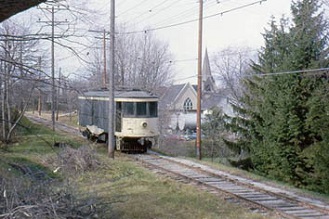
Of special interest was the employee shuttle operated from the Lakeside Plant through the coal yards to Kinnickinnic Ave. This
service used a variety of streetcars through the years. Although intended for employees, railfans were usually able to catch a ride.
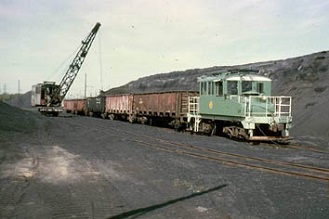
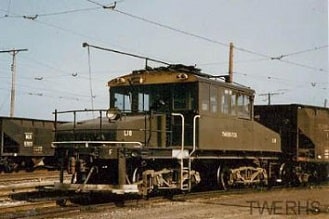
Switching was handled by their fleet of home-built steeplecab locos, but with the demise of the streetcar and interurban lines, many
other pieces of equipment found their way to Lakeside. Although seldom, if ever used, they escaped scrapping and were later donated to
TWERHS.
|
|
|
|
LAKESIDE
April 15, 1921 - Plant opens. First in world to burn pulverized
coal. Soon holds world record for efficiency.
At first, coal is unloaded from ships at Kinnickinnic River and
hauled through streets to Lakeside. Connection is soon made
with C&NW near Howard Ave.
Because few employees own autos, a shuttle service runs
between power plant and streetcar line on Kinnickinnic Ave.
Variety of cars used through the years.
1925 - Generating 86% of electricity for TMER&L.
1931 - Work begins on Lakeside Beltline railroad intended as
freight by-pass for traffic between Milwaukee, Racine and
Kenosha, as well as bringing in coal. Built with minimum of
grade crossings.
April 17, 1932 - Beltline opens from coal yards west to Rapid
Transit Line near 100th and Howard Ave. Also connects with
C&NW, the M-R-K interurban line and the Milwaukee Road at
Powerton Jct.
1950's - With end of Rapid Transit service, Belt Line abandoned
west of Powerton Jct.
E-Z Paintr is the last industry on line.
May 8, 1961 - Shuttle service discontinued.
1969 - Lakeside converted to natural gas. Tracks from scales
west sold to C&NW. Used to store bad-order cars waiting
repairs at Cudahy shops.
Surplus equipment, track and wire donated to TWERHS and
moved to East Troy.
Loco L-9 remains to shuttle supplies.
1970's - Natural gas shortage causes Lakeside to bring in tank
cars of fuel oil. L-10 returned from East Troy to assist L-9.
1976 - CNW removes track connection. L-9, L-10 M-26 and
portable substation stranded.
1979 - Army Corps moves L-9 to East Troy on trucks as part of
training.
1984 - L-10, M-26 and portable sub sold to IRM and moved to
Union, IL.
|
|
PORT WASHINGTON
Sept. 1, 1935 - Power Plant opens. Rail connection made to
TMER&L Milwaukee-Sheboygan line (former Milwaukee
Northern Rwy.) Interchange made with C&NW.
Most coal brought in by ship. Locos mostly used to shuttle cars
within plant and bring in supplies from C&NW.
Sept. 23, 1940 - Passenger service discontinued between
Sheboygan and Port Washington.
Mar. 29, 1948 - Passenger service discontinued between
Milwaukee and Port Washington. Portion of line between power
plant and CNW remains for hauling power plant supples.
1976 - Electric freight operation ends. Track, wire and
equipment donated to TWERHS.
|
|
|
|
|
|
 |
|
|
|
|
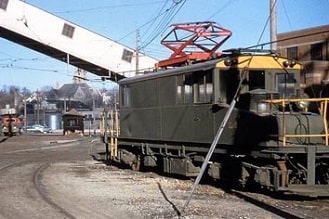
L-8 at Port
Washington. TM
built its own locos.
No two were
exactly alike. L-8
was the largest.
|
|
|
|
|
|
|
|
|
 |
|
|
|
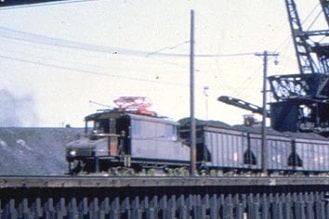
L-8 with hoppers
on coal dock at
Port Washington
|
|
|
|
|
|
|
|
|
|
 |
|
 |
|
 |
|
|
|
|
|
|
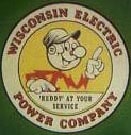
Reddy Kilowatt, the symbol of several
electric companies, was featured in this
emblem from the locos
|
|
|
|
|
|
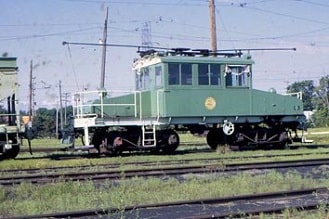
L-3 in WEPCO green in the Lakeside coal
yard. It is operating on a "stinger" cable
|
|
|
Merchandise car M-1 on Port Washington
Power Plant line.
|
|
|
|
|
|
|
 |
|
 |
|
 |
|
|
|
A well-kept, L-10 in TMER&L drab olive
sits in the Lakeside Power Plant yard.
|
|
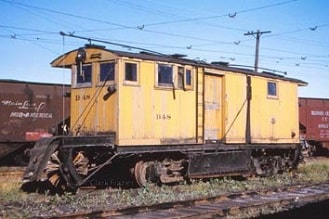
Sweeper B-48 was among equipment moved
to Lakeside after end of streetcar service.
|
|
L-9 in WEPCO green waits for an
assignment in the Lakeside yard.
|
|
|
|
|
|
|
|
|
 |
|
 |
|
|
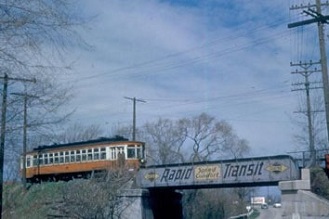
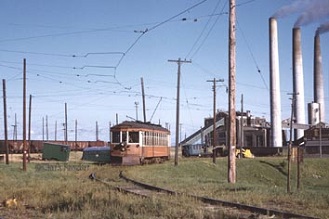
Left: Car 523 crossing Lake Drive was one of
several streetcars assigned to the Lakeside
shuttle through the years.
Right: Car 882 heading through the yard was
the last in shuttle service.
|
|
|
|
|
|
 |
|
|