
|
|
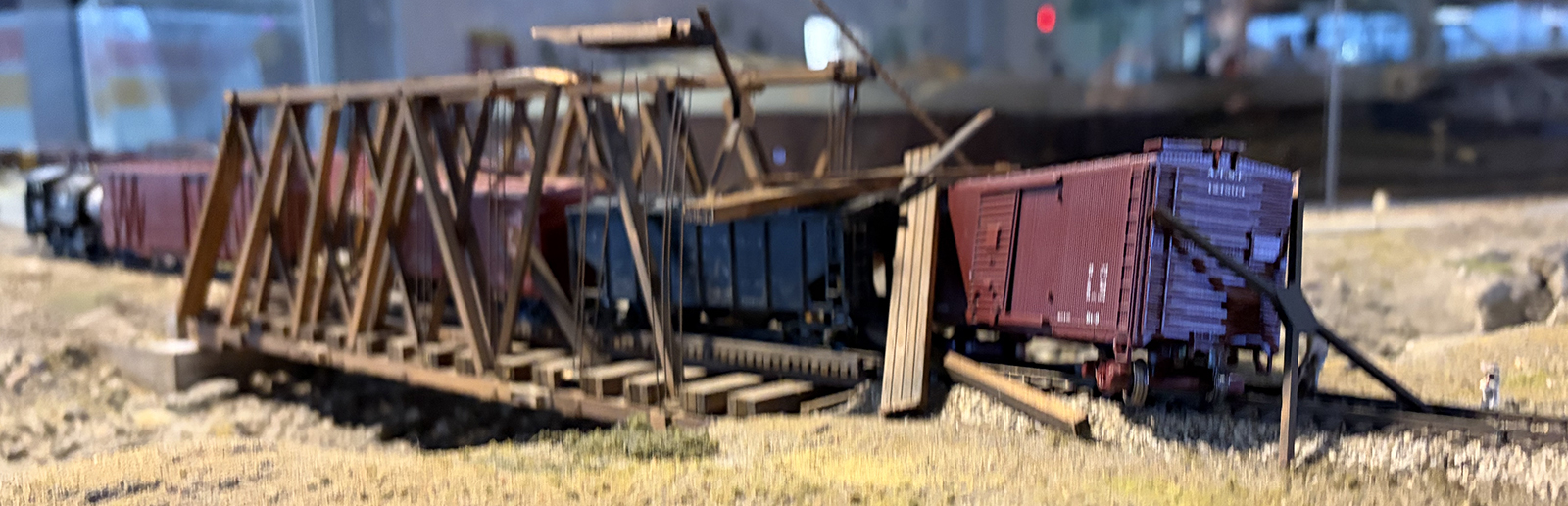
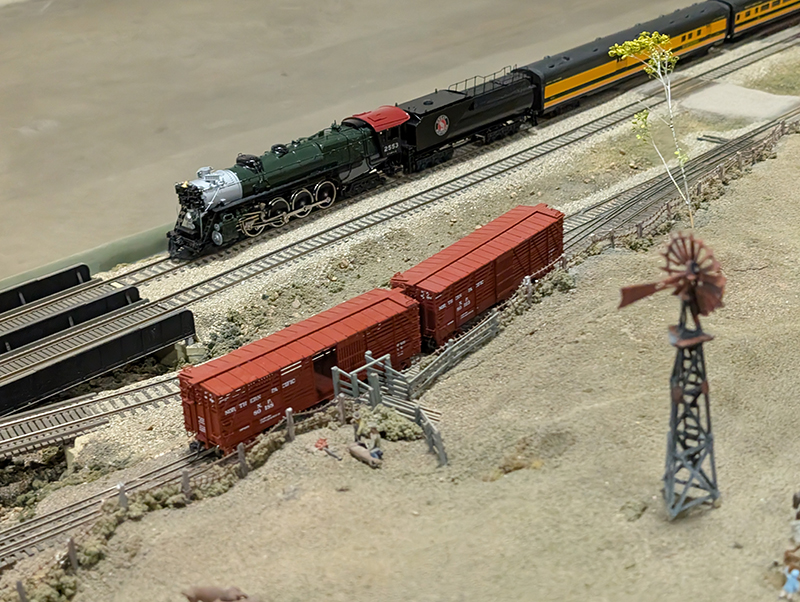
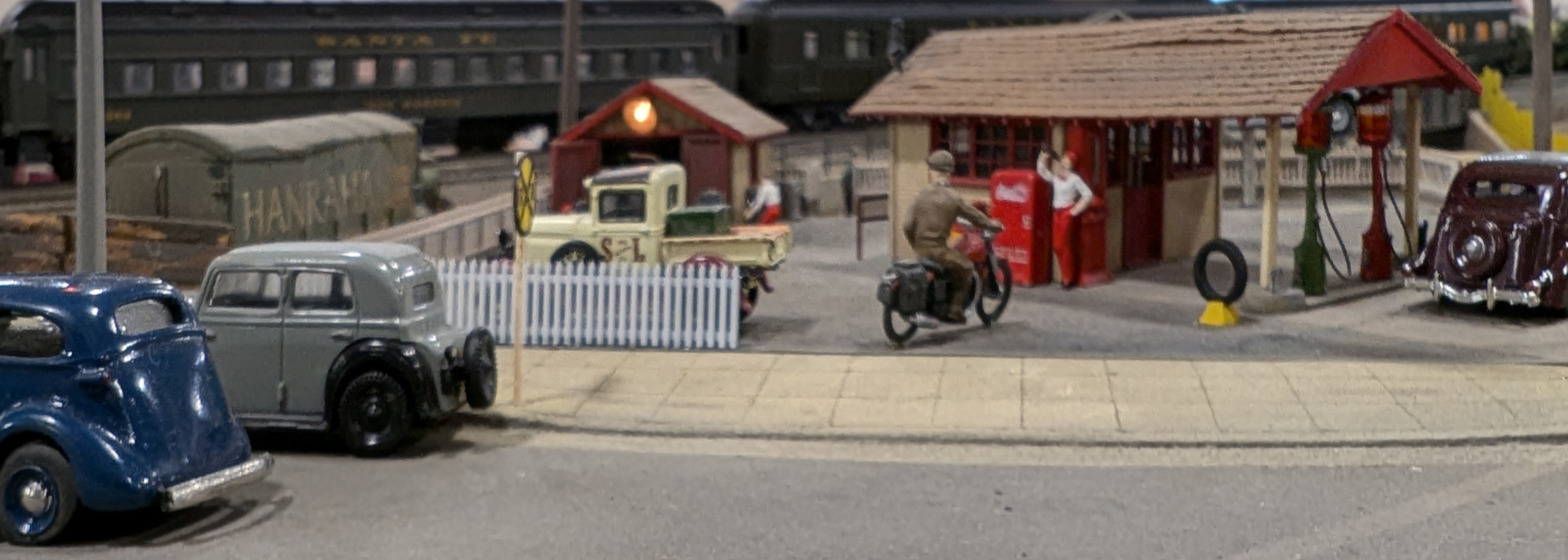
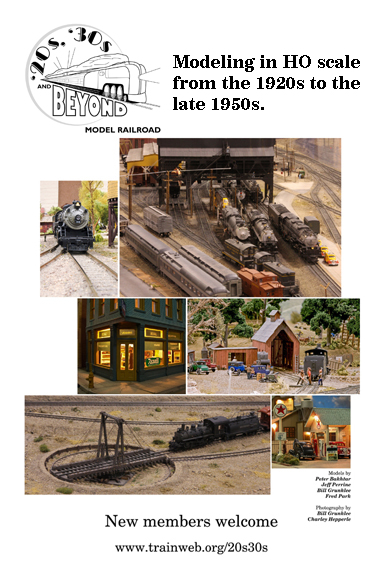
All Aboard!The '20s & '30s Modular Model Railroad recreates the Golden Age of railroading modeled in 1:87 HO scale. Members build and transport their own six-foot-long modules which depict North American railroading during the period from 1920 through December 7, 1941, Pearl Harbor Day. Started in 1991 by Charley Hepperle, seventeen members have built a total of 35 modules, many of which were on display at the National Model Railroad Association Train Show in San Jose, California in August 2000. Each module or group of modules meets standards for interface such as rail location, height and electrical connections so that each can connect with another. The club sets up at public shows in Southern California about six times a year. See our blogTimetableFebruary 13-14, 2010World's Greatest HobbyAll model railroad show Long Beach Convention Center Long Beach, California Saturday 10 a.m.-6 p.m. Sunday 10 a.m.-5 p.m. Admission: adults $10 , kids under 16 free Parking: about $8, subject to change More info: World's Greatest Hobby ...more events will be posted as they are confirmed... Specifications(.Zip file 1.6mB) Galleryphotos by Bill Grunklee ![]() A pair of kettles take rest in in the Branchline engine House... ![]() It's roundup time alongside the dual guage branch... ![]() The dual guage branch ends at Clifton on Dave's mine... ![]() Red Cars still run in 1930s Los Angles...
A narrow guage tanker waiting to be loaded on a club corner module...
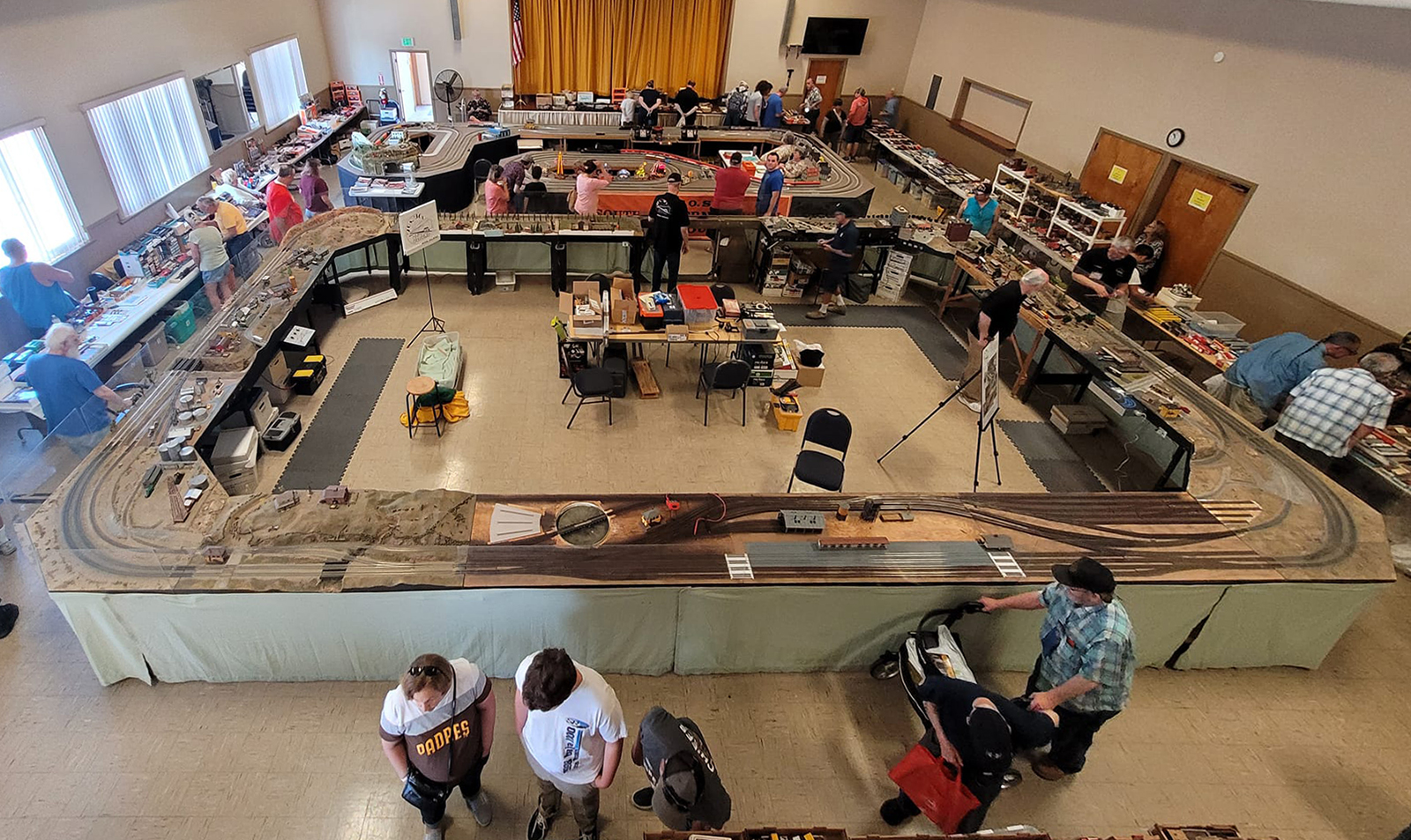
An EsPee early articulated waits in the hole for an express to pass... ![]() Here is a bird's eye view of our club layout
![]() A narrow gauge mixed departs Matt McMenamin's Hillside Junction...
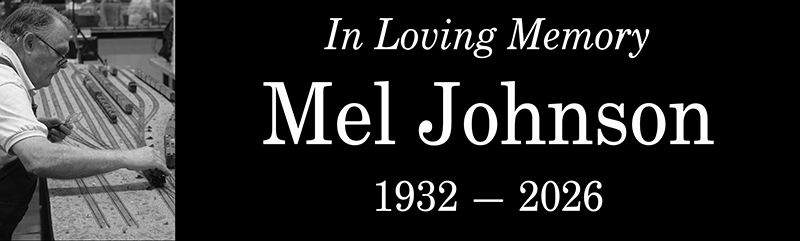
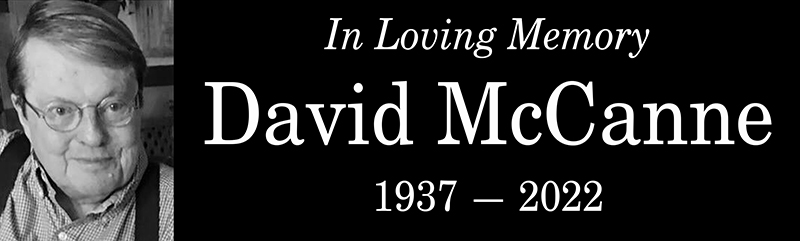
Members and their modulesPeter Bakhtar, 4 modules + club cornerA Union Pacific service terminal and passenger station are shown along with an adjoining gas station and junkyard. The six-stall roundhouse is served by an operating scratchbuilt turntable and is flanked by locomotive service structures such as a coaling tower and water facilities. Motorized chain-link gates protect goods within the loading track area. A scratchbuilt passenger terminal depicts the UP's Cheyenne, Wyoming station. It's detailed inside and out and includes rotating ceiling fans and four clocks in the tower made from watches that show the correct time. A scratchbuilt three-stall engine house serves standard-gauge and HOn3 locomotives. Peter's modules earned the Module Best of Show award at the 1996 NMRA Train Show in Long Beach, California Rich DeRosa, 1 moduleRyandale is Rich's ficticious central California town located off Highway 99 between Bakersfield and Fresno. The date is Friday, June 13, 1941, Rich's birthday. This agricultural town includes a scratchbuilt Racy Tractor dealership and an SS Ltd. country store. Under construction is a scratchbuilt UP-style station that is of cutaway design so that visitors can view the interior as well as the exterior. A fleet of vintage vehicles, including many from Greg's Garage, accompany crowds of figures. Future additions include animated details that will include an order board and a little girl jumping rope. Bill Grunklee, 1 moduleHOn3 trackage and mountainous mining terrain is the emphasis on Bill's module. A Master Creations one-stall engine house is completed and plans for future construction are being developed. Dual-gauge tracks mate with those on the modules of Peter Bakhtar, Matt McMenamin and Gil Morales. Charley Hepperle, 1 module + club "city" cornerLa Palma is the name of Charley's ficiticious Los Angeles suburb set in the autumn of 1939. Actual buildings in Southern California were photographed and measured for scratchbuilt structures depicting a fruit packing plant, diner, warehouses and a gas station. A Pacific Electric Hollywood car operates on street trackage down the boulevard. Animated features include a moving forklift, smoke from under the hood of a stalled car, concrete mixer with a rotating bin, and a rotating roof-top cyclone vent. Mel Johnson, 3 modulesOne of Mel's modules represents a generic Wyoming town with a Union Pacific watering and coal facility of the the 1920's. His two-module scene shows a engine facility that has models of structures from a variety of actual UP locations in Wyoming and Kansas. Some of the many buildings include a three-stall roundhouse with operating turntable, coaling and water facilities, a light repair shop and a PFE ice transfer plant (ITP). Passengers and freight are served by the Pine Bluff station. Mel has an abundance of highly-detailed UP locomotives and rolling stock as well as highway vehicles and many mini-scenes such as a dog knocking over a trash can.Mel also has a highly detailed city scene with full interiors, built with the help of his wife Pat. Dave McCanne, 1 moduleDave's module depicts a ficticious 1920s suburb of Los Angeles. Standard gauge and dual-gauge 3'6" trolley trackage wind through city blocks and up an incline to Buena Vista station. All the track is handlaid, most of which is girder rail for street trackage and includes many dual-gauge switches. Traction companies represented include Pacific Electric, Los Angeles Railway, Los Angeles Pacific, and Los Angeles and Redondo lines. Detailed scratchbuilt buildings including the Gristle Stop cafe and a Red Crown gas station are in place with mock-ups for future buildings ready to be replaced with models. Matt McMenamin, 1 moduleHillside Junction is Matt's ficticious lumbermill town located between San Bernardino and Arrowhead in the forested mountains of southern California. Logs in the mill pond await cutting at the mill which is served by HOn3 tracks which are the terminus of the Hillside & San Bernardino Railway. The narrow gauge connects to dual-gauge track that passes over a scratchbuilt A-frame timber bridge and runs through adjacent modules. Structures include a station, water tower, oil facility and a sawdust burner that really smokes via burning incense inside. Chuck Mogk and Dale Mogk, 2 modulesChuck's hometown of Darby, Pennsylvania in the late '30s is subject of the module he and his son Dale are building. The dual trackage of the Philadelphia Rapid Transit intersect the double-track mainline of the Baltimore and Ohio railroad. A station and fuel facility are in place. Future additions will include a lumber yard and a coal/sand/gravel dealer. As on the prototype, the coal dealer's spur is placed so that several switching moves are needed to transpose the position of the switcher and hopper cars since no run-around track is available. Gil Morales, 1 moduleOn one module, Louviers, Colorado circa 1935 is dominated by a molybdenum processing plant Gil kitbashed from a Magnuson kit. Other structures include scratchbuilt handcar shed and cabin and resin kit commercial buildings. The ATSF/Rio Grande shared-rights mainline is paralleled by the Colorado and Southern's dual-gauge track which connects with other HOn3 trackage. Fred Park, 2 modules + club cornerFred's Mojachapi, California town is expanding into the high desert countryside near Tehachapi in the late '30s. Increased mining operations off-module is driving the expansion. Most of the structures are kit-bashed and include a gas station managed by Dick Nixon, Park & Sons Manufacturing and the Park Hotel. The station is heavily modified from a plastic kit and is due to be replaced with one made from a Santa Fe-style laser-cut craftsman kit. A variety of sidings serve lineside businesses. At the east end, a stream flows through a canyon beneath the plate girder bridge of the mainline. Fred scenicked an adjacent club corner module with similar rocky canyons that depicts the rugged country near the Tehachapi Loop. Jeff Perrine, 1 moduleThe high desert of the Owens Valley in California is the location of Jeff's town of Owenyo that is the transfer point between the standard gauge Jawbone Branch and SP narrow gauge. A ramp permits delivery of narrow gauge equipment shipped in on standard gauge flatcars. Future plans include adding an Armstrong gallows turntable, depot and hotel. Dave Toschak, 1 moduleRugged rocky mountains similar to the Cliffton, Arizona copper mines are the subject of Dave's module. Served by dual-gauge trackage that connects to other modules, ore can be shipped out or processed at the small stamp mill perched on a hillside. Dual mainline tracks cross a deep gorge; one on a Pratt truss with a plate girder bridge at each end, the other via a plate girder supported by steel towers. Club modulesThe club provides a filler module, corners, yard and a turntable. If only an odd number of members' modules are available for a show, the club's filler module can even the number to make a complete loop of track for continuous operation. The club's 90 degree corners have 38" radius track on the outer mainline. Chuck and Dale Mogk and Mel Johnson designed and built the controls and structure of the club's yard throat and yard. These items are electrically interlocked so trains can travel between the two mainlines and the yard safely. Many members applied the scenery to the yard throat. Mel Johnson built an "armstrong" turntable that uses knife switches to align the track as well as make/break the electrical power. |
|
|
|