



 ACR Freight Operations
Loading Spurs
Special Operating Instructions
On this page:
For a good idea of the volume and breakdown of the ACR's trackage, here are some figures compiled from the ACR's own annual reports. Note that the manufacturing column will be primarily finished steel.
| Year | Mining | Manufacturing | Forestry | Total | Notes |
|---|---|---|---|---|---|
| 1970 | 2338 | 975 | 621 | 3934 | |
| 1971 | 2338 | 922 | 519 | 3779 | |
| 1972 | 2561 | 994 | 504 | 4059 | |
| 1973 | 2875 | 1056 | 506 | 4437 | |
| 1974 | 3194 | 1027 | 474 | 4695 | |
| 1975 | 1881 | 683 | 281 | 2845 | Strike on AC |
| 1976 | 2434 | 831 | 484 | 3749 | |
| 1977 | 2338 | 832 | 492 | 3662 | |
| 1978 | 2382 | 984 | 566 | 3932 | |
| 1979 | 2383 | 1139 | 545 | 4067 | |
| 1980 | 2053 | 1130 | 515 | 3698 | |
| 1981 | 1993 | 1296 | 455 | 3744 | |
| 1982 | 1239 | 685 | 311 | 2235 | |
| 1983 | 1775 | 982 | 320 | 3077 | |
| 1984 | 1803 | 1053 | 294 | 3150 | |
| 1985 | 1906 | 1224 | 401 | 3531 | |
| 1986 | 1625 | 796 | 407 | 2828 | |
| 1987 | 1529 | 1071 | 437 | 3037 | |
| 1988 | 1443 | 1222 | 421 | 3086 | |
| 1989 | 1677 | 1355 | 354 | 3386 | |
| 1990 | 1013 | 944 | 361 | 2318 | 4-month strike at Algoma Steel in 1990 |
| 1991 | 1569 | 1406 | 437 | 3412 | |
| 1992 | 1437 | 1313 | 309 | 3059 | |
| 1993 | 1393 | 1567 | 335 | 3295 | |
Timetables from the 1970s and 1980s list nos. 9 and 11 northbound, and 10 and 12 southbound. However, according to some sources, the ACR regularly ran 3 northbound trains out of the Sault on a daily basis in the late 1970s, with the morning (#9) and afternoon (extra) trains primary ore empties, plus miscellaneous freight, and the midnight train (#11) a steel train for Franz and Oba interchanges (train will go to Hawk Junction with the loads forwarded on train no. 5 around mid-day). Late 1970s and early 1980s timetables show #9 with a scheduled departure at Steelton between 6:00-6:45AM (varies a bit from year to year), and #11 departing in the night, between 10:30-11:30PM. An October 1968 timetable however lists a Wednesday-only #7. Here the scheduled times are quite different, with #7 departing at 8:30AM, #9 at 3:45PM (although in following June 1969 timetable this has been moved up to 12:30PM), and #11 at 11:00PM. Only freights #10 and 12 are scheduled southbound, with #10 leaving Hawk Jct. around 2:30-3:30AM and #12 around 3:00-3:30PM in the 1960s. #10 would gradually be pushed later and later over the years. By the late 1970s-early 1980s, #10's departure is scheduled between 8-9PM, and by the late 1980s it varies between 11:30PM-1:30AM. By 1986, freights #9 and 12 have been reduced to once per week on the schedule.
A good place to read more about operations in the early-mid 1970s is found on Ray Kennedey's Old Time Trains site, in the form of an unpublished article by Wayne Brittain from 1975.
Along the ACR's trackage there are many small camps and cottages, that depend entirely on the railway for supplies. These supplies would be delivered by a once-weekly wayfreight. In the 1970's this service was handled on the rear of one of the ACR's regular freights, with the wayfreight cars tacked onto the end, just before the caboose. With the curving track on the ACR, the engineer could never see the end of his train, so the conductor would call out car lengths over the radio until the car was directly across from where it would be unloaded.
In the 1990's, the wayfreight would be its own little train. There is a wonderful segment in the video "Tracks of the Black Bear" documenting the activities of this little train on its run from the Sault to Hawk Junction, no more than an engine, 3 boxcars and a caboose. Anything and everything that could be required by the camps along the line: construction supplies such as lumber and windows, propane tanks, and wood stoves are all visible being unloaded from this train in the video.
As the ACR's division yard and the junction between all three of the ACR's subdivisions, all trains in all directions start and terminate at Hawk Junction. There was no assigned yard switcher; both the SW8s worked Steelton and Sault Ste. Marie exclusively and all outbound trains switched their own cars.
Weekday regulars: Train #5 left Hawk Junction in the morning, Mon-Fri, and returned from Hearst the next day as #6 (Tues-Sat.) As the only freight trains running the length of the Northern Subdivision, most of the switching is done by these two trains.
Turn jobs: On weekends, #5 is replaced by the Oba Turn, running as #15. As
its name indicates, #15 runs as far as Oba, handling interchange steel traffic for Franz and Oba, and any overflow
switching requirements at the pulpwood operations at Mosher. The train returns to Hawk Junction from Oba as #16.
I've been told that a second turn job, the Franz Turn, ran Mon-Fri in the evenings in the 1970s and 1980s. This train primarily
handled a second mill switch at Dubreilville, including delivering outbound loads to the interchange at
Franz. The Franz Turn ran as an extra and is not listed on any period timetables.
The large rigid 3-axle trucks of the SD40's and SD40-2's cause increased track maintenance on the ACR. For this reason they are almost never operated north of Hawk Junction where the geography is less rugged with lighter trains and lighter track. The SD40's spend most of their time putting their higher horsepower and 6-axle trucks to good use hauling heavy freights between Wawa and Sault Ste. Marie. Track conditions are upgraded to a higher standard south of Hawk Junction as well, and the southern portion of the line does not feature any of the muskeg found near the Oba-Hearst area.
Transportation Safety Board Report on 1994 Derailment near Hearst
A southbound freight derailed 8 miles from Hearst due to a broken rail joint. The TSB report attributes
the derailment to a pre-existing crack in a joint bar, caused by poor track conditions, and exacerbated by a
recent set of CN detours. The report highlights that the ACR did not normally allow heavy 6-axle locomotives
on this northern section, and that the last CN train to detour (and likely others before it) contained 6-axle
locomotives in the consist. Poor track conditions and increased wear by the heavy CN engines are blamed for
the derailment.
Timetables from the 1970s and 1980s show no scheduled trains on the branchline; all mine and harbour runs were operated as extras. Some sources indicate that during the 1970s period as many as two or three runs to Wawa would be made daily. In later years this would decrease to a single train daily for Michipicoten and Wawa needs. After the mines and sinter plant around Wawa closed down in 1998, the Michipicoten sub. was abandoned and torn up.
In addition to the shipments from Wawa to Algoma Steel in Sault Ste. Marie, Algoma Ore Properties also apparently shipped some amounts of sinter from Wawa to an Algoma Steel operation in Port Colbourne, ON (near Niagara) for processing into "pig" iron (ingots). I don't have any hard indication of a start date to this service, but I have seen a photo of new AC 8000 series hoppers in Port Colbourne in 1972, and the old ACR twin hoppers were basically falling apart at this point and likely wouldn't have been used in interchange service to other railways. The smelter and blast furnaces at Port Colbourne closed in 1977 which puts a definite end limit to this operation, putting the approximate dates of this operation to about 1971-1977. Loads would have been forwarded via CN at Oba. As late as 1985, CN's General Operating Instructions booklet has a specific mention under Speed Restrictions for Algoma Central hoppers in series 8200-8500 restricting movements handling these cars to 40 MPH. It's possible this may be a left-over reference from the 1970 movements of ore to Port Colbourne rather than a separate contemporary shipment. Shipments of sintered iron from Wawa to Sault Ste. Marie outweighs all other ACR traffic combined, as seen in the tonnage numbers above. Through the early 1990s this traffic declined, and in 1998 the sintering plant at Wawa shut down and was demolished along with more than half of the ACR's traffic numbers.
One other interesting odd-ball shipment that was brought up was an apparent one-time only shipment of a car of sinter to a pet food plant in Michigan or Wisconsin, for blending into the food to enrich the iron content.
Beginning in the mid-late 1990s, Algoma Steel began replacing Wawa sinter as their main feed source with iron ore from mines in Wisconsin. Wisconsin Central organized an year-round all-rail direct movement of trains of ore from Tilden Mine to Algoma Steel starting in 2000.
Finished steel products from Algoma Steel in Sault Ste. Marie were handled to every interchange except Hearst. CN and CP both provided additional cars for loading. Algoma produced sheet, coil, plate, rail, beams and pipe. There was no wire mill at Algoma. In addition to finished steel out, some scrap steel for the oxygen furnace would have been received as well, some by rail and also by ship directly to the steel mill. Coal for the coke ovens and blast furnaces was delivered by ship and not the railway.
In the 1970s and early 1980s there was a scrap yard between the Sault Ste. Marie passenger station and the paper mill that had a spur into it. (Trader's Metal).
Since the ACR served the steel mill exclusively, any and all inbound or outbound traffic to or from the mill would have at least handled via interchange in the Sault.
Many log loadouts have been operating at numerous sidings and spurs up and down the ACR over the years. In the steam era, large amounts of pulpwood used to be shipped out of Michipicoten harbour by lake boat using the old commercial dock. This dock was abandoned by the mid 1960s.
Much pulpwood was and still is shipped south to the Abitibi (now St. Marys) paper mill in Sault Ste. Marie. Abitibi operated several pulpwood cutting operations along the ACR line; several spurs are identified in the timetables as operated by Abitibi. In addition, many other private forestry companies cut logs and pulpwood that sold to Abitibi or exported to the US.
From about 1974-1985 pulpwood was also shipped to the Newaygo sawmill at Mead, which produced lumber and large amounts of woodchips for export to the US. Newaygo operated a sizeable logging operation around Mosher. Newaygo operated a number of their own logging camps and loading spurs, with a particularly significant operation at Mosher. Pulpwood from Mosher was also exported directly to the US.
Logs were also shipped to G.W. Martin/Weldwood Canada at Searchmont, and likely to sawmills at Hearst and other locations off-line, included US export. Apparently some shipments were made from Mosher to Ontario Paper at Thorold, ON via CP Franz, using Kimberly-Clark (KCWX) log racks provided from Terrace Bay, ON. (The ACR eventually purchased a number of cars from this series in the late 1990s and numbered them into the 238500 series.)
From 1974 to 1985 Newaygo Forest Products operated a lumber mill at Mead (mile 275 between Oba and Hearst). A good portion of the output of this mill was likely exported to the US via the SOO Line. This mill also produced large amounts of woodchips for export to paper mills in Wisconsin (see below).
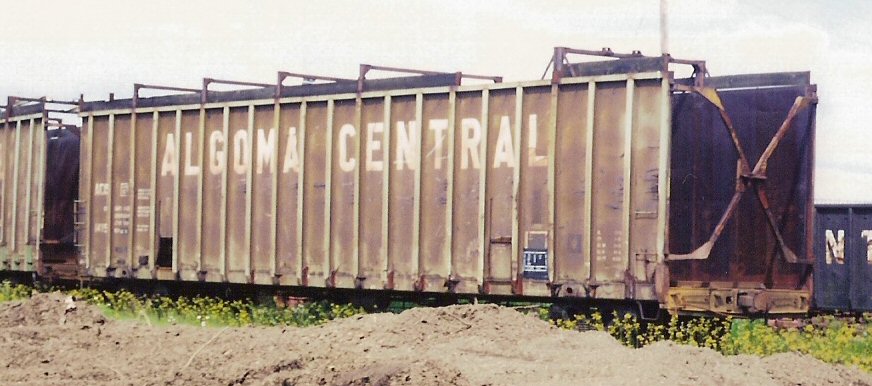
At Dubreilville, between Franz and Hawk Junction, is a mill operated by Dubreil Forest Products (formerly Dubreil Bros. Lumber). Dubreil Bros. once operated a lumber yard next to the Steelton shops where lumber was off-loaded for sale or export to the US (by truck). For this service, the ACR rebuilt a couple of the ACIS woodchip cars as special lumber cars. The end doors were removed to load/unload the cars from one end and the car would normally be handled at the end of the southbound train to facilitate cutting it off at Steelton and moving it to the unloading ramp. (Only 2 or 3 cars were so modified, and 2400 series bulkhead flatcars also carried lumber from Dubreuilville to Steelton, as well as to other locations in the US. The modified chip cars were only used between Dubreuilville and Steelton.) According to former Franz station agent/operator Reg Fitzpatrick, from the mid-1970s through mid-1980s this mill was not really shipping via rail, until around 1987 the mill started to ship lumber and woodchips via rail again in a big way. The Dubreuilville mill closed in 2007.
G.W. Martin (later Weldwood Canada) operated a veneer mill at Searchmont. This operation was abandoned sometime in the late 1980s.
Another sawmill still operates in Sault Ste. Marie, now owned by Domtar. Older sources indicate this used to be a Weyerhauser mill.
In the mid 1990s, shortly after the WC takeover, a new OSB (oriented strandboard) plant was built several miles south of Hawk Junction by Jager Engineered Wood Products. This plant closed a few years ago as a result of weak American economy reducing demand for Canadian lumber exports.
Also, lumber from mills on the CN and Ontario Northland would route over the ACR from Hearst to other interchanges. This would include, but not necessarily be limited to, mills at
During the period from 1974 to 1985 when it was in operation, the Newaygo Forest Products mill at Mead (between Oba and Hearst) exported woodchips into the USA via the SOO Line interchange in Sault Ste. Marie. The chips were loaded in the ACIS 1401-1489 and AC 1501-1523 series 60' woodchip cars, which were provided exclusively for this service. These shipments averaged about 10-12 cars daily at its peak. The mill closed in 1985 and the cars were largely sold off. (Most were taken by Newaygo for use on other routes and locations.)
The Dubreil Bros. mill at Dubreilville also shipped out massive amounts of woodchips to James River Pulp & Paper in Marathon, ON from the late 1980s. Empty cars for this service were provided by CP Rail from White River. This service averaged 15-18 loaded cars daily from Dubreilville to Marathon via Franz. The Dubreuilville mill closed in 2007.
During the 1970s Abitibi's paper mill in Sault Ste. Marie shipped a good portion of the paper it produced there via the CPR and SOO Line with empty cars provided those railways. Photographic evidence suggests that CN also supplied paper empties from Oba for loading (although it's possible these are actually paper loads from Kapuskasing and Smooth Rock Falls). In 1987, WC bought the line into Sault Ste. Marie, MI from the SOO Line, so US traffic would be hauled in mostly WC cars. With CN's purchase of the WC (and the AC) in 2001, any CN family (WC remains extremely common) paper boxcars could be seen in Sault Ste. Marie, although it's possible that Huron Central (in QGRY cars) and CP may have still provided some cars for paper loading as well. The paper mill in the Sault shut down around 2007 and has since been demolished except for some of the original heritage sandstone structures from the 1890s.
Abitibi (the mill was sold by Abitibi and renamed St. Marys Paper in the early 1980s) also received shipments of baled market pulp from James River and Kimbery-Clarke in Marathon and Terrace Bay, respectively (both located on the CPR west of Franz).
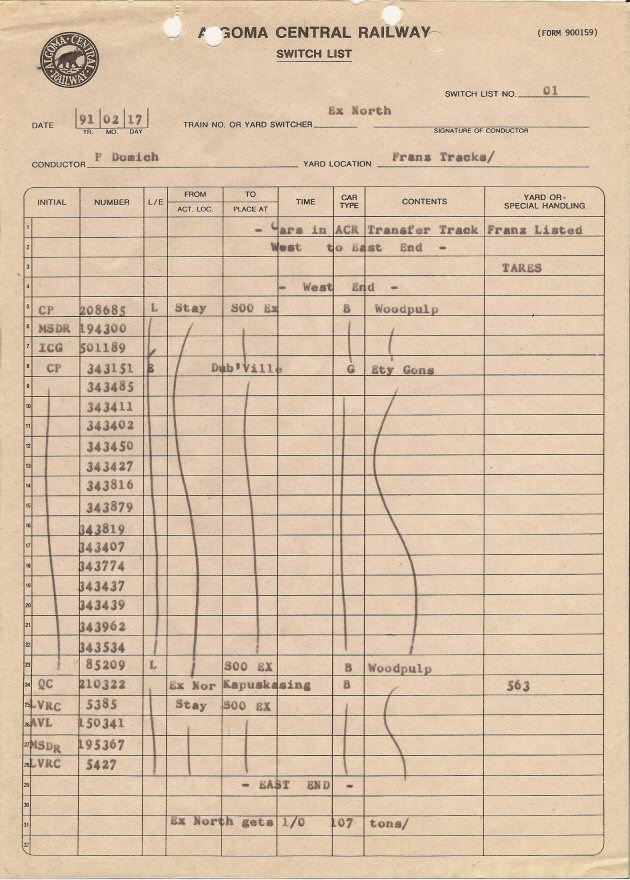
Some shipments of pulp from Marathon and Terrace Bay were also routed over the ACR to mills on the CN and Ontario Northland via Franz and Hearst. Scan of a switchlist at Franz, note one car of pulp (QC 210322) being lifted for Kapuskasing
There is also evidence that some shipments of paper and pulp from Kapuskasing (CN, now ONR) and Iroquois Falls (ONR) were routed via the ACR into the US (Wisconsin, Minneapolis & Chicago areas). Some westbound movements from Kaspuskasing or Cochrane may have also been routed via Hearst-Oba. CP traffic from Northern Ontario (Red Rock/Terrace Bay/Marathon/etc. to the US probably would have been handled via Sudbury and not over the ACR from Franz since the CP interchanged directly with SOO Line in Sault Ste. Marie.
There was a propane dealer (Canadian Propane) and a fuel dealer (Texaco Canada) in Wawa that were rail served. The Texaco spur is listed as out of service by 1986, and removed from the timetable by 1989, while Canadian Propane is still listed into the early 1990s. These two companies would have received occasional one-car shipments.
There were also a couple of fuel and propane dealers at Hearst that were rail-served, but cars for these would have come over CN from Cochrane.
Sulphuric acid is used in the paper making process for chemically pulping the pulpwood logs. Acid tank cars can be commonly seen in Sault Ste. Marie at the paper mill, and seem to mostly come in via CP/HCRY. INCO and Falconbridge (now XStrata) in Sudbury are major producers of suphuric acid and may be suppliers to St Marys Paper in the Sault. Some of this acid may also be export traffic from the Sudbury area to the midwest United States. Acid from the smelter at Rouyn-Noranda, QC on the Ontario Northland to midwest destinations also seems to route over the length of the ACR via Hearst.
Sodium hydroxide (caustic soda) and chlorine are also commonly used in the paper-making process.
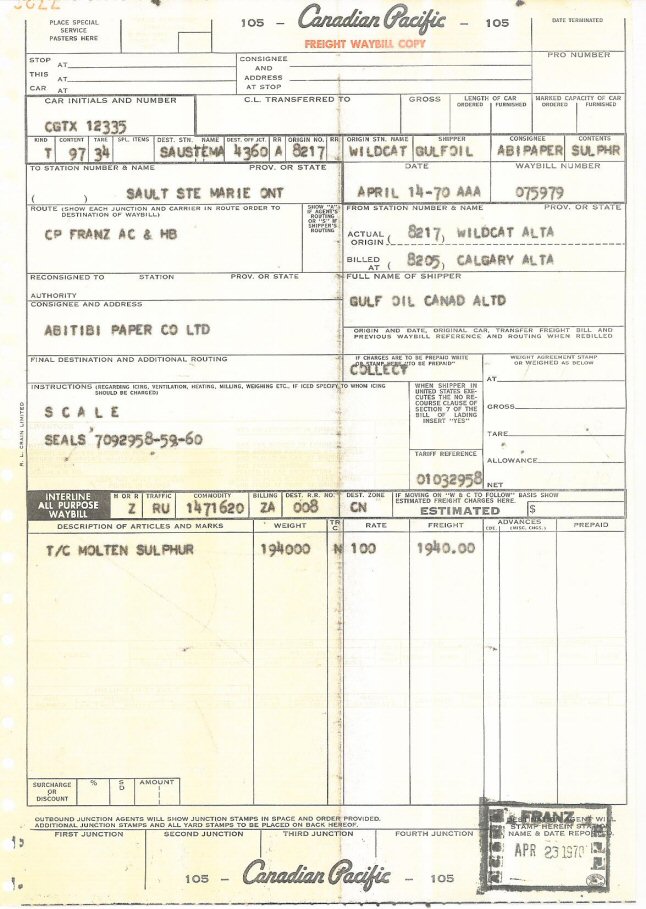
There's also a scan in the documents section of this site of a waybill for a tank car of molten sulphur destined for the paper mill in the Sault.
There may also have been uses for some acids and chemicals by the Algoma Steel mill, and anything in or out of the steel mill would have been handled by the AC.
Clay slurry from the southern United States would be shipped into the paper mill in Sault Ste. Marie for use in making high quality coated papers. Today this mostly comes in from CN over the former WC lines, and probably would have arrived via SOO Line or CP (Sudbury) in the 1980s. Some clay may have also been sourced from the east, or from Canadian sources, especially pre-free trade agreements.
In 1999 a new potash mine mine owned by Agrium went into service at the end of a new branch near Opasatika on the Ontario Northland's former CN Kapuskasing subdivision, east of Hearst. Much or all of this traffic is routed west to Manitoba over the CN and heads over the former ACR tracks from Hearst to Oba from where it heads westward. This operation shut down again around 2010.
Some shipments of paper (from Iroquois Falls) and metal products (from Timmins or Rouyn-Noranda) from the Ontario Northland Railway to central/midwest US destinations were routed over the ACR from Hearst to Sault Ste. Marie for interchange with SOO Line (later WC). Some paper products from Kapuskasing heading west may have also travelled over portions of the Algoma Central, although prior to the 1980s, when the CN Pagwa Subdivision from Heart to Nakina was still in place, any such traffic could have been handled by mixed trains 272/273.
This page © 2002-2005 Chris VanderHeide