




| I am sitting at my desk typing this article for the "Railway Flyer." Nearby, my scanner is turned on and tuned into the Niagara Frontier railroad scene as it channel surfs the airwaves for the human and computer synthesized voices vital in keeping train movement fluid in the switching yards, and on the mainline. My "train" of thought is momentarily interrupted as the hot box/ dragging equipment detector is activated. The computer synthesized voice saying, "Conrail...Bay View... New York...track one...no defects...total axle count...76...train speed...75 ..over." In less then a minute I will hear the sound of the air horn as an Amtrak Passenger train roars past the Bay View Road grade crossing before rounding the curve as it heads eastbound towards Buffalo. The two-way radio conversation between the dispatcher and engineer increases as he announces that he is "Coming by the Bay!" It is here that our symbol freight train is leaving the jurisdiction of the Cleveland east dispatcher some 200 miles away in Pittsburgh, and entering the Buffalo terminal dispatchers territory which is monitored by computer some 300 miles distant in Selkirk, New York just south of Albany. It is here in Selkirk, that the Buffalo mainline dispatcher has charge of the area east of Buffalo while the Niagara Branch dispatcher monitors the area north to Niagara Falls, Lockport and the belt line in the city of Buffalo. As our conversation between the Buffalo terminal dispatcher and engineer of our eastbound symbol freight continues, the dispatcher determines if any cars need to be set out or picked up at either seneca yard or frontier yard, if any problems encountered enroute need to be taken care of, and where this train crew will be stopping the train for a crew change before proceeding east. While all this is taking place, the hot box/ dragging equipment detector is activated at Lancaster, New York by a westbound Amtrak train some four and one-half miles out from the passenger station at Depew, New York. This is the 1996 world of centralized traffic control! What centralized traffic control or "CTC" does is enable a dispatcher at a distant point to monitor train movements in his or her jurisdiction using a computer. The dispatcher sees a diagram of the available routes on a double-track railroad. He or she selects the route option, switches at control points are electrically locked in place, and signals displayed indicating if any traffic is ahead. If a problem does occur that may impede the dual direction of traffic, the dispatcher can take decisive action and keep everything moving with little delay. The train crews are also the eyes of the dispatcher as they can relay information that the dispatcher may be totally unaware of miles away such as weather conditions and traffic congestion around major cities and freight terminals. In an age when steam locomotion was at its zenith and diesels would be coming into its own, it was the signal tower operator, the ever vigilant sentry in his outpost of civilization who kept the trains on schedule as they passed in constant procession day and night hurtling toward their destination. "At one time, interlocking towers were strung around the North American railroad network like pearls on an endless string." Originally called block or signal towers, they sheltered mechanical equipment that controlled signals and switches: telegraphs and other communication devices: and the tower operators. They have been part of the railroad landscape since the early 1850's, when railroads began using the telegraph to keep track of train locations. Over the following decades, as other devices for controlling rail traffic were invented, these four-square, two-story structures continued to multiply. They were built generally of wood or brick, architecturally unremarkable, and hardly tall enough to be called a "tower." Most had unfussy, two-letter names derived from their telegraph call names, which were in turn derived from the location. They stood alone in remote locations-mountains, prairies, the "Great American Desert", in the middle of the country, the swampy bayous of Louisiana, and the wilderness of Idaho. ref. 1 In 1919 there were an estimated 5,300 interlocking signal towers in the united states, on the New York Central they were called "signal stations;" quite a number of them could be seen along the 960.7 mile right of way that was divided into nine divisions between grand central terminal in New York city and Lasalle Street Station in Chicago, Illinois. The Erie division, 163 miles in length between Bay View, New York and the Cleveland, Ohio outskirts, had a total of 19 signal stations which were open 24 hours a day. They included bay view (BV), Lake View (RD), Angola (NA), Silver Creek (MN), Dunkirk (X), Canadaway (CA), Westfield (WX), North East (N), Wesleyville (WV), P & E Crossing (XC), Dock Junction (DJ), Girard Junction (GJ), Amboy (J), Ashtabula, J & F Crossing (OD), West Tower (W), Madison (OX), Painesville, B & 0 Tower (AF), Willoughby (SW), B.R. Tower (BR). |
 "©1992 Aaron Heverin - BV Tower 1990's - Click to Enlarge (10K)-(100K)") |
The focus of our story is Bay View tower "BV" located 445 .79 miles west from grand central terminal and 8.77 miles west of Buffalo Central Terminal. Chicago is 513.37 miles to the west. Bay View tower long abandoned for some 30 plus years until its demolition by Conrail in 1995, was a local area landmark for Western New York railfans in the town of Hamburg, New York just to the west of Bay View road. |
 "©1980's - BV Tower 1980's - Click to Enlarge") |
In 1923, the New York Central Railroad built a concrete and brick interlocking signal station at Bay View, New York, replacing the original wooden signal station dating back to 1898 and completion of the Buffalo Terminal Railway better known as the "Gardenville Branch. |  "©1992 Aaron Heverin - BV Tower 1990's - Click to Enlarge (10K)-(100K)") |
| It was one of the special ones! It was here that depending on your direction of travel it was the demarcation between lines east/west of the New York Central & Hudson River railroad and the Lake Shore & Michigan Southern railroad which merged to form New York Central lines in 1914. Other railroads, notably the Boston & Albany, Big Four, and Michigan Central were subsequently leased to the New York Central which became known as the New York Central System in 1935. Bay View tower was the demarcation between the Buffalo terminal division and the Erie division; there was a connecting track between the New York Central and the Nickel Plate Road, which was used as a bypass if traffic had to get around a derailment. It was in the vicinity of Bay View tower that the eastbound and westbound "20th Century Limiteds" often running in several sections passed in the night, and finally Bay View tower controlled the access to and from the Gardenville branch! The City of Buffalo's emergence as the nation's second largest railroad center after Chicago, Illinois based on the amount of freight cars interchanged and the through traffic passing through on a daily basis was evident by the early 1890's. There was rumor of constructing a by-pass around the city of Buffalo to alleviate yard congestion and speed-up travel. Preliminary survey work had taken place in 1892, but not much else was done while congestion in he western end of the state was worsening. "One of the greatest undertakings in railway circles completed during the past year (1898), and one that means a great deal to the railway companies operating between New York and Chicago, has been the construction of the Buffalo Terminal Railway, a line built exclusively for the purpose of making a savings of some six hours in the shipment of freight between Chicago and New York." ref. 1 To railway men this was a great deal more than can be imagined by the uninitiated. In a word it means that instead of being compelled to bring all through freight into Buffalo and through the yards here, The trains will take the new line at Blasdell (Bay View) and cut across the county to Depew, New York. Heretofore the cars were brought into the yards and owing to the great congestion of traffic were sidetracked here and many hours of very valuable time lost. It is the completion of an idea long since decided upon as the only way of solving the problem of rapid transit between America's two great centers, and railway men long ago came to the conclusion that some new way of getting freight through to Chicago had to be devised, and as the only obstacle in the way was the delay at Buffalo, it was determined that the useless run into the city and all the extra work attending it would have to be cut out. A new road was the only possible solution and now that it is completed its value will be appreciated. Next to the grade crossing improvement in Buffalo it is the most important work of railway construction that has bee done in this end of New York State in years. The road runs from Blasdell (Bay View), where it connects with the Lake Shore road, and runs in an almost direct line to Buffalo's growing railway and industrial suburb of Depew. There it connects with the New York Central as stated, the road was built to eliminate the necessity of hauling lake shore through freight trains into the city and then taking them out again over the Central. The congestion at East Buffalo from this unnecessary work has in times past been very great, and there will be an immense saving in time and to the roads as a result of the building of the terminal. Entering the city of Buffalo from the east and south are ten railroads, whose sole method of interchange of business in the past has been through cramped yards, over-burdened connecting tracks, and across busy grade street crossings. These undesirable conditions have caused both delay and expense in the movement of freight traffic, and have been distasteful to the public, owing to the smoke, noise, and danger incident to grade crossings. To eliminate these faults, the Terminal Railway of Buffalo was incorporated June 12, 1895 to construct a double track railroad from the New York Central and Hudson river railroad at Depew, to the Lake Shore & Michigan Southern railway at West Seneca (Lackawanna), intersecting the railroads and radiate easterly and southerly from the City of Buffalo. A "certificate of necessity" for the construction of the road was granted by the board of railroad commissioners, August 6, 1895, and the location of the final line was laid out by the engineers, and negotiations commenced for the acquisition of the right of way. Owing to the high priced character of the property on the outskirts of the city of Buffalo, the large number of separate parcels of land affected about eighty one in all. The number of steam and electric railways intersected, progress in acquiring the necessary lands and crossing contracts was slow, and actual construction was not commenced until July 13, 1897. While the route laid out encountered few natural obstacles, the necessity for crossing over and under the numerous trunk line railroads, electric railways and highways, without obstructing regular traffic gave rise to problems both expensive and difficult to solve. The line was finally completed and opened for operation September 20, 1898. The general route and profile, and the character of the construction are briefly described as follows: Leaving the main line of the New York Central & Hudson river (s.s. 46) on the north side of the freight tracks east of the transit road at Depew, the line runs in a westerly direction parallel and adjacent to the New York Central & Hudson river railroad, crosses over the Tonawanda branch of the Lehigh Valley railroad, and then descending on a grade of 52.8 feet per mile, turns southwesterly and passes under the New York Central & Hudson river railroad, Delaware, Lackawanna & Western railroad, Lehigh Valley Railroad and Broadway. This portion of the line involved the removal of 125,000 cubic yards of excavation, and the construction of six masonry and steel bridges. The larger portion of the excavated material was transported to Depew, for which a temporary standard gauge railroad ten miles in length was constructed. Thence the line continues southwesterly crossing over Cuyahoga Creek, Slate Bottom Creek and Buffalo Creek, to the intersection at grade of the Western New York & Pennsylvania Railroad, at which latter point an interlocking signal plant (signal station GJ) has been erected. Thence the line runs southwesterly, crossing under the highway known as Central Road, Seneca Plank Road, over Casanovia Creek and north fork of Smoke's Creek to the crossing of the Buffalo, Rochester & Pittsburgh railway. This railroad was raised eighteen feet to permit an undercrossing for the Terminal Railway of Buffalo. Thence the line crosses the south fork of Smoke's Creek, passes under the White's Corners Road, over the Hamburg Electric Railway, Western New York & Pennsylvania Railroad, Nickel Plate Line, Erie Railroad, Lake Shore & Michigan Southern Railway, and drops down a grade of forty feet per mile into the West Seneca yard of the Lake Shore & Michigan Southern Railway. This latter portion of the line involved the placing of over 200,000 cubic feet of embankment. The West Seneca yard of the Lake Shore & Michigan Southern railroad has been laid out with ample trackage, engine house facilities etc., For prompt handling the large amount of interchange business with the New York Central & Hudson River Railroad. The total distance from the Depew connection to the West Seneca yard is eleven and one half miles. The line has been built in the most substantial and permanent manner, with steel bridges, cast iron pipe culverts, masonry abutments and piers, woven wire fences, white oak ties, steel rails at eighty pounds per yard, and gravel ballast. The following quantities of material, in round numbers were used in the construction of the line, including the New York Central connection at Depew, and the raising of the track of the Buffalo, Rochester & Pittsburgh railway: 50,000 cubic yards of earthwork; 15,000 cubic yards of masonry of all classes: 12,500 linear feet of piling in foundations: 4,000,000 pounds of steel bridging, including thirty two spans: 186,000 pounds of cast iron in culverts, 2,000 tons of steel rails: 64,000 oak ties: 70,000 cubic yards of gravel ballast. The total cost of the line, in round figures, including connections, may be stated at $1,000,000. The value of this enterprise to the two railroads chiefly interested, the New York Central & Hudson River Railroad, and the Lake Shore & Michigan Southern railway, is already proved by the saving of six hours time in the shipment of through freight between New York & Chicago. The contractors for the construction were as follows: roadbed, George E. Smith & Co., Detroit, Michigan, later succeeded by the National Surety Company of New York: masonry, the J.L. Fulton company of Chicago, Illinois: steel bridges, Pennsylvania Steel Company, Elmira Bridge Company, Shifter Bridge Company, and the Buffalo Bridge & Iron Works: fencing, Page Woven Wire Fence Company, Adrian Michigan. The work was designed and executed under supervision of "Willam J. Wilgus" chief engineer, and C.J. Coon, assistant engineer. ref. 2 As a side note of interest, on April 29, 1914, the consolidation of the New York Central & Hudson river railroad and the Lake Shore & Michigan Southern Railroad forming New York Central Lines lists the Terminal Railway of Buffalo board of directors at that time as Chauncey M. Depew, Frederick w. Vanderbilt, William H. Newman, William K. Vanderbilt, Jr., Alfred H. Smith, and William Rockefeller. ref. 3 Already in 1918, Bay View Tower was a hotbed of rail activity as the New York Central listed 56 trains passing by this spot in a twenty-four hour time period. Its not known how many freight trains were operated along the adjacent parallel joint trackage of the Pennsylvania Railroad and New York, Chicago, & St. Louis Railroad (Nickel Plate Road), but the Nickel Plate operated six passenger trains daily as did the Pennsylvania Railroad. In this article and the concluding article we will see how the number of trains dramatically increases at key time periods in future decades by using employee timetables. |
| THE NEW YORK CENTRAL RAILROAD COMPANY ERIE DIVISION - ETT 6-A - January 1st, 1918 | TIME | TRAIN | NAME/DESCRIPTION | DIRECTION | FREQUENCY |
|---|---|---|---|---|
| 12:05AM | BF-1 | NEW YORK-GARDENVILLE-ST. LOUIS | WEST | TUESDAY-SUNDAY |
| 12:15AM | NY-4 | CHICAGO-GARDENVILLE-NEW YORK | EAST | DAILY |
| 12:27AM | #41 | NEW YORK-BOSTON-CHICAGO SPECIAL | WEST | DAILY |
| 12:40AM | BFNY4 | INDIANAPOLIS-GARDENVILLE-NEW YORK | EAST | DAILY |
| 12:40AM | KB-2 | COLLINGWOOD-WEST SENECA | EAST | DAILY |
| 1:20AM | #11 | SOUTHWESTERN LIMITED | WEST | DAILY |
| 2:52AM | #16 | NEW YORK-NEW ENGLAND EXPRESS | EAST | DAILY |
| 3:17AM | #19 | THE LAKE SHORE LIMITED | WEST | DAILY |
| 3:47AM | #21 | CLEVELAND LIMITED | WEST | DAILY |
| 5:35AM | #64 | CHICAGO-BUFFALO SPECIAL | EAST | DAILY |
| 5:43AM | #18 | KNICKERBOCKER SPECIAL | EAST | DAILY |
| 5:53AM | #22 | THE LAKE SHORE LIMITED | EAST | DAILY |
| 6:15AM | #600 | EXPRESS | EAST | TUESDAY-SUNDAY |
| 6:35AM | LS-1 | NEW YORK-GARDENVILLE-CHICAGO | WEST | TUESDAY-SUNDAY |
| 6:48AM | #23 | WESTERN EXPRESS | WEST | DAILY |
| 7:05AM | #606 | ERIE ACCOMMODATION | EAST | MONDAY-SATURDAY |
| 7:32AM | #35 | SPECIAL MAIL LIMITED | WEST | DAILY |
| 8:10AM | #27 | AMERICAN EXPRESS | WEST | TUESDAY-SUNDAY |
| 8:25AM | LS-3 | BOSTON-GARDENVILLE-CHICAGO | WEST | TUESDAY-SUNDAY |
| 9:17AM | #20 | NEW YORK CENTRAL LIMITED | EAST | DAILY |
| 9:17AM | #81 | PITTSBURGH-BUFFALO SPECIAL | WEST | DAILY |
| 9:20AM | BS-3 | BUFFALO-WEST SENECA-CLEVELAND | WEST | DAILY |
| 9:45AM | #47 | EXPRESS | WEST | TUESDAY-SUNDAY |
| 10:15AM | WS-4 | ELKHART-GARDENVILLE | EAST | DAILY |
| 11:00AM | WS-74 | BIG FOUR-GARDENVILLE | EAST | DAILY |
| 11:28AM | #60 | CLEVELAND-BUFFALO SPECIAL | EAST | DAILY |
| 12:37AM | #X-43 | FAST MAIL | WEST | TUESDAY-SUNDAY |
| 12:42AM | #43 | ST. LOUIS-CHICAGO EXPRESS | WEST | DAILY |
| 1:17PM | #37 | PACIFIC EXPRESS | WEST | DAILY |
| 1:20PM | WAY FREIGHT ERIE-WEST SENECA | EAST | MONDAY-SATURDAY | |
| 1:40PM | #28 | NEW YORK EXPRESS | EAST | DAILY |
| 2:41PM | #82 | PITTSBURGH AND BUFFALO LIMITED | EAST | DAILY |
| 3:10PM | THROUGH LOCAL ERIE-WEST SENECA | EAST | MONDAY-SATURDAY | |
| 3:13PM | #X-28 | EXPRESS | EAST | TUESDAY-SUNDAY |
| 3:40PM | #605 | ERIE ACCOMMODATION | WEST | MONDAY-SATURDAY |
| 3:53PM | #32 | FAST MAIL | EAST | DAILY |
| 4:51PM | #83 | EMPIRE LIMITED | WEST | DAILY |
| 6:00PM | WAY FREIGHT BUFFALO-ERIE | WEST | MONDAY-SATURDAY | |
| 6:32PM | #3 | NEW YORK-CHICAGO SPECIAL | WEST | DAILY |
| 7:02PM | #65 | EXPRESS | WEST | DAILY |
| 7:32PM | #44 | CLEVELAND-NEW YORK SPECIAL | EAST | DAILY |
| 8:02PM | #5 | BUFFALO-CHICAGO SPECIAL | WEST | DAILY |
| 8:05PM | #2 | FAST MAIL | EAST | DAILY |
| 8:30PM | #4 | NUMBER FOUR | EAST | DAILY |
| 9:08PM | #84 | EMPIRE LIMITED | EAST | DAILY |
| 9:20PM | THROUGH LOCAL WEST SENECA-ERIE | WEST | MONDAY-SATURDAY | |
| 10:03PM | #6 | NUMBER SIX | EAST | DAILY |
| 10:12PM | #9 | FAST MAIL | WEST | DAILY |
| 10:15PM | NY-6 | ST. LOUIS - NEW YORK | EAST | DAILY |
| 10:40PM | SB-4 | COLLINGWOOD-WEST SENECA | EAST | DAILY |
| 11:02PM | #26 | THE 20TH CENTURY LIMITED | EAST | DAILY |
| 11:10PM | #25 | THE 20TH CENTURY LIMITED | WEST | DAILY |
| 11:16PM | BA-4 | CHICAGO-GARDENVILLE-BOSTON | EAST | TUESDAY-SUNDAY |
| 11:17PM | #12 | NEW YORK AND BOSTON SPECIAL | EAST | DAILY |
| "This signal station with its 1923 cornerstone would become a landmark in the town of Hamburg, New York for railroad men, passengers, steam excursionists, and railfans for 72 years until it was torn down by Conrail in 1995. Its design was typical of the New York Central Railroad, but I don't know who designed the structure, who actually built it, or its exact date of opening. I do know however, that railroad traffic, both freight and passenger was booming during the early 1920's and the railroads were spending huge sums to upgrade and modernize their right-of-way. On September 22,1923, "The public service commission today approved the plans of the New York Central Railroad for the development of the connections between the West Shore tracks and its main line and Gardenville Branch in the town of Cheektowaga and the Village of Depew, Erie county, for the purpose of facilitating movements in the western part of the state." An item also appeared in Railway Age magazine, the September 22, 1923 issue which read. "The New York Central has ordered from the General Railway Signal Company an electrical interlocking machine, 41 working levers, for installation at Bay View, N.Y." |
 "©1980's - BV Tower's interlocking machine - 1980's - Click to Enlarge") |
In recent conversations with Mr. Gerald E. Toomey, WNYRHS member, and retired New York Central tower operator at Bay View, New York, 1950-1965, I was able to get an insight as to what was at the tower while it was in use. The first floor contained the signal relay and switching mechanisms for the switch machine located on the second level. Also on the first floor was an oil burning furnace which had replaced the original coal furnace as evident by the coal chute located on the outside wall facing westward. The second floor of bay view tower "BV" was the command center of operations. |
| Open twenty-four hours a day, there would be one tower operator on duty for each eight hour shift. There would be the familiar tower operator sitting at his desk in the window illuminated by a lamp. At his disposal was the telegraph, teletype, telephone, and speaker box with the dispatcher at Erie, PA., which was the CTC control point for the entire "Erie Division." Mounted on the roof and coming down past the overhang were wires connected to a signal light which displayed yellow for train orders, or displayed blue indicating car pickup or setout at Seneca Yard. |
 "©1980's - BV Tower tracks looking East - 1980's - Click to Enlarge") |
Outside of the tower, was the four track mainline. Numbered 4,2,1,3, going from east to west, tracks numbered 2 and 1 being the high-speed tracks, and tracks numbered 4 and 3 for slower traffic, as well as the connection to and from the Gardenville Yard. (see track chart insert). |  "©1980's - BV Tower tracks looking West - 1980's - Click to Enlarge") |
| There was also a manually operated switch immediately south of the tower which was used infrequently by both the Nickel Plate and Central as a bypass in the event or a derailment or some other unusual circumstance. In front of the tower were also high-speed crossover switch tracks to speed traffic along without any delays if congestion in and out of Buffalo or to and from the Gardenville Yard. |
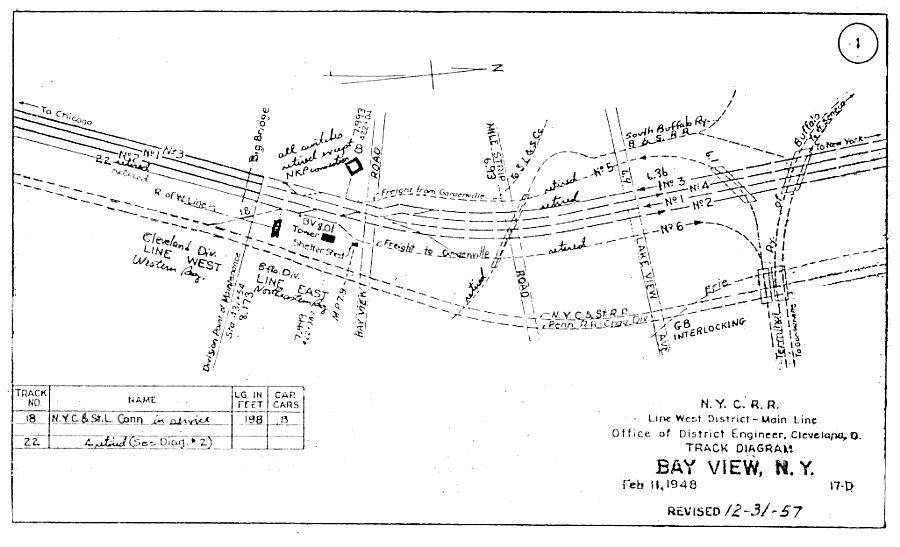 |
| Just northwest of "BV" Tower you can today see two telephone poles side by side with a crossbeam. It was here where a high-car detector device was placed after an incident in which an extra high vehicle on the top level of an autorack car was riding in the days before they were fully enclosed and it didn't quite make it under the Tifft Street highway overpass. Oops! By 1930, when the Bay View Tower that we remember was seven years old, there were within a twenty-four hour period 83 scheduled trains. Not counting extra sections of passenger trains, and the adjacent Nickel Plate and Pennsylvania Railroad traffic this meant over 100 trains crossing Bay View Road. Quite a traffic increase from 54 trains in 1918 and 67 trains in 1924. |
| THE NEW YORK CENTRAL RAILROAD COMPANY ERIE DIVISION - ETT #32 - September 28th, 1930 | TIME | TRAIN | NAME/DESCRIPTION | DIRECTION | FREQUENCY |
|---|---|---|---|---|
| 12:01AM | CB-2 | ENGLEWOOD-SENECA-EAST BUFFALO | EAST | DAILY |
| 12:01AM | NY-4 | CHICAGO-GARDENVILLE-NEW YORK | EAST | DAILY |
| 12:03AM | #26 | THE 20TH CENTURY LIMITED | EAST | DAILY |
| 12:11AM | #25 | THE 20TH CENTURY LIMITED | WEST | DAILY |
| 12:30AM | PWB-4 | PITTSBURGH-GARDENVILLE | EAST | DAILY |
| 12:30AM | ADV-NY6 | ST. LOUIS-EAST BUFFALO-NEW YORK | EAST | DAILY |
| 12:30AM | #15 | THE OHIO STATE LIMITED | WEST | DAILY |
| 12:43AM | #41 | THE CAYUGA | WEST | DAILY |
| 1:17AM | #10 | THE EASTERNER | EAST | DAILY |
| 1:40AM | #67 | THE COMMODORE VANDERBILT | WEST | DAILY |
| 2:32AM | #68 | THE COMMODORE VANDERBILT | EAST | DAILY |
| 2:52AM | #24 | THE KNICKERBOCKER | EAST | DAILY |
| 3:12AM | #7 | THE WESTERNER | WEST | DAILY |
| 3:28AM | #600 | RAILWAY EXPRESS | EAST | MONDAY-SATURDAY |
| 3:34AM | #11 | THE SOUTHWESTERN LIMITED | WEST | DAILY |
| 3:42AM | #142 | THE PRAIRIE STATE | EAST | DAILY |
| 4:06AM | #19 | THE LAKE SHORE LIMITED | WEST | DAILY |
| 4:15AM | GP-1 | GARDENVILLE-PITTSBURGH | WEST | DAILY |
| 4:30AM | BS-5 | GARDENVILLE-COLLINWOOD | WEST | DAILY |
| 4:30AM | NY-6 | ST. LOUIS-EAST BUFFALO-NEW YORK | EAST | DAILY |
| 4:34AM | X-19 | WEST | DAILY | |
| 4:40AM | #27 | CLEVELAND SPECIAL | WEST | DAILY |
| 4:45AM | SB-4 | COLLINWOOD-EAST BUFFALO-NEW YORK | EAST | DAILY |
| 4:45AM | BF-3 | NEW YORK-GARDENVILLE-St.LOULS | WEST | DAILY |
| 5:07AM | #21 | CLEVELAND LIMITED | WEST | DAILY |
| 5:10AM | #132 | EAST | DAILY | |
| 5:23AM | #22 | THE LAKE SHORE LIMITED | EAST | DAILY |
| 5:42AM | #72 | PITTSBURGH-BUFFALO EXPRESS | EAST | DAILY |
| 6:27AM | #18 | HUDSON RIVER EXPRESS | EAST | DAILY |
| 6:45AM | BT-1 | GARDENVILLE-TOLEDO | WEST | DAILY |
| 7:00AM | E-12 | LOCAL ERIE-EAST BUFFALO | EAST | MONDAY-SATURDAY |
| 7:30AM | E-1 | LOCAL GARDENVILLE-ERIE | WEST | MONDAY-SATURDAY |
| 7:33AM | #131 | WEST | TUESDAY-SUNDAY | |
| 7:38AM | #23 | WESTERN EXPRESS | WEST | DAILY |
| 7:46AM | #606 | BUFFALO ACCOMMODATION | EAST | MONDAY-SATURDAY |
| 8:36AM | #35 | WEST | TUESDAY-SUNDAY | |
| 8:55AM | #40 | NORTH SHORE LIMITED | EAST | DAILY |
| 9:08AM | #151 | INTERSTATE EXPRESS | WEST | DAILY |
| 10:20AM | #81 | PITTSBURGH-DETROIT SPECIAL | WEST | DAILY |
| 11:15AM | LS-3 | BOSTON-GARDENVILLE-CHICAGO | WEST | DAILY |
| 12:01PM | CW-10 | COLLINWOOD-GARDENVILLE-SYRACUSE | EAST | DAILY |
| 12:27PM | #60 | CLEVELAND BUFFALO SPECIAL | EAST | DAILY |
| 12:30PM | SB-2 | COLLINWOOD-SENECA | EAST | DAILY |
| 1:23PM | #43 | SOUTH SHORE EXPRESS | WEST | DAILY |
| 1:57PM | #56 | THE DEWITT CLINTON | EAST | DAILY |
| 2:30PM | E-4 | LOCAL ERIE-GARDENVILLE | WEST | MONDAY-SATURDAY |
| 3:18PM | #137 | RAILWAY EXPRESS | WEST | TUESDAY-SUNDAY |
| 3:47PM | #82 | PITTSBURGH AND BUFFALO LIMITED | EAST | DAILY |
| 4:10PM | #32 | EAST | DAILY | |
| 4:15PM | #128 | RAILWAY EXPRESS | EAST | DAILY |
| 4:30PM | NY-8 | GIBSON-GARDENVILLE-NEW YORK | EAST | DAILY |
| 4:38PM | #83 | EMPIRE STATE EXPRESS | WEST | DAILY |
| 4:52PM | #605 | ERIE ACCOMMODATION | WEST | MONDAY-SATURDAY |
| 5:00PM | PB-10 | YOUNGSTOWN-GARDENVILLE | EAST | DAILY |
| 5:02PM | #52 | CHICAGO-BUFFALO EXPRESS | EAST | DAILY |
| 5:34PM | #91 | FOREST CITY SPECIAL | WEST | DAILY |
| 5:48PM | #9 | WEST | TUESDAY-SUNDAY | |
| 6:00PM | KB-10 | COLLINWOOD-SENECA | EAST | DAILY |
| 6:07PM | #612 | LAKESIDE | EAST | MONDAY-SATURDAY |
| 7:00PM | BF-NY4 | ST. LOUIS - GARDENVILLE - NEW YORK | EAST | DAILY |
| 7:00PM | GP-3 | GARDENVILLE - PITTSBURGH | WEST | DAILY |
| 7:44PM | #3 | CLEVELAND EXPRESS | WEST | DAILY |
| 8:35PM | NY-10 | CHICAGO - GARDENVILLE | EAST | DAILY |
| 8:52PM | #44 | BUFFALONIAN | EAST | DAILY |
| 9:07PM | #150 | INTERSTATE EXPRESS | EAST | DAILY |
| 9:08PM | #607 | RAILWAY EXPRESS | WEST | MONDAY-SATURDAY |
| 9:15PM | BS-3 | GARDENVILLE - CLEVELAND | WEST | DAILY |
| 9:18PM | #5 | THE MOHAWK | WEST | DAILY |
| 9:23PM | X4 | FAST MAIL | EAST | DAILY |
| 9:30PM | XB-4 | ELKHART - EAST BUFFALO | EAST | THURSDAY - SUNDAY |
| 9:44PM | #4 | NEW YORK LIMITED | EAST | DAILY |
| 9:45PM | BF-1 | NEW YORK - GARDENVILLE - ST. LOUIS | WEST | DAILY |
| 10:08PM | #39 | NORTH SHORE LIMITED | WEST | DAILY |
| 10:15PM | #84 | EMPIRE EXPRESS | EAST | DAILY |
| 10:20PM | XN-2 | CHICAGO - EAST BUFFALO - NEW YORK | EAST | DAILY |
| 10:35PM | #6 | FIFTH AVENUE SPECIAL | EAST | DAILY |
| 10:45PM | ED-10 | COLLINWOOD - GARDENVILLE - DEWITT | EAST | DAILY |
| 11:00PM | PS-10 | YOUNGSTOWN - SENECA | EAST | DAILY |
| 11:09PM | #38 | ADVANCE 20TH CENTURY LIMITED | EAST | DAILY |
| 11:15PM | LS-1 | NEW YORK - GARDENVILLE - CHICAGO | WEST | DAILY |
| 11:27PM | #37 | ADVANCE 20TH CENTURY LIMITED | WEST | DAILY |
| 11:38PM | #12 | THE SOUTHWESTERN LIMITED | EAST | DAILY |
| BAY VIEW "BV" Tower was also synonymous with one of the greatest spectacles in the annals of railroading, as it was here that the "Greatest Train in the World", both Eastbound and Westbound, sections of the "20TH CENTURY LIMITED" would "PASS IN THE NIGHT" as they sped toward their destinations in New York City or Chicago. First inaugurated on June 15, 1902, it had gone through numerous schedule changes until its demise on December 3, 1967. The era between November 1912 and April 1932, had the Centuries scheduled to pass by the tower at 12:03 am eastbound and 12:11 am westbound with an eight minute interval in between. But, the Centuries often were ran in two and three sections in each direction. Sometimes, four or even five sections were not uncommon. On January 11, 1926, "The Century operated in seven eastbound sections and Detroiter in four eastbound sections in conjunction with the New York Auto Show." The New York Central railroad referred to the 60 minutes prior to departure from Grand Central terminal or LaSalle street station as "The Century Hour" as those paying a $10 surcharge would be arriving at the depot to check-in, and board the train while a flurry of redcap activity and photographers in search of celebrities ensued. This was no ordinary train, but the flagship of "The Great Steel Fleet," and to be a patron of this extra-fare, extra-service train was a status symbol of its day from the ordinary businessman to those making the news headlines. You had arrived! Bay View tower had its own "Century Hour" as nothing else was scheduled between 12:03 and 12:30 a.m. You can almost visualize a hot summer night in 1930 as the air is warm with little breeze coming off the lake as this beacon of civilization near a dimly lit country road waits in anticipation. The switches are aligned, the telegraph is silent. Outside the only sound is that of a cricket and a bullfrog in the nearby ditch. The bell rings signaling the approach of a train! The adrenaline is flowing! The headlight of the first section pierces the night as the whistle blares for the bay view road crossing. The second and third sections follow about a minute apart each with green flags flying. You get a glimpse of the illuminated open platform observation cars as they pass by with their red marker lamps and lit blue and white tail signs "20th Century Limited." You hear the third eastbound section blow his whistle at Milestrip road crossing around the bend as he salutes the first westbound section which will shortly come into view. Two more will follow behind him. Indeed, this was Bay View. In the ensuing years, the century would be streamlined in 1938, and later again in 1948. According to NYC Ett #57 issued 06/27/1943 at the height of World War II eastbound #26 passed Bay View Tower at 1:05 am and #25 westbound passed at 1:30 a.m. NYC Ett #76 issued 09/26/1954 showed the times as #26 eastbound at 1:21 am, and 1:43 am westbound for #25. By 1964, NYC Ett #16 "Lake Division" formerly "Erie Division" indicated the times past Bay View as #26 eastbound at 1:37 am, and #25 westbound at 1:45 am. During the World War II years, Gardenville Yard continued to be of strategic importance in facilitating freight traffic and helping to win the war effort employee timetable #57 "Erie Division," dated June 27, 1943 showed that 11 of 12 westbound (scheduled) freight trains daily came over the Gardenville Branch by way of Bay View. The 12th westbound freight train being a Tuesday through Sunday run from east Buffalo to Cleveland. All freight traffic eastbound during this time 12 (scheduled), utilized the east Buffalo railyard. The 13th train was a (scheduled) Erie-Gardenville Tuesday through Sunday operation. In addition, there were 23 westbound and 23 eastbound (scheduled) passenger trains daily passing by Bay View or "BV" tower. This amounted to 71 trains in a twenty-four hour period! Its not known how many troop train or war material trains were operated daily as needed, but they could have easily boosted the total to around 100! By moving westbound freight traffic through Gardenville, and eastbound traffic through East Buffalo, the New York Central kept trains rolling with little chance of a bottleneck. In post-war Western New York in the late 1940's, Gardenville continued to be an important yard and bypass route around the city of Buffalo. "climaxing years of exhaustive tests, the New York Central railroad yesterday (march 19, 1947) placed in operation radio equipment permitting two-way communication between engine and train crews and the yardmaster at the Gardenville"hump." It marked the first installation of its kind on the central system and in Buffalo railroad yards. The hump yardmaster can talk directly to the engineer anywhere in the Gardenville yards" The diesel could be as far away as ten miles and still receive orders." In a preliminary test at Central Terminal, V.C. Chappell, engineer for the General Railway Signal Co., Rochester, seated in a station-wagon equipped with a portable set, succeeded in contacting the hump. He said "reception was very good." the wagon was parked on Curtiss Street. The test was significant because of the distance between the terminal and Gardenville. Quoting I.F. Nash, trainmaster regarding the first ever successful two-way radio communication with engineer Frank Shilling, "the communication system is one of numerous steps in a general modernization program to speed up operations on the railroad. One other diesel engine is nearly fully equipped, and three others are in the process of being equipped." call letters of the new system, licensed to operate on a frequency of 160.41 megacycles, are "WNYH." The equipment installed here by the Rochester firm is the result of tests conducted in the yards at Selkirk. Both Selkirk and the DeWitt yards will shortly have the two-way communication system in effect, we have come a long way in 50 years! On March 1, 1952, the New York Central railroad announced a $1,000,000 modernization program for Gardenville yard which would be completed in about one years time, included were a huge turning "Y" for diesel locomotives, a 1,000,000 million gallon fuel storage tank, fuel station, pump house, tracks for diesel storage, refueling, and inspection. Also included, was an inspection building and a 60 room, two-story "YMCA." By 1954, changes were taking place all along the New York Central railroad. ETT #76 "Erie Division" dated 09/26/54 listed 22 westbound and 21 eastbound passenger trains daily past Bay View "BV" tower. Thirteen westbound freights were scheduled all by way of Gardenville, and 13 eastbound freights were shown, of which 6 were by way of Gardenville. One of these eastbound symbol freight trains was "ON-2 Pacemaker" going past "BV" tower daily at 3 PM. In 1918 the "Erie Division" of the New York Central railroad had 19 interlocking signal stations between Buffalo and Cleveland. Technological advances in signaling and communications enabled the railroad to eliminate 4 of these towers during the 1930's. Gone were Lake View (RD), Silver Creek (MN), Canadaway-Brigham road (CA), North East (N), and Amboy (J). Girard Junction (GJ) remained open into the 1940's. The remaining 14 towers "open day and night" would last into the 1950's. There's an old adage, "nothing endures but change," this is especially true on the railroad. With Alfred E. Perlman elected president in 1954, the winds of change were blowing. During his tenure as president of the New York Central Railroad (1954-1968) Alfred Edward Perlman (1902-1983) had the formidable task of turning around a bankrupt, but didn't know it, railroad back into solvency. Alfred Perlman's credo was: "all it takes is common sense and modern equipment." ref. 1 He turned around Vanderbilt's paradise lost into a lean, aggressive plant He heretically substituted reverse-signaled CTC double track for Central's cherished four-track mains, introduced 70-mph Flexi-Vans to fight off truckers, sublimated the road's passenger orientation, replaced across-the-board rate hikes with marketing strategy, and defied politics who mistreated the rai1road . ref. 1 When Alfred E. Perlman took command of the New York Central presidency in 1954, he began the transformation of the road from a passenger-oriented line built essentially for nineteenth-century purposes into a lean physical plant. One of his first duties was to tour the property. The Central was more passenger orientated than he had realized. There were a dozen passenger stations the size of St. Patricks cathedral and just as costly to heat. The freight tracks on the main line, in poor repair and signaled for thirty miles an hour, were incapable of providing a competitive freight service. West of Buffalo, along the south shore of Lake Erie where the Central and Nickel Plate ran side by side, the Nickel Plate's short, fast freights went darting past the Perlman inspection train on their lean, well-signaled single track line in a dazzling display of technological superiority, an embarassment made even greater because they were pulled by steam locomotives. ref. 2 "Centralized Traffic Control with reverse signaling, allowing trains to move in either direction on either track, was installed on the main line between Cleveland and Buffalo in a pioneering application of CTC in high-density, high-speed territory. Two of the four tracks could now be removed and freight trains could roll on the fast passenger tracks. Improvements in service and reduction of maintenance costs were immediate." ref. 2 To see the difference before and after CTC was installed in 1957 between Cleveland and Buffalo all one has to do is compare Erie Division "Employee Timetable" #76 dated September 24, 1954. You had a four track main line with 12 interlocking signal stations which were opened and manned twentyfour hours around the clock. Here were the crossover tracks and levers in the tower to align the switches. These towers included: Bay View (BV), Angola (NA), Dunkirk (X), Westfield (WX), Wesleyville (WV), P&E Crossing (XC), Dock Junction (DJ), Ashtabula (OD), Madison (OX)i Painesville (AF), Willoughby (SW), and (BR) north of Collinwood, Ohio. On January 16, 1957, Alfred Perlman was the first to push the button at the Erie, Pa control center activating the world's longest stretch of electronically - controlled railroad at a cost of $6,238,460 which enabled one operator each shift to control the trains between Erie and Cleveland while another operator each shift controlled train movement between Erie and Buffalo, "Synchroscan" transmits train - control and train location indications. Controls are transmitted from the remote-control center in Erie in l to 2 seconds ... frequently-spaced, power operated track crossovers (remote interlockings) divert trains from one track to another on the two track speedway making use of sections of track that would otherwise be idle. By operating selector buttons and knobs at the control panel ... he can run fast express trains around slower freight trains or give prority to famous "named" trains that were in a hurry. ref. 2
"Coming By The Bay" is dedicated to John G. Frazer 1946 - 1996 for the FOOTNOTES
| ||||