




ORCHARD PARK DEPOT UPDATES
JANUARY 2001
Things We Accomplished in 2000
by Dave Peters - Depot Chairman
|
February 2001
| On Monday night, February 11th, an allegedly drunk driver lost control of her car and struck the depot, taking down two of the main roof supports on the portico. Luckily for us, Orchard Park resident, Douglas McFarland, happened on the scene and reported the incident to the police and they arrested the female driver at the scene. The portico support poles were destroyed and will have to be replaced. Emergency repairs were made that night and our Insurance Company is working on our claim. |
March 2001
| The center garden between the depot and the freight house has been started. The old broken curb has been dug up and steel rebard installed ready for spring finishing. This project was spearheaded by Mike Fitzsimmons. Thank you Mike! New electrlcal work is coming along. The donations we received are doing much good. We could use a few more dollars to help finish the new service to the electric pole. Spearheaded by Bob Reyenders. Thank you Bob! Our new window glass replacement project should be finished this year. |
April 2001
| The Orchard Park Depot crew has already been busy with the completion of the new underground electric service project. Through your generous donations, Bob Reyenders raised well over $1200 which was
enough to purchase the service wire. NYSE&G generously donated an electric pole and placed it in the ground at no charge to the Society. Work has also restarted on the garden project as well. The Farmers Market will be starting in May, we could use a little help. If you have a free Saturday that you lend a hand, please give me a call or email me. This makes some good money for the depot. There are a number of things to do and a lot of people to talk about the depot to. Any thing you can do will help. |
June 2001
| The electric service changeover has also been completed and all of our electric & phone service is now underground. The unsightly telephone pole next to the depot has been removed and you cannot believe how that has changed the appearance of the property. But by far, the biggest change has been the completion of the center garden curbing. On Tuesday, June 19th, a small gang of eager volunteers learned on the run how to pour a concrete curb, and the results were surprisingly good. All that is now left to do is to layout the electric conduit for the garden lighting, water sprinkler system, and backfill the garden oval. |
August 2001
| As this article is being written in early August, work is progressing on the Flower Garden at the Depot. On June 19th, the concrete forming the garden's perimeter was poured. The concrete was delivered
by United Materials Company and donated through the generosity of Mr. Dick Holmes. Thank you Mr. Holmes! The Village of Orchard Park on their part, contributed six truckloads of backfill on July 14. The only work left to be done is to bring in and spread the topsoil, install an automatic sprinkler system, and plant the flowers and shrubbery. This work should be done by the end of the month. Thank you to the following Society members who put in a lot of hard work and time to make this project a reality: Bud Benedict, Dave Fleenor, Mike Fitzsimmons. Joe Krezmien, Bob Reyenders, Dave Shuster, Roger Smith. Bob Snyder and Jim Szymanski. On July 4, 2001, the Western New York Railway Historical Society participated in the annual Village of Orchard Park Fourth of July parade marching down Baker Road and Route 20A to Lincoln Street. We got our walking exercise that day! |
September 2001
| On Sunday, September 16th, the restored center garden was dedicated to the Past, Present and Future Citizens of Western New York. Although this event was over shadowed by the tragic events of the 11th, those who did attend appreciated the sunny day and the beautiful garden. Many people made the restoration of the garden possible with their donations of money and several businesses donated materials. Many of our members donated numerous hours of their time. A special thanks to Roger Smith for pushing onward with the building of the forms and Bob Menninger for helping him, to Gary Ludwig for laying out the elevation and grade of the garden. Dave Fleenor, Jim Szymanski, Dave Schuster and Bud Benedict for helping to pour the concrete. And thanks to Bob Reynders for installing the garden electric and also Bob Snyder and Dave Peters for their constant help with the project and Art Toale who helped out at the start when we were digging by hand and the garden was more of a dream than reality. At the dedication, a few short speeches were given and I want to thank Joe, Bob and Dave for theirs. Also thank you to Mayor Dickman and Supervisor Cudney for their participati on in the ceremony. Sincerely, Mike Fitzsimmons. After a great deal of work Gary Ludwig has finished the repair and restoration of the baggage room doors on the track side of the Depot and made a silk purse from a sows ear. Gary will be systematically redoing all the doors of the depot. Hats off to Gary for a job we'll done! |
October 2001
| On October 10th, 2001, the Western New York Railway Historical Society, was pleased to learn it was selected as the third annual winner of the prestigious "TRAINS PRESERVATION AWARD" for 2001. The $10,000 award will be used to help the Society to organize, preserve and share its collection of railroad artifacts and ephemera. |
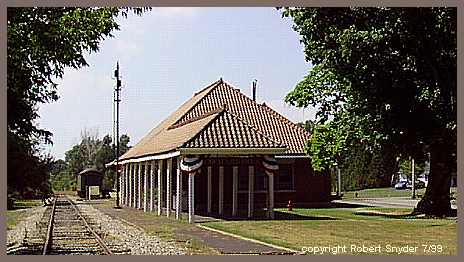
 "(c)1998 Robert Snyder - BR&P Freight House, built by the railroad in the H.H. Richardson style with its tapestry brick exterior and classic pagoda roof line. (10K) - CLICK to Enlarge") |
The the funds will be used to restore the original BR&P Freight House, which is one hundred feet west of the passenger station. It, like the passenger depot, was built by the railroad in the H.H. Richardson style with its tapestry brick exterior and classic pagoda roof line. The building itself is in very good condition for a 91 year old building. Thanks to Society member Mike Fitzsimmons' drive, the interior and exterior grounds will be returned to their original 1920's appearance. |
| The final goal is to have the freight house serve as a historical artifacts storage center. To accomplish this, over 500 boxes of railroad records, many from the New York Central, need to be stored in an organized manner. Two 40ft box cars will be brought in, and placed on panel track on the west end. In this picture, you can see the surveying stakes which identify where the track will be laid. |  "(c)2002 Robert Snyder - Surveying stakes identify where the track will be laid. (10K) - CLICK to Enlarge") |
 "(c)2002 Robert Snyder - Surveying stakes identify where the track will be laid. (10K) - CLICK to Enlarge") |
Rails and ties have been stocked next to the freight house in anticipation of grading and the arrival of ballast. Beyond the other end of the Freight House, the garden island has been restored and grass has been removed to restore the original wagon and buggy turn around next to the Depot. |
| The exteriors of the boxcars will be restored to their original road names, while the interiors will be fitted with paneling, shelving, lighting, climate and fire protection control and prepared to store the Societies archives. With the archives removed from the freight house, much needed room will be availible to museum displays and a society store. Work is progressing very nicely and the rails should soon be in place. Thanks to Robert Snyder, another member of the depot crew, for providing these pictures. Bob is also chairman of the Farmers Market, which is held every Saturday at the depot. Over 25 vendors show up, rain or shine to sell their produce to the Orchard Park Community. Please stop back to view our progress. And of course, another big Thank You to TRAINS Magazine for this award. A very nice article appeared in the December 2001 issue of Trains. |

Web Site Hosting by TRAIN WEB
The WNYRHS, Inc., 100 Lee Street, Buffalo, NY. 14210 is an independent organization and has no affiliation with any other local or national group.
The Society is a fully qualified organization under 501 (C) (3) of the Internal Revenue Code and all donations to the Society are tax deductible.
©Copyright 1999 , WNYRHS Inc. all rights reserved